
Judge, 1918-03-23 · page 19 of 32
Judge — March 23, 1918 — page 19: what you’re looking at
What you’re looking at
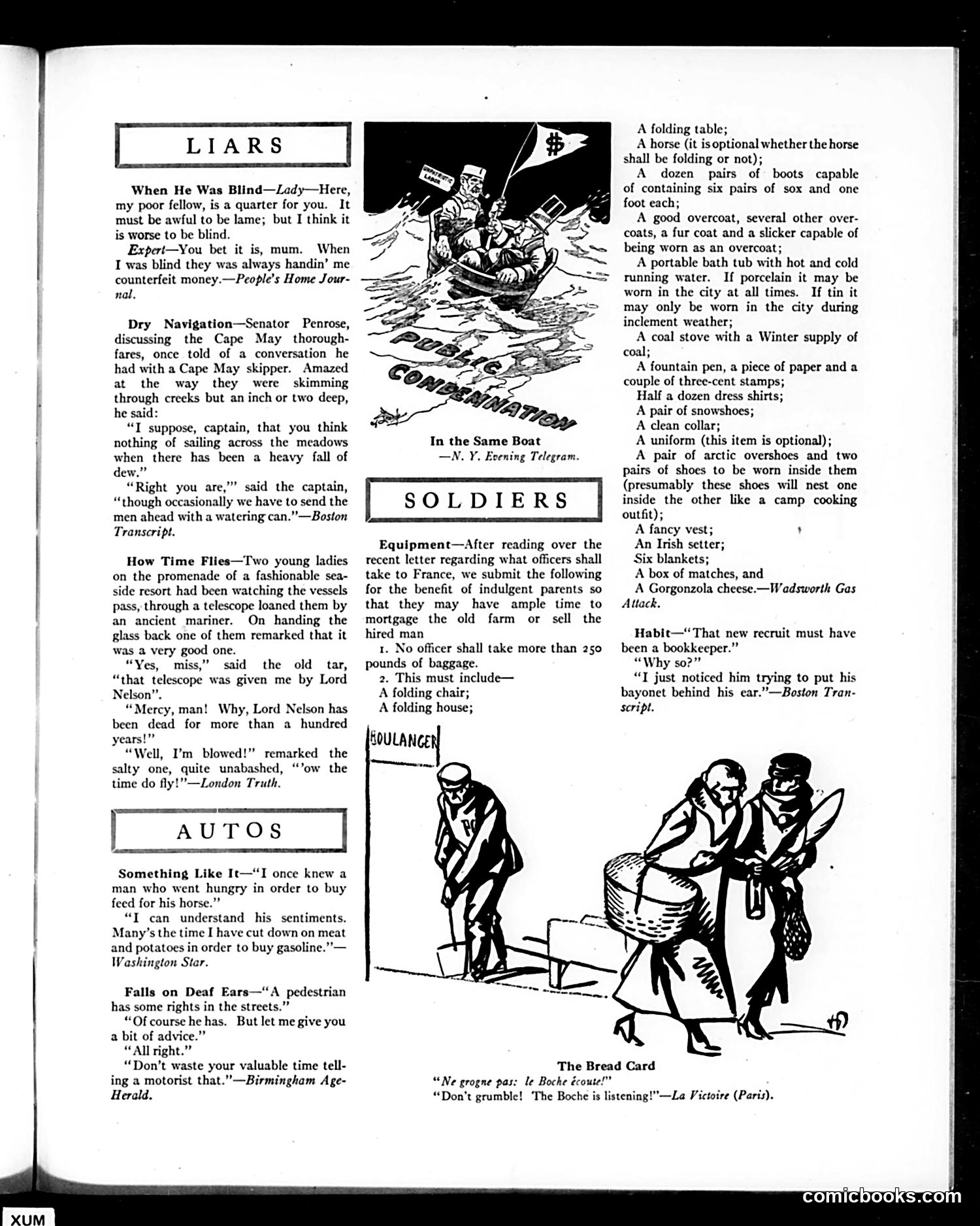
This Judge magazine page contains satirical humor from World War I era (likely 1917-18, given France deployment references). **"Liars" section**: Three brief jokes mocking exaggeration and tall tales—a blind beggar claiming counterfeit money, a sailor claiming a telescope from the long-dead Lord Nelson, and a sea captain joking about sailing through meadows during dew. **"Autos" section**: Humor about early automobile culture—men sacrificing food for gasoline, and motorists ignoring pedestrians' rights. **"Soldiers" section**: The main satire. Officers preparing for France face a 250-pound baggage limit, yet the list absurdly includes "folding" furniture (with a joke that a horse is "optional whether folding or not"), multiple coats, coal stoves, and a Gorgonzola cheese. This mocks military bureaucracy and officers' perceived entitlement. The recruit "bayonet behind his ear" jokes about bookkeeper habits. **"The Bread Card" cartoon**: Shows French rationing during wartime; the caption warns against complaining because "the Boche [German] is listening"—reflecting wartime propaganda and food shortages.
📄 Transcribed text from this page (OCR, searchable)
Machine-transcribed from the original scan — historical spelling and the odd misread are preserved.
XUM LIARS When He Was Blind—Lady—Here, my poor fellow, is a quarter for you. It must be awful to be lame; but I think it is worse to be blind. Expert—You bet it is, mum. When I was blind they was always handin’ me counterfeit money.—People’s Home Jour- nal. Dry Navigation—Senator Penrose, discussing the Cape May thorough- fares, once told of a conversation he had with a Cape May skipper. Amazed at the way they were skimming through creeks but an inch or two deep, he said: “T suppose, captain, that you think nothing of sailing across the meadows when there has been a heavy fall of dew.” “Right you are,” said the captain, “though occasionally we have to send the men ahead with a watering can.” —Boston Transcript. How Time Flies—Two young ladies on the promenade of a fashionable sea- side resort had been watching the vessels pass, through a telescope loaned them by an ancient mariner. On handing the glass back one of them remarked that it was a very good one. “Yes, miss,” said the old tar, “that telescope was given me by Lord Nelson”. “Mercy, man! Why, Lord Nelson has been dead for more than a hundred years!”” “Well, I’m blowed!” remarked the salty one, quite unabashed, “’ow the time do fly!” —London Truth. | AUTOS Something Like It—“I once knew a man who went hungry in order to buy feed for his horse.” “I can understand his sentiments. Many’s the time I have cut down on meat and potatoes in order to buy gasoline.””— Washington Star. Falls on Deaf Ears—“A pedestrian has some rights in the streets.” “Of course he has. But let me give you a bit of advice.” “All right.” “Don’t waste your valuable time tell- ing a motorist that.”—Birmingham Age- Herald. In the Same Boat —N. Y. Evening Telegram. | SOLDIERS Equipment—After reading over the recent letter regarding what officers shall take to France, we submit the following for the benefit of indulgent parents so that they may have ample time to mortgage the old farm or sell the hired man 1. No officer shall take more than 250 pounds of baggage. 2. This must include— A folding chair; A folding house; Foucanc Jaen. A folding table; A horse (it is optional whether the horse shall be folding or not); A dozen pairs of boots capable of containing six pairs of sox and one foot each; A good overcoat, several other over- coats, a fur coat and a slicker capable of being worn as an overcoat; A portable bath tub with hot and cold running water. If porcelain it may be worn in the city at all times. If tin it may only be worn in the city during inclement weather; A coal stove with a Winter supply of coal; A fountain pen, a piece of paper and a couple of three-cent stamps; Half a dozen dress shirts; A pair of snowshoes; A clean collar; A uniform (this item is optional); A pair of arctic overshoes and two pairs of shoes to be worn inside them (presumably these shoes will nest one inside the other like a camp cooking outfit); A fancy vest; ’ An Irish setter; Six blankets; A box of matches, and A Gorgonzola cheese.—Wadsworth Gas Allack. Habit—“ That new recruit must have been a bookkeeper.” “Why so?” “TI just noticed him trying to put his bayonet behind his ear.”—Boston Tran- script. The Bread Card “Ne grogne pas: le Bocke écoute!” “Don’t grumble! The Boche is listening!"—La Victoire (Paris).