
Judge, 1918-03-23 · page 15 of 32
Judge — March 23, 1918 — page 15: what you’re looking at
What you’re looking at
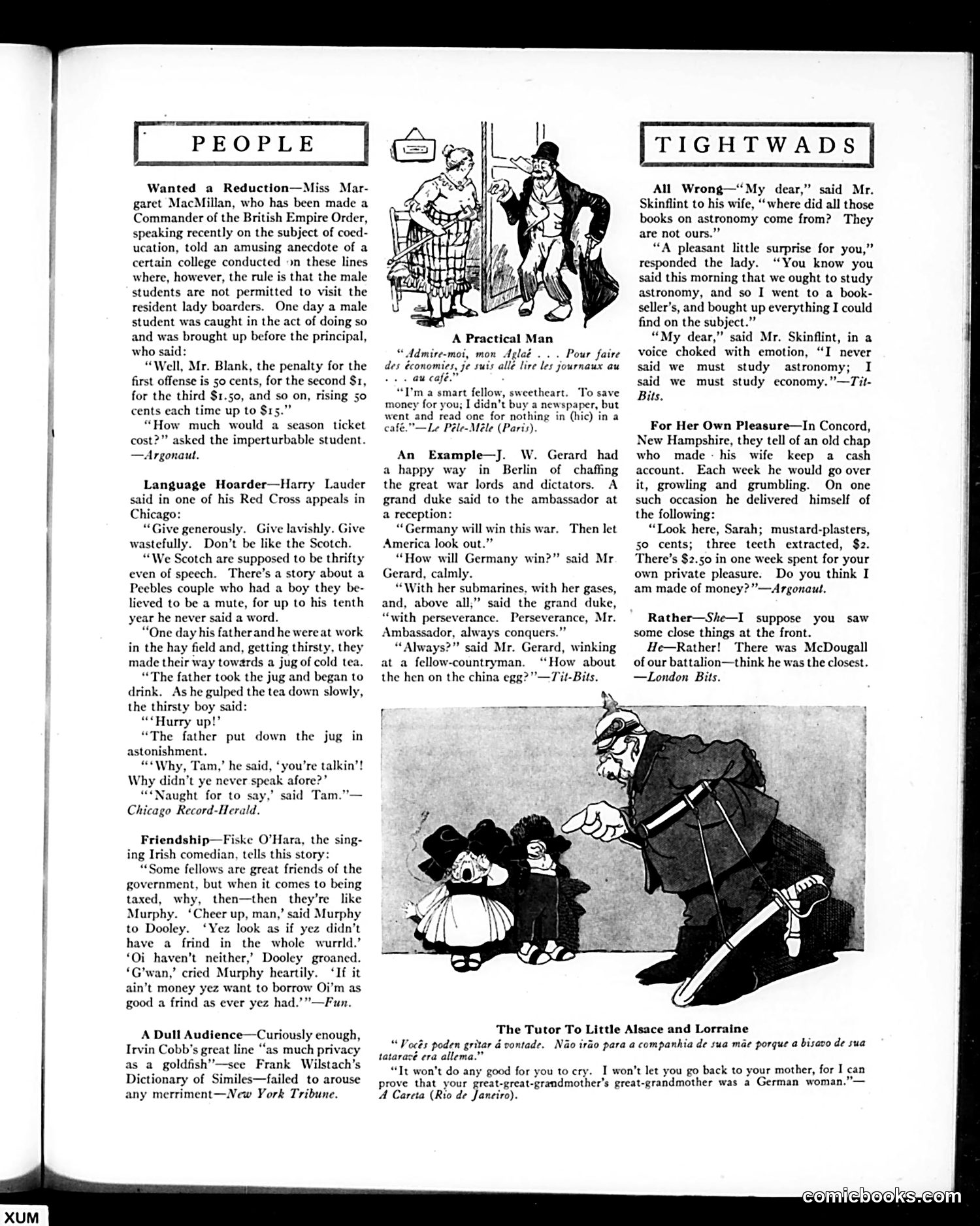
This page contains humorous anecdotes and a cartoon from *Judge* magazine. The main visual shows "The Tutor To Little Alsace and Lorraine"—a stern figure forcibly instructing two small children labeled as French territories. The caption references a German quote, satirizing Germany's harsh treatment of occupied French regions (Alsace-Lorraine) during WWI. The tutor's aggressive posture and the children's distress critique German militarism and imperialism. The text stories mock various social behaviors: miserly husbands, Scottish thriftiness, government hypocrisy about taxation, and marital finances. References to "J. W. Gerard" appear to relate to WWI-era diplomatic commentary. Overall, the page reflects early 20th-century concerns about war, class economics, and gender relations in marriage, using light satire and ethnic stereotypes typical of the era.
📄 Transcribed text from this page (OCR, searchable)
Machine-transcribed from the original scan — historical spelling and the odd misread are preserved.
[ PEOPLE | Wanted a Reduction—Miss Mar- garet MacMillan, who has been made a Commander of the British Empire Order, speaking recently on the subject of coed- ucation, told an amusing anecdote of a certain college conducted on these lines where, however, the rule is that the male students are not permitted to visit the resident lady boarders. One day a male student was caught in the act of doing so and was brought up before the principal, who said: “Well, Mr. Blank, the penalty for the first offense is 50 cents, for the second $1, for the third $1.50, and so on, rising 50 cents each time up to $15.” “How much would a season ticket cost?” asked the imperturbable student. —Argonaut. Language Hoarder—Harry Lauder said in one of his Red Cross appeals in Chicago: “Give generously. Give lavishly. Give wastefully. Don’t be like the Scotch. “We Scotch are supposed to be thrifty even of speech. There’s a story about a Peebles couple who had a boy they be- lieved to be a mute, for up to his tenth year he never said a word. “One day his fatherand he were at work in the hay field and, getting thirsty, they made their way towards a jug of cold tea. “The father took the jug and began to drink. As he gulped the tea down slowly, the thirsty boy said: “*Hurry up!’ “The father put down the jug in astonishment. “*Why, Tam,’ he said, ‘you're talkin’! Why didn’t ye never speak afore?’ “*Naught for to say,’ said Tam.”— Chicago Record-Herald. Friendship—Fiske O'Hara, the sing- ing Irish comedian, tells this story: “Some fellows are great friends of the government, but when it comes to being taxed, why, then—then they’re like Murphy. ‘Cheer up, man,’ said Murphy to Dooley. ‘Yez look if yez didn’t have a frind in the whole wurrld.’ ‘Oi haven't neither,’ Dooley groaned. ‘G’wan,’ cried Murphy heartily. ‘If it ain’t money yez want to borrow Oi’m as good a frind as ever yez had.’”—Fun. A Dull Audience—Curiously enough, Irvin Cobb's great line “‘as much privacy as a goldfish’—see Frank Wilstach’s Dictionary of Similes—failed to arouse any merriment—New York Tribune. A Practical Man “Admire-moi, mon Aglaé . . . Pour faire des économies, je suis allé lire les journaux au au café.” “I'm a smart fellow, sweetheart. To save money for you; I didn’t buy a newspaper, but went and read one for nothing in (hic) in a café."—Le Péle-Méle (Paris). An Example—J. W. Gerard had a happy way in Berlin of chaffing the great war lords and dictators. A grand duke said to the ambassador at a reception: “Germany will win this war. Then let America look out.” “How will Germany win?” said Mr Gerard, calmly. “With her submarines, with her gases, and, above all;” said the grand duke, “with perseverance. Perseverance, Mr. Ambassador, always conquers.” “Always?” said Mr. Gerard, winking at a fellow-countryman. ‘How about the hen on the china egg?” —Tit-Bits. [ricHTwaps | All Wrong—‘“‘My dear,” said Mr. Skinflint to his wife, ‘where did all those books on astronomy come from? They are not ours.” “A pleasant little surprise for you,” responded the lady. “You know you said this morning that we ought to study astronomy, and so I went to a book- seller’s, and bought up everything I could find on the subject.” “My dear,” said Mr. Skinflint, in a voice choked with emotion, “I never said we must study astronomy; I said we must study economy.”—Tit- Bits. For Her Own Pleasure—In Concord, New Hampshire, they tell of an old chap who made: his wife keep a cash account. Each week he would go over it, growling and grumbling. On one such occasion he delivered himself of the following: “Look here, Sarah; mustard-plasters, 50 cents; three teeth extracted, $2. There’s $2.50 in one week spent for your own private pleasure. Do you think I am made of money?”—Argonaut, Rather—She—I suppose you saw some close things at the front. He—Rather! There was McDougall of our battalion—think he was the closest. —London Bits. The Tutor To Little Alsace and Lorraine “Voces poden gritar d vontade. Nao iro para a companhia de sua mae porgue a bisavo de sua tatai era allema.” “Tt won't do any good for you to cry. I won't let you go back to your mother, for I can prove that your great-great-grandmother’s great-grandmother was a German woman,”— A Careta (Rio de Janeiro).