
Judge, 1918-03-23 · page 11 of 32
Judge — March 23, 1918 — page 11: what you’re looking at
What you’re looking at
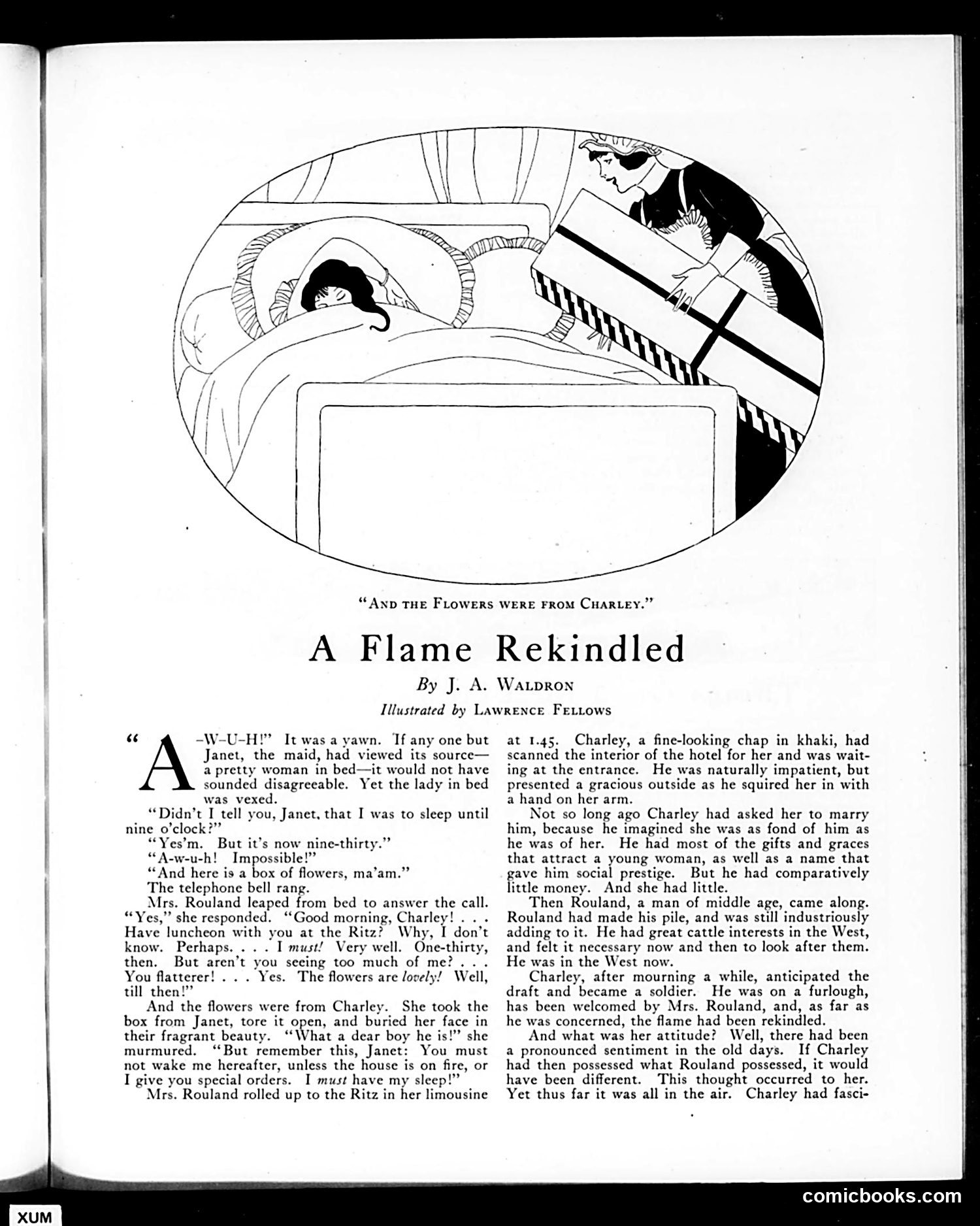
This is a serialized romantic story, not political satire. It depicts a love triangle involving Mrs. Rouland, her current wealthy husband (absent in the West on business), and Charley, a soldier on furlough whom she previously rejected for lack of money. The narrative explores early 20th-century class anxiety: Mrs. Rouland chose the wealthy, older Rouland over the charming but poor Charley. Now, with Charley back in uniform (likely WWI-era, given the khaki reference), her old feelings resurface through flowers and lunch dates. The story's irony—suggested by the caption and her sleeping late while eagerly awaiting his call—is that sentiment and rekindled romance cannot override her original mercenary calculation. The illustration shows her in bed receiving flowers, establishing the domestic/romantic tone of this Judge serialized fiction.
📄 Transcribed text from this page (OCR, searchable)
Machine-transcribed from the original scan — historical spelling and the odd misread are preserved.
XUM “AND THE FLOWERS WERE FROM CHARLEY.” A Flame Rekindled By J. A. Wapron Illustrated by Lawrence FeLLows “ -W-U-H!”) It was a yawn. Tf any one but Janet, the maid, had viewed its source— a pretty woman in bed—it would not have sounded disagreeable. Yet the lady in bed was vexed. “Didn't I tell you, Janet, that I was to sleep until nine o'clock?” “Yes’m. But it’s now nine-thirty.” “A-w-u-h! Impossible!” “And here is a box of flowers, ma’am.” The telephone bell rang. Mrs. Rouland leaped from bed to answer the call. “Yes,” she responded. ‘Good morning, Charley! .. . Have luncheon with you at the Ritz? Why, I don’t know. Perhaps. . . . I must! Very well. One-thirty, then. But aren’t you seeing too much of me?.. . You flatterer! . . . Yes. The flowers are lovely! Well, till then!” And the flowers were from Charley. She took the box from Janet, tore it open, and buried her face in their fragrant beauty. ‘What a dear boy he is!” she murmured. ‘But remember this, Janet: You must not wake me hereafter, unless the house is on fire, or I give you special orders. I must have my sleep!” Mrs. Rouland rolled up to the Ritz in her limousine at 1.45. Charley, a fine-looking chap in khaki, had scanned the interior of the hotel for her and was wait- ing at the entrance. He was naturally impatient, but presented a gracious outside as he squired her in with a hand on her arm. Not so long ago Charley had asked her to marry him, because he imagined she was as fond of him as he was of her. He had most of the gifts and graces that attract a young woman, as well as a name that gave him social prestige. But he had comparatively little money. And she had little. Then Rouland, a man of middle age, came along. Rouland had made his pile, and was still industriously adding to it. He had great cattle interests in the West, and felt it necessary now and then to look after them. He was in the West now. Charley, after mourning a while, anticipated the draft and became a soldier. He was on a furlough, has been welcomed by Mrs. Rouland, and, as far as he was concerned, the flame had been rekindled. And what was her attitude? Well, there had been a pronounced sentiment in the old days. If Charley had then possessed what Rouland possessed, it would have been different. This thought occurred to her. Yet thus far it was all in the air. Charley had fasci- comicbooks.com