
Judge, 1918-03-23 · page 17 of 32
Judge — March 23, 1918 — page 17: what you’re looking at
What you’re looking at
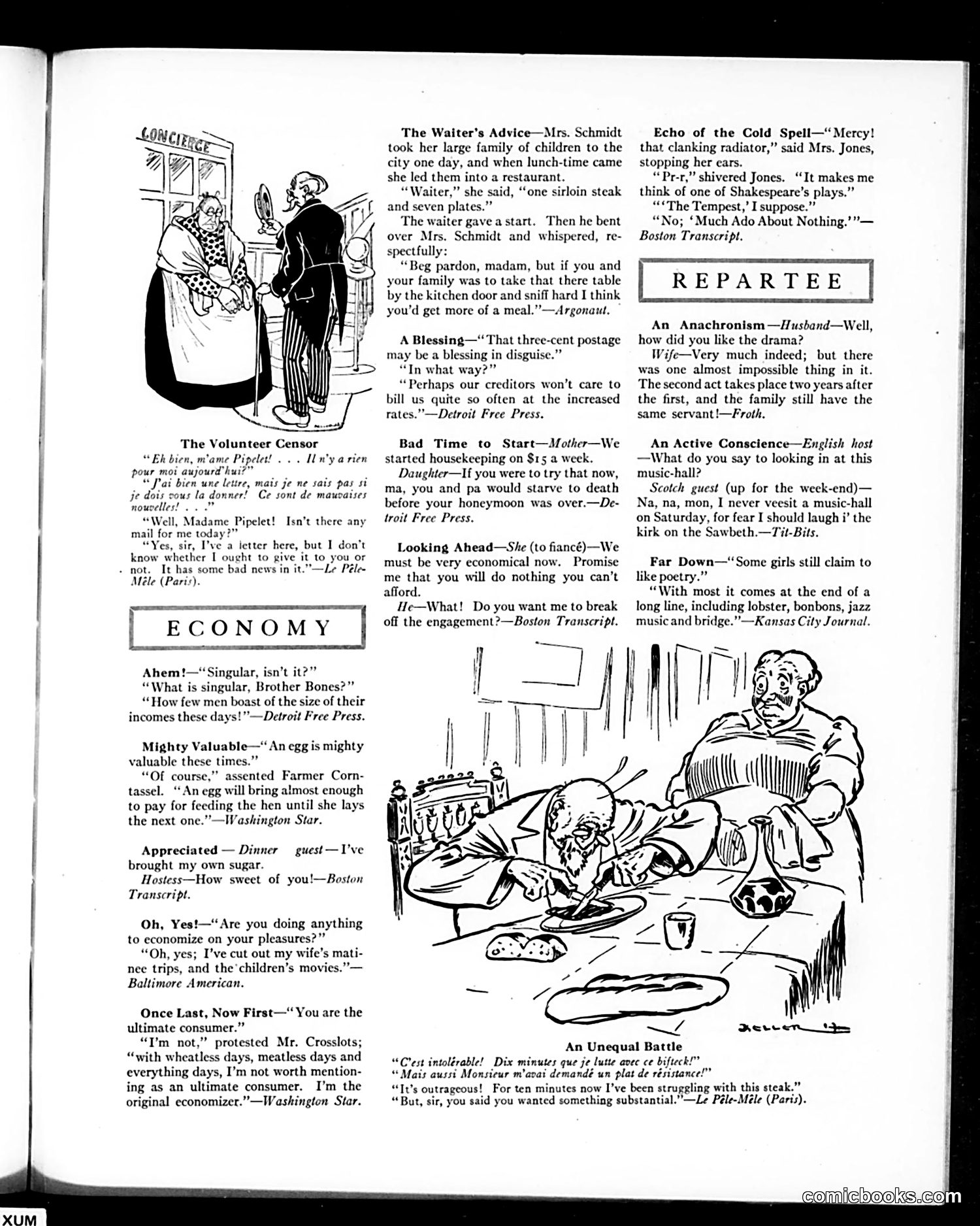
This page from *Judge* presents wartime humor, likely from WWI era, centered on **economic hardship and rationing**. The cartoons mock domestic austerity measures: families struggling with "wheatless days" and "meatless days"; a waiter sarcastically suggesting a poor family simply *smell* food rather than buy it; a couple economizing so severely they consider breaking an engagement. **"An Unequal Battle"** (bottom right) shows a diner fighting with an impossibly tough steak—a visual pun on meat scarcity making poor cuts expensive. The French caption confirms this: the diner demanded "something substantial," so he got inedible toughness. The humor targets both **wartime privation** and **consumer behavior**—people claiming poverty while maintaining small luxuries, or bargain-hunting so aggressively they sabotage their own comfort. **"The Volunteer Censor"** references wartime mail censorship (a French example), suggesting this is WWI-period satire about how economic anxiety pervades daily life.
📄 Transcribed text from this page (OCR, searchable)
Machine-transcribed from the original scan — historical spelling and the odd misread are preserved.
+ not. The Volunteer Censor es Mn'yarien aujourd ai bien une lettre, mais je ne sais pas si je dois cous la donner! Ce sont de mauoaises nouvelles! .. .” “Well, Madame Pipelet! mail for me today?” “Yes, sir, I've a letter here, but I don’t know whether I ought to give it to you or It has some bad news in it."—Le Péle- Méle (Paris). ' | ECONOMY | Ahem!—“ Singular, isn’t it?” “What is singular, Brother Bones?” “How few men boast of the size of their incomes these days!""—Detroit Free Press. pour Isn't there any Mighty Valuable—“ An egg is mighty valuable these times.” “Of course,” assented Farmer Corn- tassel. ‘An egg will bring almost enough to pay for feeding the hen until she lays the next one.”—IWashington Star. Appreciated — Dinner guest —I’ve brought my own sugar. Hostess—How sweet of you!—Boston Transcript. Oh, Yes!—“Are you doing anything to economize on your pleasures?” “Oh, yes; I’ve cut out my wife's mati- nee trips, and the’ children’s movies.” — Baltimore American. Once Last, Now First—‘ You are the ultimate consumer.” “I’m not,” protested Mr. Crosslots; “with wheatless days, meatless days and everything days, I’m not worth mention- ing as an ultimate consumer. I’m the original economizer.” —Washington Star. The Waiter’s Advice—Mrs. Schmidt took her large family of children to the city one day, and when lunch-time came she led them into a restaurant. “Waiter,” she said, “one sirloin steak and seven plates.” The waiter gave a start. Then he bent over Mrs. Schmidt and whispered, re- spectfully: “Beg pardon, madam, but if you and your family was to take that there table by the kitchen door and sniff hard I think you'd get more of a meal.” —Argonaut, A Blessing—“ That three-cent postage may be a blessing in disguise.” “In what way?” “Perhaps our creditors won’t care to bill us quite so often at the increased rates.”"—Detroit Free Press. Bad Time to Start—Mother—We started housekeeping on $15 a week. Daughter—If you were to try that now, ma, you and pa would starve to death before your honeymoon was over.—De- troit Free Press. Looking Ahead—She (to fiancé)—We must be very economical now. Promise me that you will do nothing you can’t afford. He—What! Do you want me to break off the engagement?—Boston Transcript. Echo of the Cold Spell—“ Mercy! that clanking radiator,” said Mrs. Jones, stopping her ears. “Pr-r,” shivered Jones. ‘It makes me think of one of Shakespeare’s plays.” “‘The Tempest,’ I suppose.” “No; ‘Much Ado About Nothing.’ ”— Boston Transcript. | REPARTEE An Anachronism —Husband—Well, how did you like the drama? Wife—Very much indeed; but there was one almost impossible thing in it. The second act takes place two years after the first, and the family still have the same servant!—Froth, An Active Conscience—English host —What do you say to looking in at this music-hall? Scotch guest (up for the week-end)— Na, na, mon, I never veesit a music-hall on Saturday, for fear I should laugh i’ the kirk on the Sawbeth.—Tit-Bits. Far Down—“Some girls still claim to like poetry.” “With most it comes at the end of a long line, including lobster, bonbons, jazz music and bridge.” —Kansas City Journal. An Unequal Battle “Crest intolérable! Dix minutes que je lutte avec ce bifteck!” “Mais aussi Monsieur m’avai demandé un plat de résistance!” “Tr’s outrageous! For ten minutes now I’ve been struggling with this steak,” “But, sir, you said you wanted something substantial."—Le Péle-Méle (Paris).