
Judge, 1918-03-23 · page 20 of 32
Judge — March 23, 1918 — page 20: what you’re looking at
What you’re looking at
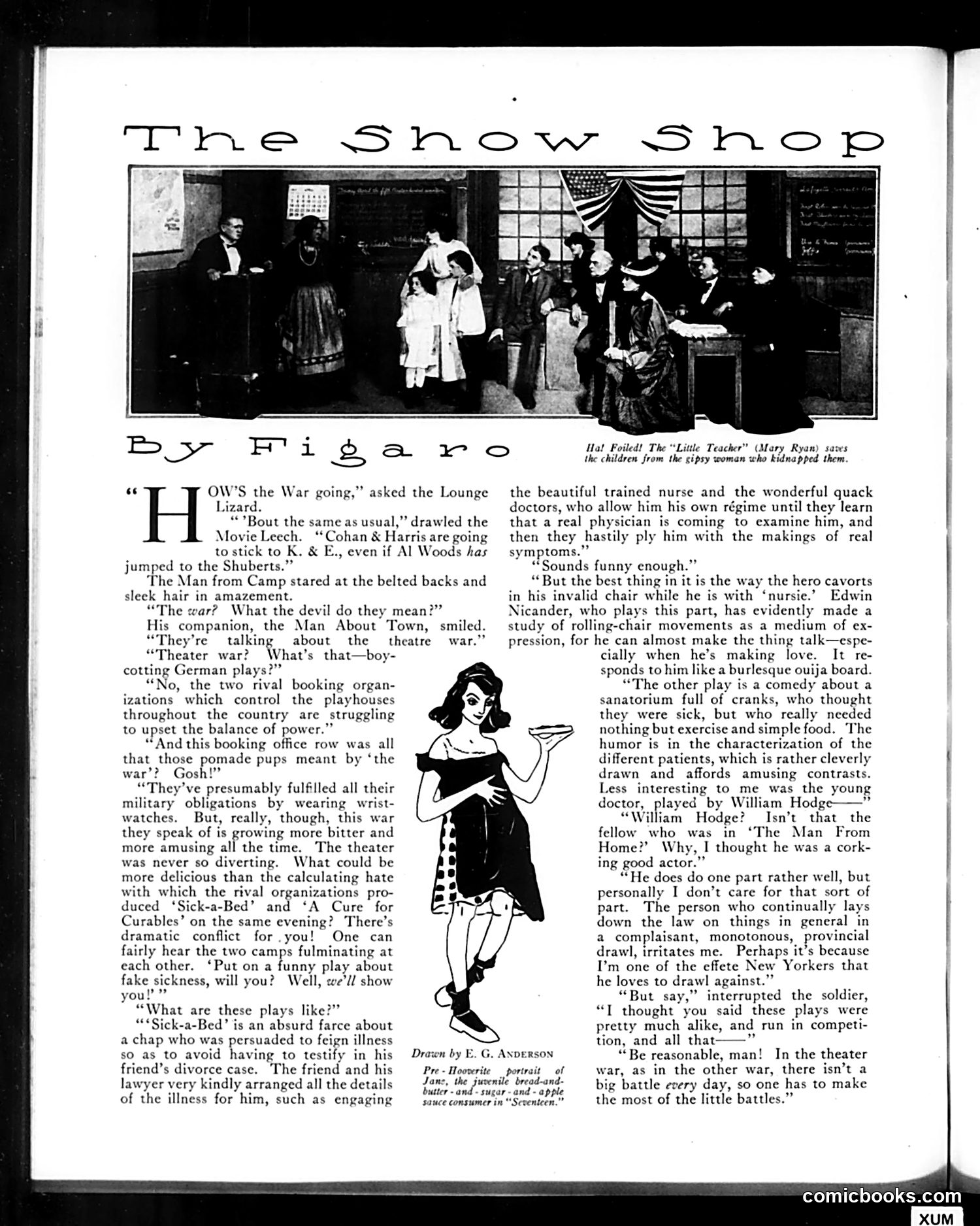
This page satirizes the "theater war" between two rival booking organizations (theater chains) competing for control of American playhouses during what appears to be the World War I era. The dialogue mocks theater people who discuss their industry competition using military terminology borrowed from the actual war ("theater war," "battle," "camps"). The characters—a "Lounge Lizard," "Movie Leech," and "Man About Town"—represent shallow theater-world types more concerned with industry rivalries than the real war. The satire targets two competing plays: "Sick-a-Bed" and "A Cure for Curables," which the rival organizations produced simultaneously as aggressive competitive moves. The piece ridicules both the plays' similarities and the petty nature of theatrical competition dressed up in wartime language. The accompanying illustration shows a scene from "The Show Shop," featuring a plot involving a trained nurse, while the E.G. Anderson illustration depicts a character from "Seventeen." The overall message: while soldiers fought abroad, New York theater people obsessed over trivial industry disputes.
📄 Transcribed text from this page (OCR, searchable)
Machine-transcribed from the original scan — historical spelling and the odd misread are preserved.
“ OW’S the War going,” asked the Lounge Lizard. “*Bout the Movie Leech. me as usual,” drawled the “Cohan & Harris are going to stick to K. & E., even if Al Woods has jumped to the Shuberts.” The Man from Camp stared at the belted backs and sleck hair in amazement. “The war? What the devil do they mean?” s companion, the Man About Town, smiled. war. talking about the _ theatre “They’re What’s that—boy- 3?” “Theater war? cotting German plays? “No, the two rival booking organ- izations which control the playhouses throughout the country are struggling to upset the balance of power.” “And this booking office row was all that those pomade pups meant by ‘the war’? Gosh!” “They’ve presumably fulfilled all their military obligations by wearing wrist- watches. But, really, though, this war they speak of is growing more bitter and more amusing all the time. The theater was never so diverting. What could be more delicious than the calculating hate with which the rival organizations pro- duced ‘Sick-a-Bed’ and ‘A Cure for Curables’ on the same evening? There’s dramatic conflict for.you! One can fairly hear the two camps fulminating at each other. ‘Put on a funny play about fake sickness, will you? Well, we’// show “What are these plays like?” “*Sick-a-Bed’ is an absurd farce about a chap who was persuaded to feign illness so as to avoid having to testify in his friend’s divorce case. The friend and his lawyer very kindly arranged all the details of the illness for him, such as engaging Drawn by Pre - Hooverite Bs> Figarnd Janz, the juvenile bread-and- butter - and - sugar -and - apple sauce consumer in “Seventeen.” Hat Foiled! The “Little Teacher” (Mary Ryan) saves the children from the gipsy woman who kidnapped them. the beautiful trained nurse and the wonderful quack doctors, who allow him his own régime until they learn that a real physician is coming to examine him, and then they hastily ply him with the makings of real symptoms.” “Sounds funny enough. “But the best thing in it is the way the hero cavorts in his invalid chair while he is with ‘nursie.? Edwin Nicander, who plays this part, has evidently made a study of rolling-chair movements as a medium of ex- pression, for he can almost make the thing talk—espe- cially when he’s making love. It re- sponds to him like a burlesque ouija board. “The other play is a comedy about a sanatorium full of cranks, who thought they were sick, but who really needed nothing but exercise and simple food. The humor is in the characterization of the different patients, which is rather cleverly drawn and affords amusing contrasts. Less interesting to me was the young doctor, played by William Hodge——” “William Hodge? Isn’t that the fellow who was in ‘The Man From Home?’ Why, I thought he was a cork- ing good actor.” “He does do one part rather well, but personally I don’t care for that sort of part. The person who continually lays down the law on things in general in a complaisant, monotonous, provincial drawl, irritates me. Perhaps it’s because I’m one of the effete New Yorkers that he loves to drawl against.” “But say,” interrupted the soldier, “I thought you said these plays were pretty much alike, and run in competi- tion, and all that - “Be reasonable, man! In the theater war, as in the other war, there isn’t a big battle every day, so one has to make the most of the little battles.” ANDERSON portrait of comicbooks.com