
Judge, 1918-03-23 · page 25 of 32
Judge — March 23, 1918 — page 25: what you’re looking at
What you’re looking at
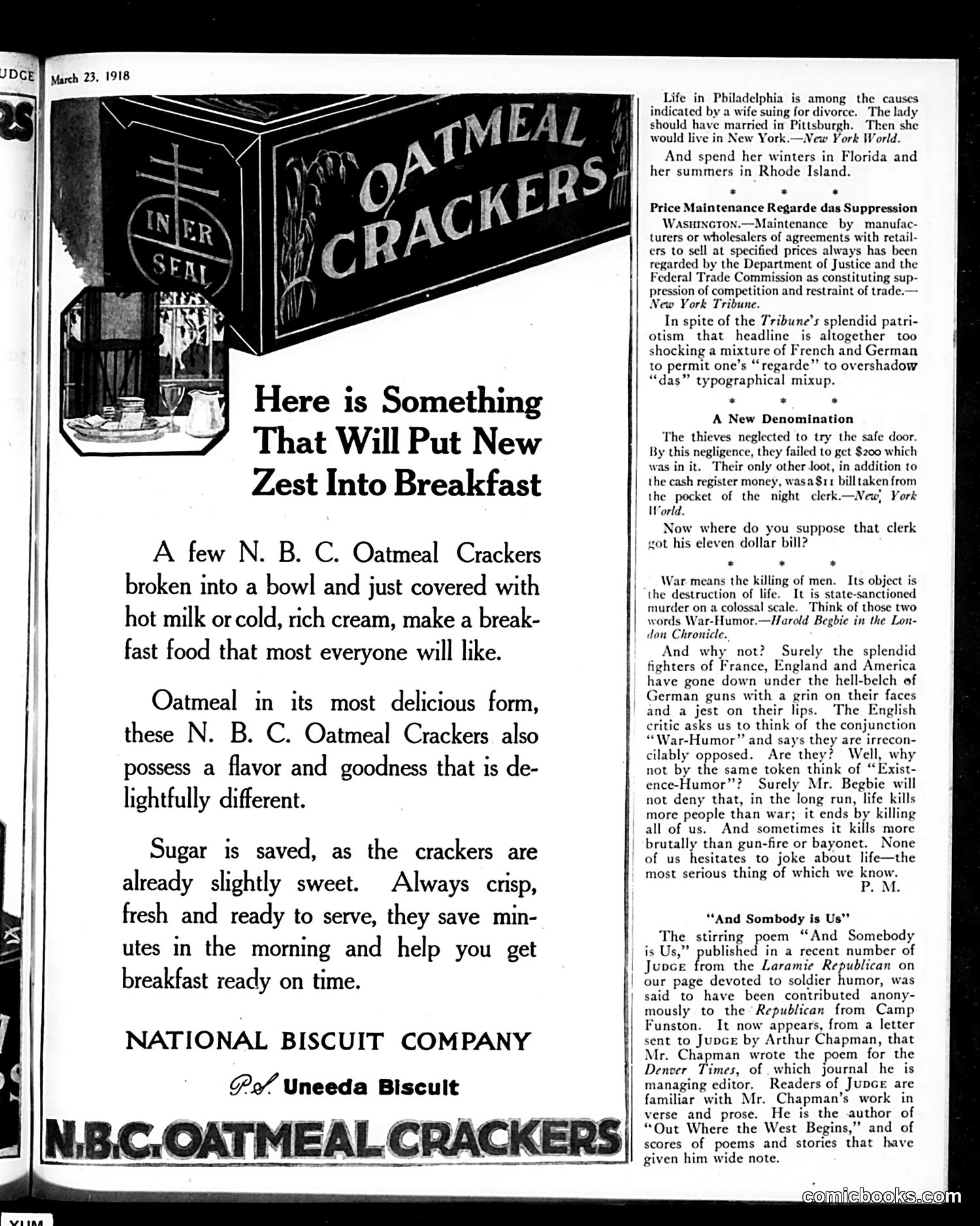
This page is **primarily advertising** (N.B.C. Oatmeal Crackers occupy the left half) alongside **brief satirical snippets** on the right. The satirical items mock: 1. **Divorce/Geography**: A woman divorcing in Philadelphia should have married in Pittsburgh to live in New York and winter in Florida—mocking the wealthy's seasonal migration patterns. 2. **Linguistic Absurdity**: A headline mixing French ("Regarde") and German ("das") about price maintenance is ridiculed as patriotically inappropriate during WWI. 3. **The "Eleven Dollar Bill" Joke**: A thief steals only an $11 bill from a night clerk, prompting the sarcastic question of where a clerk got such an odd denomination—implying petty theft or desperation. 4. **War-Humor Paradox**: An essay argues that joking about war isn't incongruous, since life itself kills everyone eventually, so humor about serious matters is philosophically defensible. The page reflects 1918 wartime sensibilities: jingoism, class observation, and dark humor about mortality.
📄 Transcribed text from this page (OCR, searchable)
Machine-transcribed from the original scan — historical spelling and the odd misread are preserved.
JDGEF jarch 23. 1918 Here is Something That Will Put New Zest Into Breakfast A few N. B. C. Oatmeal Crackers broken into a bowl and just covered with hot milk or cold, rich cream, make a break- fast food that most everyone will like. Oatmeal in its most delicious form, these N. B. C. Oatmeal Crackers also possess a flavor and goodness that is de- lightfully different. Sugar is saved, as the crackers are already slightly sweet. Always crisp, fresh and ready to serve, they save min- utes in the morning and help you get breakfast ready on time. NATIONAL BISCUIT COMPANY Poe Uneeda Biscuit Life in Philadelphia is among the causes indicated by a wife suing for divorce. The lady should have married in Pittsburgh. Then she would live in New York.—New York World. And spend her winters in Florida and her summers in Rhode Island. * * * Price Maintenance Regarde das Suppression WaAsuINGTON.—Maintenance by manufac- turers or wholesalers of agreements with retail- ers to sell at specified prices always has been regarded by the Department of Justice and the Federal Trade Commission as constituting sup- pression of competition and restraint of trade.— New York Tribune. In spite of the Tribune’s splendid patri- otism that headline is altogether too shocking a mixture of French and German to permit one’s “‘regarde”’ to overshadow “das” typographical mixup. . * * A New Denomination The thieves neglected to try the safe door. By this negligence, they failed to get $200 which was in it. Their only other Joot, in addition to the cash register money, wasa$rr billtaken from the pocket of the night clerk.—New, York World. Now where do you suppose that clerk got his eleven dollar bill? * * * War means the killing of men. Its object is the destruction of life. It is state-sanctioned murder on a colossal scale. Think of those two words War-Humor.—Harold Begbie in the Lon- | don Chronicle. And why not? Surely the splendid fighters of France, England and America have gone down under the hell-belch of German guns with a grin on their faces ' and a jest on their lips. The English critic asks us to think of the conjunction “War-Humor” and says they are irrecon- cilably opposed. Are they? Well, why not by the same token think of “Exist- ence-Humor”? Surely Mr. Begbie will not deny that, in the long run, life kills more people than war; it ends by killing all of us. And sometimes it kills more brutally than gun-fire or bayonet. None of us hesitates to joke about life—the most serious thing of which we know. P. M. “And Sombody is Us" The stirring poem “And Somebody is Us,” published in a recent number of Jupce from the Laramie Republican on our page devoted to soldier humor, was said to have been contributed anony- mously to the Republican from Camp | Funston. It now appears, from a letter sent to Jupce by Arthur Chapman, that Mr. Chapman wrote the poem for the Denver Times, of which journal he is managing editor. Readers of JupGe are familiar with Mr. Chapman’s work in verse and prose. He is the author of “Out Where the West Begins,” and of scores of poems and stories that have given him wide note.