
Judge, 1918-03-23 · page 14 of 32
Judge — March 23, 1918 — page 14: what you’re looking at
What you’re looking at
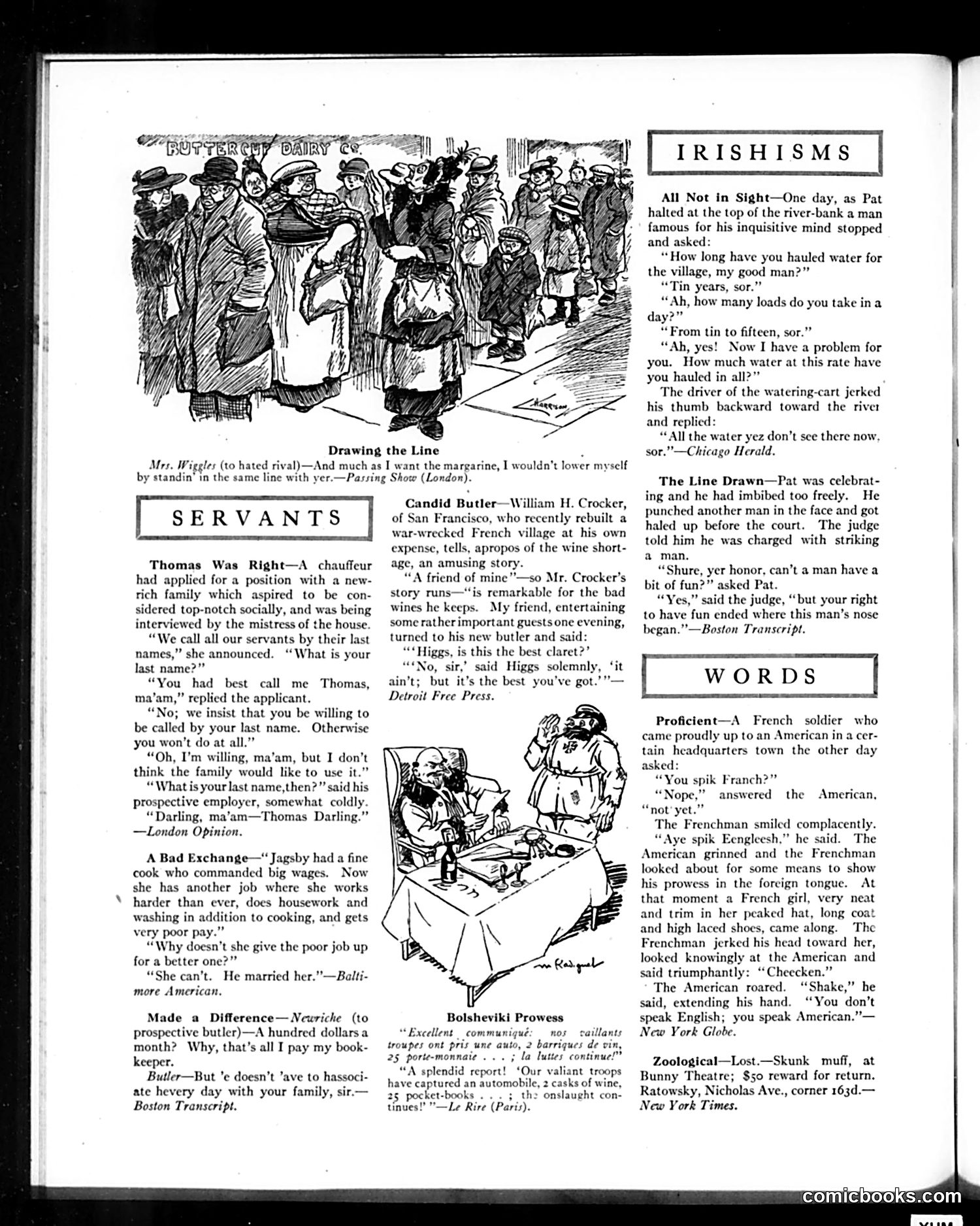
This page collects brief humorous anecdotes organized by theme. The main satirical content includes: **"Drawing the Line"** (top): A class-conscious British woman refuses to stand in line with a rival, even for margarine—satirizing snobbery during wartime rationing. **Servants/Butler Stories**: Multiple jokes mock the pretensions of newly wealthy Americans ("new-rich") who ape upper-class British servant protocols. The humor lies in servants' honest reactions exposing their employers' absurdity—a butler frankly tells his master the wine is poor quality; another refuses to be called by his last name "Darling" to spare the family embarrassment. **"Bolsheviki Prowess"**: A French military communiqué satirizes the Russian Revolution's chaos by suggesting Bolshevik "victories" consist merely of looting cars, wine, and wallets while claiming the "struggle continues." **Irishisms & Other Sections**: Stereotypical Irish dialect humor; WWI-era Franco-American soldier miscommunication jokes. The overall tone reflects post-WWI American attitudes: mocking class pretension, satirizing revolutionary chaos, and trading in ethnic stereotypes.
📄 Transcribed text from this page (OCR, searchable)
Machine-transcribed from the original scan — historical spelling and the odd misread are preserved.
Drawing the Line Mrs. Wiggles (to hated rival)—And much as I want the margarine, I wouldn't lower myself by standin’ in the same line with yer.—Passing Show (London). | SERVANTS Thomas Was Right—A chauffeur had applied for a position with a new- rich family which aspired to be con- sidered top-notch socially, and was being interviewed by the mistress of the house. “We call all our servants by their last names,” she announced. ‘What is your last name?” “You had best call me Thomas, ma’am,” replied the applicant. “No; we insist that you be willing to be called by your last name. Otherwise you won't do at all.” “Oh, I’m willing, ma’am, but I don’t think the family would like to use it.” “What is your last name,then?” said his prospective employer, somewhat coldly. “Darling, ma’am—Thomas Darling.” —London Opinion. A Bad Exchange—“ Jagsby had a fine cook who commanded big wages. Now she has another job where she works harder than ever, does housework and washing in addition to cooking, and gets very poor pay.” “Why doesn’t she give the poor job up for a better one?” “She can’t. He married her.” —Balti- more American. Made a Difference—Newriche (to prospective butler)—A hundred dollars a month? Why, that’s all I pay my book- keeper. Butler—But 'e doesn’t ’ave to hassoci- ate hevery day with your family, sir— Boston Transcript. Candid Butler—William H. Crocker, of San Francisco, who recently rebuilt a war-wrecked French village at his own expense, tells, apropos of the wine short- age, an amusing story. “A friend of mine”—so Mr. Crocker’s story runs—“is remarkable for the bad wines he keeps. My friend, entertaining some rather important guests one evening, turned to his new butler and said: is this the best claret?’ said Higgs solemnly, ‘it ain’t; but it’s the best you've got.’”— Detroit Free Press. Bolsheviki Prowess “Excellent communiqué: nos caillants troupes ont pris une auto, 2 barriques de vin, 25 porte-monnaie ... ; la luttes continue!” “A splendid report! ‘Our valiant troops have captured an automobile, 2 casks of wine, 25 pocket-books .... ; th: onslaught con- tinues!" "—Le Rire (Paris). IRISHISMS All Not in Sight—One day, as Pat halted at the top of the river-bank a man famous for his inquisitive mind stopped and asked: “How long have you hauled water for the village, my good man?” “Tin years, sor.” h, how many loads do you take in a day “From tin to fifteen, sor.” “Ah, yes! Now I have a problem for you. How much water at this rate have you hauled in all?” The driver of the watering-cart jerked his thumb backward toward the river and replied: “All the water yez don’t sce there now, sor.” —Chicago Herald. The Line Drawn—Pat was celebrat- ing and he had imbibed too freely. He punched another man in the face and got haled up before the court. The judge told him he was charged with striking a man. “Shure, yer honor, can’t a man have a bit of fun?” asked Pat. “Yes,” said the judge, “but your right to have fun ended where this man’s nose began.”—Boston Transcript. Proficient—A French soldier who came proudly up to an American in a cer- tain headquarters town the other day asked: “You spik Franch?” “Nope,” answered the American, “not' yet.” The Frenchman smiled complacently. “Aye spik Eengleesh,” he said. The American grinned and the Frenchman looked about for some means to show his prov in the foreign tongue. At that moment a French girl, very neat and trim in her peaked hat, long coat and high laced shoes, came along. The Frenchman jerked his head toward her, looked knowingly at the American and said triumphantly: ‘Cheecken.” The American roared. “Shake,” he said, extending his hand. “You don’t speak English; you speak American.”— New York Globe. Zoological—Lost.—Skunk muff, at Bunny Theatre; $50 reward for return. Ratowsky, Nicholas Ave., corner 163d.— New York Times.