
A complete issue · 28 pages · 1917
Judge — July 28, 1917
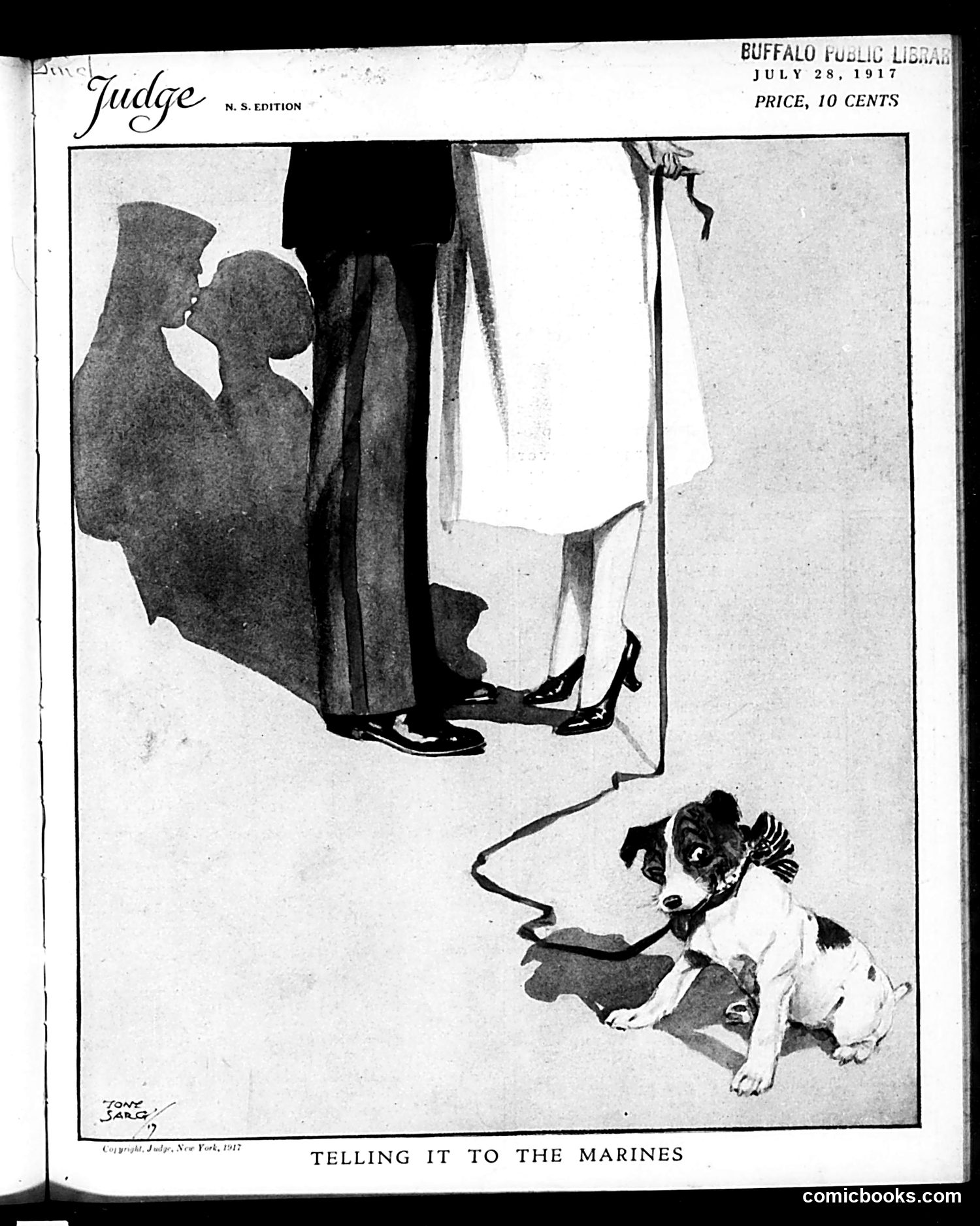
This Judge magazine cover from July 28, 1917 uses the phrase "telling it to the Marines"—a contemporary idiom meaning to tell an outlandish lie to someone unlikely to believe it. The cartoon depicts two figures in silhouette whispering to each other while a dog on a leash sits below them. The dog appears skeptical or unimpressed by their conversation. The visual joke plays on the expression: the couple is literally "telling it to" a canine audience, as if the dog represents the Marines—implying their story is so implausible that only a gullible dog (or Marines) would believe it. Published during World War I, the cartoon likely satirizes propaganda or dubious wartime claims circulating at the time.
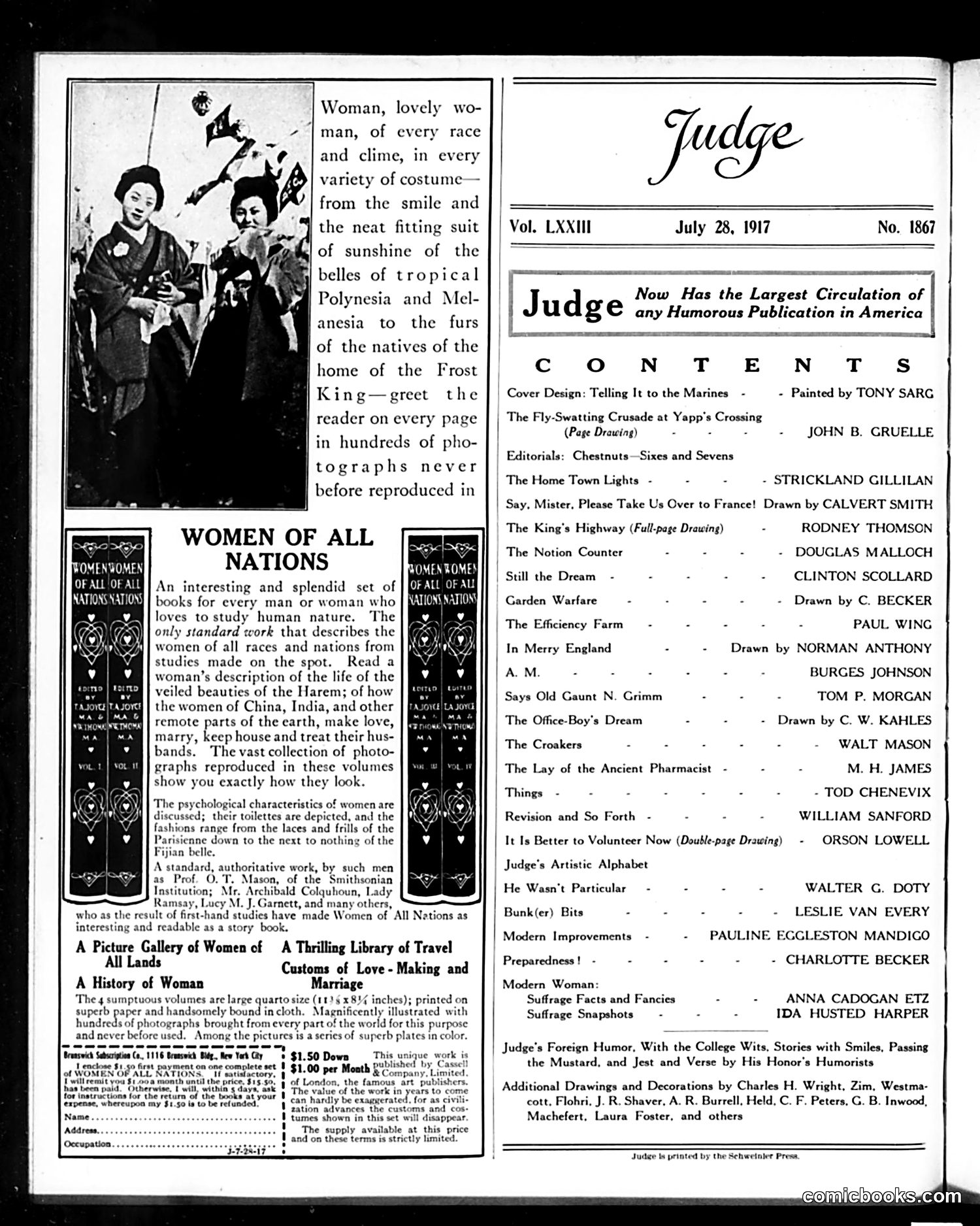
The left page advertises a book series called "Women of All Nations," describing illustrated volumes about women's customs, dress, and domestic life across different cultures—from China and India to Arctic regions. The marketing emphasizes anthropological study of how women "look" and behave across races. The right page is a contents listing for Judge magazine's humor articles and illustrations. Notable contributions include political cartoons and satirical pieces, though specific subjects aren't clearly identified in this index. The overall context reflects early 20th-century attitudes toward ethnographic study and colonial-era Western fascination with categorizing non-Western peoples, presented here as educational entertainment for American readers.
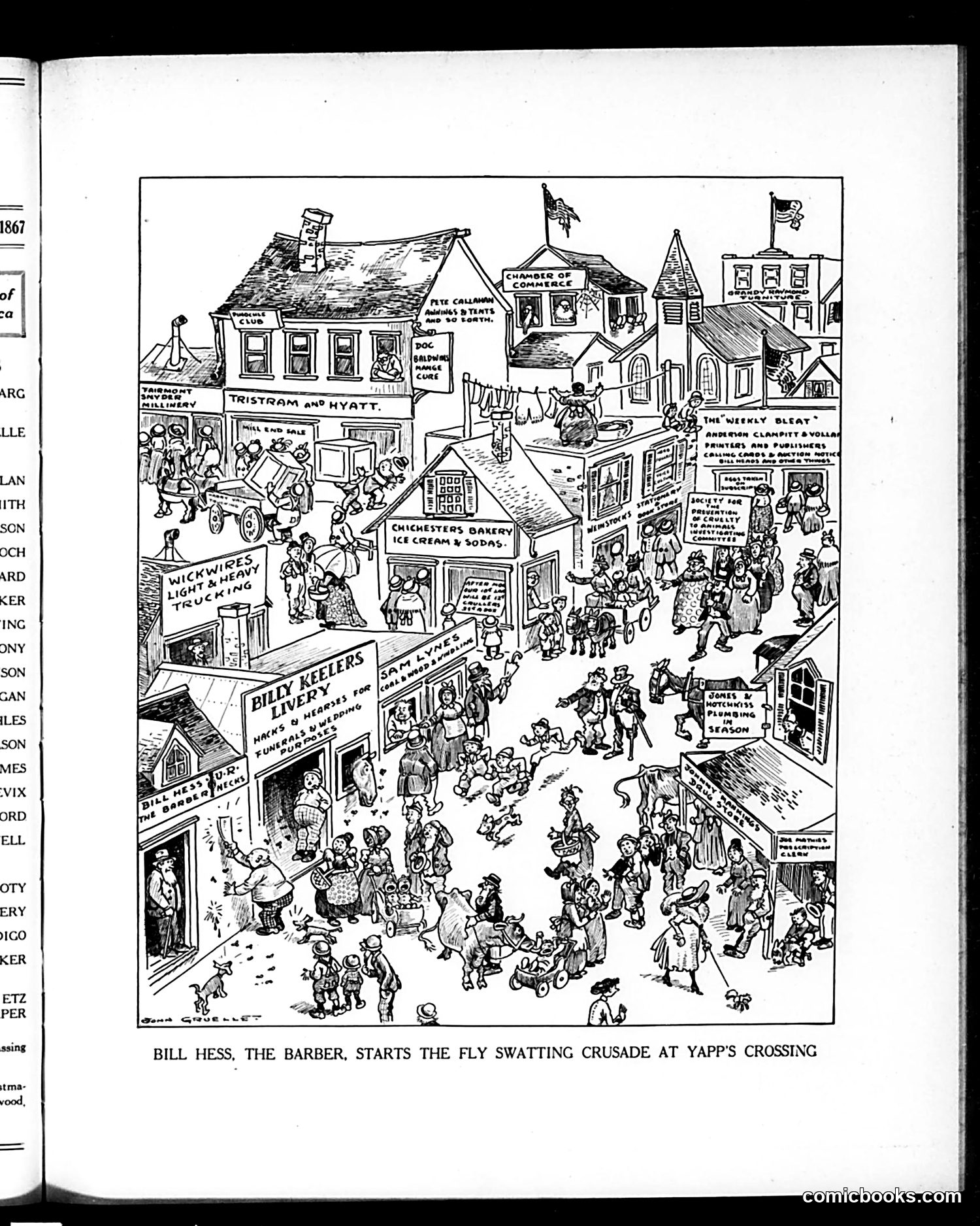
This cartoon depicts a busy street scene at "Yapp's Crossing" where various businesses and townspeople gather around a fly-swatting campaign initiated by Bill Hess, a local barber. The visible storefronts include a barbershop (Tristram and Hyatt), a Chamber of Commerce, an ice cream parlor (Chichester's), and other establishments. The satire appears to mock small-town civic enthusiasm—showing how a simple public health initiative (swatting flies, a legitimate Progressive-era hygiene concern) generates bustling community activity and excitement. The crowded, chaotic street scene suggests the humorous overreaction of townspeople to this grassroots crusade, poking fun at small-town culture and civic boosterism typical of Judge magazine's satirical approach.
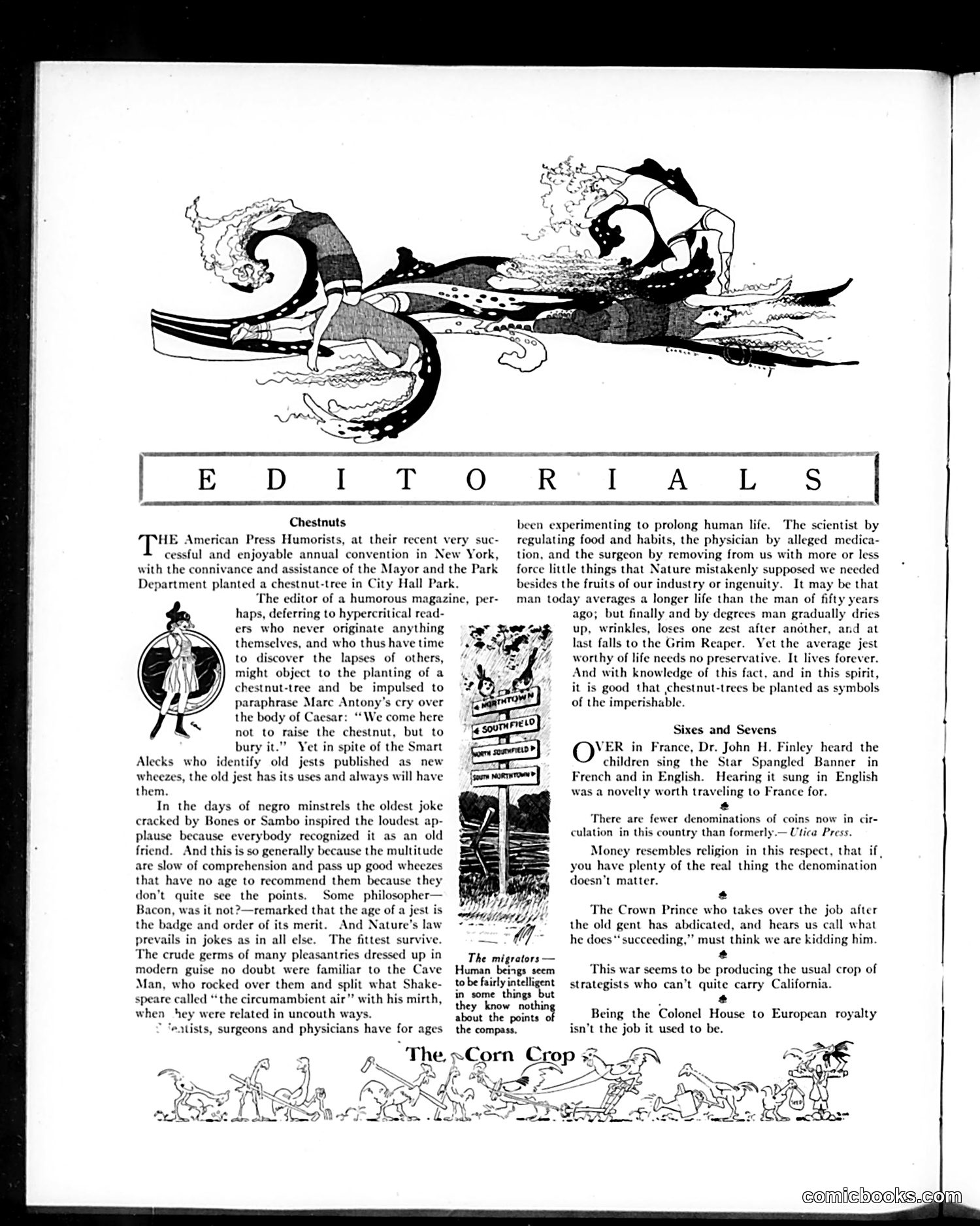
The top illustration depicts a figure being pulled apart by three octopus-like tentacles, likely representing competing political or social forces. The "Editorials" header indicates this is opinion content. The text discusses the American Press Humorists' convention in New York and references Marc Antony's famous funeral oration from Shakespeare's *Julius Caesar*—a classical allusion to political manipulation and rhetoric. There are scattered brief editorial items: one mocking the planting of chestnut trees as symbolic but ineffective, another about coin denominations and a "Crown Prince," and a third about California strategists and the "Colonel House" (likely referring to Woodrow Wilson's advisor Edward House). The page appears to offer political and social commentary typical of early 20th-century satirical magazines, though specific contemporary references remain unclear without additional historical context.
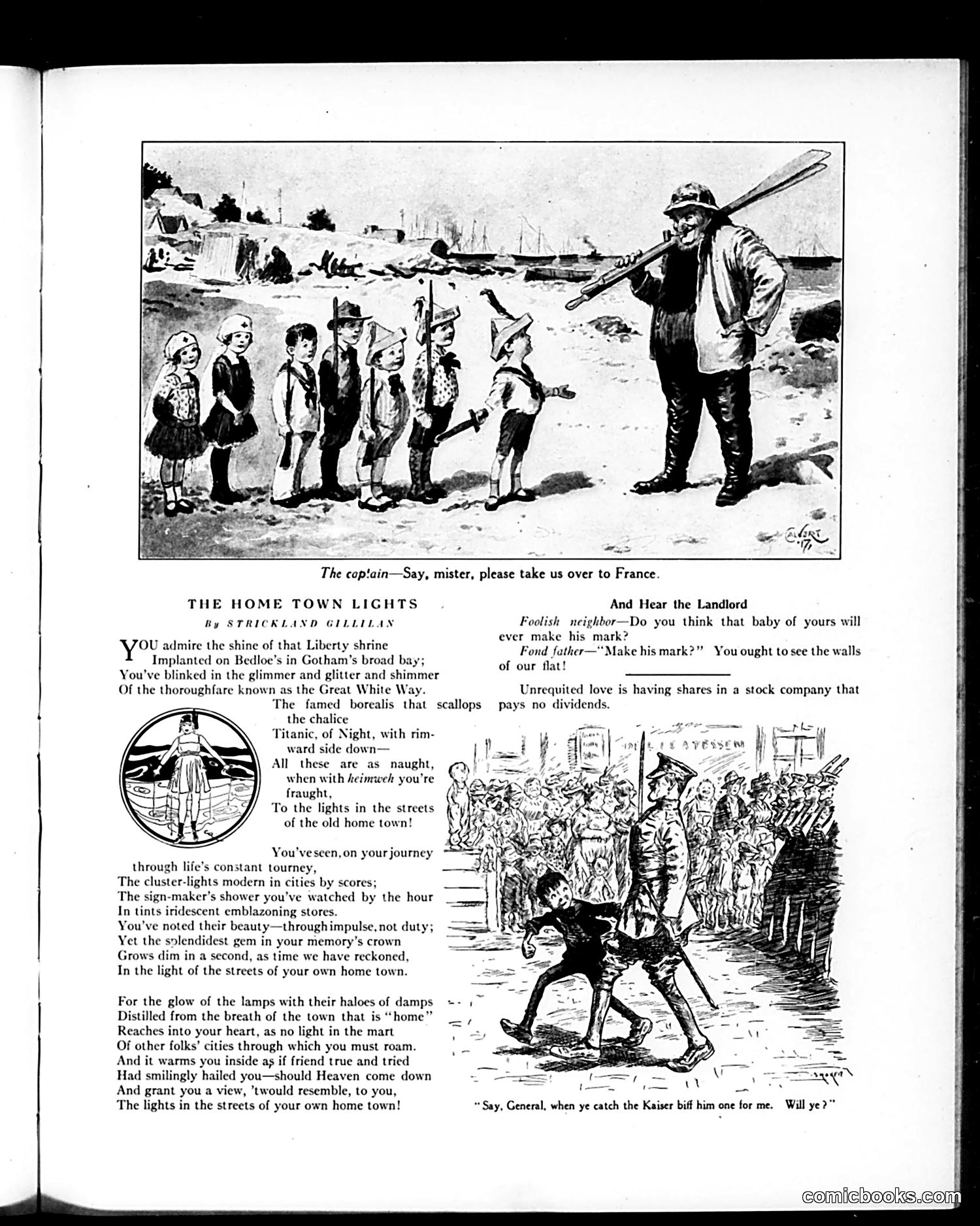
**Top Cartoon:** Shows children asking a ship captain to transport them to France, likely referencing WWI-era evacuation or escape fantasies during the conflict. **"The Home Town Lights" Poem** by Stricklind Gillilan celebrates small-town American life—its modest beauty, familiar streets, and welcoming nature—contrasting with urban sophistication. It's nostalgic verse emphasizing that hometown simplicity surpasses fancy city attractions. **"And Hear the Landlord" Dialogue:** A brief comedic exchange mocking working-class anxieties about poverty and child-rearing prospects. **Bottom Cartoon:** Depicts a soldier or military figure addressing a general about capturing "the Kaiser," referencing WWI's enemy German leader Kaiser Wilhelm II. This reflects American war sentiment of that era. The page blends patriotic and domestic themes typical of WWI-period American humor magazines.
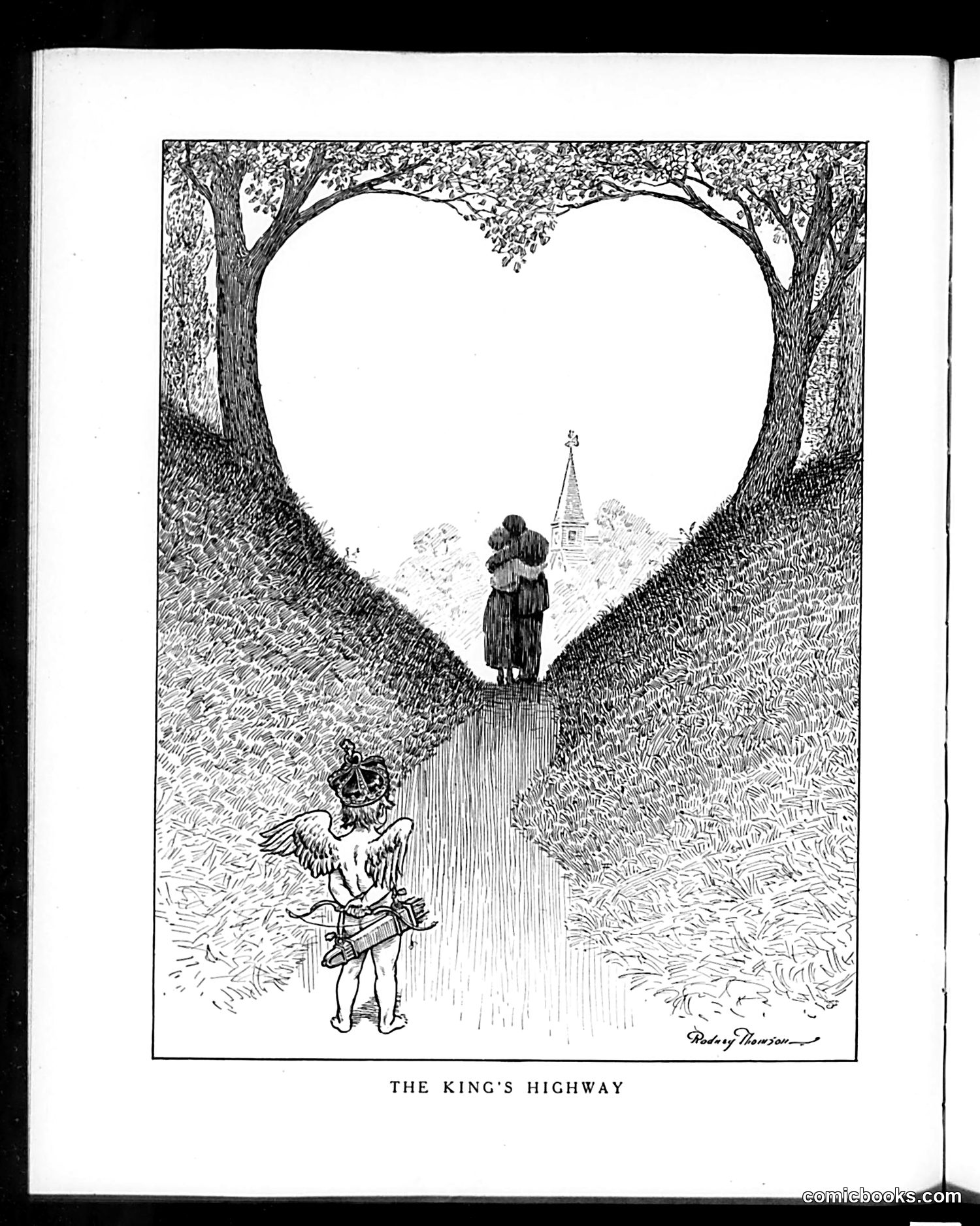
This satirical illustration depicts a cherub or cupid figure in the foreground, watching a couple walking together down a path framed by trees that form a heart shape. A church with a steeple appears in the distant background. The title "The King's Highway" likely references the biblical/traditional concept of marriage as a sacred path. The satire appears to mock the romanticization of courtship and marriage—presenting the idealized journey (symbolized by the heart-shaped frame and heavenly cherub) as the supposed "proper" route to matrimony. The cherub's observant pose and the formal composition suggest Judge magazine is commenting ironically on contemporary attitudes toward romance and social expectations around marriage during this period.
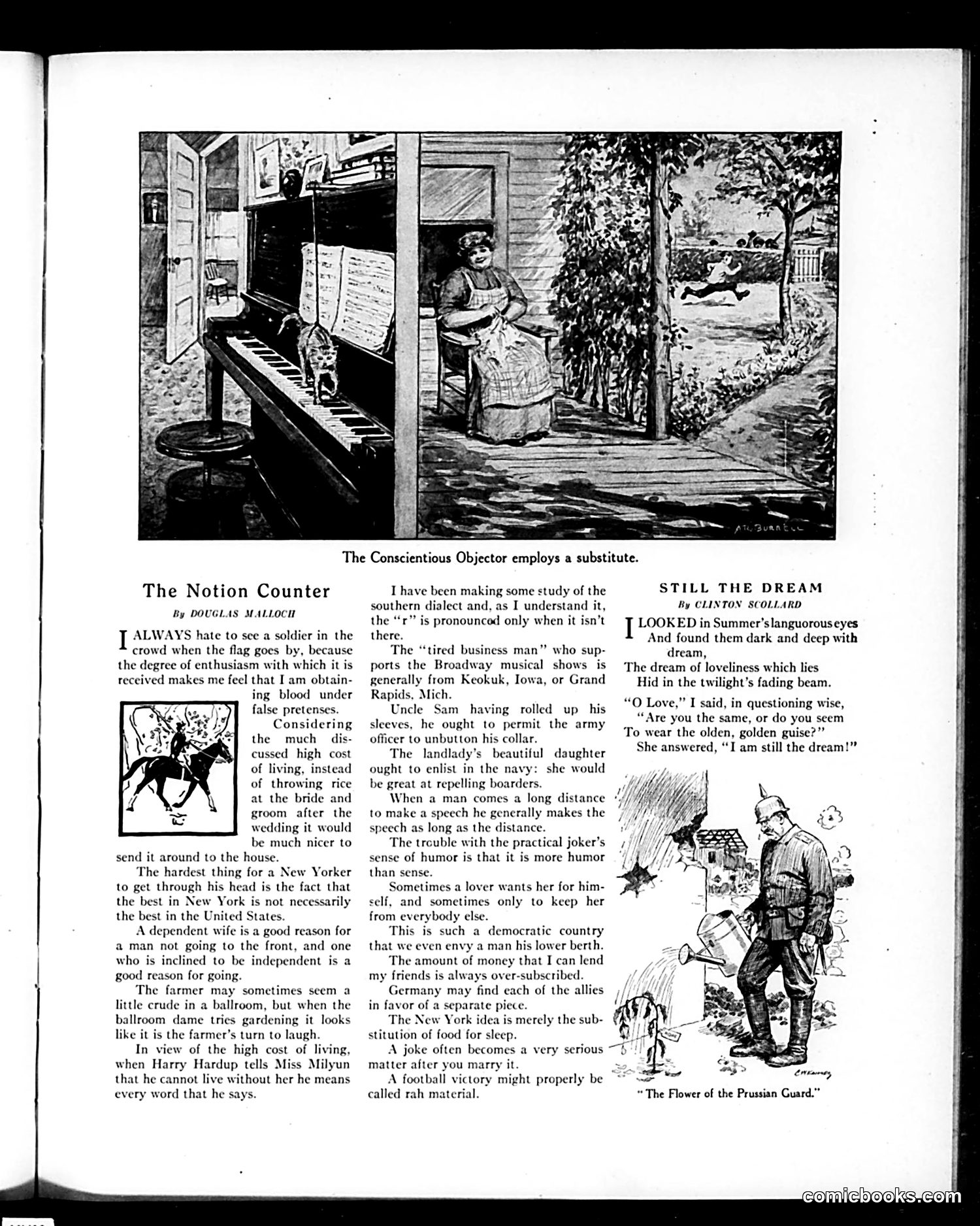
This page contains **humorous social commentary** from Judge magazine, likely WWI-era based on references to soldiers, army officers, and military service. **The top cartoon** shows "The Conscientious Objector employs a substitute"—satirizing wealthy or privileged men who avoided military service by paying others to serve in their place, a legal but controversial practice during wartime. **"The Notion Counter"** by Douglas Malloch is a collection of witty one-liners mocking American society: expensive living costs, regional pretensions (rural farmers vs. city dwellers), dependent marriages, Broadway audiences from the Midwest, and romantic clichés. The line about the "conscientious objector" repeats the cartoon's theme of draft avoidance. **The lower illustration** titled "The Flower of the Prussian Guard" appears to mock German militarism (Prussia being Germany's dominant state), showing a stiff, pompous officer—typical anti-German propaganda of the era. **"Still the Dream"** is an unrelated sentimental poem about romantic idealism.
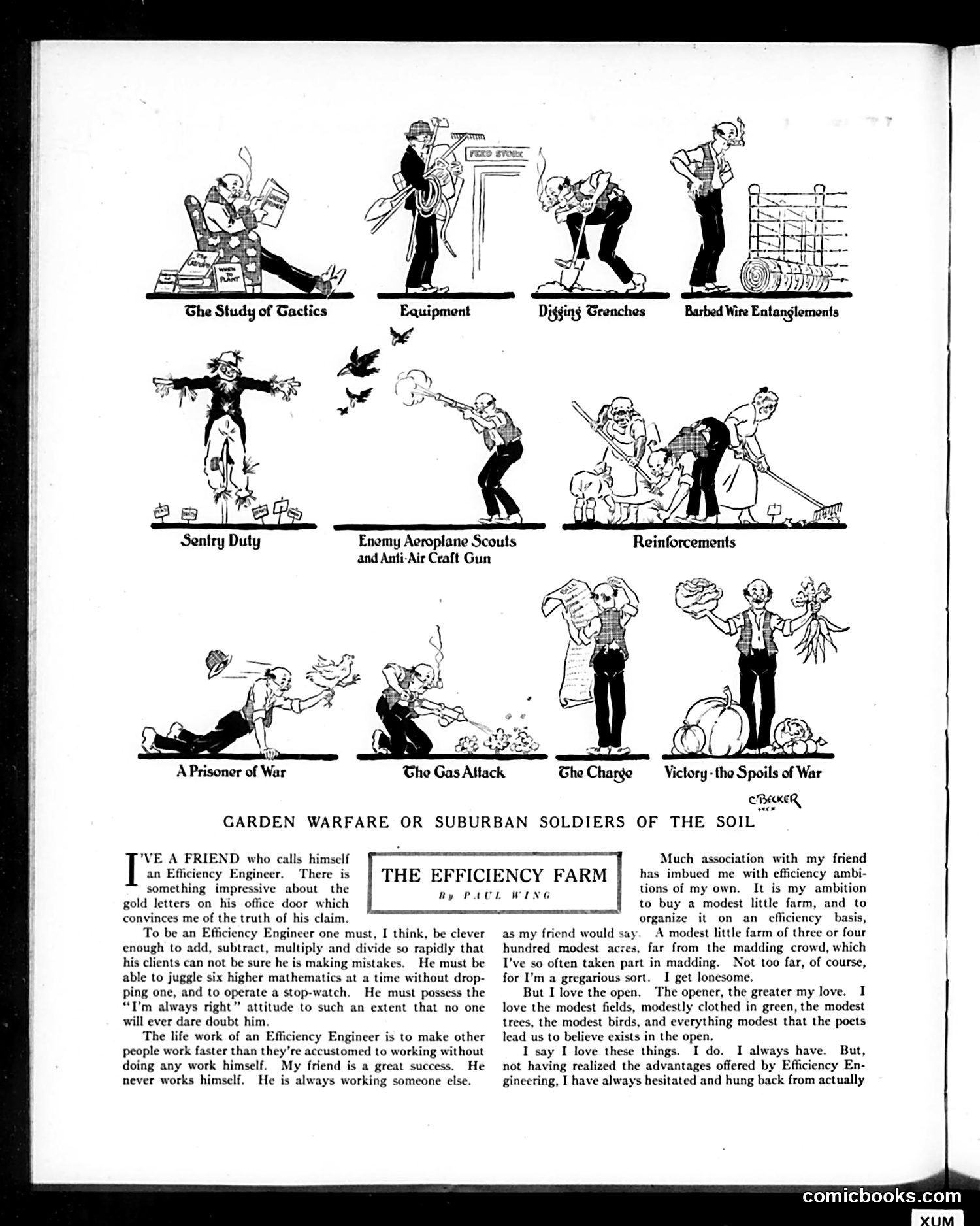
This satirical cartoons mocking World War I home-front efforts. The top panel depicts civilians attempting wartime activities—studying tactics, manning equipment, digging trenches, handling barbed wire, standing sentry, spotting enemy aircraft, and managing gas attacks—with comedic incompetence. The figures are portrayed as bumbling amateurs playing soldier. The bottom article satirizes "Efficiency Engineers"—a contemporary business trend—through a narrator's friend who claims expertise while doing no actual work himself, merely directing others faster. The narrator ironically plans an "efficiency farm," suggesting the absurdity of applying corporate optimization theory to rural life. Together, the page mocks both civilian war participation as amateurish theater and the era's obsession with "efficiency" as a catch-all solution, presenting both as pretentious and ineffectual. The satire targets American overconfidence about contributing to WWI efforts.
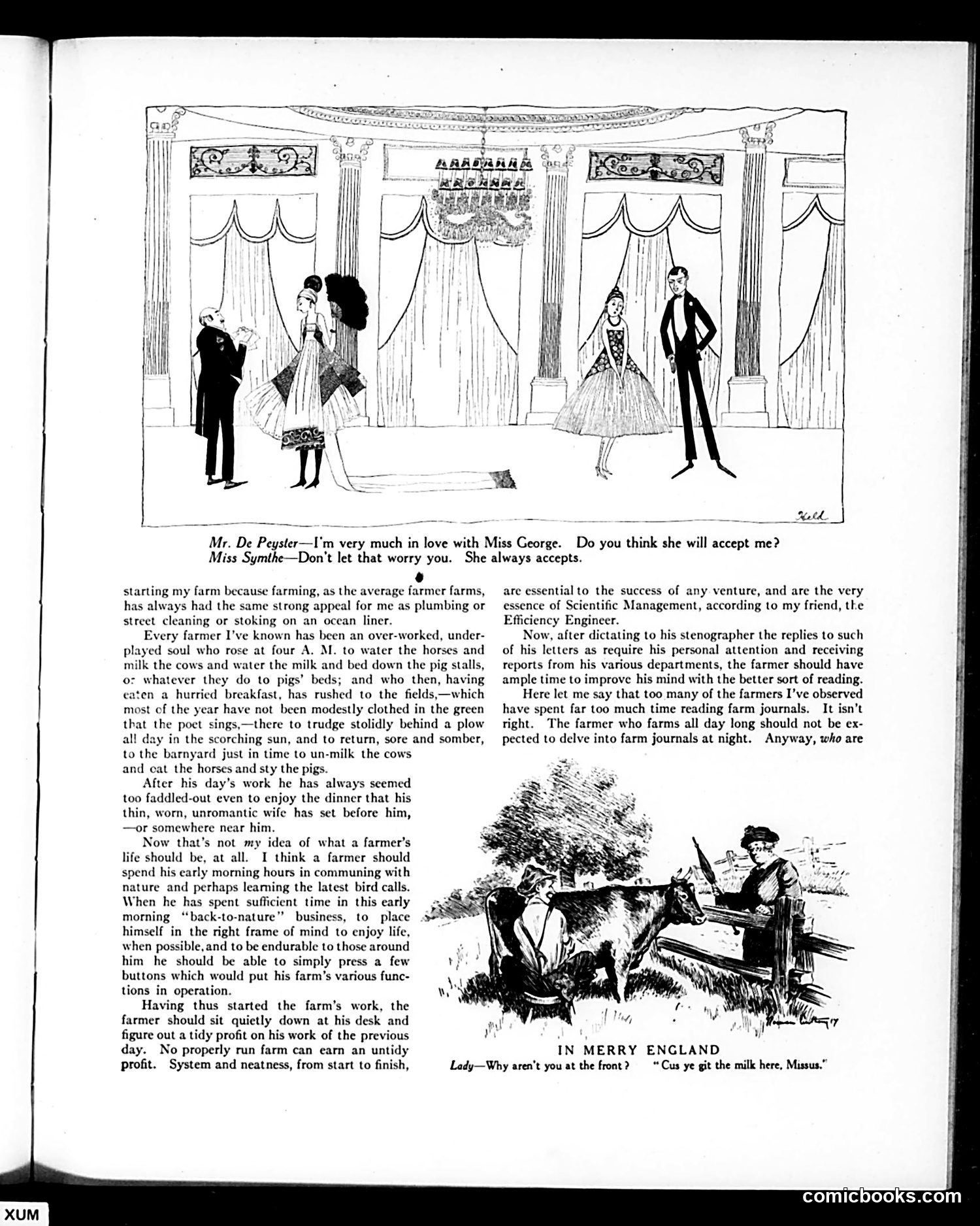
**Top Cartoon:** A drawing-room scene satirizing shallow high-society romance. Mr. De Peyster asks if Miss George will accept his marriage proposal; Miss Smythe replies "Don't let that worry you. She always accepts"—implying Miss George is promiscuously willing to marry anyone. The joke targets the frivolous marriage market among the wealthy elite. **Main Article & Illustration:** A satirical critique of the "Scientific Management" movement (early 1900s efficiency craze). The author mocks a naive vision of modern farming where the farmer merely presses buttons to automate work, then sits at a desk calculating profits—ignoring the brutal physical reality of farm labor. The illustration shows actual farmwork's grinding reality. **Bottom Cartoon ("In Merry England"):** A wartime joke (likely WWI-era). A lady asks a man why he isn't at the front; he replies he must stay to milk the cows—satirizing the excuse-making of those avoiding military service by claiming essential home duties.
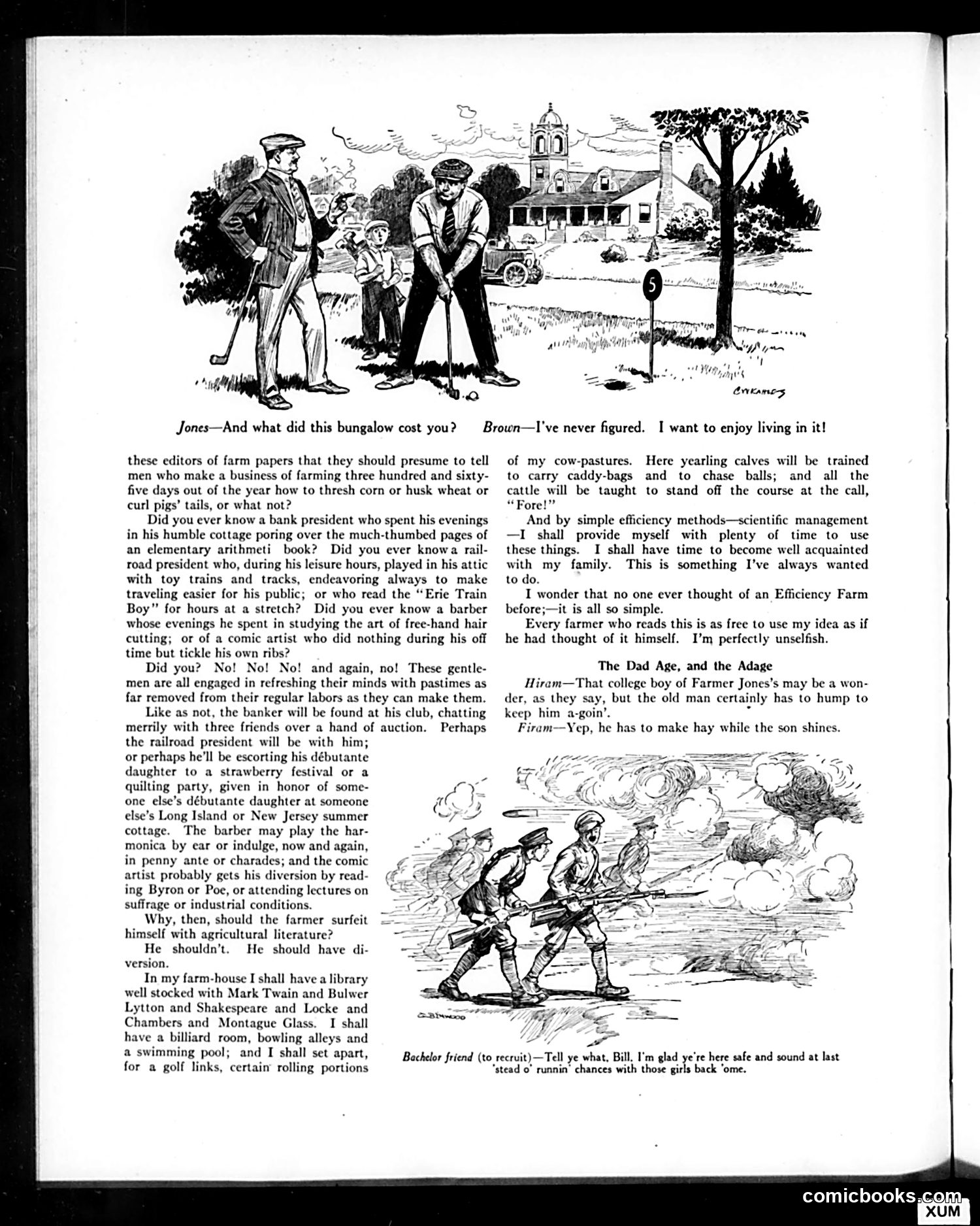
This page satirizes a wealthy farmer's pretentious vision of rural life. The top cartoon shows "Jones" describing his new bungalow to "Brown," who simply wants to enjoy living in it—establishing the conflict between aspiration and practicality. The lengthy text mocks the farmer's absurd plan to import urban leisure into farm life. He argues that professionals (bankers, railroad presidents, barbers) don't practice their trades during leisure—so why should farmers read agricultural literature? Instead, he'll stock his farmhouse with classic literature, add billiard rooms, bowling alleys, and a golf course on his cow-pastures. He'll train calves to carry golf bags. The satire targets the farmer's delusion that "scientific management" and efficiency will somehow create abundant free time for cultured pursuits while actually farming. The bottom cartoon reinforces the theme: while the college boy enjoys leisure, the old farmer "has to hump to keep him a-goin'"—suggesting hard farm work never stops regardless of fancy theories. The joke: farmers can't escape their labor through mere pretension or pseudo-scientific management.
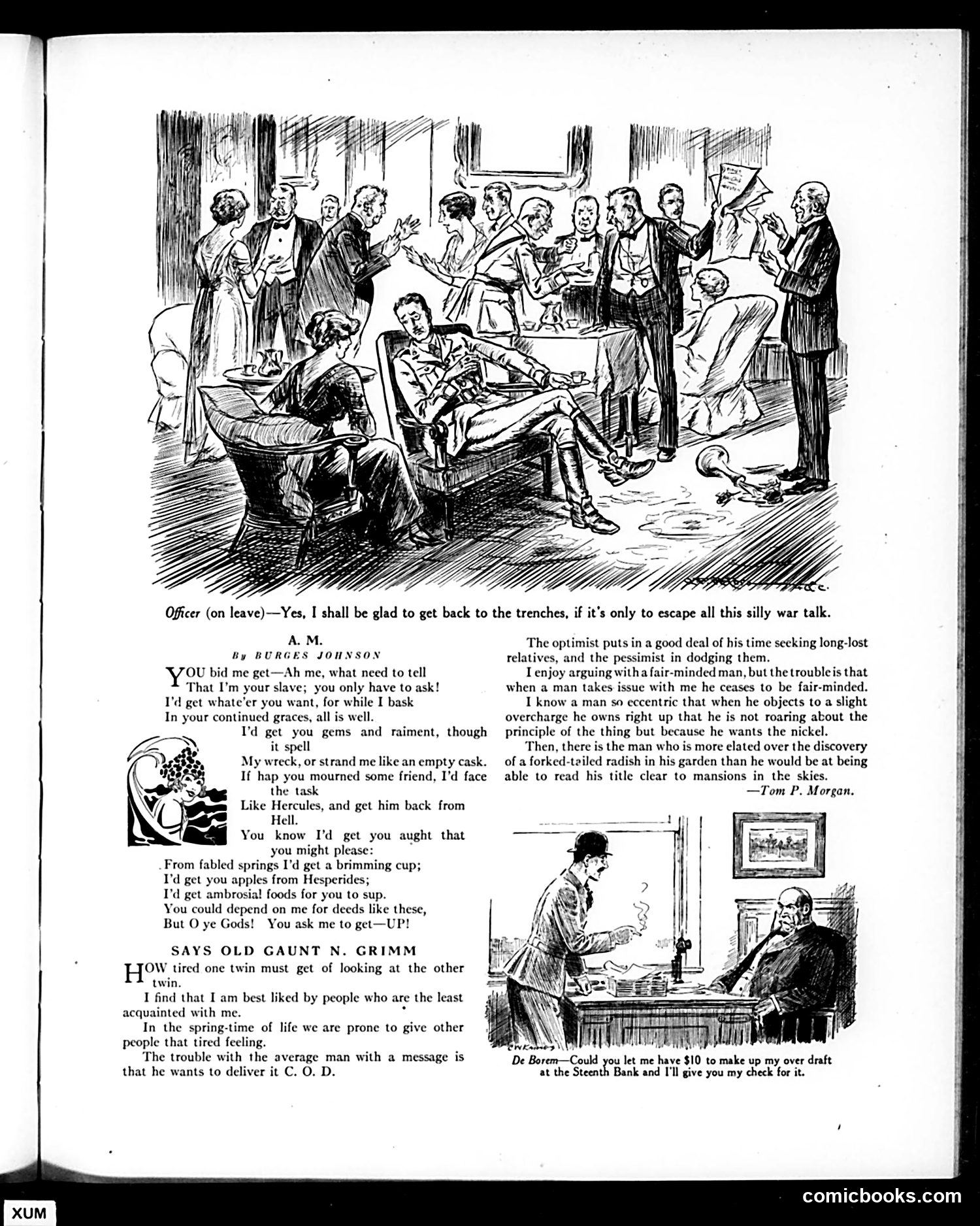
This page collects humorous observations and cartoons satirizing early 20th-century American social types and behavior. The **top cartoon** depicts an officer on military leave complaining about endless "war talk"—likely referencing WWI-era domestic discussion, where he'd prefer to escape to the trenches rather than endure civilians' endless commentary. The **poem by Burges Johnson** humorously contrasts romantic devotion with one practical limitation: the speaker will do anything *except* get out of bed—mocking lazy suitors and exaggerated promises. The **prose section** contains witty observations about human nature: optimists chasing relatives, pessimists avoiding them; argumentative people ceasing to be "fair-minded"; and the eccentric man obsessed with a forked radish more than spiritual matters. The **bottom cartoon** shows a bank interaction where someone requests an overdraft loan, promising to repay via check—a circular, absurd transaction mocking financial desperation and poor banking practices. The satire targets human vanity, laziness, and contradictory behavior.
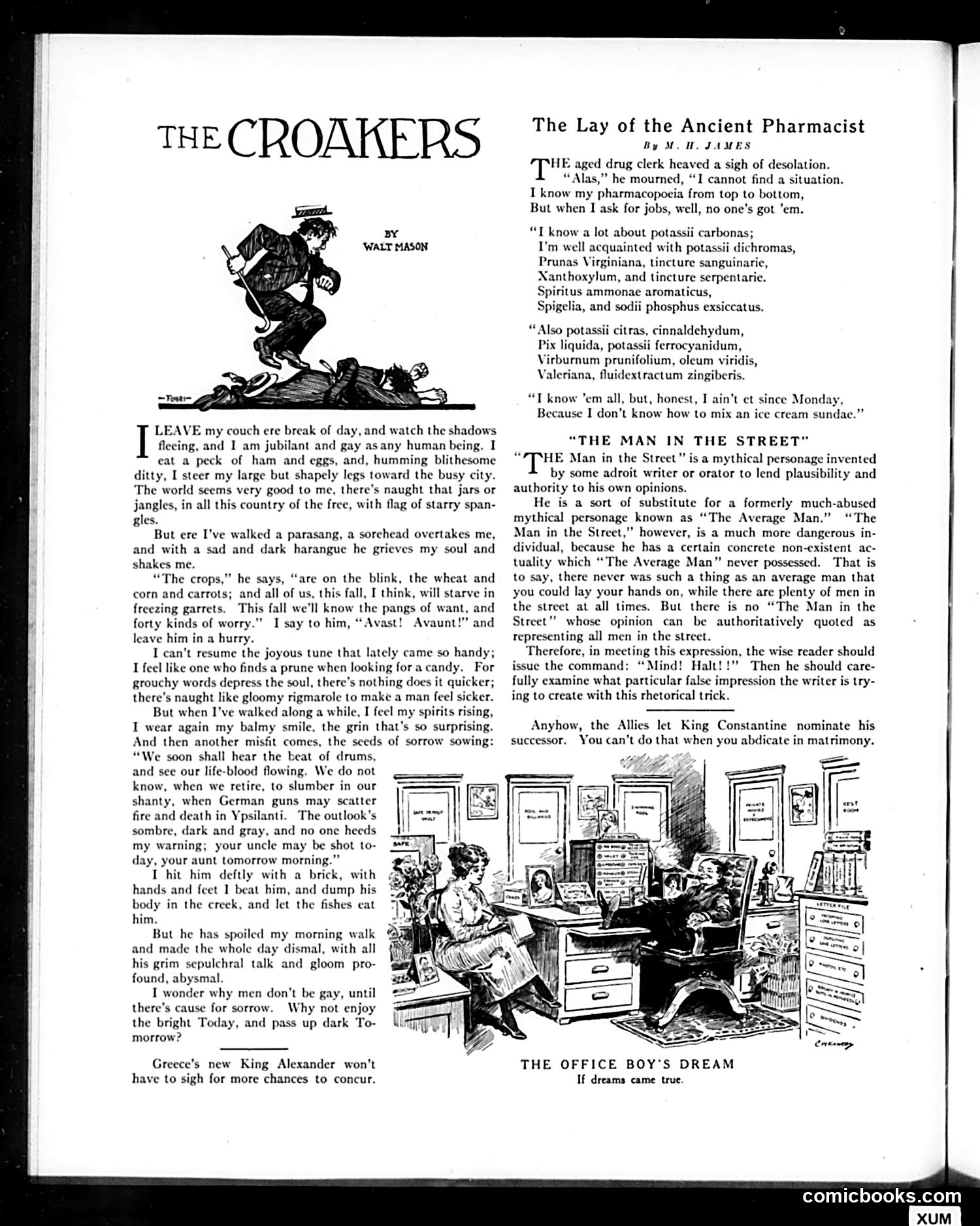
**"The Croakers"** (left) satirizes pessimists who spread doom and gloom. The poem's narrator encounters repeated "sorehead" complainers—one warning of crop failures and starvation, another predicting war and death—who poison his cheerful mood. The humor lies in his increasingly violent (fantastical) responses, culminating in drowning one in a creek. It's a wartime piece (references to Ypsilanti, German guns) mocking defeatist talk. **"The Lay of the Ancient Pharmacist"** jokes about unemployed expertise. A pharmacist can recite elaborate Latin pharmaceutical terms perfectly but can't find work—and can't even make a basic ice cream sundae. The satire targets educated specialists rendered useless by economic conditions (likely postwar unemployment). **"The Man in the Street"** (right) is meta-commentary explaining how writers and politicians invoke this invented "everyman" figure to lend false authority to opinions. The piece warns readers to distrust this rhetorical trick. The bottom cartoon ("The Office Boy's Dream") depicts a young worker daydreaming at his desk—common aspirational humor of the era.
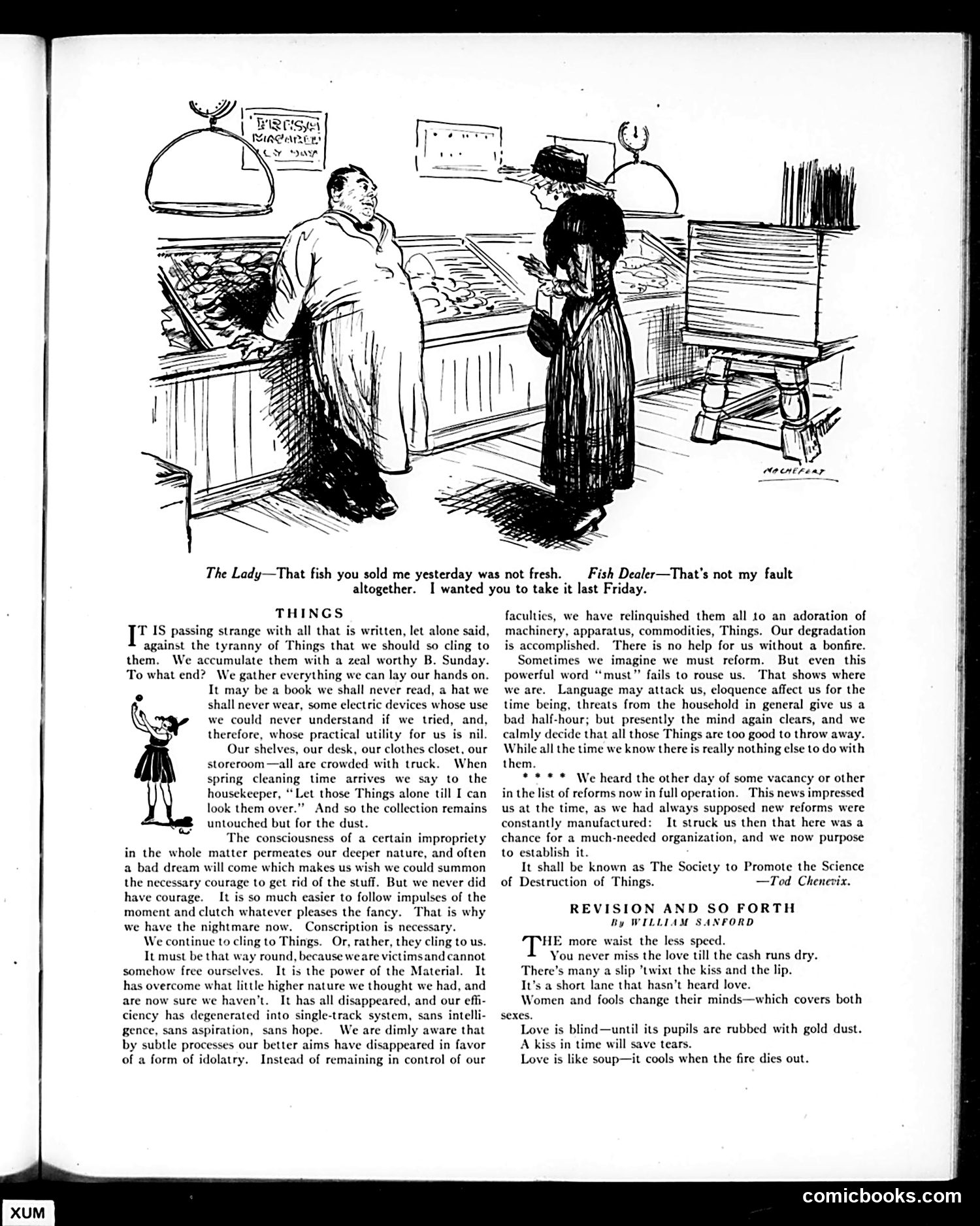
**The Cartoon (top):** A fish dealer and dissatisfied customer dispute over spoiled fish. The lady complains the fish wasn't fresh; the dealer deflects blame, saying she should have taken it Friday. This is a straightforward consumer complaint joke—the dealer won't take responsibility. **"Things" Essay (main text):** This is social satire about materialism and consumerism. The author argues that modern people obsessively accumulate possessions—books, clothes, gadgets—they don't use or need, but lack courage to discard them. He suggests materialism has corrupted human nature, replacing aspiration with "idolatry" of commodities. The essay proposes a humorous solution: a "Society to Promote the Science of Destruction of Things"—essentially, a bonfire of excess possessions. **Context:** This reflects early 20th-century anxieties about industrial consumer culture and clutter, anticipating modern decluttering movements. The tone mixes genuine social criticism with satirical wit typical of *Judge* magazine.
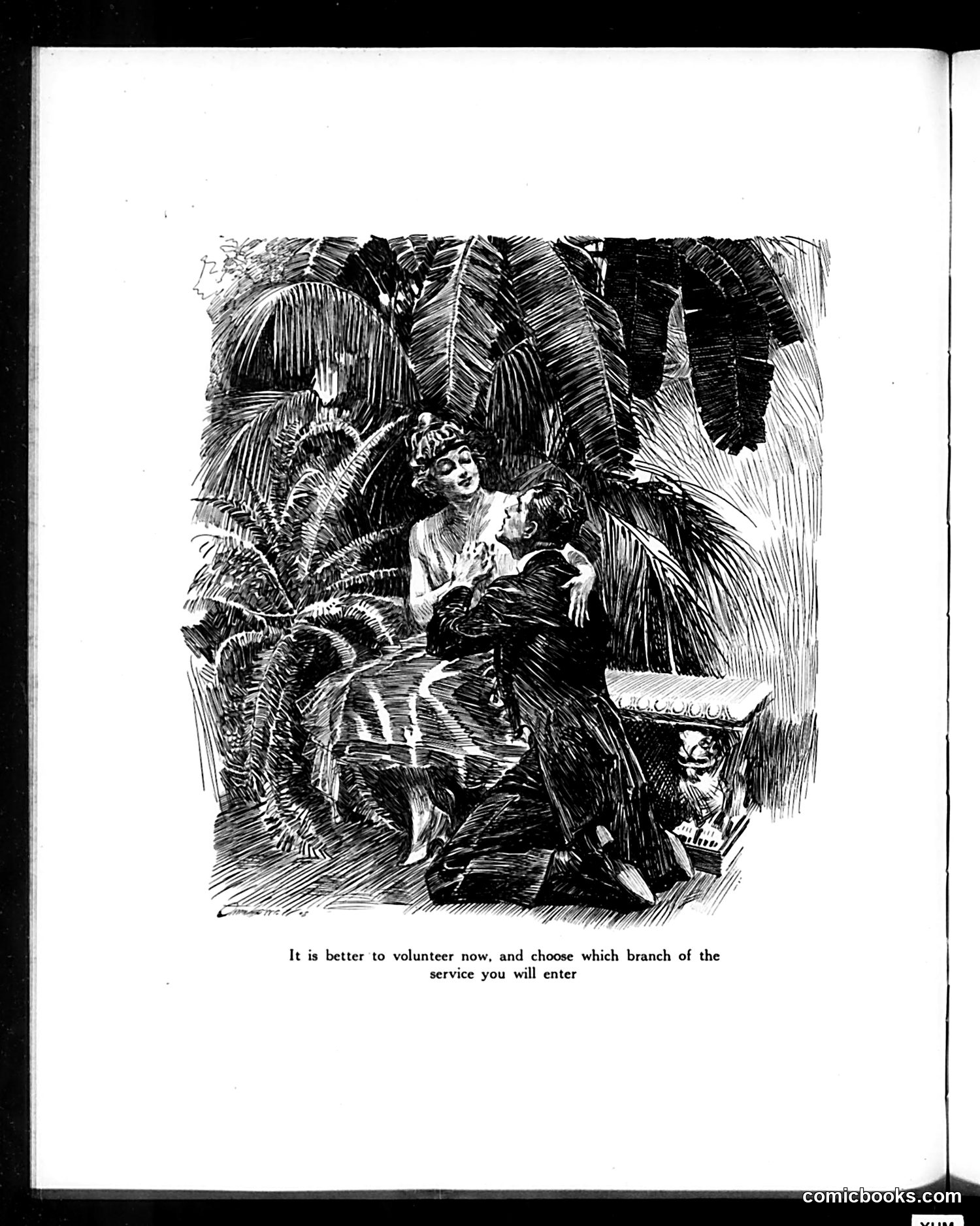
This is a WWI-era recruitment cartoon from *Judge* magazine. It depicts a well-dressed woman persuading a man (likely a young suitor or romantic interest) to enlist voluntarily in military service. The tropical setting with palm fronds suggests an intimate, private moment—perhaps meant to appeal to masculine pride or romance. The caption's message is propagandistic: volunteer now so you can *choose* your service branch, implying that waiting means forced conscription with no choice. This reflects the tension between voluntary and mandatory enlistment during America's WWI mobilization. The cartoon uses domestic/romantic pressure as a recruitment tool, suggesting women should encourage men to enlist. It's subtle psychological manipulation dressed as romantic persuasion.
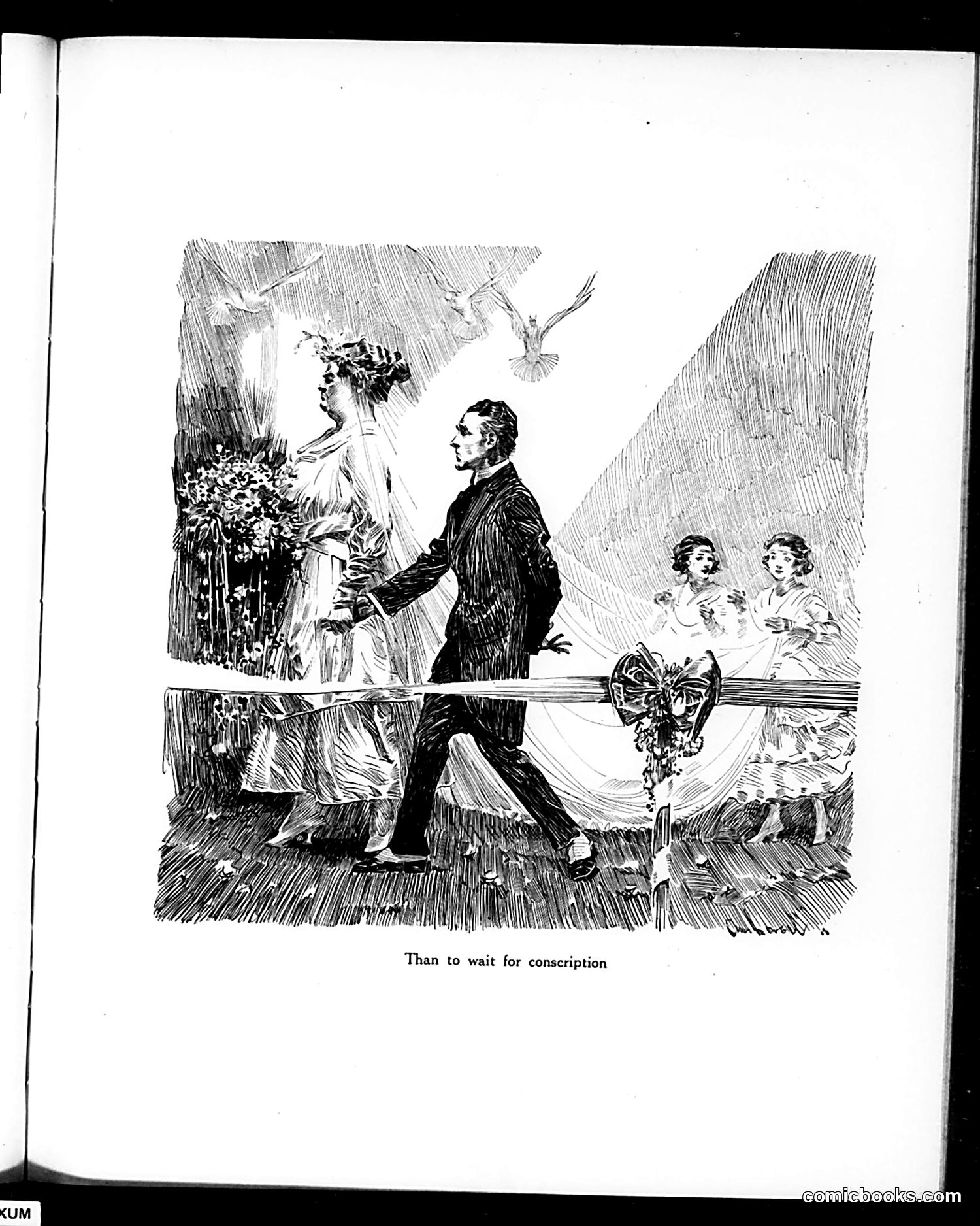
This Judge magazine cartoon satirizes men rushing into marriage to avoid military conscription. The image shows a man in formal dress presenting flowers to a woman, while Cupid flies overhead and two cherub-like figures observe on the right—suggesting a hastily arranged romantic scenario. The caption's dark humor implies that marriage was preferable to being drafted into military service. This likely references either World War I or II era conscription debates in America, when some men sought marriage as a potential exemption from draft obligations (though eligibility rules varied by conflict and period). The satire mocks both the desperation of draft-dodging and the mercenary nature of wartime marriages, presenting marriage itself as an escape route rather than a genuine romantic commitment.
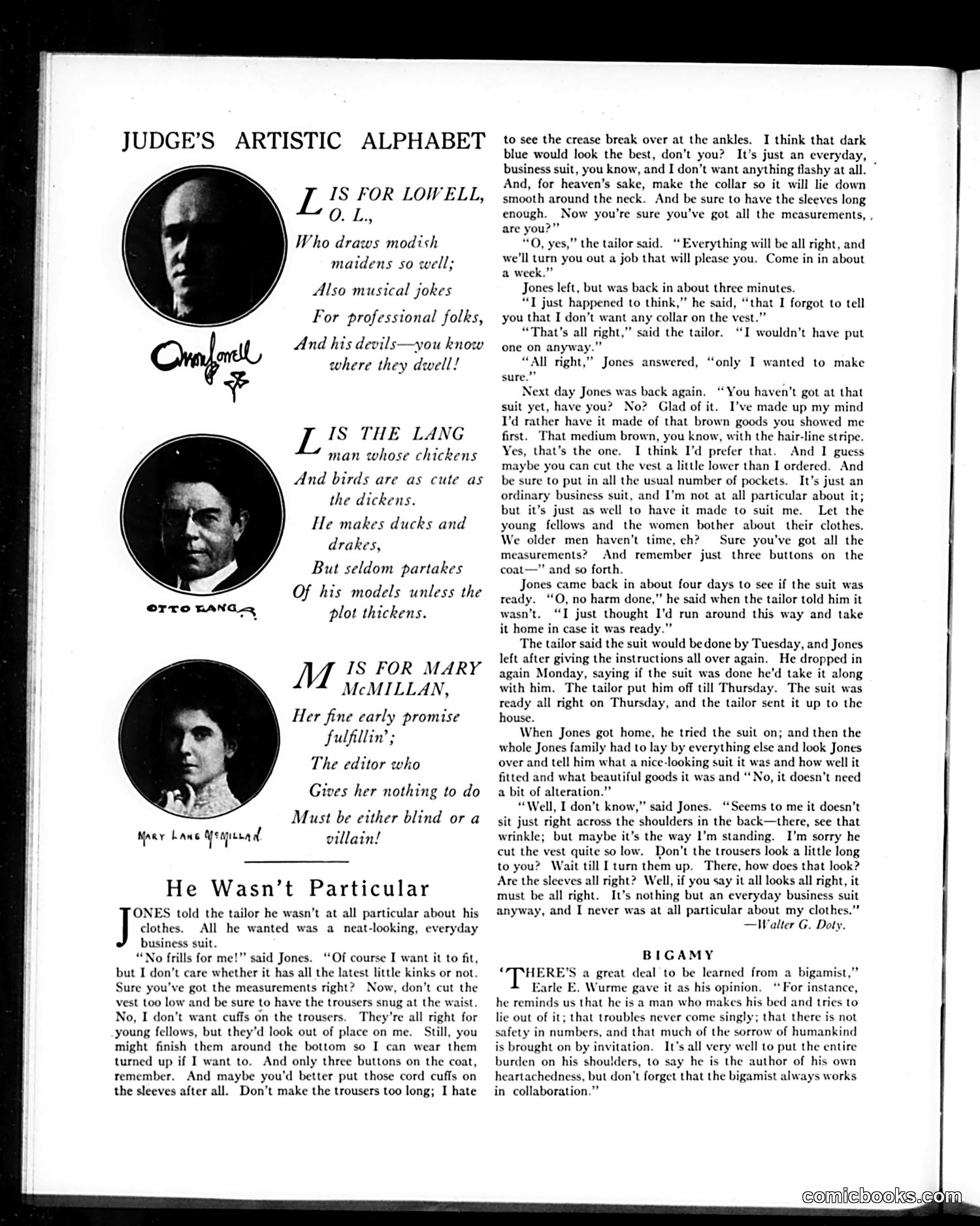
This page contains two distinct elements: **The "Artistic Alphabet"** features caricatured portraits of three contributors to Judge magazine: Lowell (O.L.), who draws fashionable maidens and devils; Lang, known for cute animal illustrations; and Mary McMillan, an editor criticized for being underutilized—the verse suggests whoever supervises her "must be either blind or a villain" for wasting her talent. **"He Wasn't Particular"** is the main story, satirizing a man who claims to want a simple business suit but then obsessively micromanages every detail—collar height, button count, cuff style, fabric choice, trouser length—while repeatedly visiting the tailor with contradictory instructions. The humor lies in the gap between his stated indifference ("I'm not at all particular") and his exhausting perfectionism, mocking men who claim casual attitudes while demanding meticulous control.
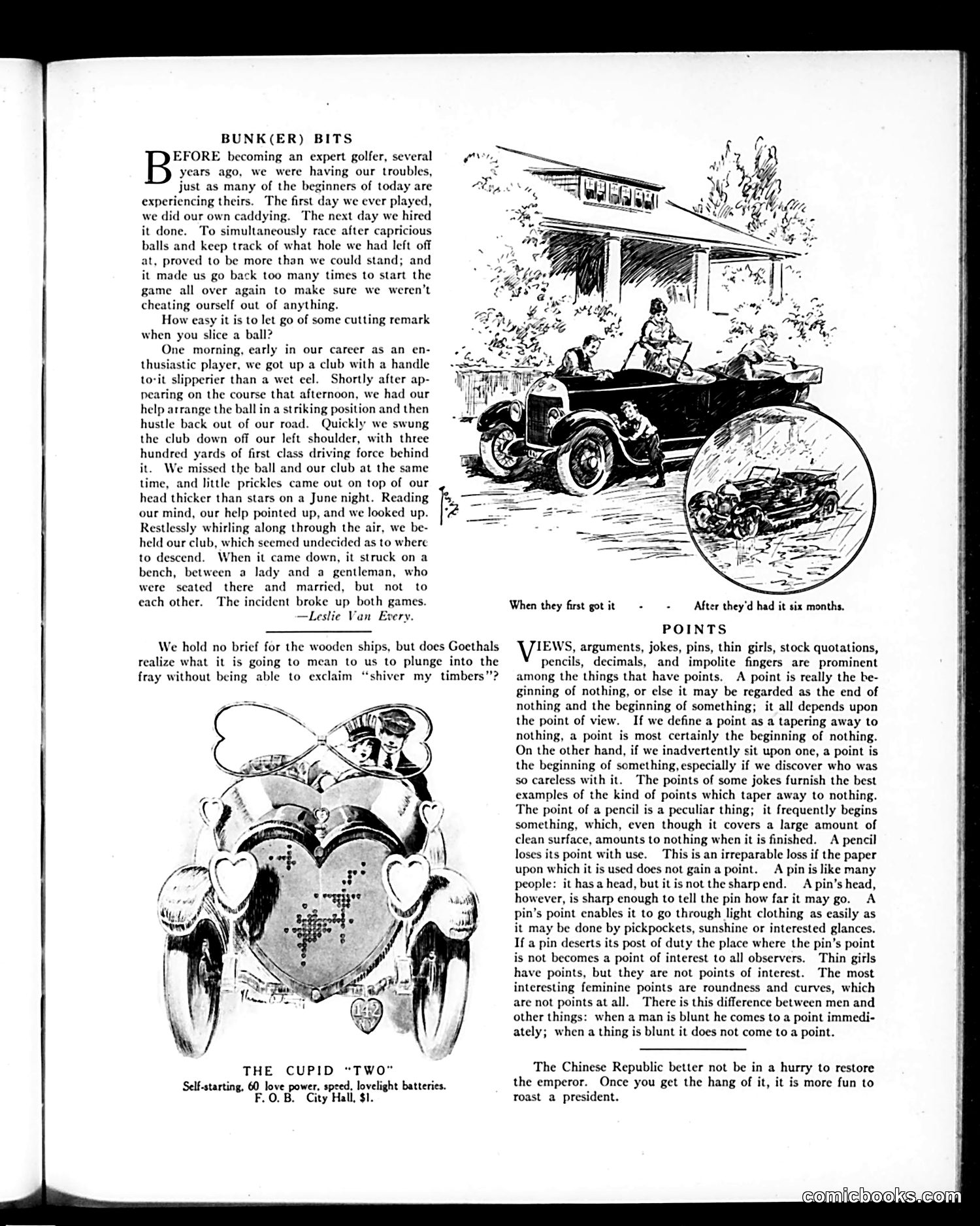
This page contains three distinct pieces of humor content: **"Bunker(er) Bits"** is a golf anecdote by Leslie Van Every. The narrator describes a mishit golf swing where the club flies through the air and strikes a bench between a married couple and another person—implying an affair. The humor derives from the awkward situation created and the disruption of "both games" (golf and romance). **"The Cupid 'Two'"** is an automobile advertisement joke. It shows a car before and after six months of marriage, depicting deterioration. The satire mocks newlyweds' honeymoon period versus marital reality, playing on the trendy "self-starting" automobiles of the era. **"Points"** is philosophical wordplay exploring the multiple meanings of "point"—literal (pencil tips, pins) and figurative (arguments, jokes). It's extended commentary on how "points" vary in significance depending on context and perspective. The closing reference to the Chinese Republic appears unrelated, possibly editorial commentary. These are light, contemporary satirical pieces typical of Judge's humor style.
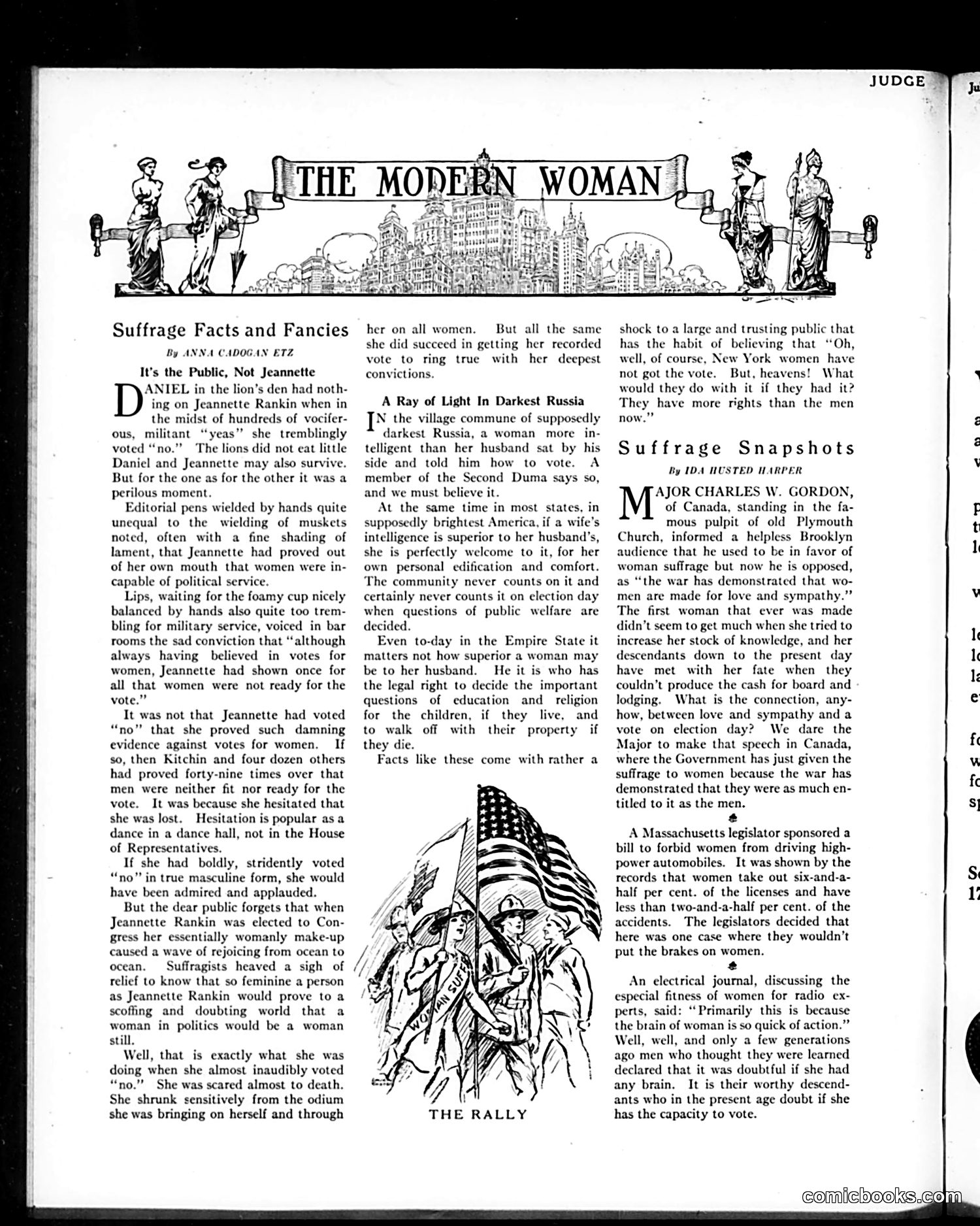
This page satirizes anti-suffrage arguments circulating during the women's suffrage debate (likely early 1900s, given reference to Jeannette Rankin's 1916 Congressional vote). **Main cartoon "The Rally"** depicts a suffrage march with an American flag, representing women's organized political activism. **The article criticizes opponents' logic:** When Jeannette Rankin voted hesitantly on a measure, anti-suffragists claimed this "proved" women unfit for politics. The author notes men voted the same way without similar scrutiny—the real issue was her *demeanor*, not her vote. **The Russian comparison** highlights hypocrisy: Americans boast of women's superior rights versus "darkest Russia," yet U.S. law denies married women control over their children's education and property. **"Suffrage Snapshots"** quotes a Canadian clergyman claiming women are "made for love and sympathy," not politics—a common contemporary argument that women's nature disqualified them from voting. The page's satire exposes the circular logic and double standards used to oppose women's suffrage.
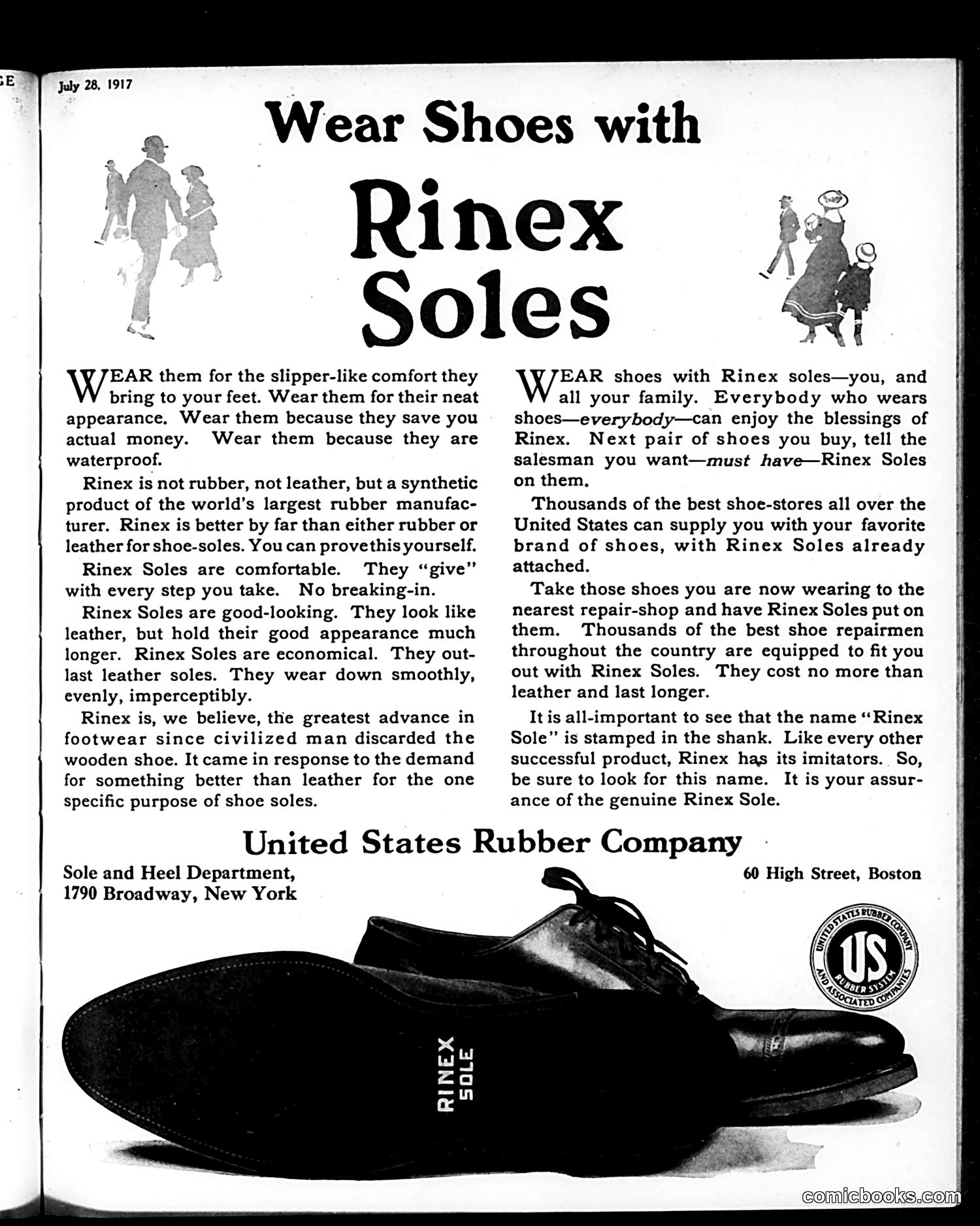
This is **a full-page advertisement**, not satirical content. It promotes Rinex Soles, a synthetic shoe sole product manufactured by the United States Rubber Company (dated July 28, 1917). The ad makes claims typical of early 20th-century marketing: Rinex is superior to leather or rubber, more durable, economical, waterproof, and requires no "breaking-in." The text emphasizes this is a synthetic innovation—"the greatest advance in footwear since civilized man discarded the wooden shoe." The illustrations show families and individuals wearing shoes with Rinex soles, normalizing the product across demographics. A large photograph displays the sole stamped with the brand name, with a US Rubber Company seal for authenticity. A notable detail: the ad warns consumers to verify "Rinex Sole" is stamped on shoes, explicitly acknowledging counterfeit imitators exist—suggesting the product's market success had already attracted knockoffs by 1917.
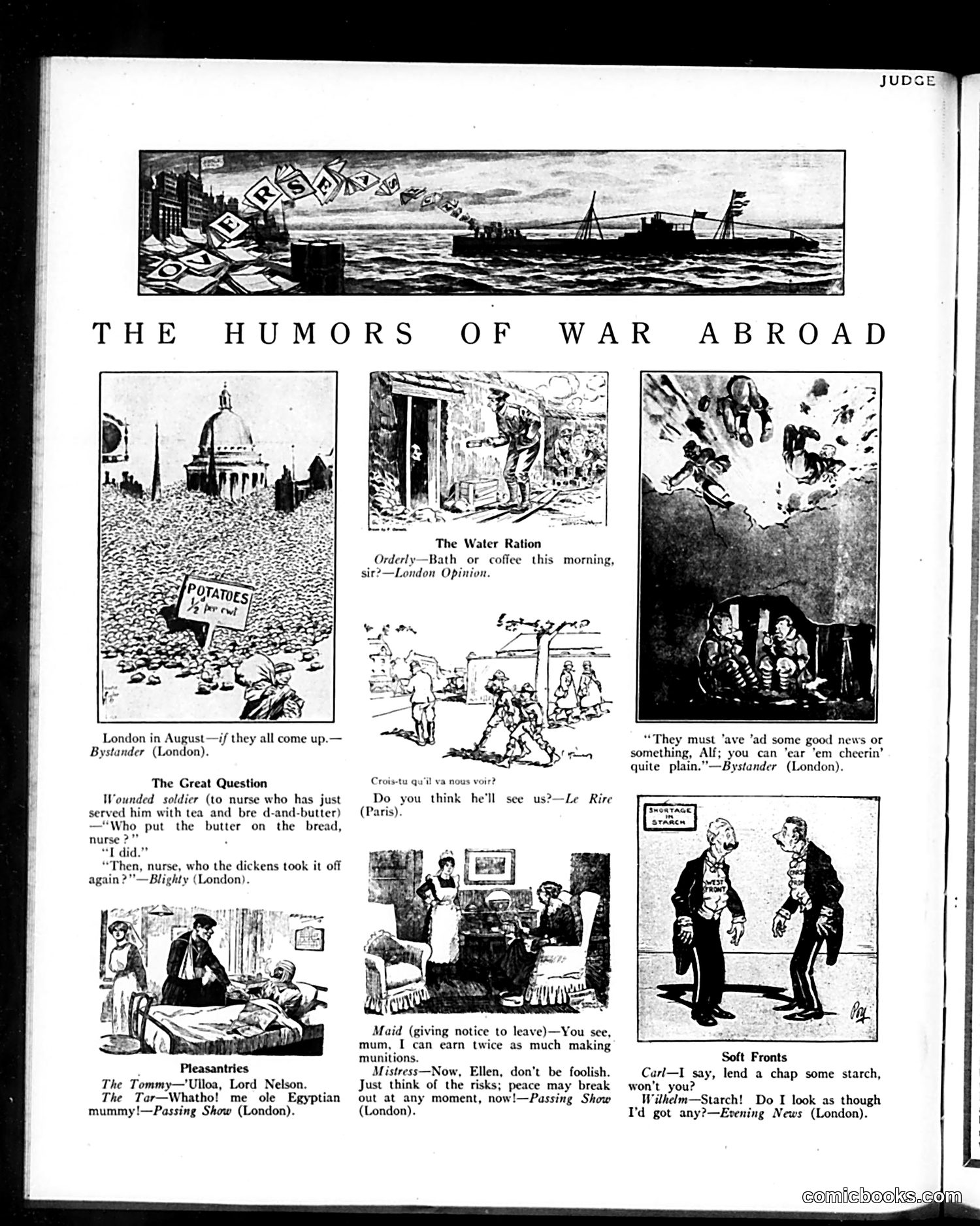
This Judge page compiles wartime humor from British satirical magazines, mocking WWI conditions through British working-class perspectives. Key satirical points: **"The Great Question"**: A wounded soldier jokes bitterly about missing butter—food scarcity and rationing were severe hardships. **"The Water Ration"**: Dark humor about choosing between bathing or coffee, highlighting extreme resource shortages. **Maid's Notice**: Satirizes home-front moral collapse—a servant abandons domestic service for munitions factory work (double wages), while her employer ironically fears "peace may break out," revealing how war profiteering sustained the conflict economically. **"Soft Fonts"**: Wilhelm (caricatured German kaiser) claims he lacks starch—likely mocking German resource depletion or morale collapse. The collection presents working-class British wartime experience: food rationing, water scarcity, labor mobility, and economic disruption—wrapped in dark humor to make hardship palatable to readers.
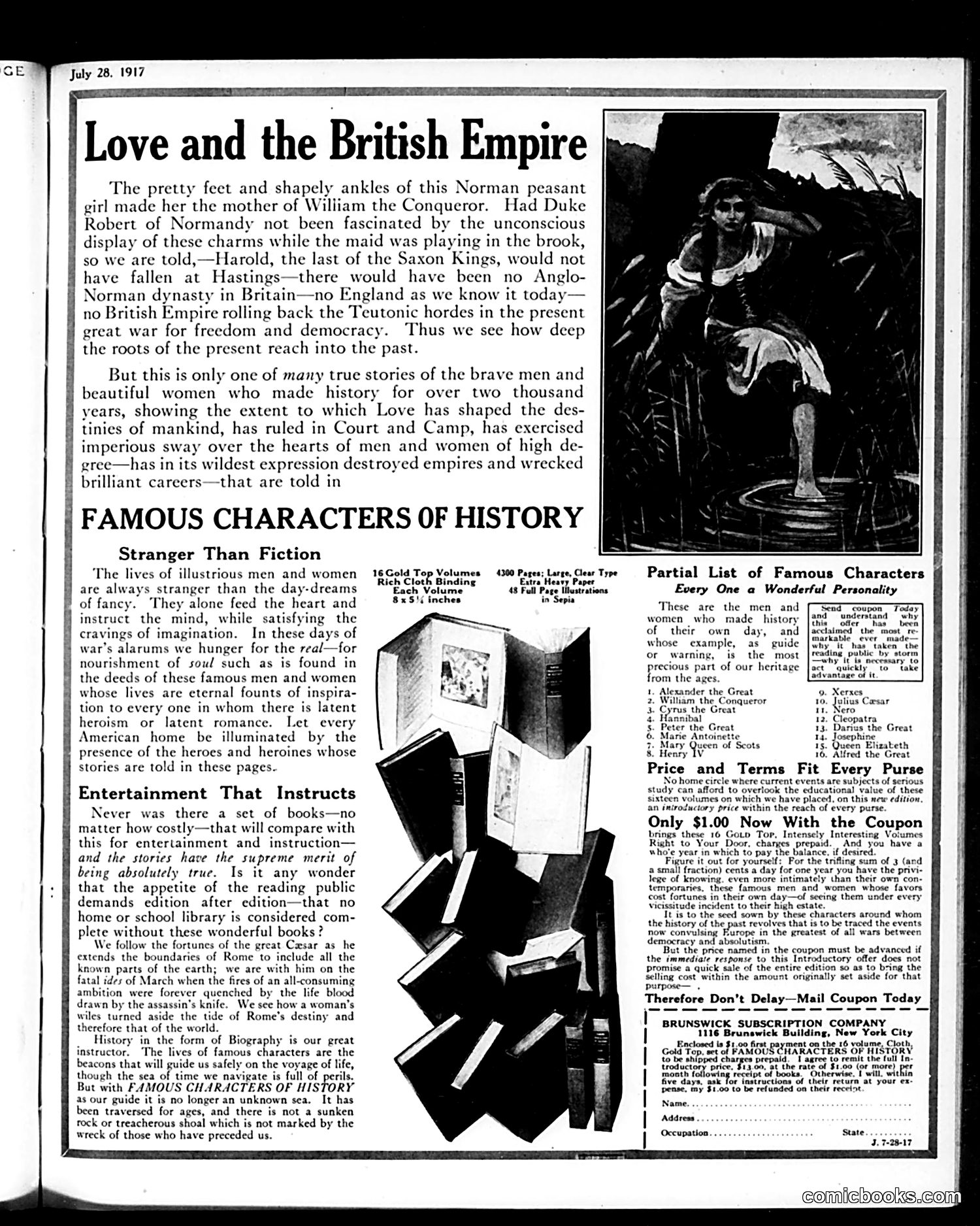
This is primarily a **product advertisement** disguised as historical commentary, published during World War I (July 1917). The opening section uses a tenuous historical claim to sell a 16-volume encyclopedia set called "Famous Characters of History." The narrative argues that a Norman peasant girl's beauty led to William the Conqueror's birth, which eventually resulted in the British Empire—which is now fighting in WWI against "Teutonic hordes." **The propaganda angle**: The ad conflates romantic love with imperial destiny, suggesting that Britain's current military struggle is the natural culmination of historical forces. This frames WWI as a continuation of civilization's grand narrative. **The visual**: A stack of leather-bound volumes is prominently displayed, emphasizing the product's impressive appearance and perceived value. **The pitch**: At only $1.00 with a coupon (charges prepaid), these books promise to illuminate American homes with heroic inspiration during wartime—a clever marketing tactic exploiting patriotic sentiment and hunger for meaning during a costly, confusing conflict.
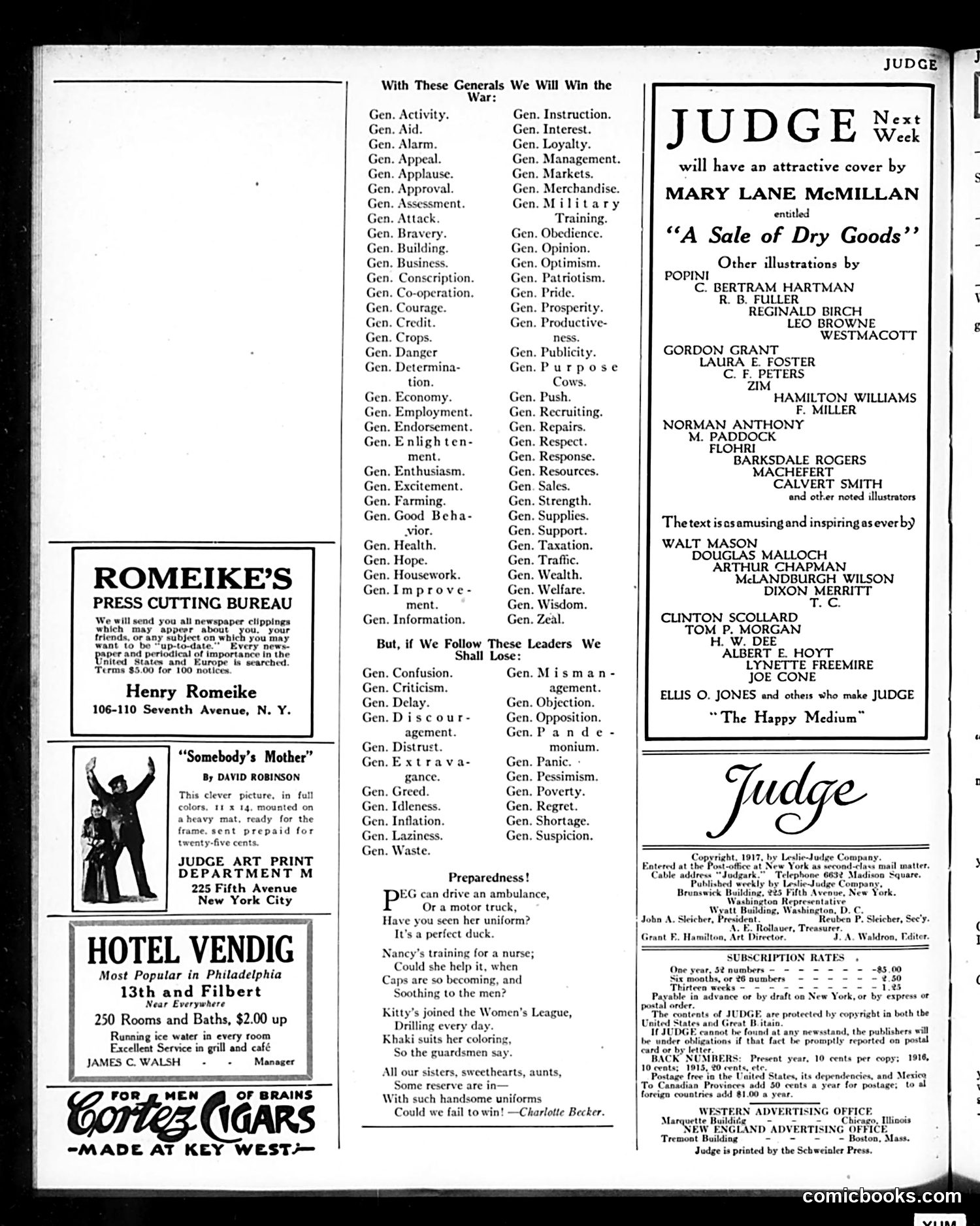
This is primarily a **title/contents page** rather than a satirical cartoon, though it contains one poem with social commentary. **Main Content:** The page features two paired lists of military virtues ("With These Generals We Will Win") versus vices ("If We Follow These Leaders We Shall Lose")—a wartime morale piece from 1917, during U.S. involvement in World War I. The lists use puns on "General" (rank/concept), mixing actual military qualities with abstract virtues. **The Satire:** The poem "Preparedness!" by Charlotte Becker mocks young women joining military auxiliary services, suggesting their motivation is vanity rather than patriotism. It portrays them as more interested in how khaki uniforms flatter their appearance and attract male attention than in actual military duty. This reflects period anxieties about women's wartime participation and changing gender roles. **Context:** Published in 1917, this reflects American WWI-era messaging about national preparedness and gendered assumptions about women's motivations.
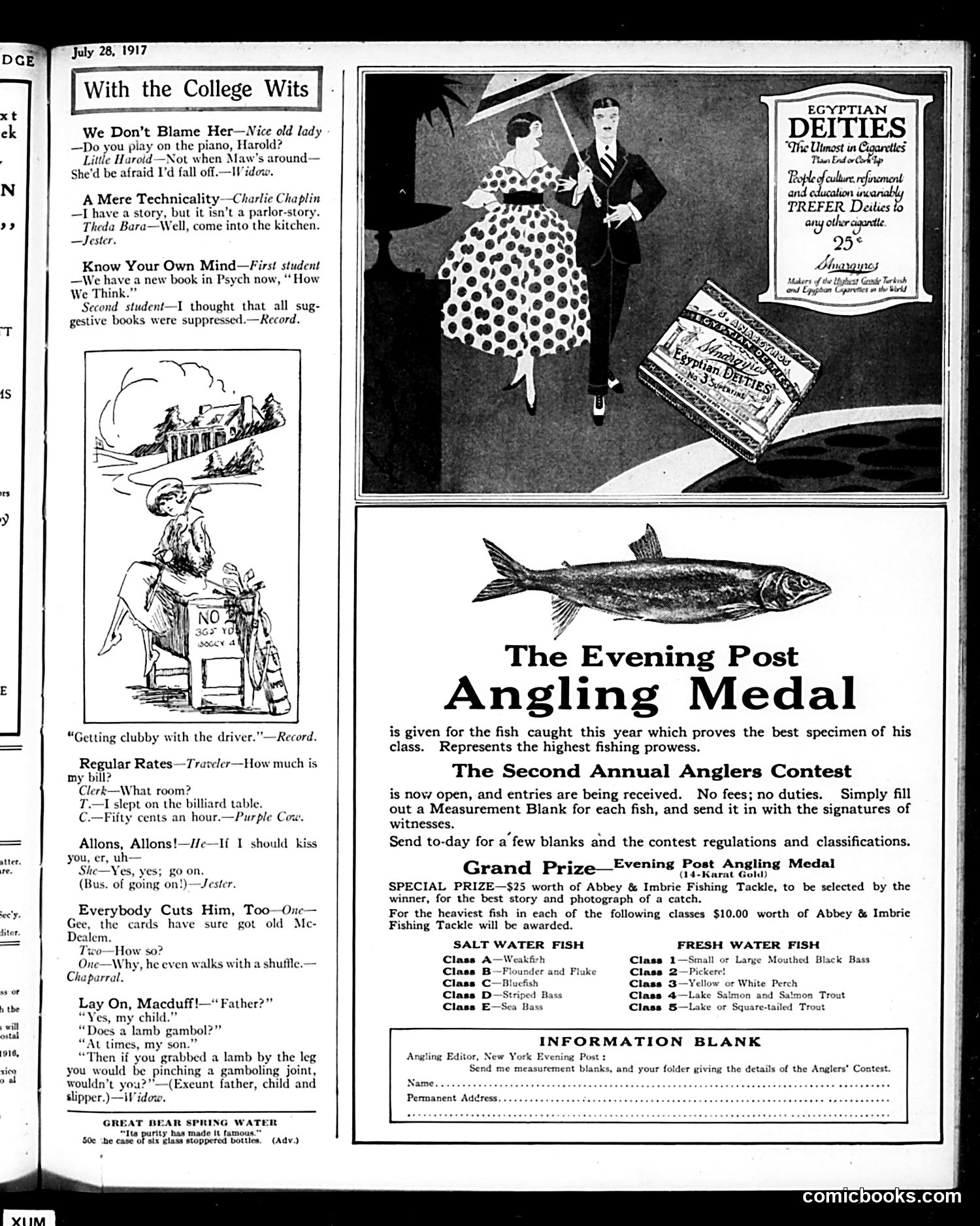
This page features short jokes aimed at college audiences, reflecting 1917 sensibilities. The humor relies on wordplay and mild social commentary: **"We Don't Blame Her"** jokes about a boy afraid to play piano when his mother is present—implying clumsiness or fear of parental criticism. **"A Mere Technicality"** references Charlie Chaplin (famous silent comedian) and Theda Bara (notorious "vamp" actress), with innuendo about privacy in kitchens versus parlors. **"Know Your Own Mind"** satirizes censorship of "suggestive" books in academic psychology texts. Other jokes play on puns ("gambol/gambling joint") and dated slang humor. The right page is primarily **advertising**: an Egyptian Deities cigarette ad and The Evening Post's fishing contest announcement. The cigarette ad's appeal emphasizes quality and Egyptian exoticism—luxury marketing typical of 1917. The page reflects college-age humor of WWI-era America, mixing mild sexual innuendo with wordplay, while advertising leisure products to its educated readership.
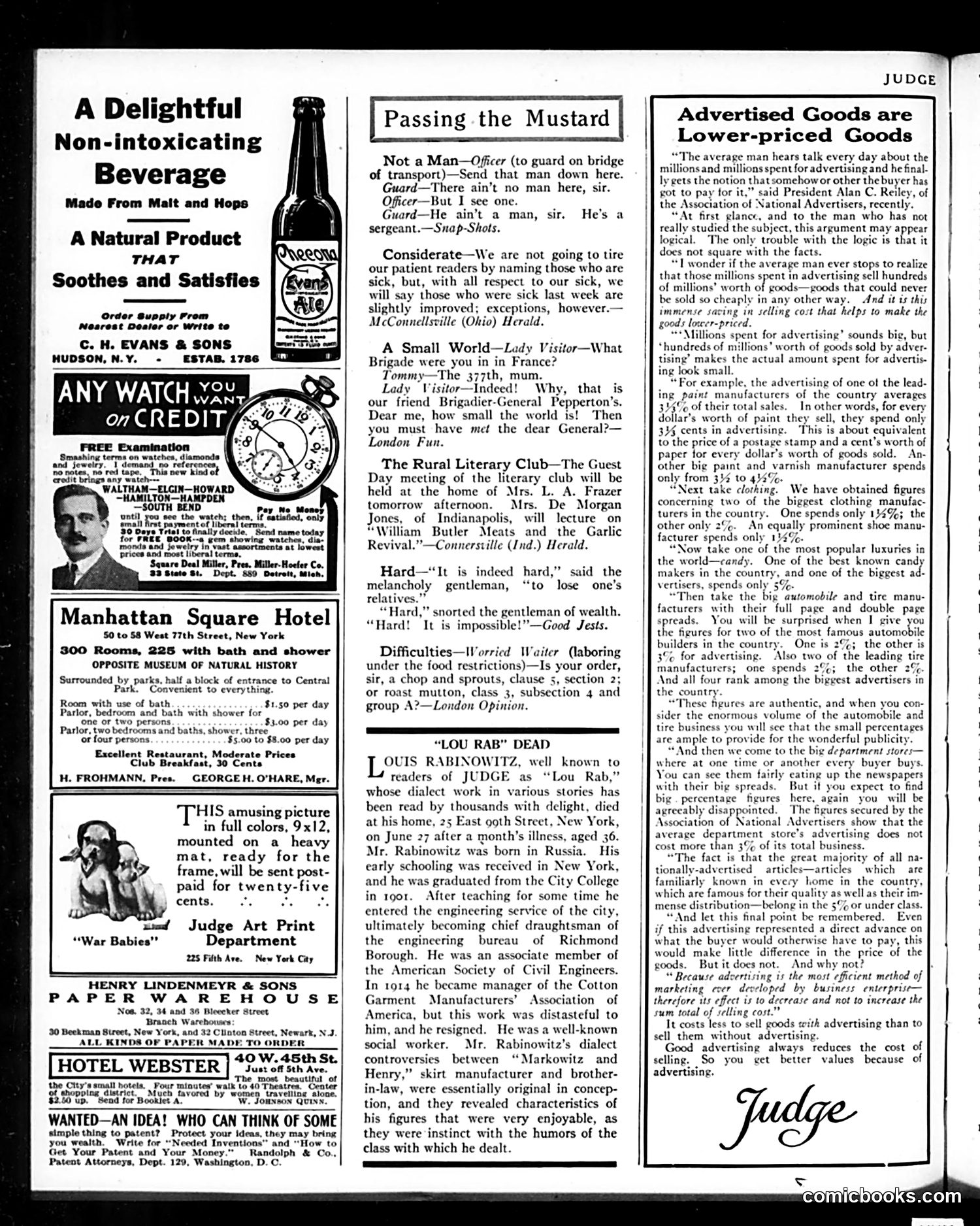
This page is primarily **advertisements and miscellaneous short jokes**, not a political cartoon. The page contains: - Multiple hotel and product ads (beverage, watches, hotels) - A section titled "Passing the Mustard" with brief comic anecdotes - An obituary for **Louis Rabinowitz** ("Lou Rab"), apparently a dialect humorist who contributed humorous stories to *Judge* magazine The small jokes in "Passing the Mustard" are wordplay and observational humor typical of early 20th-century magazines—a sergeant being "not a man," food rationing causing bureaucratic ordering complications, someone claiming a loss of relatives is "impossible" because wealth insulates them. The page reflects period concerns: WWI (France references, food restrictions), urbanization (NYC hotels), and genteel magazine culture. It's a typical issue page rather than featuring major political satire.
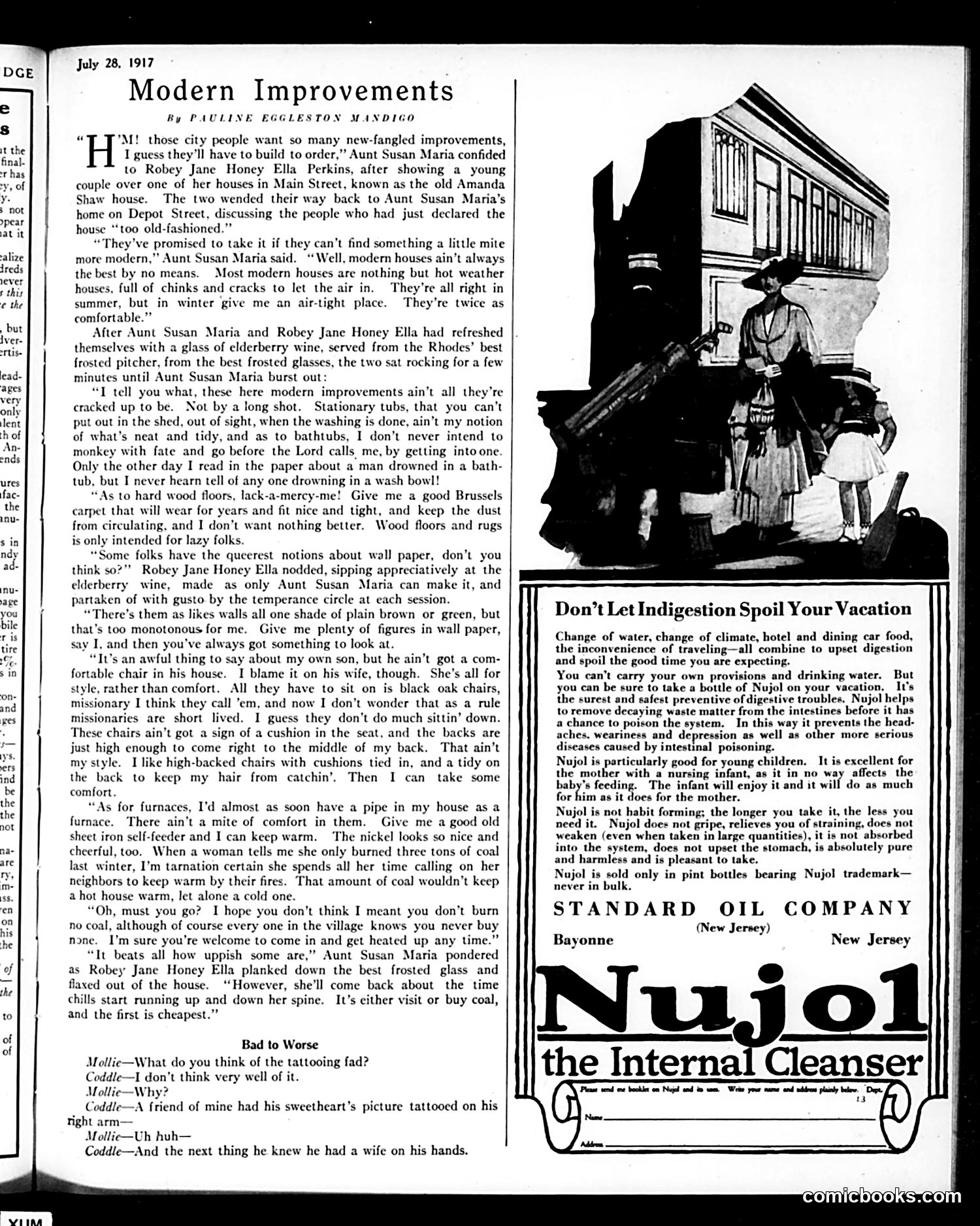
This is a satirical short story (not a cartoon) by Pauline Eggleston Mandigo mocking rural resistance to modern conveniences. Two country women, Aunt Susan Maria and Robey Jane Honey Ella Perkins, discuss a young couple's rejection of an old house as "too old-fashioned." The satire targets older generations' stubborn defense of outdated practices: stationary bathtubs are dangerous (people drown!), hardwood floors encourage laziness, patterned wallpaper beats solid colors, uncomfortable missionary chairs build character, and coal stoves provide coziness that modern furnaces cannot match. The piece gently ridicules small-town conservatism and the clash between rural tradition and urban modernity—a relevant theme in 1917 America as industrialization accelerated. The homespun dialect and folksy wisdom are meant to be both endearing and laughably obstinate.
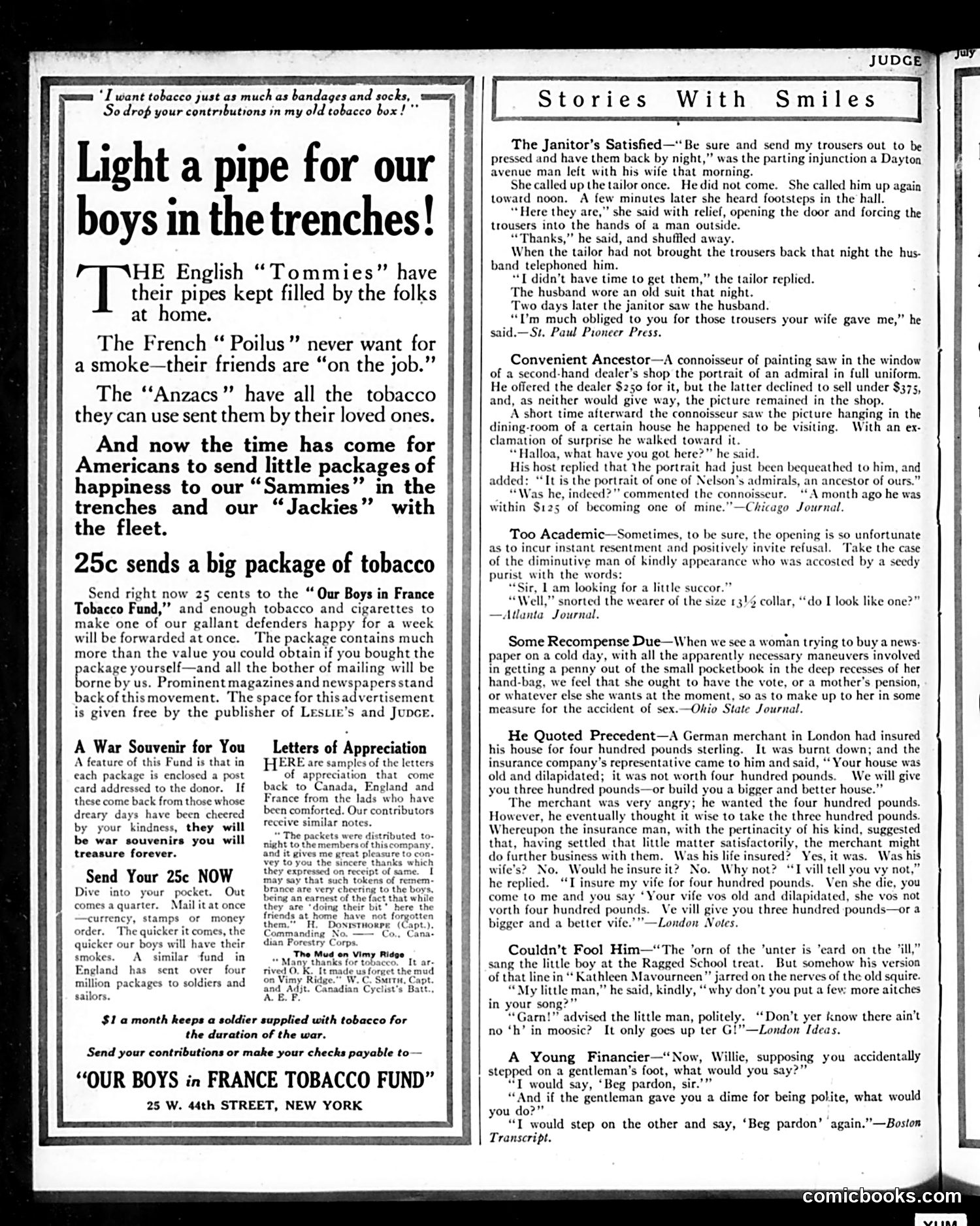
This page is primarily **advertising and fundraising**, not political satire. The dominant content is a wartime charity appeal for the "Our Boys in France Tobacco Fund," soliciting 25-cent donations to send tobacco packages to American soldiers ("Sammies") and sailors ("Jackies") serving in World War I. The appeal uses patriotic framing, comparing American efforts to similar initiatives by British ("Tommies"), French ("Poilus"), and Australian ("Anzacs") soldiers' families. It emphasizes the morale-boosting value of tobacco and promises donors will receive appreciation postcards as "war souvenirs." The right column contains "Stories With Smiles"—humorous anecdotes unrelated to the war, appearing to be filler content typical of Judge magazine's format. The overall message reflects early-20th-century assumptions about tobacco as a legitimate, even virtuous, comfort item for troops.
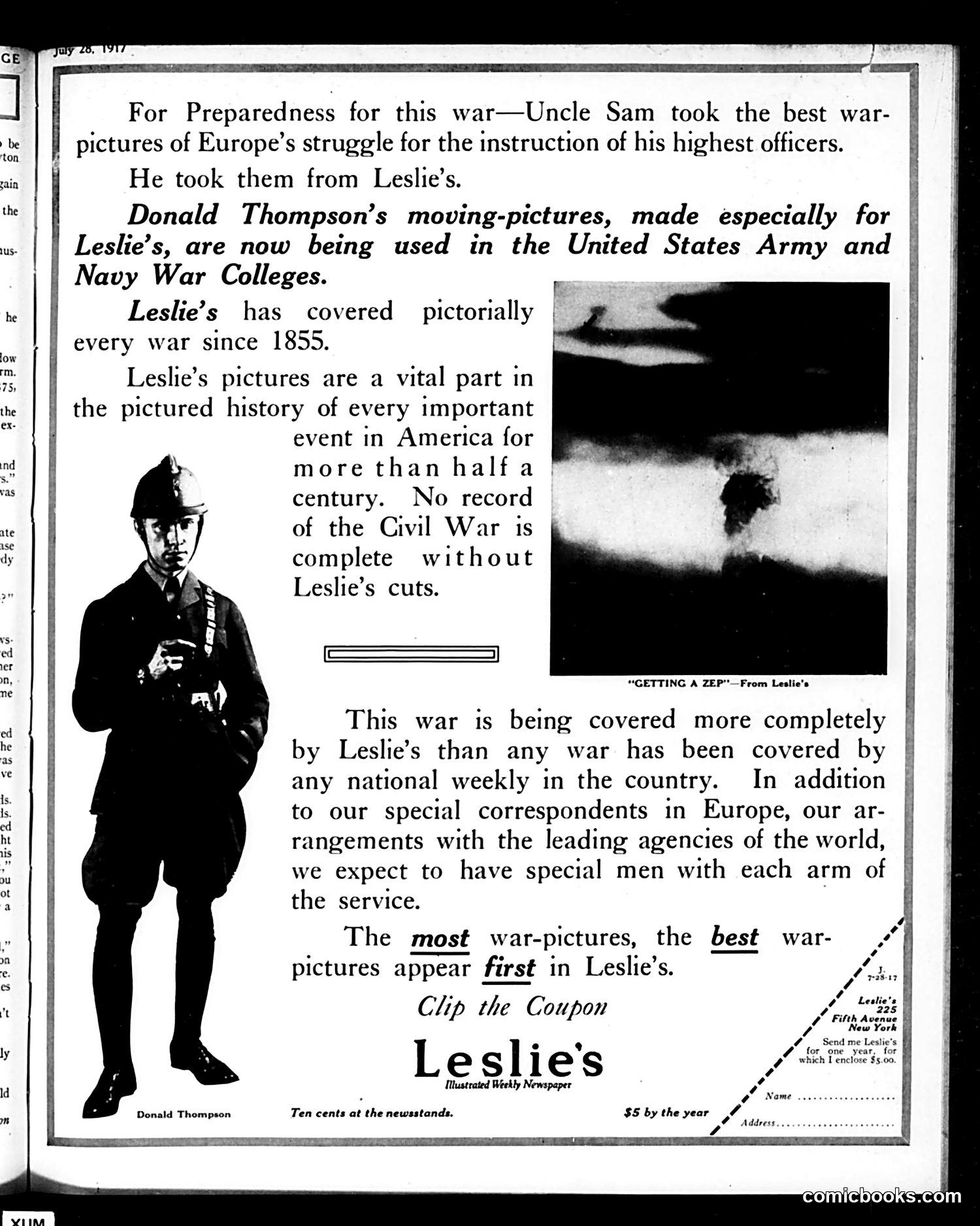
This is primarily an advertisement for *Leslie's* illustrated weekly magazine, using World War I preparedness as its selling point. The page features a silhouetted military officer (identified as Donald Thompson, a war correspondent/filmmaker) and a photograph labeled "Getting a Zep" (referring to a German Zeppelin airship). The ad emphasizes that *Leslie's* provides superior war coverage compared to competitors, claiming its photographs are used by the U.S. Army and Navy War Colleges for officer training. It boasts the magazine has documented every major American conflict since 1855, positioning itself as the authoritative visual record of warfare. The appeal is straightforward: buy *Leslie's* to see the "most" and "best" war pictures before any other publication. At ten cents per issue or $5 yearly, the magazine marketed itself as essential reading for Americans concerned about military preparedness during the Great War.
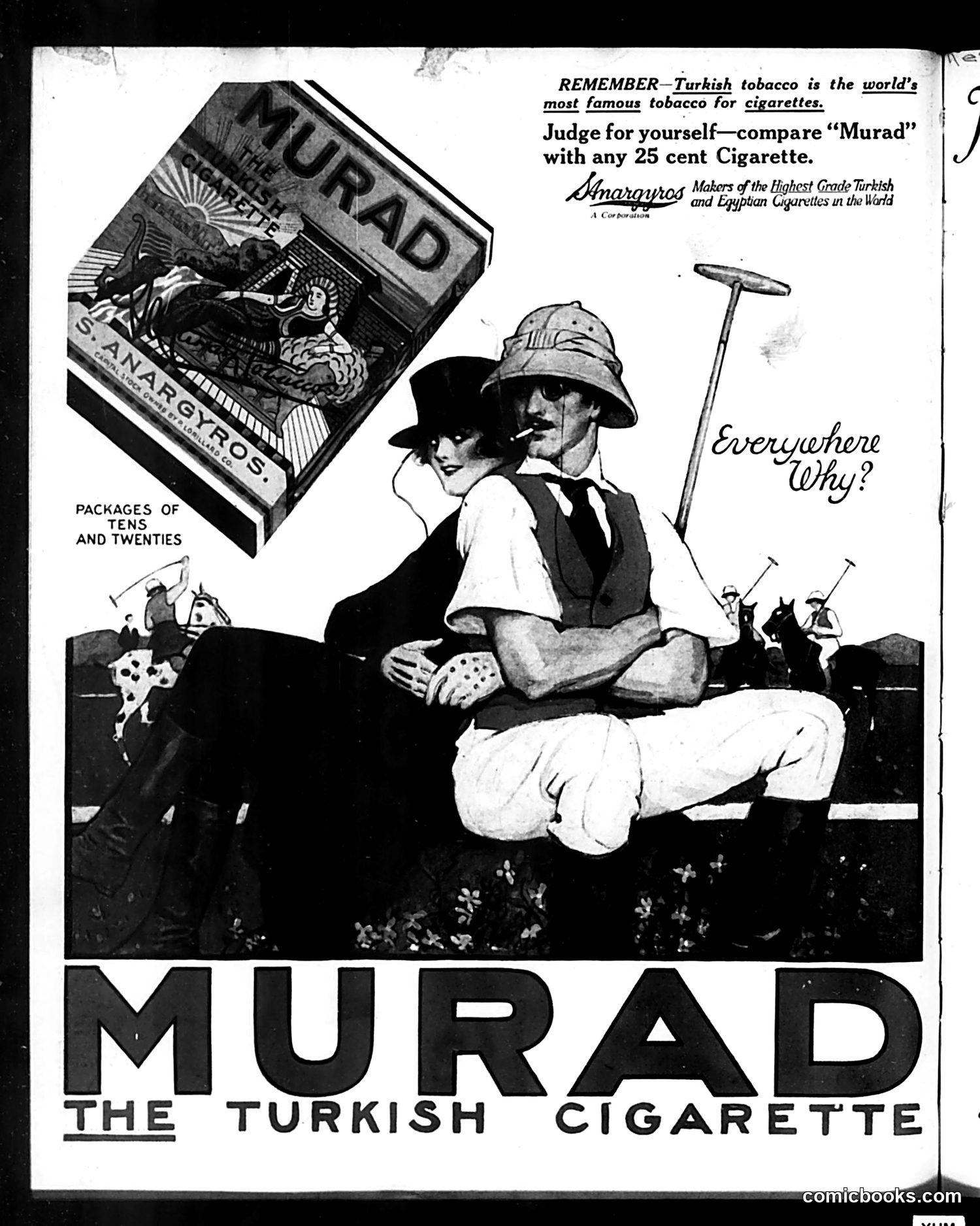
This is primarily a **cigarette advertisement** for Murad brand Turkish cigarettes, not political satire. The image shows two figures in colonial/polo attire on horseback, with the tagline "Everywhere Why?" — though the connection between the imagery and the product claim is unclear. The ad's main message claims Murad Turkish tobacco is superior to competing 25-cent cigarettes and invites direct comparison. The decorative package shown emphasizes the brand's Turkish and Egyptian origins, which were marketing selling points in early 20th-century America, when "Oriental" tobacco was considered premium. The colonial sporting imagery (polo players) may have been intended to suggest sophistication and worldliness, though it's uncertain whether specific historical figures are referenced. This represents typical early-1900s cigarette marketing before health warnings.