
Judge, 1917-07-28 · page 17 of 28
Judge — July 28, 1917 — page 17: what you’re looking at
What you’re looking at
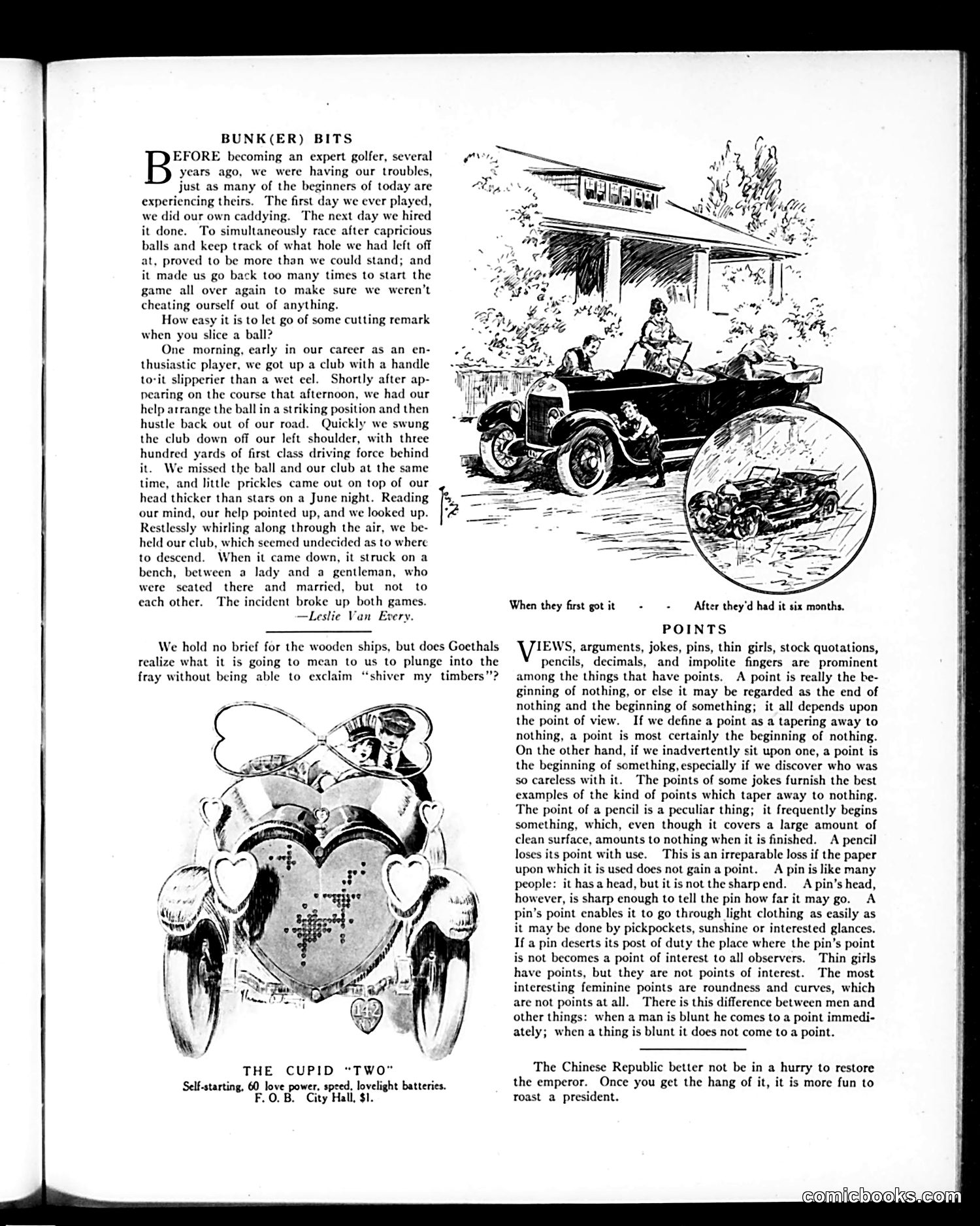
This page contains three distinct pieces of humor content: **"Bunker(er) Bits"** is a golf anecdote by Leslie Van Every. The narrator describes a mishit golf swing where the club flies through the air and strikes a bench between a married couple and another person—implying an affair. The humor derives from the awkward situation created and the disruption of "both games" (golf and romance). **"The Cupid 'Two'"** is an automobile advertisement joke. It shows a car before and after six months of marriage, depicting deterioration. The satire mocks newlyweds' honeymoon period versus marital reality, playing on the trendy "self-starting" automobiles of the era. **"Points"** is philosophical wordplay exploring the multiple meanings of "point"—literal (pencil tips, pins) and figurative (arguments, jokes). It's extended commentary on how "points" vary in significance depending on context and perspective. The closing reference to the Chinese Republic appears unrelated, possibly editorial commentary. These are light, contemporary satirical pieces typical of Judge's humor style.
📄 Transcribed text from this page (OCR, searchable)
Machine-transcribed from the original scan — historical spelling and the odd misread are preserved.
BUNK(ER) BITS EFORE becoming an expert golfer, several B years ago, we were having our troubles, just as many of the beginners of today are experiencing theirs. The first day we ever played, we did our own caddying. The next day we hired it done. To simultaneously race after capricious balls and keep track of what hole we had left off at, proved to be more than we could stand; and it made us go back too many times to start the game all over again to make sure we weren't cheating ourself out of anything. How easy it is to let go of some cutting remark when you slice a ball? One morning, early in our career as an en- thusiastic player, we got up a club with a handle to-it slipperier than a wet cel. Shortly after ap- pearing on the course that afternoon, we had our help arrange the ball in a striking position and then hustle back out of our road. Quickly we swung the club down off our left shoulder, with three hundred yards of first class driving force behind it. We missed the ball and our club at the same time, and little prickles came out on top of our head thicker than stars on a June night. Reading our mind, our help pointed up, and we looked up. Restlessly whirling along through the air, we be- held our club, which seemed undecided as to where to descend. When it came down, it struck on a bench, between a lady and a gentleman, who were seated there and married, but not to each other. The incident broke up both games. —Leslie Van Every. We hold no brief for the wooden ships, but does Goethals realize what it is going to mean to to plunge into the fray without being able to exclaim “shiver my timbers’? THE CUPID “TWO” Self-starting, 60 love power, speed, lovelight batteries. F.0.B. City Hall, $1. When they first got it - - After they'd had it six months. POINTS VIEWs, arguments, jokes, pins, thin girls, stock quotations, pencils, decimals, and impolite fingers are prominent among the things that have points. A point is really the be- ginning of nothing, or else it may be regarded as the end of nothing and the beginning of something; it all depends upon the point of view. If we define a point as a tapering away to nothing, a point is most certainly the beginning of nothing. On the other hand, if we inadvertently sit upon one, a point is the beginning of something, especially if we discover who was so careless with it. The points of some jokes furnish the best examples of the kind of points which taper away to nothing. The point of a pencil is a peculiar thing; it frequently begins something, which, even though it covers a large amount of clean surface, amounts to nothing when it is finished. A pencil loses its point with use. This is an irreparable loss if the paper upon which it is used does not gain a point. A pin is like many t has a head, but itis not the sharpend. A pin’s head, sharp enough to tell the pin how far it may go. A pin’s point enables it to go through light clothing as easily as it may be done by pickpockets, sunshine or interested glances. If a pin deserts its post of duty the place where the pin’s point is not becomes a point of interest to all observers. Thin girls have points, but they are not points of interest. The most interesting feminine points are roundness and curves, which are not points at all. There is this difference between men and other things: when a man is blunt he comes to a point immedi- ately; when a thing is blunt it does not come to a point. The Chinese Republic better not be in a hurry to restore the emperor. Once you get the hang of it, it is more fun to roast a president.