
Judge, 1917-07-28 · page 12 of 28
Judge — July 28, 1917 — page 12: what you’re looking at
What you’re looking at
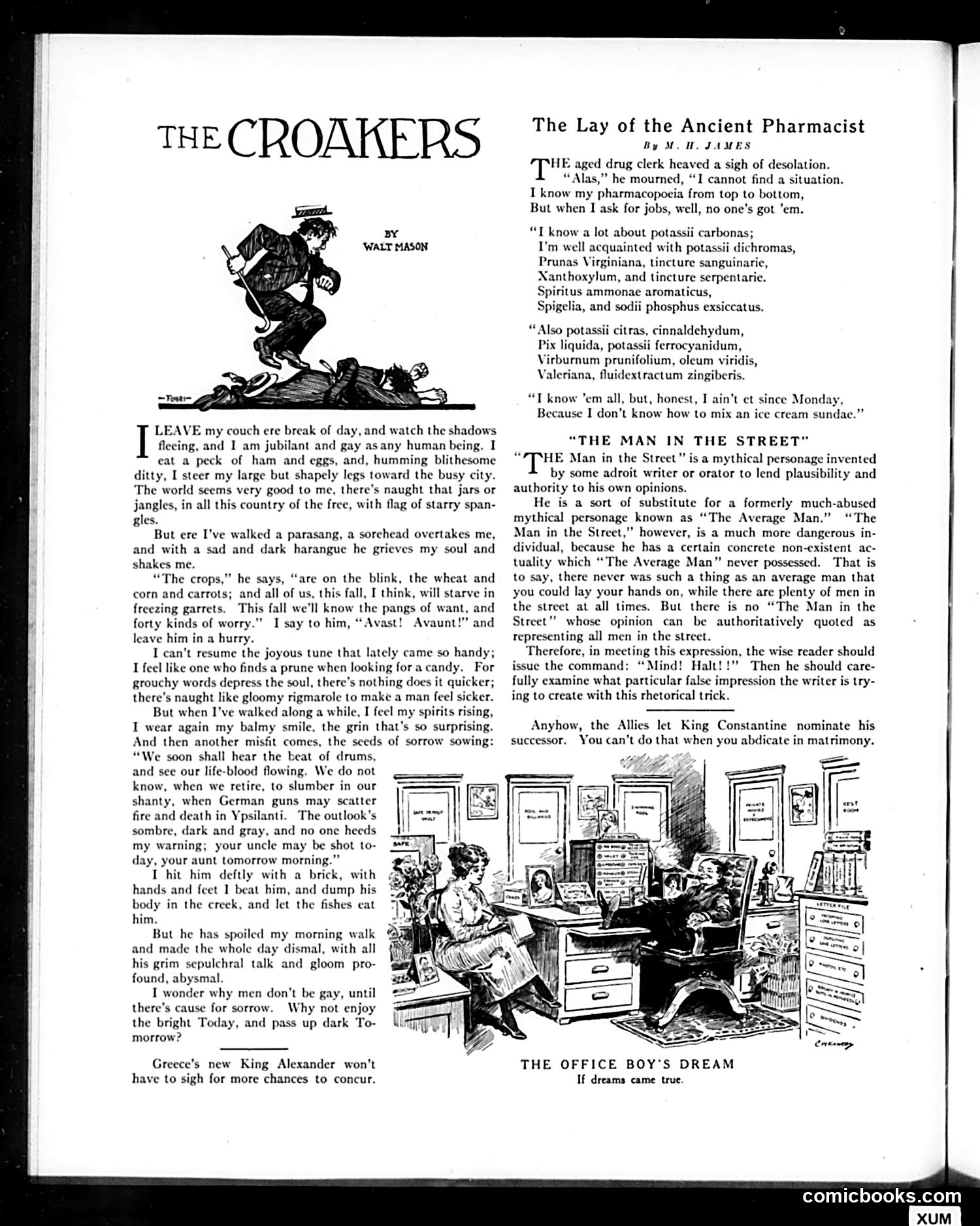
**"The Croakers"** (left) satirizes pessimists who spread doom and gloom. The poem's narrator encounters repeated "sorehead" complainers—one warning of crop failures and starvation, another predicting war and death—who poison his cheerful mood. The humor lies in his increasingly violent (fantastical) responses, culminating in drowning one in a creek. It's a wartime piece (references to Ypsilanti, German guns) mocking defeatist talk. **"The Lay of the Ancient Pharmacist"** jokes about unemployed expertise. A pharmacist can recite elaborate Latin pharmaceutical terms perfectly but can't find work—and can't even make a basic ice cream sundae. The satire targets educated specialists rendered useless by economic conditions (likely postwar unemployment). **"The Man in the Street"** (right) is meta-commentary explaining how writers and politicians invoke this invented "everyman" figure to lend false authority to opinions. The piece warns readers to distrust this rhetorical trick. The bottom cartoon ("The Office Boy's Dream") depicts a young worker daydreaming at his desk—common aspirational humor of the era.
📄 Transcribed text from this page (OCR, searchable)
Machine-transcribed from the original scan — historical spelling and the odd misread are preserved.
THECROAKERS LEAVE my couch ere break of day, and watch the shadows flecing, and I am jubilant and gay asany human being. I eat a peck of ham and eggs, and, humming blithesome ditty, I steer my large but shapely legs toward the busy city. The world seems very good to me, there’s naught that jars or jangles, in all this country of the free, with flag of starry span- gles. But ere I’ve walked a parasang, a sorehead overtakes me, and with a sad and dark harangue he grieves my soul and shakes me. “The crops,” he says, “are on the blink, the wheat and corn and carrots; and all of us, this fall, I think, will starve in freezing garrets. This fall we'll know the pangs of want, and forty kinds of worr, I say to him, “Avast! Avaunt!” and leave him in a hurry. I can’t resume the joyous tune that lately came so handy; I feel like one who finds a prune when looking fora candy. For grouchy words depress the soul, there’s nothing does it quicker; there's naught like gloomy rigmarole to make a man feel sicker. But when I've walked along a while, I feel my spirits rising, I wear again my balmy smile, the grin that's so surprising. And then another misfit comes, the seeds of sorrow sowing: “We soon shall hear the beat of drums, and see our life-blood flowing. We do not know, when we retire, to slumber in our The Lay of the Ancient Pharmacist By M.W. JAMES HE aged drug clerk heaved a sigh of desolation. “Alas,” he mourned, “I cannot find a situation. I know my pharmacopoeia from top to bottom, But when I ask for jobs, well, no one’s got ’em. “T know a lot about potassii carbonas; I'm well acquainted with potassii dichromas, Prunas Virginiana, tincture sanguinarie, Xanthoxylum, and tincture serpentarie. Spiritus ammonae aromaticus, Spigelia, and sodii phosphus exsiccatus. “Also potassii citras, cinnaldehydum, Pix liquida, potassii ferrocyanidum. Virburnum prunifolium, oleum viri Valeriana, fluidextractum zingiberi: “T know ‘em all, but, honest, I ain’t et since Monday, Because I don’t know how to mix an ice cream sundae.” “THE MAN IN THE STREET” HE Man in the Street” is a mythical personage invented by some adroit writer or orator to lend plausibility and authority to his own opinions. He is a sort of substitute for a formerly much-abused mythical personage known as “The Average Man.” “The Man in the Street,” however, is a much more dangerous in- dividual, because he has a certain concrete non-existent ac- tuality which “The Average Man” never possessed. That is to say, there never was such a thing as an average man that you could lay your hands on, while there are plenty of men in the street at all times. But there is no “The Man in the Street’? whose opinion can be authoritatively quoted as representing all men in the street. Therefore, in meeting this expression, the wise reader should issuc the command: ‘*Mind! Halt! !” Then he should care- fully examine what particular false impression the writer is try- ing to create with this rhetorical trick. Anyhow, the Allies let King Constantine nominate his successor. You can’t do that when you abdicate in matrimony. shanty, when German guns may scatter fire and death in Ypsilanti. The outlook’s sombre, dark and gray, and no one heeds my warning; your uncle may be shot to- day, your aunt tomorrow morning.” I hit him deftly with a brick, with hands and feet 1 beat him, and dump his body in the creck, and let the fishes cat him. But he has spoiled my morning walk and made the whole day dismal, with all his grim sepulchral talk and gloom pro- found, abysm I wonder why men don't be gay, until there’s cause for sorrow. Why not enjoy the bright Today, and pass up dark To- morrow? Greece’s new King Alexander won't have to sigh for more chances to concur. THE OFFICE BOY'S DREAM If dreams came true. comicbooks.com