
Judge, 1917-07-28 · page 26 of 28
Judge — July 28, 1917 — page 26: what you’re looking at
What you’re looking at
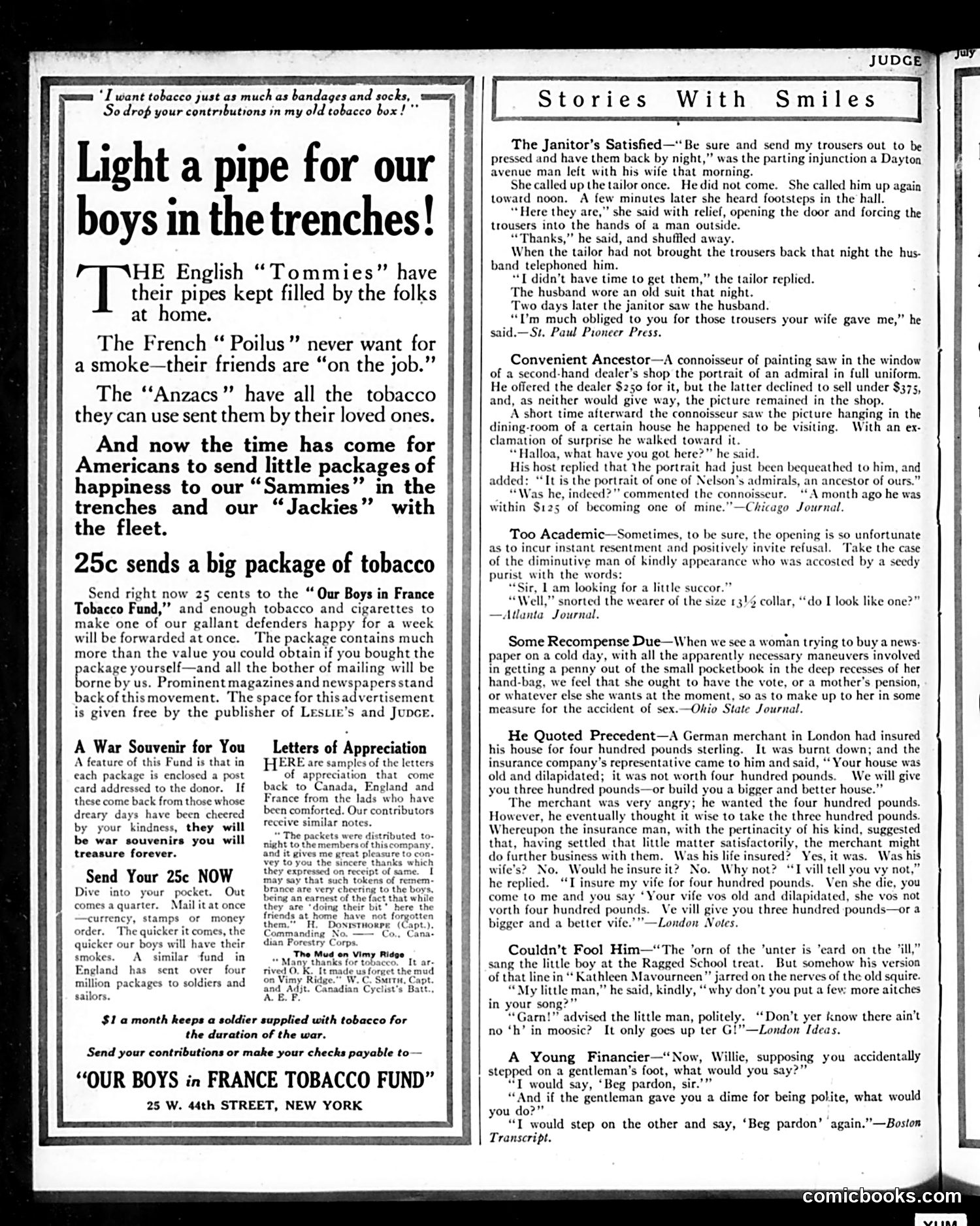
This page is primarily **advertising and fundraising**, not political satire. The dominant content is a wartime charity appeal for the "Our Boys in France Tobacco Fund," soliciting 25-cent donations to send tobacco packages to American soldiers ("Sammies") and sailors ("Jackies") serving in World War I. The appeal uses patriotic framing, comparing American efforts to similar initiatives by British ("Tommies"), French ("Poilus"), and Australian ("Anzacs") soldiers' families. It emphasizes the morale-boosting value of tobacco and promises donors will receive appreciation postcards as "war souvenirs." The right column contains "Stories With Smiles"—humorous anecdotes unrelated to the war, appearing to be filler content typical of Judge magazine's format. The overall message reflects early-20th-century assumptions about tobacco as a legitimate, even virtuous, comfort item for troops.
📄 Transcribed text from this page (OCR, searchable)
Machine-transcribed from the original scan — historical spelling and the odd misread are preserved.
‘T want tobacco just as much as bandages and socks, So drop your contributions in my old cobacco box!" Light a pipe for our boys in the trenches! HE English “Tommies” have their pipes kept filled by the folks at home. The French “ Poilus” never want for a smoke—their friends are “on the job.” The ‘‘Anzacs”’ have all the tobacco they can use sent them by their loved ones. And now the time has come for Americans to send little packages of happiness to our “Sammies” in the trenches and our “Jackies” with the fleet. 25c sends a big package of tobacco Send right now 25 cents to the “ Qur Boys in France Tobacco Fund,” and enough tobacco and cigarettes to make one of our gallant defenders happy for a week will be forwarded at once. The package contains much more than the value you could obtain if you bought the package yourself—and all the bother of mailing will be borne by us. Prominent magazines and newspapers stand backof thismovement. The space for thi advertisement is given free by the publisher of Lestie’s and JupcE. Letters of Appreciation HERE are samples of the letters each package is enclosed a post of appreciation that come card addressed to the donor. If back to Canada, England and A War Souvenir for You A feature of this Fund is that in these come back from those whose France from the lads who have dreary days have been cheered by your kindness, they will be war souvenirs you will treasure forever. Send Your 25¢ NOW Dive into your pocket. Out comes a quarter. Mail itat once -currency, stamps of money order. ‘The quicker it comes, the quicker our boys will have their smokes. A similar fund in England has sent over four million packages to soldiers and sailors. been comforted. Our contributors receive similar notes. nembers of this comp and it gives me great pleasure to cc vey to you the since nem- brance are very cheering to the boys, being an earnest of the fact, that whi they are “doing their bit * friends at home have not them.” H. Dowistuor: Commanding No. —— dian Forestry Corps. The Mud on Vimy Ridge $1 a month keeps a soldier supplied with tobacco for the duration of the war. Send your contributions or make your checks payable to— “OUR BOYS in FRANCE TOBACCO FUND” 25 W. 44th STREET, NEW YORK The Janitor’s Satisfied—Be sure and send my trousers out to be pressed and have them back by night,” was the parting injunction a Dayton avenue man left with his wife that morning. She called up the tailor once. Hedid not come. She called him up again toward noon. A few minutes later she heard footsteps in the hall. “Here they are,” she said with relief, opening the door and forcing the trousers into the hands of a man outside. “Thanks,” he said, and shuffled away. When the tailor had not brought the trousers back that night the hus- band telephoned him. “I didn’t have time to get them,” the tailor replied. The husband wore an old suit that night. Two days later the janitor saw the husband. “I’m much obliged to you for those trousers your wife gave me,” he said.—St. Paul Pioneer Press. Convenient Ancestor—A connoisseur of painting saw in the window of a second-hand dealer’s shop the portrait of an admiral in full uniform. He offered the dealer $250 for it, but the latter declined to sell under $375, and, neither would give way, the picture remained in the shop. short time afterward the connoisseur saw the picture hanging in the dining-room of a certain house he happened to be visiting. With an ex- clamation of surprise he walked toward it. "he said. His host replied that the portrait had just been bequeathed to him, and added: “It is the portrait of one of Nelson’s admirals, an ancestor of ours.” “Was he, indeed?" commented the connoisseur. ‘A month ago he was within $125 of becoming one of mine."—Chicago Journal. Too Academic—Sometimes, to be sure, the opening is so unfortunate as to incur instant resentment and positively invite refusal. ‘Take the case of the diminutive man of kindly appearance who was accosted by a seedy purist wits the words: 5 1 am looking for a little succor.’ Well,” snorted the wearer of the size 6 ¢ collar, “do I look like one?” —Allanta Journal. Some Recompense Due—When we sce a woman trying to buy a news: paper on a cold day, with all the apparently necessary maneuvers involved in getting a penny out of the small pocketbook in the deep recesses of her hand-bag, we feel that she ought to have the vote, or a mother’s pension, or whatever else she wants at the moment, so as to make up to her in some measure for the accident of sex.—Ohio State Journal. He Quoted Precedent—A German merchant in London had insured his house for four hundred pounds sterling. It was burnt down; and the insurance company’: representative came to him and said, “ Your house was old and dilapidated; it was not worth four hundred pounds. We will give you three hundred pounds—or build you a bigger and better house.” The merchant was very angry; he wanted the four hundred pounds. However, he eventually thought it wise to take the three hundred pounds. Whereupon the insurance man, with the pertinacity of his kind, suggested that, having settled that litue ter satisfactorily, the merchant might do further business with them. Was his life insure wife’s?_ No. Would he insure it? No. Why not? he replied. “I insure my vife for four hundred pounds. Ven’she die, you come to me and you say ‘Your vife vos old and dilapidated, she vos not vorth four hundred pounds. Ve vill give you three hundred pounds—or a bigger and a better vife.’""—London Not Couldn’t Fool Him—‘The ‘orn of the ‘unter is ‘eard on the ‘ill,” sang the little boy at the Ragged School treat. But somehow his version of that line in“ Kathleen Mavourneen” jarred on the nerves of the old squire. “My little man,” he said, kindly, “why don’t you put a few more aitches in your song?” “*Garn!” advised the little man, politely. ‘Don’t yer know there ain’t no ‘h’ in moosic? It only goes up ter G!"—London Ideas. A Young Financier—‘Now, Willie, supposing you accidentally stepped ona gentleman’ 's foot, what would you say?” “I would say, ‘Beg pardon, sir.’” “And if the gentleman gave you a dime for being polite, what would you do?” “TI would step on the other and say, ‘Beg pardon’ again.” —Boston Transcript. comicbooks.com