
Judge, 1917-07-28 · page 24 of 28
Judge — July 28, 1917 — page 24: what you’re looking at
What you’re looking at
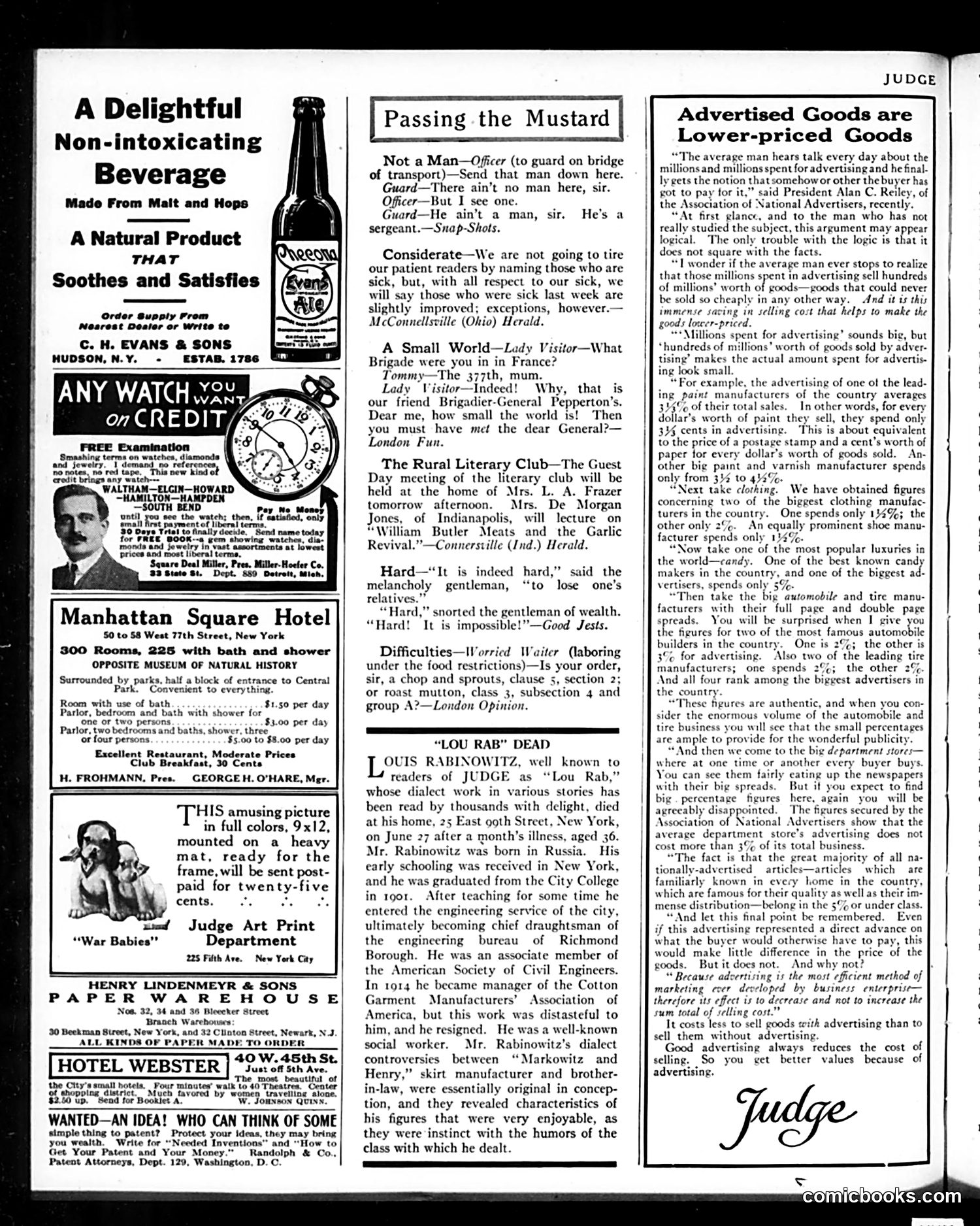
This page is primarily **advertisements and miscellaneous short jokes**, not a political cartoon. The page contains: - Multiple hotel and product ads (beverage, watches, hotels) - A section titled "Passing the Mustard" with brief comic anecdotes - An obituary for **Louis Rabinowitz** ("Lou Rab"), apparently a dialect humorist who contributed humorous stories to *Judge* magazine The small jokes in "Passing the Mustard" are wordplay and observational humor typical of early 20th-century magazines—a sergeant being "not a man," food rationing causing bureaucratic ordering complications, someone claiming a loss of relatives is "impossible" because wealth insulates them. The page reflects period concerns: WWI (France references, food restrictions), urbanization (NYC hotels), and genteel magazine culture. It's a typical issue page rather than featuring major political satire.
📄 Transcribed text from this page (OCR, searchable)
Machine-transcribed from the original scan — historical spelling and the odd misread are preserved.
A Delightful Non-intoxicating Beverage Made From Malt and Hops A Natural Product THAT Soothes and Satisfies Order Supply From Nearest Dealer or Write te Cc. H. EVANS & SONS HUDSON, N.Y. - ESTAB. 1786 Smashing terms on watches, diamonds and jewelry. I'demand no no notes, no red tape, ‘Ths now "Kind ot WALTHAM—ELCIN—HOWARD 0TH REND Manhattan Square Hotel 50 to S8 West 77th Street, New York 300 Rooms, 225 with bath and shower OPPOSITE MUSEUM OF NATURAL HISTORY Surrounded by parks, half a block of entrance to Central ark. Convenient to everything. $1.50 per day Parlor, bedroom and bath with shower for one or two persons $3.00 per day Parlor, two bedrooms and baths, shower, three Of four persons '$5.00 to $8.00 per day nt, Moderate Prices kfast, 30 Cents GEORGE H. O'HARE, Mg: Room with use of bath THIS amusing picture in full colors, 9x12, mounted on a_ heavy mat, ready for the frame, will be sent post- paid for twenty: five cents. es i oe asf Judge Art Print “War Babies” Department 225 Filth Ave. New York City HENRY LINDENMEYR & SONS PAPER WAREHOUSE Nos. 32, 34 and 36 Bleecker Street Branch Warehouses 30 Beekman Street, New York, and ALL KINDS OF PA HOTEL WEBSTER | “Suncast” ‘The most beautiful of the City’s amall hotels. Your minutey walk to “10 Theatres. “Genter of shopping district.” Much favored $2.00 up. Send for Booklet A. WANTED—AN IDEA! WHO CAN THINK OF SOME simple thing to patent? Protect your ideas, they may bring you wealth. Write for “Needed Inventions” and “How to Get Your Patent and Your Money.” Randolph & Co.. Patent Attorneys, Dept. 129, Washington, D.C. by women travelling alone. W. JOMNBON QUINN. Passing the Mustard Not a Man—Offcer (to guard on bridge of transport)—Send that man down here. Guard—There ain’t no man here, sir. Officer—But I see one. Guard—He ain’t a man, sir. He's a sergeant.—Snap-Shots. Considerate—We are not going to tire our patient readers by naming those who are sick, but, with all respect to our sick, we will say those who were sick last week are slightly improved; exceptions, however.— McConnellsville (Ohio) Herald. A Small World—Lady Visitor—What Brigade were you in in France? Tommy—The 377th, mum. Lady ‘Visitor—Indeed! Why, that is our friend Brigadier-General Pepperton’s. Dear me, how small the world is! Then you must have met the dear General?— London Fun. The Rural Literary Club—The Guest Day mecting of the literary club will be held at the home of Mrs A. Frazer tomorrow afternoon. Mrs. De Morgan Jones, of Indianapoli: lecture on “William Butler Meats and the Garlic Revival.”—Connerstille (Ind.) Herald. Hard—‘It is indeed hard,” said the melancholy gentleman, “to lose one’s relati “Hard,” snorted the gentleman of wealth. “Hard! It is impossible!”—Good Jests. Difficulties—Worried Waiter (laboring under the food restrictions)—Is your order, sir, a chop and sprouts, clause 5, section 2; or roast mutton, class 3, subsection 4 and group A?—London Opinion. ‘LOU RAB” DEAD OUIS RABINOWITZ, well known to readers of JUDGE as “Lou Rab,” whose dialect work in various stories has been read by thousands with delight, died at his home, 25 East ooth Street, New York, on June 27 after a month’s illn aged 36. Mr. Rabinowitz was born in Russia. His early schooling was received in New York, and he was graduated from the City College in roor. After teaching for some time he entered the engineering serv of the city, ultimately becoming chief draughtsman of the engineering bureau of Richmond Borough. He was an associate member of the American Society of Civil Engineers. In 1914 he became manager of the Cotton Garment Manufacturers’ Association of America, but this work was distasteful to him, and he resigned. He was a well-known social worker. Mr. Rabinowitz’s dialect controversies between “Markowitz and Henry,” skirt manufacturer and_brother- in-law, were essentially original in concep- tion, and they revealed characteristics of his figures that were very enjoyable, as they were instinct with the humors of the class with which he dealt. [EEE Advertised Goods are Lower-priced Goods “The average man hears talk every day about the illions and millions spent for advertising and he final- ets the notion that somehow or other the buyer has got to pay for it,” said President Alan C. Reiley, of the Association of National Advertisers, recently. t first glance, and to the man who has not really studied the subject, this argument may appear logical. The only trouble with the logic is that it does not square with the facts. “L wonder if the average man ever stops to realize that those millions spent in advertising sell hundreds of millions’ worth al goods—goods that could never be sold so cheaply in any other way. And it is this immense saving in selling cost that helps to make the goods lower-priced. “*Millions spent for advertising’ sounds big, but “hundreds of millions’ worth of goods sold by adver- tising’ makes the actual amount spent for advertis- ing look small. “For example, the advertising of one of the lead- g paint manufacturers of the country averages Co of their total sales. In other words, for every dollar's worth of paint they sell, they spend only 33 cents in advertising. ‘This is about equivalent 10 the price of a postage stamp and a cent’s worth of paper for every dollar’s worth of goods sold. An- other big paint and varnish manufacturer spends only from 334 to 443%. ext take clothing. We have obtained figures concerning two of the biggest clothing manufac- turers in the country. One spends only 134%}. the other only 2%. An equally prominent shoe manu- facturer spends only 14%. “Now take one of the most popular luxuries in the world—ca: One of the best known candy makers in the country, and one of the biggest ad- vertisers, spends only 5%. Then take the big ‘automobile and tire manu- facturers with their full page and double page spreads. You will be surprised when I give you the figures for two of the most famous automobile builders in the country. One is 2%} the other is 3% for advertising. Also two of the leading manufacturers; one spends 2%; the other 2%. And all four rank among the biggest advertisers in the country. “These figures are authentic, and when you con- sider the enormous volume of the automobile and tire business you will see that the small percentages are ample to provide for the wonderful publicity “And then we come to the big department stor where at one time or another every buyer buys. You can see them fairly cating up the newspapers with their big spreads. But if you expect to find big. percentage figures here, again you will be agreeably disappointed. ‘The figures secured by the Association of National Advertisers show that the average department store’s advertising does not cost_more than 3% of its total business. “The fact is that the great majority of all na- tionally-advertised — articles—articl which are familiarly known in every home in the country, which are famous for the quality as well as their im- ense distribution—belong in the $% or under class. final point be remembered. Even ng represented a direct advance on what the buyer would otherwise have to pay, this would make little difference in the price of the goods, But it does not. And why not? Icertising is the most efficient method of marketing ever developed by business enterprise— therefore its effect is to decrea se and not to increase the sum total of selling cost.’ It costs less to sell goods with advertising than to sell them without advertising. Good advertising always reduces the cost of selling. So you get better values because of advertisin: