
Judge, 1917-07-28 · page 13 of 28
Judge — July 28, 1917 — page 13: what you’re looking at
What you’re looking at
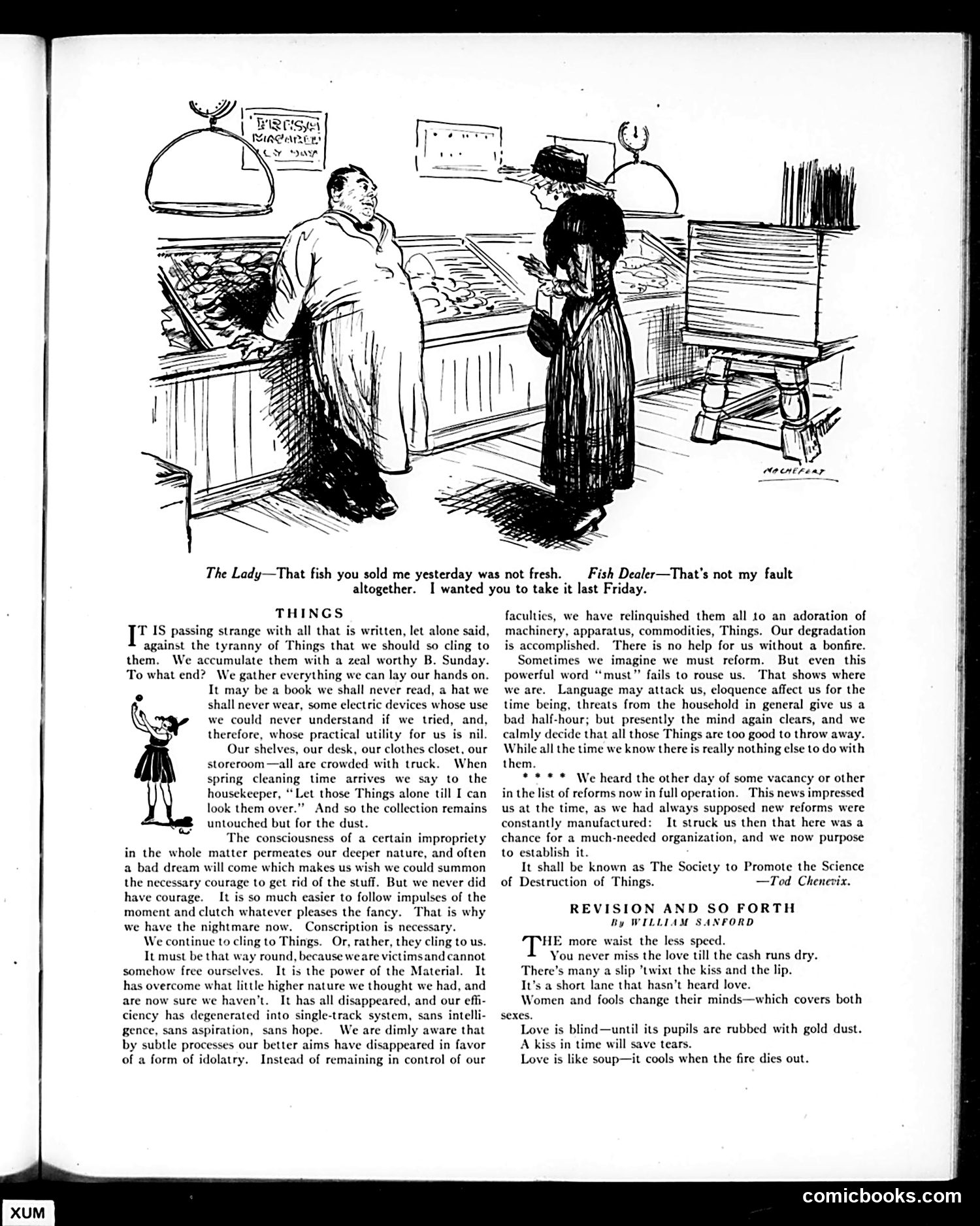
**The Cartoon (top):** A fish dealer and dissatisfied customer dispute over spoiled fish. The lady complains the fish wasn't fresh; the dealer deflects blame, saying she should have taken it Friday. This is a straightforward consumer complaint joke—the dealer won't take responsibility. **"Things" Essay (main text):** This is social satire about materialism and consumerism. The author argues that modern people obsessively accumulate possessions—books, clothes, gadgets—they don't use or need, but lack courage to discard them. He suggests materialism has corrupted human nature, replacing aspiration with "idolatry" of commodities. The essay proposes a humorous solution: a "Society to Promote the Science of Destruction of Things"—essentially, a bonfire of excess possessions. **Context:** This reflects early 20th-century anxieties about industrial consumer culture and clutter, anticipating modern decluttering movements. The tone mixes genuine social criticism with satirical wit typical of *Judge* magazine.
📄 Transcribed text from this page (OCR, searchable)
Machine-transcribed from the original scan — historical spelling and the odd misread are preserved.
‘Tiana PIRES, Mager. The Lady—That fish you sold me yesterday was not fresh. I wanted you to take it last Friday. altogether. THINGS ie IS passing strange with all that is written, let alone said, against the tyranny of Things that we should so cling to them. We accumulate them with a zeal worthy B. Sunday. To what end? We gather everything we can lay our hands on. It may be a book we shall never read, a hat we shall never wear, some electric devices whose use we could never understand if we tried, and, therefore, whose practical utility for us is nil. Our shelves, our desk, our clothes closet, our storeroom—all are crowded with truck. When spring cleaning time arrives we say to the housekeeper, “Let those Things alone till I can look them over.”” And so the collection remains untouched but for the dust. The consciousness of a certain impropriety in the whole matter permeates our deeper nature, and often a bad dream will come which makes us wish we could summon the necessary courage to get rid of the stuff. But we never did have courage. It is so much easier to follow impulses of the moment and clutch whatever pleases the fancy. That is why we have the nightmare now. Conscription is necessary. We continue to cling to Things. Or, rather, they cling to us. Tt must be that way round, because weare victimsand cannot somehow free ourselves. It is the power of the Material. It has overcome what little higher nature we thought we had, and are now sure we haven't. It has all disappeared, and our effi- ciency has degenerated into single-track system, sans intelli- gence, sans aspiration, sans hope. We are dimly aware that by subtle processes our better aims have disappeared in favor of a form of idolatry. Instead of remaining in control of our rw] Owe feay Fish Dealer—That’s not my fault faculties, we have relinquished them all to an adoration of machinery, apparatus, commodities, Things. Our degradation is accomplished. There is no help for us without a bonfire. Sometimes we imagine we must reform. But even this powerful word “must” fails to rouse us. That shows where we are. Language may attack us, eloquence affect us for the time being, threats from the household in general give us a bad half-hour; but presently the mind again clears, and we calmly decide that all those Things are too good to throw away. While all the time we know there is really nothing else to do with them. * ** * We heard the other day of some vacancy or other in the list of reforms now in full operation. This news impressed us at the time, as we had always supposed new reforms were constantly manufactured: It struck us then that here was a chance for a much-needed organization, and we now purpose to establish it. It shall be known as The Society to Promote the Science of Destruction of Things. —Tod Chenevix. REVISION AND SO FORTH By WILLIAM SANFORD HE more waist the less speed. You never miss the love till the cash runs dry. There’s many a slip ’twixt the kiss and the lip. It’s a short lane that hasn’t heard love. Women and fools change their minds—which covers both S. Love is blind—until its pupils are rubbed with gold dust. A in time will save tears. Love is like soup—it cools when the fire dies out. comicbooks.com