
Judge, 1917-07-28 · page 10 of 28
Judge — July 28, 1917 — page 10: what you’re looking at
What you’re looking at
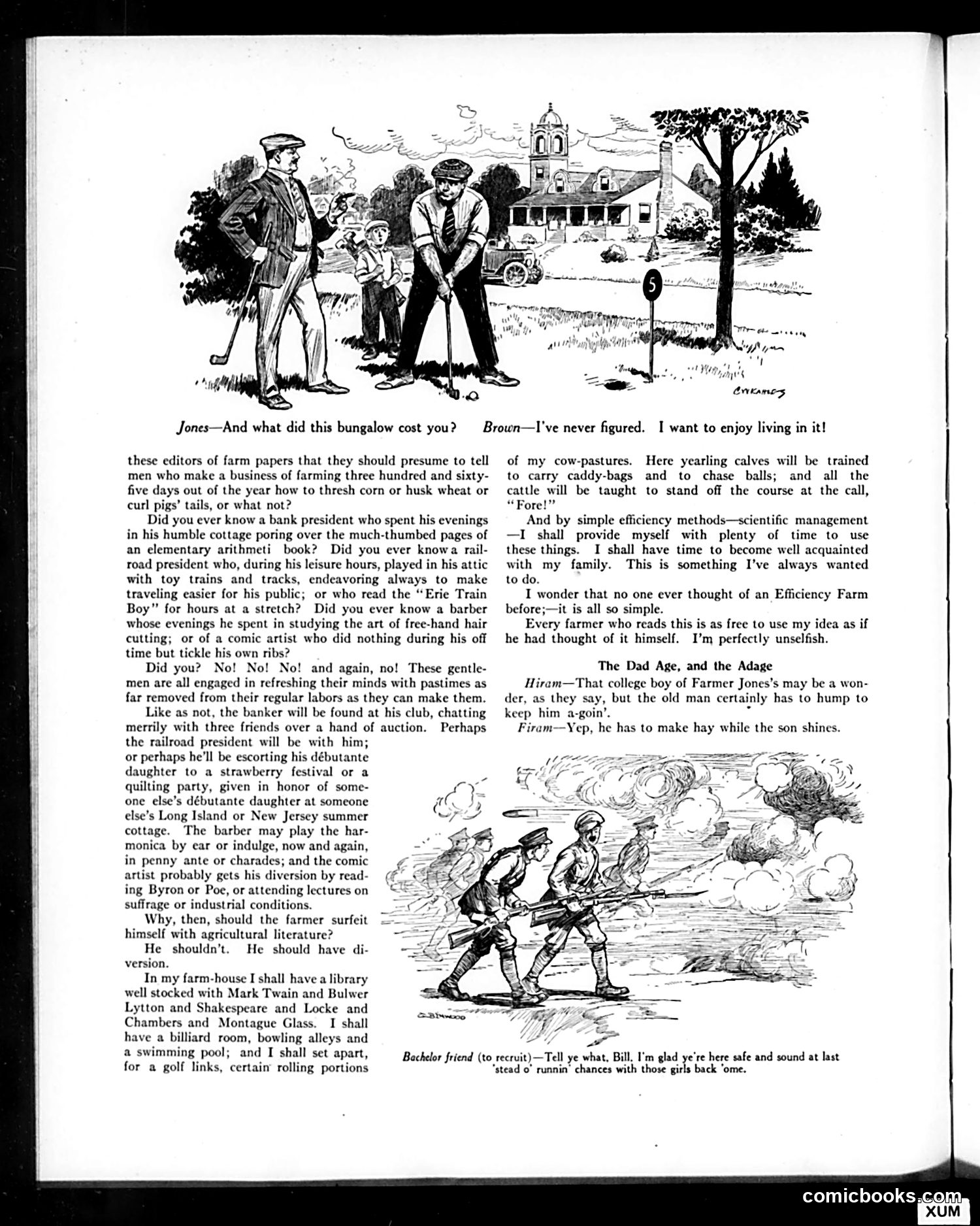
This page satirizes a wealthy farmer's pretentious vision of rural life. The top cartoon shows "Jones" describing his new bungalow to "Brown," who simply wants to enjoy living in it—establishing the conflict between aspiration and practicality. The lengthy text mocks the farmer's absurd plan to import urban leisure into farm life. He argues that professionals (bankers, railroad presidents, barbers) don't practice their trades during leisure—so why should farmers read agricultural literature? Instead, he'll stock his farmhouse with classic literature, add billiard rooms, bowling alleys, and a golf course on his cow-pastures. He'll train calves to carry golf bags. The satire targets the farmer's delusion that "scientific management" and efficiency will somehow create abundant free time for cultured pursuits while actually farming. The bottom cartoon reinforces the theme: while the college boy enjoys leisure, the old farmer "has to hump to keep him a-goin'"—suggesting hard farm work never stops regardless of fancy theories. The joke: farmers can't escape their labor through mere pretension or pseudo-scientific management.
📄 Transcribed text from this page (OCR, searchable)
Machine-transcribed from the original scan — historical spelling and the odd misread are preserved.
Jones—And what did this bungalow cost you? these editors of farm papers that they should presume to tell men who make a business of farming three hundred and sixty- five days out of the year how to thresh corn or husk wheat or curl pigs’ tails, or what not? Did you ever know a bank president who spent his evenings in his humble cottage poring over the much-thumbed pages of an elementary arithmeti book? Did you ever knowa rail- road president who, during his leisure hours, played in his attic with toy trains and tracks, endeavoring always to make traveling easier for his public; or who read the “Erie Train Boy” for hours at a stretch? Did you ever know a barber whose evenings he spent in studying the art of free-hand hair cutting; or of a comic artist who did nothing during his off time but tickle his own ribs? Did you? No! No! No! and again, no! These gentle- men are all engage refreshing their minds with pastimes as far removed from their regular labors as they can make them. Like as not, the banker will be found at his club, chatting merrily with three friends over a hand of auction. Perhaps the railroad president will be with him; or perhaps he'll be escorting his débutante daughter to a strawberry festival or a quilting party, given in honor of some- one else’s débutante daughter at someone else’s Long Island or New Jersey summer cottage. The barber may play the har- monica by ear or indulge, now and again, in penny ante or charades; and the comic artist probably gets his diversion by read- ing Byron or Poe, or attending lectures on suffrage or industrial conditions. Why, then, should the farmer surfeit himself with agricultural literature? He shouldn’t. He should have di- version. In my farm-house I shall have a library well stocked with Mark Twain and Bulwer Lytton and Shakespeare and Locke and Chambers and Montague Glass. I shall have a billiard room, bowling alleys and a swimming pool; and I shall set apart, for a golf links, certain rolling portions Brown—lI've never figured. I want to enjoy living in it! of my cow-pastures. Here yearling calves will be trained to carry caddy-bags and to chase balls; and all the catule will be taught to stand off the course at the call, “Fore!” And by simple efficiency methods—scientific management —I shall provide myself with plenty of time to use these things. I shall have time to become well acquainted with my family. This is something I’ve always wanted to do. I wonder that no one ever thought of an Efficiency Farm before is all so simple. Every farmer who reads this is as free to use my idea as if he had thought of it himself. I’m perfectly unselfish. The Dad Age, and the Adage Hiram—That college boy of Farmer Jones’s may be a won- der, as they say, but the old man certainly has to hump to : -goin’. . Bachelor friend (to recruit) —Tell ye what, Bill, I'm glad ye're here safe and sound at last ‘stead o' runnin’ chances with those girls back ‘ome. comichooks i