
Judge, 1917-07-28 · page 16 of 28
Judge — July 28, 1917 — page 16: what you’re looking at
What you’re looking at
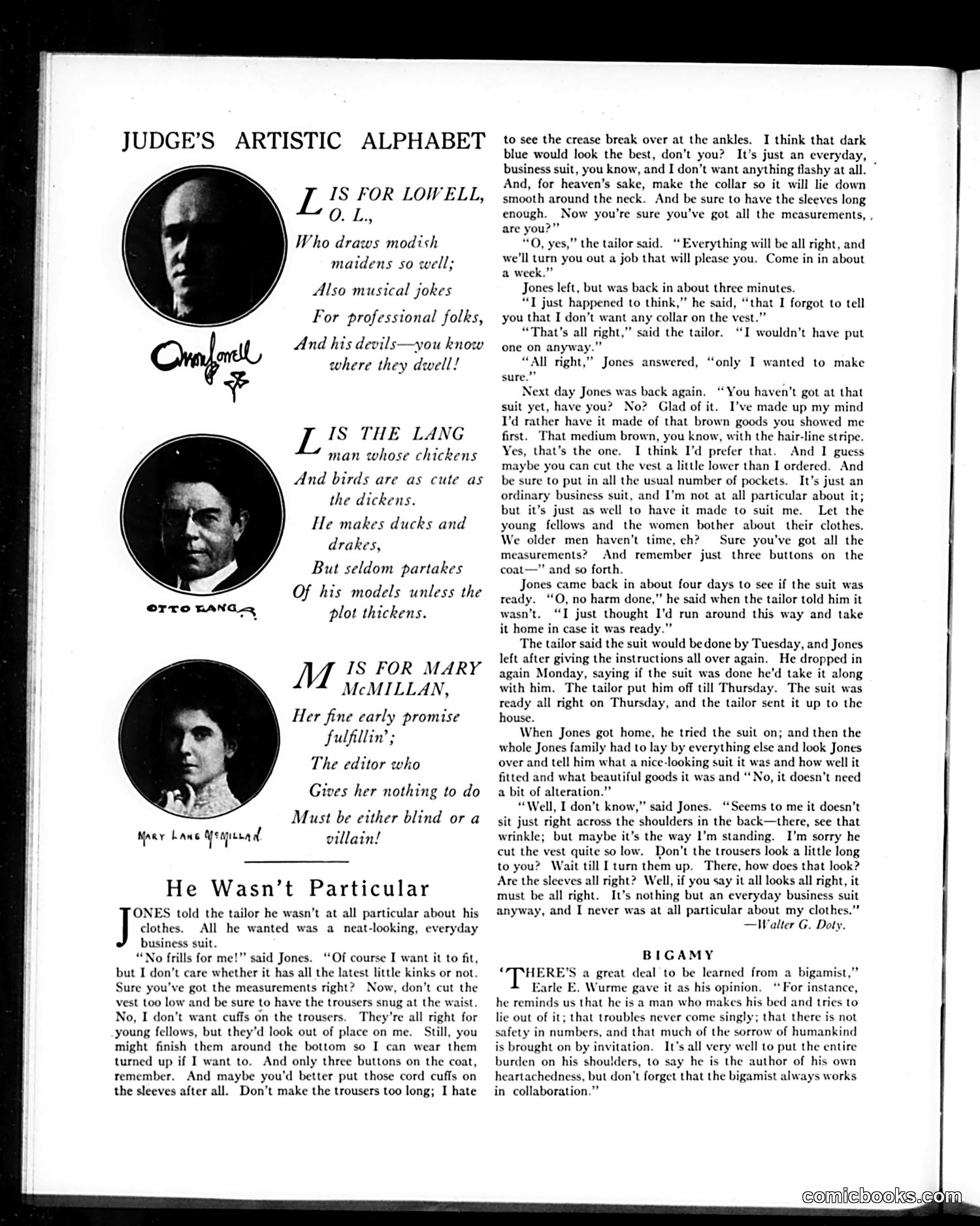
This page contains two distinct elements: **The "Artistic Alphabet"** features caricatured portraits of three contributors to Judge magazine: Lowell (O.L.), who draws fashionable maidens and devils; Lang, known for cute animal illustrations; and Mary McMillan, an editor criticized for being underutilized—the verse suggests whoever supervises her "must be either blind or a villain" for wasting her talent. **"He Wasn't Particular"** is the main story, satirizing a man who claims to want a simple business suit but then obsessively micromanages every detail—collar height, button count, cuff style, fabric choice, trouser length—while repeatedly visiting the tailor with contradictory instructions. The humor lies in the gap between his stated indifference ("I'm not at all particular") and his exhausting perfectionism, mocking men who claim casual attitudes while demanding meticulous control.
📄 Transcribed text from this page (OCR, searchable)
Machine-transcribed from the original scan — historical spelling and the odd misread are preserved.
JUDGE’S ARTISTIC ALPHABET © ©TTo KANG & a Nagy bane ysaennd. IS FOR LOWELL, 0. L., Who draws modish maidens so well; Also musical jokes For professional folks, And his devils—you know where they dwell! IS THE LANG man whose chickens And birds are as cute as the dickens. He makes ducks and drakes, But seldom partakes Of his models unless the plot thickens. IS FOR MARY McMILLAN, Her fine early promise fulfillin’ ; The editor who Gives her nothing to do Must be either blind or a villain! He Wasn’t Particular ONES told the tailor he wasn’t at all particular about his J clothes. All he wanted was a neat-looking, everyday business suit. No frills for me!” said Jones. “Of course I want it to fit, but I don’t care whether it has all the latest little kinks or not. Sure you've got the measurements right? Now, don’t cut the vest too low and be sure to have the trous nug at the waist. No, I don’t want cuffs on the trousers. They're all right for young fellows, but they’d look out of place on me. Still, you might finish them around the bottom so I can wear them turned up if I want to. And only three buttons on the coat, remember. And maybe you'd better put those cord cuffs on the sleeves after all. Don’t make the trousers too long; I hate to see the crease break over at the ankles. I think that dark blue would look the best, don’t you? It’s just an everyday, business suit, you know, and I don’t want anything flashy at all. * And, for heaven’s sake, make the collar so it will lie down smooth around the neck. And be sure to have the sleeves long enough. Now you're sure you've got all the measurements, , are you?” “O, yes,” the tailor said.“ Everything will be all right, and we'll turn you out a job that will please you. Come in in about a week.” Jones left, but was back in about three minutes. “IT just happened to think,” he said, “that I forgot to tell you that I don’t want any collar on the vest.” “That's all right,” said the tailor. ‘I wouldn’t have put one on anyway.” “All right,” Jones answered, “only I wanted to make sure.” Next day Jones was back again. “You haven't got at that suit yet, have you? No? Glad of it. I’ve made up my mind I'd rather have it made of that brown goods you showed me first. That medium brown, you know, with the hair-line stripe. Yes, that’s the one. I think I'd prefer that. And I guess maybe you can cut the vest a little lower than I ordered. And be sure to put in all the usual number of pockets. It’s just an ordinary business suit, and I’m not at all particular about it; but it’s just as well to have it made to suit me. Let the young fellows and the women bother about their clothes. We older men haven't time, eh? Sure you've got all the measurements? And remember just three buttons on the coat—” and so forth. Jones came back in about four days to see if the suit was ready. “O, no harm done,” he said when the tailor told him it wasn’t. “I just thought I’d run around this way and take it home in case it was ready.” The tailor said the suit would be done by Tuesday, and Jones left after giving the instructions all over again. He dropped in again Monday, saying if the suit was done he'd take it along with him. The tailor put him off till Thursday. The suit was ready all right on Thursday, and the tailor sent it up to the house. When Jones got home, he tried the suit on; and then the whole Jones family had to lay by everything else and look Jones over and tell him what a nice-looking suit it was and how well it fitted and what beautiful goods it was and “No, it doesn’t need a bit of alteration.” “Well, I don’t know,” said Jones. ‘Seems to me it doesn’t sit just right across the shoulders in the back—there, see that wrinkle; but maybe it’s the way I'm standing. I’m sorry he cut the vest quite so low. Don’t the trousers look a little long to you? Wait till I turn them up. There, how does that look? Are the sleeves all right? Well, if you say it all looks all right, it must be all right. It’s nothing but an everyday business suit anyway, and I never was at all particular about my clothes.” —Walter G. Doty. BIGAMY S'S a great ¢ to be learned from a bigami: arle E. Wurme gave it as his opinion. ‘For instanc he reminds us that he is a man who makes his bed and tri lie out of it; that troubles never come singly; that there is not safety in numbers, and that much of the sorrow of humankind is brought on by tation. It’s all very well to put the entire burden on his shoulders, to say he is the author of his own heartachedness, but don’t forget that the bigamist always works in collaboration.” comichooks.