
Judge, 1917-07-28 · page 18 of 28
Judge — July 28, 1917 — page 18: what you’re looking at
What you’re looking at
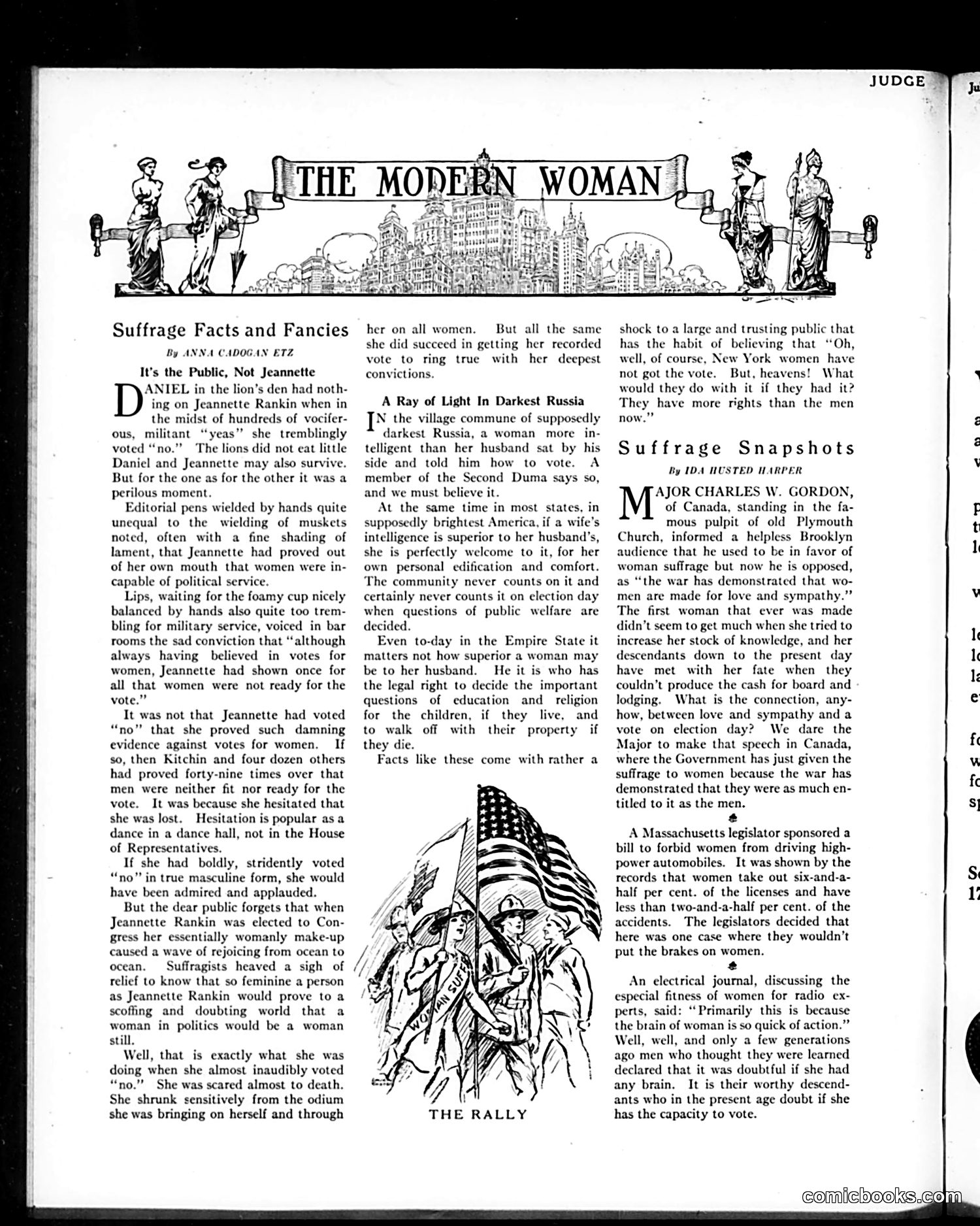
This page satirizes anti-suffrage arguments circulating during the women's suffrage debate (likely early 1900s, given reference to Jeannette Rankin's 1916 Congressional vote). **Main cartoon "The Rally"** depicts a suffrage march with an American flag, representing women's organized political activism. **The article criticizes opponents' logic:** When Jeannette Rankin voted hesitantly on a measure, anti-suffragists claimed this "proved" women unfit for politics. The author notes men voted the same way without similar scrutiny—the real issue was her *demeanor*, not her vote. **The Russian comparison** highlights hypocrisy: Americans boast of women's superior rights versus "darkest Russia," yet U.S. law denies married women control over their children's education and property. **"Suffrage Snapshots"** quotes a Canadian clergyman claiming women are "made for love and sympathy," not politics—a common contemporary argument that women's nature disqualified them from voting. The page's satire exposes the circular logic and double standards used to oppose women's suffrage.
📄 Transcribed text from this page (OCR, searchable)
Machine-transcribed from the original scan — historical spelling and the odd misread are preserved.
Suffrage Facts and Fancies By ANNA CADOGAN ETZ It’s the Public, Not Jeannette ANIEL in the lion’s den had noth- ing on Jeannette Rankin when in the midst of hundreds of vocifer- ous, militant eas’ she tremblingly voted “no.” The lions did not eat little Daniel and Jeannette may also survive. But for the one as for the other it was a perilous moment. Editorial pens wielded by hands quite unequal to the wielding of muskets noted, often with a fine shading of lament, that Jeannette had proved out of her own mouth that women were in- capable of political service. Lips, waiting for the foamy cup nicely balanced by hands also quite too trem- bling for military service, voiced in bar rooms the sad conviction that “although always having believed in votes for women, Jeannette had shown once for all that women were not ready for the vote.” It was not that Jeannette had voted “no” that she proved such damning evidence against votes for women. If so, then Kitchin and four dozen others had proved forty-nine times over that men were neither fit nor ready for the vote. It was because she hesitated that she was lost. Hesitation is popular as a dance in a dance hall, not in the House of Representatives. If she had boldly, stridently voted “no” in true masculine form, she would have been admired and applauded. But the dear public forgets that when Jeannette Rankin was elected to Con- gress her essentially womanly make-up caused a wave of rejoicing from ocean to ocean. Suffragists heaved a sigh of relief to know that so feminine a person as Jeannette Rankin would prove to a scoffing and doubting world that a woman in politics would be a woman that is exactly what she was en she almost inaudibly voted She was scared almost to death. She shrunk sensitively from the odium she was bringing on herself and through her on all women. But all the same she did succeed in getting her recorded vote to ring true with her deepest convictions. A Ray of Light In Darkest Russia N the village commune of supposedly darkest Russia, a woman more in- telligent than her husband sat by his side and told him how to vote. A member of the Second Duma says so, and we must believe it. At the same time in most states, in supposedly brightest America, if a wife's intelligence is superior to her husband's, she is perfectly welcome to it, for her own personal edification and comfort. The community never counts on it and certainly never counts it on election day when questions of public welfare are decided. Even to-day in the Empire State it matters not how superior a woman may be to her husband. He it is who has the legal right to decide the important questions of education and _ religion for the children, if they live, and to walk off with their property if they die. Facts like these come with rather a THE RALLY shock to a large and trusting public that has the habit of believing that “Oh, well, of course, New York women have not got the vote. But, heavens! What would they do with it if they had it? They have more rights than the men now.” Suffrage Snapshots By IDA HUSTED HARPER AJOR CHARLES W. GORDON, M of Canada, standing in the fa- mous pulpit of old Plymouth Church, informed a helpless Brooklyn audience that he used to be in favor of woman suffrage but now he is opposed, as “the war has demonstrated that wo- men are made for love and sympathy.” The first woman that ever was made didn’t seem to get much when she tried to increase her stock of knowledge, and her descendants down to the present day have met with her fate when they couldn’t produce the cash for board and lodging. What is the connection, any- how, between love and sympathy and a vote on election day? We dare the Major to make that speech in Canada, where the Government has just given the suffrage to women because the war has demonstrated that they were as much en- titled to it as the men. & A Massachusetts legislator sponsored a bill to forbid women from driving high- power automobiles. It was shown by the records that women take out six-and-a- half per cent. of the licenses and have less than two-and-a-half per cent. of the accidents. The legislators decided that here was one case where they wouldn’t put the brakes on women. ¢ An electrical journal, discussing the especial fitness of women for radio ex- perts, said: “Primarily this is because the brain of woman is so quick of action.” Well, well, and only a few generations ago men who thought they were learned declared that it was doubtful if she had any brain. It is their worthy descend- ants who in the present age doubt if she has the capacity to vote. comichooks.com