
Judge, 1917-07-28 · page 9 of 28
Judge — July 28, 1917 — page 9: what you’re looking at
What you’re looking at
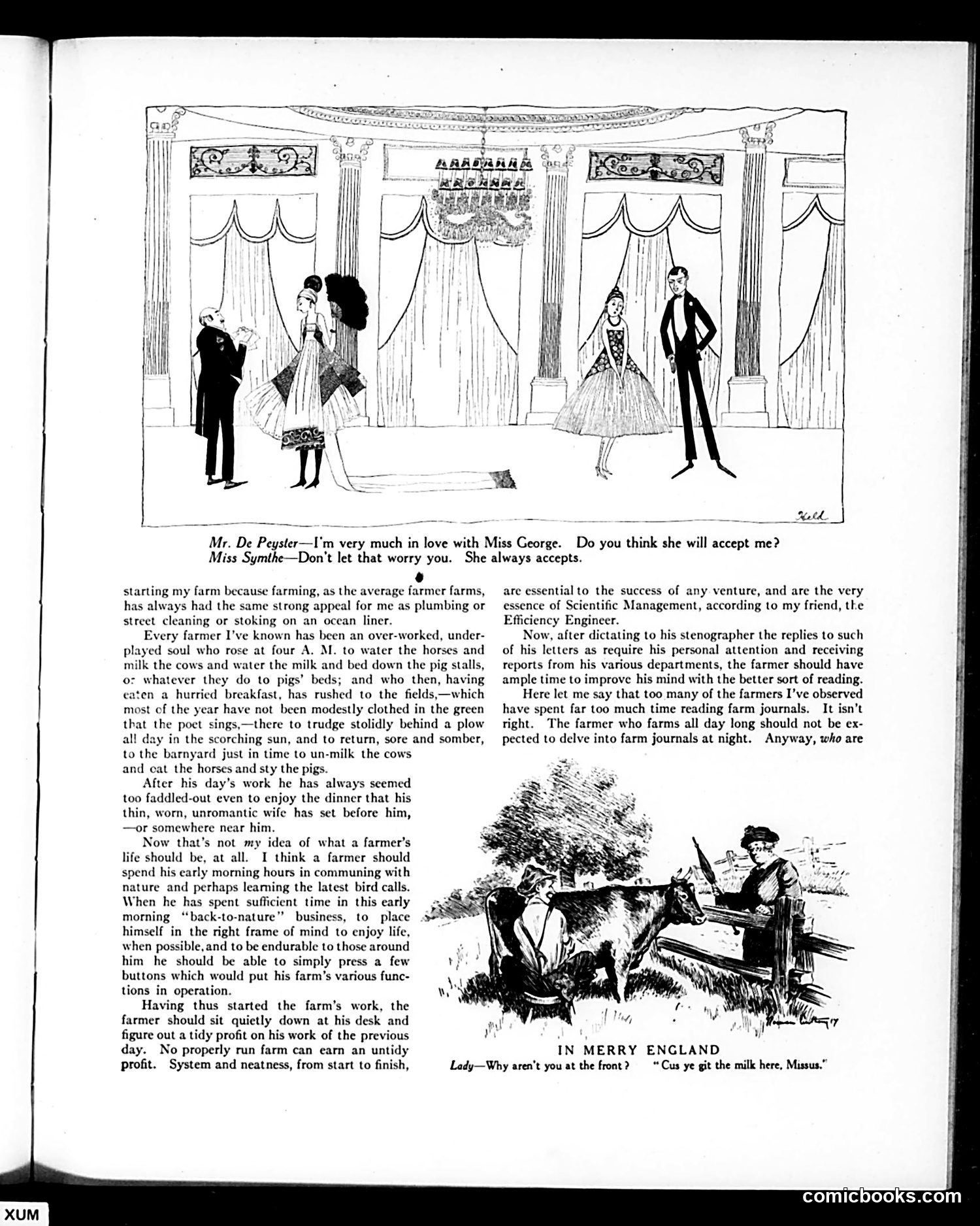
**Top Cartoon:** A drawing-room scene satirizing shallow high-society romance. Mr. De Peyster asks if Miss George will accept his marriage proposal; Miss Smythe replies "Don't let that worry you. She always accepts"—implying Miss George is promiscuously willing to marry anyone. The joke targets the frivolous marriage market among the wealthy elite. **Main Article & Illustration:** A satirical critique of the "Scientific Management" movement (early 1900s efficiency craze). The author mocks a naive vision of modern farming where the farmer merely presses buttons to automate work, then sits at a desk calculating profits—ignoring the brutal physical reality of farm labor. The illustration shows actual farmwork's grinding reality. **Bottom Cartoon ("In Merry England"):** A wartime joke (likely WWI-era). A lady asks a man why he isn't at the front; he replies he must stay to milk the cows—satirizing the excuse-making of those avoiding military service by claiming essential home duties.
📄 Transcribed text from this page (OCR, searchable)
Machine-transcribed from the original scan — historical spelling and the odd misread are preserved.
XUM jn SLI Mr. De Peyster—I'm very much in love with Miss George. Do you think she will accept me? Miss Symthe—Don’t let that worry you. She always accepts. e starting my farm because farming, as the average farmer farms, has always had the same strong appeal for me as plumbing or street ning or stoking on an ocean liner. Every farmer I’ve known has been an over-worked, under- played soul who rose at four A. M. to water the horses and milk the cows and water the milk and bed down the pig stalls, o: whatever they do to pigs’ beds; and who then, having eaten a hurried breakfast, has rushed to the fields,—which most of the year have not been modestly clothed in the green that the poet sings,—there to trudge stolidly behind a plow al! day in the scorching sun, and to return, sore and somber, to the barnyard just in time to un-milk the cows and cat the horses and sty the pigs. After his day’s work he has always seemed too faddled-out even to enjoy the dinner that his thin, worn, unromantic wife has set before him, —or somewhere near him. Now that’s not my idea of what a farmer’s life should be, at all. I think a farmer should spend his early morning hours in communing with nature and perhaps leaming the latest bird calls. When he has spent sufficient time in this early morning ‘“‘back-to-nature” business, to place himself in the right frame of mind to enjoy life, when possible,and to be endurable to those around him he should be able to simply press a few buttons which would put his farm’s various func- tions in operation. Having thus started the farm's work, the farmer should sit quietly down at his desk and figure out a tidy profit on his work of the previous day. No properly run farm can earn an untidy profit. System and neatness, from start to finish, are essential to the success of any venture, and are the very essence of Scientific Management, according to my friend, the Efficiency Engineer. Now, after dictating to his stenographer the replies to such of his letters as require his personal attention and receiving reports from his various departments, the farmer should have ample time to improve his mind with the better sort of reading. Here let me say that too many of the farmers I’ve observed have spent far too much time reading farm journals. It isn’t right. The farmer who farms all day long should not be ex- pected to delve into farm journals at night. Anyway, who are IN MERRY ENGLAND Lady—Why aren't you at the front ? “Cus ye git the milk here, Missus.” comicbooks.com