
A complete issue · 24 pages · 1914
Judge — February 7, 1914
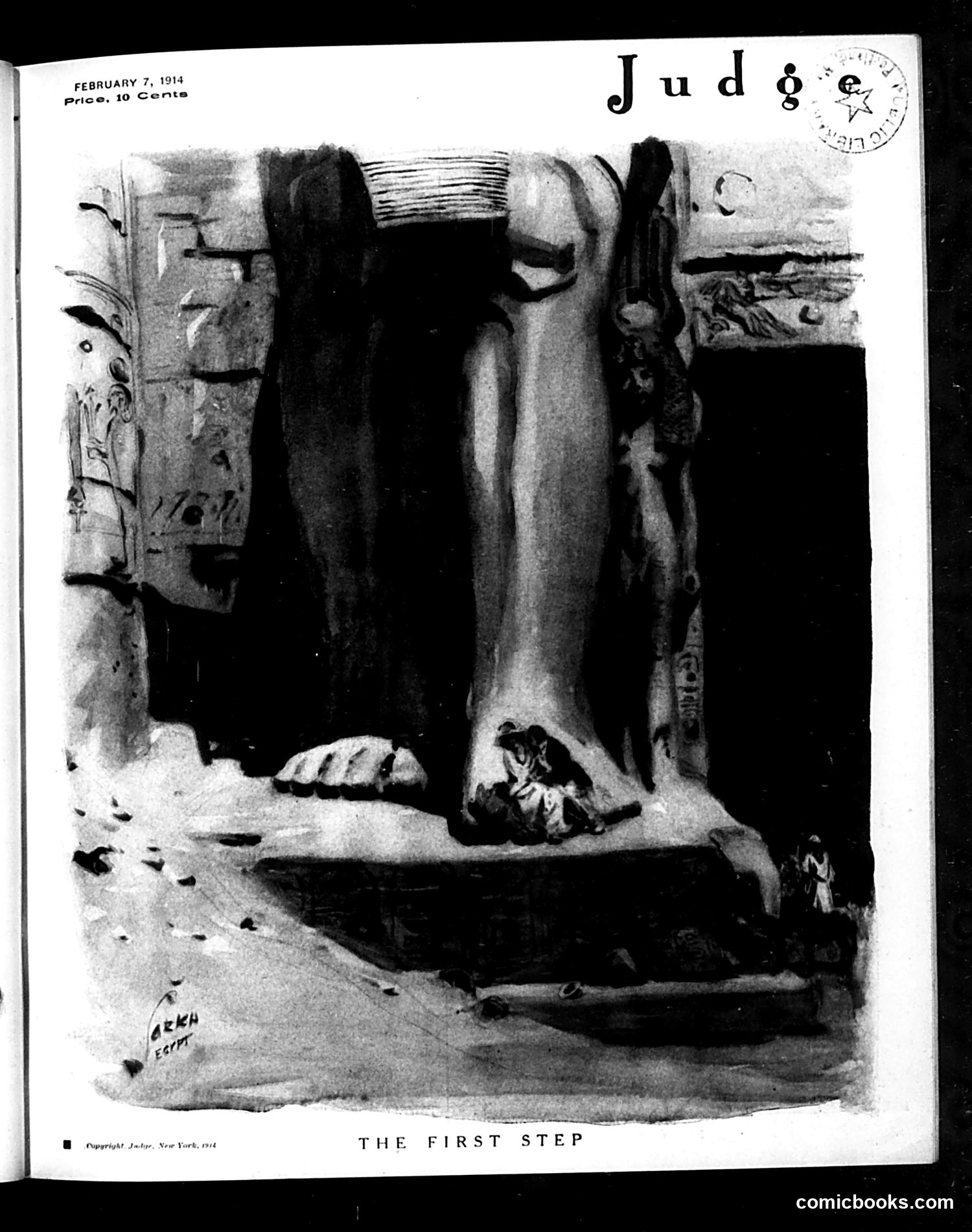
This cartoon depicts a baby taking its first step—a literal visualization of the title. The image shows an infant between two adult figures (likely parents or guardians), attempting to walk independently while being supported. The political meaning remains unclear without additional context from the magazine's other content. Given Judge's satirical nature and the 1914 date, this could allegorically reference: - A nascent political movement or administration taking early action - A new nation or government beginning its governance - Progressive social reform making initial progress The figures flanking the child appear carved or monumental, suggesting they represent larger political or social forces. However, without identifying marks or accompanying text, the specific historical reference cannot be definitively determined.
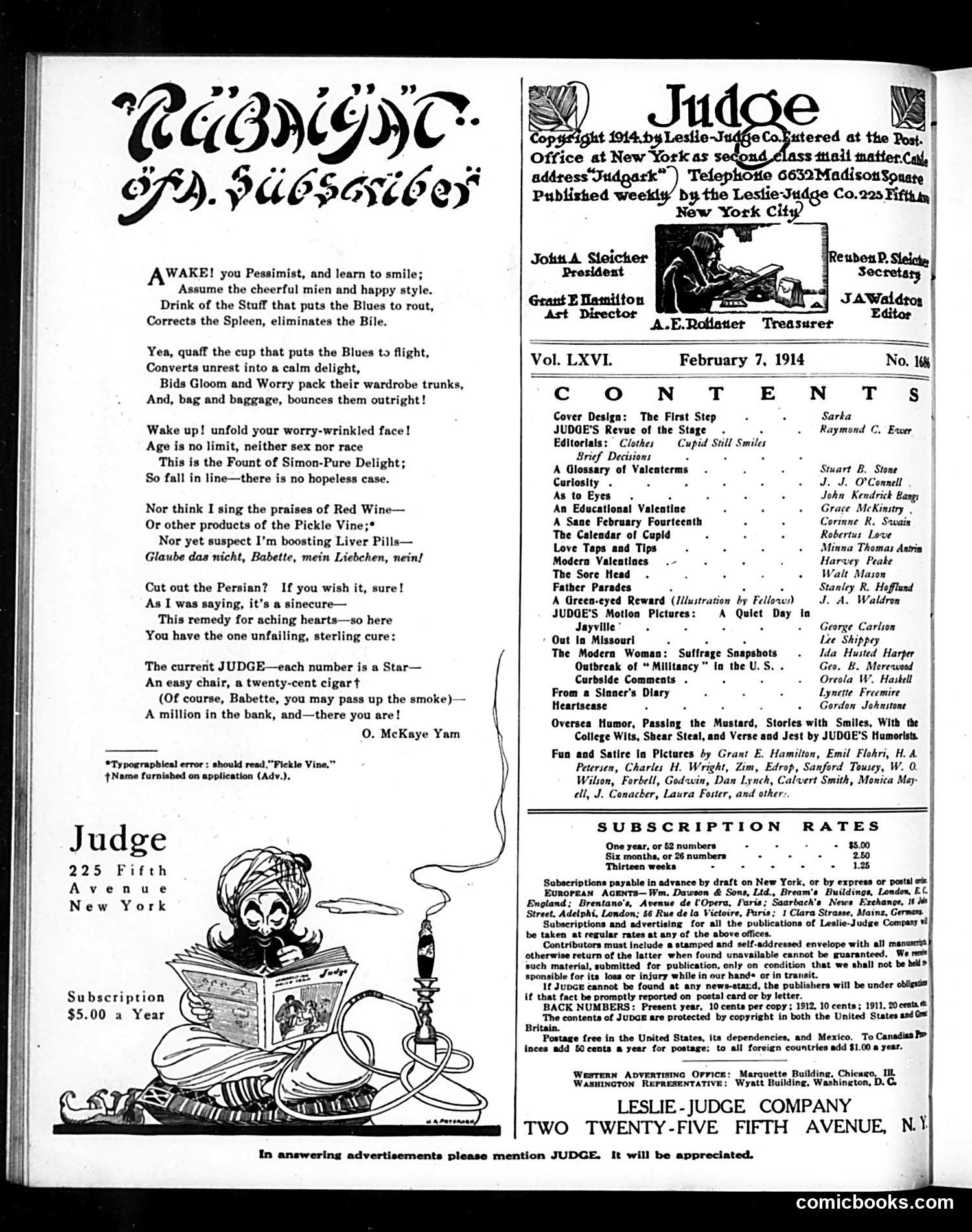
The left side contains a poem titled "Awake! My Subscriber" (byline O. McKaye Yam) that mocks pessimism and encourages optimism through humor. It references drinking wine, taking pills, and enjoying life's pleasures—typical of satirical advice columns of the era. The content table lists various articles and illustrations, though specific subjects are difficult to identify from the OCR. The bottom features the magazine's masthead and subscription information ($5.00/year). This appears primarily to be a contents and advertisement page rather than featuring a prominent political cartoon. The overall tone suggests lighthearted social satire rather than sharp political commentary.
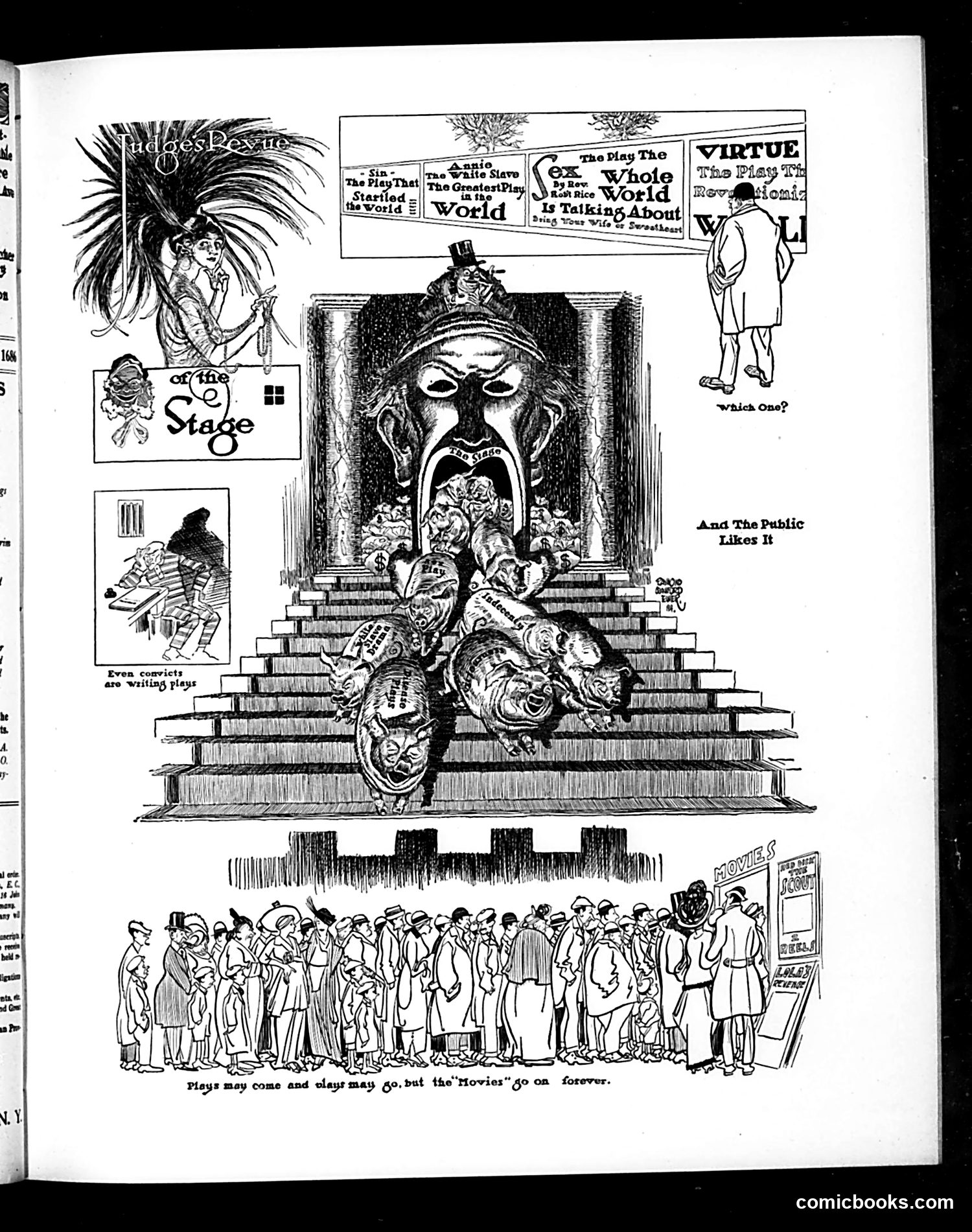
This page satirizes the theatrical industry's dominance over legitimate drama. The central image shows a grotesque theatrical mask-god presiding over steps littered with theatrical masks and figures, suggesting theater has become an all-consuming cultural force. The top section displays competing theatrical productions ("The Play That Startled the World," "The White Slave," etc.), mocking the proliferation of sensational stage plays. Small vignettes criticize theatrical excess—including "Even complete are waiting plays" and questions like "Which One?" highlighting the overwhelming number of productions. The bottom illustration shows crowds queuing at theaters while "Plays may come and clays may go, but the 'Movies' go on forever," suggesting early concerns that cinema might displace traditional theater, despite theater's current cultural dominance. This reflects anxieties from the early 1910s about emerging film entertainment.
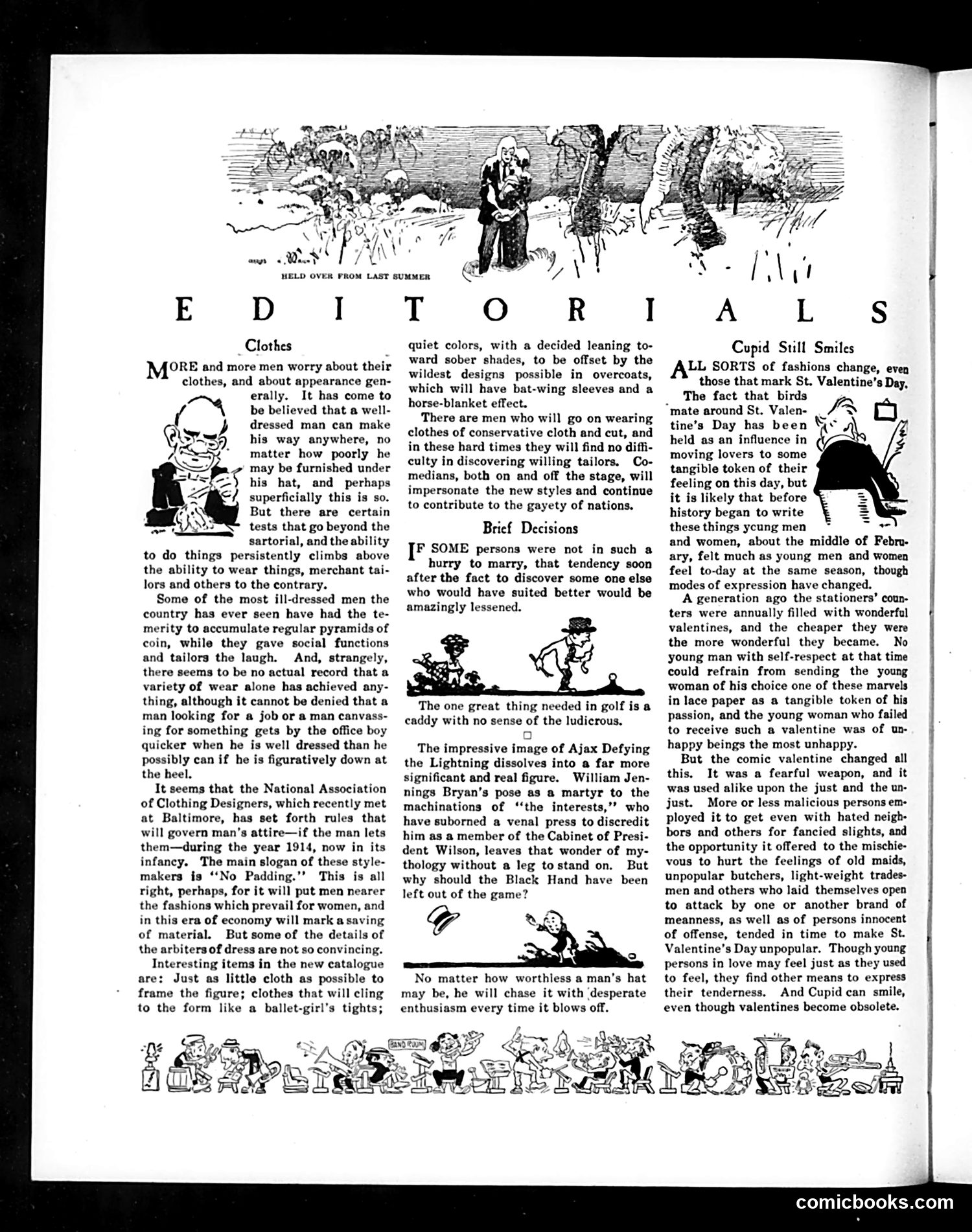
This Judge magazine editorial page contains three sections: **Left column ("Clothes"):** Satirizes men's anxiety about fashion and appearance. The caricatured man worries excessively about clothing choices, mocking the notion that well-dressed men achieve social success through tailors rather than merit. **Center ("Brief Decisions"):** Two single-panel cartoons with minimal text. The first addresses golf etiquette; the second references "Ajax Defying the Lightning" and mentions President Wilson and "the Black Hand," likely alluding to political or social tensions of that era (appears WWI-period). **Right column ("Cupid Still Smiles"):** Discusses Valentine's Day traditions and how comic valentines became vehicles for social commentary, allowing people to mock unpopular figures—butchers, tradesmen, politicians—through humor rather than direct confrontation. The page blends fashion criticism with period political commentary.
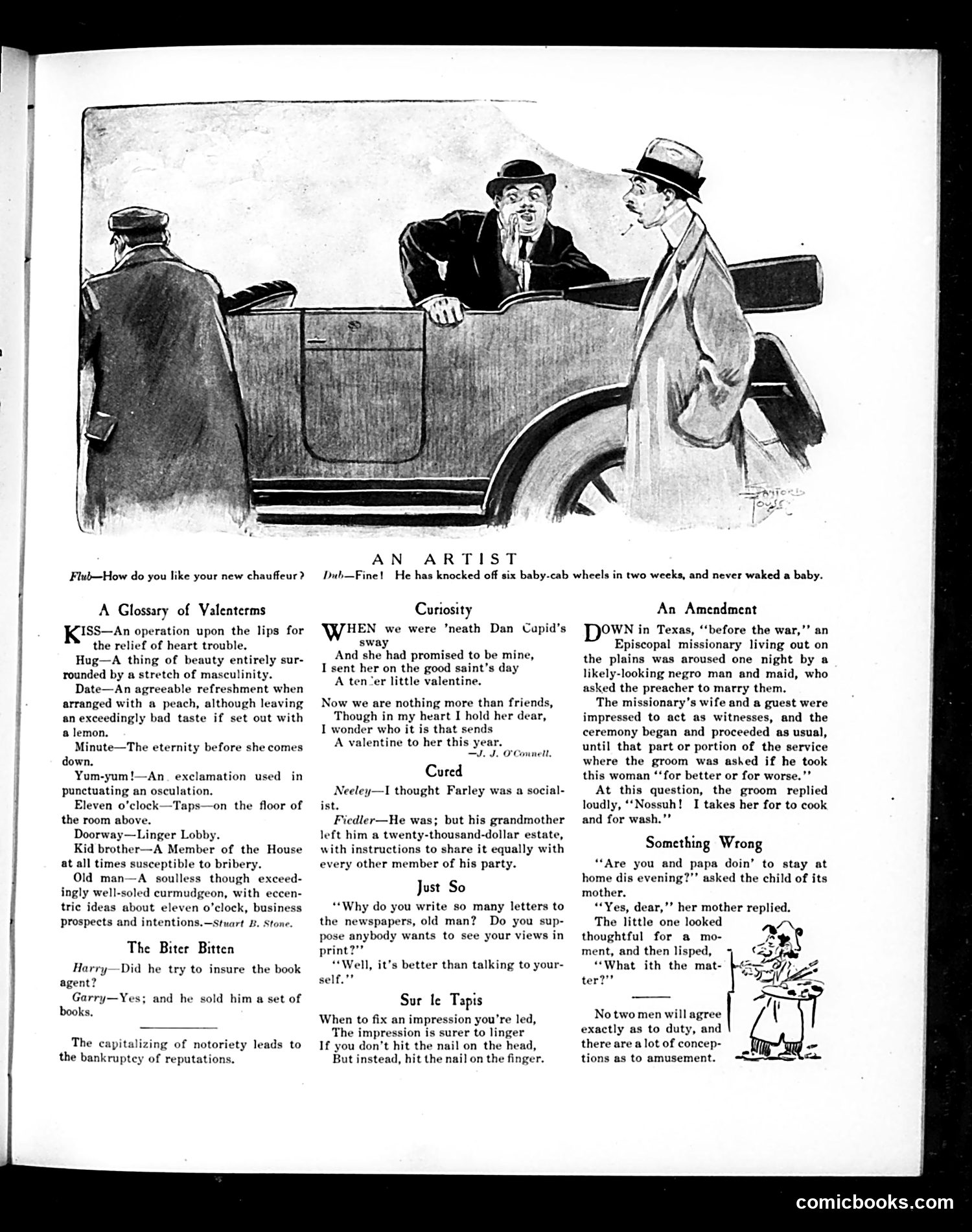
The main cartoon depicts three men and a chauffeur with an early automobile. The caption reads: "How do you like your new chauffeur?" / "Fine! He has knocked off six baby-cab wheels in two weeks, and never waked a baby." This is satire about the early automobile era's dangers to pedestrians and children. The joke relies on the absurd contrast between reckless driving (destroying multiple baby carriages) and an impossible standard of care (never disturbing sleeping infants). It mocks both negligent drivers and the naive optimism of automobile owners who prioritize property damage over actual safety. The page also contains unrelated humor pieces like "Just So" and "Something Wrong"—typical Judge magazine filler combining wordplay, anecdotes, and small comic illustrations.
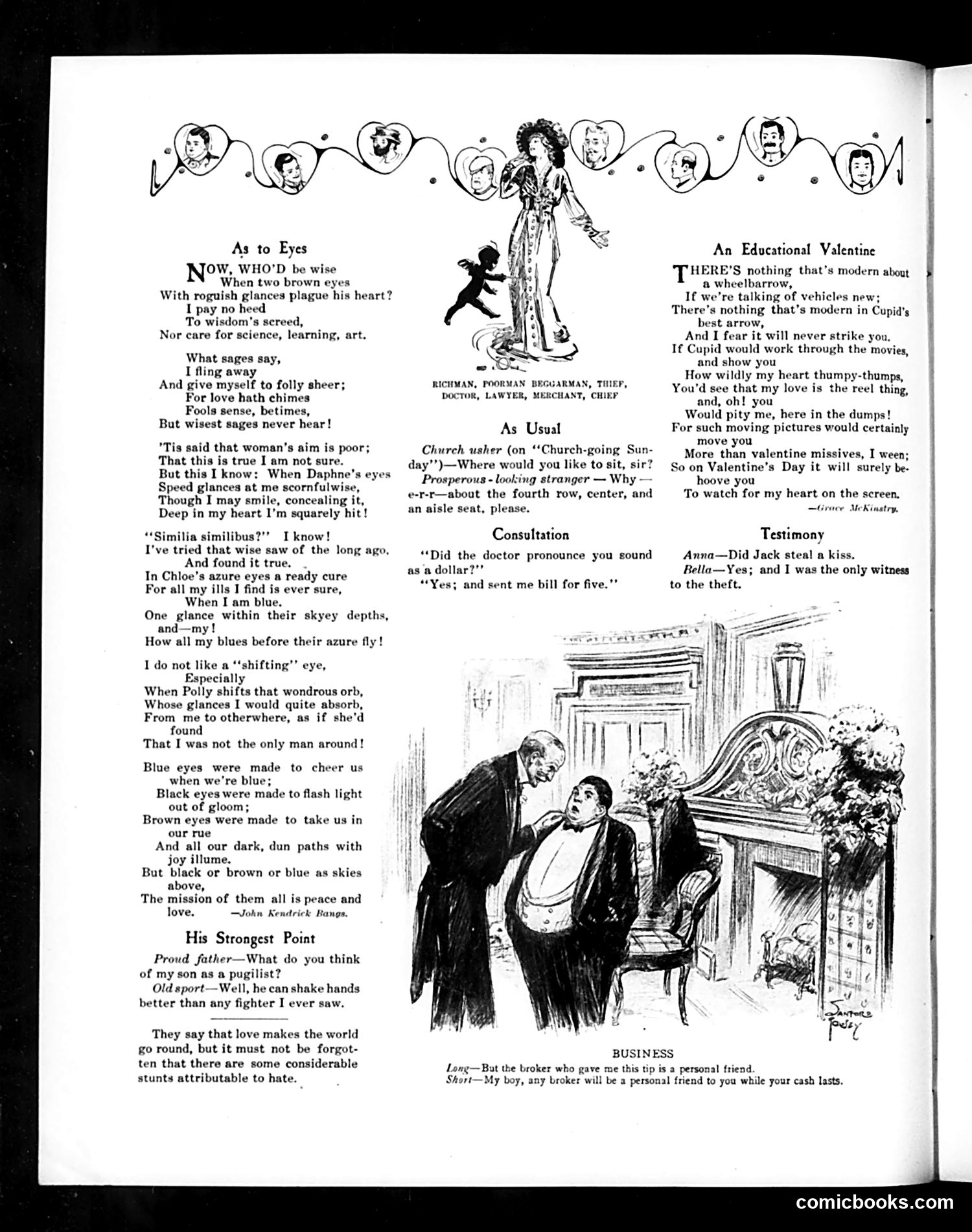
This page presents Valentine's Day-themed humor typical of early 20th-century American satire. The dominant content includes romantic poetry about eyes and love, alongside several brief comic scenarios. **The cartoons mock social pretensions and romantic conventions:** 1. **"As Usual"** satirizes class-conscious church attendance—a wealthy stranger demands a prominent fourth-row seat, suggesting vanity disguised as piety. 2. **"Consultation"** uses a common joke format: a doctor pronounces the patient "sound as a dollar" but charges five dollars for the visit, implying the bill itself proves the diagnosis false. 3. **"Testimony"** presents a mild scandal joke about a stolen kiss, with dual innuendo about witnessing. 4. **"Business"** skewers financial advice: a broker's "friendship" evaporates once your money runs out—a Depression-era concern about market advice reliability. The romantic poetry emphasizes eyes as love's instruments, conventional for the era. Overall, the page balances sentimental Valentine's content with cynical observations about materialism, social climbing, and dishonesty.
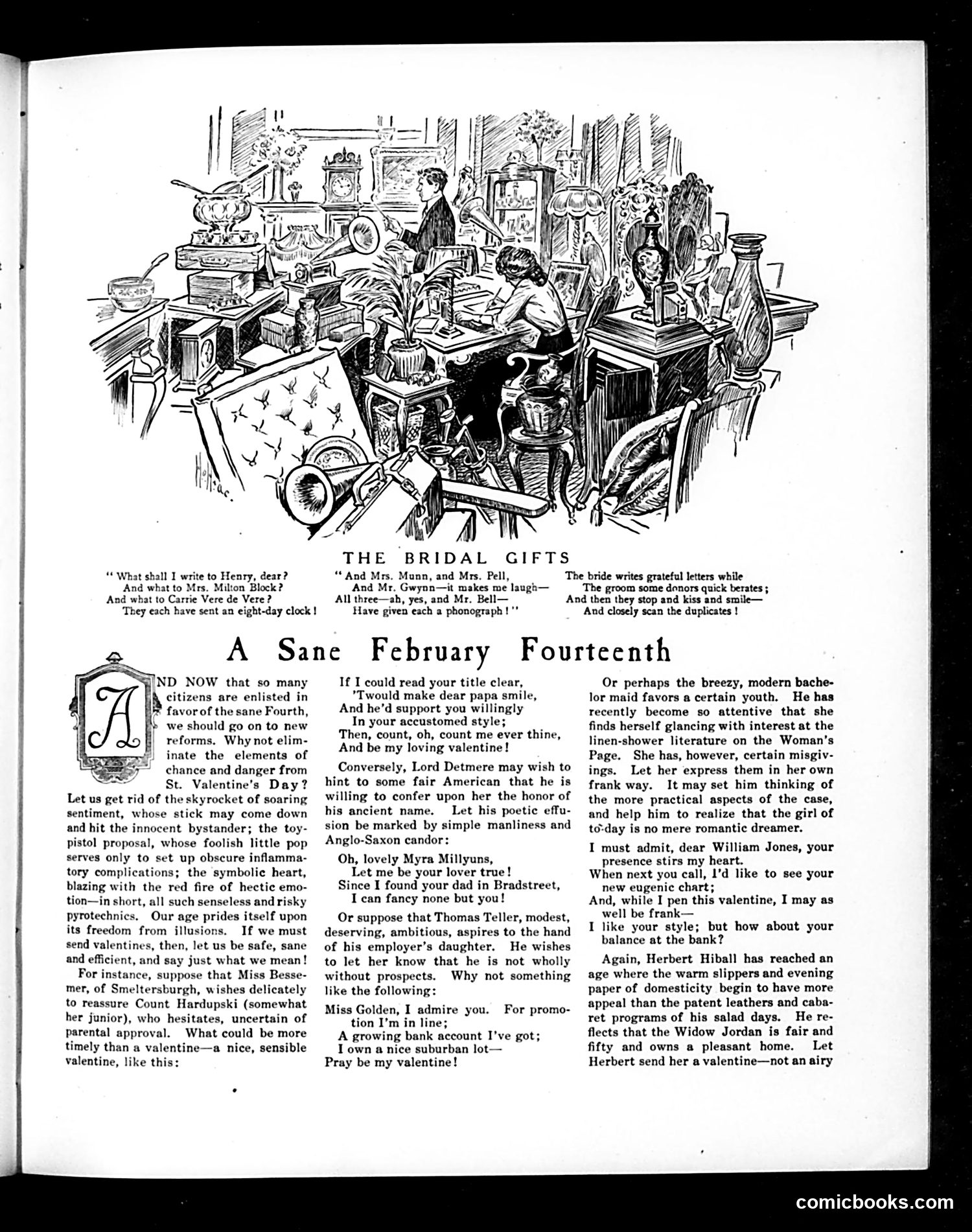
This satirical piece mocks the Progressive Era's obsession with "sane" reform by applying utilitarian logic to Valentine's Day romance. The cartoon depicts the chaos of duplicate wedding gifts; the accompanying article humorously proposes eliminating sentimental, spontaneous proposals in favor of brutally practical valentines. The satire presents mock valentines where suitors candidly discuss financial prospects, bank accounts, and suburban real estate rather than expressing emotion. A woman requests to see a man's "eugenic chart" (reflecting contemporary eugenics pseudoscience), and another frankly questions a suitor's bank balance. The joke targets Progressive reformers who sought to rationalize every aspect of life—from eliminating "dangerous" Fourth of July celebrations to optimizing human reproduction. By pushing this logic to absurd extremes in courtship, Judge ridicules the movement's joyless efficiency and loss of romance. The piece suggests that some human experiences shouldn't be "sanitized" by reason and practicality.
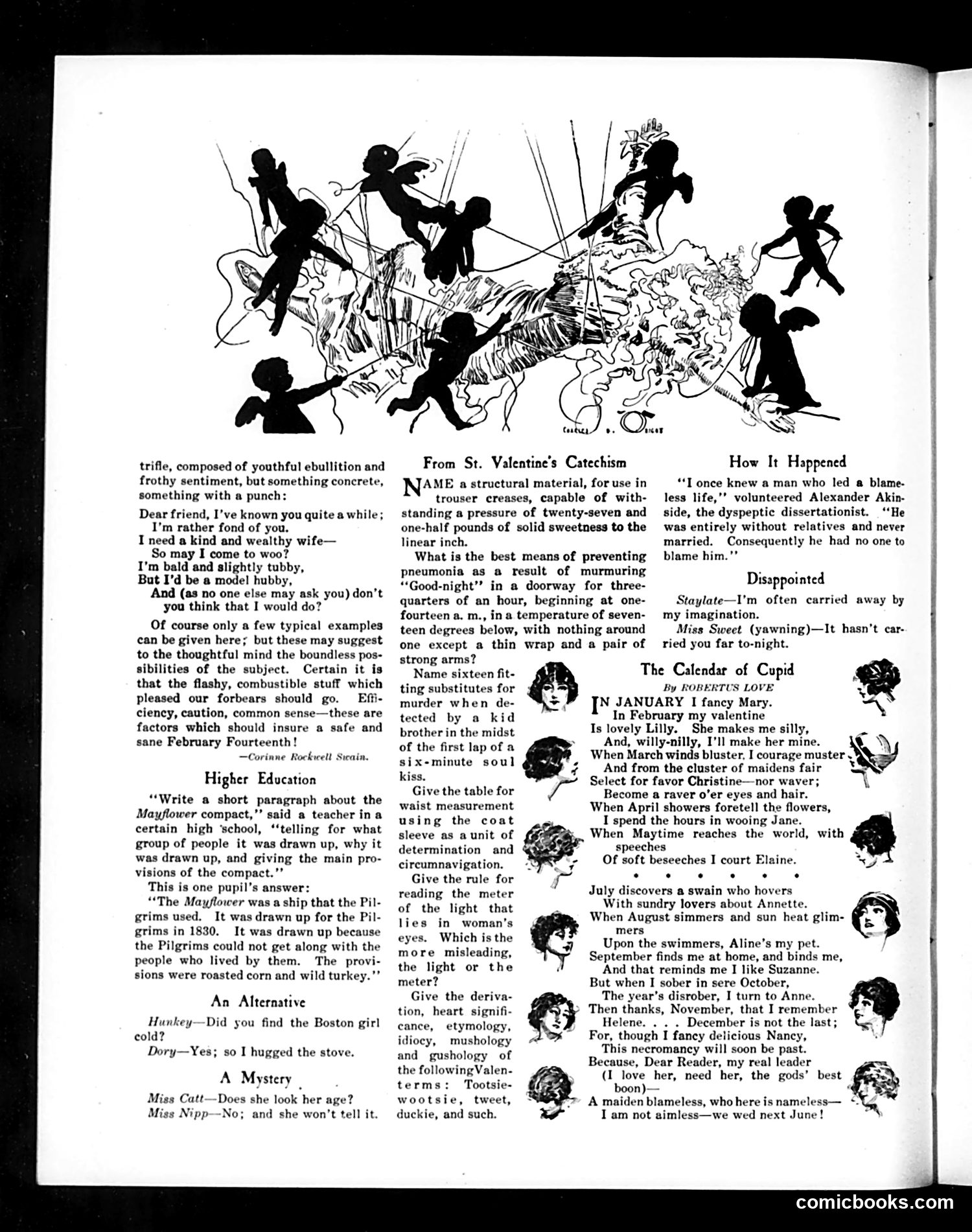
This page contains several satirical pieces typical of early 20th-century Judge magazine humor: **"St. Valentine's Catechism"** mockingly treats Valentine's Day romance with mock-academic language, asking absurd questions about trouser creases, doorway pneumonia from prolonged goodbyes, and decoding women's eye-light. The satire targets sentimental romance as impractical nonsense. **"Higher Education"** ridicules student ignorance through a pupil's garbled answer about the Mayflower Compact—confusing the 1620 document with an 1830 ship and claiming its "provisions" were food. This mocks poor education outcomes. **"The Calendar of Cupid"** humorously catalogs a man's romantic infatuations month-by-month (Mary, Lilly, Christine, Jane, Elaine, Annette), culminating in marriage to an unnamed woman—satirizing male fickleness and shallow courtship. Minor jokes include a pun about hugging a stove instead of a cold Boston girl, and commentary on Valentine's Day as overly sentimental. The illustration shows playful cherubs. Overall, the page gently mocks romance, education failures, and courtship customs of the era.
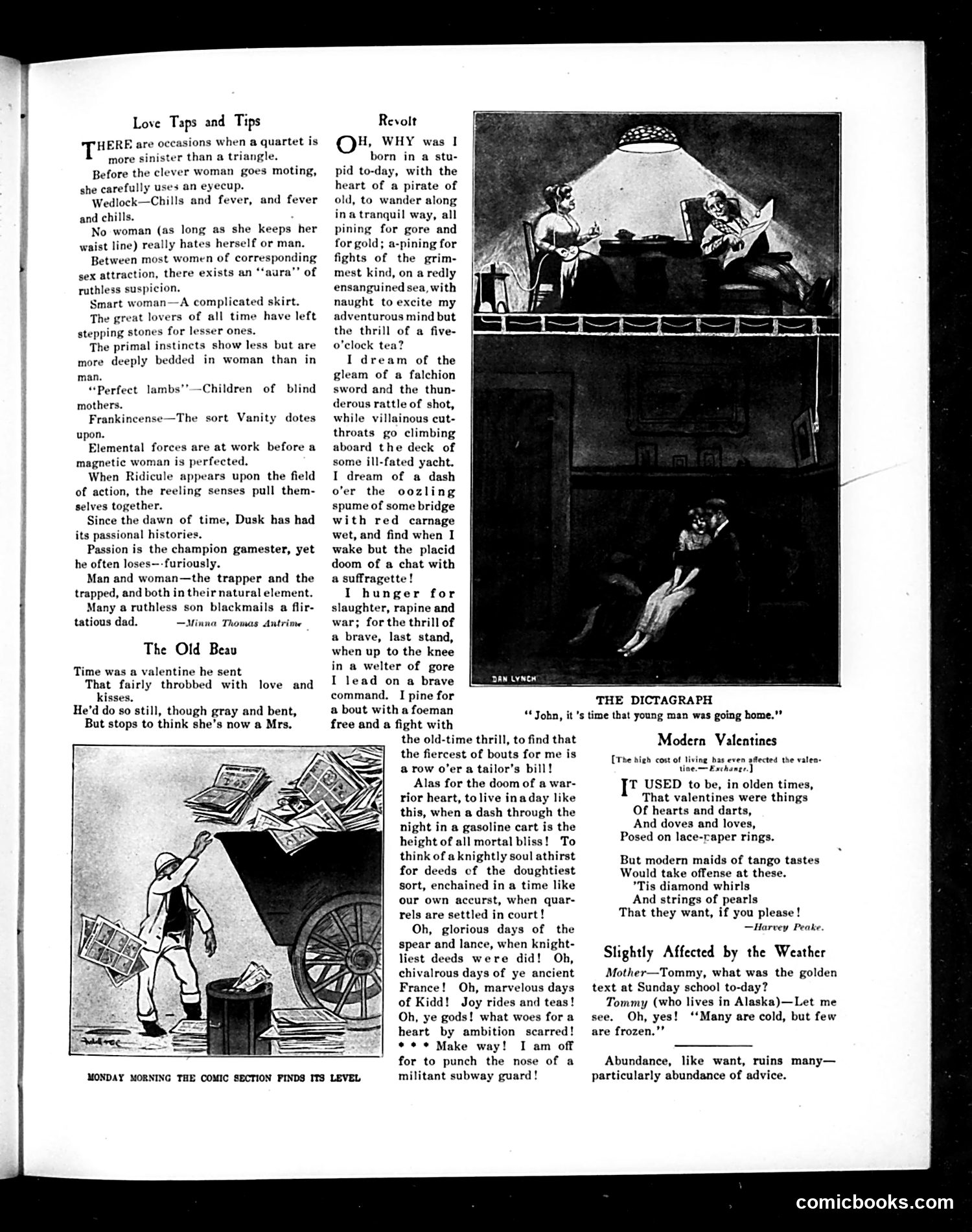
This page contains several pieces of satirical content reflecting early 20th-century gender and social anxieties: **"Love Taps and Tips"** and **"The Old Beau"** mock romantic conventions. The latter depicts an aging man nostalgic for youthful courtship, now constrained by marriage ("stops to think she's now a Mrs"). **"Revolt"** is the central satire: a man fantasizes about pirate adventures, sword fights, and naval combat, only to lament that modern life offers merely "a chat with a suffragette" and arguing over tailor's bills. The poem mocks both his thwarted martial ambitions and—implicitly—the irritation of dealing with politically active women ("suffragette"), while depicting modern domestic concerns as laughably mundane compared to imagined heroics. **"The Dictagraph"** illustration appears to reference early dictation/recording technology, suggesting surveillance concerns in modern life. **"Modern Valentines"** satirizes inflation: traditional romantic tokens (hearts, lace) are now replaced by expensive jewelry demands, reflecting post-war economic strain. The overall theme: modern life (wives, suffragettes, bills, inflation) has emasculated and domesticated men's romantic and adventurous spirits.
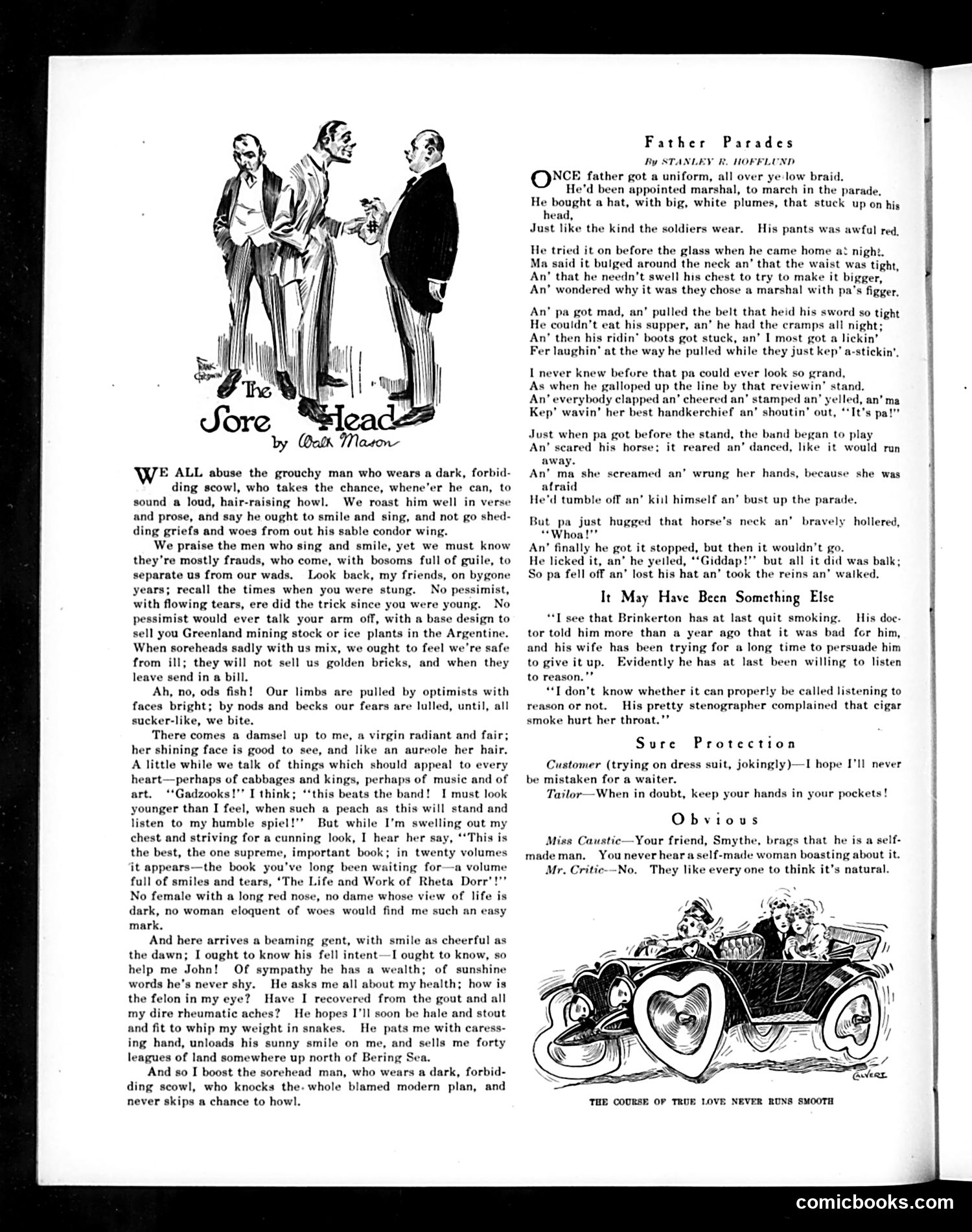
**"The Sore Head"** (main text) satirizes American optimism and salesmanship. The author argues that pessimists—despite their gloomy demeanor—are actually *safer* to associate with than cheerful people. The joke: optimists with bright smiles are con artists who bilk the gullible (selling worthless land schemes, mining stock, fake books). A grouchy pessimist won't sell you anything because he's not motivated by profit. The piece mocks the era's culture of aggressive sales pitches and American gullibility—people are literally "sucker[s]" for a smiling face, even when being robbed. **"Father Parades"** is a humorous poem about a working-class father appointed town marshal for a parade. The comedy derives from his physical discomfort in the formal uniform (tight pants, stuck boots) and his vanity despite the indignity. It gently satirizes small-town pride and masculine ego—he's uncomfortable but won't admit it, suffering silently to maintain dignity. Both pieces reflect early 20th-century concerns: consumer fraud and the clash between working-class aspiration and uncomfortable modernity.
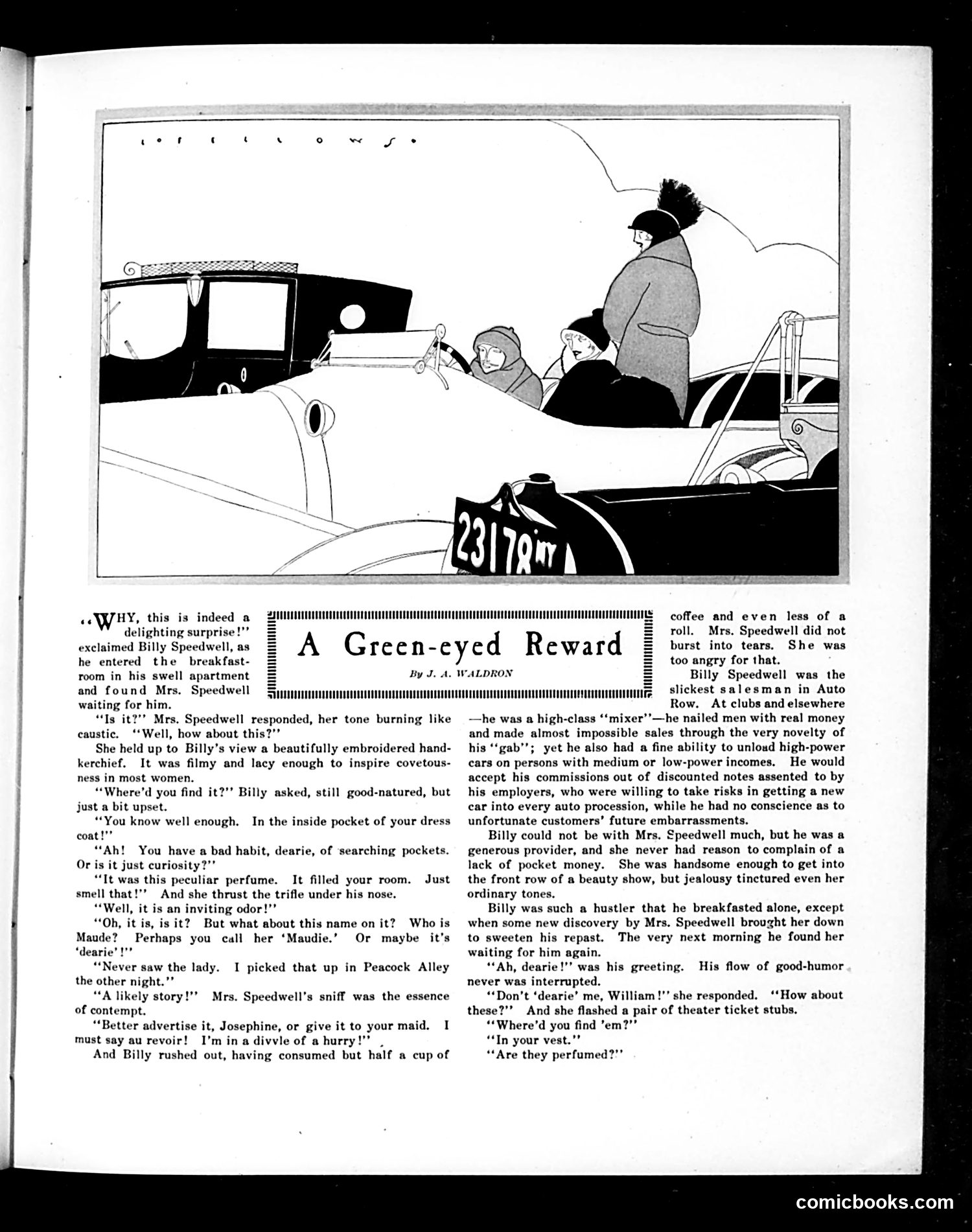
This story satirizes the lifestyle of a smooth-talking 1920s car salesman named Billy Speedwell, who exploits his charisma ("gab") to sell automobiles to people who can't afford them. The humor centers on marital infidelity and jealousy. Mrs. Speedwell discovers evidence of Billy's extramarital activities: a perfumed handkerchief with a woman's name ("Maudie") found in his coat pocket, then theater ticket stubs in his vest. Billy deflects her accusations with glib charm and excuses, rushing off before breakfast to continue his hustling lifestyle. The satire mocks both Billy's unscrupulous sales methods and his casual marital deceptions. The title "Green-eyed Reward" refers to the jealousy his infidelity provokes. The cartoon above depicts him with his mistress while his wife waits at home—visualizing the duplicity the text describes. The story presents a period critique of Jazz Age morality and commercial dishonesty.
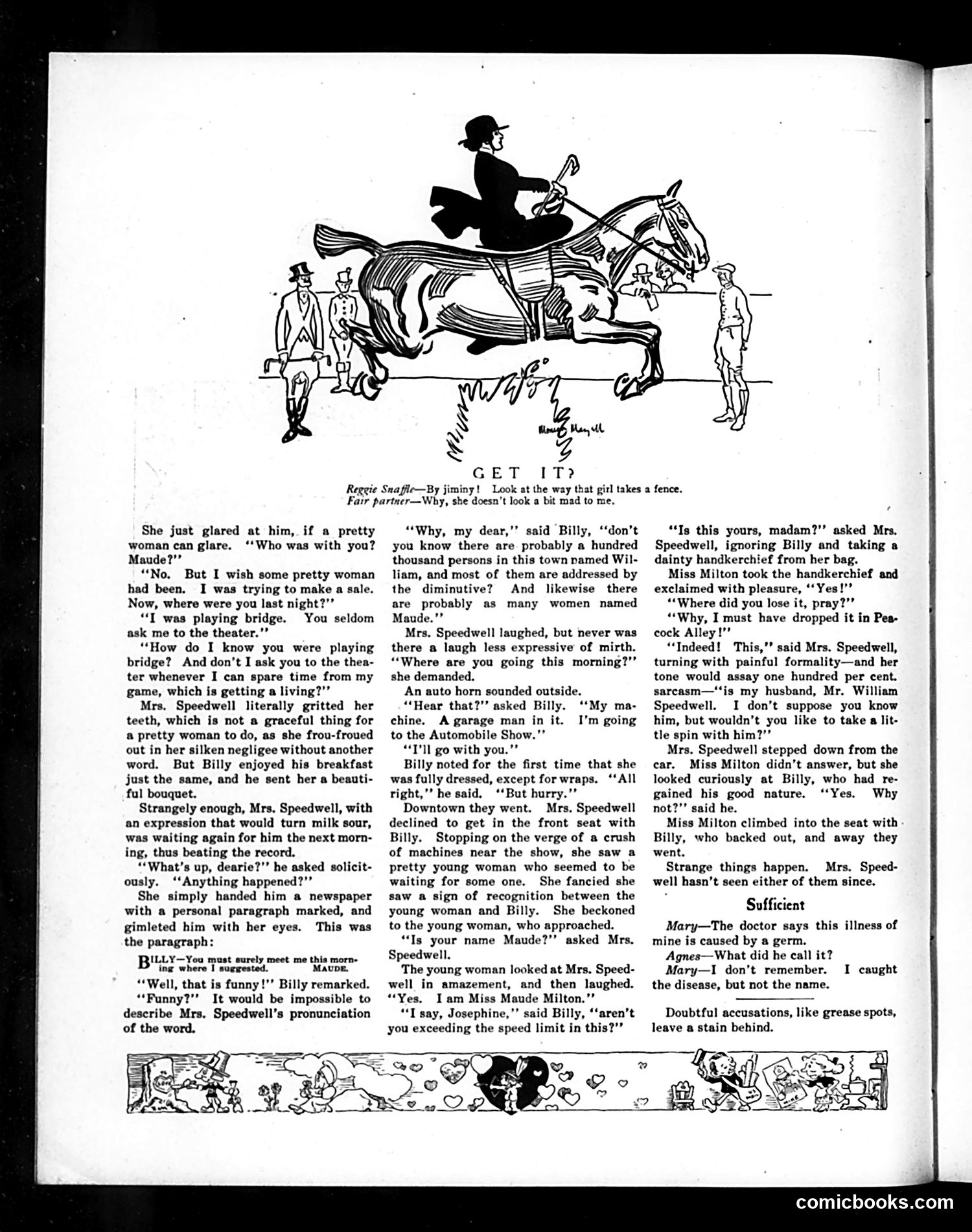
This story satirizes early 20th-century marital suspicion and the era's leisured class. Billy Speedwell, a wealthy man, arrives home late claiming to have been at work; his wife Mrs. Speedwell is skeptical. When a newspaper personal ad addresses "Billy" from someone named "Maude," she suspects an affair. The satire cuts both ways: Billy dismissively explains away her concerns with the logic that "William" and "Maude" are common names—a transparent excuse. Mrs. Speedwell, rather than confront him directly, engineers a clever trap: she finds an actual Miss Maude Milton and deliberately introduces her to Billy, then offers to let them go together unchaperoned. Billy accepts with suspicious eagerness. The joke's conclusion—that Mrs. Speedwell never sees either of them again—suggests her scheme backfired spectacularly, implying Billy actually *was* unfaithful, or at minimum, readily willing to be. The satire mocks both marital dishonesty and the ineffectual way wives attempt to catch cheating husbands.
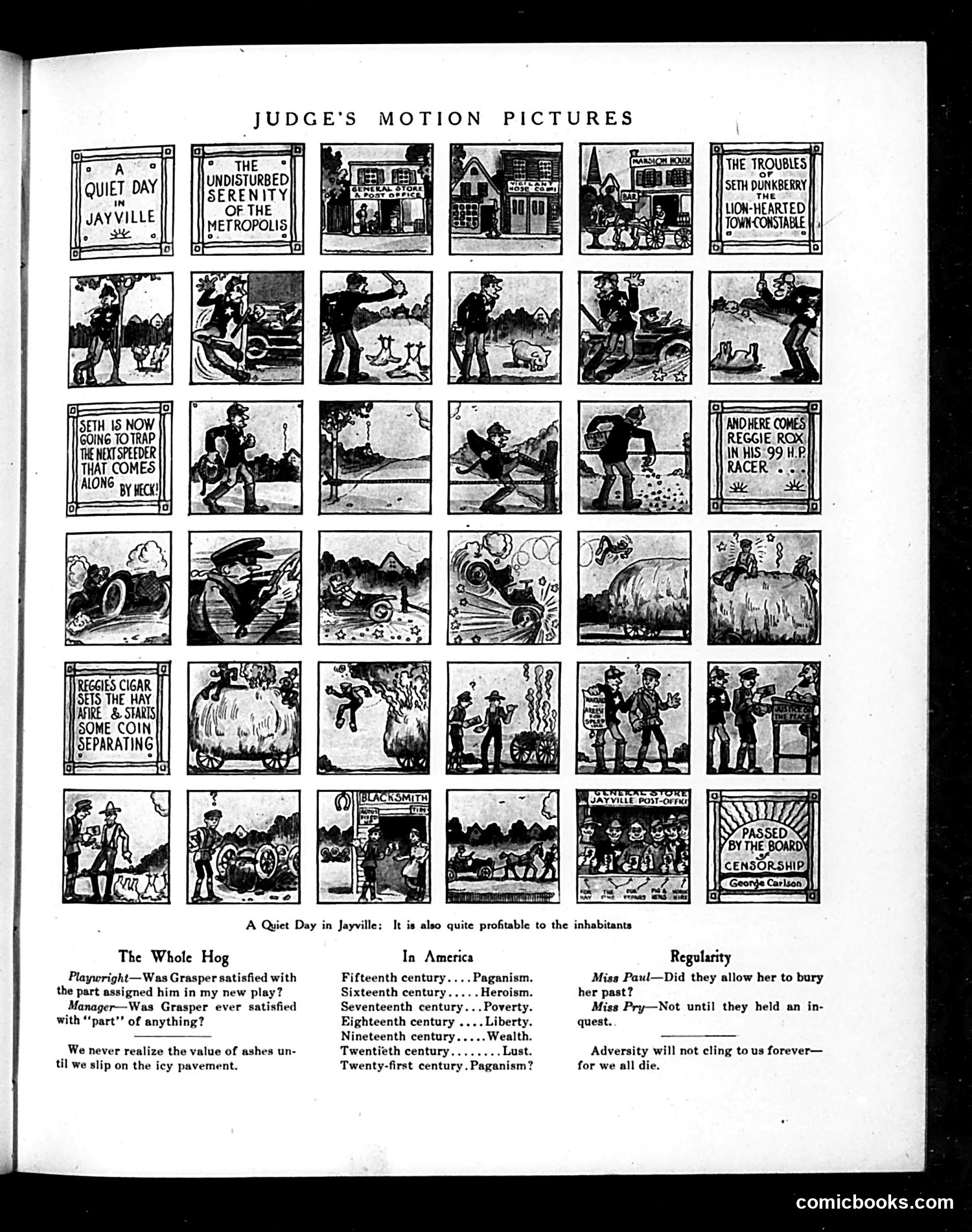
This page showcases **Judge's "Motion Pictures"** — a series of silent-film-style comic strips mocking American social life circa early 20th century. The page satirizes several targets: **Top row**: Film titles parody popular movies ("A Quiet Day in Jayville," "The Undisturbed Serenity of the Metropolis," "The Troubles of Seth Punkberry"). **Middle panels**: Slapstick humor depicting everyday mishaps — people falling, crashing vehicles, and comic violence — reflecting silent film's physical comedy style. **Bottom section** contains satirical text. "In America" traces supposed moral decline from paganism through wealth back to paganism in the 21st century — suggesting cyclical decadence. "The Whole Hog" jokes about greedy theater people. Other bits mock social pretension and hypocrisy. The final panel notes "Passed by the Board of Censorship," satirizing film censorship boards that were increasingly powerful during this era. Overall, the page mocks contemporary entertainment, morality anxieties, and social obsessions through exaggerated visual and textual humor.
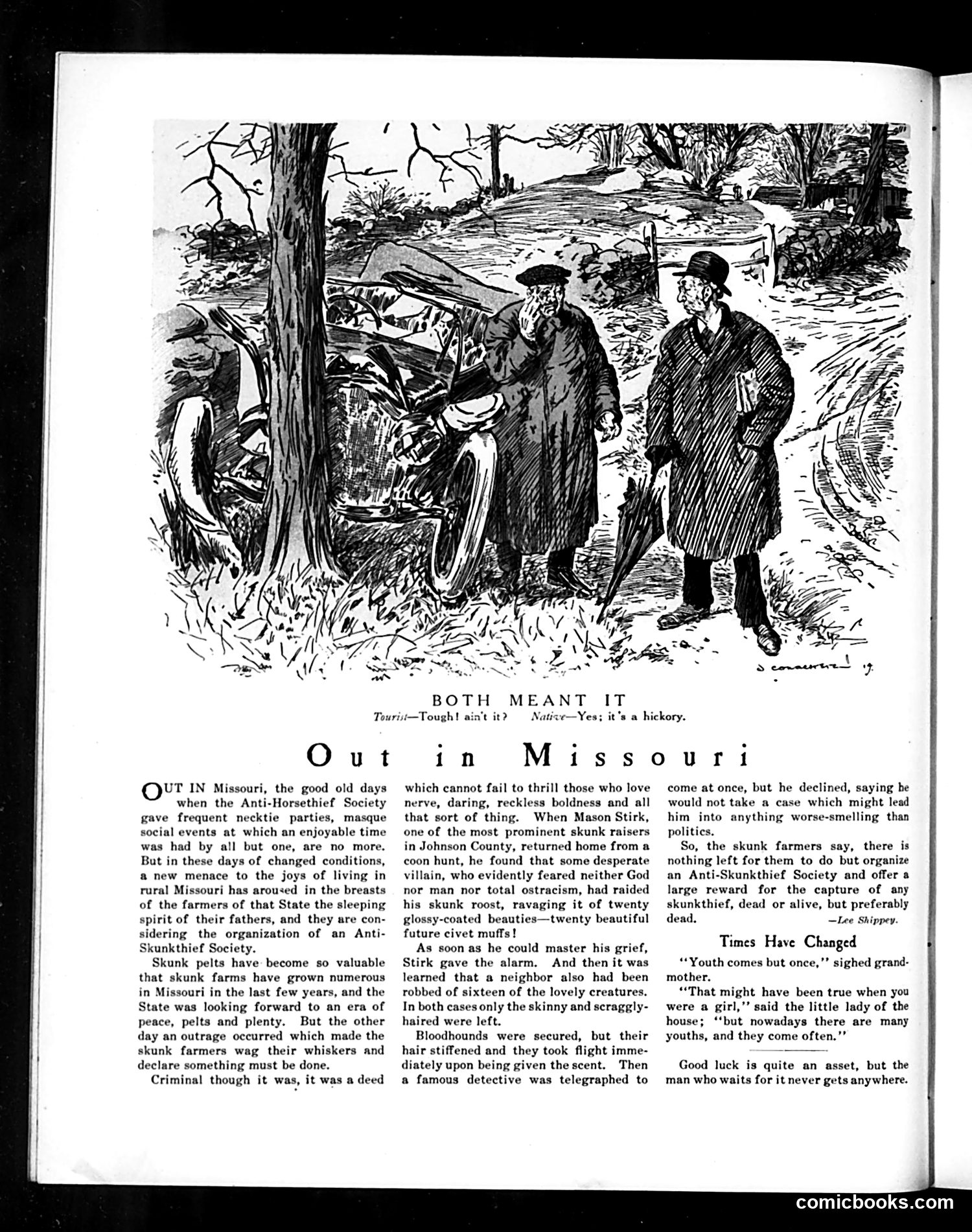
This piece satirizes rural vigilantism and changing times. The illustration shows a lynching ("necktie party"—a euphemism for hanging), referencing Missouri's historical Anti-Horsethief Societies, which were extrajudicial groups that summarily executed suspected thieves. The article humorously suggests farmers must now form an "Anti-Skunkthief Society" because skunk pelts have become valuable enough to steal. The joke mocks the absurdity of applying frontier justice to a trivial economic problem: the same violent spirit once directed at horse thieves is now needed for... skunk rustlers. A detective refuses the case, claiming politics smells worse than skunks—a side jab at government corruption. The cartoon's subtitle, "Both Meant It," suggests the tourist and native are discussing whether violence is justified, playing on American frontier mythology where such brutality was once normalized.
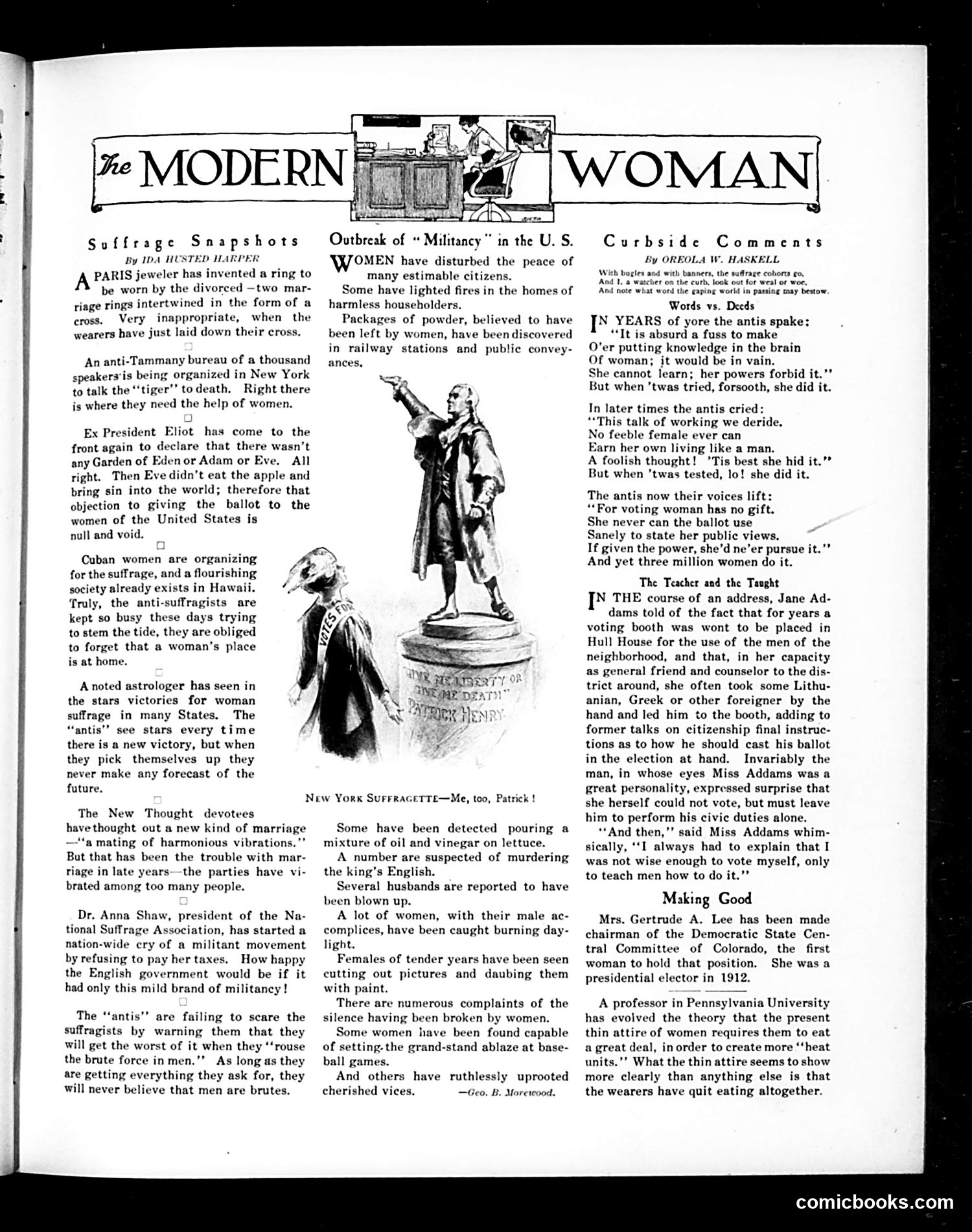
This Judge magazine page satirizes anti-suffrage arguments through mock-outraged reporting of women's activism. **The central cartoon** depicts a statue labeled "Patrick Henry" with a woman below saying "Me, too, Patrick!"—a suffragette claiming the patriot's revolutionary spirit for her own cause. **"Suffrage Snapshots"** (left column) uses ironic headlines to mock anti-suffragists' panic over women's militancy. References like "packages of powder" in railway stations and "several husbands blown up" allude to actual British suffragette bombing campaigns. The tone treats these acts as trivial ("mild brand of militancy"). **"Curbside Comments"** (right column) presents a poem contrasting anti-suffragists' predictions ("woman cannot learn," "cannot work," "cannot vote wisely") with women's demonstrated ability to do exactly these things—undermining opponents' core arguments. The page's strategy: ridicule anti-suffragists by showing their objections repeatedly disproven by reality, while simultaneously defending women's militant tactics as justified resistance to unreasonable opposition.
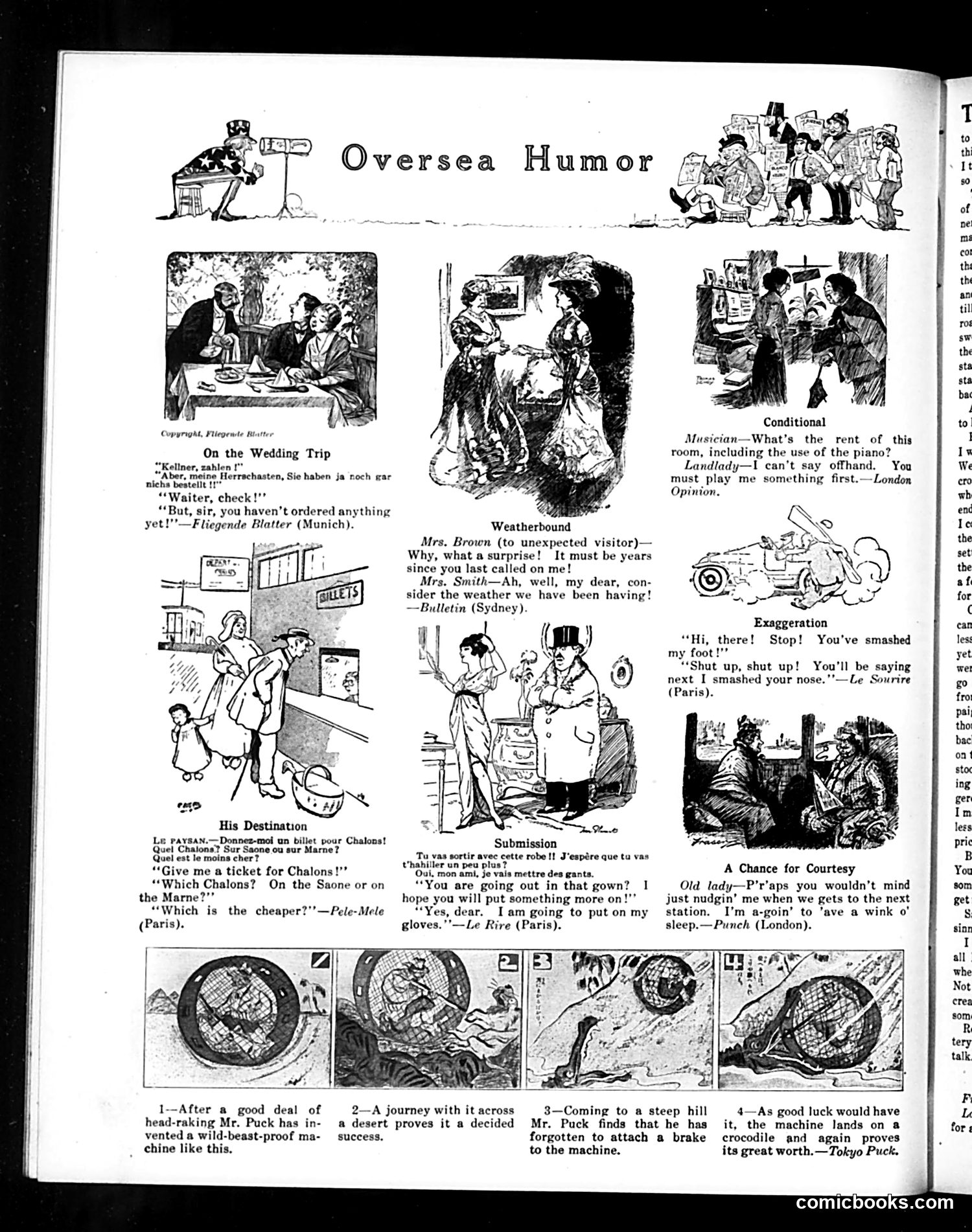
This page compiles humorous cartoons and jokes reprinted from European and other international satirical publications—German (*Fliegende Blatter*), French (*Pele-Mele*, *Le Rire*), British (*Punch*), Australian (*Bulletin*), and Japanese (*Tokyo Puck*). The humor relies on everyday social situations: a waiter confronting diners who haven't ordered; a traveler choosing the cheaper train route; weather as an excuse for infrequent visits; a woman deflecting criticism about her plain dress by saying she'll wear gloves; a landlord demanding an audition before renting; exaggerated car accidents; and a tired passenger asking for a wake-up call. The bottom strip depicts "Mr. Puck" testing an invented "wild-beast-proof machine" that survives desert and hill journeys, ultimately proving its worth by landing on a crocodile. These are gentle, universal jokes about manners, travel, and daily absurdities, presented to American *Judge* readers as examples of international wit.
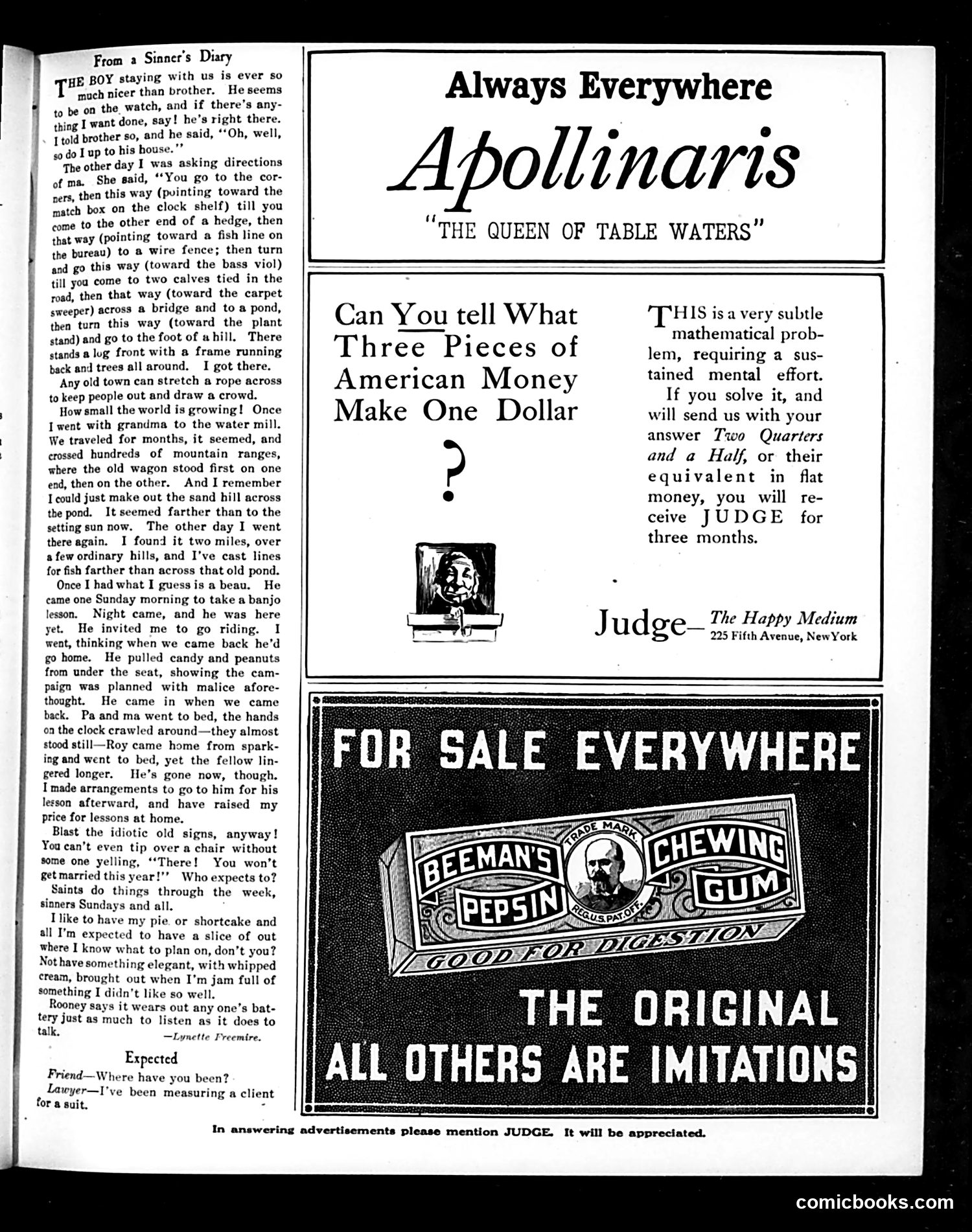
This page from Judge magazine contains primarily **advertising and a reader puzzle**, rather than political satire. **Main Content:** 1. **"From a Sinner's Diary"** (left column): A humorous, autobiographical essay by "Lynette Freemire" about small-town life—exaggerated directions using household objects, the shrinking distances of modern travel, an overstaying suitor, and social hypocrisies. The satire targets rural absurdities and Victorian courtship customs rather than political figures. 2. **Puzzle Advertisement** (center): Asks readers to identify three pieces of American currency that total one dollar, offering a three-month Judge subscription as prize. No satirical content. 3. **Product Advertisements**: Apollinaris bottled water and Beeman's Pepsin Chewing Gum occupy the lower half—purely commercial. **No identifiable political cartoons or caricatures appear on this page.** It's primarily a filler/advertising page from an early-20th-century satirical magazine.
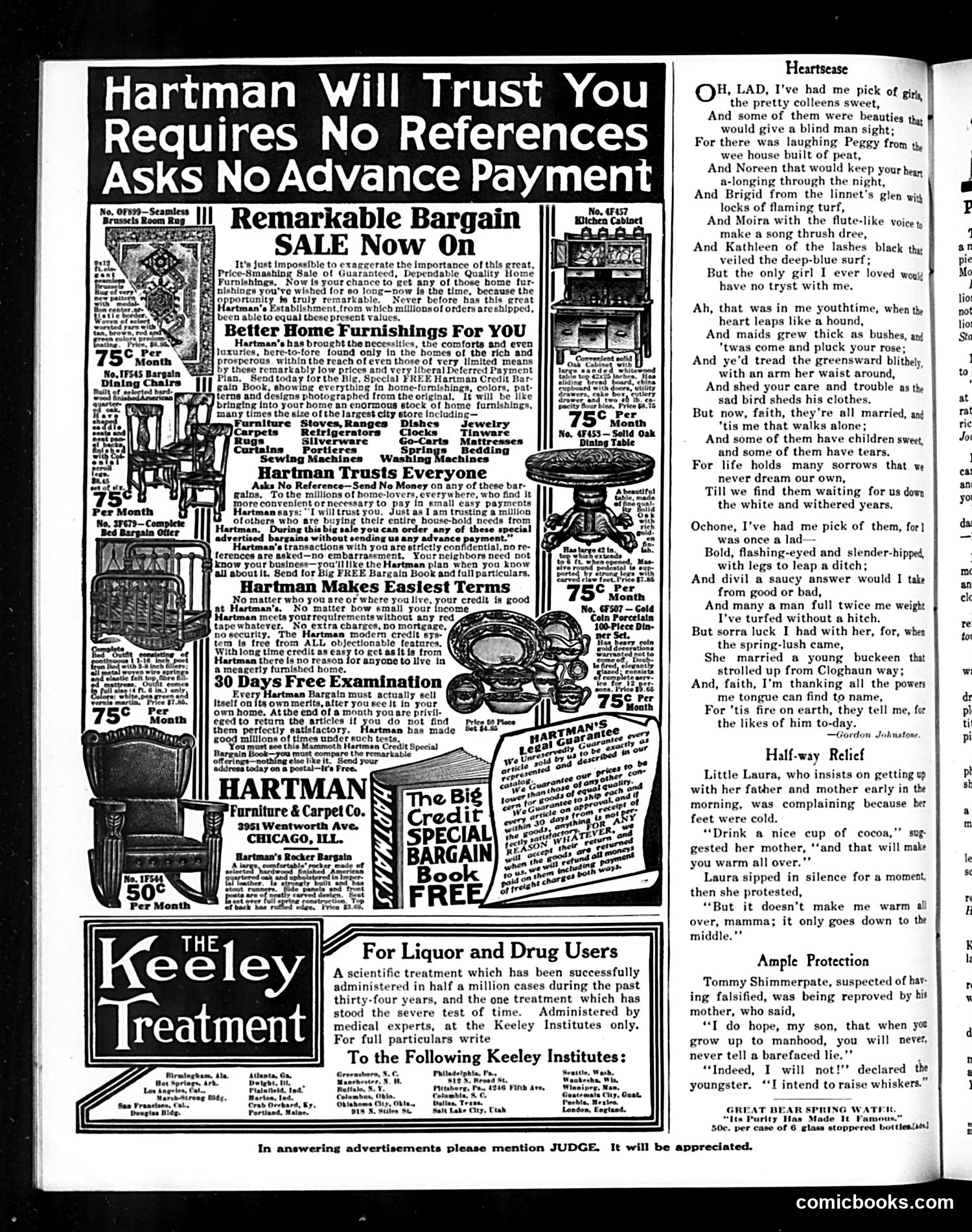
This page is primarily **advertising**, not political satire. The dominant content features a large Hartman Furniture & Carpet Company advertisement promoting home furnishings with extremely lenient credit terms—"No References," "No Advance Payment," "30 Days Free Examination." The satirical angle appears subtle: Hartman's boasts of trusting customers unconditionally ("I will trust you. Just as I am trusting a million others"), which likely mocks the aggressive, predatory credit practices emerging in early 20th-century consumer culture. The company explicitly assures customers their neighbors won't know about purchases—suggesting shame around installment buying was common. The right page contains a sentimental Irish poem titled "Heartsease" about lost love, unrelated to the advertisements. **Context for moderns:** This reflects an era when consumer credit was novel and carried social stigma, yet companies exploited it aggressively. The "no questions asked" approach would have seemed both liberating and vaguely disreputable to contemporary readers.
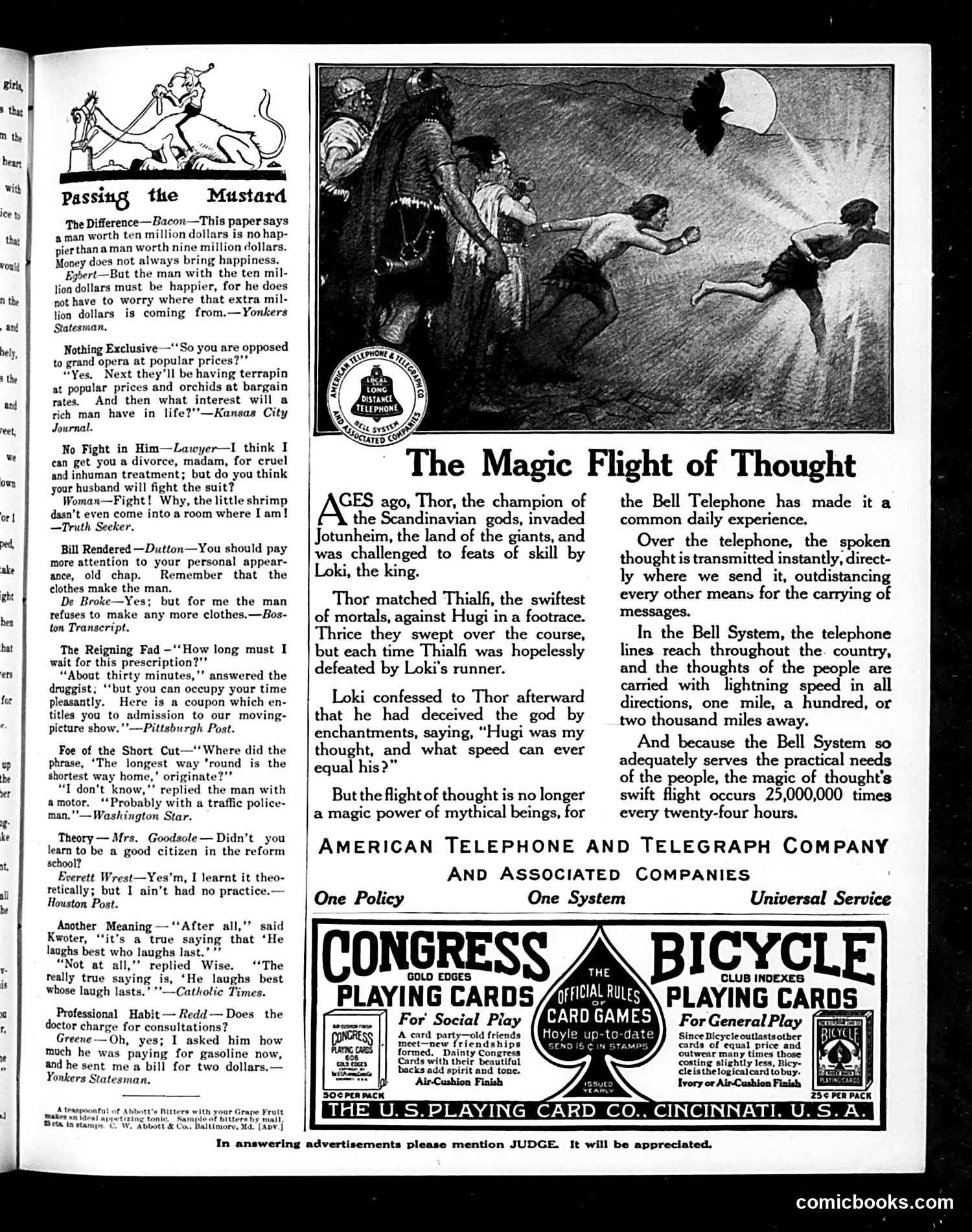
This page mixes satirical commentary with advertising. The left side contains brief humorous exchanges about wealth, divorce, fashion, and social pretension—typical Judge magazine fare mocking middle-class anxieties and professional types. The main feature is a Bell Telephone advertisement disguised as editorial content. It retells the Norse myth of Thor challenging the giant Loki: Thor's champion Thialfi races against "Hugi" (thought) and loses repeatedly. The advertisement's point: just as thought once seemed magically swift in mythology, the telephone now makes instantaneous communication an everyday reality—25 million calls daily. This is corporate propaganda presenting the Bell monopoly as modern magic serving "universal service." For modern readers: the ad equates telephone infrastructure with mythological power, while the satirical snippets above suggest Judge's audience were prosperous enough to worry about wealth distinctions and social status—the exact demographic Bell marketed to.
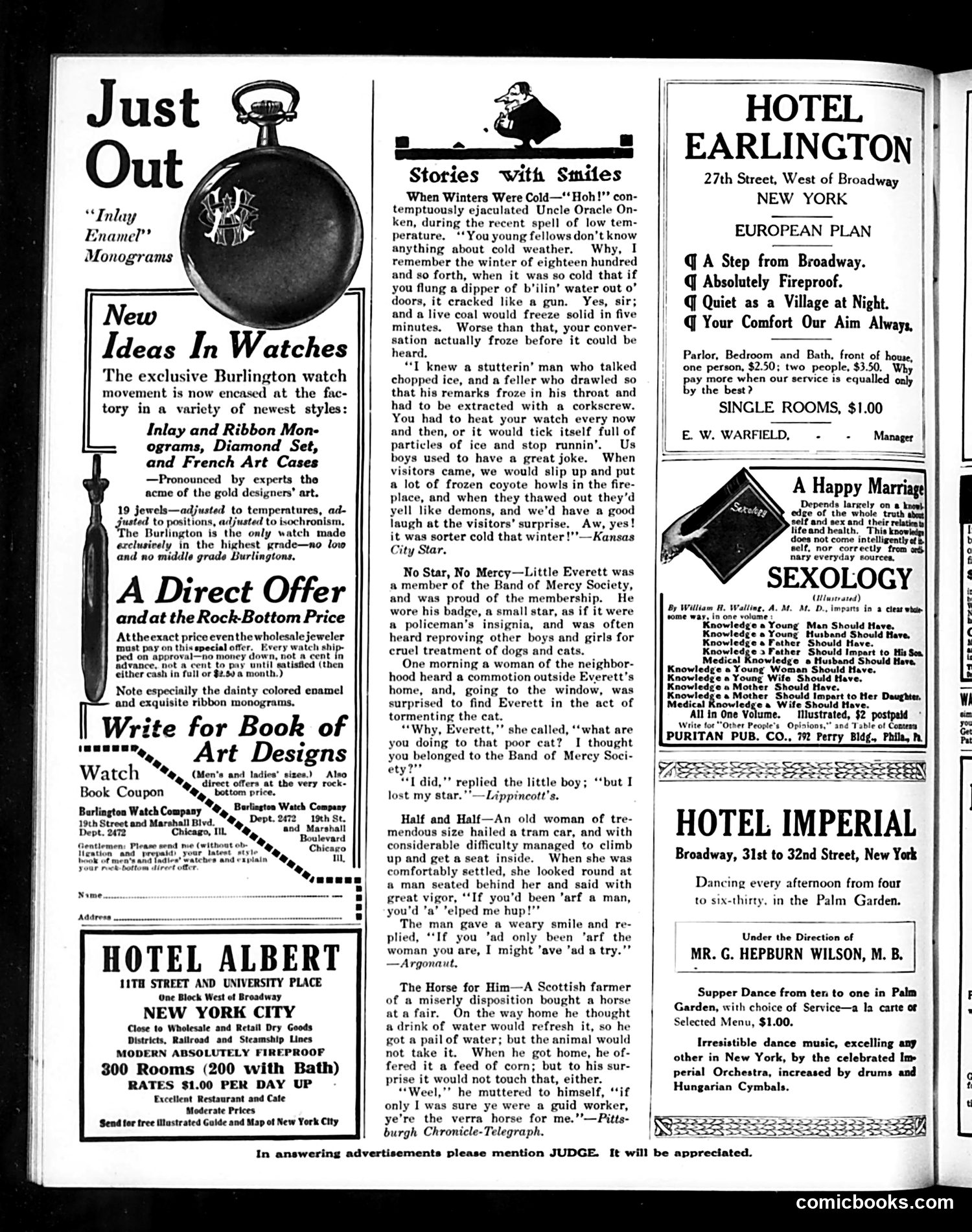
This page is primarily **commercial advertisements** with minimal satirical content. The dominant features are ads for Burlington Watches, hotels (Albert, Earlington, Imperial), and a "Sexology" book series. The only satirical element is a small section titled **"Stories with Smiles"**—humorous anecdotes rather than political cartoons. These are nostalgic tall tales (an elderly man exaggerating winter cold), a brief joke about a boy in the "Band of Mercy Society" who loses his moral badge, and working-class humor about a large woman and a tired man on a tram. The humor relies on wordplay and class-based comedy typical of early 20th-century popular magazines. **Context for modern readers:** These brief stories represent the magazine's lighter content between advertisements, targeting working and middle-class readers with accessible, sentimental, or mildly risqué humor. There is no significant political or social satire visible on this particular page.
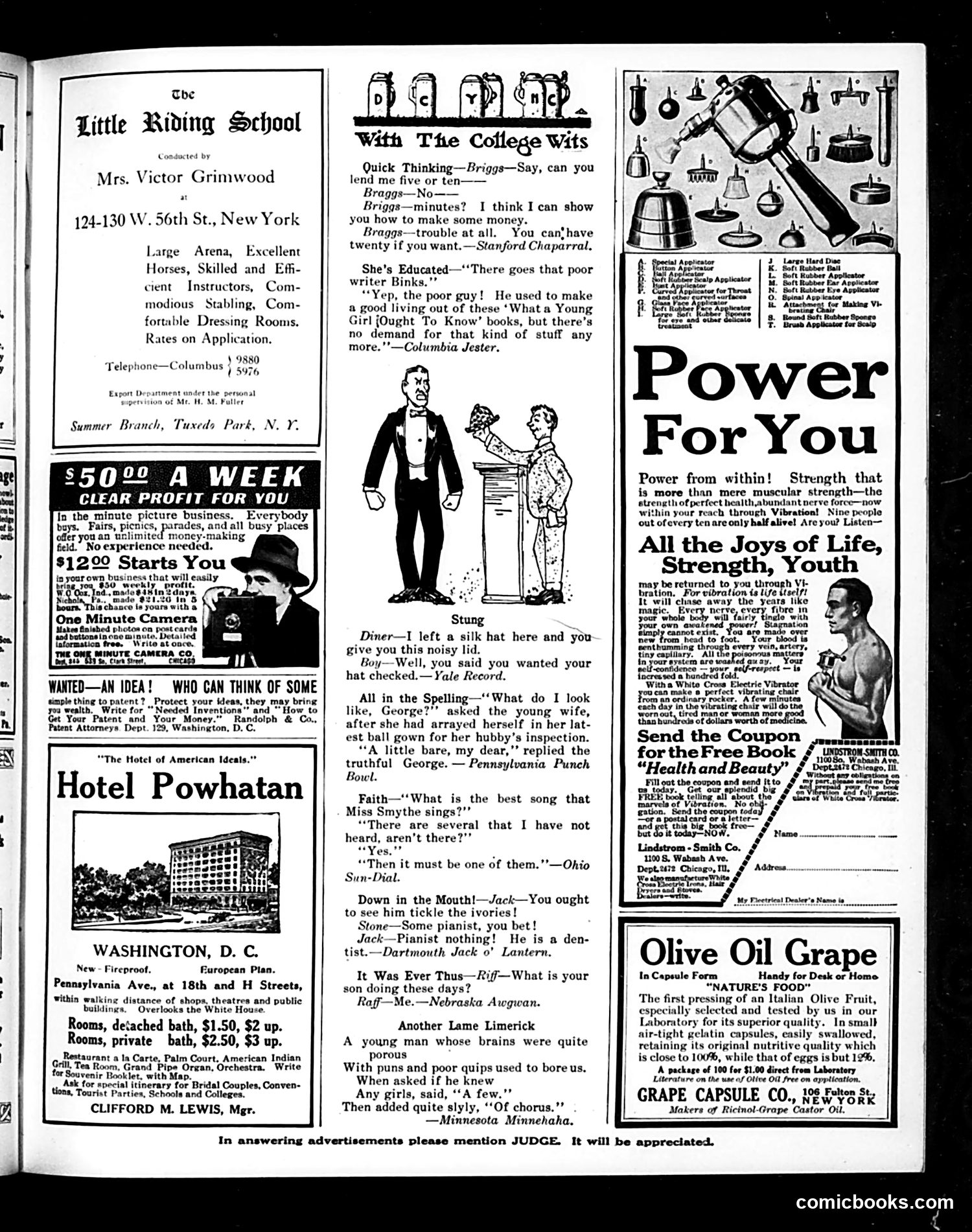
This page is primarily **advertising with humor content** rather than political satire. The main features are: **"With The College Wits"** section: A collection of jokes from college humor magazines (Stanford Chaparral, Columbia Jester, Yale Record, etc.). These are light, undergraduate humor pieces—puns about lending money, mistaken hat-checking, spelling jokes, and a limerick about a bore who frequents chorus girls. They reflect 1920s college culture and social attitudes toward courtship and romance. **Advertisements dominate the page**, promoting: a riding school, camera business opportunity, patent services, Washington D.C. hotels, and a "White Cross Electric Vibrator" (marketed as a health device for vitality and youth—a common early-20th-century wellness product). **The satire is minimal and gentle**—mostly wordplay and predictable punchlines aimed at college audiences. There are no identifiable political figures or sharp social commentary visible. The page reflects period concerns about entrepreneurship, leisure activities, and commercialized "self-improvement."
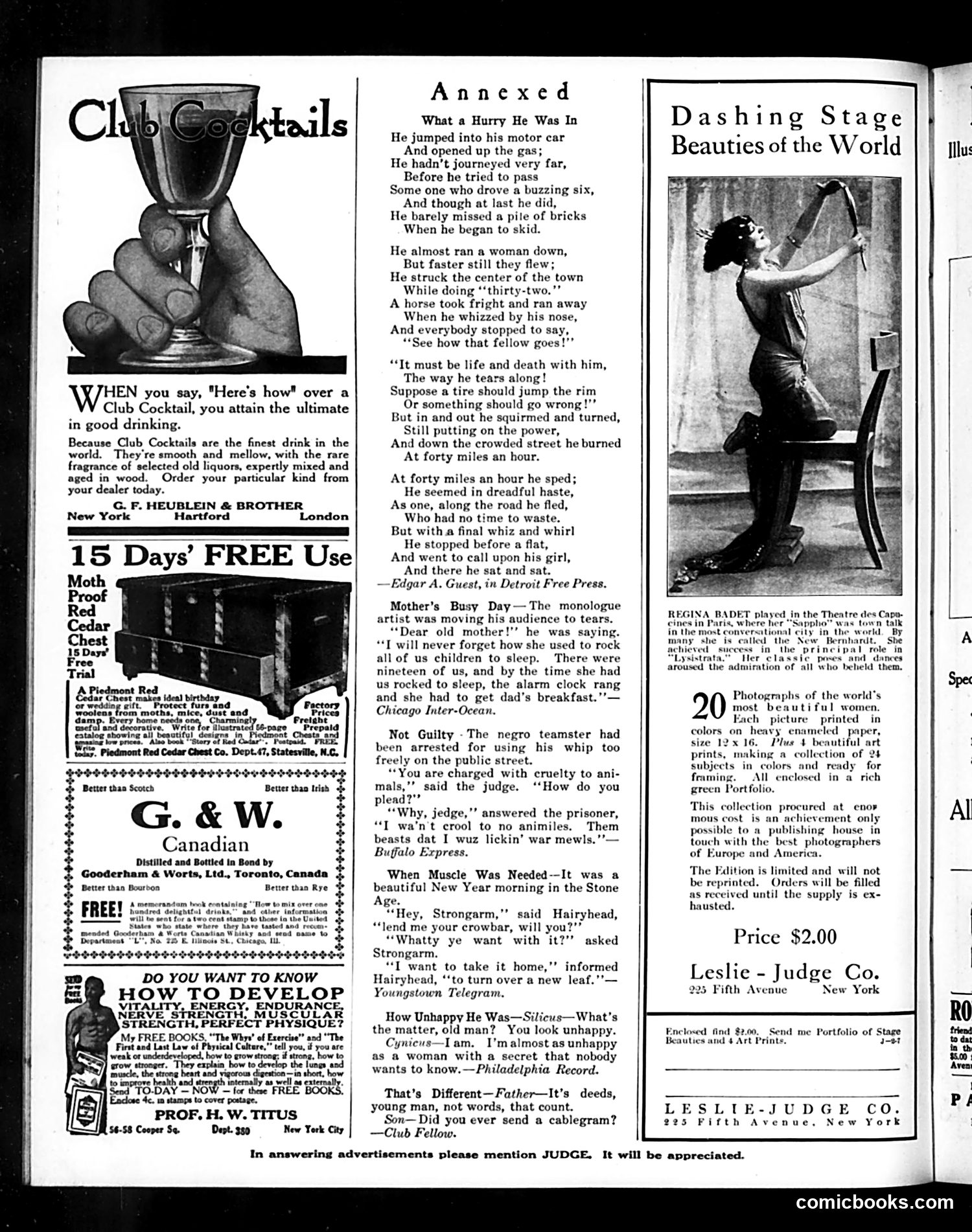
This page is primarily **advertising and humor content** rather than political satire. The main text features humorous anecdotes typical of Judge's satirical style, including: - A poem about a reckless motorist who drives at dangerous speeds (40+ mph) through town, nearly causing accidents, only to arrive at his girlfriend's apartment and sit talking with her—the joke being his urgent haste was pointless. - Brief joke segments ("Mother's Busy Day," "Not Guilty," "When Muscle Was Needed," etc.) poking fun at various everyday situations—a mother's exhaustion raising 19 children, a Black teamster's malapropism in court, primitive Stone Age logic, and romantic disappointment. The advertisements promote **alcohol** (Club Cocktails, Canadian whiskey) and consumer goods (cedar chests), reflecting the pre-Prohibition era when such ads were standard. There's no identifiable political cartoon on this page. The humor is gentle, domestic satire targeting common social situations and human folly rather than specific political figures or events.
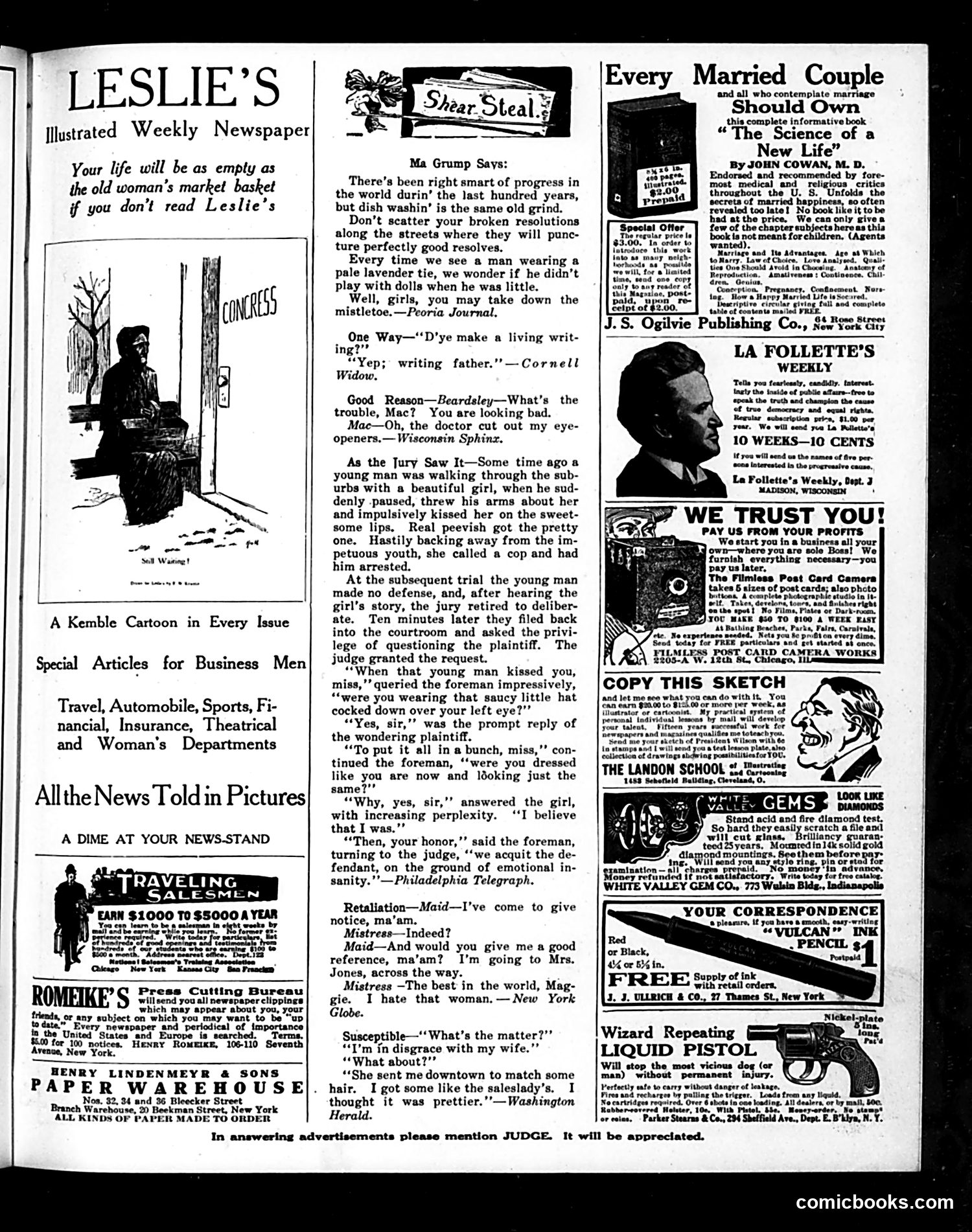
This is primarily an **advertising and content compilation page** from Judge magazine, peppered with reprinted humorous anecdotes and jokes rather than original political cartoons. The Kemble cartoon (left) depicts an empty-pocketed, worn-out figure—likely satirizing struggling urban poverty or economic hardship, a common Judge subject. The anecdotes mock gender relations and social pretension: "Ma Grump's" column ridicules outdated domesticity; jokes target vain men (pale lavender ties suggesting emasculation) and complain about women's expectations. The legal anecdote about the kissing trial uses satirical jury logic to mock both young romance and female social performance—the jurors implicitly excuse assault because the girl was dressed attractively. The page reflects **early 20th-century attitudes** toward work, marriage, gender, and justice now perceived as misogynistic. Most space goes to recruitment ads, patent medicines ("The Science of a New Life"), and business services—revealing the magazine's actual commercial focus beyond satire.
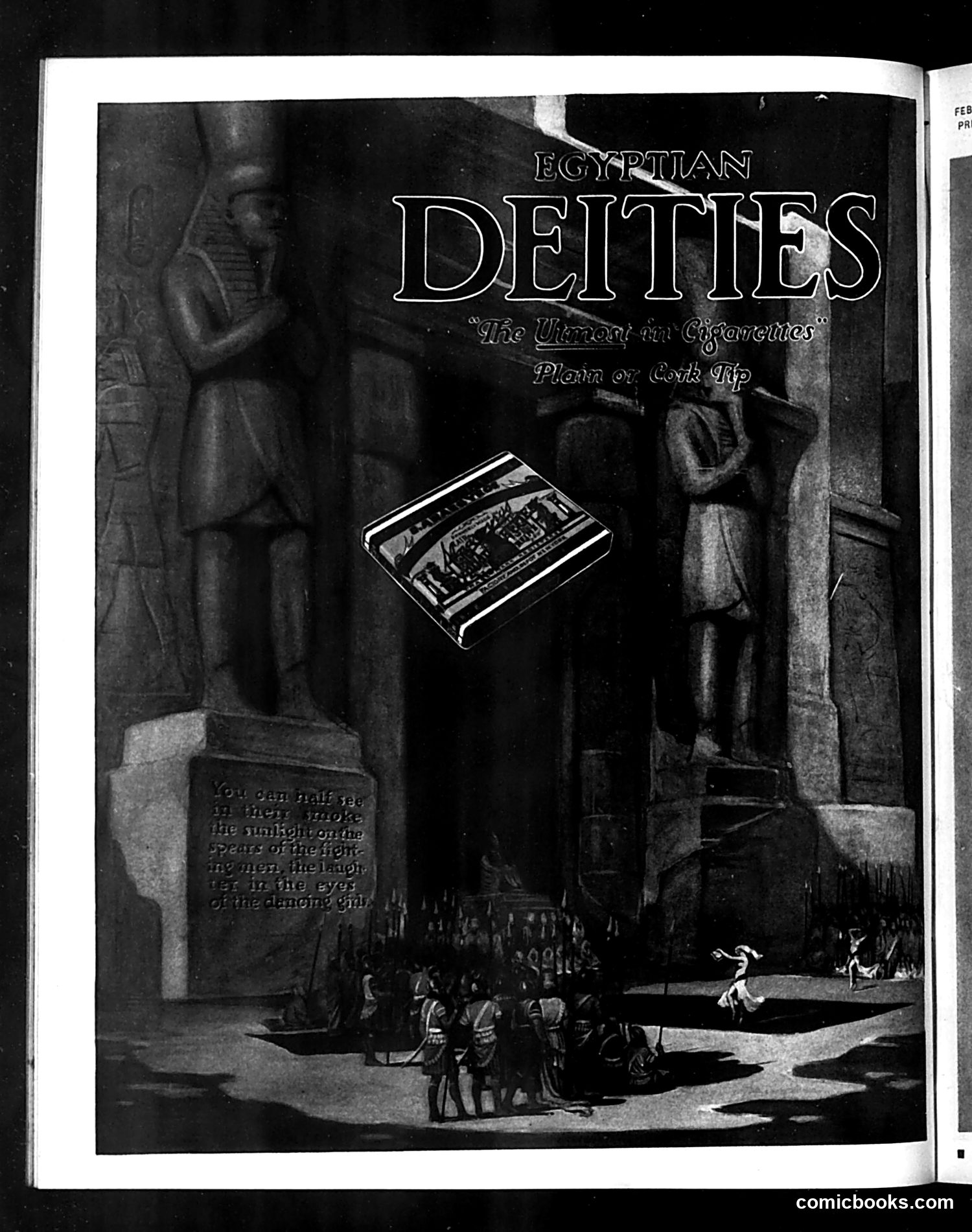
This is a **title page or advertisement** for a product called "Egyptian Deities," subtitled "The Utmost in Gorgeousness / Plain or Dark Life" (likely referring to plain or dark chocolate). The imagery depicts an **Egyptian temple setting** with colossal statues of pharaohs and gods, small human figures, and what appears to be a **product box displayed prominently** in the center—floating or highlighted against the grand architectural backdrop. The satire likely **mocks American consumerism and marketing excess** by juxtaposing humble candy/chocolate with grandiose Ancient Egyptian imagery. The advertising strategy elevates an ordinary confection to mythic, "godlike" status—a satirical commentary on how advertising copy inflates mundane products with false magnificence and cultural prestige.