
Judge, 1914-02-07 · page 14 of 24
Judge — February 7, 1914 — page 14: what you’re looking at
What you’re looking at
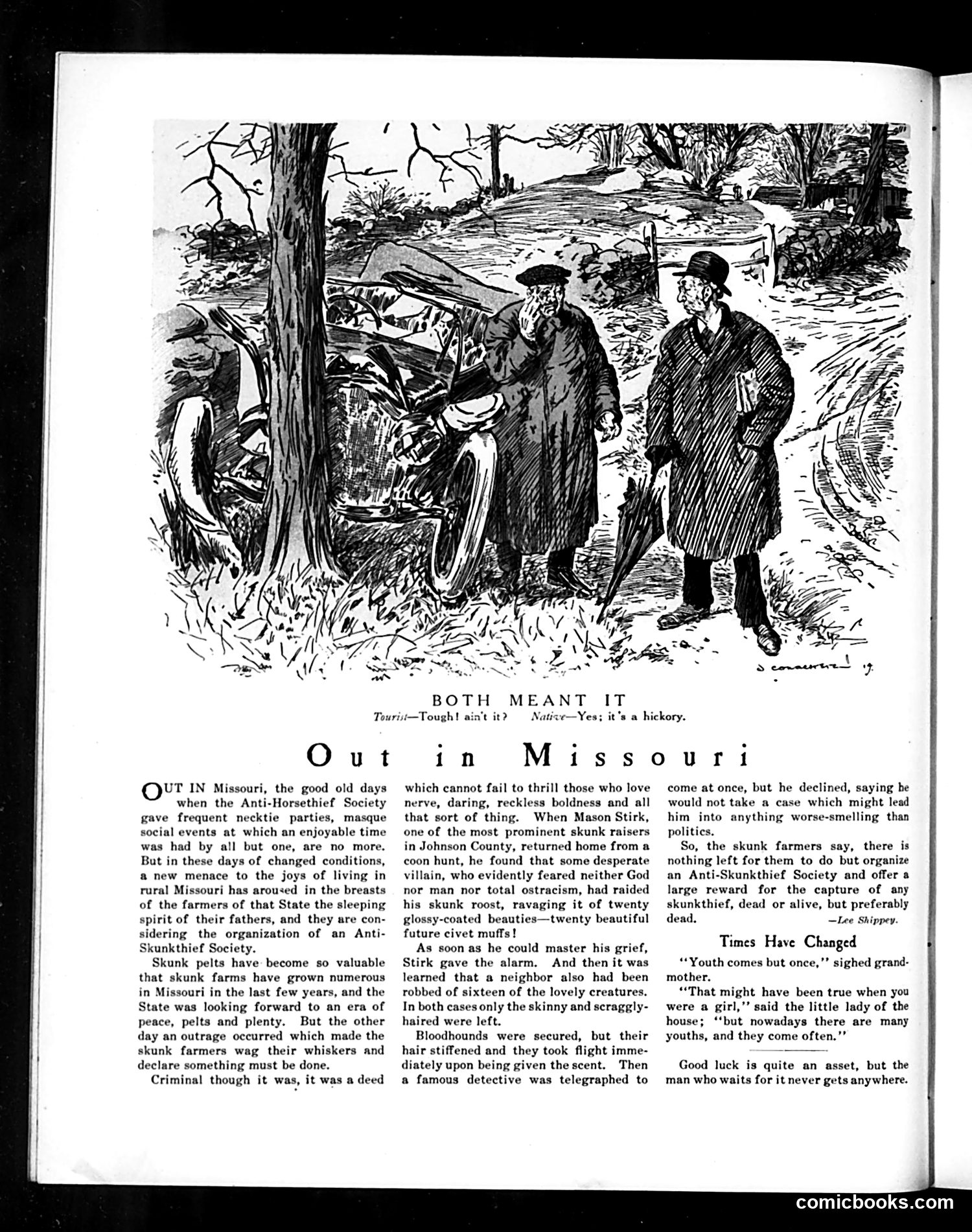
This piece satirizes rural vigilantism and changing times. The illustration shows a lynching ("necktie party"—a euphemism for hanging), referencing Missouri's historical Anti-Horsethief Societies, which were extrajudicial groups that summarily executed suspected thieves. The article humorously suggests farmers must now form an "Anti-Skunkthief Society" because skunk pelts have become valuable enough to steal. The joke mocks the absurdity of applying frontier justice to a trivial economic problem: the same violent spirit once directed at horse thieves is now needed for... skunk rustlers. A detective refuses the case, claiming politics smells worse than skunks—a side jab at government corruption. The cartoon's subtitle, "Both Meant It," suggests the tourist and native are discussing whether violence is justified, playing on American frontier mythology where such brutality was once normalized.
📄 Transcribed text from this page (OCR, searchable)
Machine-transcribed from the original scan — historical spelling and the odd misread are preserved.
Tourisi—Tough! ain't it? Out Out IN Missouri, the good old days when the Anti-Horsethief Society gave frequent necktie parties, masque social events at which an enjoyable time was had by all but one, are no more. But in these days of changed conditions, a new menace to the joys of living in rural Missouri has aroused in the breasts of the farmers of that State the sleeping spirit of their fathers, and they are con- sidering the organization of an Anti- Skunkthief Society. Skunk pelts have become so valuable that skunk farms have grown numerous in Missouri in the last few years, and the State was looking forward to an era of peace, pelts and plenty. But the other day an outrage occurred which made the skunk farmers wag their whiskers and declare something must be done. Criminal though it was, it was a deed BOTH MEANT IT 1n which cannot fail to thrill those who love nerve, daring, reckless boldness and all that sort of thing. When Mason Stirk, one of the most prominent skunk raisers in Johnson County, returned home from a coon hunt, he found that some desperate villain, who evidently feared neither God nor man nor total ostracism, had raided his skunk roost, ravaging it of twenty glossy-coated beauties—twenty beautiful future civet muffs! As soon as he could master his grief, Stirk gave the alarm. And then it was learned that a neighbor also had been robbed of sixteen of the lovely creatures. In both cases only the skinny and scraggly- haired were left. Bloodhounds were secured, but their hair stiffened and they took flight imme- diately upon being given the scent. Then a famous detective was telegraphed to Native—Yes; it's a hickory. Missouri come at once, but he declined, saying he would not take a case which might lead him into anything worse-smelling than politics. So, the skunk farmers say, there is nothing left for them to do but organize an Anti-Skunkthief Society and offer a large reward for the capture of any skunkthief, dead or alive, but preferably dead. —Lee Shippey. Times Have Changed “Youth comes but once,’ sighed grand- mother, “That might have been true when you were a girl,’’ said the little lady of the house; ‘‘but nowadays there are many youths, and they come often.” Good luck is quite an asset, but the man who waits for it never gets anywhere. comicbooks.com