
Judge, 1914-02-07 · page 4 of 24
Judge — February 7, 1914 — page 4: what you’re looking at
What you’re looking at
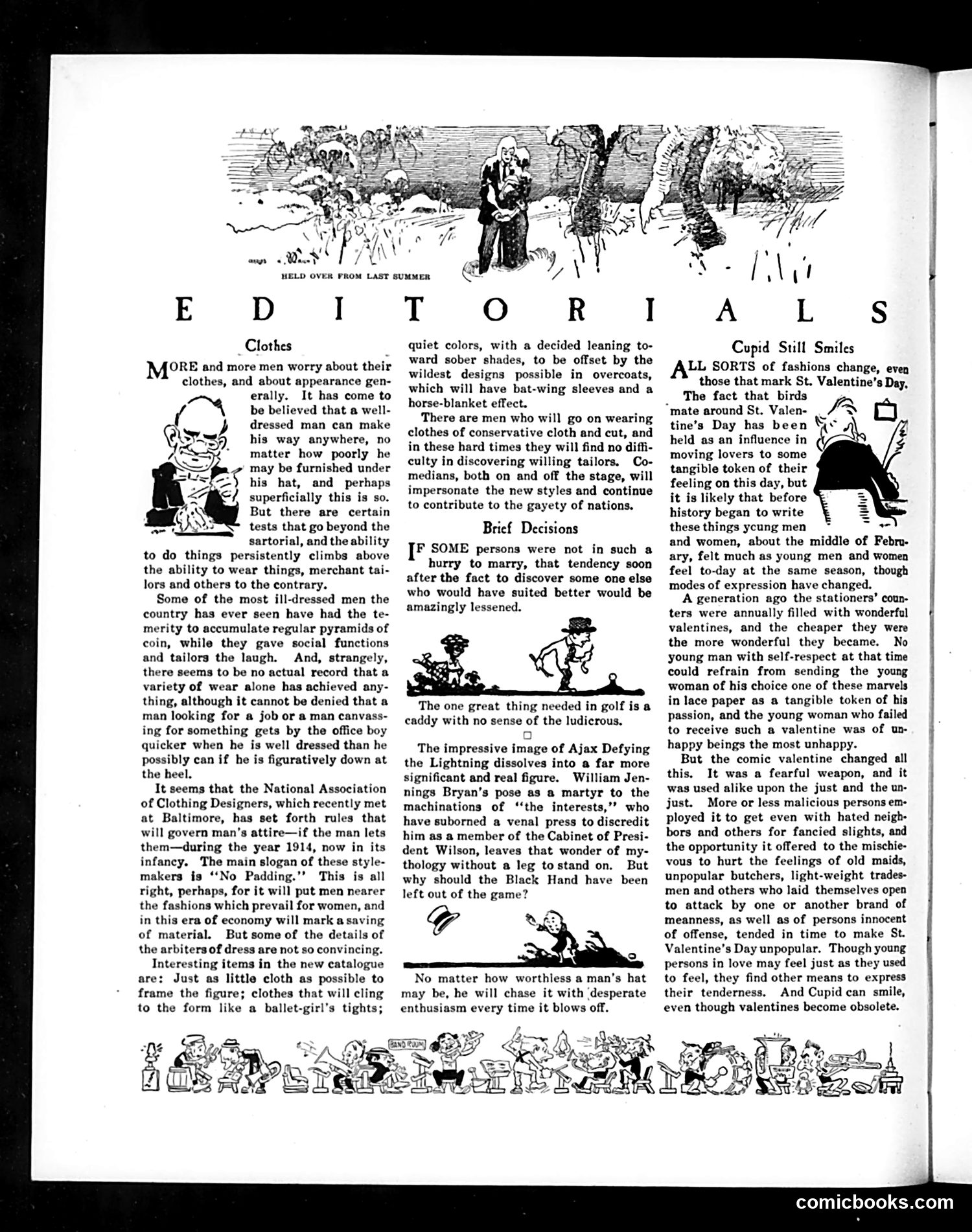
This Judge magazine editorial page contains three sections: **Left column ("Clothes"):** Satirizes men's anxiety about fashion and appearance. The caricatured man worries excessively about clothing choices, mocking the notion that well-dressed men achieve social success through tailors rather than merit. **Center ("Brief Decisions"):** Two single-panel cartoons with minimal text. The first addresses golf etiquette; the second references "Ajax Defying the Lightning" and mentions President Wilson and "the Black Hand," likely alluding to political or social tensions of that era (appears WWI-period). **Right column ("Cupid Still Smiles"):** Discusses Valentine's Day traditions and how comic valentines became vehicles for social commentary, allowing people to mock unpopular figures—butchers, tradesmen, politicians—through humor rather than direct confrontation. The page blends fashion criticism with period political commentary.
📄 Transcribed text from this page (OCR, searchable)
Machine-transcribed from the original scan — historical spelling and the odd misread are preserved.
“ i wwe WS D I E Clothes MORE and more men worry about their clothes, and about appearance gen- erally. It has come to % be believed that a well- dressed man can make CSM} his way anywhere, no AS” matter how poorly he @ may be furnished under vee PS his hat, and perhaps ma a superficially this is so. ts \ But there are certain — By D tests that go beyond the sartorial, and the ability to do things persistently climbs above the ability to wear things, merchant tai- lors and others to the contrary. Some of the most ill-dressed men the country has ever seen have had the te- merity to accumulate regular pyramids of coin, while they gave social functions and tailors the laugh. And, strangely, there seems to be no actual record that a variety of wear alone has achieved any- thing, although it cannot be denied that a man looking for a job or a man canvass- ing for something gets by the office boy quicker when he is well dressed than he possibly can if he is figuratively down at the heel, It seems that the National Association of Clothing Designers, which recently met at Baltimore, has set forth rules that will govern man’s attire—if the man lets them—during the year 1914, now in its infancy. The main slogan of these style- makers is ‘‘No Padding.”” This is all right, perhaps, for it will put men nearer the fashions which prevail for women, and in this era of economy will mark a saving of material. But some of the details of the arbiters of dress are not so convincing. Interesting items in the new catalogue are: Just as little cloth as possible to frame the figure; clothes that will cling to the form like a ballet-girl's tights; MELD OVER FROM LAST SUMMER x T quiet colors, with a decided leaning to- ward sober shades, to be offset by the wildest designs possible in overcoats, which will have bat-wing sleeves and a horse-blanket effect. There are men who will go on wearing clothes of conservative cloth and cut, and in these hard times they will find no diffi- culty in discovering willing tailors. Co- medians, both on and off the stage, will impersonate the new styles and continue to contribute to the gayety of nations. Brief Decisions IF SOME persons were not in such a hurry to marry, that tendency soon after the fact to discover some one else who would have suited better would be amazingly lessened. The one great thing needed in golf isa caddy with no sense of the ludicrous. The impressive image of Ajax Defying the Lightning dissolves into a far more significant and real figure. William Jen- nings Bryan’s pose as a martyr to the machinations of ‘‘the interests,’? who have suborned a venal press to discredit him as a member of the Cabinet of Presi- dent Wilson, leaves that wonder of my- thology without a leg tostand on. But why should the Black Hand have been left out of the game? No matter how worthless a man’s hat may be, he will chase it with ‘desperate enthusiasm every time it blows off. “mate around St. Valen- S Cupid Still Smiles LL SORTS of fashions change, even those that mark St. Valentine’s Day, The fact that birds oa 0 tine’s Day has been held as an influence in moving lovers to some tangible token of their feeling on this day, but it is likely that before history began to write these things ycung men and women, about the middle of Febru- ary, felt much as young men and women feel to-day at the same season, though modes of expression have changed. A generation ago the stationers’ coun- ters were annually filled with wonderful valentines, and the cheaper they were the more wonderful they became. No young man with self-respect at that time could refrain from sending the young woman of his choice one of these marvels in lace paper as a tangible token of his passion, and the young woman who failed to receive such a valentine was of un- happy beings the most unhappy. But the comic valentine changed all this. It was a fearful weapon, and it was used alike upon the just and the un- just. More or less malicious persons em- ployed it to get even with hated neigh- bors and others for fancied slights, and the opportunity it offered to the mischie- vous to hurt the feelings of old maids, unpopular butchers, light-weight trades- men and others who laid themselves open to attack by one or another brand of meanness, as well as of persons innocent of offense, tended in time to make St. Valentine’s Day unpopular. Though young persons in love may feel just as they used to feel, they find other means to express their tenderness. And Cupid can smile, even though valentines become obsolete. ee comicbooks.com