
Judge, 1914-02-07 · page 7 of 24
Judge — February 7, 1914 — page 7: what you’re looking at
What you’re looking at
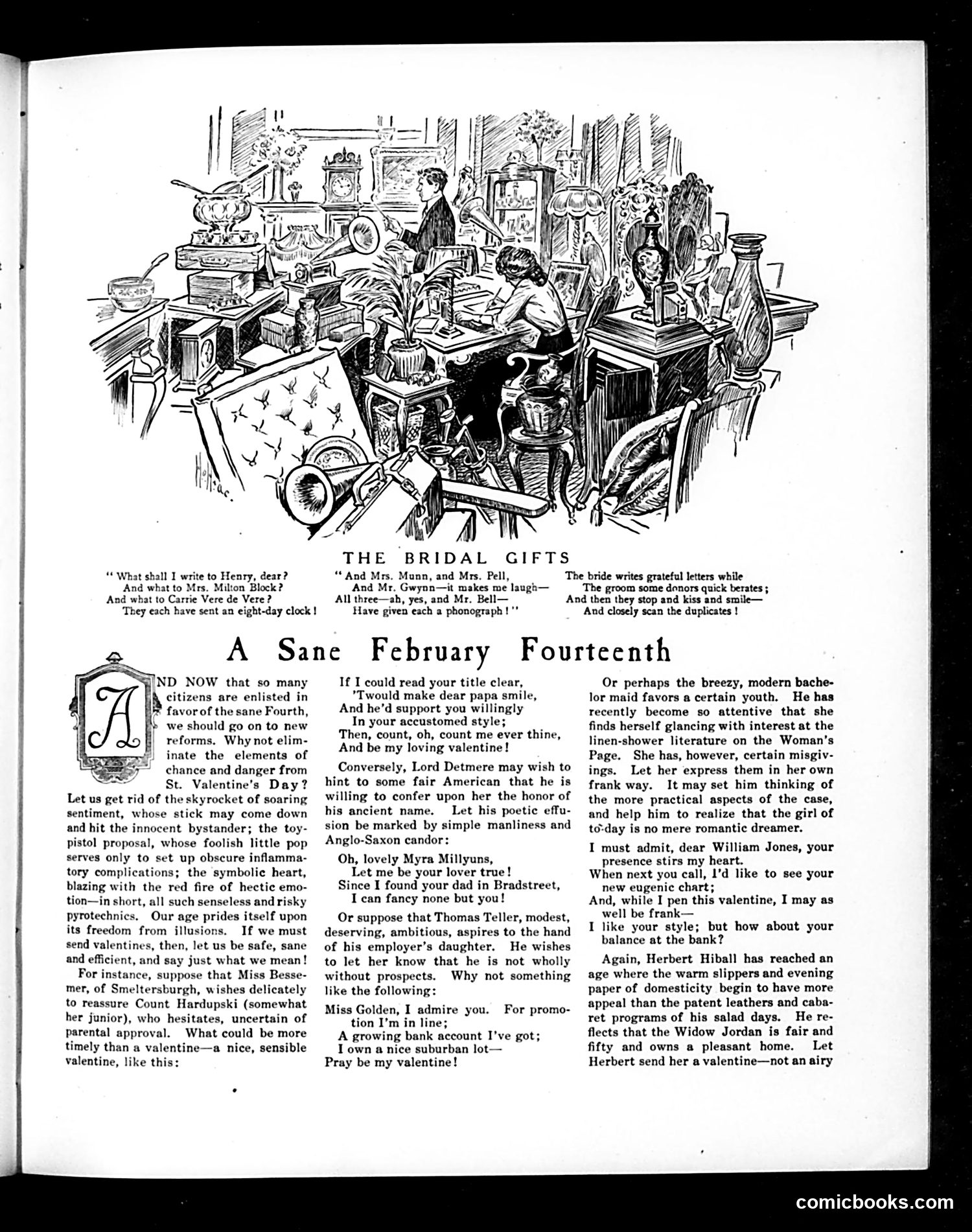
This satirical piece mocks the Progressive Era's obsession with "sane" reform by applying utilitarian logic to Valentine's Day romance. The cartoon depicts the chaos of duplicate wedding gifts; the accompanying article humorously proposes eliminating sentimental, spontaneous proposals in favor of brutally practical valentines. The satire presents mock valentines where suitors candidly discuss financial prospects, bank accounts, and suburban real estate rather than expressing emotion. A woman requests to see a man's "eugenic chart" (reflecting contemporary eugenics pseudoscience), and another frankly questions a suitor's bank balance. The joke targets Progressive reformers who sought to rationalize every aspect of life—from eliminating "dangerous" Fourth of July celebrations to optimizing human reproduction. By pushing this logic to absurd extremes in courtship, Judge ridicules the movement's joyless efficiency and loss of romance. The piece suggests that some human experiences shouldn't be "sanitized" by reason and practicality.
📄 Transcribed text from this page (OCR, searchable)
Machine-transcribed from the original scan — historical spelling and the odd misread are preserved.
“« What shall I write to Henry, dear? And what to Mrs. Milton Block? And what to Carrie Vere de Vere? ‘They each have sent an eight-day clock ! THE BRIDAL GIFTS “And Mrs. Munn, and Mrs. Pell, ‘And Mr. Gwynn—it makes me laugh— All three—ah, yes, and Mr. Bell— Have given each a phonograph !"* The bride writes grateful letters while ‘The groom some donors quick berates ; And then they stop and kiss and smile— ‘And closely scan the duplicates ! A Sane February Fourteenth ND NOW that so many citizens are enlisted in * favor of the sane Fourth, » we should go on to new reforms, Why not elim- inate the elements of chance and danger from = St. Valentine’s Day? Let us get rid of the skyrocket of soaring sentiment, whose stick may come down and hit the innocent bystander; the toy- pistol proposal, whose foolish little pop serves only to set up obscure inflamma- tory complications; the symbolic heart, blazing with the red fire of hectic emo- tion—in short, all such senseless and risky pyrotechnics, Our age prides itself upon its freedom from illusions. If we must send valentines, then, let us be safe, sane and efficient, and say just what we mean! For instance, suppose that Miss Besse- mer, of Smeltersburgh, wishes delicately to reassure Count Hardupski (somewhat her junior), who hesitates, uncertain of Parental approval. What could be more timely than a valentine—a nice, sensible valentine, like this: N= If I could read your title clear, ’Twould make dear papa smile, And he’d support you willingly In your accustomed style; Then, count, oh, count me ever thine, And be my loving valentine! Conversely, Lord Detmere may wish to hint to some fair American that he is willing to confer upon her the honor of his ancient name. Let his poetic effu- sion be marked by simple manliness and Anglo-Saxon candor: Oh, lovely Myra Millyuns, Let me be your lover true! Since I found your dad in Bradstreet, I can fancy none but you! Or suppose that Thomas Teller, modest, deserving, ambitious, aspires to the hand of his employer’s daughter. He wishes to let her know that he is not wholly without prospects. Why not something like the following: Miss Golden, I admire you. tion I’m in line; A growing bank account I've got; I own a nice suburban lot— Pray be my valentine! For promo- Or perhaps the breezy, modern bache- lor maid favors a certain youth. He has recently become so attentive that she finds herself glancing with interest at the linen-shower literature on the Woman's Page. She has, however, certain misgiv- ings. Let her express them in her own frank way. It may set him thinking of the more practical aspects of the case, and help him to realize that the girl of to-day is no mere romantic dreamer. I must admit, dear William Jones, your presence stirs my heart. When next you call, 1’d like to see your new eugenic chart; And, while I pen this valentine, I may as well be frank— I like your style; but how about your balance at the bank? Again, Herbert Hiball has reached an age where the warm slippers and evening paper of domesticity begin to have more appeal than the patent leathers and caba- ret programs of his salad days. He re- flects that the Widow Jordan is fair and fifty and owns a pleasant home. Let Herbert send her a valentine—not an airy comicbooks.com