
Judge, 1914-02-07 · page 10 of 24
Judge — February 7, 1914 — page 10: what you’re looking at
What you’re looking at
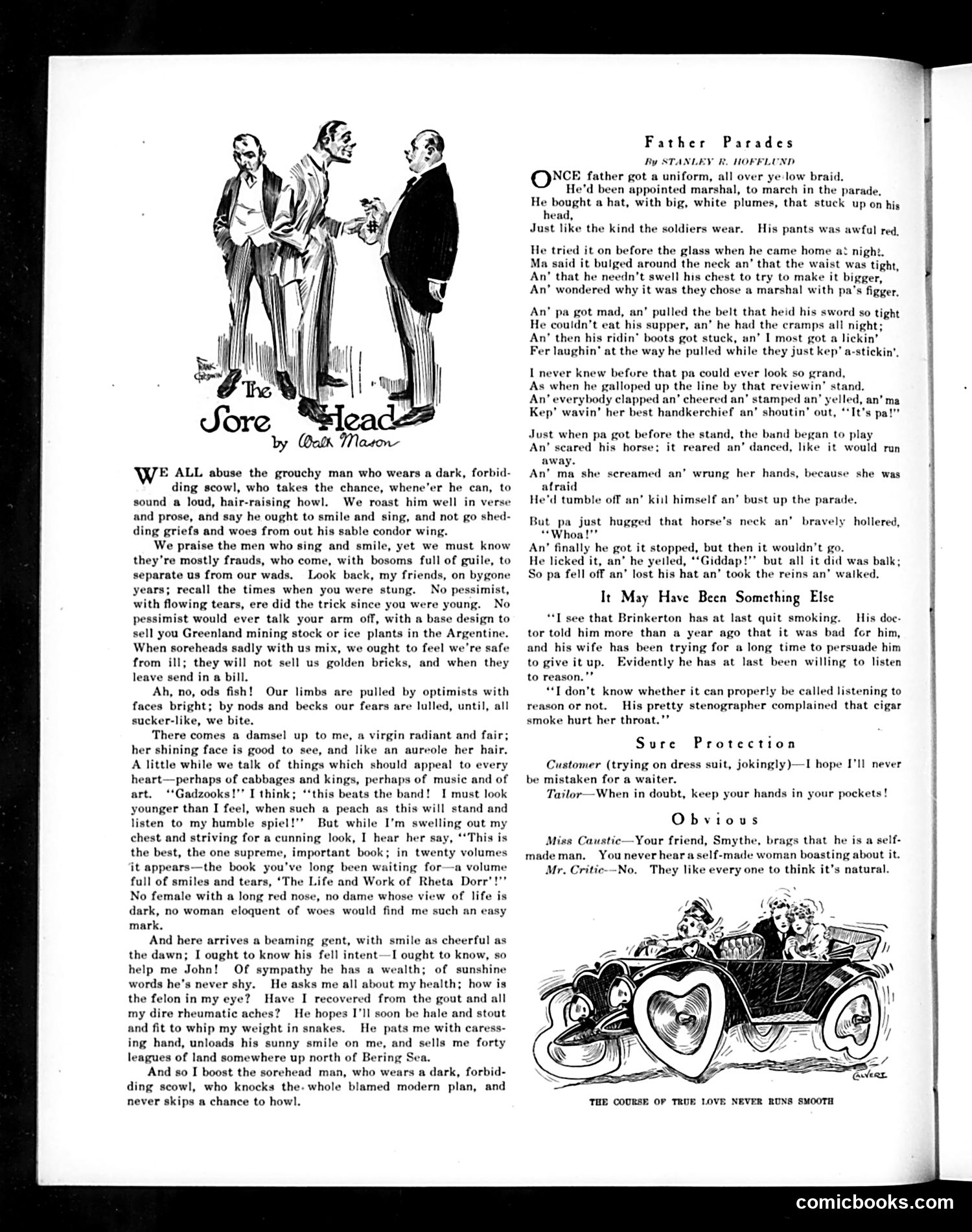
**"The Sore Head"** (main text) satirizes American optimism and salesmanship. The author argues that pessimists—despite their gloomy demeanor—are actually *safer* to associate with than cheerful people. The joke: optimists with bright smiles are con artists who bilk the gullible (selling worthless land schemes, mining stock, fake books). A grouchy pessimist won't sell you anything because he's not motivated by profit. The piece mocks the era's culture of aggressive sales pitches and American gullibility—people are literally "sucker[s]" for a smiling face, even when being robbed. **"Father Parades"** is a humorous poem about a working-class father appointed town marshal for a parade. The comedy derives from his physical discomfort in the formal uniform (tight pants, stuck boots) and his vanity despite the indignity. It gently satirizes small-town pride and masculine ego—he's uncomfortable but won't admit it, suffering silently to maintain dignity. Both pieces reflect early 20th-century concerns: consumer fraud and the clash between working-class aspiration and uncomfortable modernity.
📄 Transcribed text from this page (OCR, searchable)
Machine-transcribed from the original scan — historical spelling and the odd misread are preserved.
E ALL abuse the grouchy man who wears a dark, forbid- ding scowl, who takes the chance, whene’er he can, to sound a loud, hair-raising howl. We roast him well in verse and prose, and say he ought to smile and sing, and not go shed- ding griefs and woes from out his sable condor wing. We praise the men who sing and smile, yet we must know they’re mostly frauds, who come, with bosoms full of guile, to separate us from our wads. Look back, my friends, on bygone years; recall the times when you were stung. No pessimist, with flowing tears, ere did the trick since you were young. No pessimist would ever talk your arm off, with a base design to sell you Greenland mining stock or ice plants in the Argentine. When soreheads sadly with us mix, we ought to feel we're safe from ill; they will not sell us golden bricks, and when they leave send in a bill. Ah, no, ods fish! Our limbs are pulled by optimists with faces bright; by nods and becks our fears are lulled, until, all sucker-like, we bite. There comes a damsel up to me, a virgin radiant and fair; her shining face is good to see, and like an aureole her hair. A little while we talk of things which should appeal to every heart—perhaps of cabbages and kings, perhaps of music and of art. ‘‘Gadzooks!’’ I think; ‘‘this beats the band! I must look younger than I feel, when such a peach as this will stand and listen to my humble spiel!’? But while I’m swelling out my chest and striving for a cunning look, I hear her say, ‘‘This is the best, the one supreme, important book; in twenty volumes it appears—the book you've long been waiting for—a volume full of smiles and tears, ‘The Life and Work of Rheta Dorr’! No female with a long red nose, no dame whose view of life dark, no woman eloquent of woes would find me such an easy mark, And here arrives a beaming gent, with smile as cheerful as the dawn; I ought to know his fell intent—I ought to know, help me John! Of sympathy he has a wealth; of sunshine words he’s never shy. He asks me all about my health; how is the felon in my eye? Have I recovered from the gout and all my dire rheumatic aches? He hopes I'll soon be hale and stout and fit to whip my ight in snakes. He pats me with caress- ing hand, unloads his sunny smile on me, and sells me forty leagues of land somewhere up north of Bering Sea. And so I boost the sorehead man, who wears a dark, forbid- ding scowl, who knocks the. whole blamed modern plan, and never skips a chance to howl. Father Parades By STANLEY BR. HOF FLUND NCE father got a uniform, all over ye low brai¢ He'd been appointed marshal, to march in the parade, He bought a hat, with big, white plumes, that stuck up on his head, Just like the kind the soldiers wear. His pants was awful red, He tried it on before the glass when he came hom Ma said it bulged around the neck an’ that the wai An’ that he needn’t swell his chest to try to mak An’ wondered why at night. t was tight, it bigger, it was they chose a marshal with pa’s figger, An’ pa got mad, an’ pulled the belt that heid his sword so tight He couldn't eat his supper, an’ he had the cramps all night; An’ then his ridin’ boots got stuck, an’ I most got a lickin’ Fer laughin’ at the way he pulled while they just kep’ a-stickin’, I never knew before that pa could ever look so grand, As when he galloped up the line by that reviewin’ stand. An’ everybody clapped an’ cheered an’ stamped an’ yelled, an’ ma Kep’ wavin’ her best handkerchief an’ shoutin’ out, ‘It’s pa!” Just when pa got befo: An’ seared his horse away. An’ ma she screamed an’ wrung her hands, because she was afraid He'd tumble off an’ kiil himself an’ bust up the pars » the stand, the band began to play it reared an’ danced, like it would run But pa just hugged that horse’s neck an’ bravely hollered, “*Whoa!’’ An’ finally he got it stopped, but then it wouldn't go. He licked it, an’ he yetled, “‘Giddap!”” but all it did was balk; So pa fell off an’ lost his hat an’ took the reins an’ walked. It May Have Been Something Else “LT see that Brinkerton has at last quit smoking. His doe- tor told him more than a year ago that it was bad for him, and his wife has been trying for a long time to persuade him to give it up. Evidently he has at last been willing to listen to reason, “*T don’t know whether it can properly be called listening to reason or not. His pretty stenographer complained that cigar smoke hurt her throat.’” Sure Protection Customer (trying on dress suit, jokingly)—I hope I'll never be mistaken for a waiter. ‘ailor—When in doubt, keep your hands in your pockets! Obvious Miss Caustic—Your friend, Smythe, brags that he is a self- made man, You never hear a self-made woman boasting about it. Mr. Critic-—No. They like every one to think it’s natural. THE COURSE OF TRUE LOVE NEVER RUNS SMOOTH i comicbooks.com