
A complete issue · 24 pages · 1914
Judge — January 24, 1914
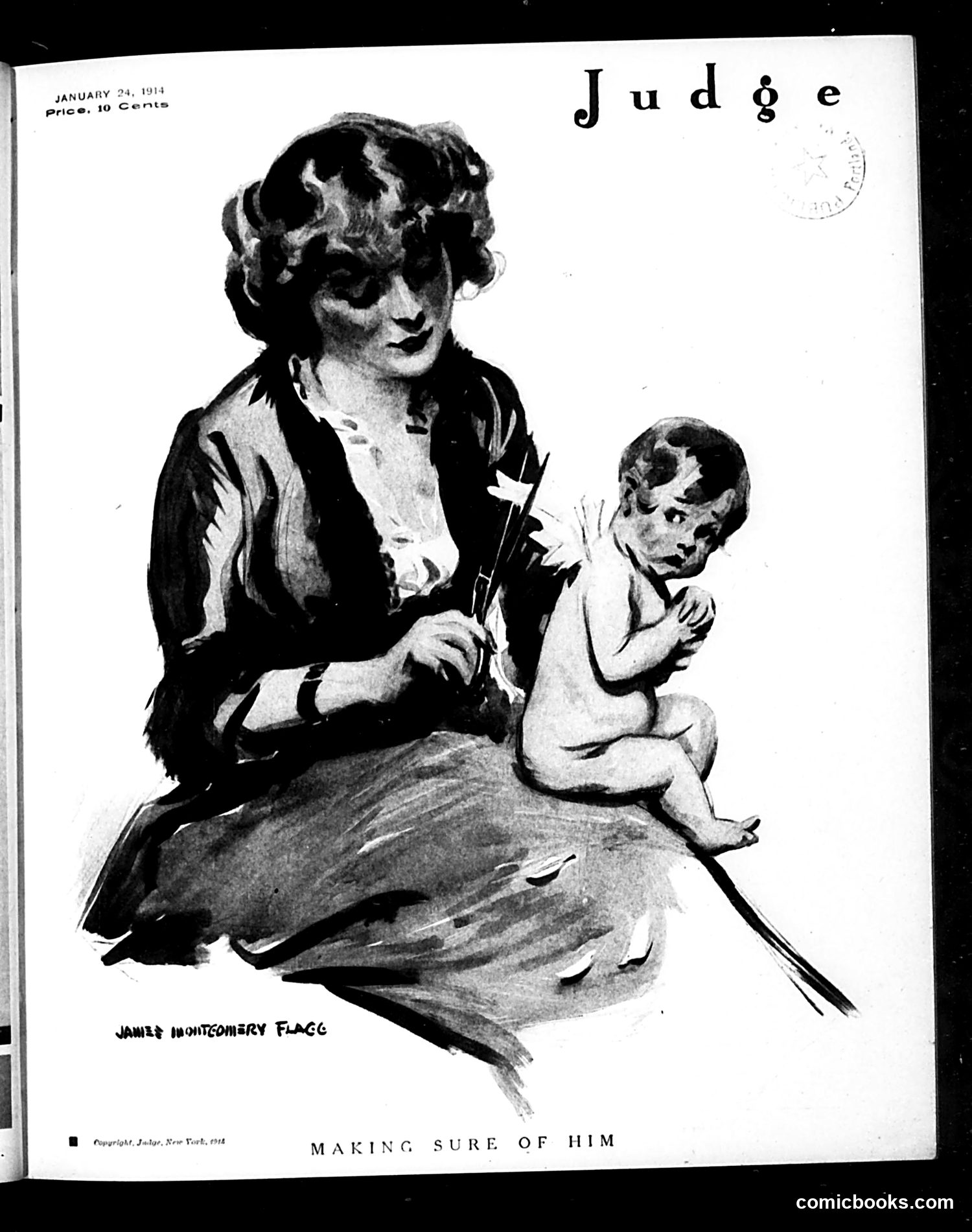
This cover illustration by James Montgomery Flagg depicts a woman holding an infant, titled "Making Sure of Him." The satire likely comments on **marriage and motherhood as means of securing a man's commitment or financial support**—a common theme in early 20th-century humor about gender relations. The image plays on anxieties about women "trapping" men into marriage through pregnancy or children. The caption's double meaning—ensuring paternity or ensuring he won't abandon them—reflects period concerns about female economic dependence and marital security. This reflects **pre-1920 attitudes toward women's limited legal rights and economic vulnerability**, before women gained voting rights. The humor targets both women's matrimonial strategies and men's wariness of such tactics.
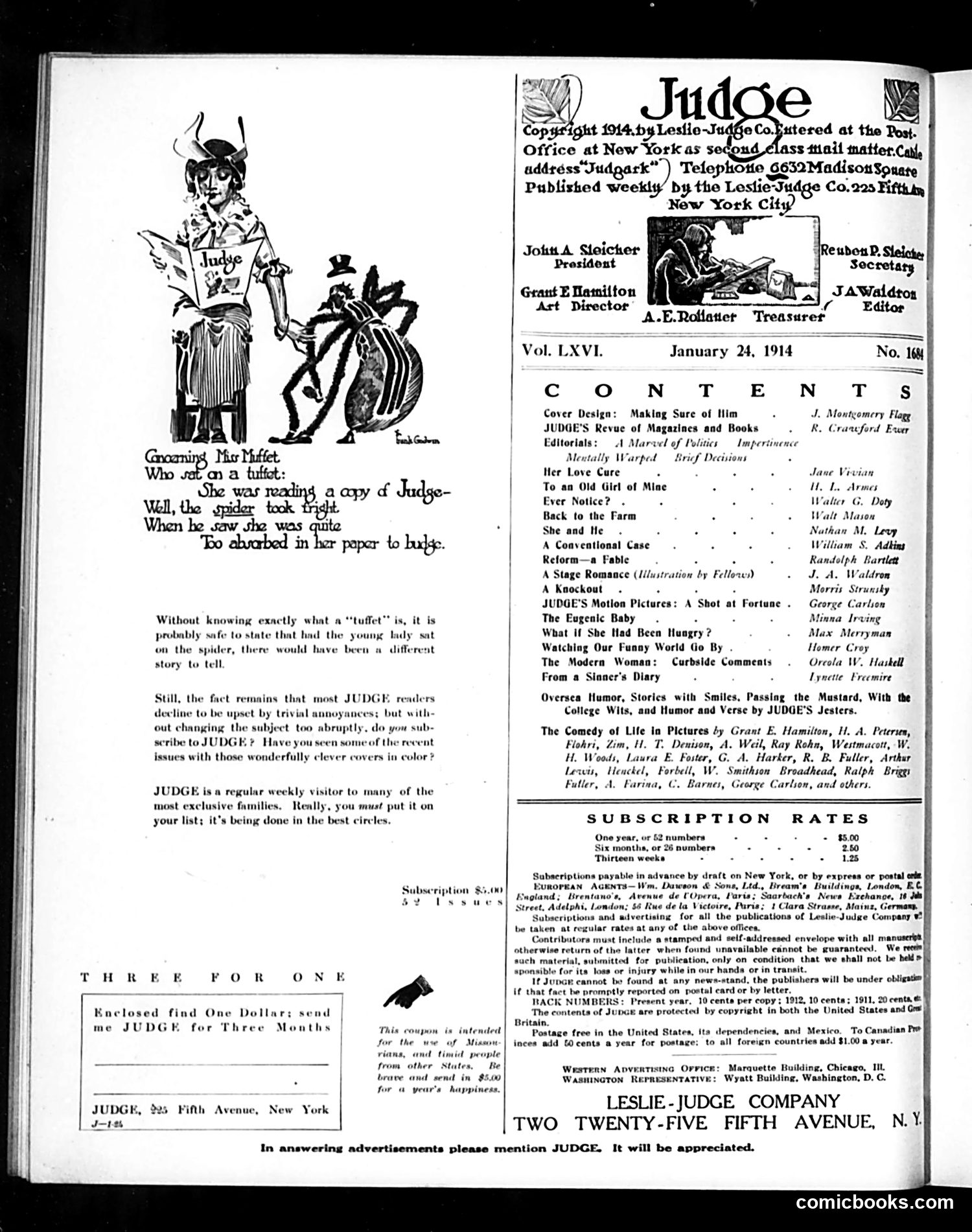
This page is primarily the magazine's masthead and table of contents, with one cartoon at left. The cartoon depicts a figure labeled "Concerning Her Buffet" showing a woman reading Judge magazine. The accompanying verse suggests the joke concerns what a woman might absorb from reading the publication—implying Judge's humorous content influences or shapes its readers' views and behavior. The page emphasizes that Judge reaches "exclusive families" and positions itself as appropriate reading "in your best circles," suggesting the magazine markets itself as sophisticated satire for the upper-middle class. The rest of the page contains subscription information and editorial credits typical of early 20th-century magazines.
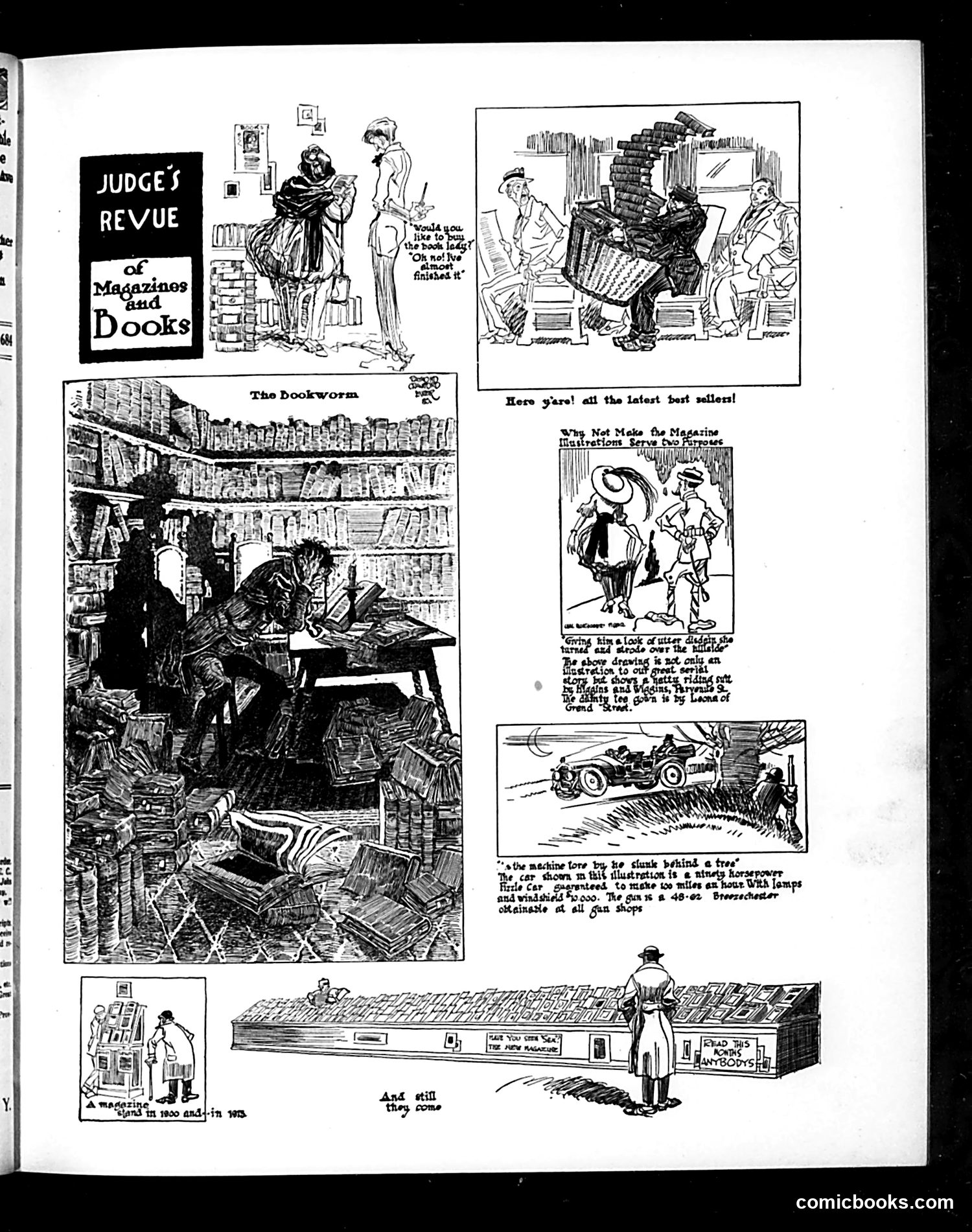
This page satirizes the publishing industry circa early 20th century. "The Bookworm" shows a figure overwhelmed amid towering stacks of publications—satirizing either excessive reading or the glut of magazines flooding the market. The other cartoons mock specific magazine illustration trends: "Here's all the latest best sellers!" depicts crowded bookshelves; "Why Not Make the Magazine Illustrations Serve Two Purposes?" jokes about recycled artwork appearing in multiple publications; and "The machine boys 'on the clank behind a tree'" comments on automobile advertisements in magazines. The bottom panel references magazines "piled in 1903 and in 1923," suggesting commentary on how publication volume or quality changed over two decades. The satire targets both magazine proliferation and repetitive editorial/advertising content.
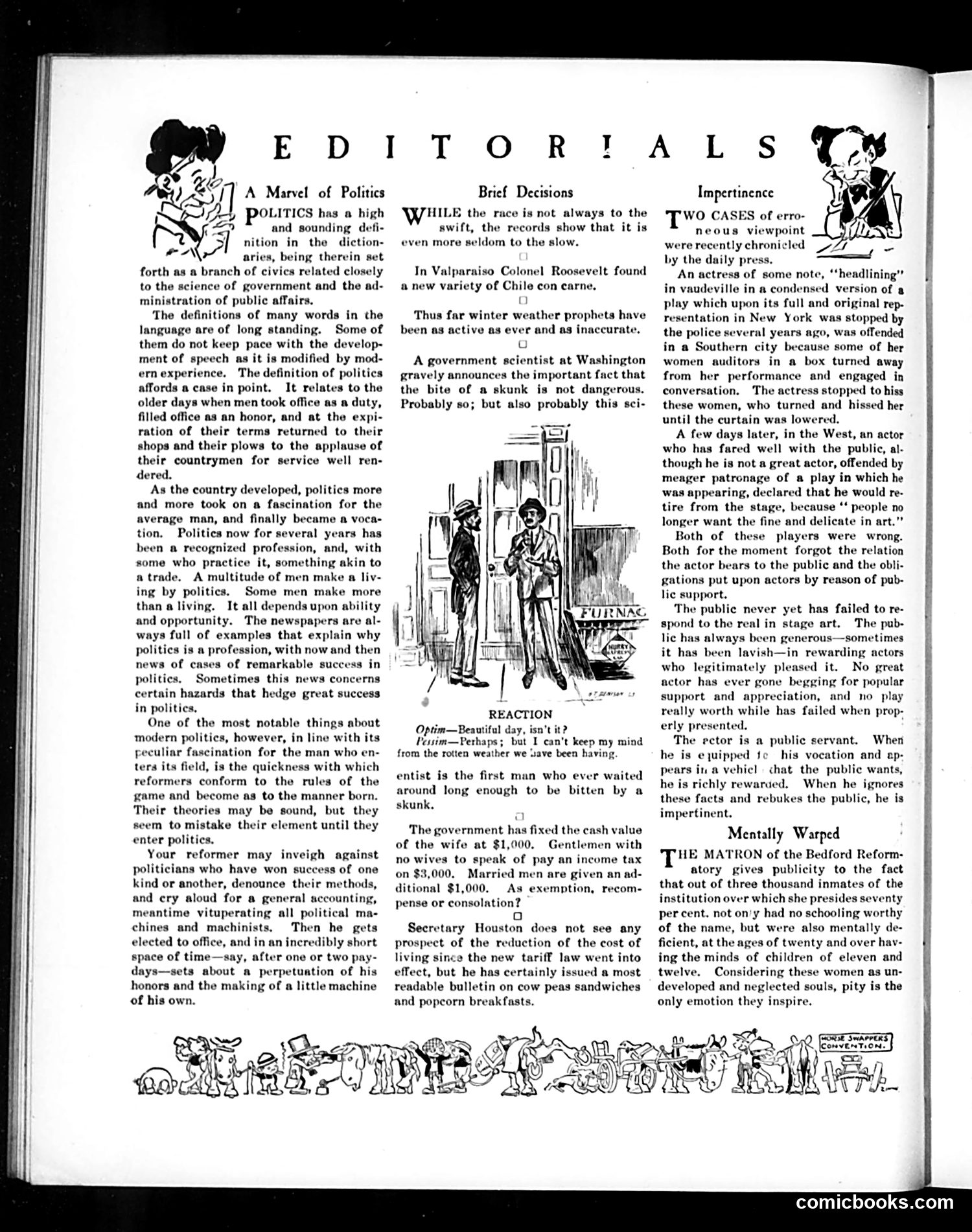
This is a satirical editorial page from *Judge* magazine addressing American politics and social commentary. The left column critiques how politics has become a profession pursued for personal gain rather than public service, noting that politicians now conform to "rules of the game" rather than serving constituents honestly. The "Brief Decisions" section mocks several targets: Colonel Roosevelt's Chilean experiences, weather forecasting accuracy, and government scientists debating whether skunk bites are dangerous. The "Impertinence" section satirizes theatrical censorship—an actress was stopped from performing in New York due to morality concerns, though similar performances proceeded elsewhere. The piece defends actors as public servants deserving support. "Mentally Warped" criticizes a reformatory's poor conditions, arguing institutional neglect harms children's development.
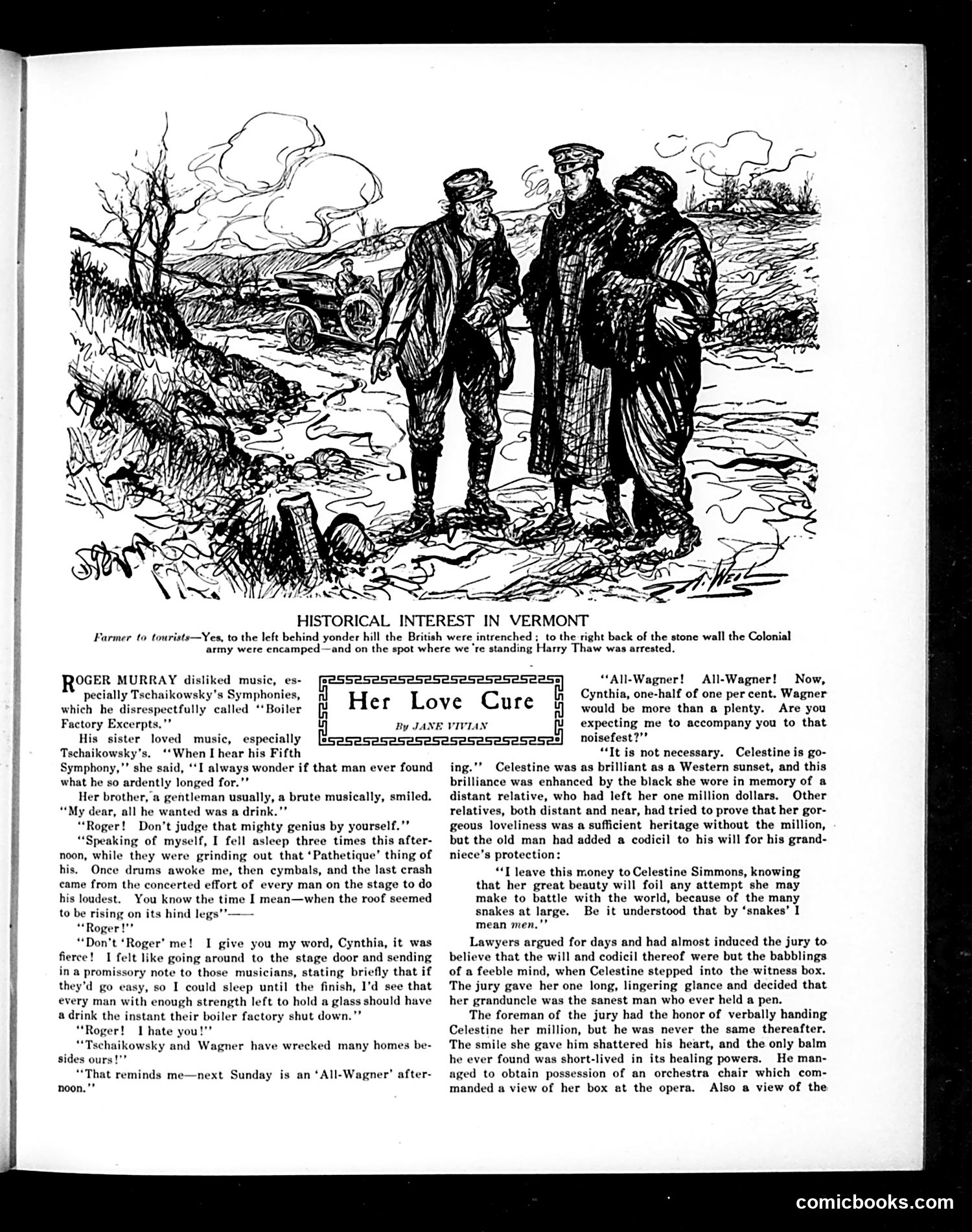
The top illustration depicts three men in military/official dress examining a battlefield site in Vermont. The caption references Harry Thaw's arrest and mentions British troops and Colonial forces—likely referencing a Revolutionary War historical marker or tour. Below is a short story titled "Her Love Cure" by Jane Vivian, concerning Roger Murray, who dislikes classical music (specifically Wagner and Tchaikovsky), and a woman named Celestine who loves it. The narrative describes their musical incompatibility and mentions a will dispute. The story appears to satirize romantic conflicts between people with clashing cultural tastes, using music preferences as the central comedic point. The page combines historical commentary with domestic humor typical of Judge's satirical approach.
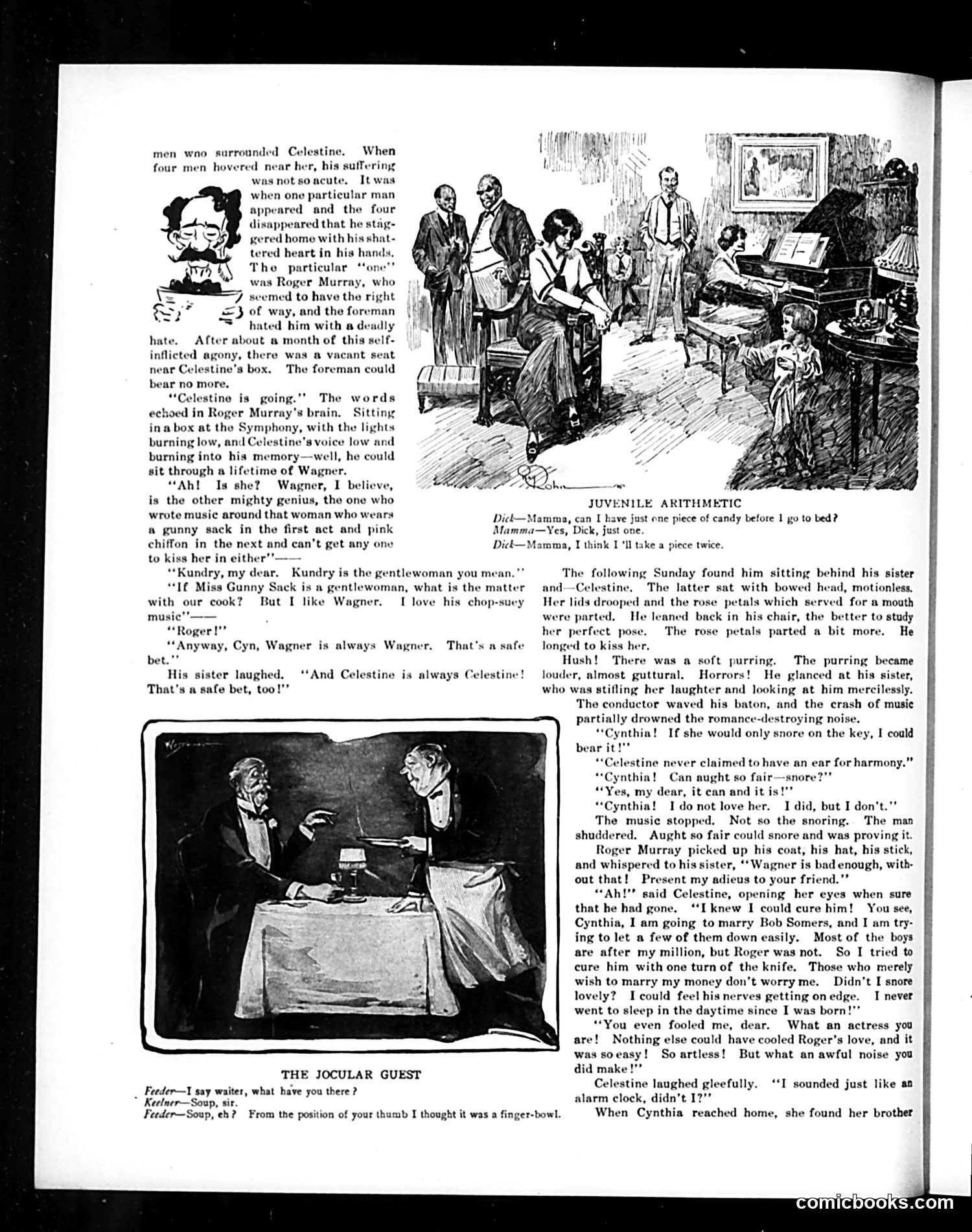
This page contains two separate satirical pieces: **Main Story ("Juvenile Arithmetic" and accompanying narrative):** A romantic comedy about Roger Murray, a foreman infatuated with wealthy Celestine. She deliberately feigns snoring at the opera to discourage his romantic interest—not because she dislikes him, but because she's already engaged to Bob Somers and wants to let down her various suitors "easily." The joke is that Celestine is manipulating Roger's emotions by performing unladylike behavior. The satire targets both romantic obsession and wealthy women's casual cruelty to admirers. **Bottom Cartoon ("The Jocular Guest"):** A waiter serves soup to a diner, who quips that based on the waiter's thumb position in the bowl, he assumed it was a finger-bowl—a crude joke implying poor hygiene and unsanitary food service. This reflects early-20th-century humor about working-class service staff. Both pieces exemplify Judge's typical satirical focus on social manners, class dynamics, and romantic entanglements among the genteel classes.
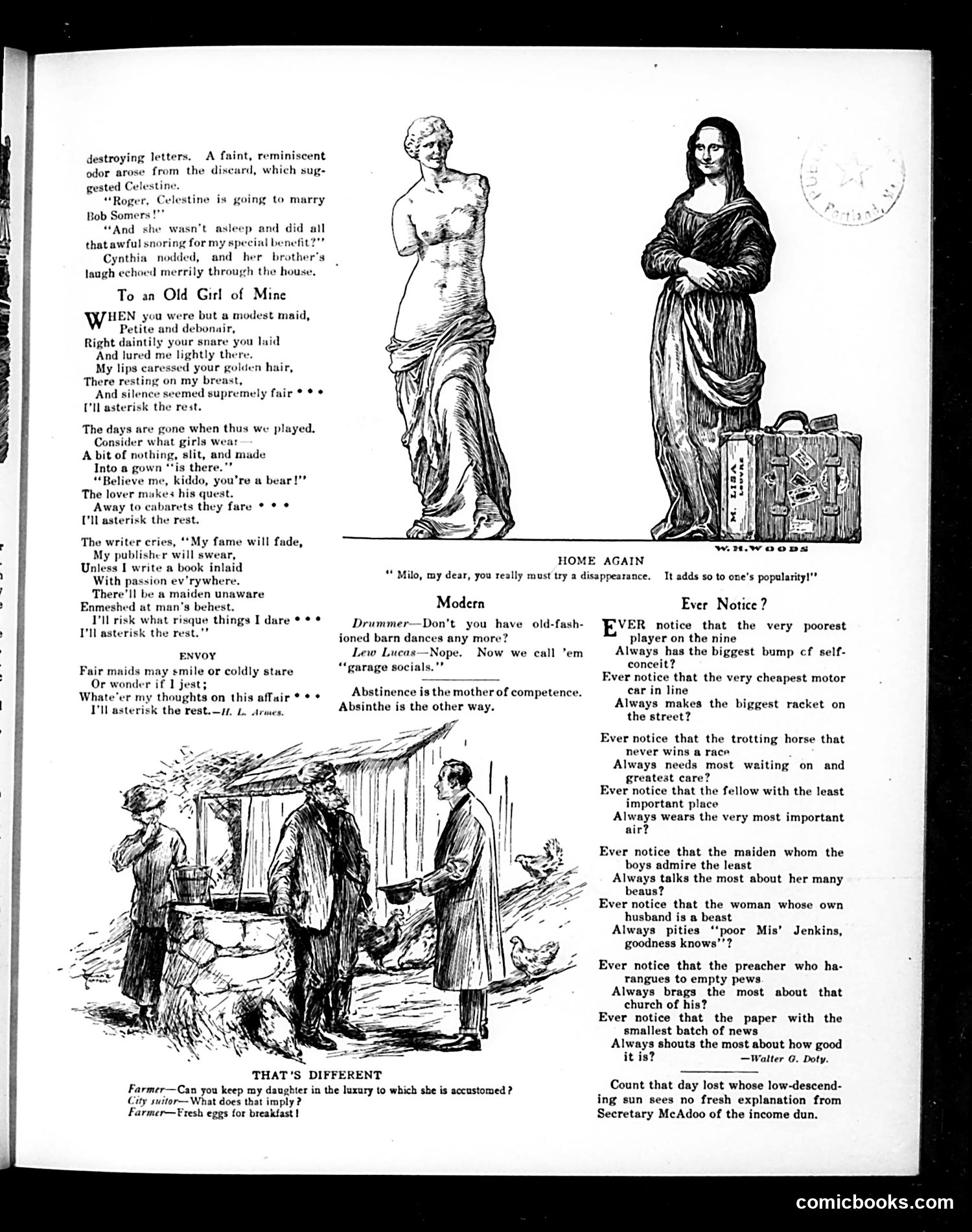
This satirical page from Judge magazine contains several distinct pieces mocking contemporary American society and attitudes: **"To an Old Girl of Mine"** is a nostalgic poem using asterisks to censor "risqué" content, satirizing both sentimental romanticism and Victorian prudishness about sexuality. The joke critiques how writers of the era used euphemism and censorship. **"That's Different"** depicts a farmer rejecting a city suitor's luxury claims by noting that "luxury" to him simply means fresh eggs for breakfast—mocking class differences and urban pretension. **"Ever Notice?"** is a series of ironic observations about human nature: the worst performer has the biggest ego, the cheapest car makes the most noise, the least important person acts most important. These attack hypocrisy and false pride across social classes. The illustrations include classical statuary and a domestic scene, supporting the magazine's satirical tone. The final line cryptically references "Secretary McAdoo of the income dun"—likely Treasury Secretary William McAdoo and income tax complaints, though context is unclear without more historical detail.
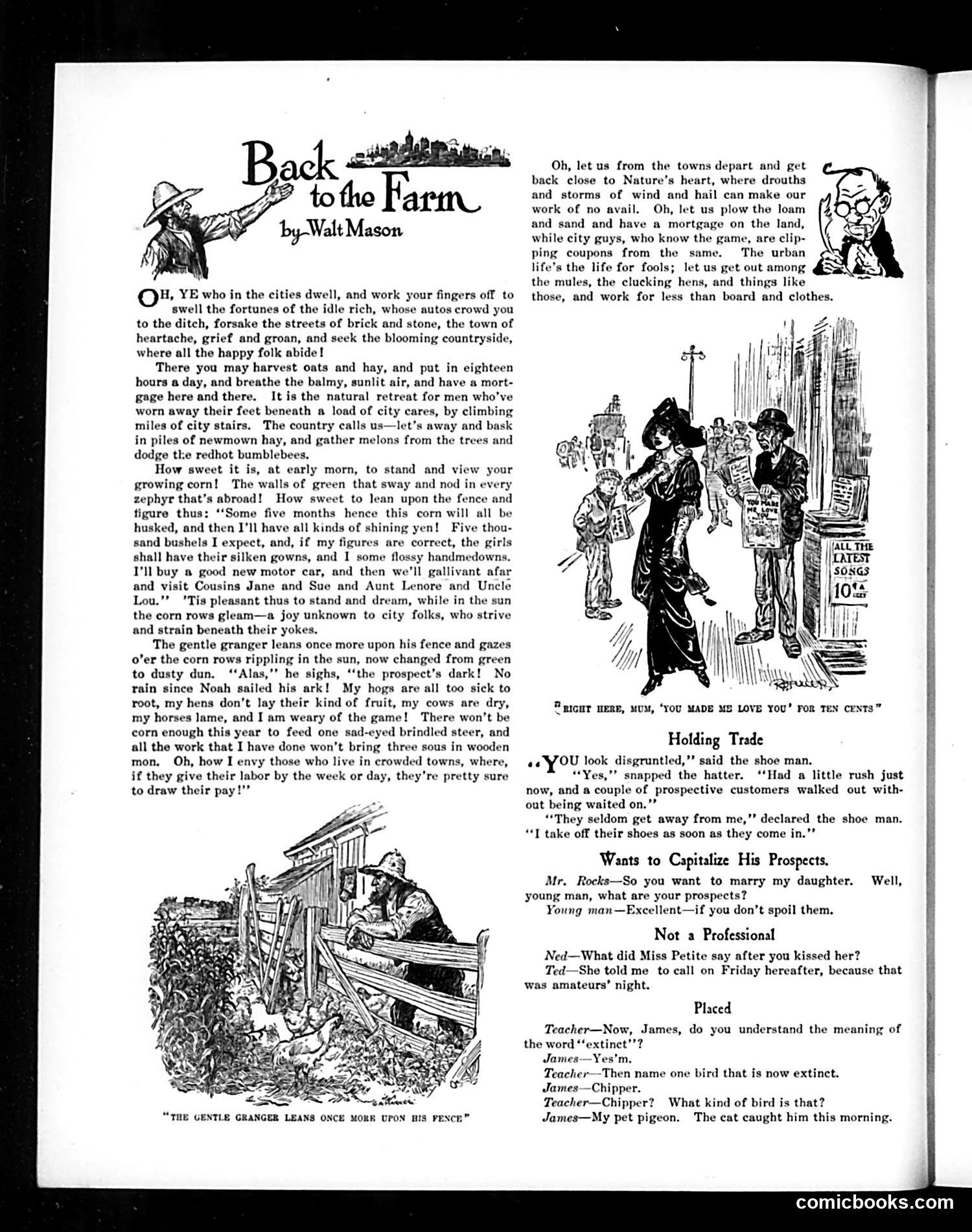
This satirical piece mocks the "back to the farm" movement popular in early 20th-century America. Mason portrays an idealistic farmer fantasizing about rural prosperity—envisioning five thousand bushels of corn, new motorcars, and visits to relatives. The satire's punch arrives when reality strikes: drought, sick livestock, dried-up cows, and lame horses destroy the crops. The farmer then laments that city workers, despite their toil, at least receive guaranteed weekly wages—a sharp reversal of the pro-rural rhetoric that opened the piece. The accompanying joke section ("Holding Trade," "Not a Professional," etc.) offers brief comedic sketches unrelated to the main article. Mason's overall message critiques romantic agrarian fantasies while acknowledging that industrial wage labor, despite its hardships, offered more financial security than farming's unpredictable fortunes during this era.
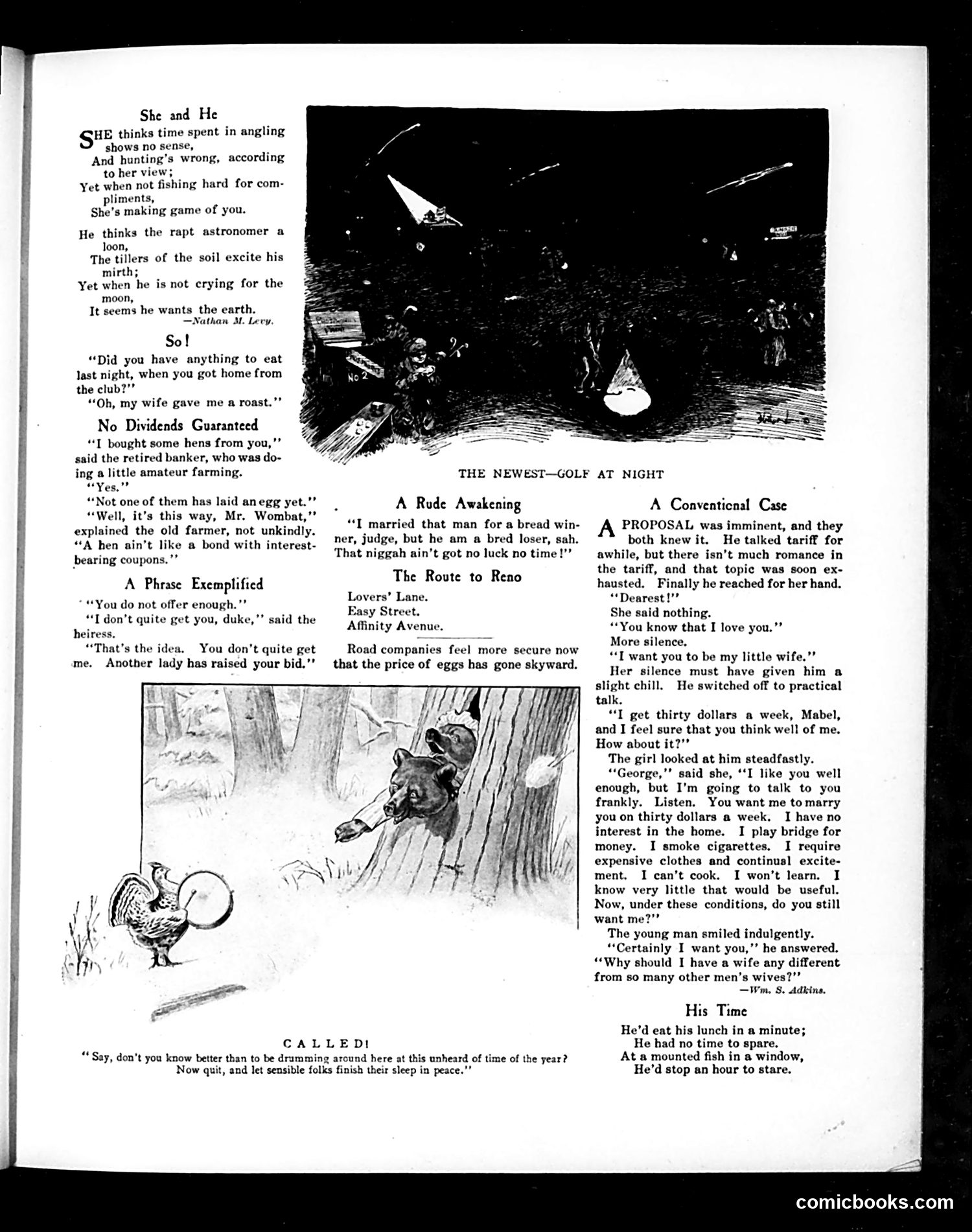
This page presents multiple short humorous pieces satirizing gender relations and social hypocrisy of the early 20th century. **"She and He"** contrasts how each gender criticizes the other's pursuits while engaging in similar frivolous behavior—she mocks his fishing/hunting yet makes "games" of men; he ridicules astronomers and farmers yet wants "the earth." **The marriage proposals** mock courtship rituals. One wife complains her husband is a "bred loser" (racial dialect humor typical of the era). Another depicts a frank woman listing her actual flaws—expensive tastes, no domestic skills, bridge-playing for money—yet the man accepts anyway, resigned that all wives are essentially the same. **"His Time"** ironically contrasts his rushed lunch against stopping an hour to gaze at a mounted fish—suggesting men prioritize trivial pursuits over practical matters. The page's overall point: both sexes engage in shallow, contradictory behavior, and marriage represents mutual acceptance of these hypocrisies rather than genuine partnership. The satire is fairly gentle social commentary on courtship and domesticity conventions.
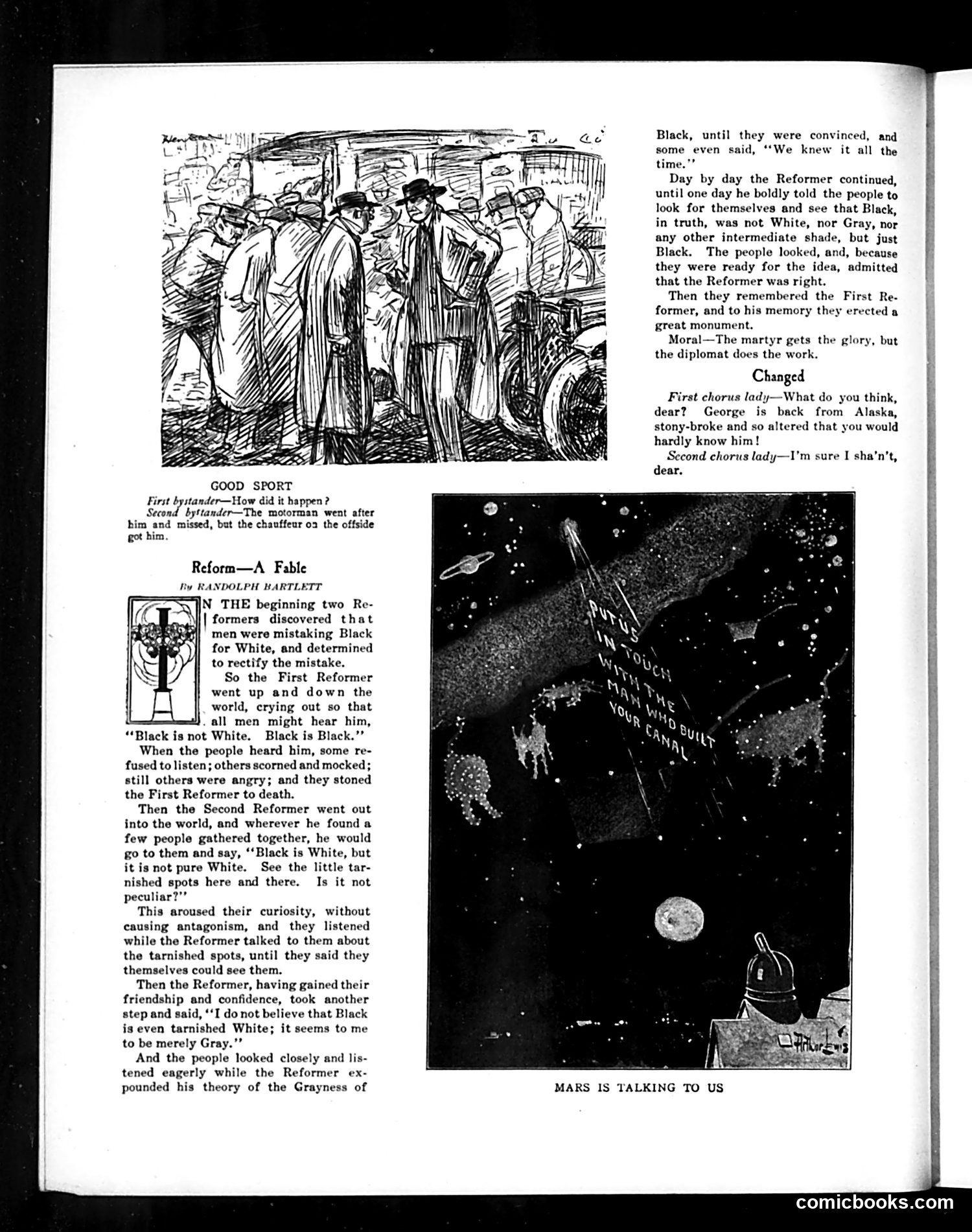
This satirical fable by Randolph Bartlett contrasts two reform approaches. The First Reformer aggressively proclaims truth ("Black is not White. Black is Black"), gets violently rejected and martyred. The Second Reformer uses diplomatic gradualism—initially compromising ("Black is White, but tarnished"), then slowly introducing nuance ("merely Gray")—gaining audience acceptance and erecting monuments. The moral explicitly states: "The martyr gets the glory, but the diplomat does the work." This critiques American Progressive Era reform tactics. The fable argues that radical truth-telling, while morally pure, accomplishes nothing. Pragmatic compromise—incrementally shifting public opinion through flattery and incremental claims—actually succeeds politically. The page's other items ("Good Sport," "Changed") are unrelated humor pieces about Alaska and chorus girls, likely topical references to contemporary scandals now obscure.
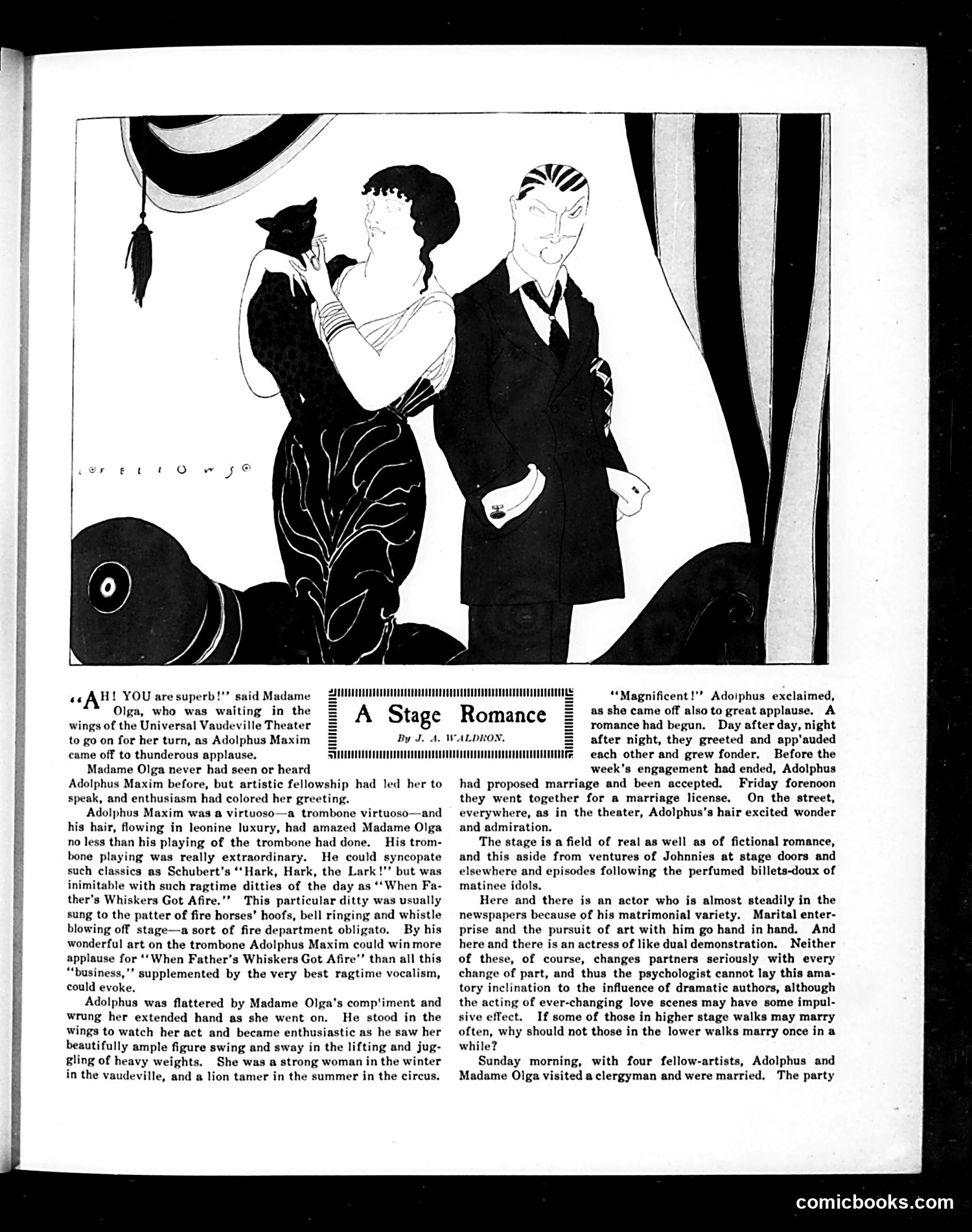
This is a humorous short story illustrated by J.A. Waldron about two vaudeville performers who meet and quickly marry. **The figures:** Adolphus Maxim (a trombone virtuoso with notably flowing hair) and Madame Olga (a strong woman performer who juggles weights and works as a lion tamer seasonally). **The joke/satire:** The story gently mocks theatrical culture and the impulsiveness of stage performers. The satire targets: - The artificiality of theatrical "romance"—mutual admiration between performers based on stage personas rather than genuine connection - Actors' and actresses' documented tendency toward frequent marriages - The absurdity that they marry after only days of knowing each other **Context:** The text questions why lower-tier vaudeville performers shouldn't marry "once in a while" if higher-status stage performers marry repeatedly—sarcastically suggesting even hasty, theatrical marriages are reasonable. The cartoon illustrates their quick courtship before obtaining a marriage license, treating their whirlwind romance as typical theatrical behavior worthy of gentle ridicule.
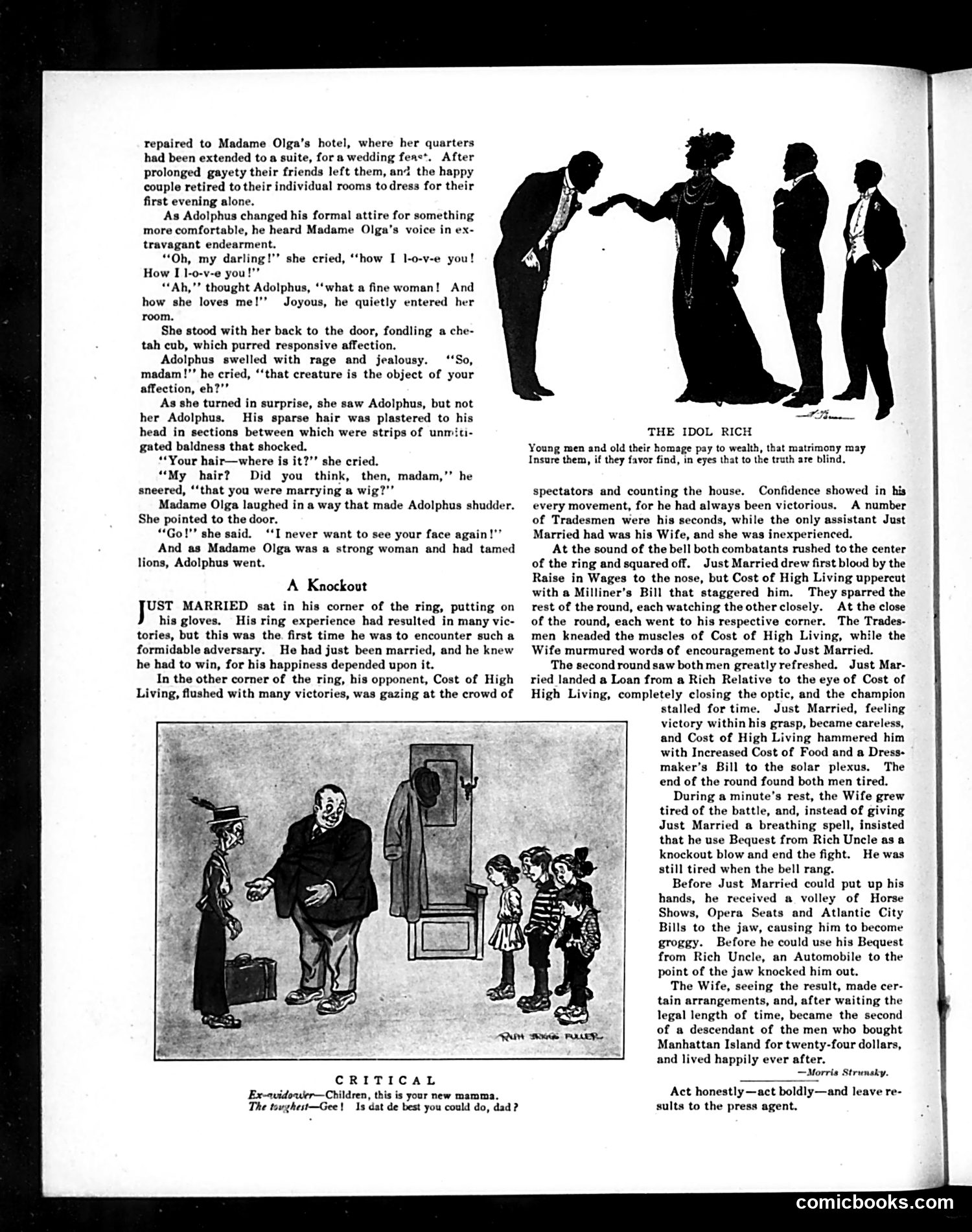
This Judge magazine page contains two satirical pieces mocking wealth and marriage: **"The Idol Rich"** (top illustration): The silhouette shows wealthy young men courting women, with the caption sardonically noting they use "homage pay to wealth" to win marriages from women "blind" to truth. This critiques gold-digging and materialism in wealthy society. **"A Knockout"** (main story): An allegory where "Just Married" (a boxer) fights "Cost of High Living" (his opponent). The match depicts marriage's financial struggles as literal combat—his wife's encouragement, money from relatives, and household expenses (milliner's bills, food costs, dressmaker bills, opera seats, automobiles) function as punches. The joke: married life is brutal economic warfare where expenses relentlessly pummel the newlywed. The companion story about "Adolphus" and Madame Olga mocks vanity—he's shocked she loves her pet cheetah more than his bald head, resulting in divorce. Together, these pieces satirize marriage as financially and emotionally destructive, particularly for men.
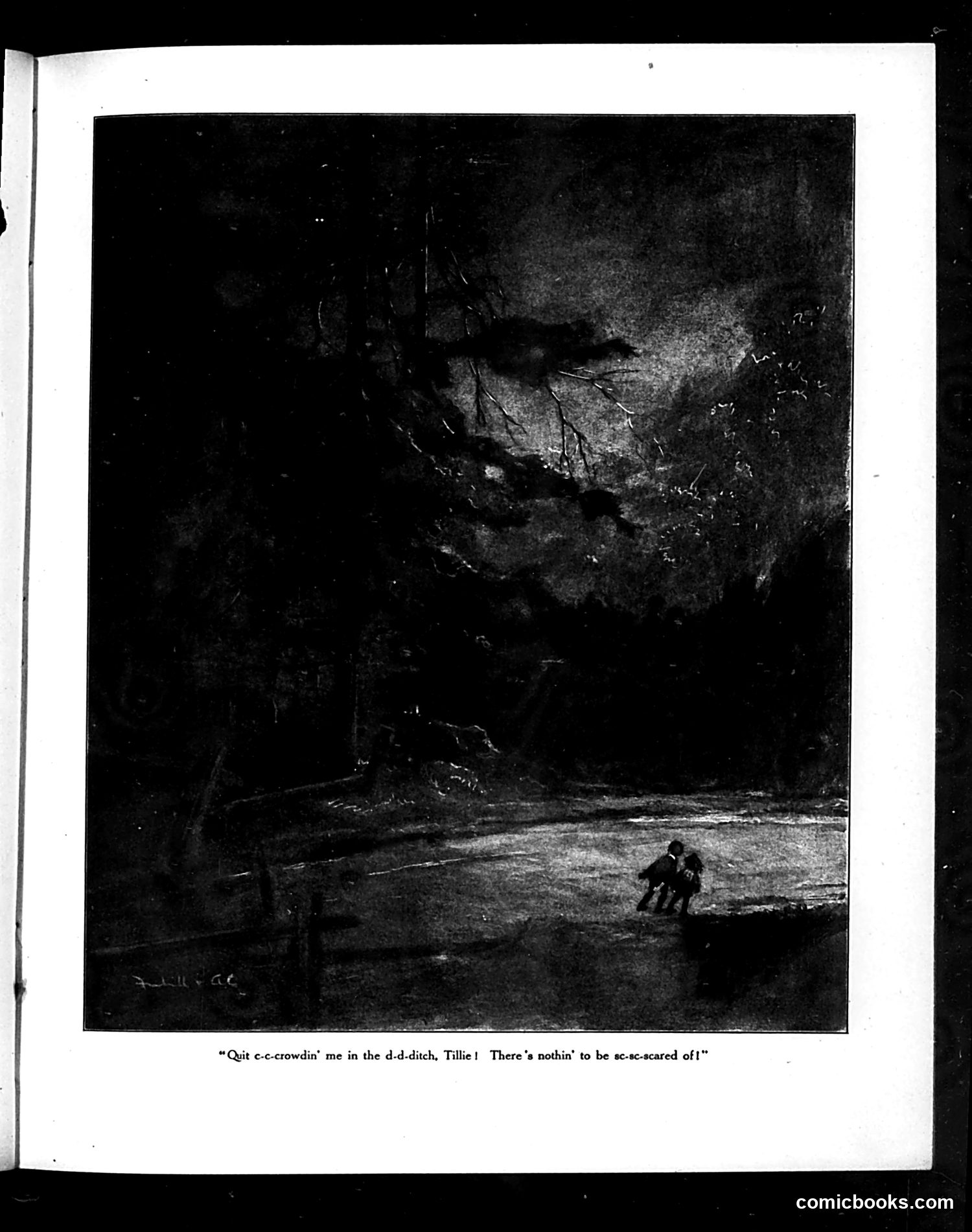
This appears to be a comedic illustration from *Judge* magazine showing two figures in a ditch at night. The caption features exaggerated stuttering dialogue, with one character (apparently named Tillie) being reassured by another not to be scared while crowded together in the ditch. The humor seems to rely on several elements: the nervous stuttering suggests anxiety or fear despite claims otherwise; the intimate crowding in a ditch provides an awkward, suggestive situation; and the darkness/theatrical lighting creates gothic atmosphere. This likely plays on contemporary dating anxieties or "spooning" humor common to early 20th-century satirical magazines, where young couples found themselves in compromising situations. The overall joke appears to mock youthful nervousness and the gap between bravado and actual fearfulness in romantic/intimate scenarios.
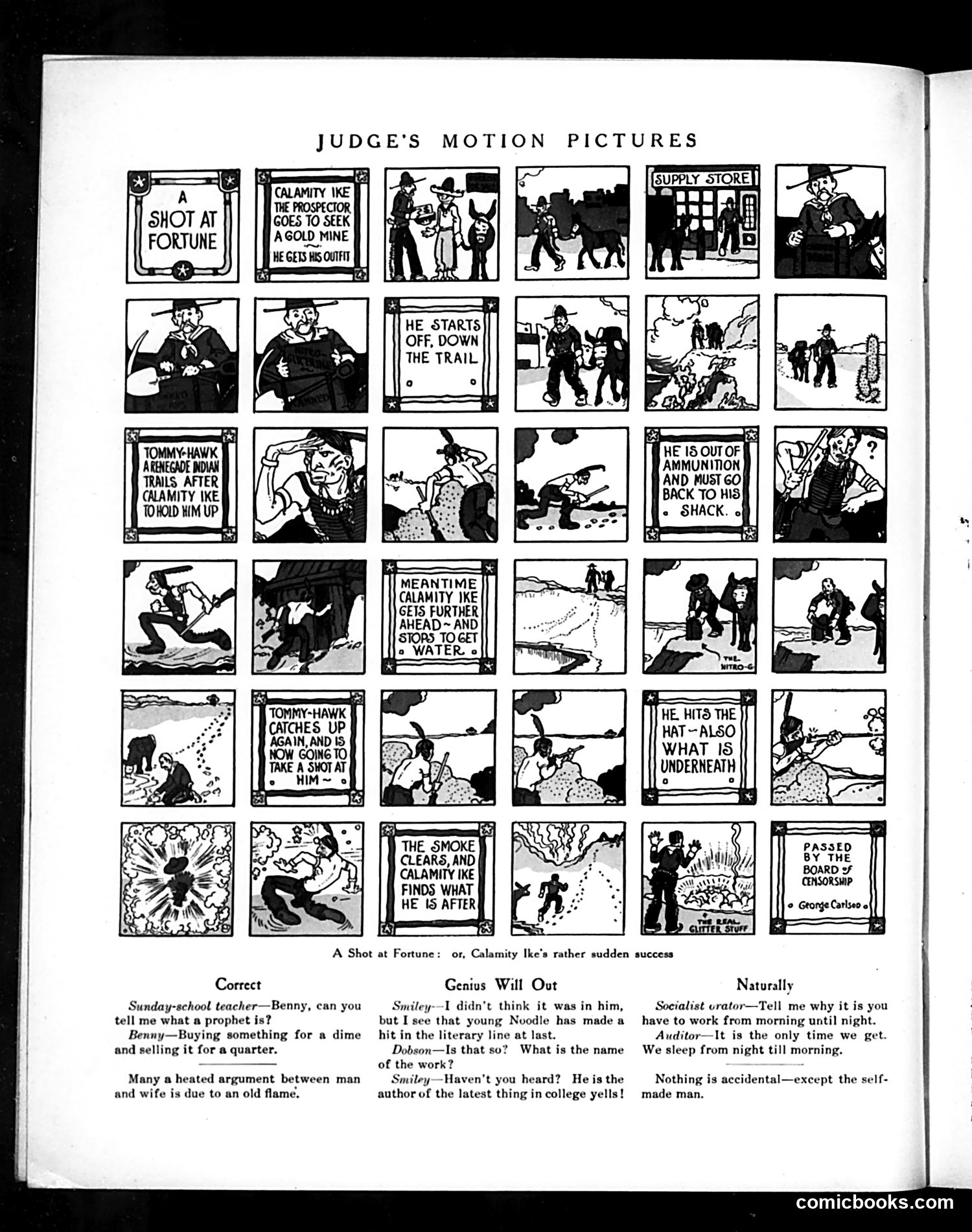
This page presents a six-panel comic strip titled "A Shot at Fortune; or, Calamity Ike's rather sudden success," depicting a prospector's journey to sudden wealth. The narrative follows a character seeking fortune: he obtains mining equipment, starts down a trail, discovers something valuable (suggested by the dramatic "explosion" panel), and ultimately succeeds—his find apparently validated by a "Board of Censorship" approval stamp at the end. The strip satirizes the get-rich-quick mythology of American prospecting culture. Below, three humorous anecdotes mock social pretension: a child redefines "prophet" as arbitrage; a man's literary success is merely plagiarizing college slang; and a socialist orator is challenged on his work schedule, exposing hypocrisy. The overall message critiques both frontier dreams of instant wealth and contemporary intellectual and political posturing.
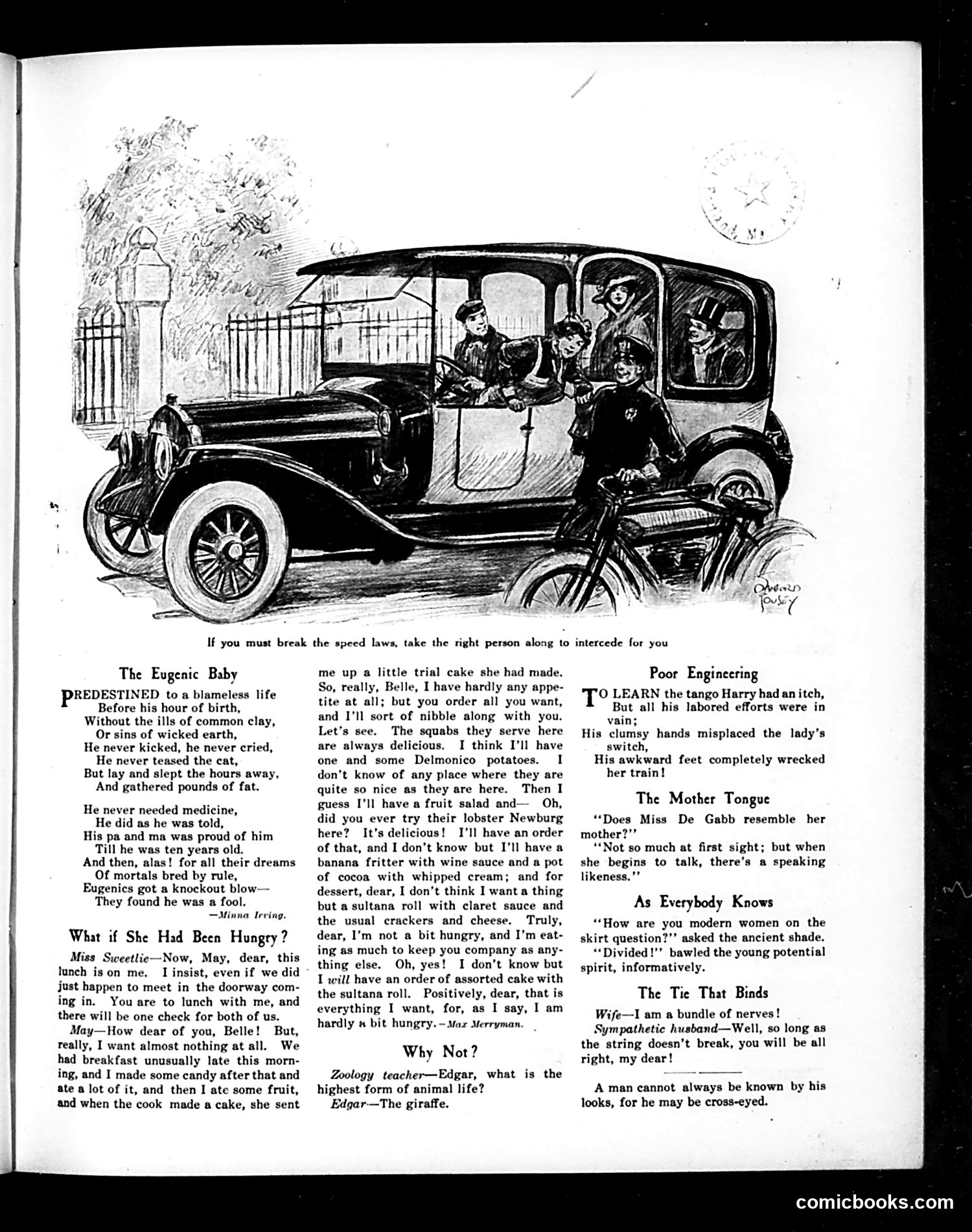
This page contains multiple short humorous pieces typical of early 20th-century satirical magazines: **Main Cartoon:** Shows a car full of lawbreakers with the caption "If you must break the speed laws, take the right person along to intercede for you"—satirizing corruption and the ability of wealthy/connected people to escape legal consequences. **"The Eugenic Baby":** Mocks the eugenics movement (then popular among progressives) by describing a "scientifically bred" perfect child who turns out to be a fool, suggesting genetic determinism is flawed. **"What if She Had Been Hungry?":** A woman claims she's not hungry while ordering an elaborate, expensive multi-course meal—social satire about hypocrisy and women's pretense at modesty while dining. The remaining pieces are brief jokes about modern social issues: women's fashion ("skirt question"), the "new woman," dating etiquette, and gender dynamics in marriage. Most humor relies on wordplay and gentle mockery of contemporary social trends and anxieties.
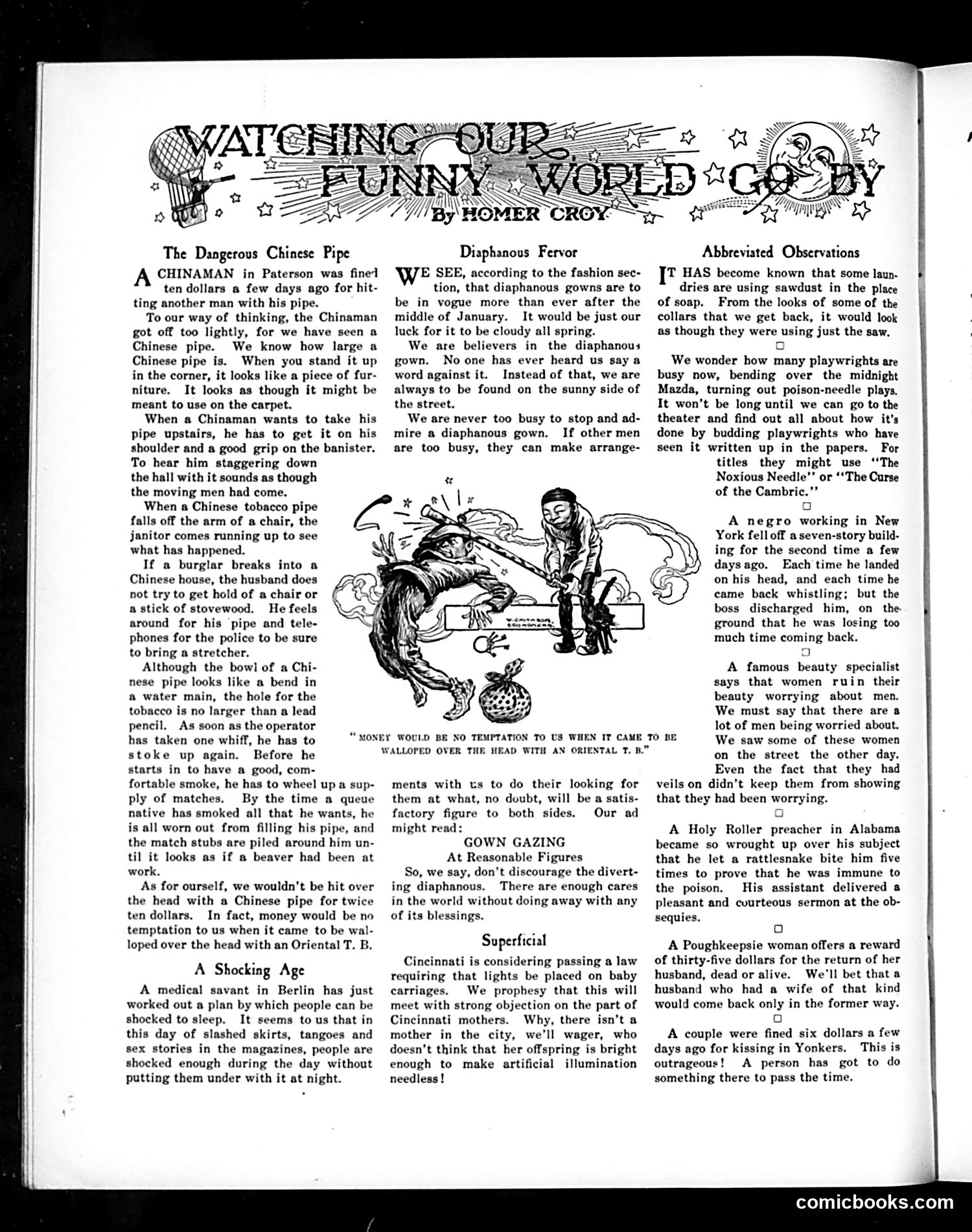
This page contains four satirical short pieces typical of Judge's humor: **"The Dangerous Chinese Pipe"** mocks both Chinese immigrants and American overreaction through exaggeration—the pipe is so massive and cumbersome that wielding it as a weapon seems almost inevitable, yet the offender received only a ten-dollar fine. The satire suggests Americans find Chinese customs absurdly foreign. **"Diaphanous Fervor"** playfully critiques fashion trends for transparent/sheer gowns while making transparent (pun intended) commentary about male voyeurism—the writer eagerly volunteers to help other men admire these revealing fashions "at reasonable figures." **"A Shocking Age"** contrasts a Berlin sleep-induction method against modern American life's inherent shocks: "slashed skirts, tangoes and sex stories," suggesting contemporary culture is already scandalous enough. **"Superficial"** jokes about Cincinnati mothers' vanity—if the city requires lights on baby carriages, mothers will object, convinced their babies are naturally bright enough to need no artificial illumination. The humor relies on period-specific references to fashion, immigration anxieties, and morality debates.
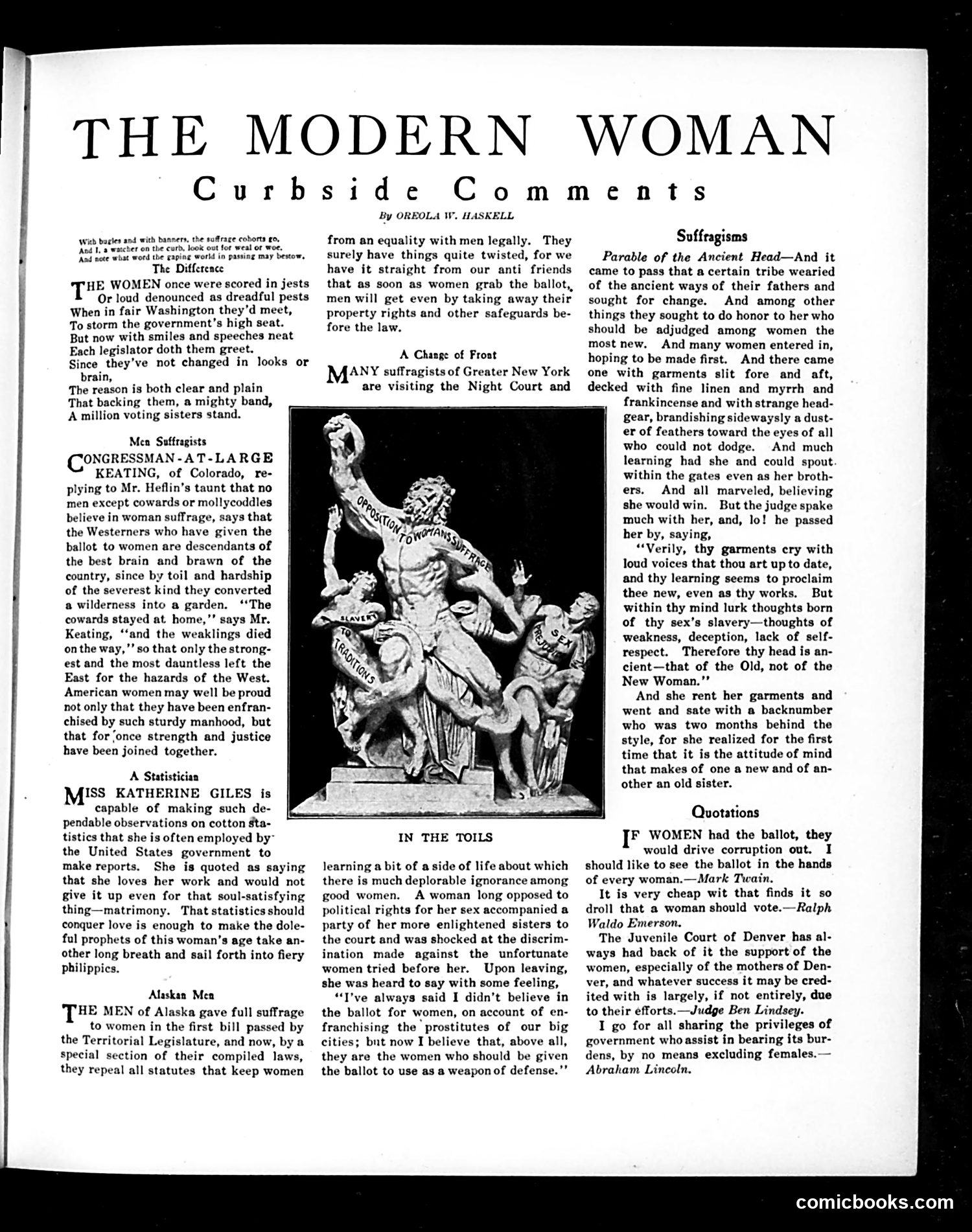
This *Judge* magazine page satirizes the women's suffrage movement circa 1910s through multiple angles: **The main cartoon** depicts Lady Justice (identifiable by her classical robes and scales) being attacked/overwhelmed by suffragettes wielding banners and placards. The satire suggests suffragists are chaotically assaulting traditional institutions. **The text sections mock suffrage advocates** while pretending to praise them—a common satirical technique. "Men Suffragists" argues only "cowards or mollycoddles" support women's voting. "A Change of Frost" ridicules suffragettes visiting Night Court in exaggerated dress, suggesting they're naive about urban immorality. "In the Toils" ironically converts an anti-suffrage woman to the cause after witnessing judicial discrimination against poor women. **The quotations at bottom**—from Mark Twain, Lincoln, and others—are attributed statements opposing women's political power, framing suffrage as dangerous or foolish. The page's core message: suffragists are either ridiculous fanatics, ignorant about social realities, or motivated by misguided sentimentality rather than legitimate grievance.
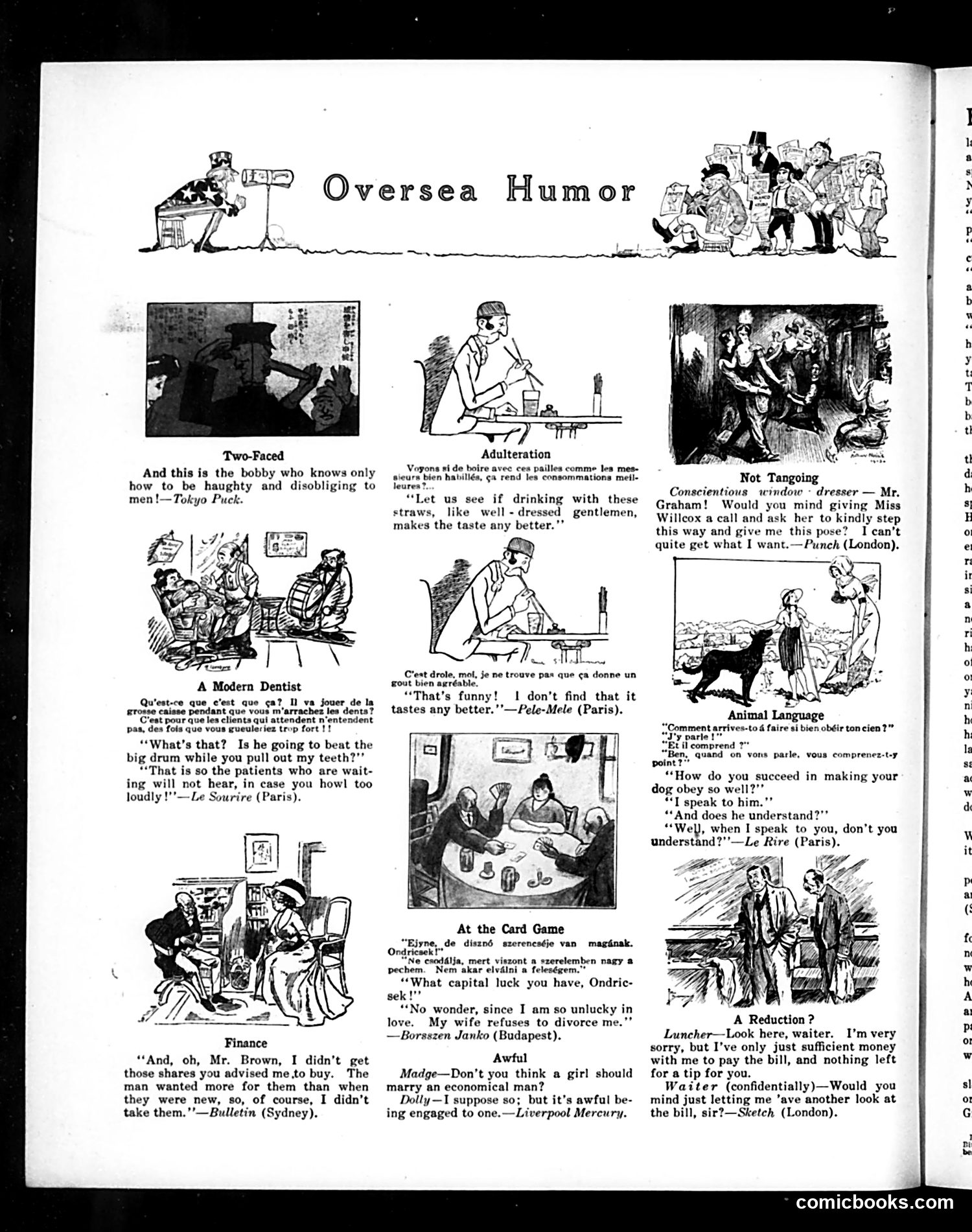
This page collects international satirical cartoons and jokes from various foreign publications (Tokyo Puck, Le Sourire, Punch, Le Rire, etc.), presenting humor that appealed to Judge's American readership. The cartoons mock universal human follies: a dentist who drums loudly to drown out patients' screams; a waiter hoping for a tip despite a diner's poverty; a wife refusing divorce despite her husband's misfortune; a window dresser requesting a model's pose; adulteration of drinks disguised by fancy straws; stock market advice gone wrong; and a dog-obedience joke playing on mutual incomprehension. The page's appeal lies in demonstrating that human nature—greed, vanity, stupidity, marital discord—transcends national boundaries. By collecting international humor, Judge suggests cosmopolitan sophistication while essentially confirming that foolishness is universal. The mix of languages reinforces this "international" framing without requiring readers to understand French or Hungarian.
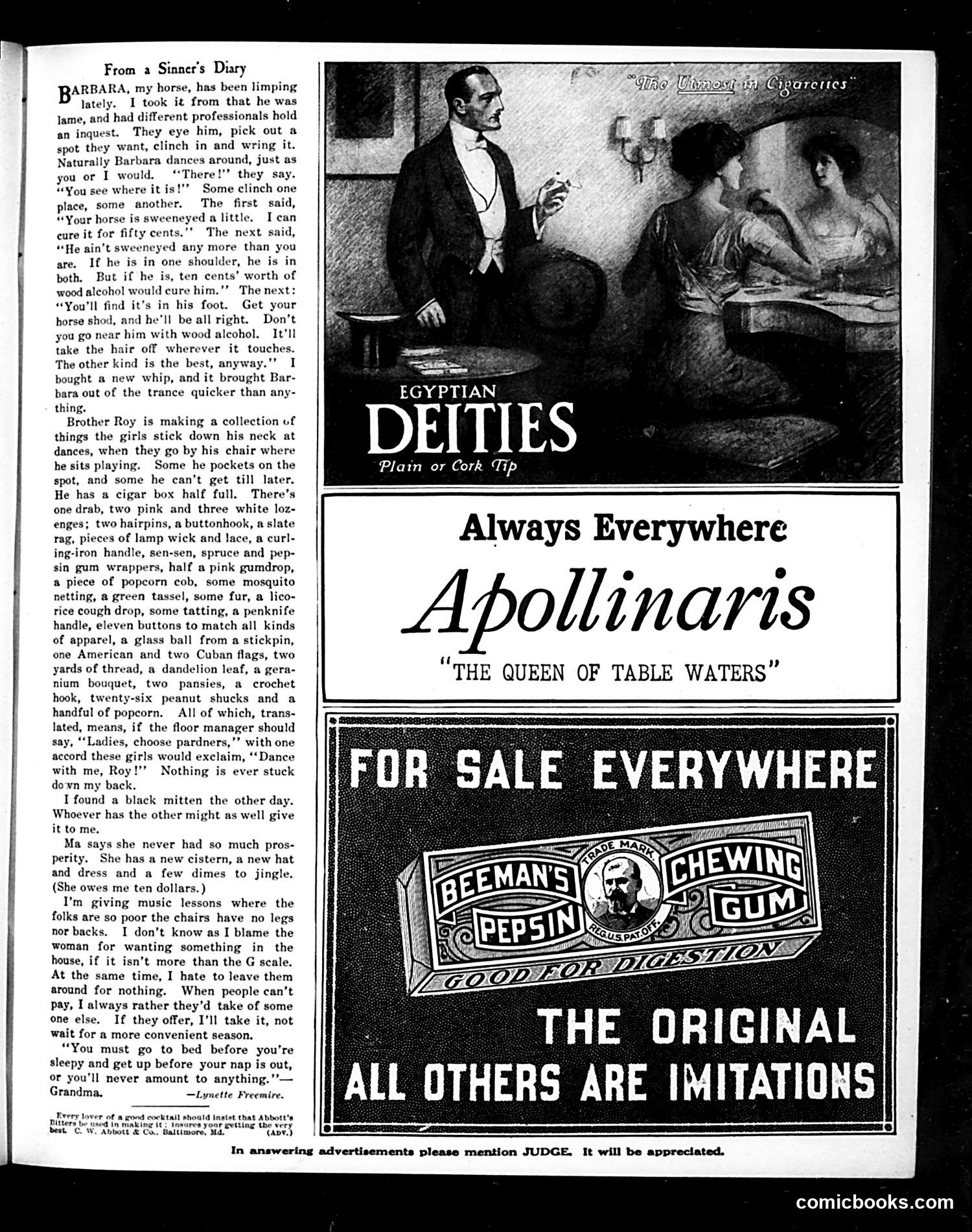
This page from *Judge* contains no political cartoon. Instead, it features: **Left column:** A humorous diary entry titled "From a Sinner's Diary" by Lynette Freemire, describing everyday absurdities—conflicting veterinary advice about a lame horse, a boy collecting trinkets girls drop down his neck at dances, and complaints about teaching music to poor families. The humor relies on relatability and mild social observation rather than satire. **Right side:** Three advertisements for consumer products: Egyptian Deities cigarettes (featuring an illustration of what appears to be Egyptian-themed imagery), Apollinaris bottled water ("Queen of Table Waters"), and Beeman's Pepsin Chewing Gum ("The Original—All Others Are Imitations"). The page is primarily **advertising-driven** rather than satirical or politically engaged. The diary content offers genteel, domestic humor typical of early-20th-century magazines aimed at middle-class readers.
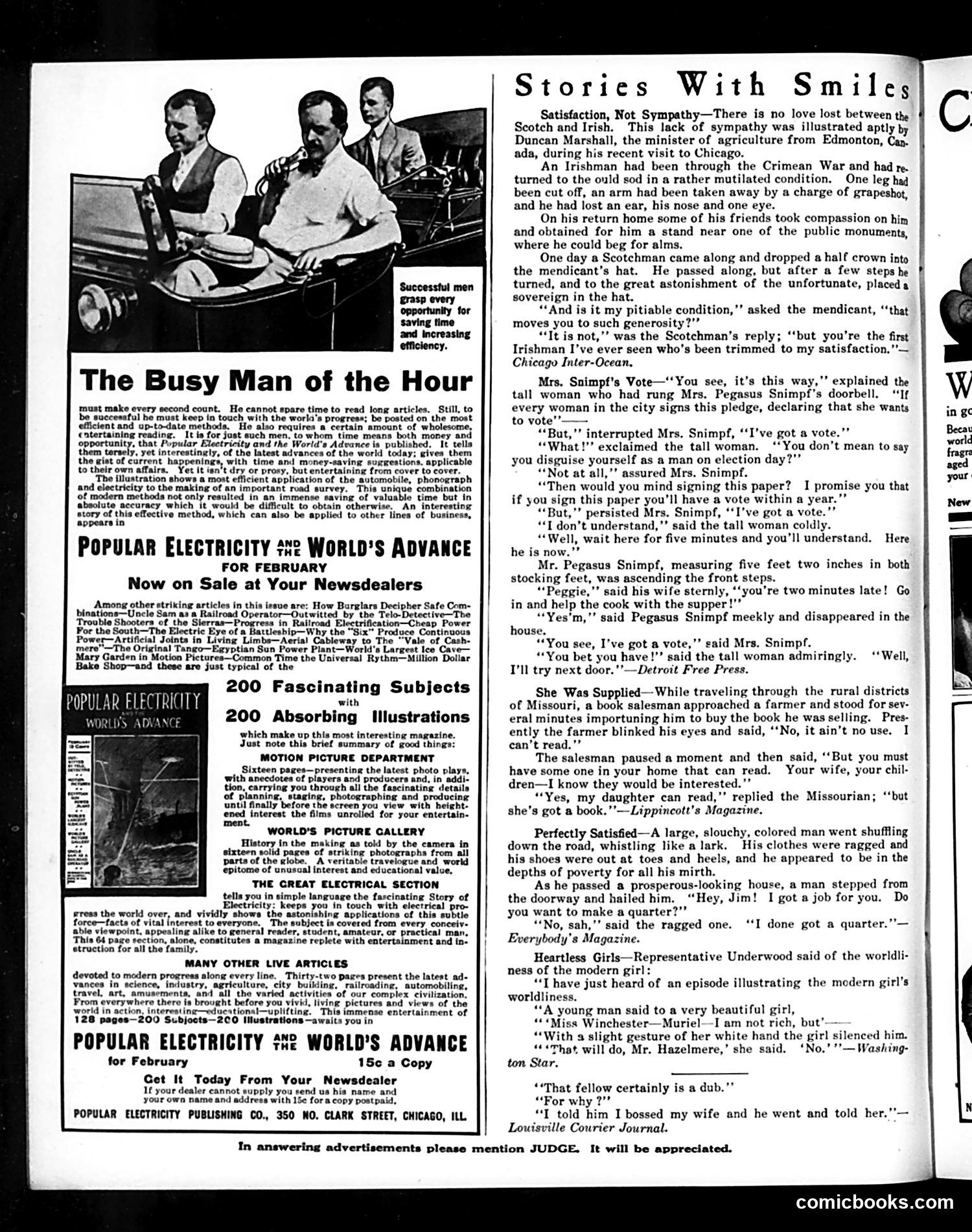
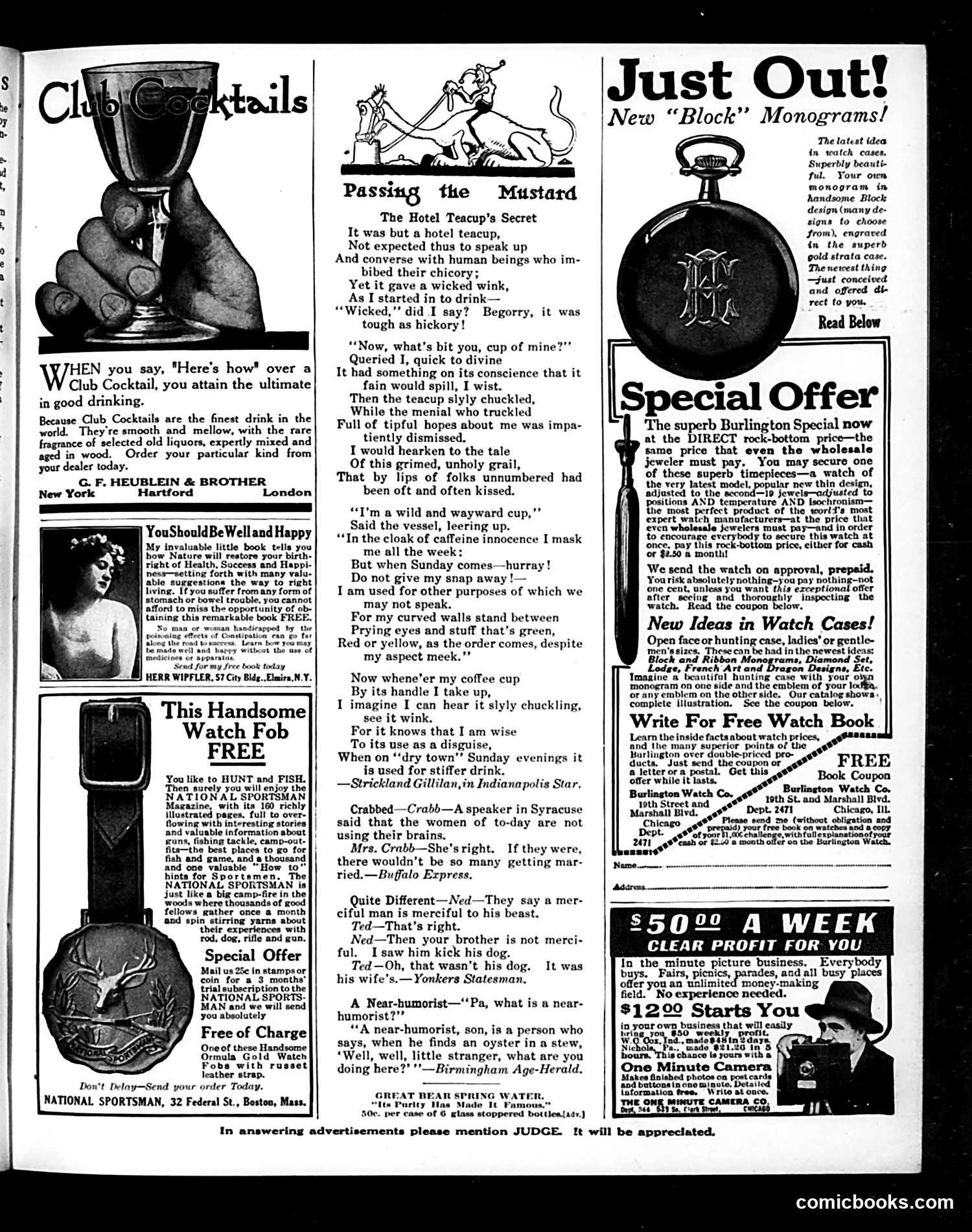
This page is primarily **advertisements and filler content** rather than political satire. The dominant features are commercial ads for watches, cocktails, sporting magazines, and health remedies—typical of early 20th-century publications. The one notable satirical piece is **"Passing the Mustard,"** a humorous poem by Strickland Gillilan about a hotel teacup that confesses to serving illicit alcohol on Sundays in a "dry town" (likely referencing Prohibition-era temperance laws). The teacup admits it's used as a disguise to conceal "stuff that's green, / Red or yellow"—alcohol—despite appearing innocent. The satire gently mocks both the hypocrisy of dry-town regulations and people's creative workarounds. Brief jokes follow about women's brains, a man kicking his wife instead of a dog, and a "near-humorist's" oyster joke. The page reflects early 1900s advertising culture and mild social humor rather than sharp political commentary.
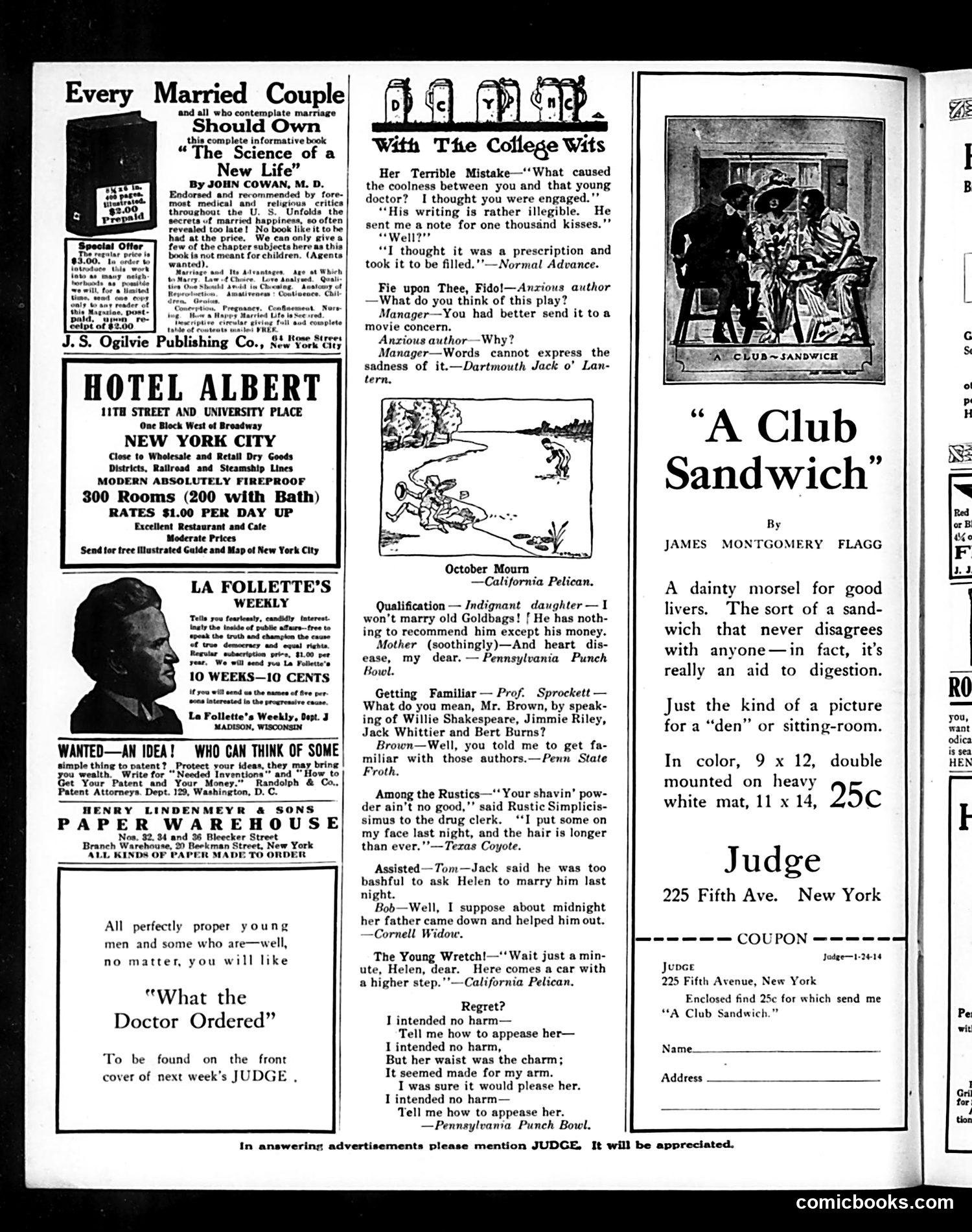
This page is primarily advertising and humor content from Judge magazine. The main features are: **"With The College Wits"** – A humor column featuring brief jokes, mostly playing on misunderstandings and double meanings typical of early 20th-century college humor. Examples include a woman mistaking a romantic note for a prescription and an author's play being too sad for theaters. **Advertisements** – Including Hotel Albert, La Follette's Weekly political journal, and a "Club Sandwich" print by James Montgomery Flagg (famous illustrator). The Flagg ad promotes an affordable color art print for home decoration. **"The Young Wretch"** – A brief joke about a young man delaying a proposal to watch a car pass. There's no significant political cartoon or social commentary on this page. It's a standard magazine spread mixing low-stakes college humor with advertisements targeting middle-class readers, typical of Judge's satirical but relatively gentle editorial approach during this era.
This page is primarily **advertising and humorous short anecdotes**, not political cartoons. The "Winnowed: First Impressions" section contains brief satirical observations on contemporary life: jokes about divorce, lazy men, modern theater, and marriage economy. These target middle-class social pretensions and marital dynamics. The anecdotes mock specific professions: an embryonic newspaper editor's cliché headline-writing, a lawyer's pedantic questioning (whether a woman wore a tiara "on" her hair), and a teacher praising a boy for learning French politeness while lacking English manners. The humor is gentle social satire typical of *Judge*—poking fun at journalists, lawyers, schoolchildren, and domestic life rather than attacking political figures or events. The references are domestic and professional rather than topical or partisan. The page is otherwise filled with hotel and service advertisements (Hotel Imperial, Hotel Powhatan, press clipping services) reflecting the magazine's commercial publishing model.
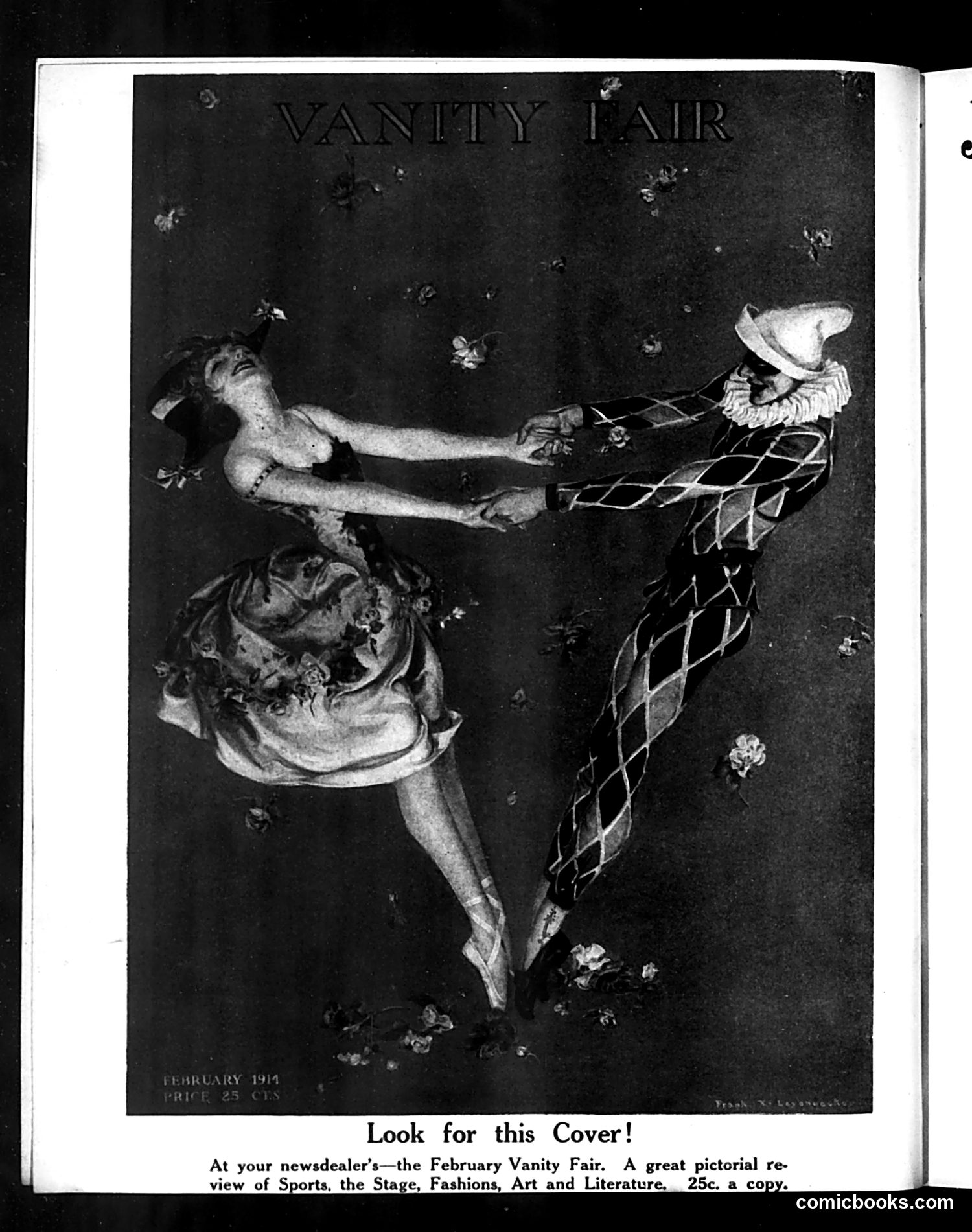
This page is an advertisement for Vanity Fair magazine's February 1914 issue, priced at 25 cents. The illustration depicts two figures in an overhead view—a reclining woman in an ornate dress and a costumed figure (possibly a jester or theatrical character) connected by what appears to be a string or ribbon, with scattered flowers around them. The ad promises "a great pictorial review of Sports, the Stage, Fashions, Art and Literature." The overhead perspective and playful composition suggest the magazine's focus on entertainment and high society. This is primarily a commercial announcement rather than political satire, designed to encourage newsstand purchases of that month's issue.