
Judge, 1914-01-24 · page 7 of 24
Judge — January 24, 1914 — page 7: what you’re looking at
What you’re looking at
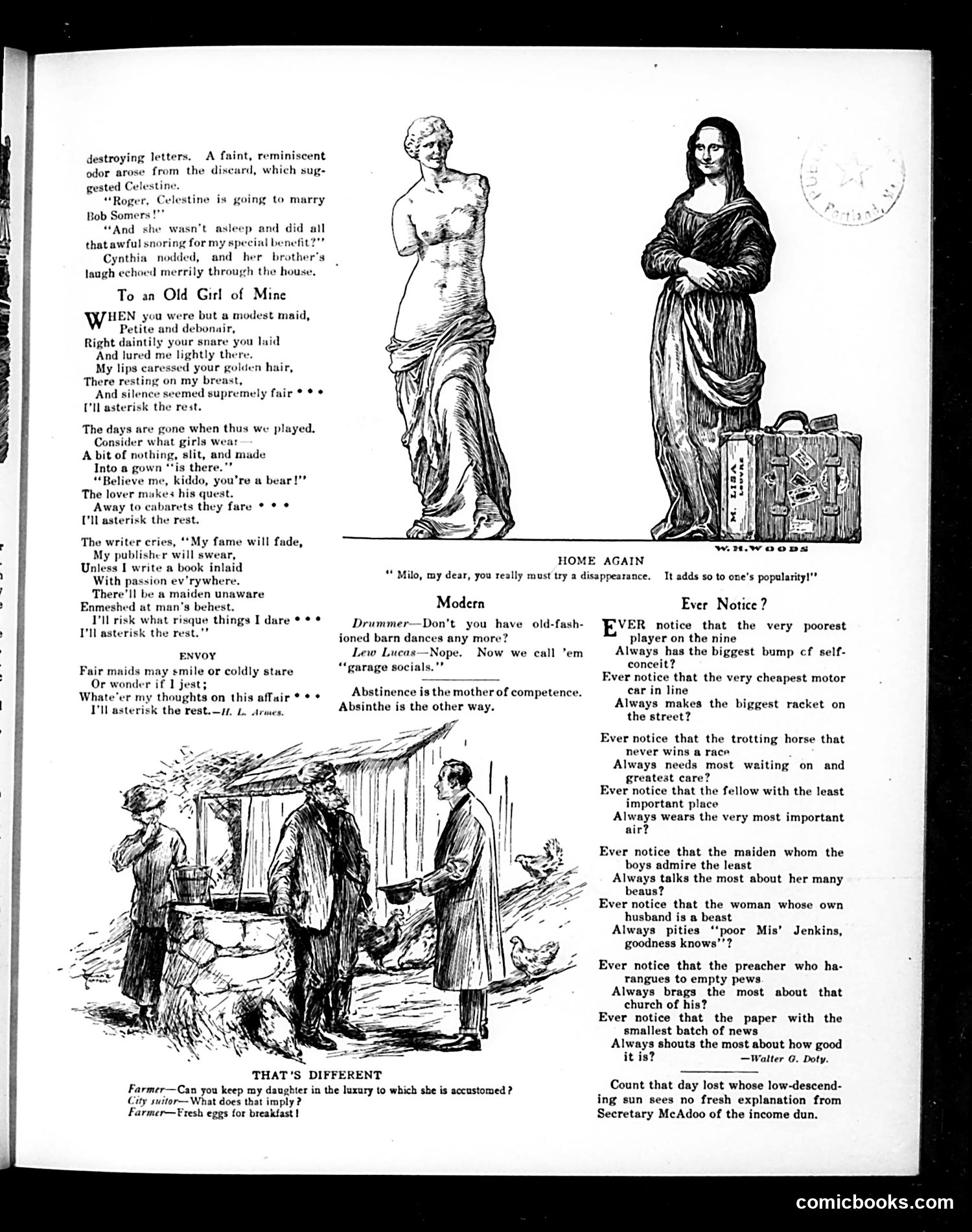
This satirical page from Judge magazine contains several distinct pieces mocking contemporary American society and attitudes: **"To an Old Girl of Mine"** is a nostalgic poem using asterisks to censor "risqué" content, satirizing both sentimental romanticism and Victorian prudishness about sexuality. The joke critiques how writers of the era used euphemism and censorship. **"That's Different"** depicts a farmer rejecting a city suitor's luxury claims by noting that "luxury" to him simply means fresh eggs for breakfast—mocking class differences and urban pretension. **"Ever Notice?"** is a series of ironic observations about human nature: the worst performer has the biggest ego, the cheapest car makes the most noise, the least important person acts most important. These attack hypocrisy and false pride across social classes. The illustrations include classical statuary and a domestic scene, supporting the magazine's satirical tone. The final line cryptically references "Secretary McAdoo of the income dun"—likely Treasury Secretary William McAdoo and income tax complaints, though context is unclear without more historical detail.
📄 Transcribed text from this page (OCR, searchable)
Machine-transcribed from the original scan — historical spelling and the odd misread are preserved.
destroying letters. A faint, reminiscent odor arose from the diseard, which sug- gested C tine. “Roger, Celestine is going to marry Bob Somer: “And she wasn’t asleep and did all that awful snoring for my special benefit?” Cynthia nodded, and her bri laugh echoed merrily through the house, To an Old Girl of Mine HEN you were but a modest maid, Petite and debonair, Right daintily your snare you laid And lured me lightly th My lips caressed your gol There resting on my breast, And silence seemed supremely fair * * * Ul asterisk the rest. The days are gone when thus we played. Consider what girls wear A bit of nothing, slit, and made Into a gown “is there.”” “Believe me, kiddo, you're a bear!’" The lover makes his quest. Away to cabarets they fare * * ¢ (ll asterisk the rest. The writer cries, ‘‘My fame will fade, My publisher will swear, Unless I write a book inlaid With passion ev'rywhere. There'll be a maiden unaware Enmeshed at man’s behest. I'll risk what risque things I dare * * I'll asterisk the rest."” ENVOY Fair maids may smile or coldly stare Or wonder if 1 jest; Whate’er my thoughts on this affair * * * I'll asterisk the rest.—17, THAT'S DIFFERENT HOME AGAIN “ Milo, my dear, you really must try a disappearance. Modern Drummer—Don't you have old-fash- ioned barn dances any more? Lew Lucas— “garage social Abstinence is the mother of competence. Absinthe is the other way. = Farmer—Can you keep my daughter in the luxury to which she is accustomed ? City suitor—What does that imply? Farmer—Fresh eggs for breakfast ! It adds so to one’s popularity!"* Ever Notice ? VER notice that the player on the nine Always has the biggest bump cf self- conceit? Ever notice that the very cheapest motor car in line Always makes the biggest racket on the street? very poorest Ever notice that the trotting horse that never wins a race Always needs most waiting on and greatest care? Ever notice that the fellow with the least important place Always wears the very most important air? Ever notice that the maiden whom the boys admire the least Always talks the most about her many beaus? Ever notice that the woman whose own husband is a beast Always pities ‘‘poor Mis’ Jenkins, goodness knows’’? Ever notice that the preacher who ha- Tangues to empty pews Always brags the most about that church of his? Ever notice that the paper with the smallest batch of news Always shouts the most about how good it is? —Walter G. Doty. Count that day lost whose low-descend- ing sun sees no fresh explanation from Secretary McAdoo of the income dun. comicbooks.com