
Judge, 1914-01-24 · page 11 of 24
Judge — January 24, 1914 — page 11: what you’re looking at
What you’re looking at
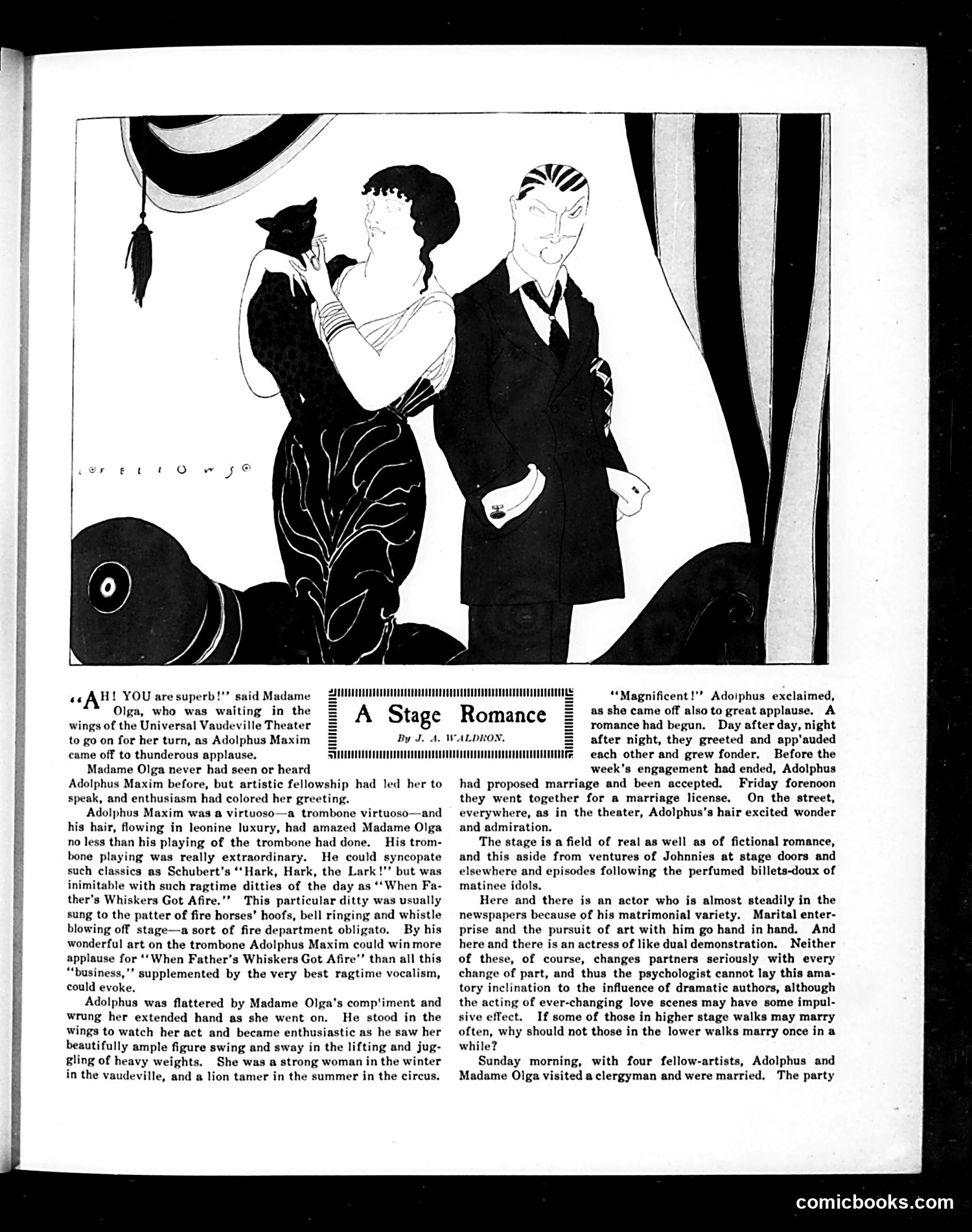
This is a humorous short story illustrated by J.A. Waldron about two vaudeville performers who meet and quickly marry. **The figures:** Adolphus Maxim (a trombone virtuoso with notably flowing hair) and Madame Olga (a strong woman performer who juggles weights and works as a lion tamer seasonally). **The joke/satire:** The story gently mocks theatrical culture and the impulsiveness of stage performers. The satire targets: - The artificiality of theatrical "romance"—mutual admiration between performers based on stage personas rather than genuine connection - Actors' and actresses' documented tendency toward frequent marriages - The absurdity that they marry after only days of knowing each other **Context:** The text questions why lower-tier vaudeville performers shouldn't marry "once in a while" if higher-status stage performers marry repeatedly—sarcastically suggesting even hasty, theatrical marriages are reasonable. The cartoon illustrates their quick courtship before obtaining a marriage license, treating their whirlwind romance as typical theatrical behavior worthy of gentle ridicule.
📄 Transcribed text from this page (OCR, searchable)
Machine-transcribed from the original scan — historical spelling and the odd misread are preserved.
««¢ AH! YOU are superb!’’ said Madame Olga, who was waiting in the wings of the Universal Vaudeville Theater to go on for her turn, as Adolphus Maxim came off to thunderous applause. Madame Olga never had seen or heard Adolphus Maxim before, but artistic fellowship had led her to speak, and enthusiasm had colored her greeting. Adolphus Maxim was a virtuoso—a trombone virtuoso—and his hair, flowing in leonine luxury, had amazed Madame Olga no less than his playing of the trombone had done. His trom- bone playing was really extraordinary. He could syncopate such classics as Schubert's ‘‘Hark, Hark, the Lark!’’ but was inimitable with such ragtime ditties of the day as ‘‘When Fa- ther’s Whiskers Got Afire.’’ This particular ditty was usually sung to the patter of fire horses’ hoofs, bell ringing and whistle blowing off stage—a sort of fire department obligato. By his wonderful art on the trombone Adolphus Maxim could win more applause for ‘When Father’s Whiskers Got Afire’’ than all this “‘business,’’ supplemented by the very best ragtime vocalism, could evoke. Adolphus was flattered by Madame Olga’s comp'iment and wrung her extended hand as she went on. He stood in the wings to watch her act and became enthusiastic as he saw her beautifully ample figure swing and sway in the lifting and jug- gling of heavy weights. She was a strong woman in the winter in the vaudeville, and a lion tamer in the summer in the circus, 2A Stage UTA By J. A. WALDRON, ETM LLC CC “Magnificent!” Adoiphus exclaimed, as she came off also to great applause. A romance had begun. Day after day, night after night, they greeted and app'auded each other and grew fonder. Before the week’s engagement had ended, Adolphus had proposed marriage and been accepted. Friday forenoon they went together for a marriage license. On the street, everywhere, as in the theater, Adolphus’s hair excited wonder and admiration. The stage is a field of real as well as of fictional romance, and this aside from ventures of Johnnies at stage doors and elsewhere and episodes following the perfumed billets-doux of matinee idols, Here and there is an actor who is almost steadily in the newspapers because of his matrimonial variety. Marital enter- prise and the pursuit of art with him go hand in hand. And here and there is an actress of like dual demonstration. Neither of these, of course, changes partners seriously with every change of part, and thus the psychologist cannot lay this ama- tory inclination to the influence of dramatic authors, although the acting of ever-changing love scenes may have some impul- sive effect. If some of those in higher stage walks may marry often, why should not those in the lower walks marry once in a while? Sunday morning, with four fellow-artists, Adolphus and Madame Olga visited a clergyman and were married. The party Romance comicbooks.com