
Judge, 1914-01-24 · page 8 of 24
Judge — January 24, 1914 — page 8: what you’re looking at
What you’re looking at
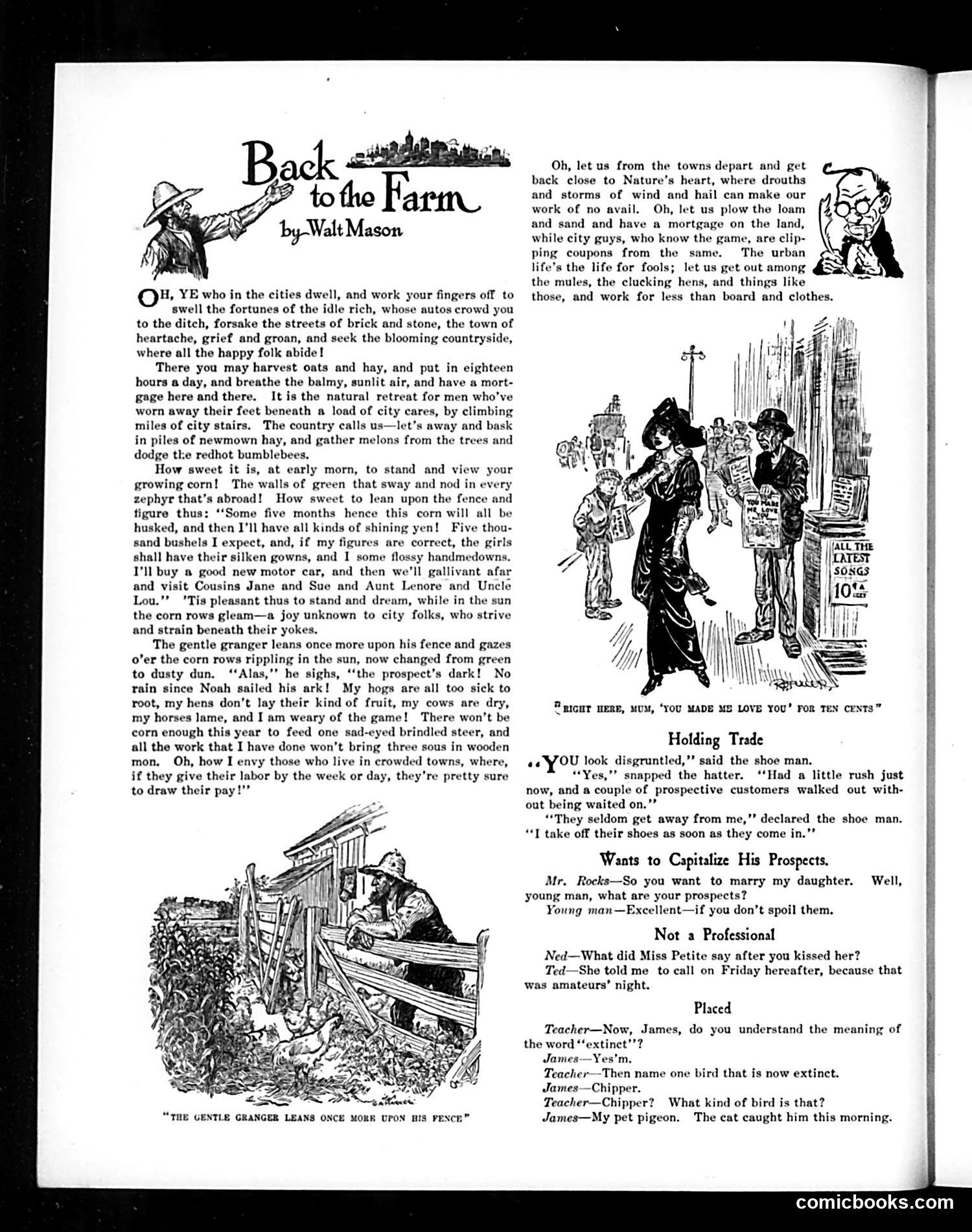
This satirical piece mocks the "back to the farm" movement popular in early 20th-century America. Mason portrays an idealistic farmer fantasizing about rural prosperity—envisioning five thousand bushels of corn, new motorcars, and visits to relatives. The satire's punch arrives when reality strikes: drought, sick livestock, dried-up cows, and lame horses destroy the crops. The farmer then laments that city workers, despite their toil, at least receive guaranteed weekly wages—a sharp reversal of the pro-rural rhetoric that opened the piece. The accompanying joke section ("Holding Trade," "Not a Professional," etc.) offers brief comedic sketches unrelated to the main article. Mason's overall message critiques romantic agrarian fantasies while acknowledging that industrial wage labor, despite its hardships, offered more financial security than farming's unpredictable fortunes during this era.
📄 Transcribed text from this page (OCR, searchable)
Machine-transcribed from the original scan — historical spelling and the odd misread are preserved.
O# YE who in the cities dwell, and work your fingers off to swell the fortunes of the idle rich, whose autos crowd you to the ditch, forsake the streets of brick and stone, the town of heartache, grief and groan, and seek the blooming countryside, where all the happy folk abide! There you may harvest oats and hay, and put in eighteen hours a day, and breathe the balmy, sunlit air, and have a mort- gage here and there. It is the natural retreat for men who've worn away their feet beneath a load of city cares, by climbing miles of city stairs. The country calls us—let’s away and bask in piles of newmown hay, and gather melons from the trees and dodge tke redhot bumblebees. How sweet it is, at early morn, to stand and view your growing corn! The walls of green that sway and nod in every zephyr that’s abroad! How sweet to lean upon the fence and figure thus: ‘‘Some five months hence this corn will all be husked, and then I'll have all kinds of shining yen! Five thou- sand bushels I expect, and, if my figures are correct, the girls shall have their silken gowns, and I some flossy handmedowns. I'll buy a good new motor car, and then we'll gallivant afar and visit Cousins Jane and Sue and Aunt Lenore and Uncle Lou.’’ ’Tis pleasant thus to stand and dream, while in the sun the corn rows gleam—a joy unknown to city folks, who strive and strain beneath their yokes. The gentle granger leans once more upon his fence and gazes o’er the corn rows rippling in the sun, now changed from green to dusty dun. ‘‘Alas,’’ he sighs, ‘‘the prospect’s dark! No rain since Noah sailed his ark! My hogs are all too sick to root, my hens don’t lay their kind of fruit, my cows are dry, my horses lame, and I am weary of the game! There won’t be corn enough this year to feed one sad-eyed brindled steer, and all the work that I have done won’t bring three sous in wooden mon. Oh, how I envy those who live in crowded towns, where, if they give their labor by the week or day, they’re pretty sure to draw their pay!’’ “THE GENTLE GRANGER LEANS ONCE MORE UPON HIS FENCE” Oh, let us from the towns depart and get back close to Nature’s heart, where drouths and storms of wind and hail can make our work of no avail. Oh, let us plow the loam and sand and have a mortgage on the land, while city guys, who know the game, are clip- ping coupons from the same. The urban life’s the life for fools; let us get out among the mules, the clucking hens, and things like those, and work for less than board and clothes. Peichr HERE, MUM, ‘YOU MADE ME LOVE YOU’ FOR TEN CENTS” Holding Trade «you look disgruntled,’’ said the shoe man. “Yes,"? snapped the hatter. ‘Had a little rush just now, and a couple of prospective customers walked out with- out being waited on.”” “They seldom get away from me,” declared the shoe man. “I take off their shoes as soon as they come in.”” Wants to Capitalize His Prospects. Mr. Rocks—So you want to marry my daughter. young man, what are your prospects? Young man—Excellent—if you don’t spoil them. Well, Not a Professional Ned—What did Miss Petite say after you kissed her? Ted—She told me to call on Friday hereafter, because that was amateurs’ night. Placed Teacher—Now, James, do you understand the meaning of the word ‘‘extinct’’? James ‘es’m, Teacher—Then name one bird that is now extinct. James—Chipper. Teacher—Chipper? James—My pet pigeon. What kind of bird is that? The cat caught him this morning. comicbooks.com