
Judge, 1914-01-24 · page 4 of 24
Judge — January 24, 1914 — page 4: what you’re looking at
What you’re looking at
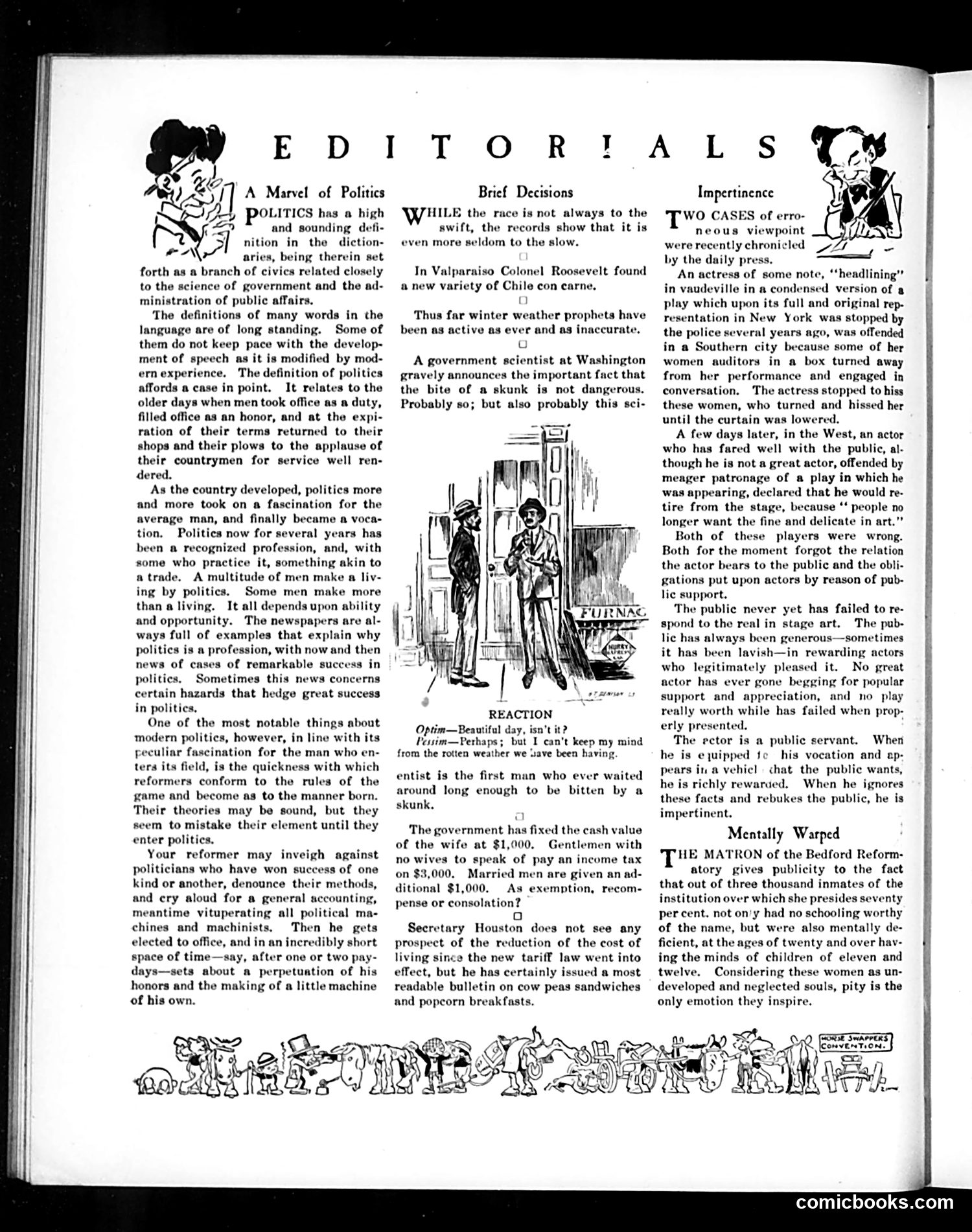
This is a satirical editorial page from *Judge* magazine addressing American politics and social commentary. The left column critiques how politics has become a profession pursued for personal gain rather than public service, noting that politicians now conform to "rules of the game" rather than serving constituents honestly. The "Brief Decisions" section mocks several targets: Colonel Roosevelt's Chilean experiences, weather forecasting accuracy, and government scientists debating whether skunk bites are dangerous. The "Impertinence" section satirizes theatrical censorship—an actress was stopped from performing in New York due to morality concerns, though similar performances proceeded elsewhere. The piece defends actors as public servants deserving support. "Mentally Warped" criticizes a reformatory's poor conditions, arguing institutional neglect harms children's development.
📄 Transcribed text from this page (OCR, searchable)
Machine-transcribed from the original scan — historical spelling and the odd misread are preserved.
E D A Marvel of Politics OLITICS has a high and sounding defi nition in the diction- aries, being therein set forth as a branch of civics related closely to the science of government and the ad- ministration of public affairs, The definitions of many words in the language are of long standing. Some of them do not keep pace with the develop- ment of speech as it is modified by mod- ern experience. The definition of politics affords a case in point. It relates to the older days when men took office as a duty, filled office as an honor, and at the expi- ration of their terms returned to their shops and their plows to the applause of their countrymen for service well ren- dered. As the country developed, politics more and more took on a fascination for the average man, and finally became a voca- tion. Politics now for several years has been a recognized profession, and, with some who practice it, something akin to atrade. A multitude of men make a liv- ing by politics. Some men make more than a living. It all depends upon ability and opportunity. The newspapers are al- ways full of examples that explain why politics is a profession, with now and then news of cases of remarkable success in politics, Sometimes this news concerns certain hazards that hedge great success in politics, One of the most notable things about modern politics, however, in line with its peculiar fascination for the man who en- ters its field, is the quickness with which reformers conform to the rules of the game and become as to the manner born. Their theories may be sound, but they seem to mistake their element until they enter polit Your reformer may inveigh against politicians who have won success of one kind or another, denounce their methods, and cry aloud for a general accounting, meantime vituperating all political ma- chines and machinists, Then he gets elected to office, and in an incredibly short space of time—say, after one or two pay- days—sets about a perpetuation of his honors and the making of a little machine of his own. T O R ! Brief Decisions HILE the race is not always to the swift, the records show that it is even more seldom to the slow. In Valparaiso Colonel Roosevelt found a new variety of Chile con carne, ( Thus far winter weather prophets have been as active as ever and as inaccurate. a A government scientist at Washington gravely announces the important fact that the bite of a skunk is not dangerous. Probably so; but also probably this sci- REACTION Optim—Beautiful day, isn’t it? Pessim—Pethaps; but I can't keep my mind from the rotten weather we uave been having. entist is the first man who ever waited around long enough to be bitten by a skunk, The government has fixed the cash value of the wife at $1,000. Gentlemen with no wives to speak of pay an income tax on $3,000. Married men are given an ad- ditional $1,000, As exemption, recom- pense or consolation? Oo Secretary Houston does not see any prospect of the reduction of the cost of living since the new tariff law went into effect, but he has certainly issued a most readable bulletin on cow peas sandwiches and popcorn breakfasts. A L §S Impertinence Two CASES of erro- neous viewpoint were recently chronicled )77/ by the daily press. An actress of some no’ in vaudeville in a conde 8 play which upon its full and original rep- resentation in New York was stopped by the police several years ago, Was offended in a Southern city because some of her women auditors in a box turned away from her performance and engaged in conversation. The actress stopped to hiss these women, who turned and hissed her until the curtain was lowered. A few days later, in the West, an actor who has fared well with the public, al- though he is not a great actor, offended by meager patronage of a play in which he was appearing, declared that he would re- tire from the stage, because “ people no longer want the fine and delicate in art.” Both of these players were wrong. Both for the moment forgot the relation the actor bears to the public and the obli- gations put upon actors by reason of pub- lic support. The public never yet has failed to re- spond to the real in stage art. The pub- lic has always been generous—sometimes it has been lavish—in rewarding actors who legitimately pleased it. No great actor has ever gone begging for popular support and appreciation, and no play really worth while has failed when prop- erly presented. The rctor is a public servant. Wher he is equipped fe his vocation and ap- pears ina vehicl chat the public wants, he is richly rewarued. When he ignores these facts and rebukes the public, he is impertinent. Mentally Warped HE MATRON of the Bedford Reform- atory gives publicity to the fact that out of three thousand inmates institution over which she presides seventy per cent. not on'y had no schooling worthy of the name, but were also mentally de- ficient, at the ages of twenty and over hav- ing the minds of children of eleven and twelve. Considering these women as un- developed and neglected souls, pity is the only emotion they inspire. NES) comicbooks.com