
A complete issue · 24 pages · 1913
Judge — April 19, 1913
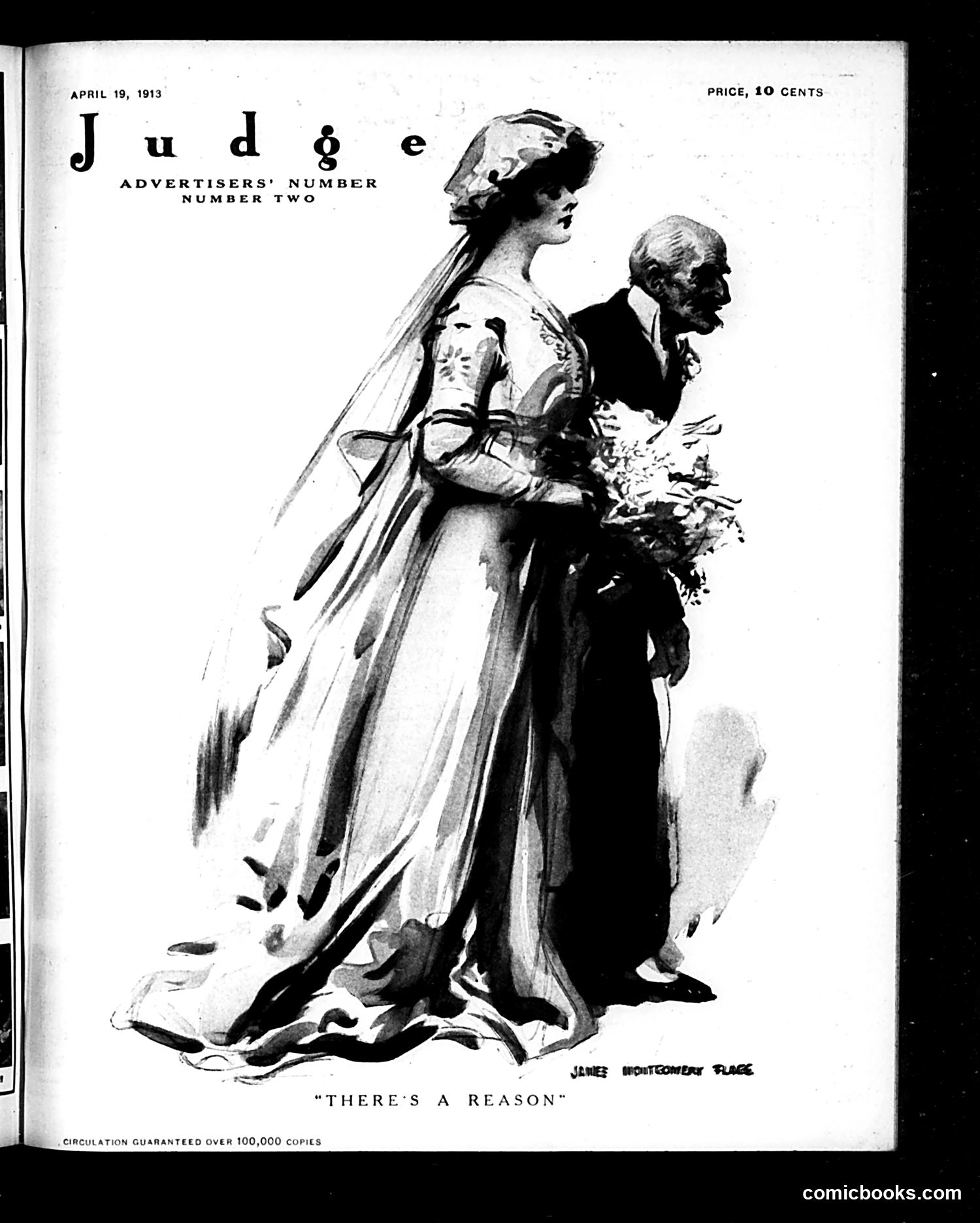
This April 19, 1913 Judge cover illustrates "There's a Reason"—likely referencing the contentious topic of marriage or divorce during this era. The artwork by James Montgomery Flagg depicts a bride in elaborate wedding dress and veil alongside an older gentleman, suggesting a commentary on marriages of convenience or significant age-gap unions—a satirical subject Judge frequently addressed. The caption's ambiguity ("There's a Reason") invites readers to consider what motivates such pairings: wealth, social status, or desperation. The bride's elaborate trousseau contrasts with the groom's modest appearance, emphasizing the transactional nature Judge critiques. This reflects Progressive Era anxieties about women's economic dependence and marriage as a financial rather than romantic institution. The specific figures remain unidentified.
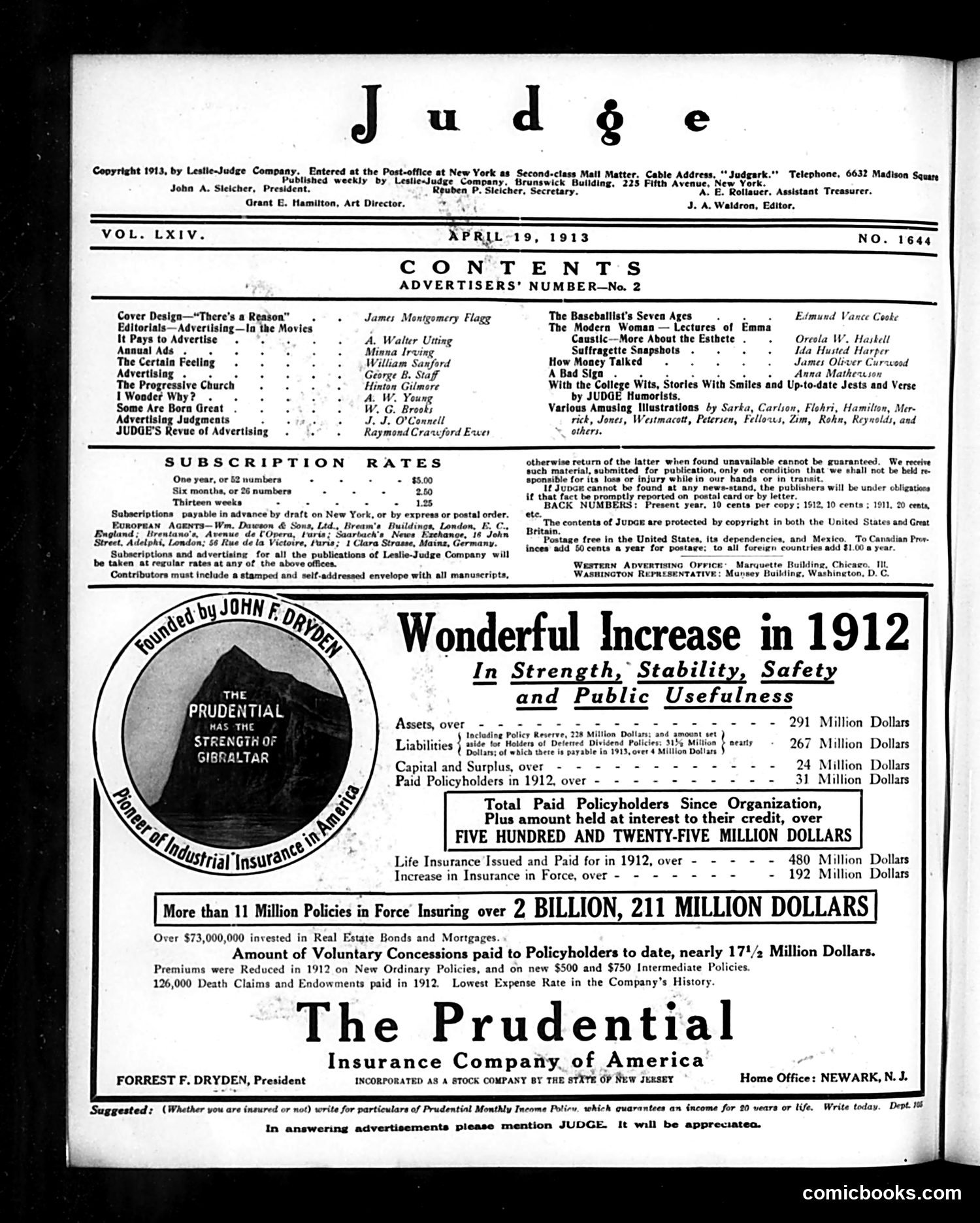
This page is primarily **advertising**, not editorial content or political satire. The dominant feature is a large advertisement for **The Prudential Insurance Company of America**, highlighting their 1912 financial growth—assets of 291 million dollars, over 11 million policies in force, and 2.2 billion dollars in coverage. The circular logo shows the Rock of Gibraltar, Prudential's iconic trademark symbolizing strength and stability. The ad emphasizes the company's expansion in "Strength, Stability, Safety and Public Usefulness," listing specific financial metrics to reassure potential customers of their security. The page's table of contents indicates the issue contains political and social commentary elsewhere, but this particular page functions as a corporate advertisement rather than satire.
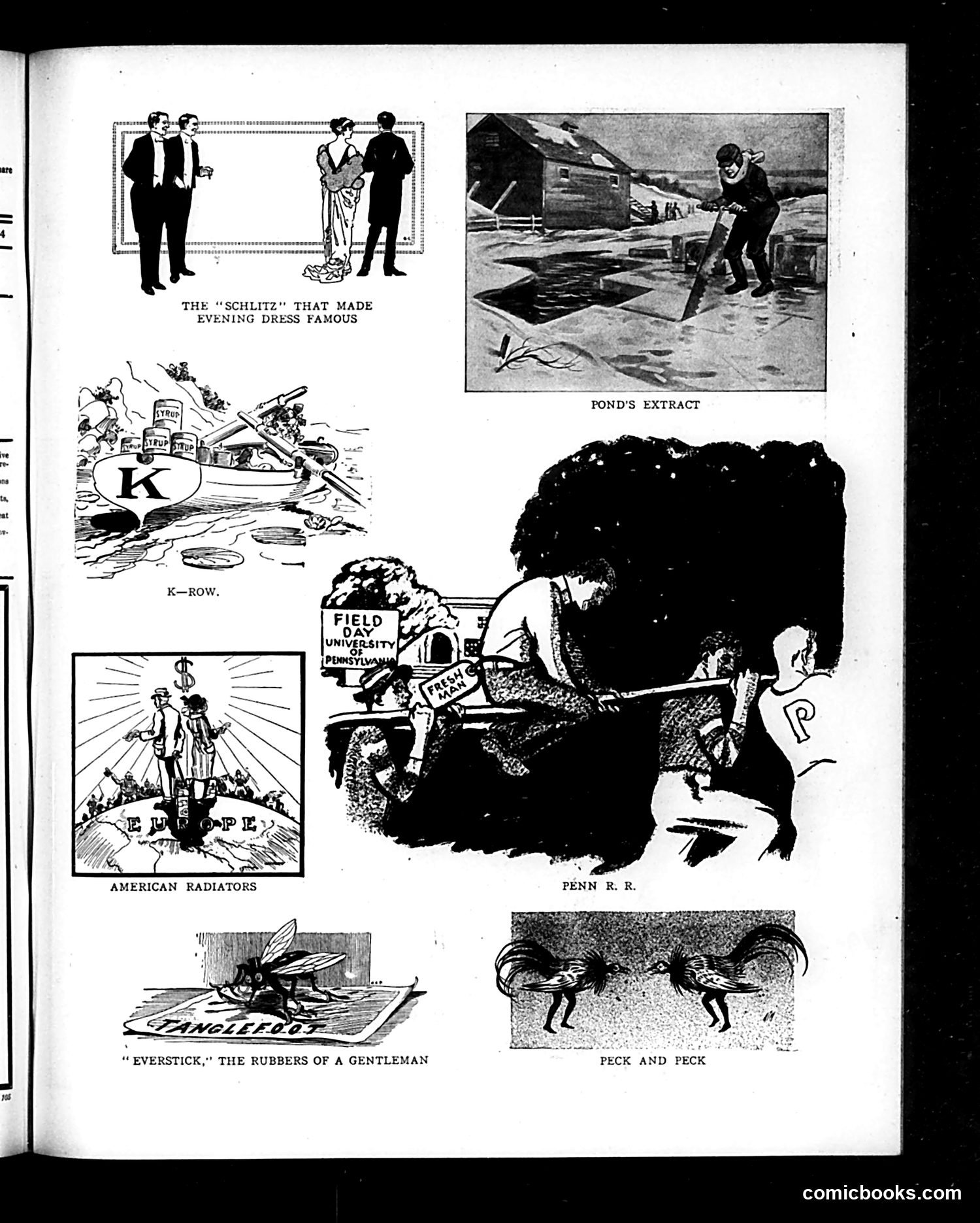
This page collects several early 20th-century satirical cartoons and advertisements: **"The Schlitz That Made Evening Dress Famous"** - A liquor advertisement using humor about formal wear. **"K-Row"** - An illustrated logo/advertisement, likely for a product or establishment. **"American Radiators"** - A commercial illustration showing wealth radiating outward, advertising heating/cooling products. **"Penn R.R."** - A cartoon satirizing Pennsylvania Railroad, depicting it as monstrous or exploitative (the grotesque creature imagery suggests corporate villainy). **"Everstick, The Rubbers of a Gentleman"** - Advertisement for rubber products (likely galoshes). **"Pond's Extract"** and **"Peck and Peck"** - Product advertisements. The page mixes commercial ads with mild social satire typical of Judge magazine's format—blending marketing with humorous commentary on contemporary institutions and consumer culture.
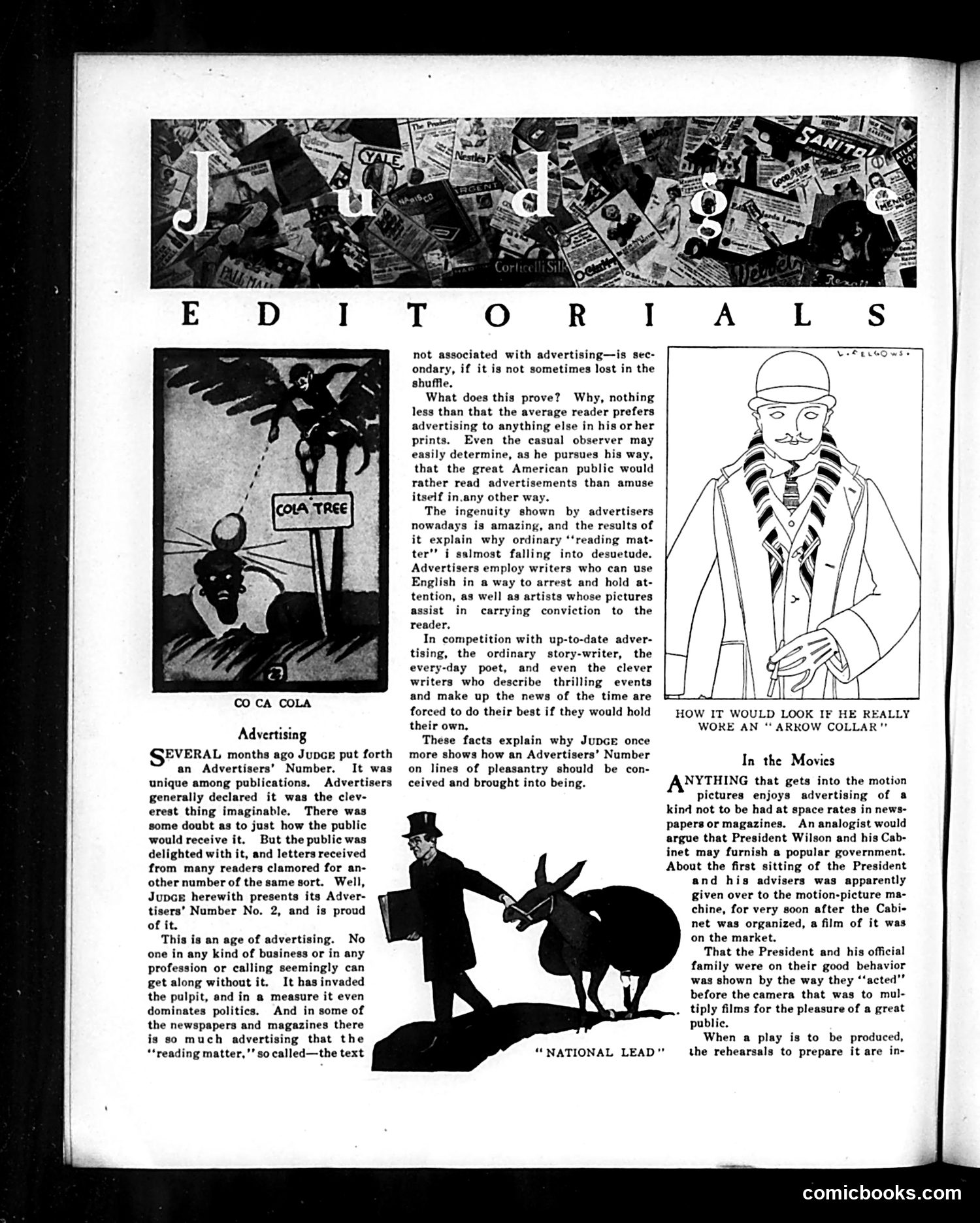
This editorials page discusses advertising's dominance in American media. The "Coca-Cola" cartoon (left) uses a giant insect at a tree labeled "COLA TREE" to satirize how advertising has become inescapable in publications. The "National Lead" illustration (center) shows a man being kicked by a donkey, likely mocking political leadership—possibly referencing President Wilson's administration, given the text's mention of Wilson and his Cabinet appearing in motion pictures. The satire suggests political leaders are as stubborn or problematic as the donkey. The right illustration humorously depicts how an "Arrow Collar" would look absurdly oversized on a man's neck, poking fun at advertisement exaggeration. Overall, the page critiques how thoroughly advertising permeates American media and culture.
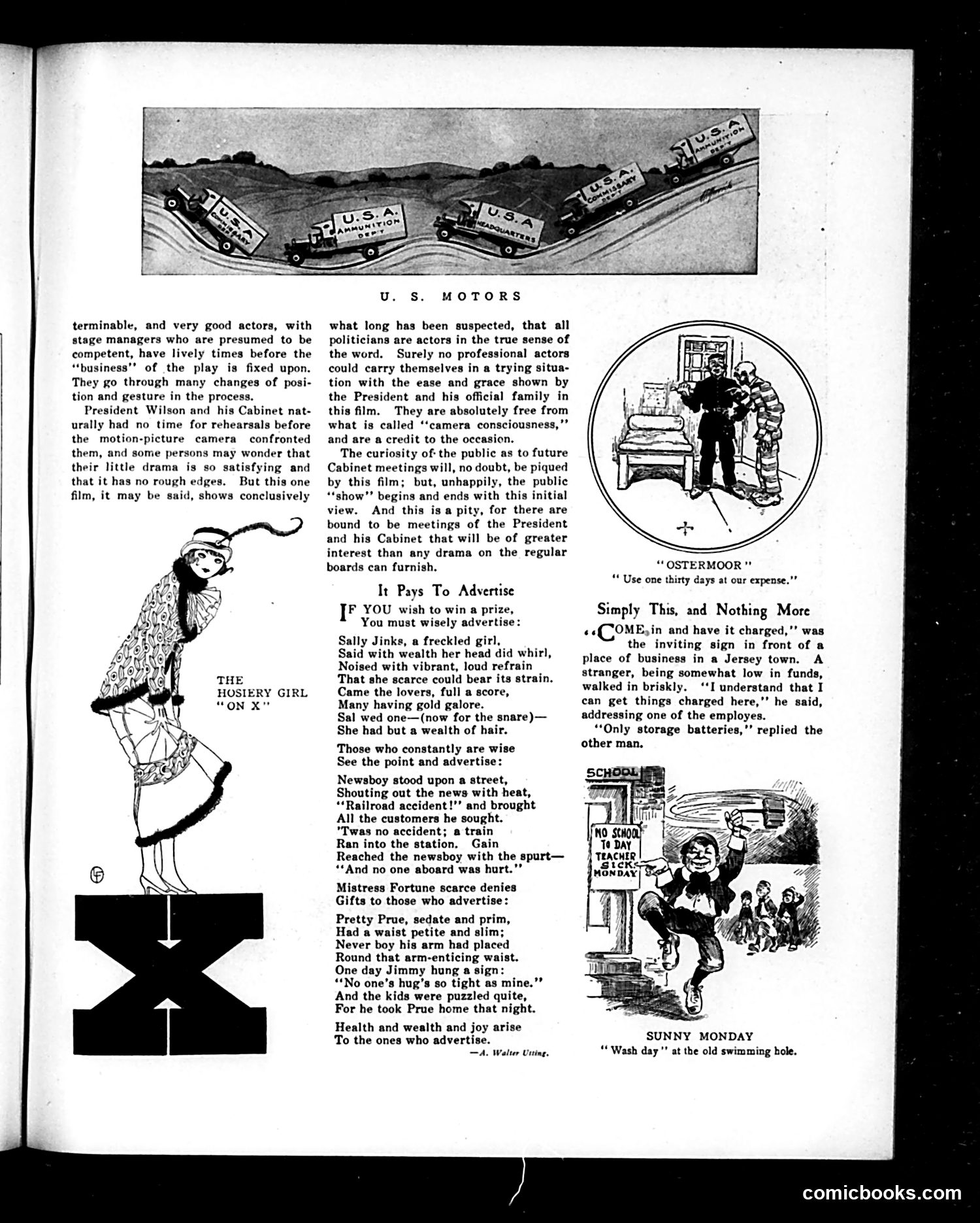
This page combines advertising and entertainment content typical of Judge magazine. The top features a U.S. Motors advertisement showing delivery trucks. **"The Hosiery Girl 'On X'"** is a cartoon about advertising effectiveness, illustrated with a stylized female figure. The accompanying poem "It Pays To Advertise" uses humorous examples (Sally Lunn, Pretty Frue) to satirize how strategic advertising creates business success and romantic fortune. The lower illustrations—"Ostermoor" (a bedding ad), "Sunny Monday" (laundry-related)—appear to be product advertisements with comedic scenarios. The overall page satirizes American consumer culture and advertising's persuasive power during the early 20th century, suggesting that shrewd marketing—not actual product quality—drives commercial success and personal advancement.
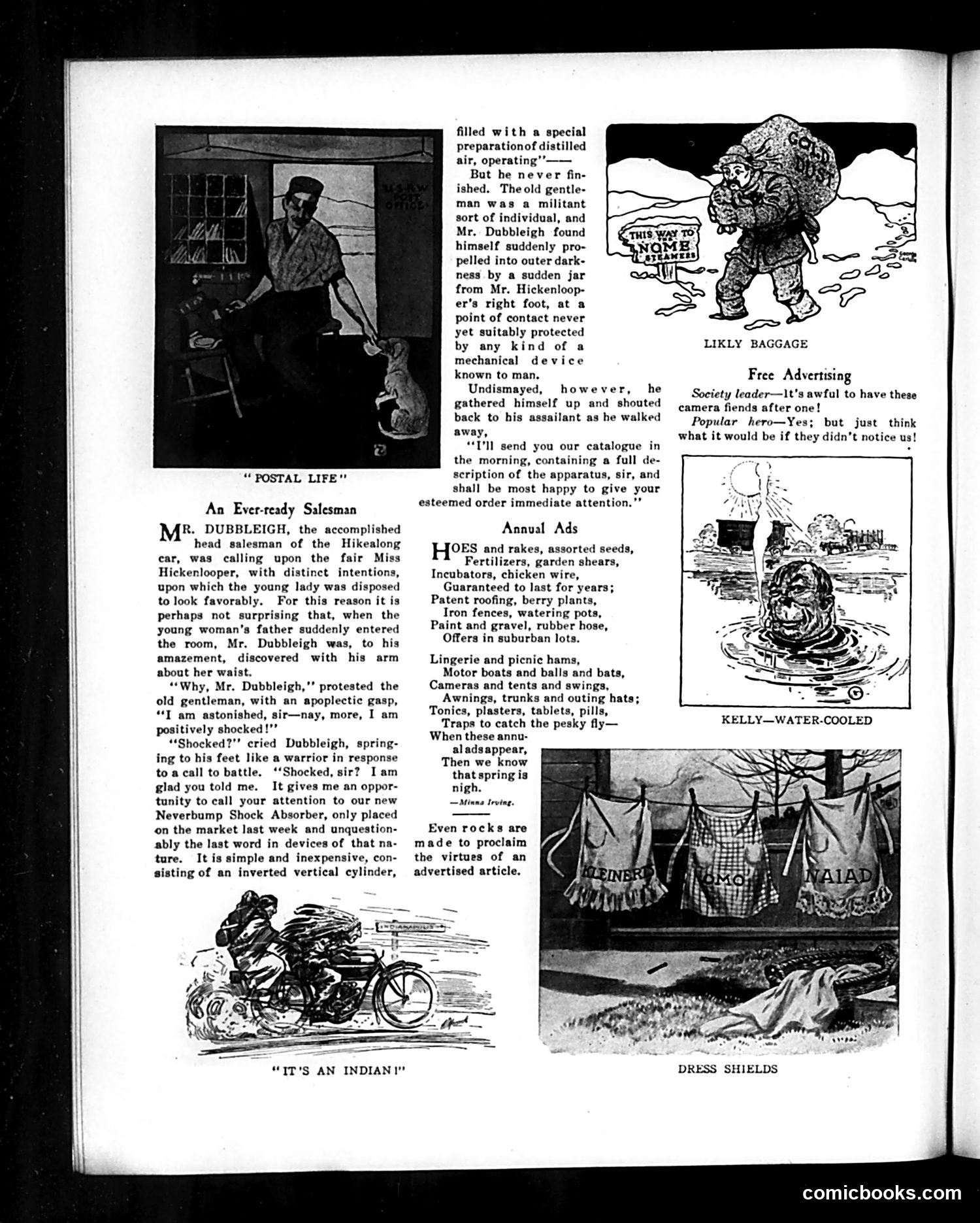
This page from Judge contains satirical humor typical of early 20th-century American magazines. **"An Ever-ready Salesman"** ridicules aggressive salesmen of the era. Mr. Dubbleigh, caught embracing Miss Hickenlooper by her father, responds to being kicked out by immediately pivoting to selling the man a "Neverbump Shock Absorber"—a fictional car part. The joke satirizes salesmen so relentlessly driven by commission that they exploit *any* situation, even violence against themselves, as a sales opportunity. **"Annual Ads"** and the accompanying cartoon snippets mock spring advertising saturation, suggesting advertisers promote everything from garden tools to patent medicines. The line "even rocks are made to proclaim the virtues of an advertised article" suggests advertisement has become absurdly omnipresent. **"Free Advertising"** dialogue jokes about celebrity culture: socialites complain about paparazzi ("camera fiends"), but popular heroes acknowledge that being photographed is itself valuable publicity—they'd be hurt if ignored. The page is primarily humorous commentary on commercialism, aggressive marketing, and emerging mass media culture.
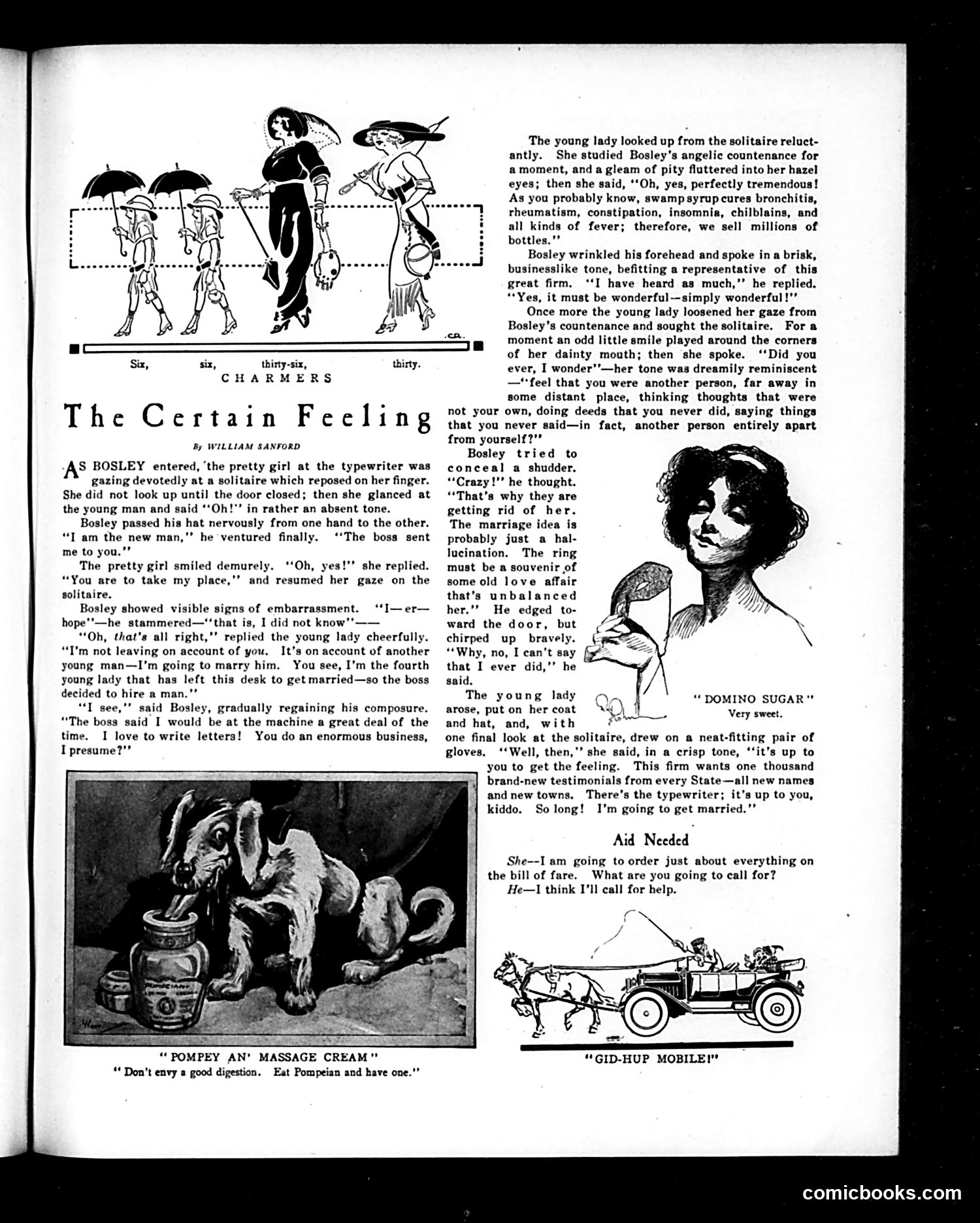
This satirical story mocks early 1900s office culture and advertising. Bosley, a new male hire, replaces a departing female secretary who's leaving to marry. The joke hinges on the woman's apparent mental instability: she stares obsessively at her solitaire engagement ring and makes bizarre philosophical statements ("feel that you were another person..."), suggesting she's emotionally unbalanced. The satire targets two things: (1) the casual sexism of replacing women workers with men as they married, and (2) the absurd patent-medicine industry. The woman reveals the "firm" actually sells worthless swamp syrup as a cure-all, yet somehow generates millions in sales through fake testimonials—a scam Bosley must now perpetuate. The page's advertisements ("Pompey Massage Cream," "Domino Sugar") are themselves parodies of the patent-medicine era's dubious marketing claims that Judge regularly lampooned.
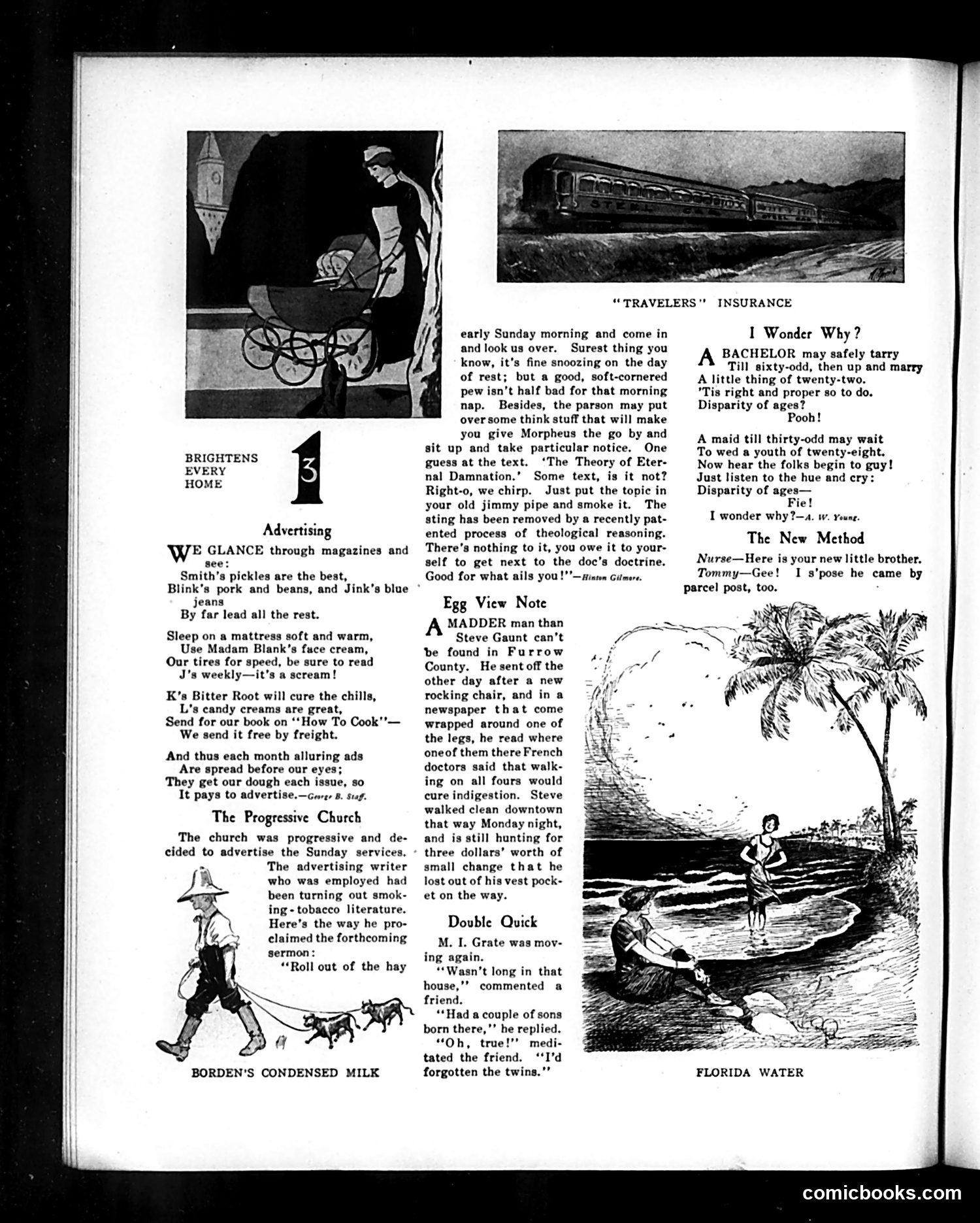
This page contains **satirical commentary on advertising and social hypocrisy**, presented through several short pieces: **"Advertising" & "The Progressive Church"**: The main satire mocks how advertising infiltrates every medium. A church hires a tobacco-advertising copywriter to promote services, resulting in absurdly inappropriate language ("Roll out of the hay," "put the topic in your old jimmy pipe"). The joke: institutions adopting crass commercial tactics while claiming moral authority. **"I Wonder Why?"**: This piece highlights **gender double standards** in marriage age gaps. An older man marrying a young woman is "proper"; an older woman marrying a younger man provokes scandal ("Fie!"). The satire exposes society's arbitrary sexual morality. **Smaller anecdotes** ("Egg View Note," "Double Quick") are humorous sketches about rural life and moving houses. The **advertisements and illustrations** are period-typical products (Borden's milk, various goods), reflecting early 20th-century magazine culture. The page exemplifies *Judge*'s satirical approach to American commercialism and social conventions.
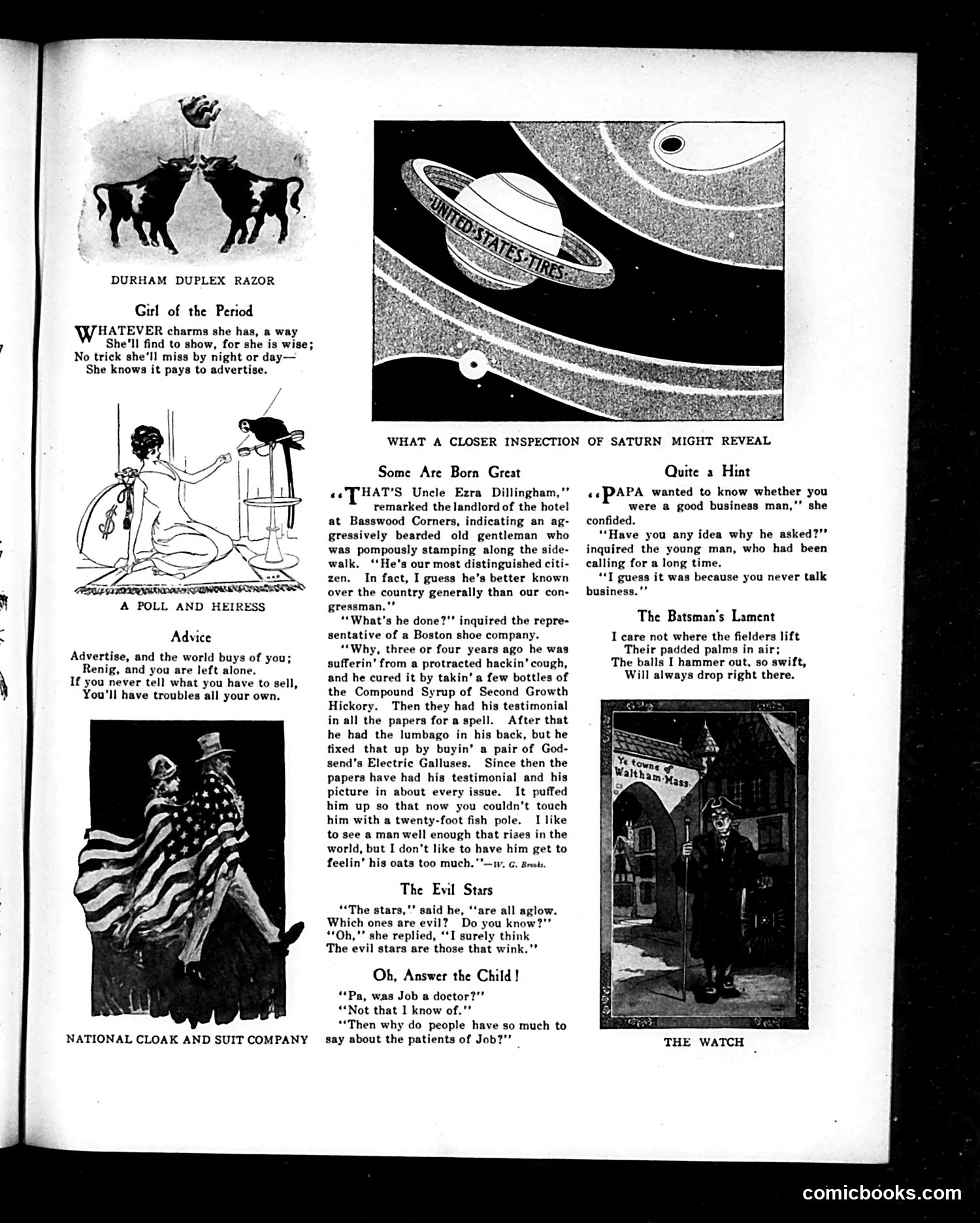
This page is primarily **advertising** for consumer products (Durham Duplex Razor, National Cloak and Suit Company) interspersed with brief humorous sketches and aphorisms. The satirical content targets **consumer culture and advertising itself**. The "Girl of the Period" poem mocks modern women for their shrewd understanding that self-promotion through advertising is essential—a critique of both consumerism and changing gender roles. The "Advice" section ironically endorses aggressive advertising as necessary for success. The longer sketch "Some Are Born Great" satirizes **small-town celebrity and testimonial culture**. Uncle Ezra Dillingham becomes nationally famous not through actual achievement, but by endorsing patent medicines and electric devices in newspaper testimonials. The satire suggests how trivial accomplishments, when heavily advertised, can inflate a person's reputation absurdly. The remaining brief jokes are wordplay pieces with no apparent political content—puns about "evil stars," Job's "patients" (biblical reference), and cricket terminology.
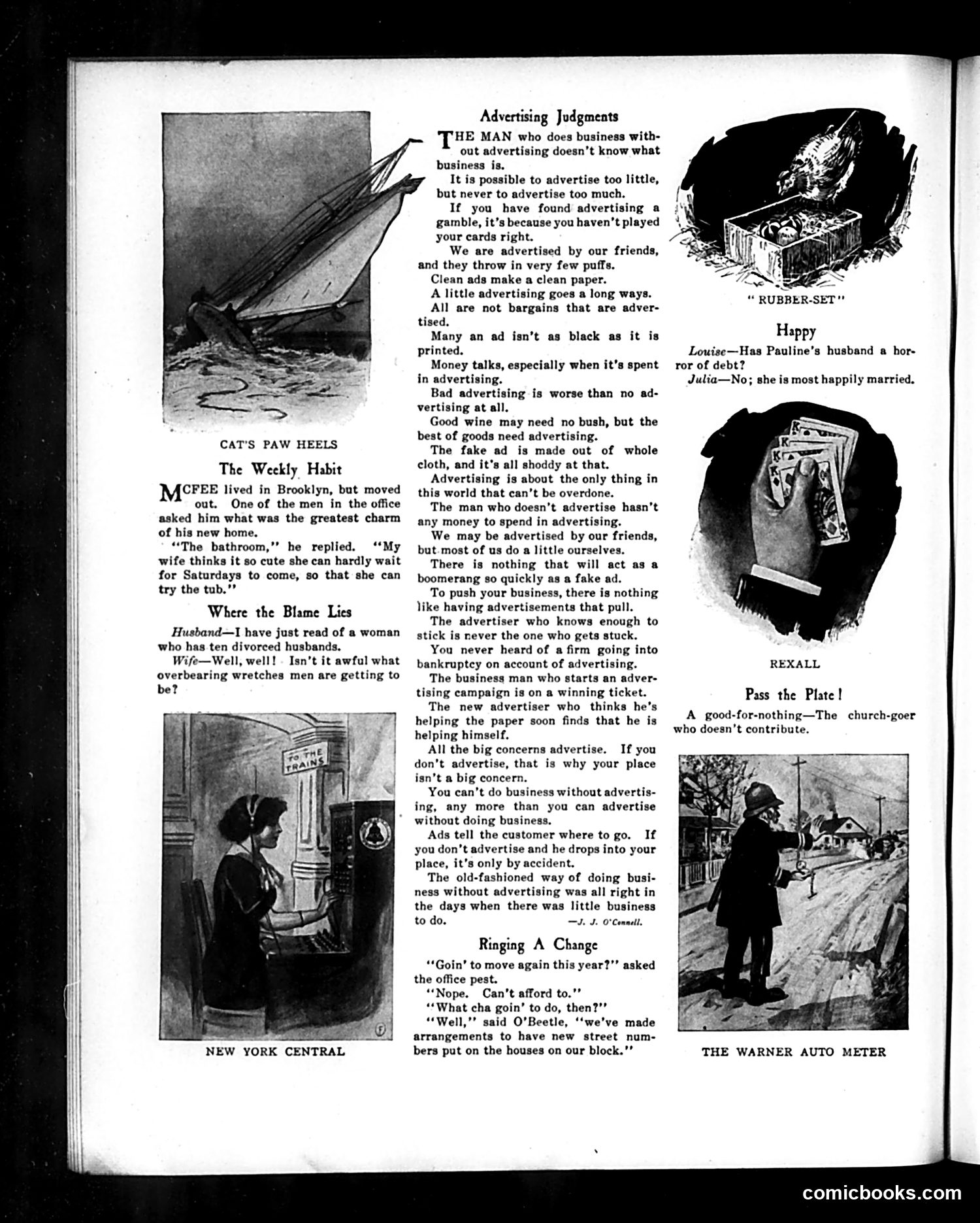
This page contains **short humor pieces and advertisements** typical of early 20th-century satirical magazines. The **main content** is a lengthy essay on "Advertising Judgments" by J.J. O'Connell—a series of aphorisms praising aggressive advertising as essential to business success. It reflects the era's emerging advertising industry asserting its cultural importance. The **cartoons and jokes** are brief social observations: "The Weekly Habit" mocks wives' obsession with new bathtubs (satirizing consumer materialism); "Where the Blame Lies" presents a husband-blaming wife's hypocrisy; "Ringing A Change" jokes about a man renumbering his house to avoid moving costs; and "Pass the Plate!" critiques non-contributing churchgoers. The **images** show period product placements (Rubber-Set, Rexall, Warner Auto Meter) integrated with editorial content—standard practice blending advertising and editorial matter. The overall tone reflects genteel, middle-class anxieties about modern consumption, gender roles, and business ethics.
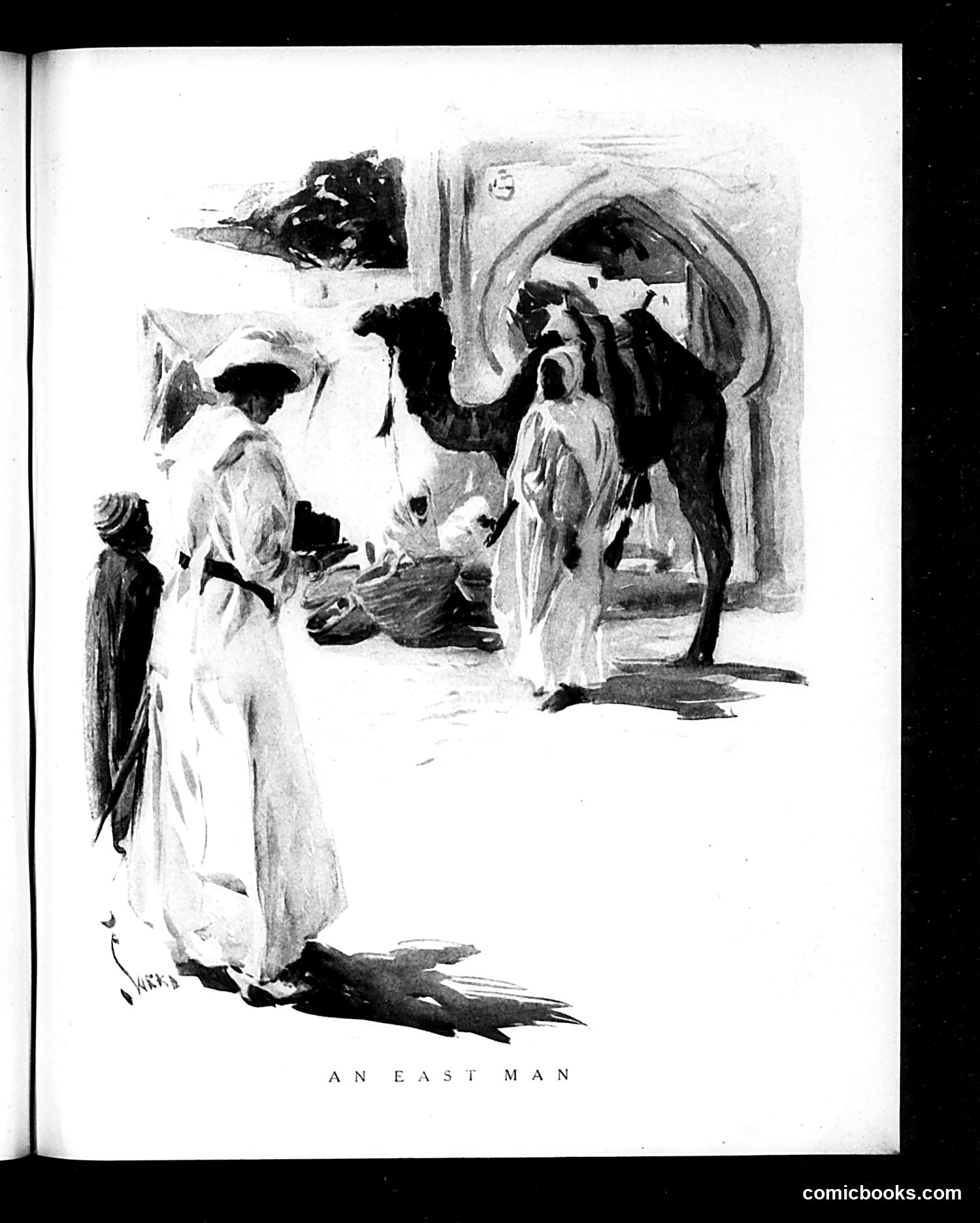
This cartoon depicts what appears to be a medieval or biblical scene set in a fortified gateway or tower. The title "An East Man" is ambiguous—possibly a pun or reference unclear without additional context. The scene shows robed figures in dramatic confrontation or interaction at an arched doorway. The style and clothing suggest either historical satire or religious commentary. One figure appears bearded and authoritative, while others display varying reactions—some seemingly submissive or deferential. Without clearer historical context or publication date, the specific political or social satire remains uncertain. The medieval/Eastern setting and formal robes suggest commentary on either foreign affairs, religious authority, or historical events, but identifying the precise figures or referenced incident requires additional information beyond what's visible here.
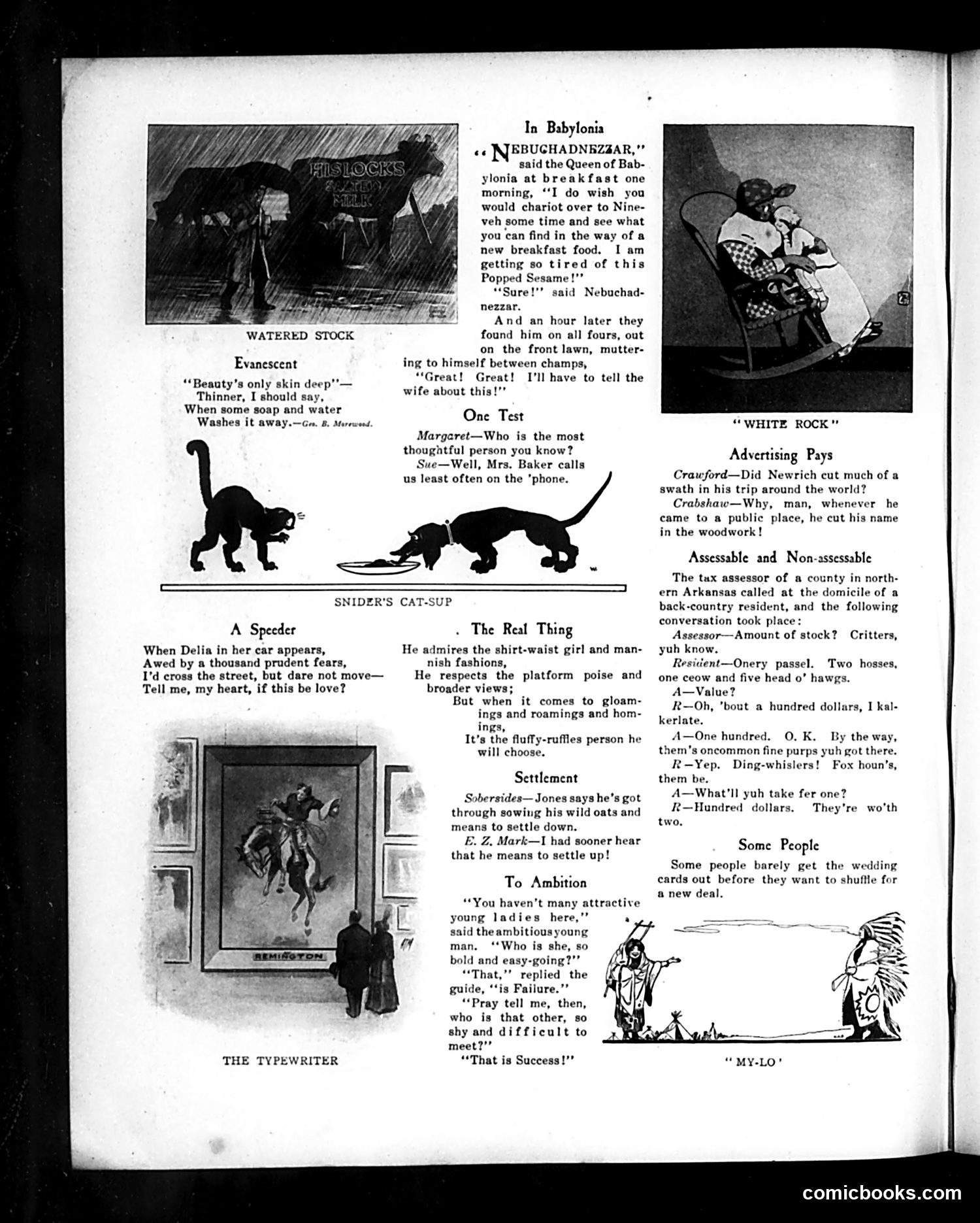
This page contains several humorous short pieces typical of early 20th-century satirical magazines: **"Watered Stock"** mocks false advertising and artificial beauty—soap washes away superficial charm, suggesting deceptive marketing practices. **"In Babylonia"** is a silly joke: King Nebuchadnezzar discovers a new breakfast cereal and crawls around on all fours eating it eagerly, unable to contain his enthusiasm. It's absurdist humor poking fun at breakfast food advertising crazes. **Other brief jokes** target common social behaviors: a woman's reluctance to use the telephone (considered inconsiderate), men's preference for "fluffy" traditionally feminine women over modern "mannish" fashions, and a reformed man who settles debts rather than "wild oats." **"Assessable and Non-assessable"** uses rural dialect humor in a tax assessor conversation, mocking backwoods speech and values. The page reflects period concerns: consumer advertising, changing gender roles, class differences, and rural-urban cultural gaps. The humor relies on wordplay, exaggeration, and social stereotypes common to Judge magazine's audience.
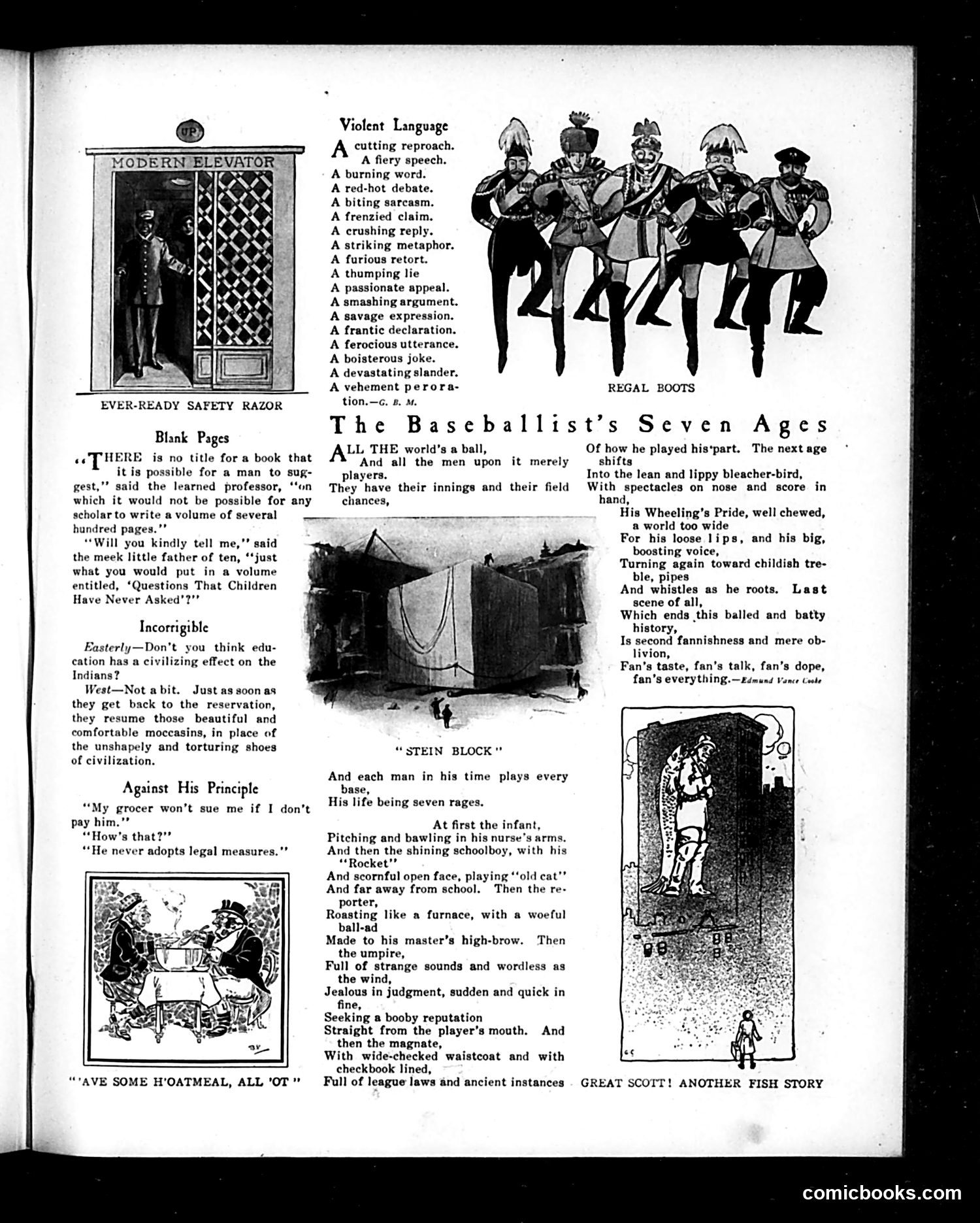
This page mixes brief humorous items with satirical commentary on early 20th-century American life. The **"Violent Language"** section is a straightforward wordplay list—playing on phrases containing aggressive terms ("cutting reproach," "burning word," "crushing reply"). The **baseball parody** rewrites Shakespeare's "Seven Ages of Man" through baseball terminology. It traces a fan's life from infant to old age, ending in senile fandom ("second fannishness and mere oblivion"). The satire targets baseball obsession as a defining life experience for American men, and mocks aging fans who persist in arguing about games. The **brief jokes** satirize social attitudes: one mocks Native Americans for abandoning "civilized" shoes, reflecting period prejudices about assimilation; another jokes about a grocer who won't use legal measures, playing on ethnic stereotypes about informal debt practices. The **advertisements** (razor, boots) are contemporary commercial content typical of the magazine's revenue model. The "Blank Pages" and "Against His Principle" sections are mild satirical anecdotes about academic pretension and commercial behavior.
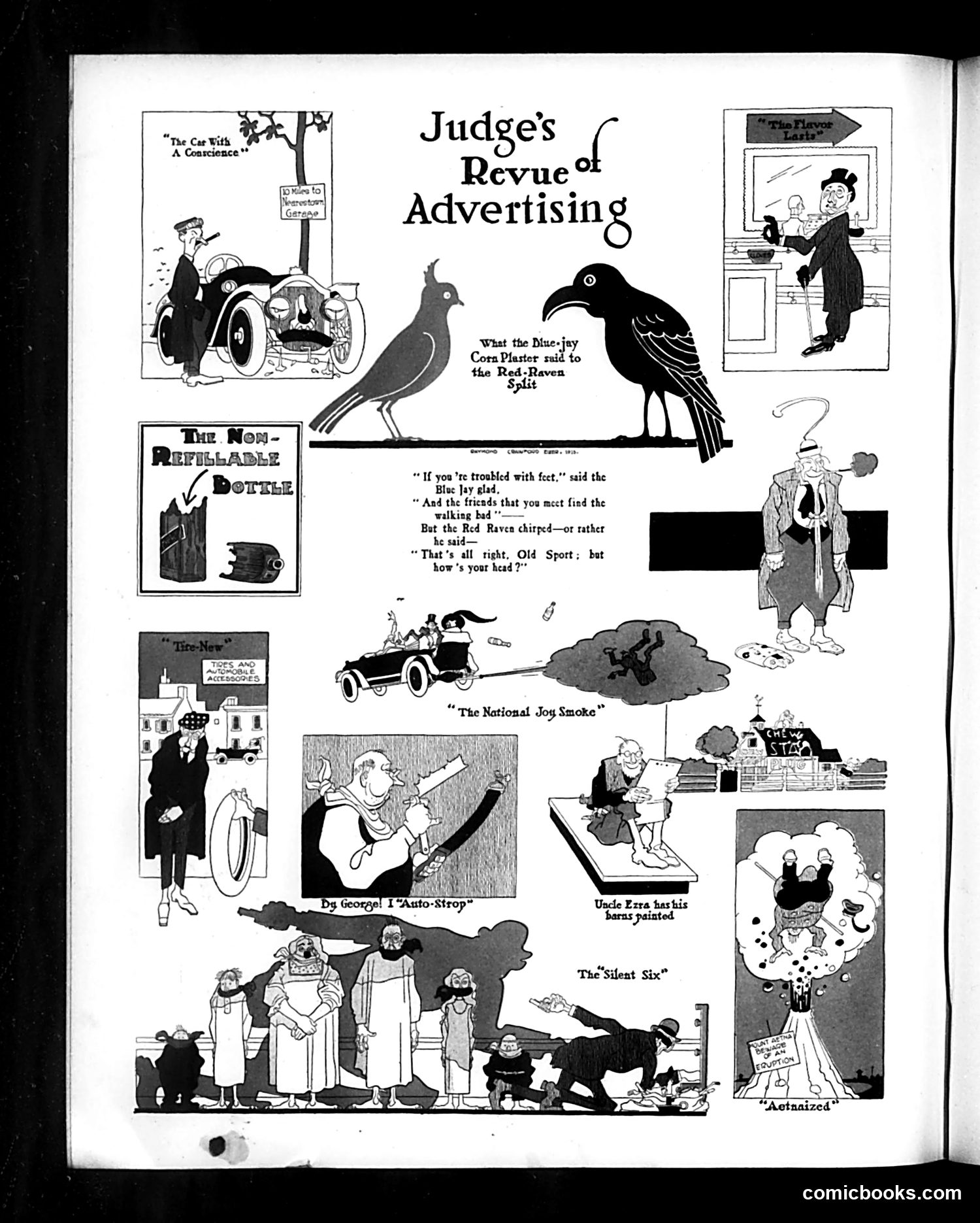
This page satirizes advertising through anthropomorphized animals and products engaged in witty banter. The central conceit has animals (Blue Jay, Red Raven, Dine-jay Corn Plaster) making humorous product pitches to each other—a parody of competing advertisements. The surrounding vignettes mock various advertised products and services: "The Non-Refillable Bottle," automobiles, tire accessories, and films like "The National Joy Smoke," "Uncle Ezra his barn painted," and "The Silent Six." The satire targets the absurdity of advertising claims and the competitive nature of marketing. By having products literally "speak" to each other with exaggerated sales pitches, Judge ridicules how advertisers promise dubious health and lifestyle benefits. The animals' dialogue about feet troubles and headaches exemplifies the era's patent-medicine advertising culture, where products claimed to cure vague ailments.
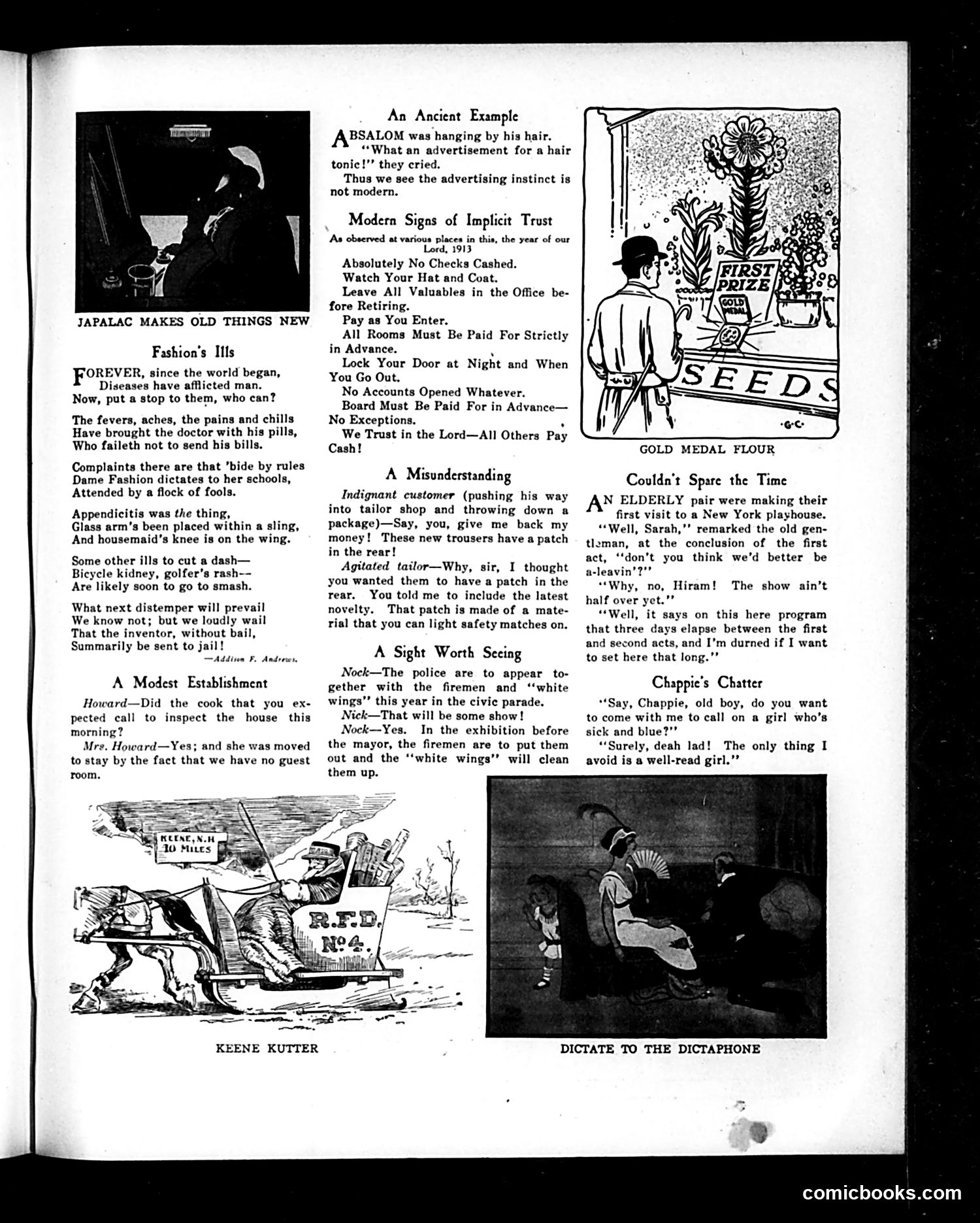
This 1913 *Judge* page offers social satire through multiple pieces: **"Fashion's Ills"** mocks how society adopts trendy diseases—appendicitis, "glass arm," housemaid's knee—following fashion rather than medical reality. The poem satirizes frivolous upper-class concerns. **"Modern Signs of Implicit Trust"** ironically catalogs business signs reflecting widespread distrust: "No Checks Cashed," "Pay as You Enter," "We Trust in the Lord—All Others Pay Cash!" This critiques the era's cynicism about financial honesty and suggests growing commercialism. **The "Elderly Pair" anecdote** ridicules rural/unsophisticated theatergoers who misunderstand theatrical convention, believing three days actually elapse between acts and refusing to wait. The advertisements (Gold Medal Flour, seeds) represent typical magazine revenue. Illustrations include "Keene Kutter" (appears to be a product mascot) and a dictaphone scene. Overall, the page targets middle-class pretension, urban suspicion, and rural ignorance—standard *Judge* fodder for educated, urban readers.
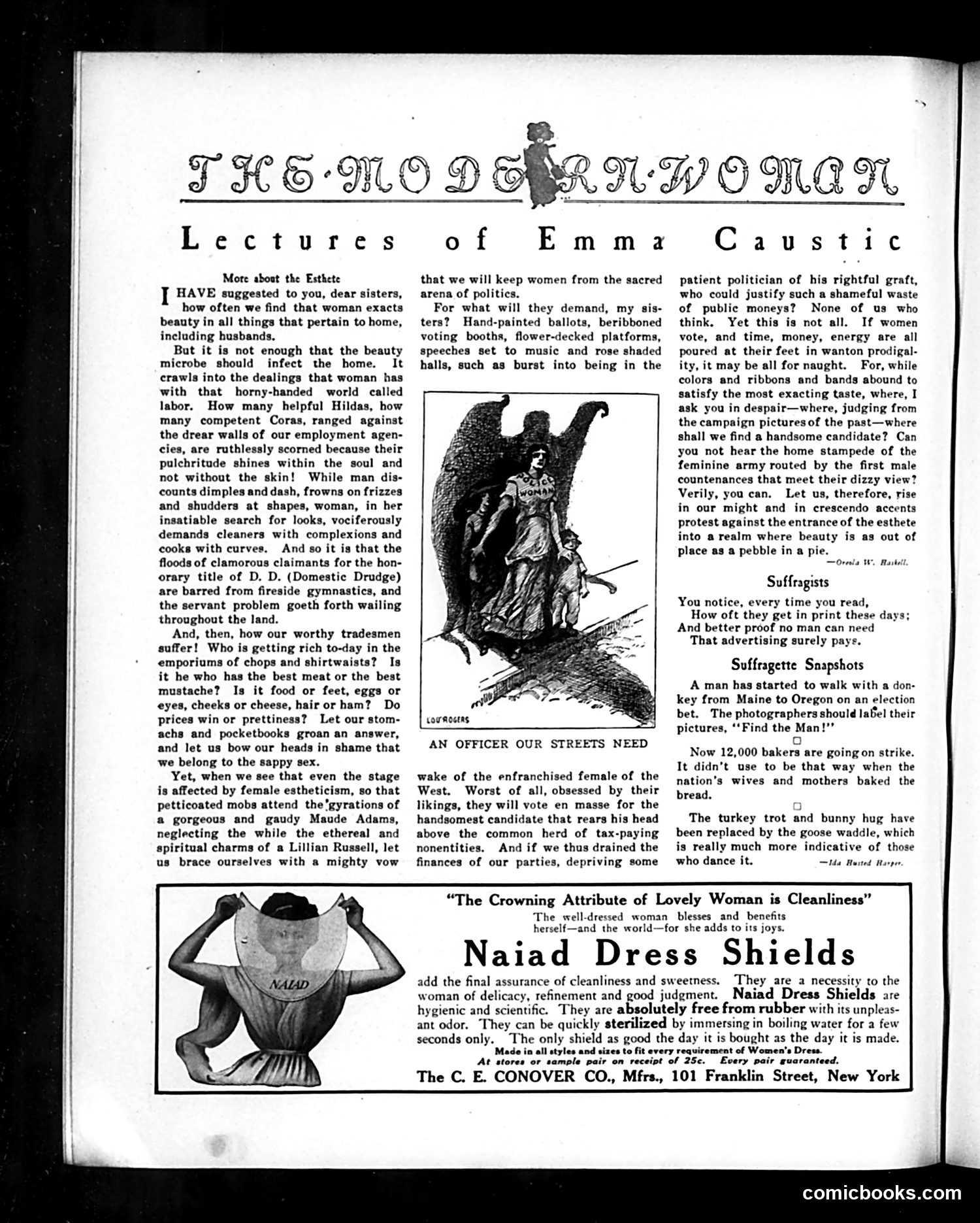
This page contains Emma Caustic's satirical lecture opposing women's suffrage by mocking female aesthetic preferences. The argument: women care excessively about beauty and appearance, so if granted voting rights, they'll vote based on candidates' looks rather than merit—wasting public funds on frivolous campaign aesthetics and potentially electing handsome nonentities. The cartoon depicts an angelic or ethereal female figure, likely representing idealized womanhood, reinforcing Caustic's ironic tone. Below are brief "Suffragette Snapshots"—mocking suffrage advocates through anecdotes: a man walking with a donkey (implying women voters are foolish), bakers' strikes (implying women once solved problems through domestic work), and dance crazes (suggesting women are frivolous). The page also advertises Naiad Dress Shields, a feminine hygiene product. **Context**: This represents anti-suffrage rhetoric from the early 1900s, using gendered stereotypes to argue women shouldn't vote.
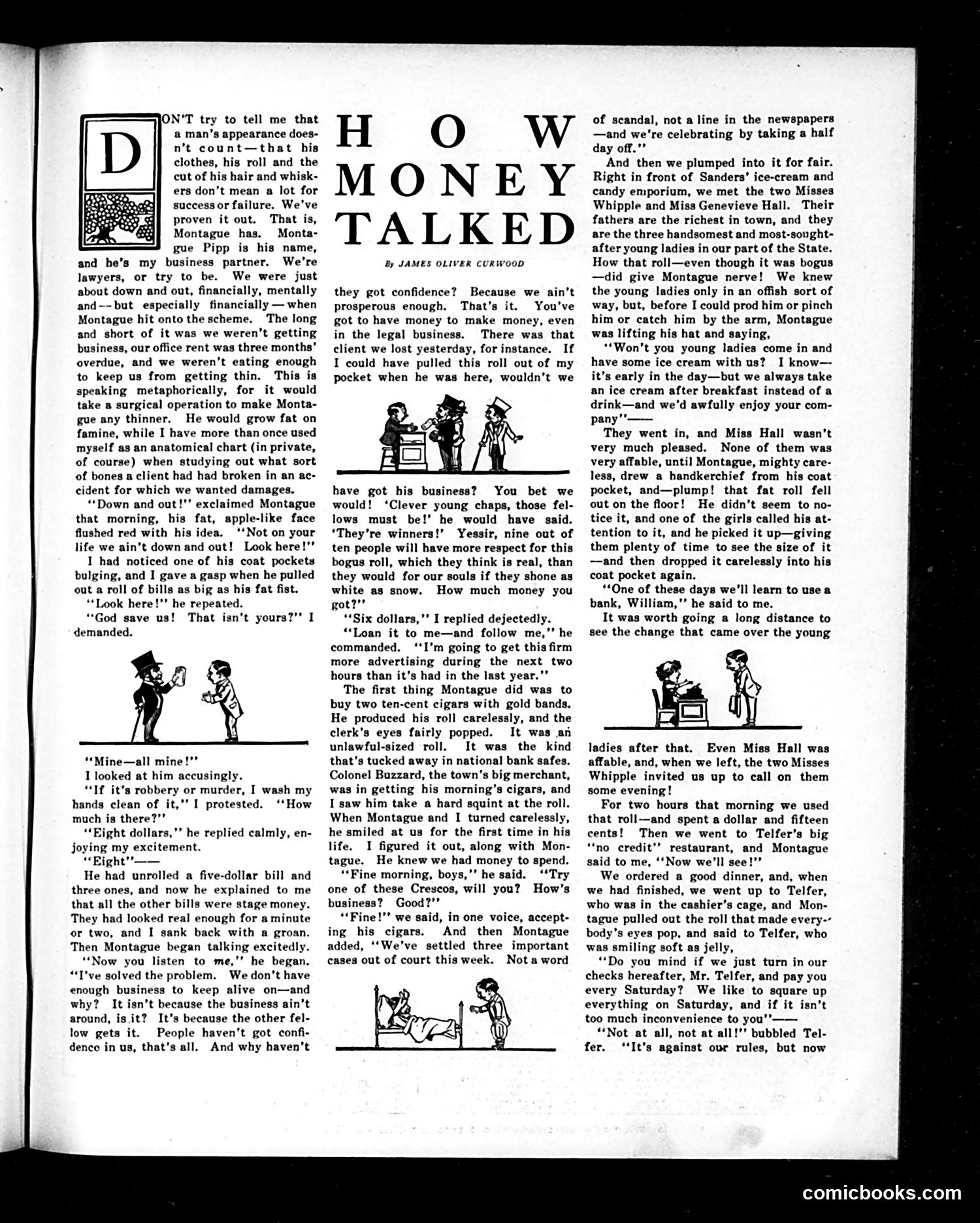
This story by James Oliver Curwood satirizes early 20th-century American materialism and shallow social judgment. Two struggling lawyers, Montague Pipp (fat, confident) and his unnamed partner (thin, cynical), are broke and losing clients. Montague devises a scheme: he creates a fake "roll" of money using stage bills to *appear* prosperous, reasoning that people judge success by visible wealth rather than actual merit. The satire targets how appearances trump substance in business and social life. By merely *displaying* money (most of it fake), the lawyers suddenly gain respect from merchants and potential clients who assume prosperity equals competence. The story mocks both the lawyers' deception and society's gullibility—the idea that confidence in appearance matters more than genuine talent or integrity. It's a commentary on American consumer culture and the performative nature of success in the era.
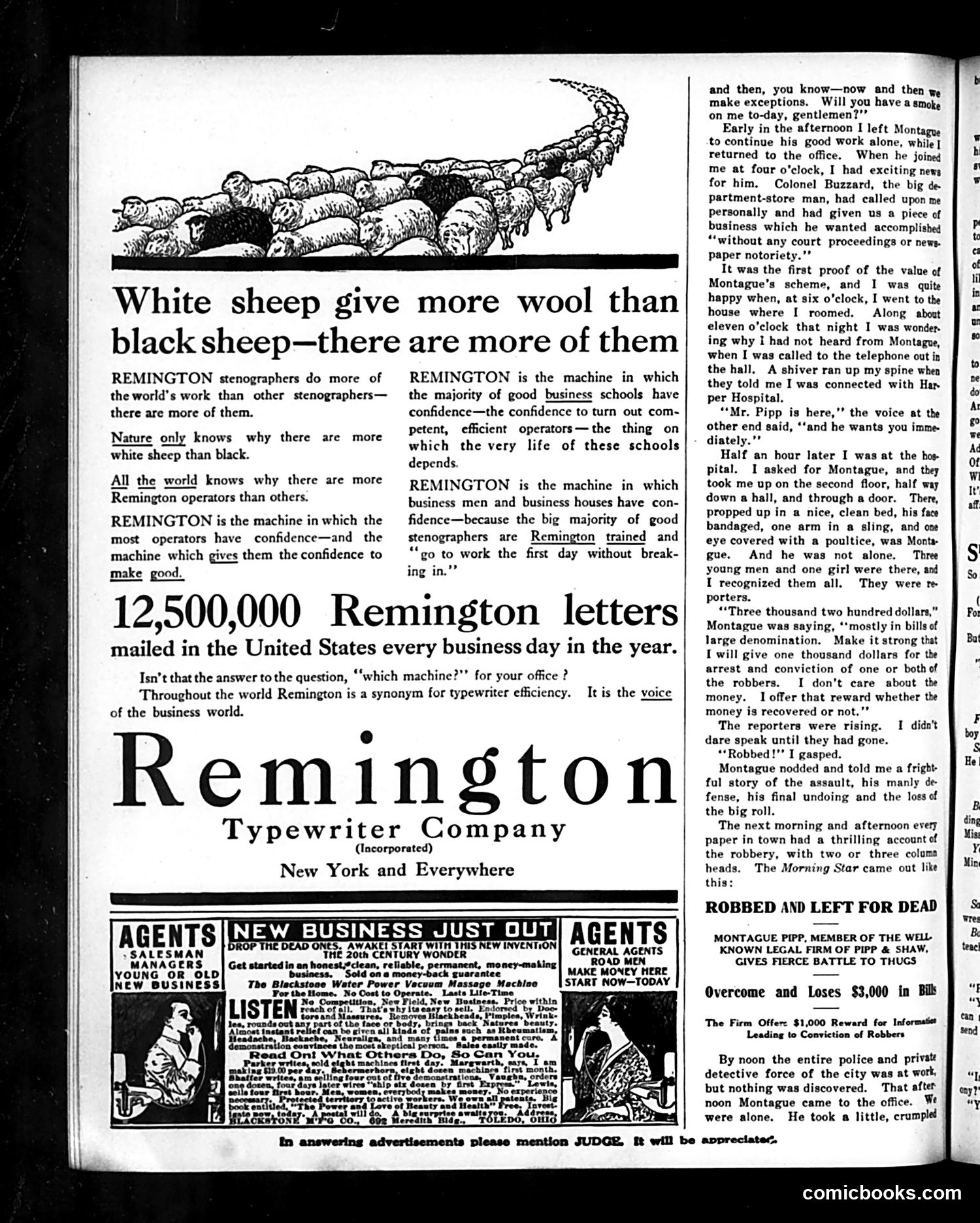
This page is **primarily advertising**, dominated by a major Remington Typewriter Company advertisement using pseudo-logic comparing typewriter market dominance to sheep wool production ("white sheep give more wool than black sheep—there are more of them"). The ad's point: Remington's ubiquity proves its superiority; 12.5 million letters daily validate its "efficiency." The right column contains what appears to be **serialized fiction** (likely a short story), featuring characters named Montague and Pipp. The narrative involves a business scheme, a robbery at Harper Hospital, and newspaper reporters. A headline reads "ROBBED AND LEFT FOR DEAD" with details about "Montague Pipp, member of the well-known legal firm of Pipp & Sharp" losing $3,200 in an assault. Below are classified ads recruiting agents/salesmen for various business opportunities and inventions (vacuum massage machine, etc.)—typical early-20th-century "get rich quick" pitches. The page reflects Judge's mix of advertising revenue with entertainment content, characteristic of period magazines.
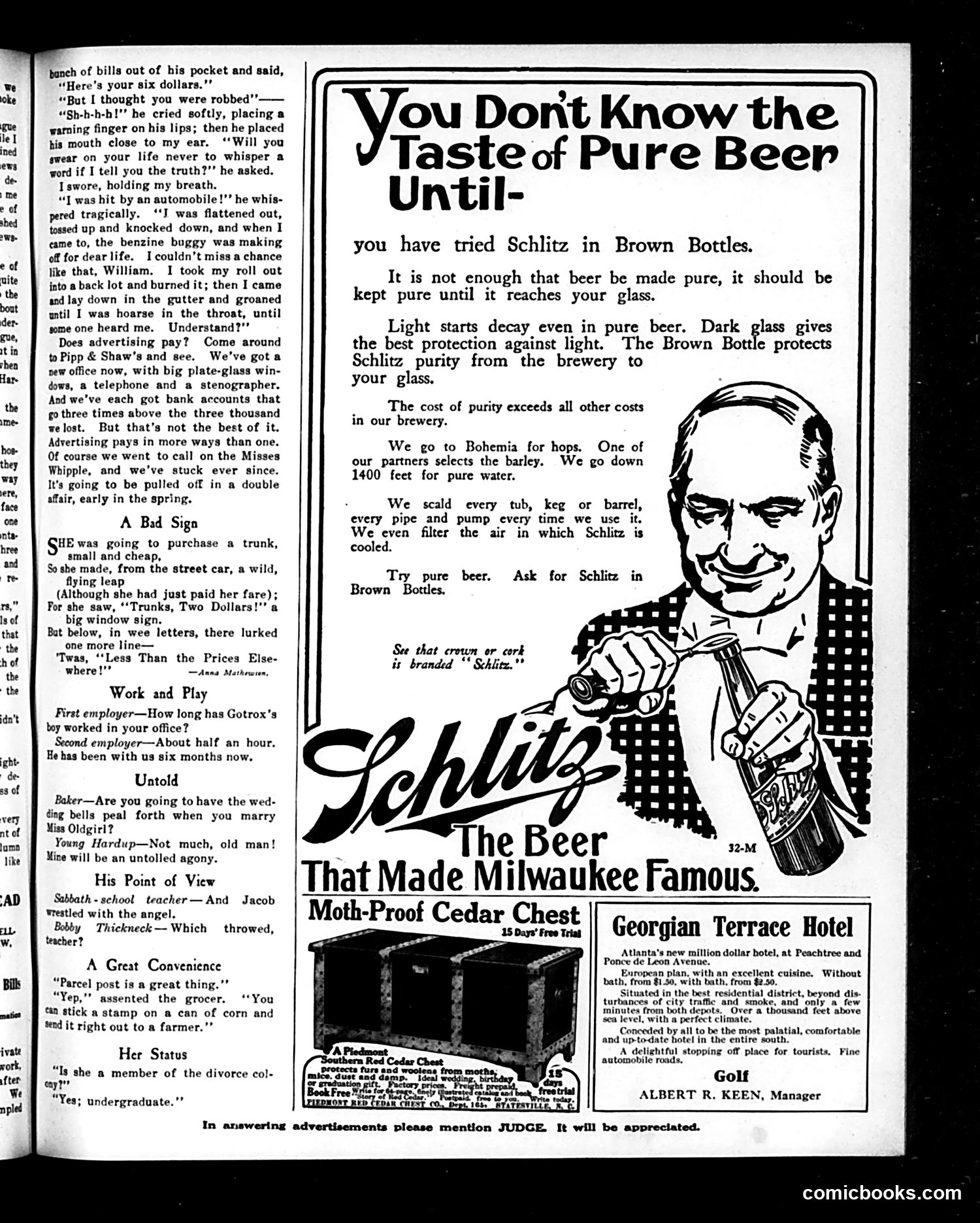
This page is primarily **advertising**, dominated by a large Schlitz beer advertisement featuring a jovial man holding a bottle. The ad argues that pure beer requires proper storage in brown bottles to prevent light-induced decay during distribution—a legitimate concern in early 20th-century brewing before refrigeration was universal. The surrounding content includes several short **humorous anecdotes** satirizing American life: a man faking a car accident to justify burning money and collect sympathy; a woman leaping from a streetcar for a "sale" that's actually more expensive; and jokes about employers, marriage, and divorce culture. The page also carries ads for a **moth-proof cedar chest** and the **Georgian Terrace Hotel** in Atlanta. The humor reflects period concerns: consumer deception, domestic life anxieties, and emerging industrial/commercial skepticism—typical of Judge's satirical approach to American society around the 1910s era.
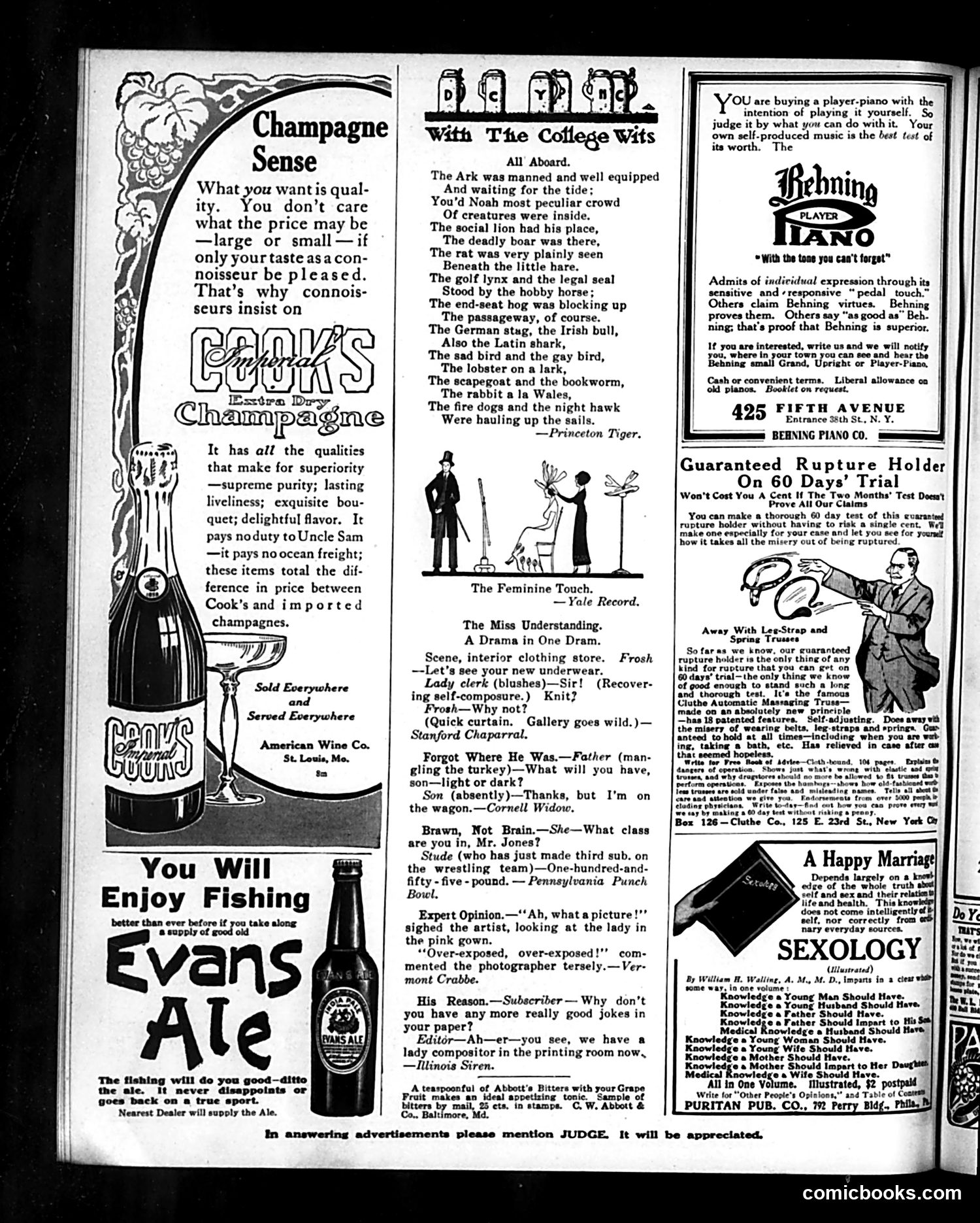
This page is primarily **advertising**, typical of Judge magazine's revenue model. The main content consists of product advertisements for champagne, player pianos, ale, rupture holders, and other goods. However, there is one **satirical section**: "With The College Wits" — a collection of short jokes and humorous pieces reprinted from various college humor magazines (Princeton Tiger, Yale Record, Stanford Chaparral, etc.). These are gentle campus humor rather than political satire: jokes about freshmen ("Frosh"), romance misunderstandings, and collegiate social mishaps. The only potentially pointed humor is "His Reason," where a newspaper editor claims a female compositor in the printing room prevents publishing "really good jokes" — a mild jab at women in the workplace, reflecting early 20th-century attitudes. The page reflects Judge's dual purpose: **commercial advertising revenue combined with lighthearted collegiate humor**, rather than the hard political satire the magazine was known for.
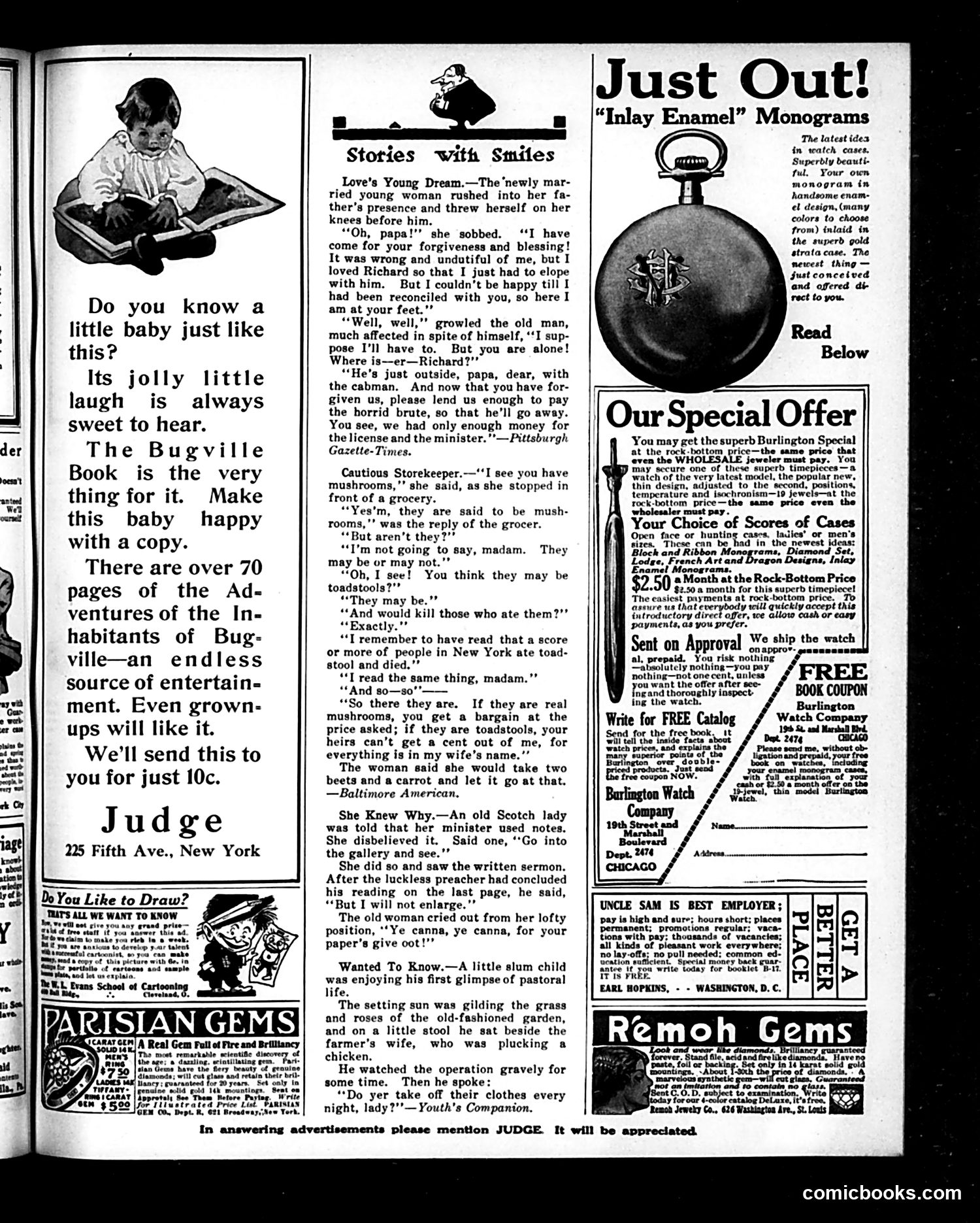
This page is primarily **advertising and light humor content**, not political satire. It contains: **Left side:** An ad for "The Bugville Book," a children's illustrated story collection about insect characters, priced at 10 cents. **Center:** A "Stories with Smiles" section featuring four short humorous anecdotes: - A newlywed woman seeking her father's forgiveness (and money) - A grocer ambiguously selling mushrooms that "may be" toadstools - A Scottish woman heckling her minister for running out of sermon notes - A slum child naively asking a farmer's wife why she removes the chicken's "clothes" **Right side:** Advertisements for "Inlay Enamel" monogrammed watch cases and Burlington watches. **No political content is present.** This is a typical early 20th-century magazine page mixing consumer advertising with family-friendly jokes aimed at general entertainment. The humor relies on wordplay, misunderstandings, and gentle social observation rather than satire.
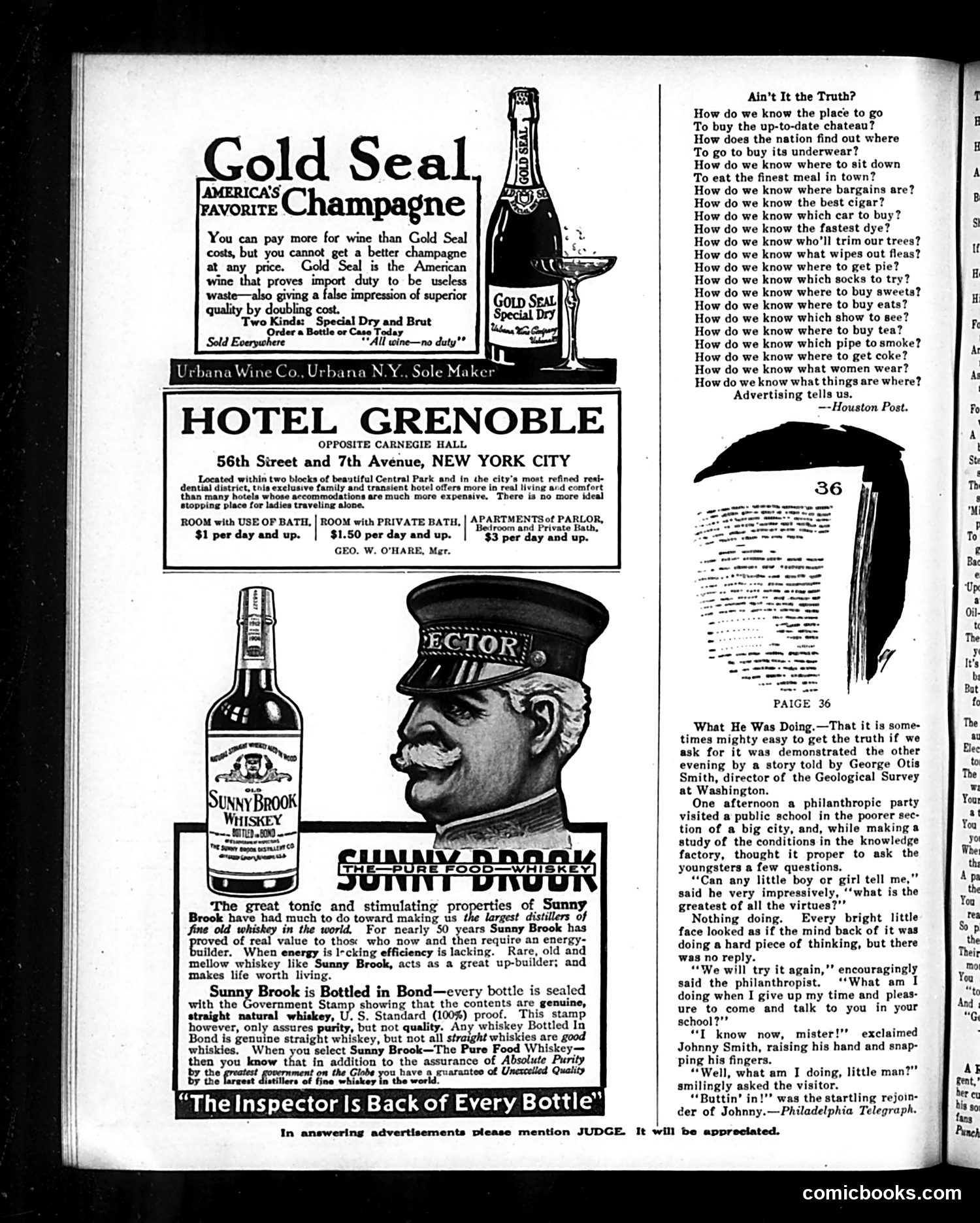
This page is primarily **advertising**, featuring promotions for Gold Seal Champagne, Hotel Grenoble, and Sunny Brook Whiskey—typical of Judge's revenue model. The only satirical content is the column "Ain't It the Truth?" which lists rhetorical questions about how consumers know where to buy various goods and services, concluding that **"Advertising tells us."** This is meta-satire: Judge itself profits from advertising while the column jokes about advertising's pervasive influence on American life. The implicit critique is that advertising has become the primary means by which the public makes consumer decisions. Below that, an anecdote describes a philanthropist visiting a poor schoolhouse, asking children about virtue. When he asks what he's doing by visiting and talking to them, a boy named Johnny replies: **"Buttin' in!"** This satirizes condescending charitable do-gooders—their self-important intrusion into others' lives masked as benevolence.
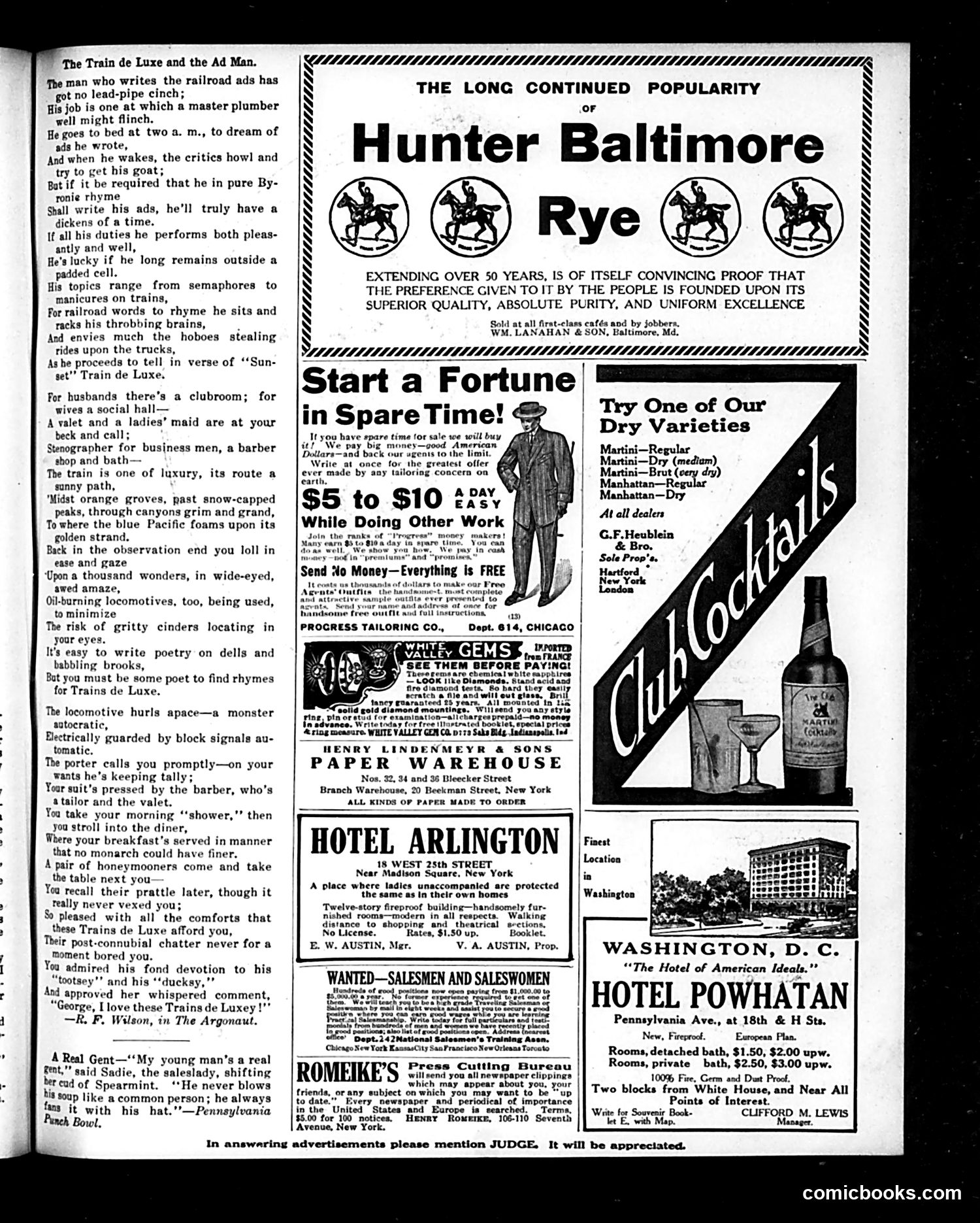
This page is primarily **advertising** with a minor satirical poem. The main advertised product is **Hunter Baltimore Rye whiskey**, prominently featured at top center with decorative horseman icons. The satirical poem "The Train de Luxe and the Ad Man" (left column) mocks the **railroad advertising copywriter's job**—a figure struggling to compose poetic descriptions of train amenities (sleeping cars, dining service, observation decks) while meeting strict rhyme schemes. The satire suggests this is an impossibly thankless job: critics attack the ads, the writer loses sleep, and he envies hoboes stealing train rides. The joke reflects early 20th-century advertising challenges: marketing luxury rail travel required ornate, flowery language that was difficult to make both persuasive and artfully composed. The writer's suffering is played for dark humor. The page otherwise consists of various classified and display ads for hotels, tailoring services, paper goods, and other commercial products typical of Judge magazine's revenue model.
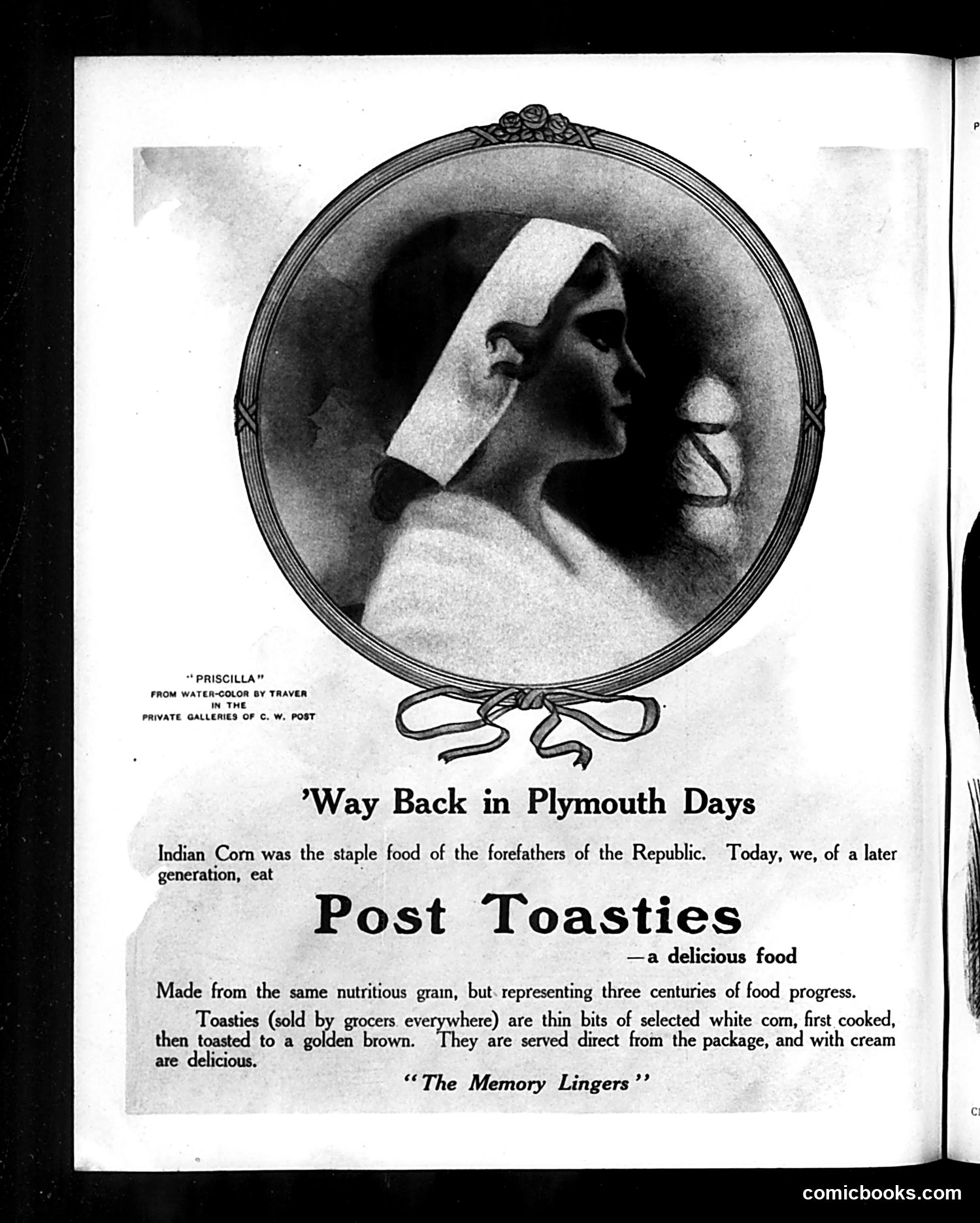
This is a **cereal advertisement**, not political satire. The page promotes **Post Toasties**, a breakfast cereal made from corn. The circular portrait labeled "Priscilla" (a watercolor by artist Traver from C.W. Post's private galleries) depicts a woman in colonial-era dress, referencing the Pilgrims and Plymouth settlement. The advertisement uses patriotic nostalgia to market the product: it claims Post Toasties represent "three centuries of food progress" while maintaining the nutritional value of the corn that sustained America's founders. The tagline "The Memory Lingers" emphasizes emotional connection to American heritage. This is a common early 20th-century marketing strategy—linking a modern commercial product to national history and tradition to encourage purchase. The ad leverages American settler mythology to sell breakfast cereal.