
Judge, 1913-04-19 · page 9 of 24
Judge — April 19, 1913 — page 9: what you’re looking at
What you’re looking at
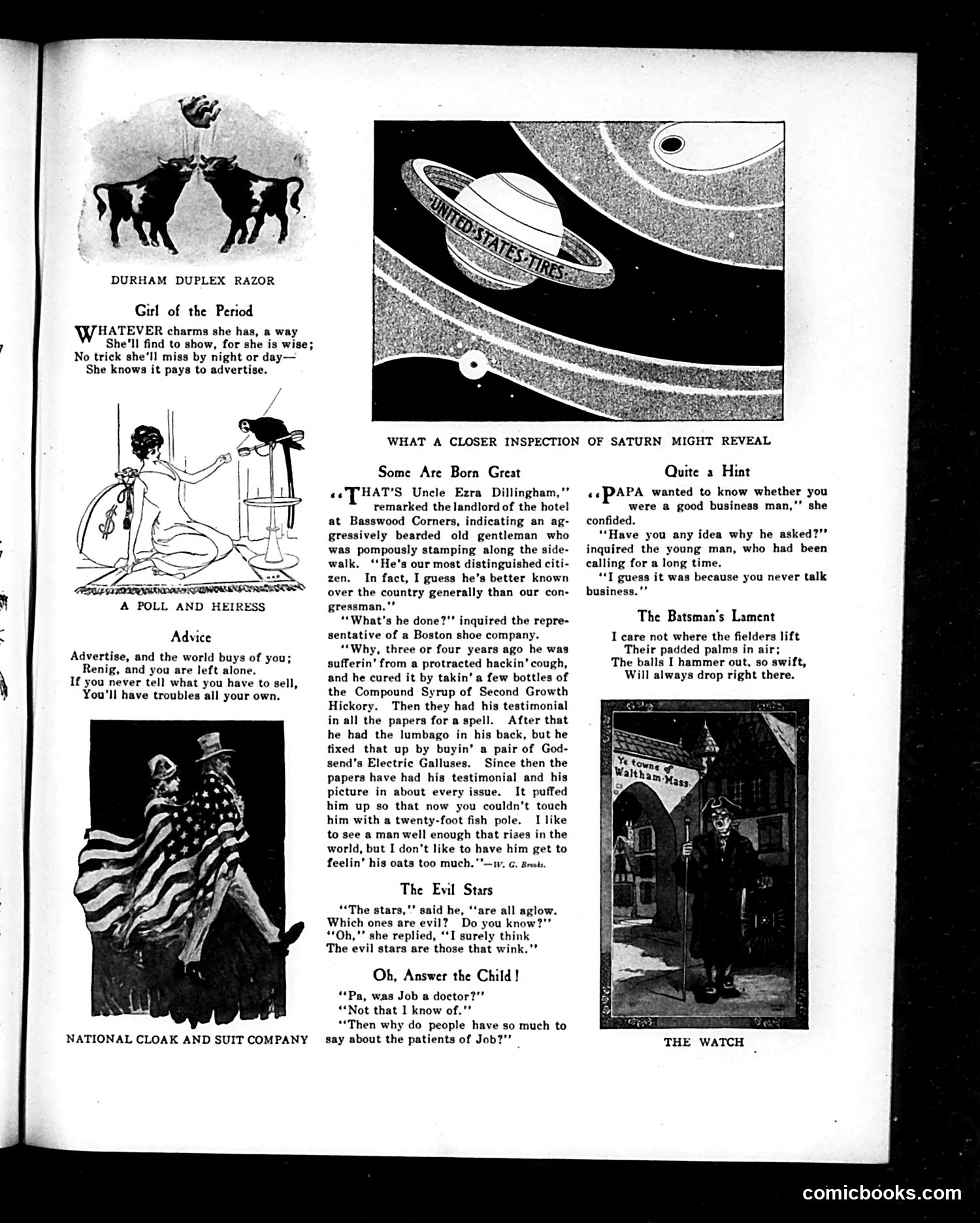
This page is primarily **advertising** for consumer products (Durham Duplex Razor, National Cloak and Suit Company) interspersed with brief humorous sketches and aphorisms. The satirical content targets **consumer culture and advertising itself**. The "Girl of the Period" poem mocks modern women for their shrewd understanding that self-promotion through advertising is essential—a critique of both consumerism and changing gender roles. The "Advice" section ironically endorses aggressive advertising as necessary for success. The longer sketch "Some Are Born Great" satirizes **small-town celebrity and testimonial culture**. Uncle Ezra Dillingham becomes nationally famous not through actual achievement, but by endorsing patent medicines and electric devices in newspaper testimonials. The satire suggests how trivial accomplishments, when heavily advertised, can inflate a person's reputation absurdly. The remaining brief jokes are wordplay pieces with no apparent political content—puns about "evil stars," Job's "patients" (biblical reference), and cricket terminology.
📄 Transcribed text from this page (OCR, searchable)
Machine-transcribed from the original scan — historical spelling and the odd misread are preserved.
DURHAM DUPLEX RAZOR Girl of the Period WHATEVER charms she has, a way She'll find to show, for she is wise; No trick she'll miss by night or day— She knows it pays to advertise. SF VX RFA OCT OLED A POLL AND HEIRESS Advice Advertise, and the world buys of you; Renig, and you are left alone. If you never tell what you have to sell, You'll have troubles all your own. NATIONAL CLOAK AND SUIT COMPANY WHAT A CLOSER INSPECTION OF SATURN MIGHT REVEAL Some Are Born Great ee THAT'S Uncle Ezra Dillingham,’’ remarked the landlord of the hotel at Basswood Corners, indicating an ag- gressively bearded old gentleman who was pompously stamping along the side- walk. ‘He's our most distinguished citi- zen. In fact, I guess he’s better known over the country generally than our con- gressman."’ ‘*What’s he done?’’ inquired the repre- sentative of a Boston shoe company. “Why, three or four years ago he was sufferin’ from a protracted hackin’ cough, and he cured it by takin’ a few bottles of the Compound Syrup of Second Growth Hickory. Then they had his testimonial in all the papers for a spell. After that he had the lumbago in his back, but he tixed that up by buyin’ a pair of God- send’s Electric Galluses. Since then the papers have had his testimonial and his picture in about every issue. It puffed him up so that now you couldn’t touch him with a twenty-foot fish pole. I like to see a man well enough that rises in the world, but I don’t like to have him get to feelin’ his oats too much. "'—1W. G. Breets The Evil Stars “The stars,’’ said he, ‘‘are all aglow. Which ones are e Do you know?"" “Oh,’” she replied, “I surely think The evil stars are those that wink.”’ Oh, Answer the Child! “Pa, was Job a doctor?” “Not that I know of.’” “Then why do people have so much to say about the patients of Job?” Quite a Hint «¢PAPA wanted to know whether you were a good business man,"’ she confided. “Have you any idea why he asked?” inquired the young man, who had been calling for a long time. “T guess it was because you never talk business.’” The Batsman’s Lament I care not where the fielders lift Their padded palms in air; The balls I hammer out, so swift, Will always drop right there. THE WATCH comicbooks.com