
Judge, 1913-04-19 · page 5 of 24
Judge — April 19, 1913 — page 5: what you’re looking at
What you’re looking at
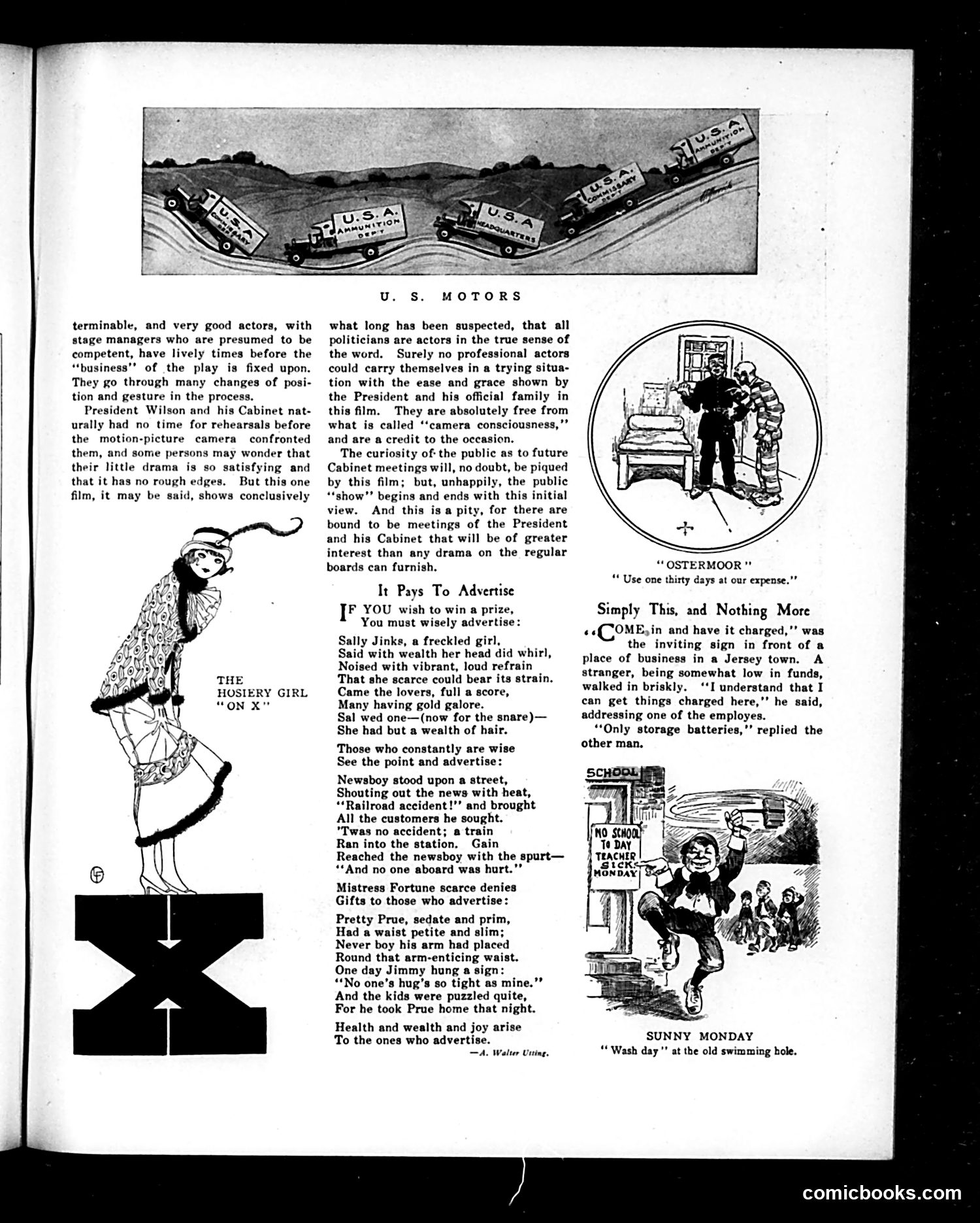
This page combines advertising and entertainment content typical of Judge magazine. The top features a U.S. Motors advertisement showing delivery trucks. **"The Hosiery Girl 'On X'"** is a cartoon about advertising effectiveness, illustrated with a stylized female figure. The accompanying poem "It Pays To Advertise" uses humorous examples (Sally Lunn, Pretty Frue) to satirize how strategic advertising creates business success and romantic fortune. The lower illustrations—"Ostermoor" (a bedding ad), "Sunny Monday" (laundry-related)—appear to be product advertisements with comedic scenarios. The overall page satirizes American consumer culture and advertising's persuasive power during the early 20th century, suggesting that shrewd marketing—not actual product quality—drives commercial success and personal advancement.
📄 Transcribed text from this page (OCR, searchable)
Machine-transcribed from the original scan — historical spelling and the odd misread are preserved.
terminable, and very good actors, with stage managers who are presumed to be competent, have lively times before the “business’? of the play is fixed upon. They go through many changes of posi- tion and gesture in the process. President Wilson and his Cabinet nat- urally had no time for rehearsals before the motion-picture camera confronted them, and some persons may wonder that their little drama is so satisfying and that it has no rough edges. But this one film, it may be said, shows conclusively HOSIERY GIRL MOTORS what long has been suspected, that all politicians are actors in the true sense of the word. Surely no professional actors could carry themselves in a trying situa- tion with the ease and grace shown by the President and his official family in this film. They are absolutely free from what is called ‘‘camera consciousness,” and are a credit to the occasion. The curiosity of: the public as to future Cabinet meetings will, no doubt, be piqued by this film; but, unhappily, the public “*show’’ begins and ends with this initial view. And this is a pity, for there are bound to be meetings of the President and his Cabinet that will be of greater interest than any drama on the regular boards can furnish. It Pays To Advertise IF YOU wish to win a prize, You must wisely advertise: Sally Jinks, a freckled girl, Said with wealth her head did whirl, Noised with vibrant, loud refrain That she scarce could bear its strain. Came the lovers, full a score, Many having gold galore. Sal wed one—(now for the snare)— She had but a wealth of hair. Those who constantly are wise See the point and advertise: Newsboy stood upon a street, Shouting out the news with heat, “‘Railroad accident!’’ and brought All the customers he sought. ‘Twas no accident; a train Ran into the station. Gain Reached the newsboy with the spurt— “*And no one aboard was hurt.’” Mistress Fortune scarce denies Gifts to those who advertise: Pretty Prue, sedate and prim, Had a waist petite and slim; Never boy his arm had placed Round that arm-enticing waist. One day Jimmy hung a sign: “No one’s hug’s so tight as mine.’’ And the kids were puzzled quite, For he took Prue home that night. Health and wealth and joy arise To the ones who advertise. A. Walter Unting. “OSTERMOOR” “ Use one thirty days at our expense.”” Simply This, and Nothing More ««(COME,in and have it charged,’ was the inviting sign in front of a place of business in a Jersey town. A stranger, being somewhat low in funds, walked in briskly. ‘‘I understand that I can get things charged here,’’ he said, addressing one of the employes. “Only storage batteries," replied the other man, SUNNY MONDAY “Wash day "" at the old swimming hole. comicbooks.com