
Judge, 1913-04-19 · page 4 of 24
Judge — April 19, 1913 — page 4: what you’re looking at
What you’re looking at
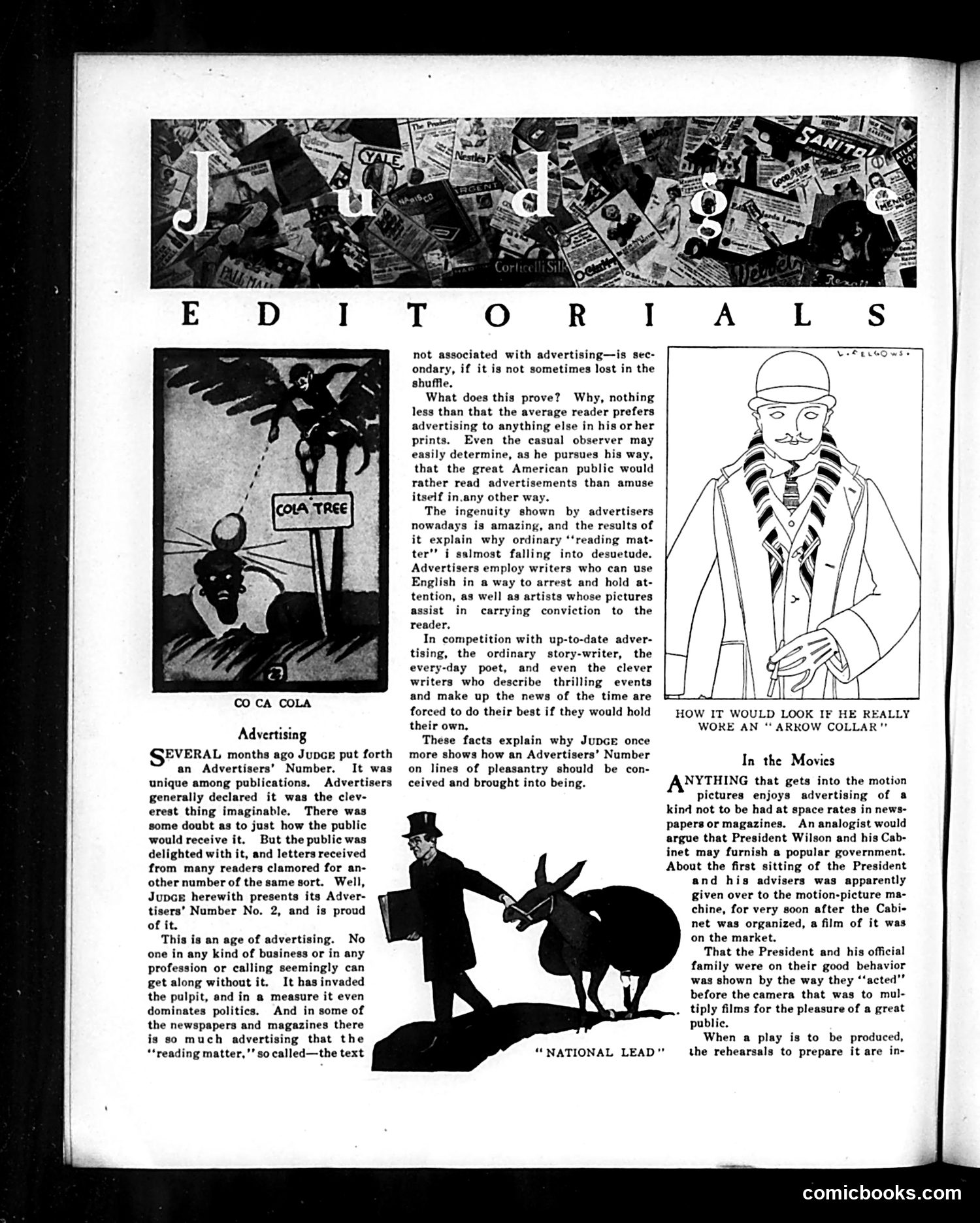
This editorials page discusses advertising's dominance in American media. The "Coca-Cola" cartoon (left) uses a giant insect at a tree labeled "COLA TREE" to satirize how advertising has become inescapable in publications. The "National Lead" illustration (center) shows a man being kicked by a donkey, likely mocking political leadership—possibly referencing President Wilson's administration, given the text's mention of Wilson and his Cabinet appearing in motion pictures. The satire suggests political leaders are as stubborn or problematic as the donkey. The right illustration humorously depicts how an "Arrow Collar" would look absurdly oversized on a man's neck, poking fun at advertisement exaggeration. Overall, the page critiques how thoroughly advertising permeates American media and culture.
📄 Transcribed text from this page (OCR, searchable)
Machine-transcribed from the original scan — historical spelling and the odd misread are preserved.
Advertising SEVERAL months ago Jupce put forth an Advertisers’ Number. It was unique among publications. Advertisers generally declared it was the clev- erest thing imaginable. There was some doubt as to just how the public would receive it. But the public was delighted with it, and letters received from many readers clamored for an- other number of the same sort. Well, Jupce herewith presents its Adver- tisers’ Number No. 2, and is proud of it. This is an age of advertising. No one in any kind of business or in any profession or calling seemingly can get along without it. It has invaded the pulpit, and in a measure it even dominates politics. And in some of the newspapers and magazines there is so much advertising that the “reading matter,’’ so called—the text not associated with advertising—is sec- ondary, if it is not sometimes lost in the shuffle. What does this prove? Why, nothing less than that the average reader prefers advertising to anything else in his orher prints. Even the casual observer may easily determine, as he pursues his way, that the great American public would rather read advertisements than amuse itself in.any other way. The ingenuity shown by advertisers nowadays is amazing, and the results of it explain why ordinary ‘treading mat- ter” i salmost falling into desuetude. Advertisers employ writers who can use English in a way to arrest and hold at- tention, as well as artists whose pictures assist in carrying conviction to the reader, In competition with up-to-date adver- tising, the ordinary story-writer, the every-day poet, and even the clever writers who describe thrilling events and make up the news of the time are forced to do their best if they would hold their own, These facts explain why JupGE once more shows how an Advertisers’ Number on lines of pleasantry should be con- ceived and brought into being. “NATIONAL LEAD" HOW IT WOULD LOOK IF HE REALLY WORE AN “ ARKOW COLLAR" In the Movies ANYTHING that gets into the motion pictures enjoys advertising of a kind not to be had at space rates in news- papers or magazines. An analogist would argue that President Wilson and his Cab- inet may furnish a popular government. About the first sitting of the President and his advisers was apparently given over to the motion-picture ma- chine, for very soon after the Cabi- net was organized, a film of it was on the market. That the President and his official family were on their good behavior was shown by the way they ‘‘acted”” before the camera that was to mul- tiply films for the pleasure of a great public. When a play is to be produced, the rehearsals to prepare it are in- comicbooks.com