
Judge, 1913-04-19 · page 17 of 24
Judge — April 19, 1913 — page 17: what you’re looking at
What you’re looking at
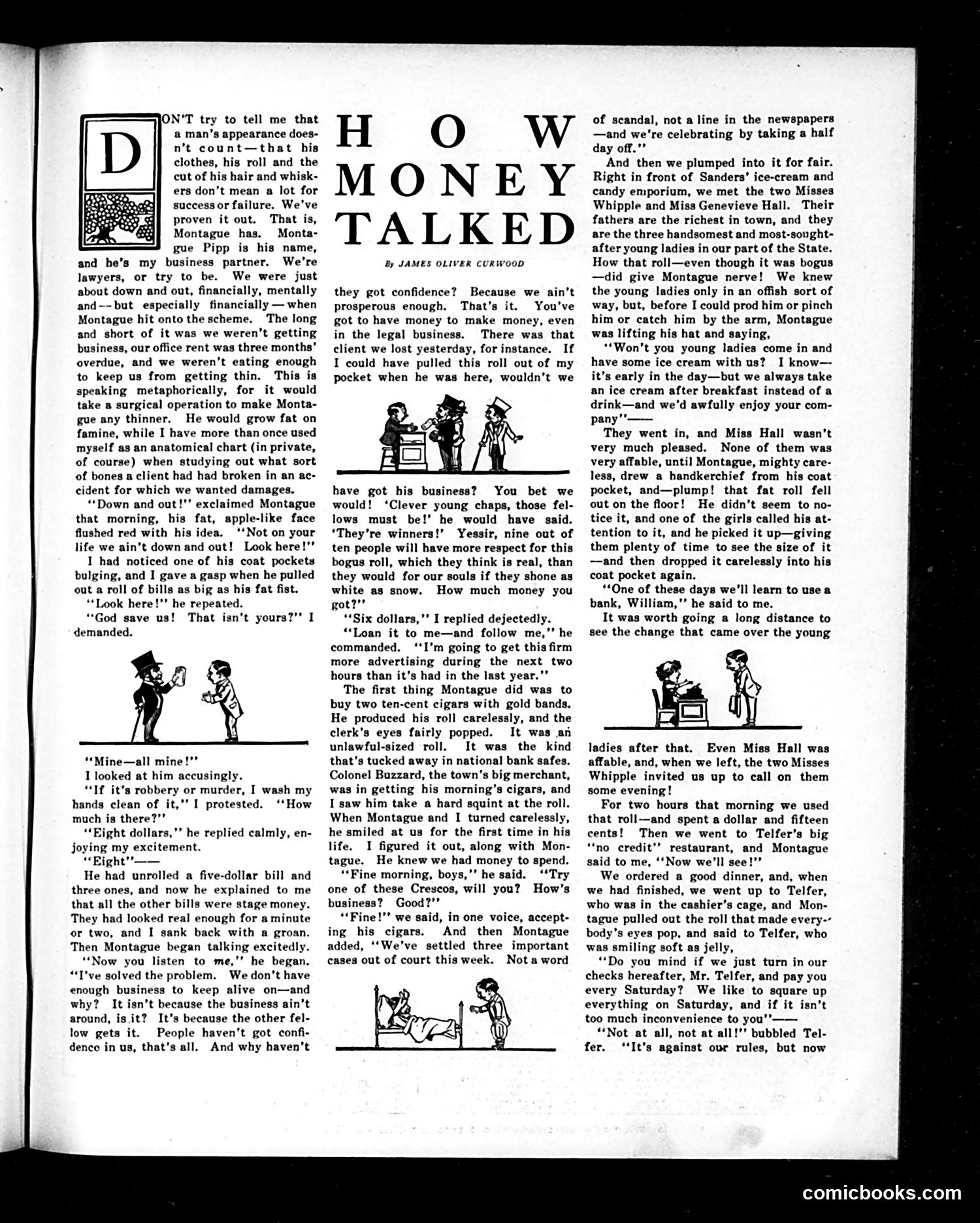
This story by James Oliver Curwood satirizes early 20th-century American materialism and shallow social judgment. Two struggling lawyers, Montague Pipp (fat, confident) and his unnamed partner (thin, cynical), are broke and losing clients. Montague devises a scheme: he creates a fake "roll" of money using stage bills to *appear* prosperous, reasoning that people judge success by visible wealth rather than actual merit. The satire targets how appearances trump substance in business and social life. By merely *displaying* money (most of it fake), the lawyers suddenly gain respect from merchants and potential clients who assume prosperity equals competence. The story mocks both the lawyers' deception and society's gullibility—the idea that confidence in appearance matters more than genuine talent or integrity. It's a commentary on American consumer culture and the performative nature of success in the era.
📄 Transcribed text from this page (OCR, searchable)
Machine-transcribed from the original scan — historical spelling and the odd misread are preserved.
ION’T try to tell me that @ man’s appearance does- n’t count—that his clothes, his roll and the cut of his hair and whisk- ers don’t mean a lot for successor failure. We've proven it out. That is, Montague has. Monta- gue Pipp is his name, and he’s my business partner. We're lawyers, or try to be. We were just about down and out, financially, mentally and--but especially financially —when Montague hit onto the scheme. The long and short of it was we weren't getting business, our office rent was three months’ overdue, and we weren't eating enough to keep us from getting thin. This is speaking metaphorically, for it would take a surgical operation to make Monta- gue any thinner. He would grow fat on famine, while I have more than once used myself as an anatomical chart (in private, of course) when studying out what sort of bones a client had had broken in an ac- cident for which we wanted damages. “Down and out!’’ exclaimed Montague that morning, his fat, apple-like face flushed red with his idea. ‘*Not on your life we ain’t down and out! Look here!’’ 1 had noticed one of his coat pockets bulging, and I gave a gasp when he pulled out a roll of bills as big as his fat fist. ‘*Look here!’’ he repeated. “God save us! That isn’t yours?” I demanded. “Mine—all mine!"’ I looked at him accusingly. “If it’s robbery or murder, I wash my hands clean of it,’ I protested. ‘‘How much is there?’’ “Eight dollars,’’ he replied calmly, en- joying my excitement. “Eight’’—— He had unrolled a five-dollar bill and three ones, and now he explained to me that all the other bills were stage money. They had looked real enough for a minute or two, and I sank back with a groan. Then Montague began talking excitedly. “Now you listen to me,’? he began. “I’ve solved the problem. We don’t have enough business to keep alive on—and why? It isn’t because the business ain’t around, isit? It’s because the other fel- low gets it. People haven't got confi- dence in us, that’s all. And why haven’t H O W MONEY TALKED By JAMES OLIVER CURWOOD they got confidence? Because we ain’t prosperous enough. That's it. You've got to have money to make money, even in the legal business. There was that client we lost yesterday, for instance. If I could have pulled this roll out of my pocket when he was here, wouldn’t we have got his business? You bet we would! ‘Clever young chaps, those fel- lows must be!’ he would have said. ‘They’re winners!’ Yessir, nine out of ten people will have more respect for this bogus roll, which they think is real, than they would for our souls if they shone as white as snow. How much money you got?”” “Six dollars,’’ I replied dejectedly. “Loan it to me—and follow me,”’ he commanded. ‘I’m going to get this firm more advertising during the next two hours than it’s had in the last year.’” The first thing Montague did was to buy two ten-cent cigars with gold bands. He produced his roll carelessly, and the clerk’s eyes fairly popped. It was an unlawful-sized roll. It was the kind that’s tucked away in national bank safes, Colonel Buzzard, the town’s big merchant, was in getting his morning’s cigars, and I saw him take a hard squint at the roll. When Montague and I turned carelessly, he smiled at us for the first time in his life. I figured it out, along with Mon- tague. He knew we had money to spend. “*Fine morning, boys,’’ he said. ‘‘Try one of these Crescos, will you? How’s business? Good?"’ ‘Fine!’ we said, in one voice, accept- ing his cigars. And then Montague added, ‘‘We've settled three important cases out of court this week. Not a word of scandal, not a line in the newspapers —and we're celebrating by taking a half day off.’” And then we plumped into it for fair. Right in front of Sanders’ ice-cream and candy emporium, we met the two Misses Whipple and Miss Genevieve Hall. Their fathers are the richest in town, and they are the three handsomest and most-sought- after young ladies in our part of the State. How that roll—even though it was bogus —did give Montague nerve! We knew the young ladies only in an offish sort of way, but, before I could prod him or pinch him or catch him by the arm, Montague was lifting his hat and saying, **Won’t you young ladies come in and have some ice cream with us? I know— it’s early in the day—but we always take an ice cream after breakfast instead of a drink—and we'd awfully enjoy your com- pany” They went in, and Miss Hall wasn’t very much pleased. None of them was very affable, until Montague, mighty care- less, drew a handkerchief from his coat pocket, and—plump! that fat roll fell out on the floor! He didn’t seem to no- tice it, and one of the girls called his at- tention to it, and he picked it up—giving them plenty of time to see the size of it —and then dropped it carelessly into his coat pocket again. “One of these days we'll learn to use a bank, William,” he said to me. It was worth going a long distance to see the change that came over the young ladies after that. Even Miss Hall was affable, and, when we left, the two Misses Whipple invited us up to call on them some evening! For two hours that morning we used that roll—and spent a dollar and fifteen cents! Then we went to Telfer’s big “tno credit’’ restaurant, and Montague said to me, ‘‘Now we'll see!"’ We ordered a good dinner, and, when we had finished, we went up to Telfer, who was in the cashier's cage, and Mon- tague pulled out the roll that made every-- body's eyes pop, and said to Telfer, who was smiling soft as jelly, “Do you mind if we just turn in our checks hereafter, Mr. Telfer, and pay you every Saturday? We like to square up everything on Saturday, and if it isn’t too much inconvenience to you’’—— “Not at all, not at all!’’ bubbled Tel- fer. ‘‘It’s against our rules, but now comicbooks.com