
A complete issue · 26 pages · 1913
Judge — March 22, 1913
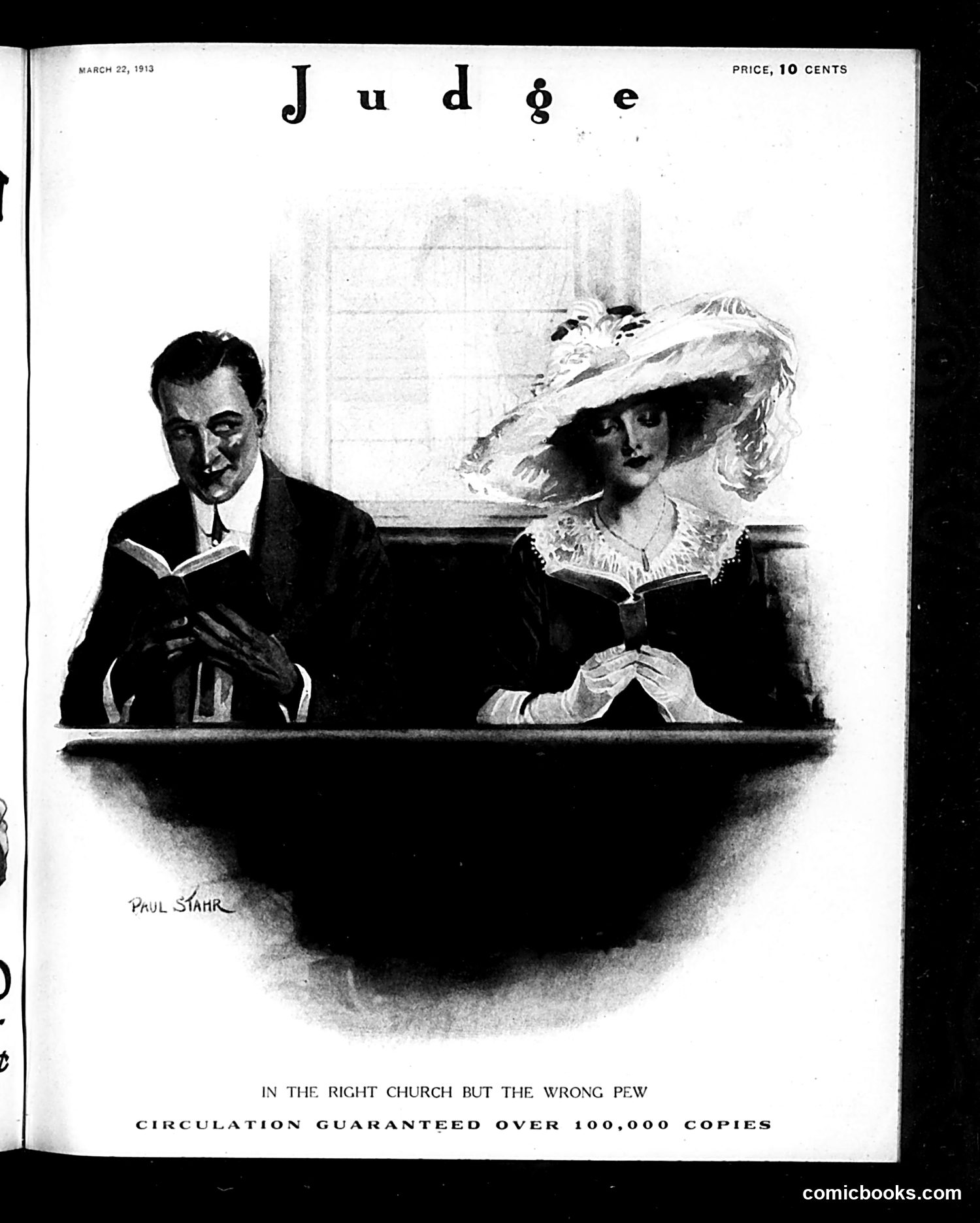
This cartoon by Paul Starr depicts two well-dressed church-goers in a pew—a man reading and a fashionably dressed woman wearing an elaborate hat. The caption reads "IN THE RIGHT CHURCH BUT THE WRONG PEW." The satire targets social climbing and church etiquette among the wealthy. The woman's ostentatious hat (a status symbol of the era) and formal attire suggest she and her companion are attempting to appear respectable by attending church, yet they've positioned themselves improperly—"the wrong pew." This likely mocks the pretensions of newly wealthy individuals trying to fit into established social hierarchies by mimicking proper behavior while missing genuine social conventions. The joke hinges on performative respectability versus actual understanding of one's place in society.
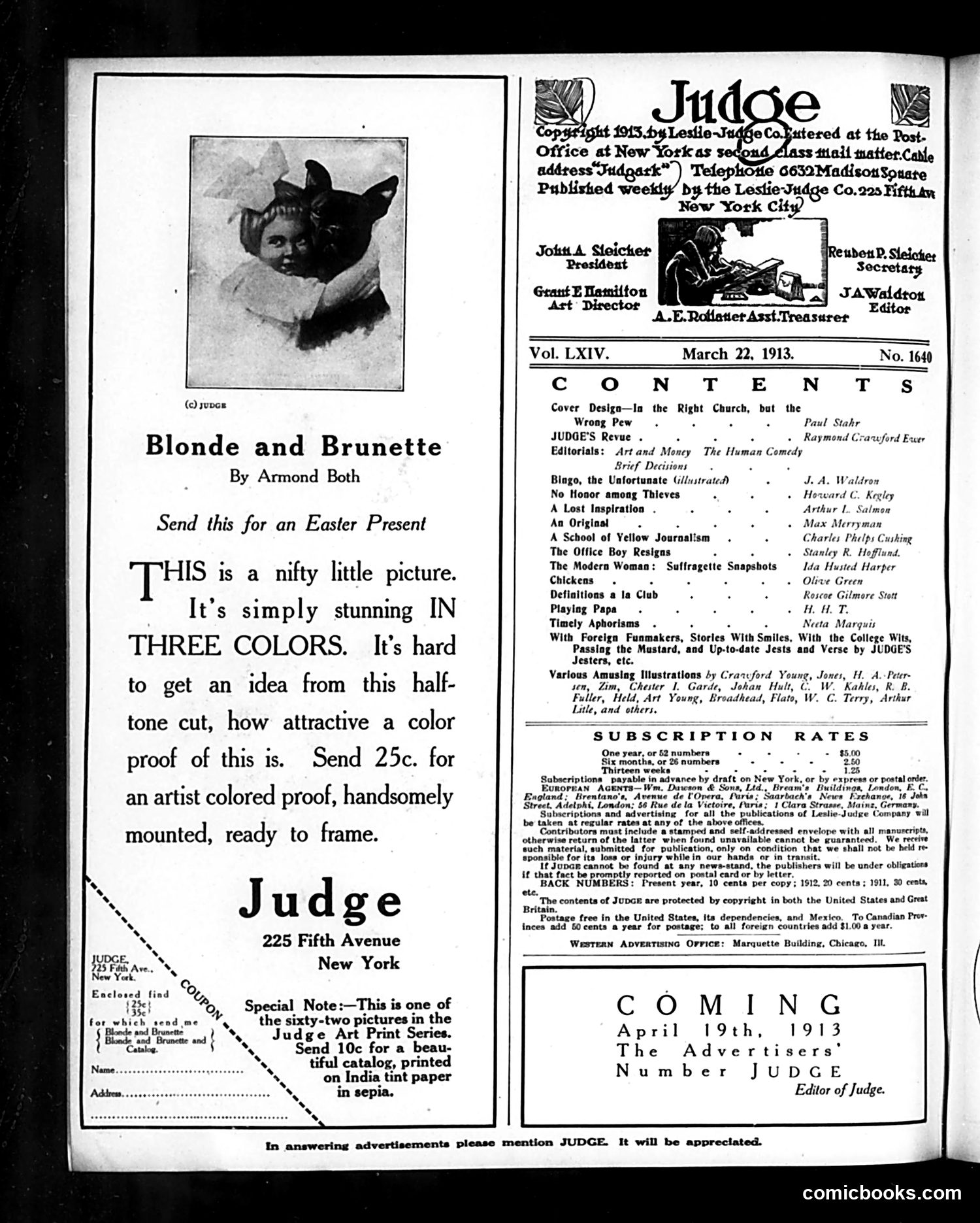
The left page features "Blonde and Brunette" by Armond Both—an advertisement for a color art print. The image shows a stylized female face with distinct blonde and brunette features, presented as an Easter gift option. The accompanying text emphasizes the print's appeal in three colors and offers an "artist colored proof" for 25 cents. This is primarily **commercial content** rather than political satire. The advertisement targets readers interested in home decoration and art prints, which were popular leisure purchases in the early 1900s. The "Judge Art Print Series" was apparently a regular offering, suggesting the magazine generated revenue through such illustrated promotional materials alongside its satirical editorial content.
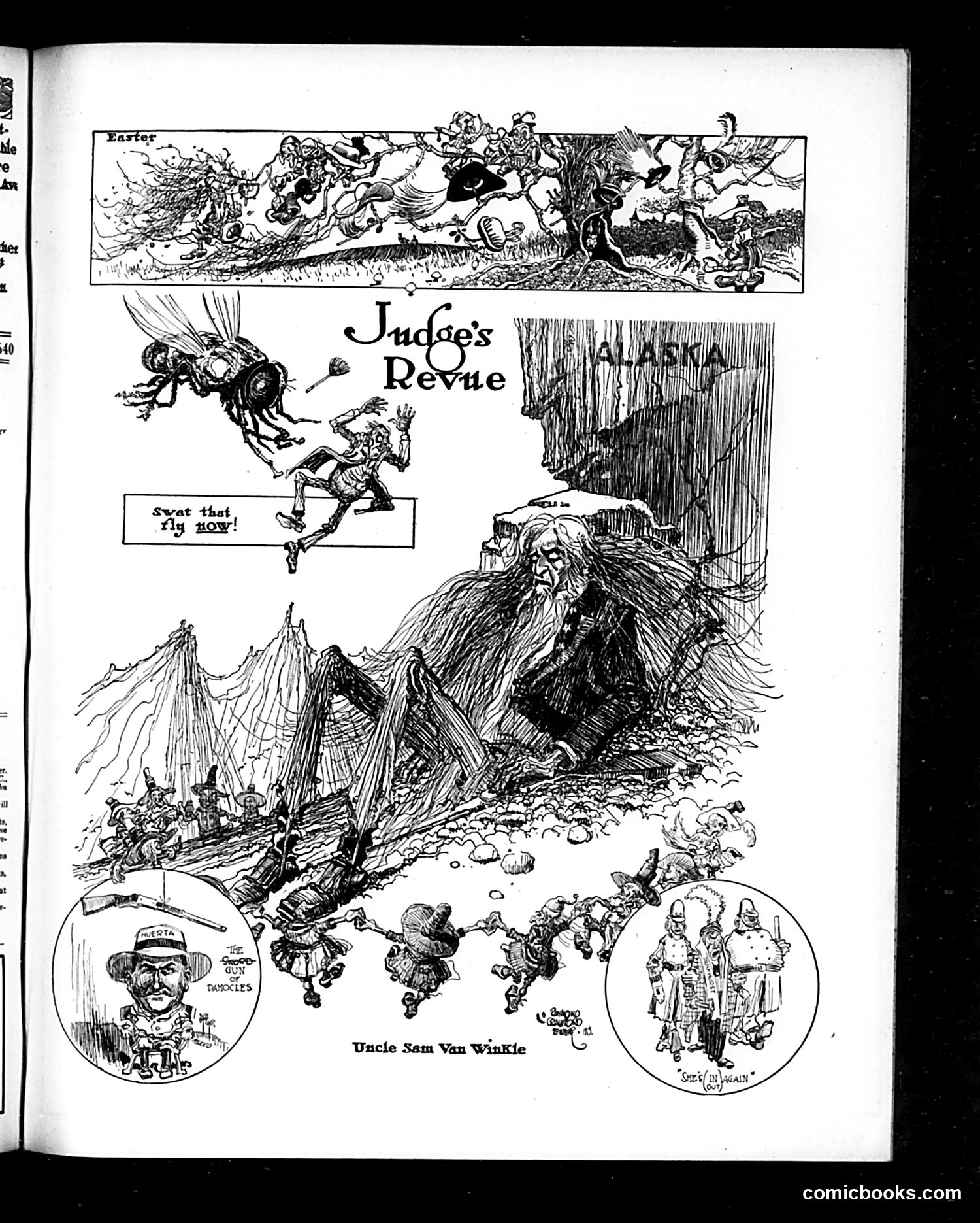
This page features satirical illustrations typical of Judge magazine's political humor. The title "Judge's Revue" suggests a collection of contemporary commentary. The main large illustration shows "Uncle Sam Van Winkle"—a reference to Washington Irving's "Rip Van Winkle," the character who slept for years and awoke to find everything changed. Here, Uncle Sam (personification of America) appears to be waking up to a transformed landscape with ships and figures below, likely commenting on major changes in American society or politics during the period. The circular vignettes at bottom left and right appear to show character types or specific figures of the day, though their identities aren't immediately clear from the image alone. The "Swat that fly now!" caption suggests commentary on a contemporary issue or nuisance needing immediate action.
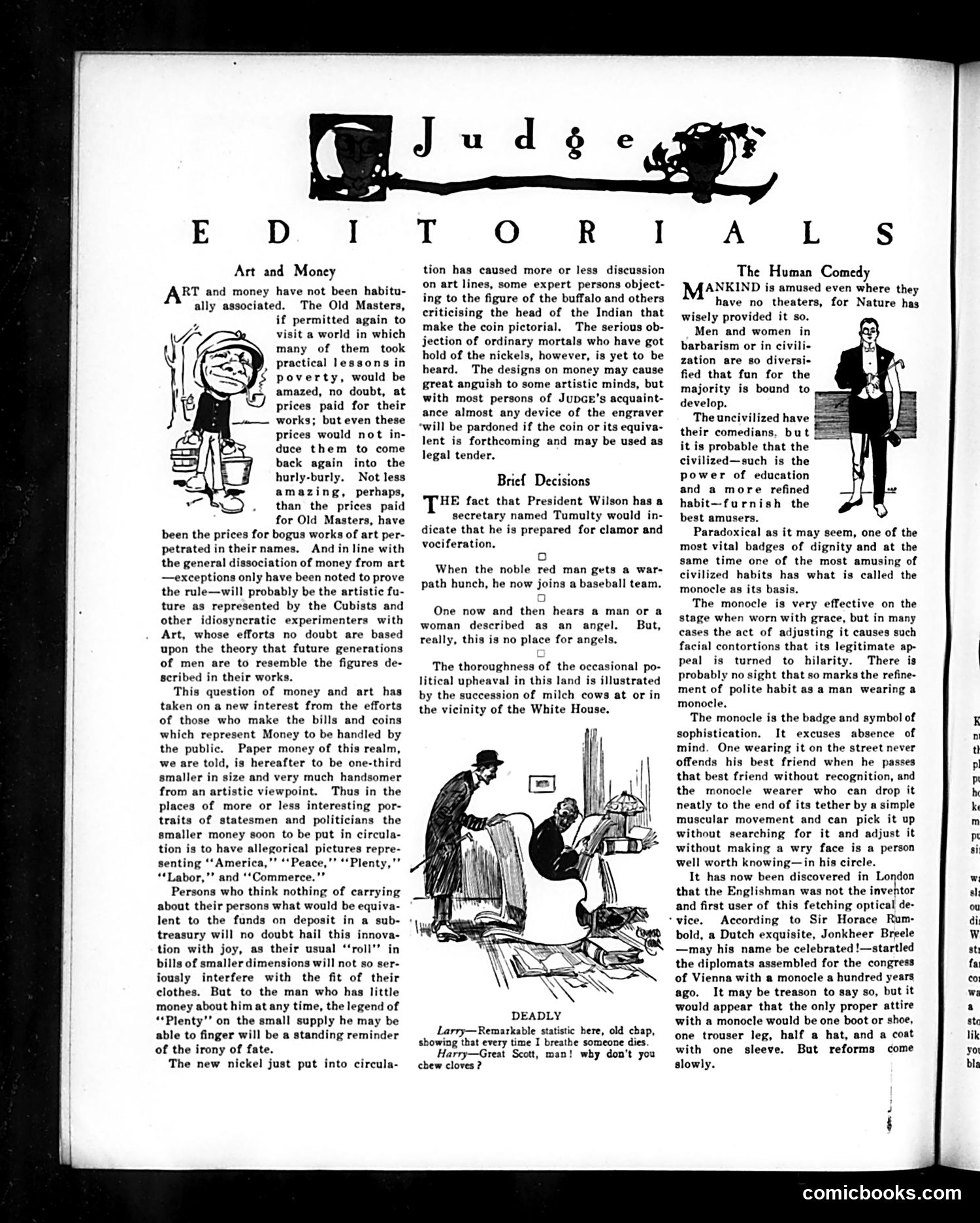
This page contains three editorial pieces. The main left column discusses the relationship between art and money, arguing that artistic prices shouldn't be dismissed simply because they're high—a defense of art market values against practical objections. The center column's "Brief Decisions" section includes short satirical comments. One mocks a secretary named Tumulty's preparedness for "clamor and vociferousness" (appears to reference a government official, likely from the Wilson administration era). The right column, "The Human Comedy," defends the monocle as a dignified fashion accessory, claiming it requires practiced sophistication. It mentions a London Englishman and Dutch explorer Jonkheer Breele as monocle users. The bottom illustration titled "DEADLY" depicts a dialogue about someone's bad breath, presented as dark humor. The satire targets pretension and social affectation broadly.
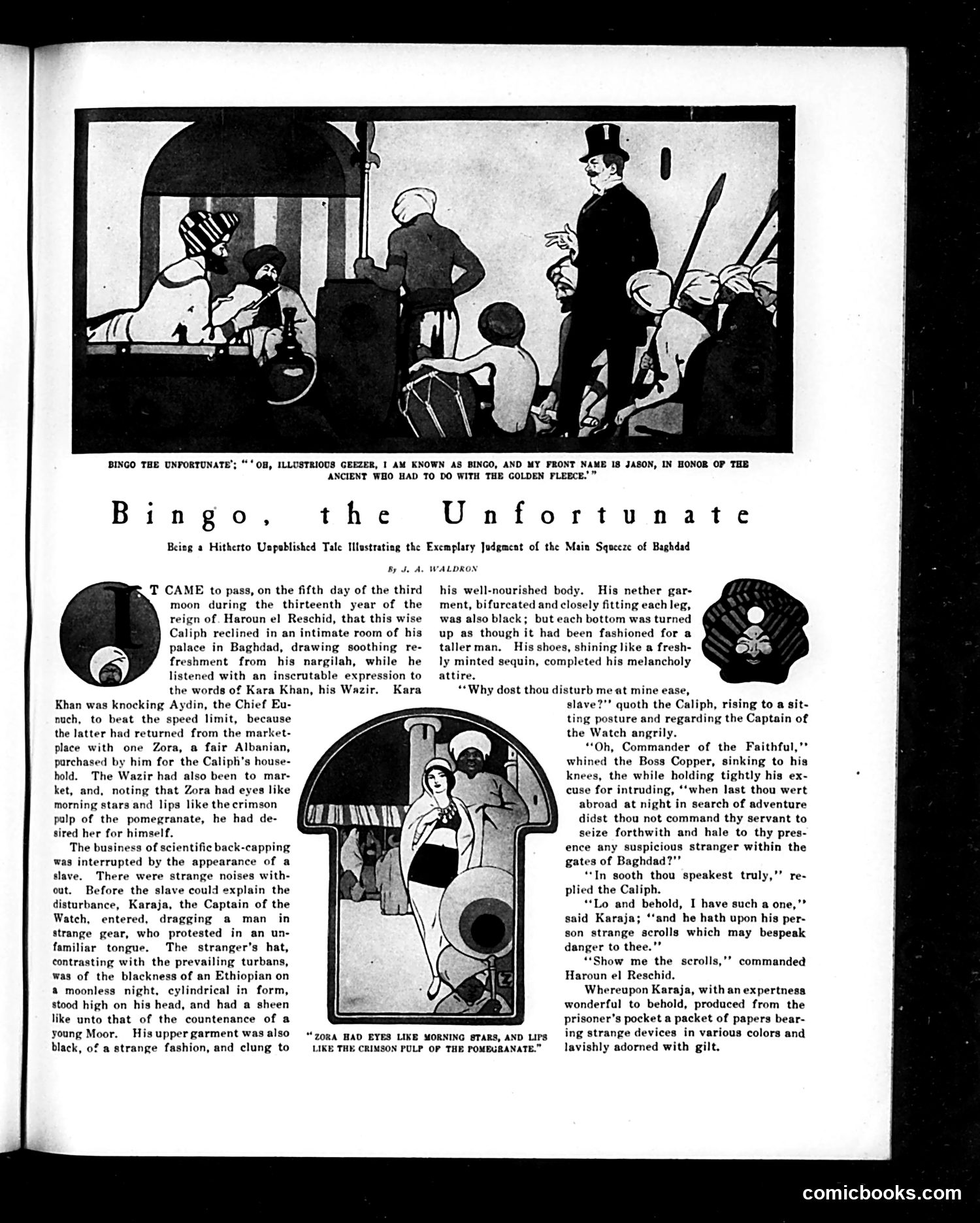
This page presents a fictional tale by J.A. Waldron set in Baghdad during Haroun al Raschid's reign. The story concerns a slave named Bingo who is discovered possessing mysterious scrolls bearing dangerous devices in various colors and gold. The narrative appears to be a fantastical adventure story rather than political satire. The illustrations show characters in period costume: the Caliph, his servants, and officials examining the suspicious documents. Without additional context about the publication date or contemporary events, the specific satirical target remains unclear. The "strange devices" and foreign scrolls might reference contemporary anxieties, but the text alone doesn't confirm a particular political or social reference point for modern readers.
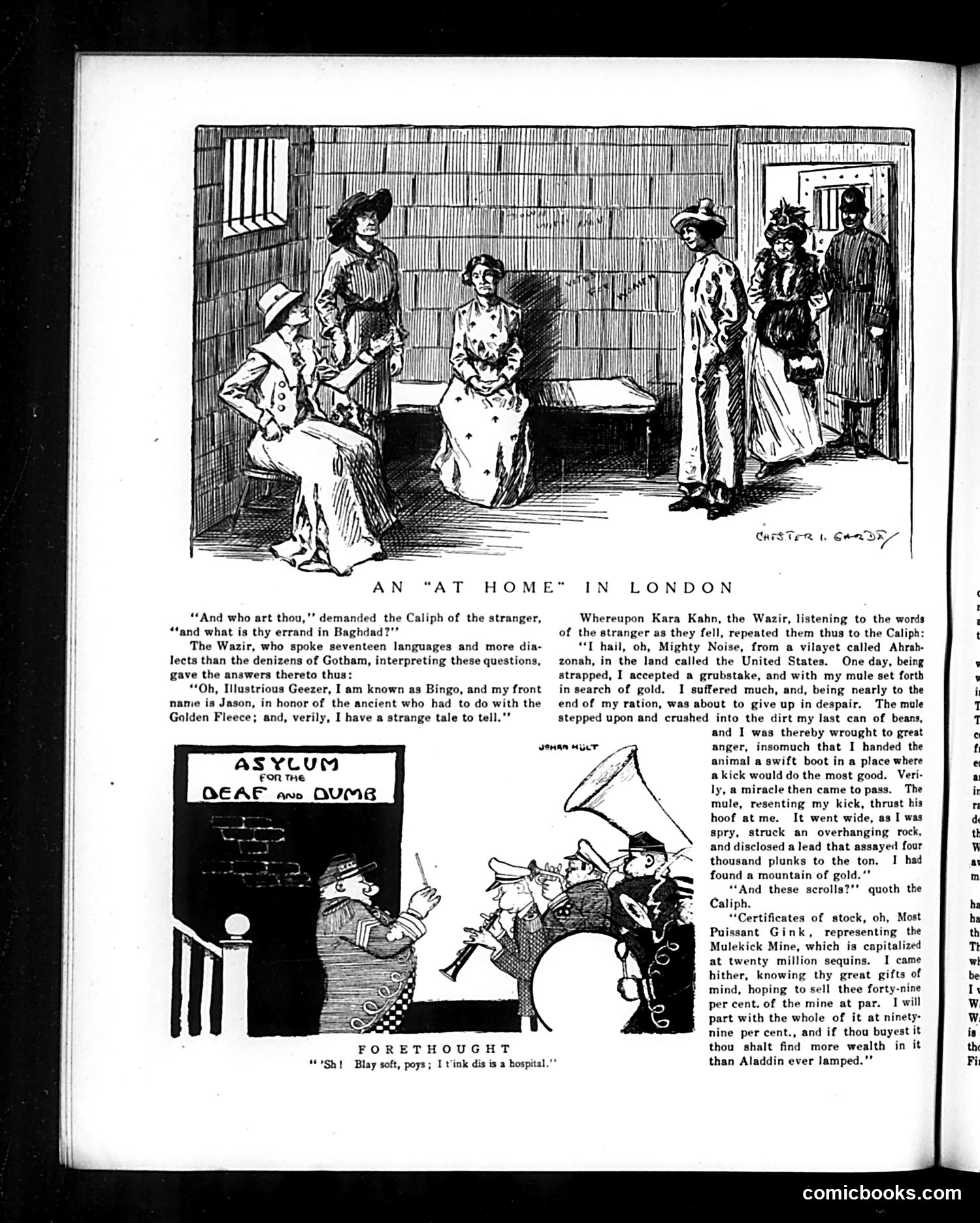
This page satirizes American get-rich-quick schemes and stock fraud of the early 20th century. The top cartoon depicts a London salon where wealthy people gather—likely representing gullible investors. The main narrative uses an orientalist frame (a con man visiting a Caliph in Baghdad) to mock a classic American swindle: a prospector claims to have struck gold, then offers inflated stock certificates in the "Mulekick Mine" at increasingly absurd valuations (starting at par value, escalating to 99 percent markup). The punch line—"Sh! Play soft, boys; I think this is a hospital"—suggests the scheme belongs in an "Asylum for the Deaf and Dumb," implying only the mentally disabled would fall for such transparent fraud. The joke targets both con artists peddling worthless mining stocks and the speculators foolish enough to buy them, a common American financial scam of the era. The ornate language mocks how such schemes dressed up their deceptions in grand rhetoric.
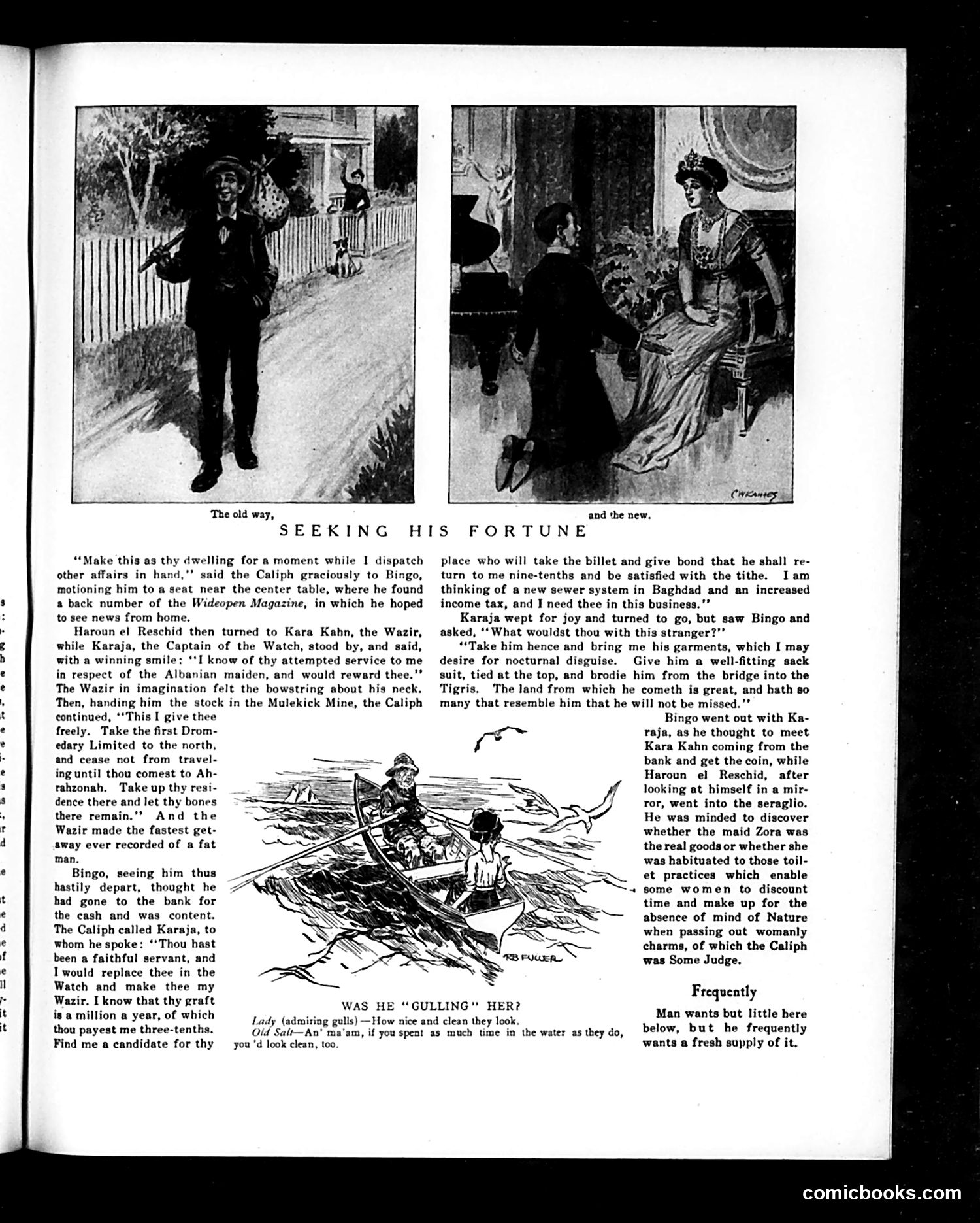
This page from *Judge* magazine presents a serialized satirical story set in a fictionalized Baghdad, using Oriental fantasy as a vehicle for American social commentary. The narrative satirizes **political corruption and graft**. The Caliph rewards his Wazir (minister) with worthless mining stock while dispatching him to a remote location—a humorous exaggeration of how corrupt officials receive "golden parachutes" or exile. The Caliph then appoints Karaja as the new Wazir, explicitly acknowledging that he expects the official to steal one million annually while returning only 30% in bribes—transparent satire of endemic government corruption. The unnamed American character "Bingo" serves as the outsider whose naiveté contrasts with this cynical system. His fate—being murdered for his clothing—mocks both the Caliph's vanity and the casual brutality of absolute rule. The bottom panel, "Was He 'Gulling' Her?", offers unrelated satirical commentary on cleanliness, mocking romantic courtship pretense. The dual illustrations titled "The old way, and the new" reinforce the contrast between traditional and modern approaches to fortune-seeking.
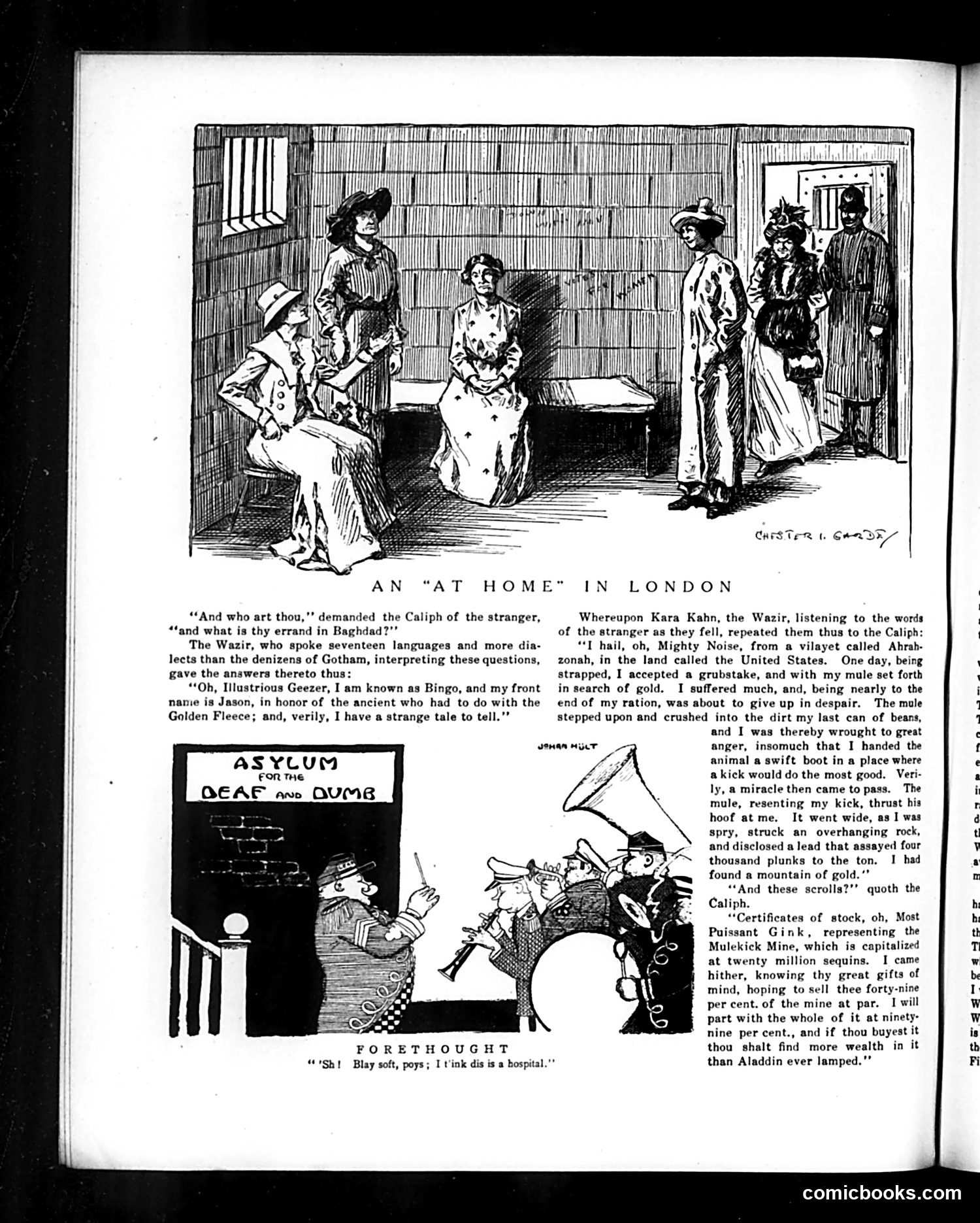
This page satirizes **wealthy American prospectors and stock schemers** of the early 1900s who courted European investors. The main cartoon depicts a con artist ("Bingo/Jason") pitching a mining stock scheme to a gullible audience in London, claiming a mule's kick discovered a fortune. The satire targets: 1. **American get-rich-quick schemes**: The absurd backstory (finding gold via mule-kick) mocks implausible prospector tales used to bilk investors. 2. **Stock manipulation**: The con offers "forty-nine per cent. of the mine at par" then "ninety-nine per cent."—exposing how scammers inflated valuations and percentages to defraud buyers. 3. **The "Asylum for the Deaf and Dumb" cartoon** below suggests such schemes appeal to those who cannot "hear" or "speak" sense. Judge magazine regularly lampooned American financial fraud and the credulity of international investors who fell for these schemes during the mining boom era.
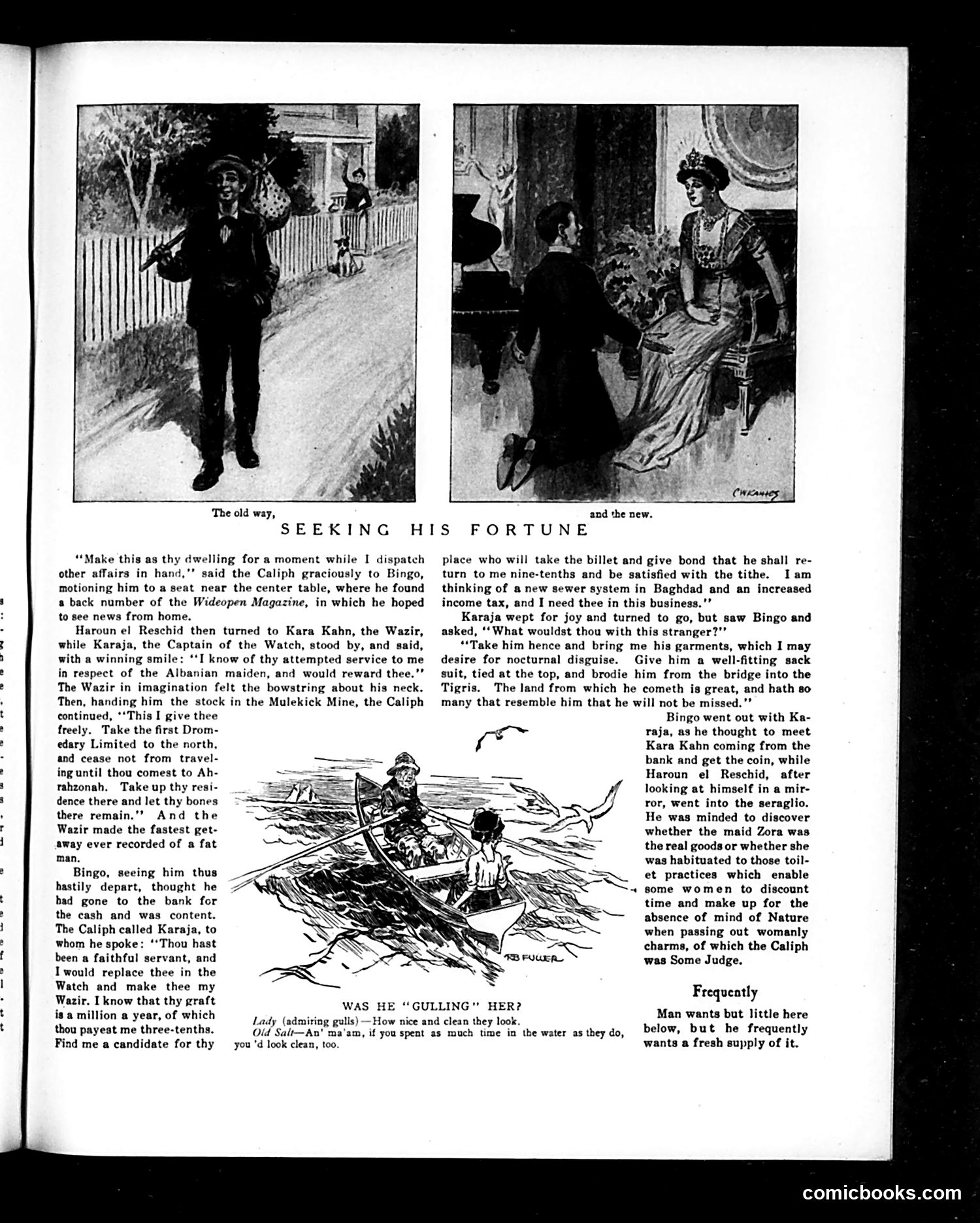
This page presents a serialized satirical story parodying Arabian Nights narratives, set in a fictional Baghdad ruled by "Haroun el Reschid" (the historical Caliph Harun al-Rashid). The humor targets early 1900s American greed and corruption through orientalist fantasy. **The satire:** A character named Bingo seeks fortune; the Caliph rewards courtiers with worthless mining stock ("Mulekick Mine") while arranging their deaths, and demands bribes disguised as "tithes"—mocking political patronage systems and financial fraud of the era. **The subplot:** The Caliph questions whether a woman's beauty is natural or achieved through cosmetic deception—typical period commentary on female appearance and authenticity. **Bottom joke:** A sailor explains seagulls look clean only because they spend time in water—a crude analogy about maintaining appearances. The "old way/new way" title contrast likely refers to traditional versus modern (corrupt) methods of seeking wealth.
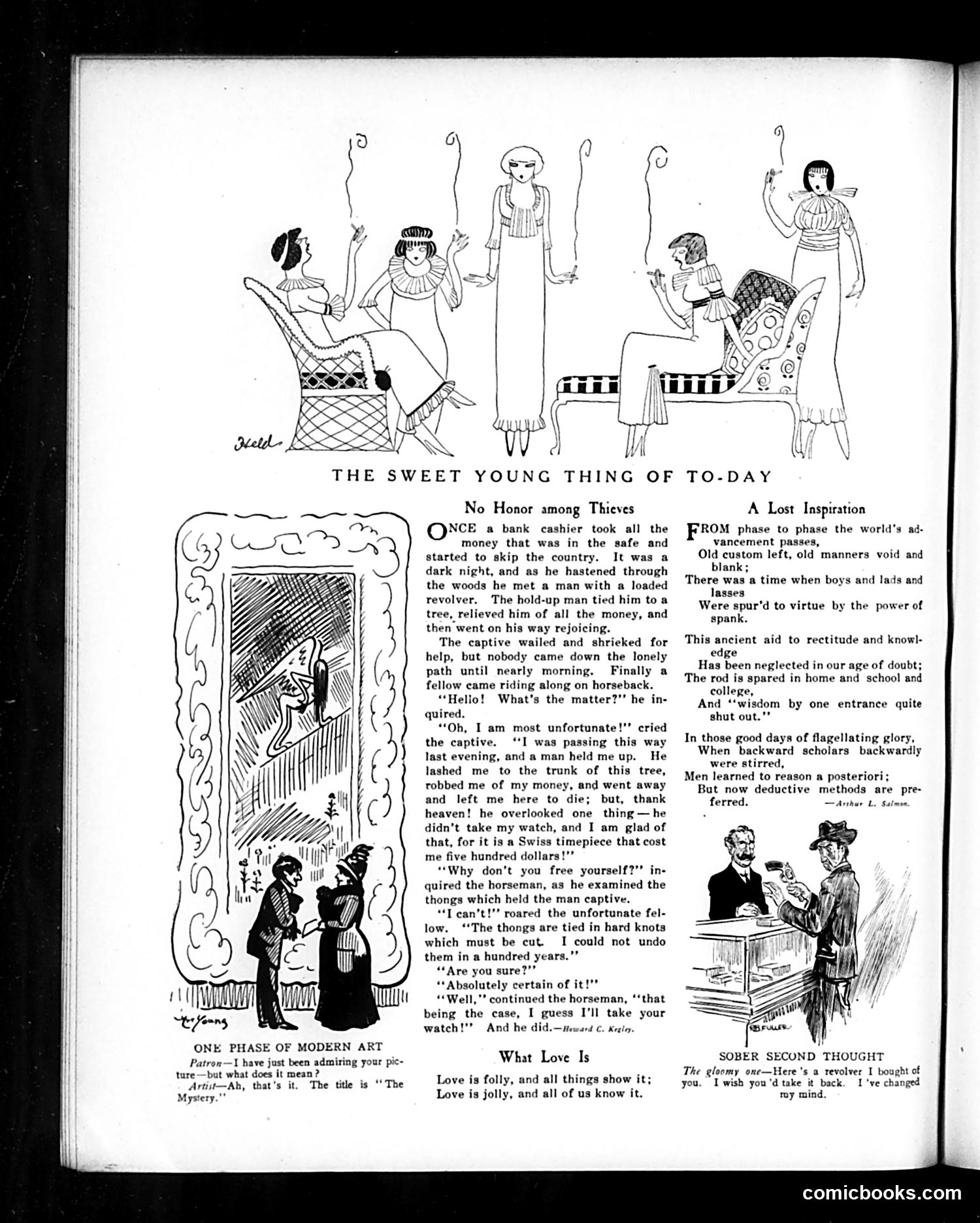
This page from the satirical magazine *Judge* contains several distinct pieces mocking early 20th-century society: **"The Sweet Young Thing of To-Day"** (top illustration): Depicts fashionable young women in flapper-style dress juggling or performing with curved objects, satirizing modern women's behavior and appearance as frivolous or absurd. **"One Phase of Modern Art"**: Mocks pretentious modern art by showing a patron confused about a painting titled "The Mystery"—the joke being that incomprehensibility itself has become the artistic point. **"No Honor among Thieves"**: A humor piece about ironic comeuppance: a robber steals from a bank cashier, then a highwayman steals from the robber. The cashier's concern that his expensive Swiss watch was overlooked (rather than his freedom) satirizes materialistic values. **"A Lost Inspiration"**: A poem lamenting the abandonment of corporal punishment in schools and homes, presenting spanking as essential to moral development—likely satirizing nostalgic attitudes about "the good old days." The page emphasizes social satire targeting modern manners, art pretension, and changing values.
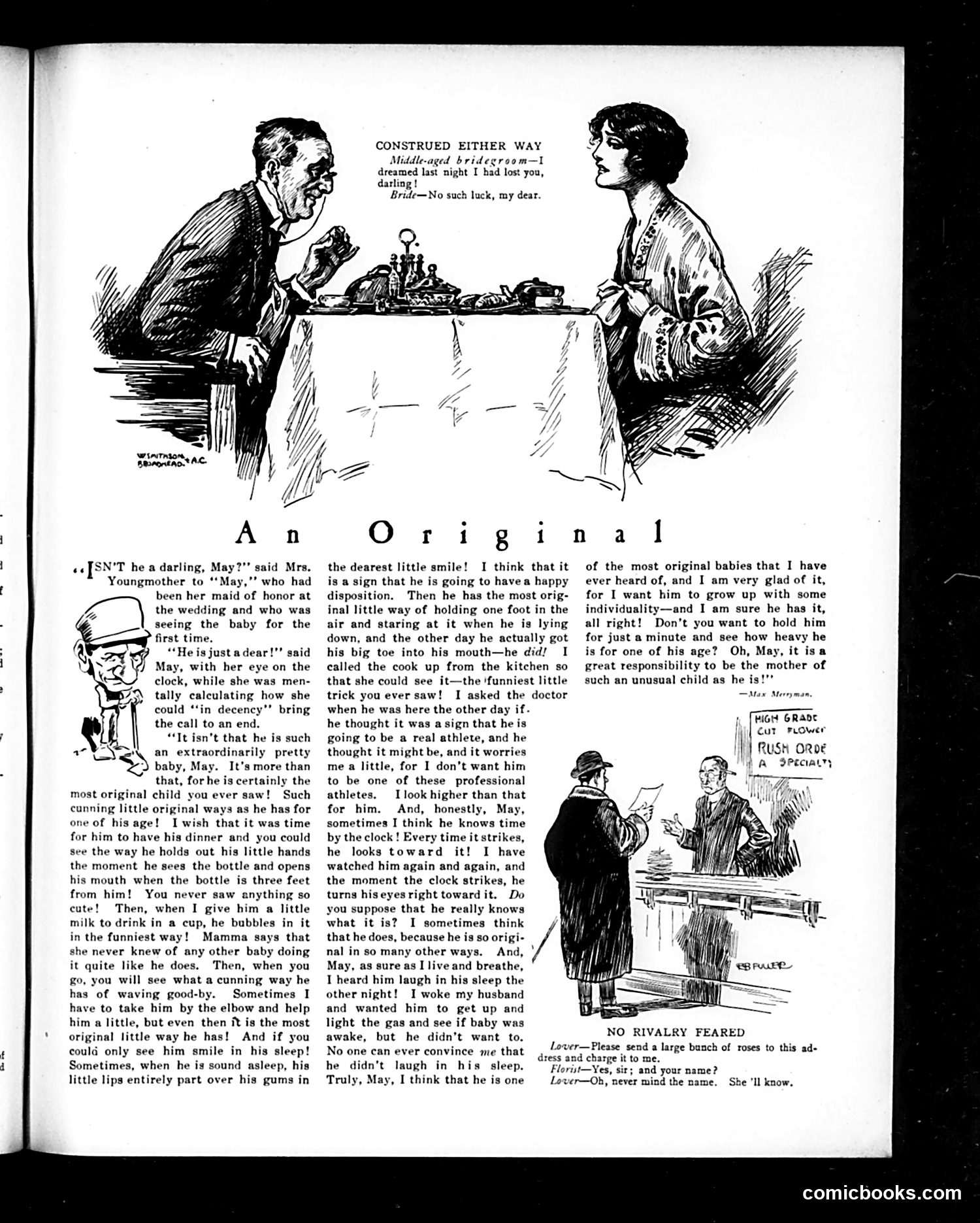
The main cartoon satirizes new mothers' tendency to describe utterly ordinary infant behavior as uniquely exceptional. Mrs. Youngmother exhaustively details her baby's "original" traits—holding out his hands for a bottle, waving goodbye, smiling in sleep, looking at his foot, even laughing while asleep—each presented as remarkable when these are standard developmental milestones. May, the former maid of honor, listens politely while mentally watching the clock, wanting the tedious visit to end. Her bored reaction contrasts with the mother's breathless enthusiasm, emphasizing how thoroughly unremarkable these behaviors actually are. The secondary cartoon "Construed Either Way" shows a newly married middle-aged man whose nightmare about losing his wife prompts her sarcastic reply: "No such luck, my dear"—a sharp joke about their marriage being undesirable. Both satirize domestic relationships through understatement and ironic contradiction.
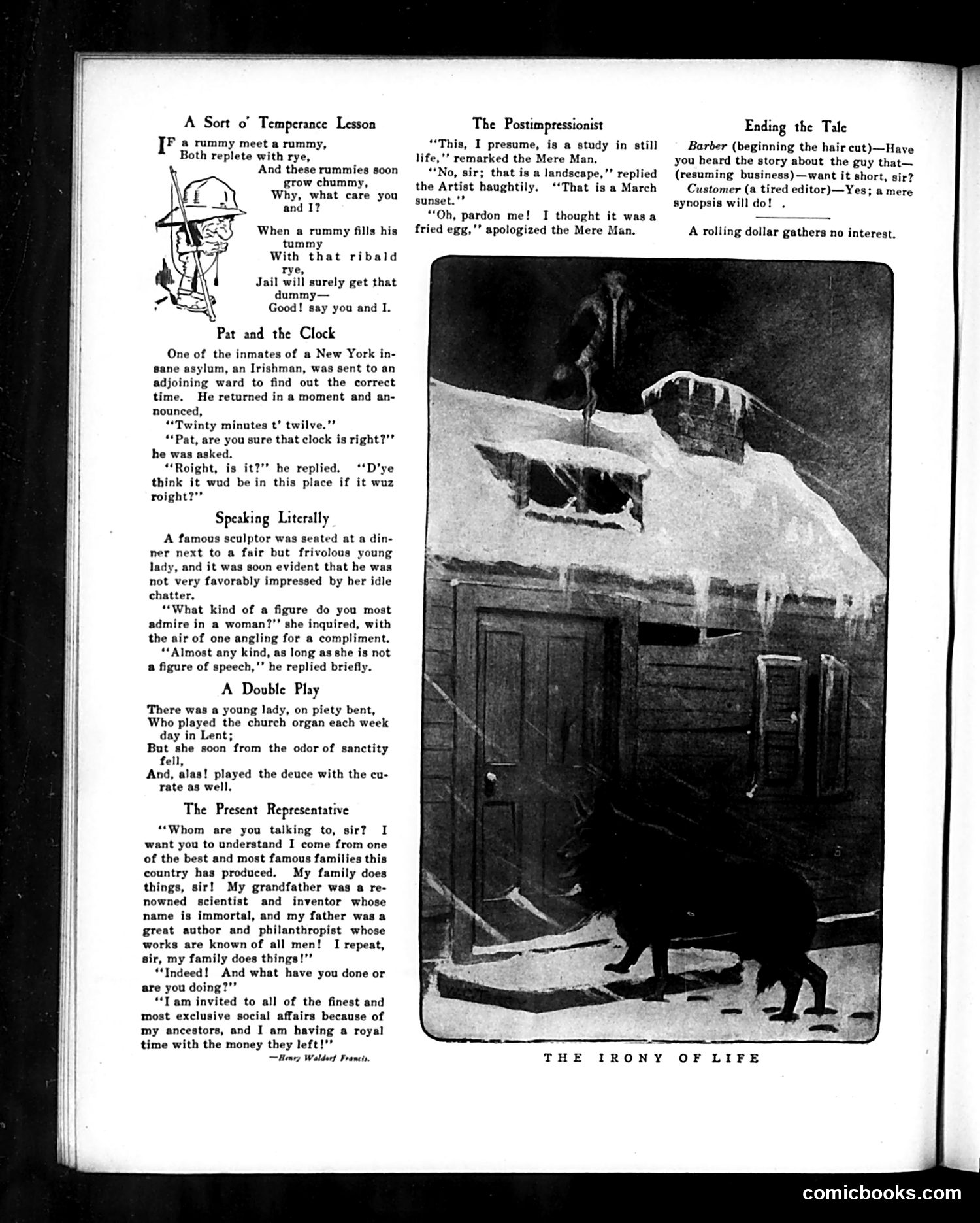
This page contains six humorous short pieces typical of early-20th-century American humor magazines: **"A Sort o' Temperance Lesson"** uses crude verse to mock drunks ("rummies") drinking whiskey ("rye"), suggesting jail awaits them—a prohibition-era temperance joke. **"Pat and the Clock"** is an Irish-stereotyped joke: an asylum inmate reports the time, and when questioned, replies the clock must be broken since it works correctly—implying insane asylums are illogical places. **"Speaking Literally"** features a sculptor dismissing shallow women; he prefers any figure except "a figure of speech"—wordplay mocking frivolous female socializing. **"A Double Play"** is a mild innuendo joke: a pious woman playing church organ during Lent "falls" from sanctity and "plays the deuce" with the curate (priest)—suggesting sexual impropriety. **"The Present Representative"** satirizes social climbers: a man boasts of famous ancestors while admitting he contributes nothing himself, merely attending parties with inherited wealth—mocking aristocratic pretension. **"The Irony of Life"** photograph's caption suggests idle wealth generates no returns—a financial joke.
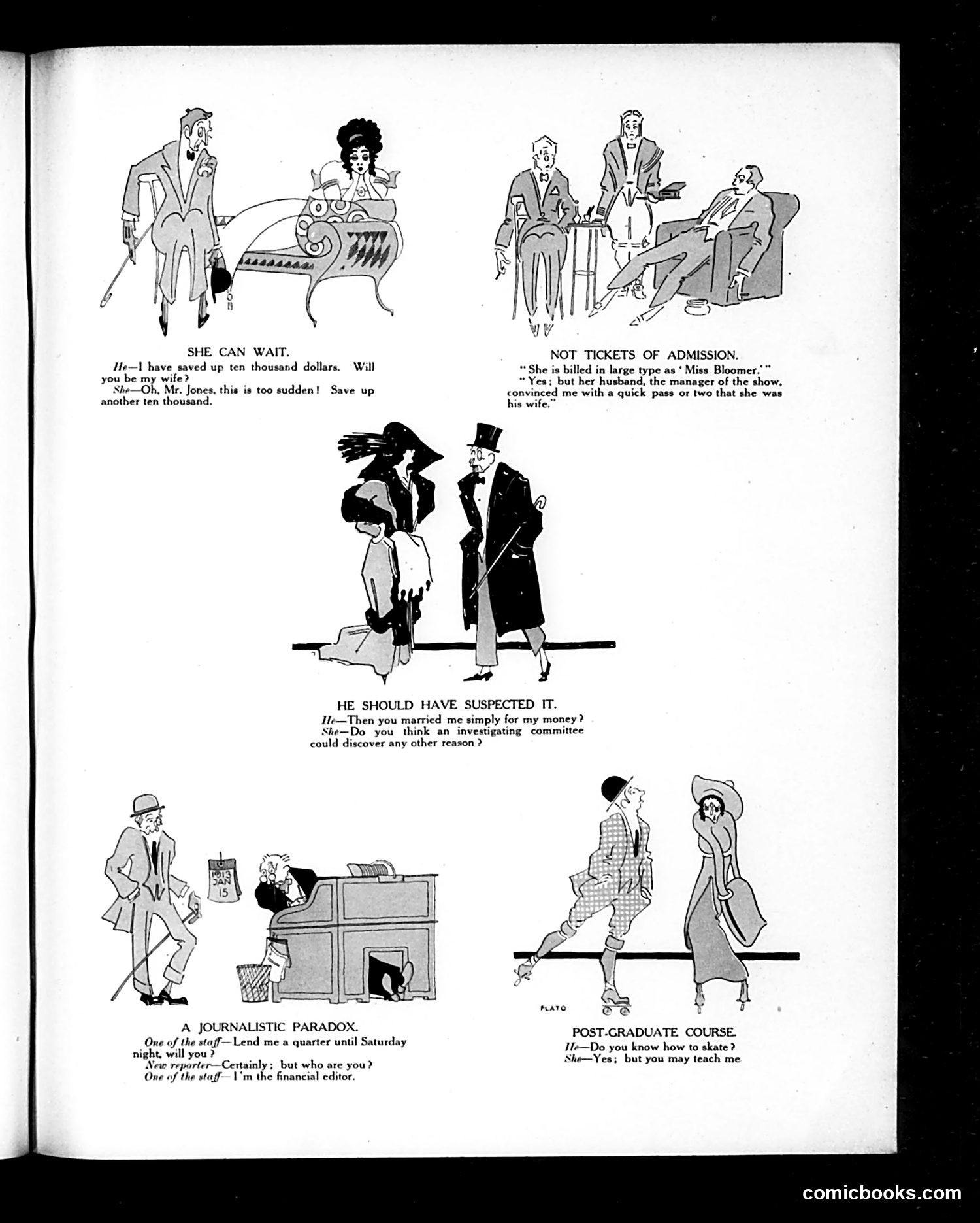
This page contains six standalone humor comics reflecting early 20th-century social attitudes: **"She Can Wait"** satirizes a woman's mercenary marriage expectations—she demands her suitor save *another* ten thousand dollars before accepting his proposal. **"Not Tickets of Admission"** jokes about a performer billed as "Miss Bloomer" (likely referencing bloomer costumes) whose husband/manager uses physical persuasion to prove she's actually his wife, not available for romance. **"He Should Have Suspected It"** mocks a husband discovering his wife married him solely for money; she sarcastically suggests an investigating committee couldn't find any other motivation. **"A Journalistic Paradox"** presents irony: the financial editor—supposedly knowledgeable about money—must borrow a quarter from a new reporter. **"Post-Graduate Course"** depicts a woman asking a man to teach her roller skating, implying ulterior romantic motives beyond athletic instruction. The comics collectively satirize marriage for financial gain, women's dependence, workplace hierarchy, and courtship pretenses—typical Judge magazine humor targeting middle-class anxieties.
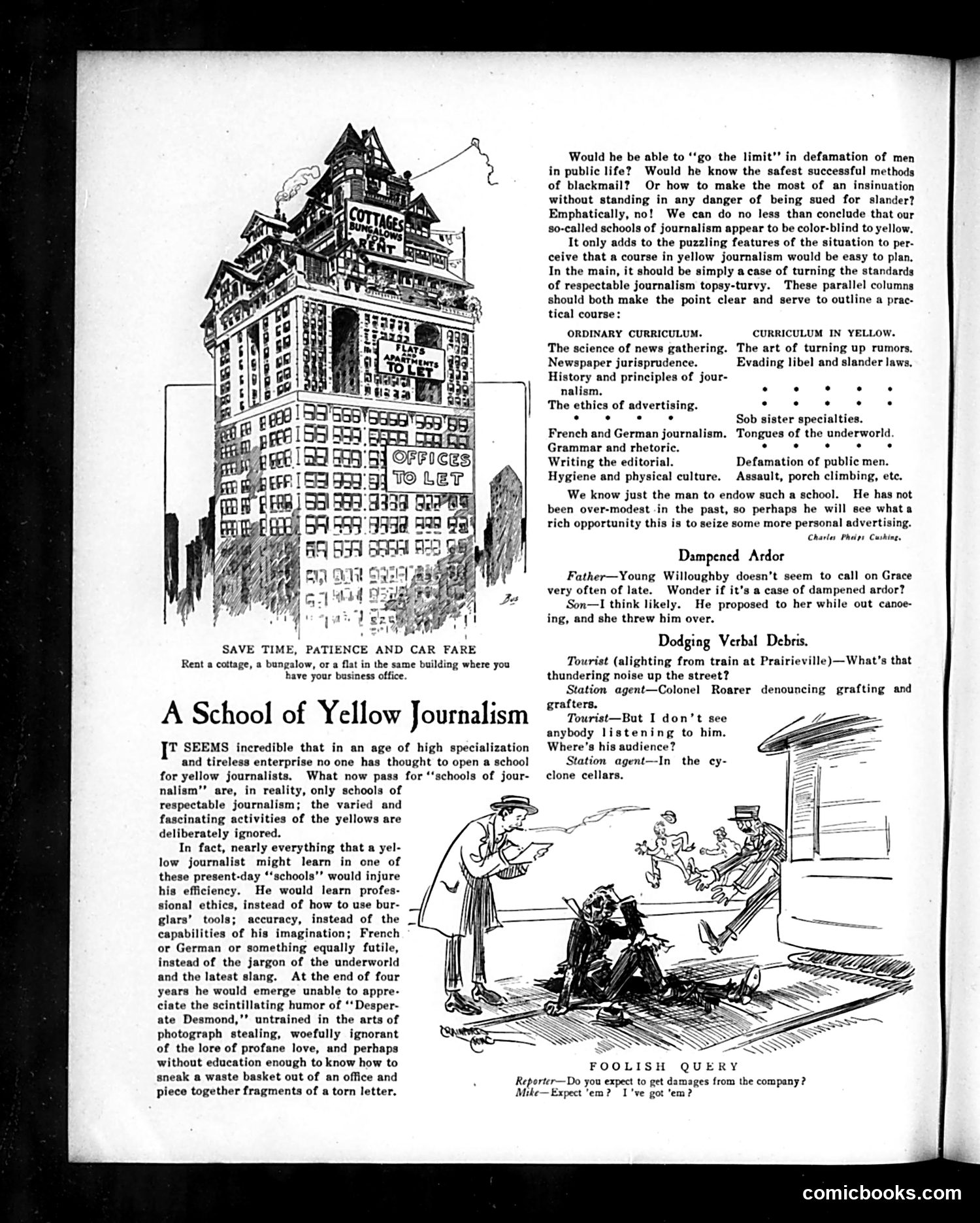
This satirical article mocks the ethical deficiencies of "yellow journalism"—sensationalist, unscrupulous newspaper practices popular in the late 19th/early 20th century. The piece sarcastically proposes establishing a formal school to train yellow journalists in their dubious "skills." The humor lies in the comparison: respectable journalism teaches ethics, accuracy, and proper language; yellow journalism would teach rumor-mongering, libel evasion, blackmail methods, photograph theft, and consulting criminal slang. The author suggests that current journalism schools fail because they teach actual professional standards instead of the underhanded tactics yellow journalists actually employ. The accompanying cartoons mock petty urban life—a damaged romantic proposal and a loudmouth politician with no audience. The piece satirizes not just yellow journalism itself, but the notion that such corrupt practices could be systematized and taught institutionally.
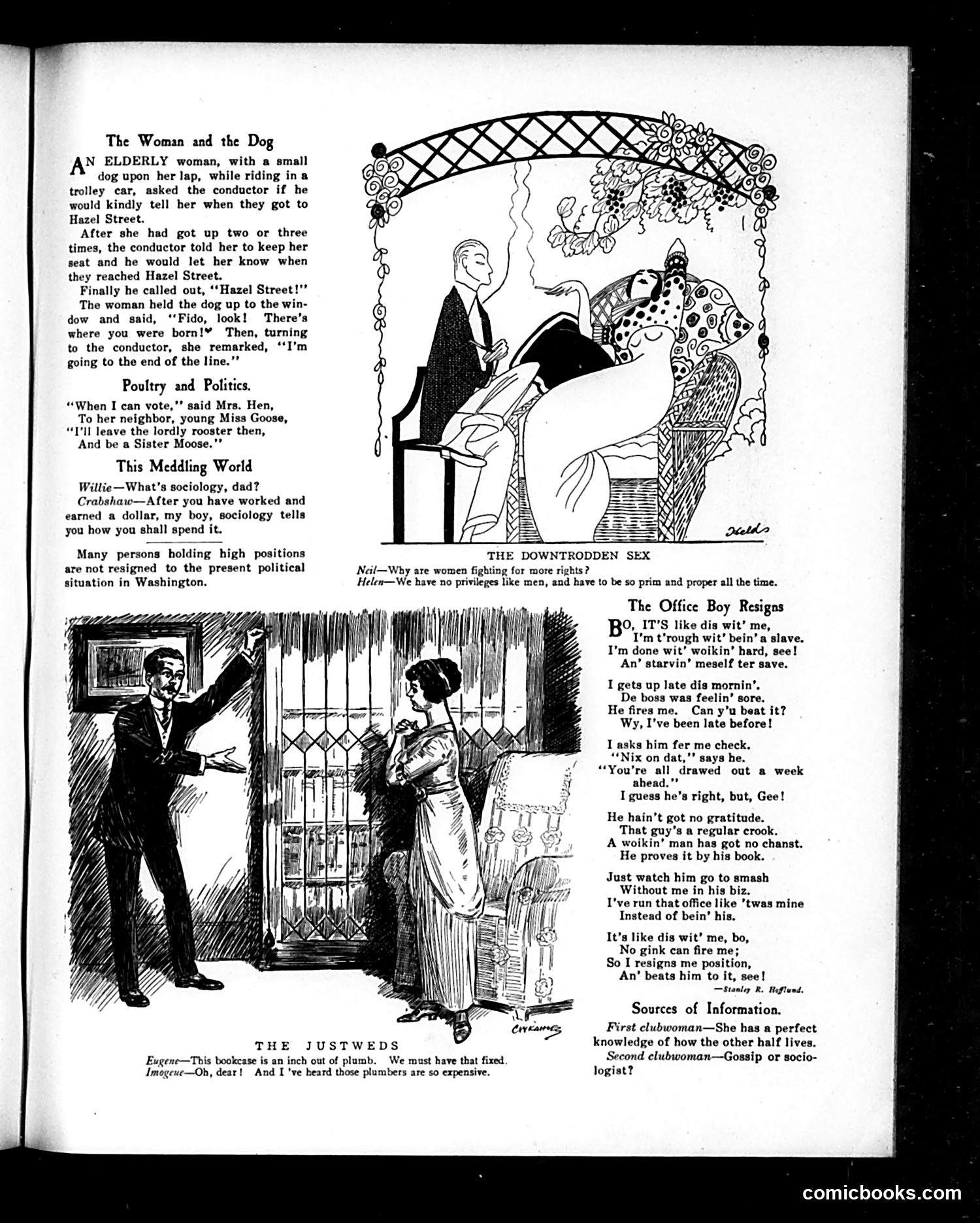
This page contains several brief satirical pieces typical of early 20th-century American humor: **"The Woman and the Dog"**: A joke about an elderly woman repeatedly asking a trolley conductor about her stop, then revealing the dog was born there—absurd sentimentality mocked. **"Poultry and Politics"**: Satire on women's suffrage. A hen declares she'll abandon domestic life (the rooster) once she can vote, suggesting women see voting as liberation from traditional roles. **"This Meddling World"**: Sociology is mocked as government control over workers' earnings—reflecting anxiety about economic regulation and class tension. **"The Office Boy Resigns"**: Written in working-class dialect, this poem satirizes an employee who quits after being fired without severance, blaming his boss while ironically claiming he made the business successful. It critiques both workplace exploitation and workers' entitled attitudes. **"The Justweds"**: A couple worries about home repairs and expensive plumbers—domestic comedy. The overall tone reflects Judge's satirical approach to labor relations, women's rights, and class anxieties of the era.
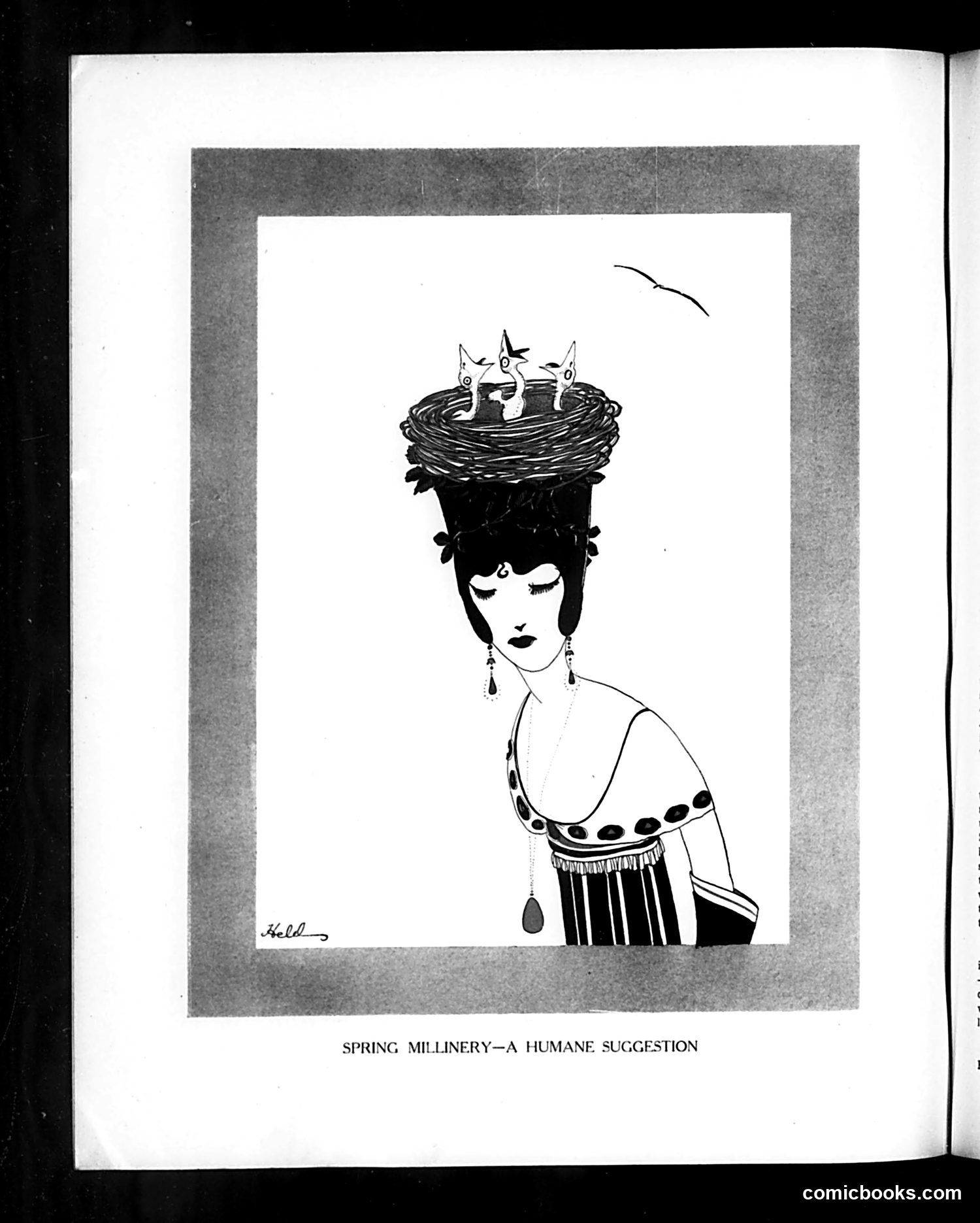
This satirical illustration mocks the elaborate bird-decorated hats that were fashionable in the early 20th century. The drawing shows a woman wearing an outrageous spring hat topped with a nest containing three live baby birds, complete with a flying parent bird above. The "humane suggestion" is darkly ironic: rather than kill birds to decorate hats (a common practice at the time), why not simply keep living birds on your head? The joke criticizes the cruelty of the millinery industry, which decimated bird populations for feathers and ornaments. This reflects genuine period concern: the Audubon Society and animal-welfare advocates actively fought the fashion industry's practice of using dead birds and feathers in women's hats.
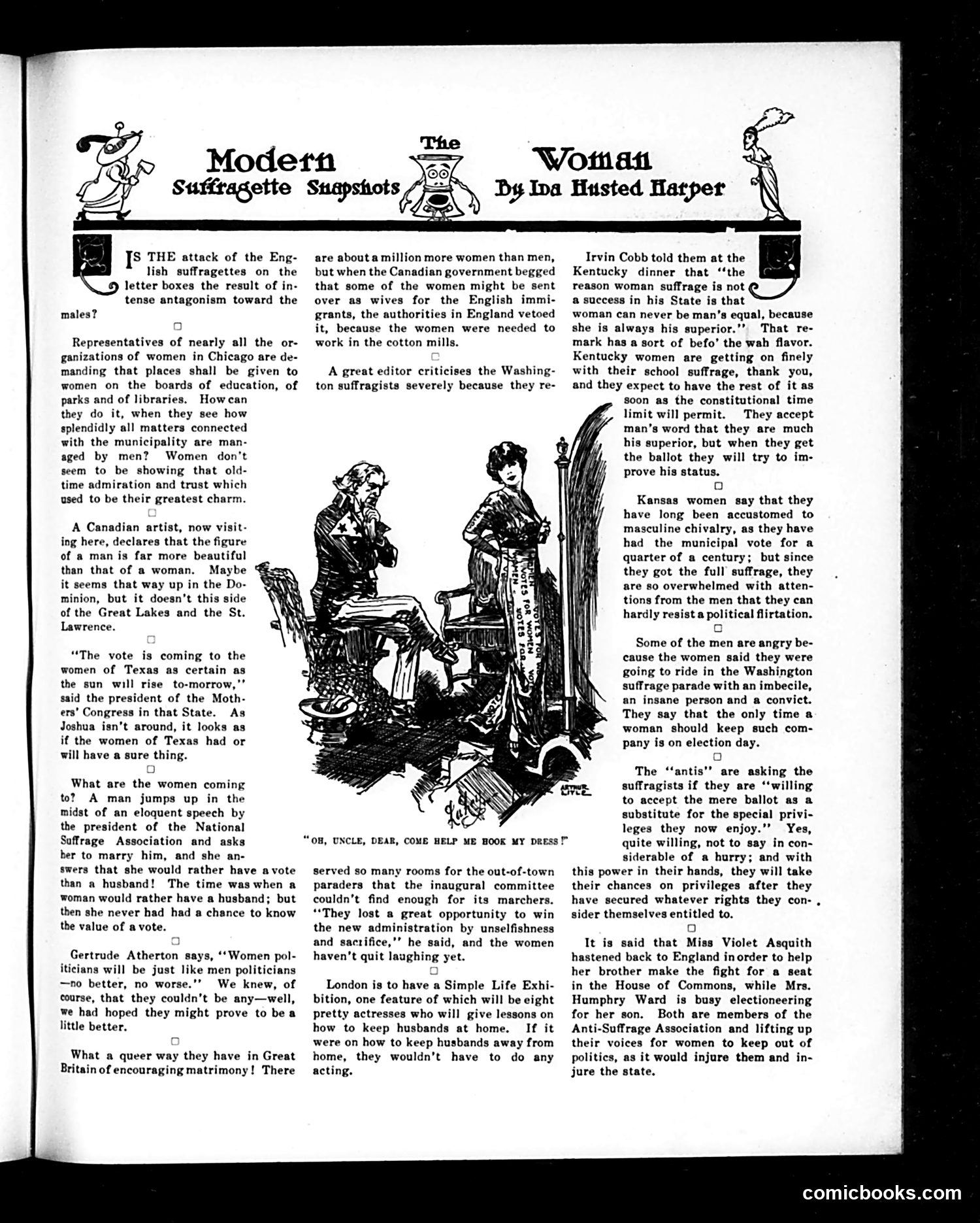
This page from *Judge* magazine satirizes anti-suffrage arguments through mock-serious commentary. The cartoon shows a man asking a woman to help him dress—a visual joke highlighting male dependence on women despite claims of superiority. The text collects anecdotes mocking opponents' positions: a Canadian artist claiming men are more beautiful than women; a man suggesting women prioritize marriage over voting rights; critics attacking suffragists for "unselfishness"; and Irvin Cobb's paternalistic claim that women can't equal men because they're "always superior." The satire's point: anti-suffragists contradict themselves—simultaneously claiming women are inferior yet need male protection, and denying them rights while depending on their labor. References to Texas, Kansas, and Kentucky women gaining voting rights suggest momentum toward suffrage. The piece uses absurdity to expose the illogic of opposition arguments.
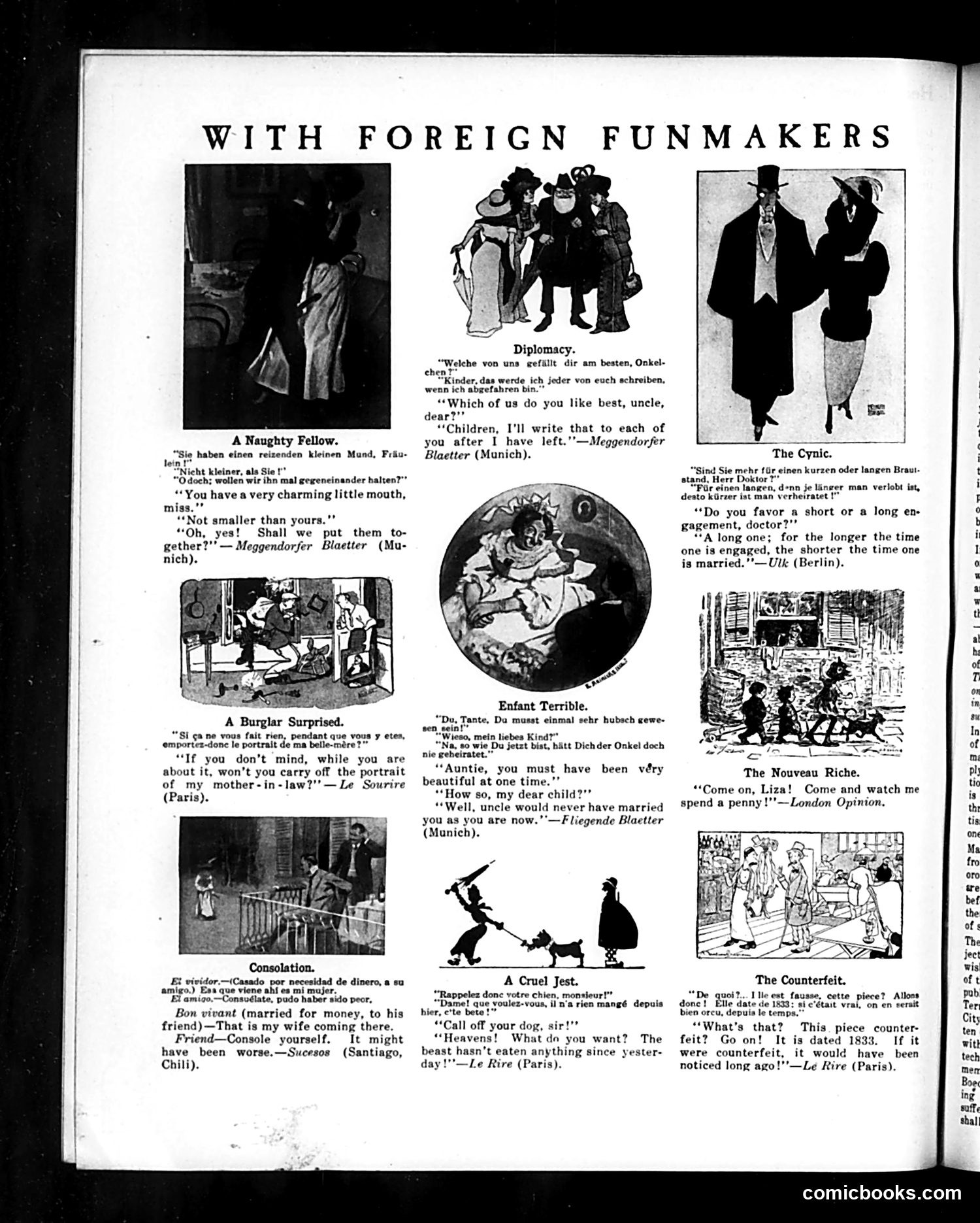
This page collects brief satirical jokes from European humor magazines, translated for American readers. The cartoons mock universal human follies: **"A Naughty Fellow"** and **"Diplomacy"** joke about flirtation and family favoritism—timeless social observations. **"A Burglar Surprised"** depicts dark humor about an unwanted mother-in-law (a stock comic target). **"Enfant Terrible"** shows a child's tactless honesty insulting an aunt's appearance. **"The Cynic"** cynically suggests engagements are longer than marriages. **"A Cruel Jest"** plays on a starving dog. **"The Nouveau Riche"** references newly wealthy people (implying ostentatious spending). **"The Counterfeit"** jokes that an obviously fake old coin shouldn't have gone undetected so long. These represent Judge's practice of publishing European humor to amuse educated American audiences with sophisticated, if occasionally mean-spirited, wit about universal human behavior rather than specific political events.
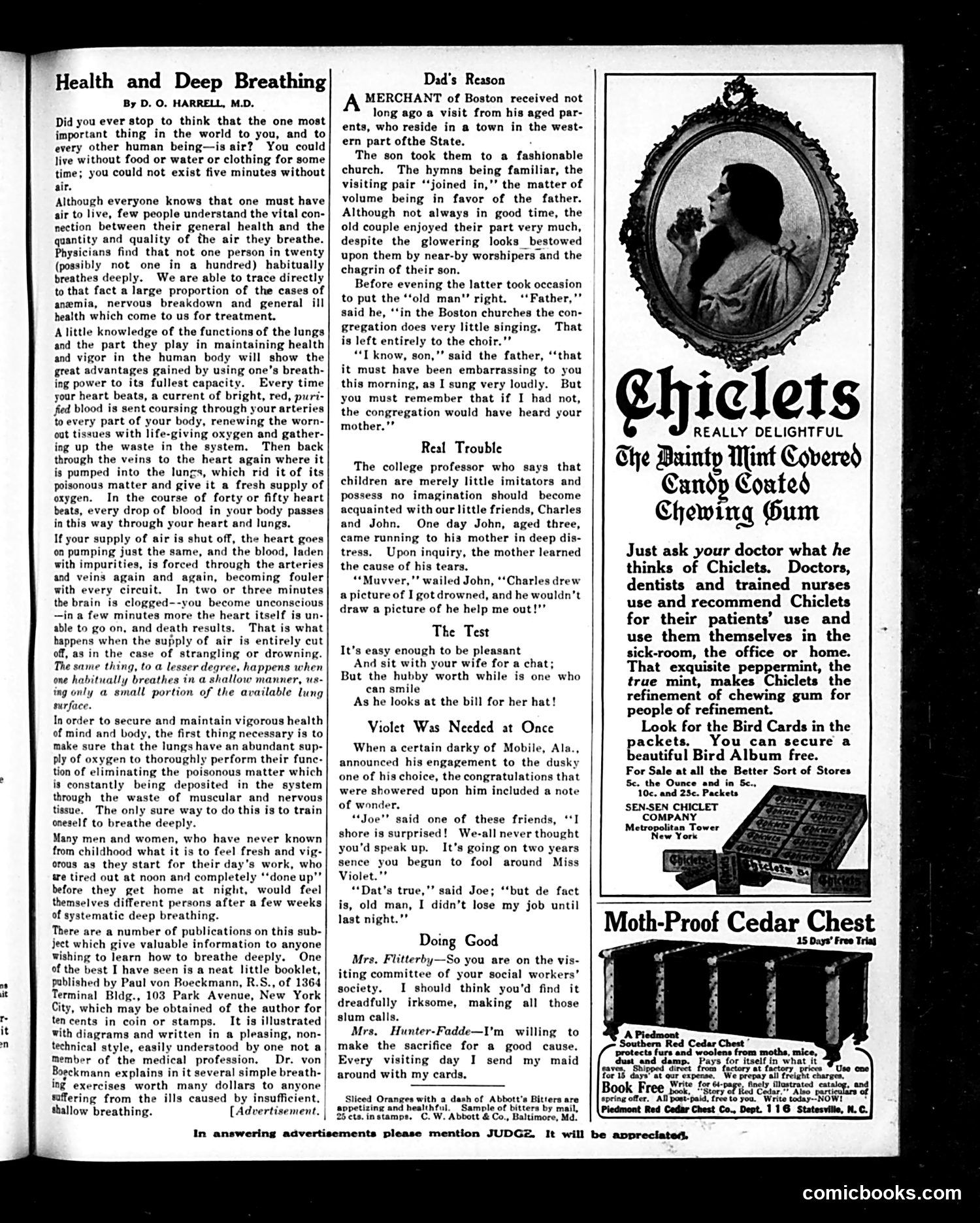
This page is primarily **medical and advertising content**, not political satire in the traditional Judge magazine sense. The main article by Dr. Harrell advocates "deep breathing" as a health cure-all—reflecting early 20th-century pseudoscientific wellness trends popular in that era. The author claims shallow breathing causes anemia, nervous breakdown, and general illness, promoting his dubious theory with anatomical-sounding explanations. The page includes several unrelated anecdotes (a father and son at church, college students' imaginations, a couple's marital quarrel) that appear designed to fill space and provide gentle humor rather than satire. The advertisements—for **Chiclets gum**, cedar chests, and breathing booklets—capitalize on contemporary health concerns. This reflects the era's tendency to market everyday products as medical remedies, which Judge would typically mock, though here it reads as straightforward promotion. The content represents the magazine's shift toward general-interest material rather than pure political commentary.
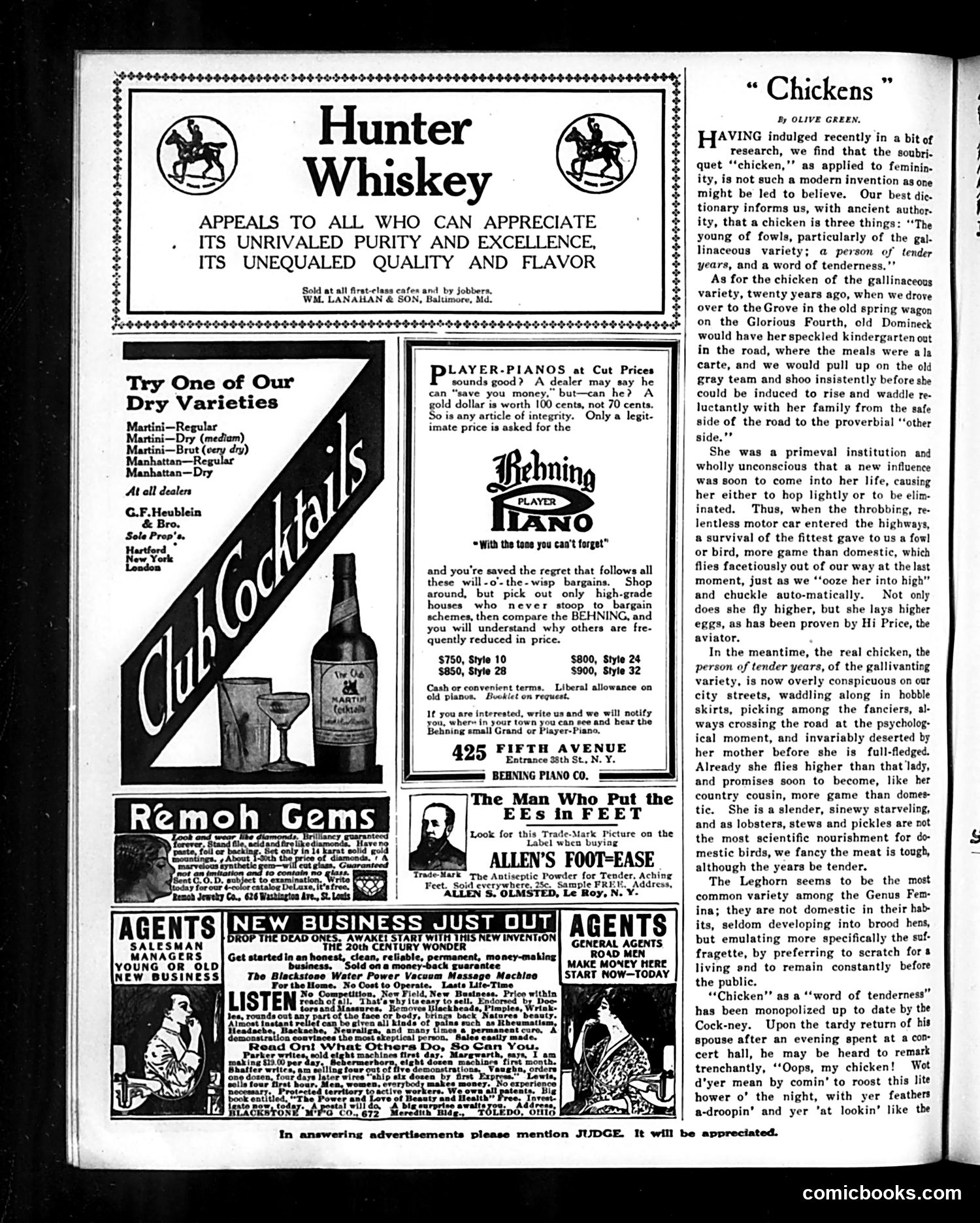
This page is primarily **advertising** with one notable editorial piece: an essay by Olive Green titled "Chickens." The essay is a **humorous social commentary** playing on the word "chicken" in three traditional senses: young fowl, young people, and a term of endearment. Green uses this wordplay to critique modern urban life and changing social customs. The satire contrasts the old-fashioned barnyard chicken (docile, domestic, from "twenty years ago") with two modern varieties: automobiles have made literal chickens faster and more elusive, and young women ("chicken" as slang for girls) are now more independent, visible in public spaces, wearing fashionable hobble skirts, and behaving less obediently than their mothers' generation. The piece gently mocks both technological change and evolving female social behavior—particularly young women's newfound mobility and visibility in city streets—as departures from traditional domesticity.
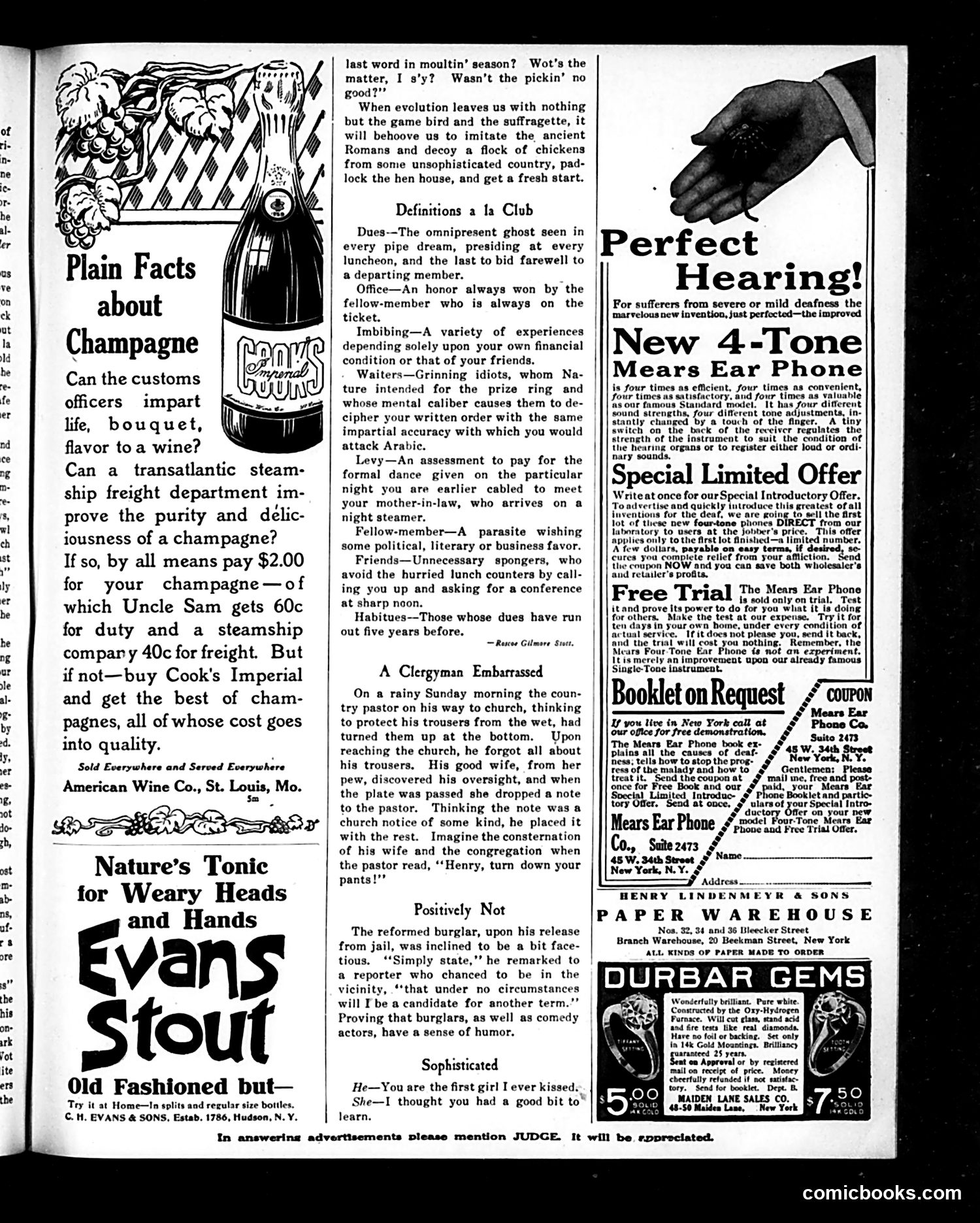
This is primarily a **magazine advertising page** from Judge (early 20th century), with several unrelated paid advertisements and humorous short pieces. The **cartoon/joke content** includes: - **"Plain Facts about Champagne"**: A wine advertisement disguised as consumer advice—sarcastically suggesting imported champagne is overpriced due to customs duties and shipping costs. - **Club member satire**: Comic definitions mocking club life (dues as "omnipresent ghosts," offices awarded to loyal time-servers, etc.). - **"A Clergyman Embarrassed"**: Anecdote humor about a pastor who forgets to unroll his trouser cuffs at church; his wife's note telling him to "turn down your pants" is mistaken for a formal notice and read aloud. - **"Positively Not"**: Joke about a reformed burglar claiming he won't run for office again. The page reflects early 1900s American satirical humor targeting social pretension, organizational absurdity, and domestic situations. The **suffragette reference** ("game bird and the suffragette") appears in an unrelated evolution joke, reflecting contemporary debates about women's rights.
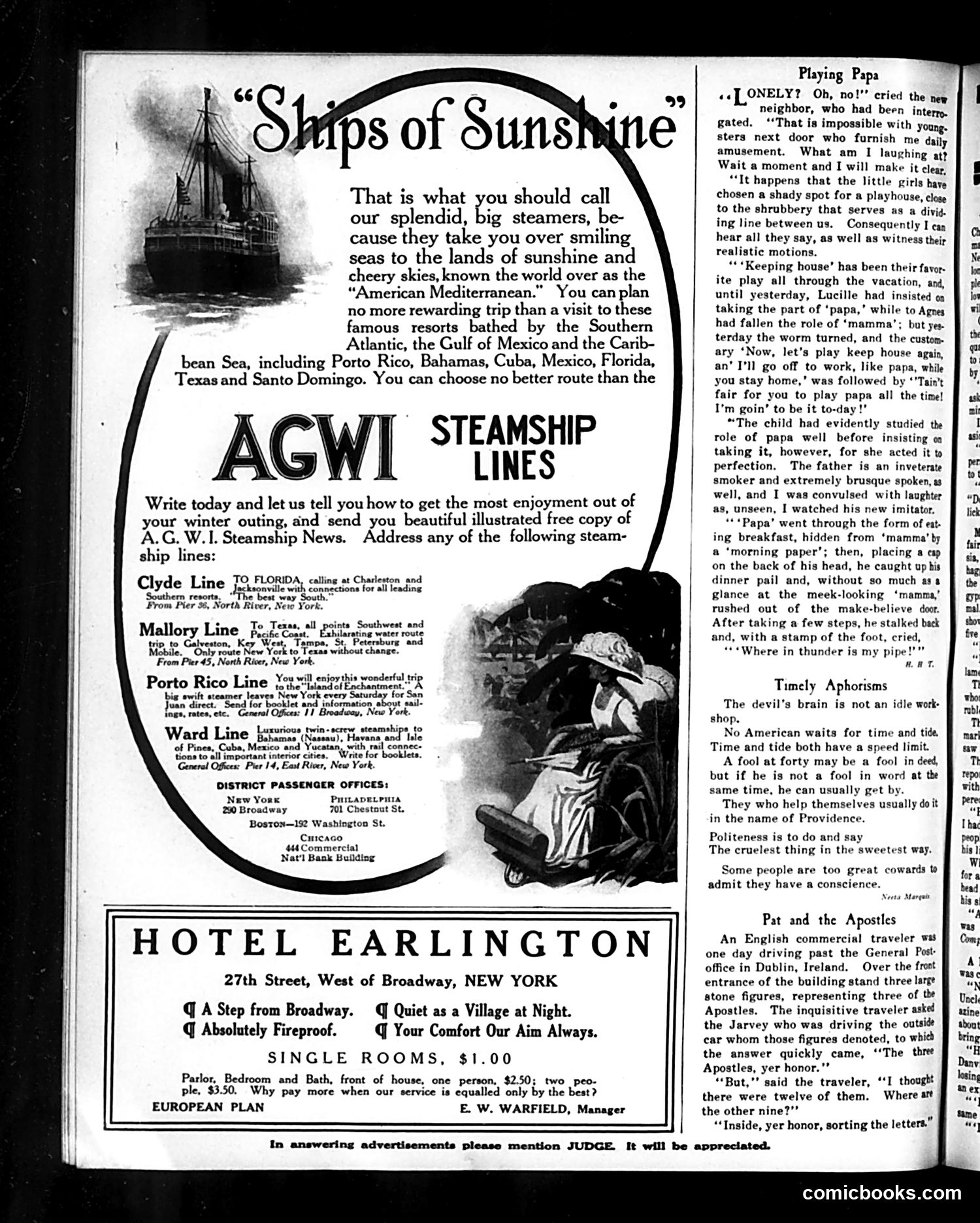
This page is primarily **advertising**, not political satire. It features steamship line promotions (AGWI, Clyde Line, Mallory Line, etc.) advertising winter cruises to sunny Caribbean and Southern U.S. destinations—positioned as the "American Mediterranean." The only humorous content is a brief anecdote titled "Playing Papa" (right column), which describes a neighbor observing neighborhood children playing house. The joke centers on a young girl imitating her father's behavior: a brusque, newspaper-reading smoker who rushes off to work without acknowledging his "wife." The humor derives from the child's surprisingly accurate mimicry of adult male domesticity—the detached, gruff father figure was apparently a recognizable social type to Judge's readers. The page contains **no political cartoons or caricatures**. It's essentially a commercial spread with light domestic humor appealing to middle-class magazine readers.
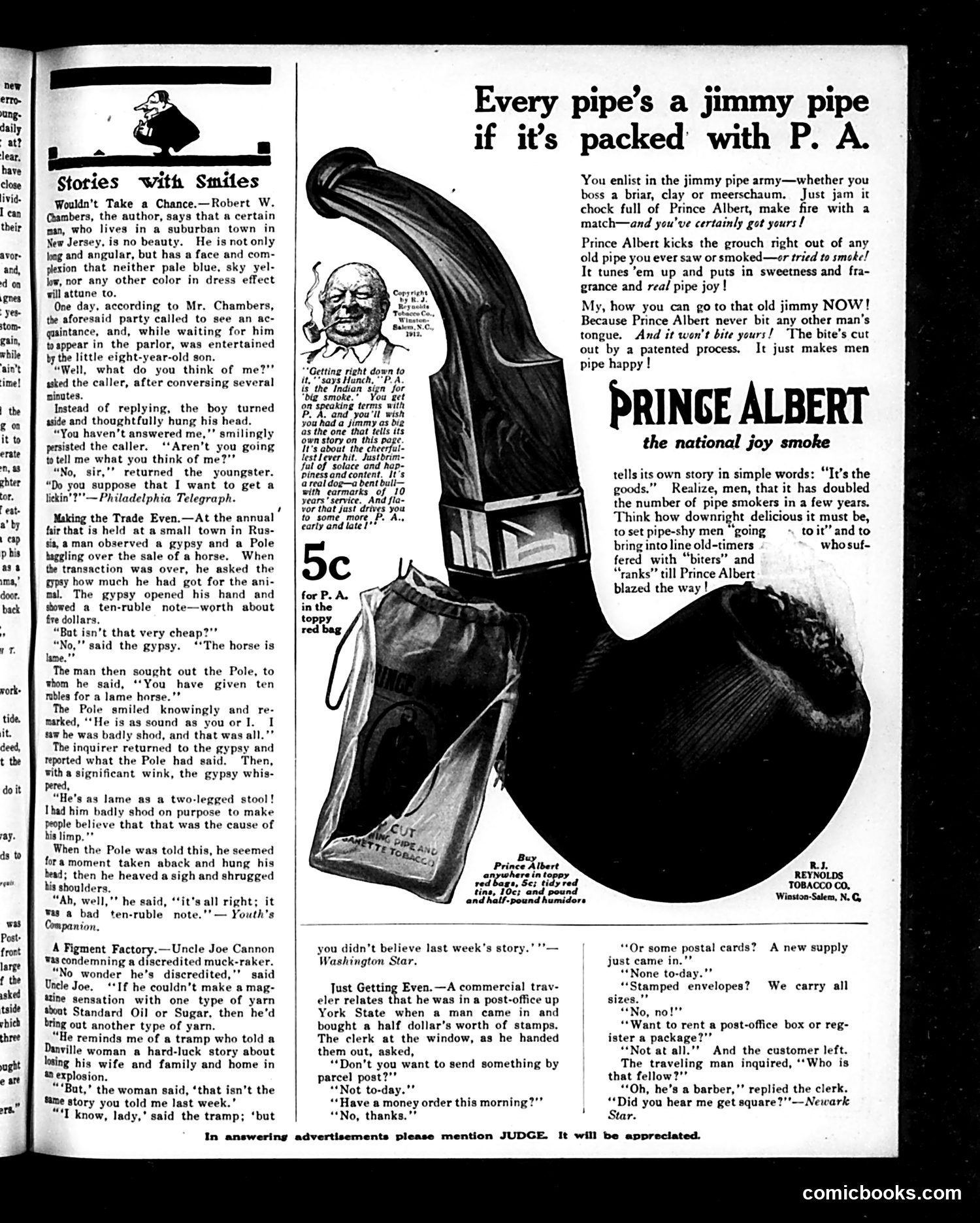
This page contains humorous short stories and a tobacco advertisement. **The Stories:** Three brief comedic anecdotes illustrating human folly: a homely man asking a child's opinion (child wisely refuses to answer), a gypsy and Pole trading a lame horse (each believing they've outsmarted the other), and Uncle Joe Cannon criticizing a "muck-raker" journalist for recycling scandal stories. **The Advertisement:** The dominant right side features a large Prince Albert pipe tobacco ad. It uses casual dialect ("Getting right down to it, says Hunch") and promises that Prince Albert tobacco, packed in any pipe ("jimmy pipe"), enhances smoking pleasure without the biting sensation other tobaccos cause. The copy emphasizes the product's universal compatibility and superior quality. **Context:** This appears to be early 20th-century advertising merged with light satire—typical of Judge's format mixing entertainment with commercial content. The reference to "muck-raker" journalists suggests progressive-era skepticism about sensationalism.
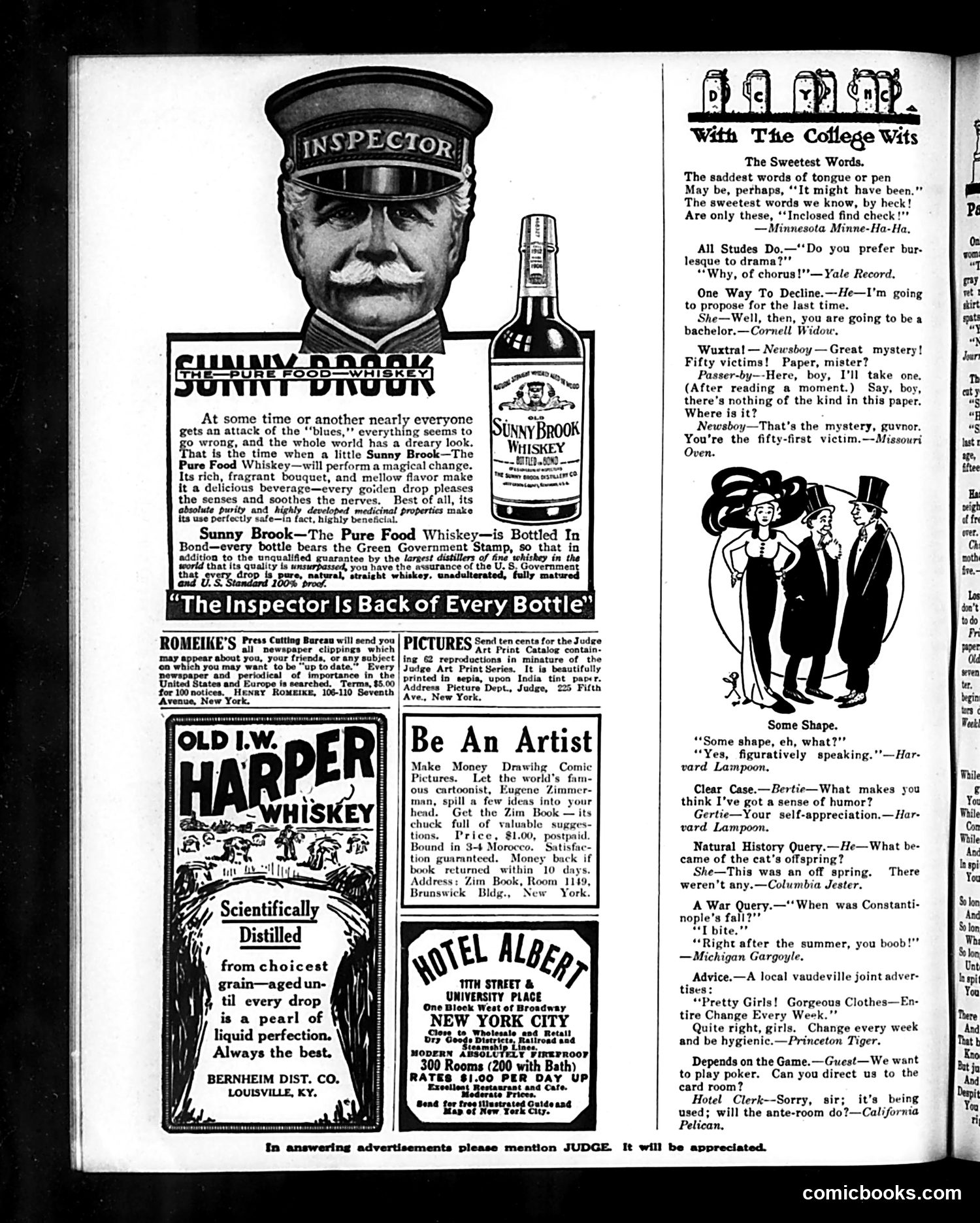
This is primarily a **whiskey advertisement page** from Judge magazine, with small comic content alongside. The dominant image shows an "Inspector" character endorsing Sunny Brook whiskey, claiming it's a "Pure Food Whiskey" bottled under government supervision—a key selling point in the early 1900s when food safety was a major consumer concern. The page also advertises Old I.W. Harper whiskey and includes small humor items ("With The College Wits") featuring college newspaper jokes about romance, mystery, and social situations. A secondary ad promotes learning cartooning from Eugene Zimmerman's instructional book. **Historical context**: This reflects pre-Prohibition America (likely 1910s) when whiskey was marketed as medicinal and wholesome. The "Pure Food" and government stamp references evoke the 1906 Pure Food and Drug Act, used here to legitimize the product. The college humor represents typical early-twentieth-century undergraduate wit from various universities.
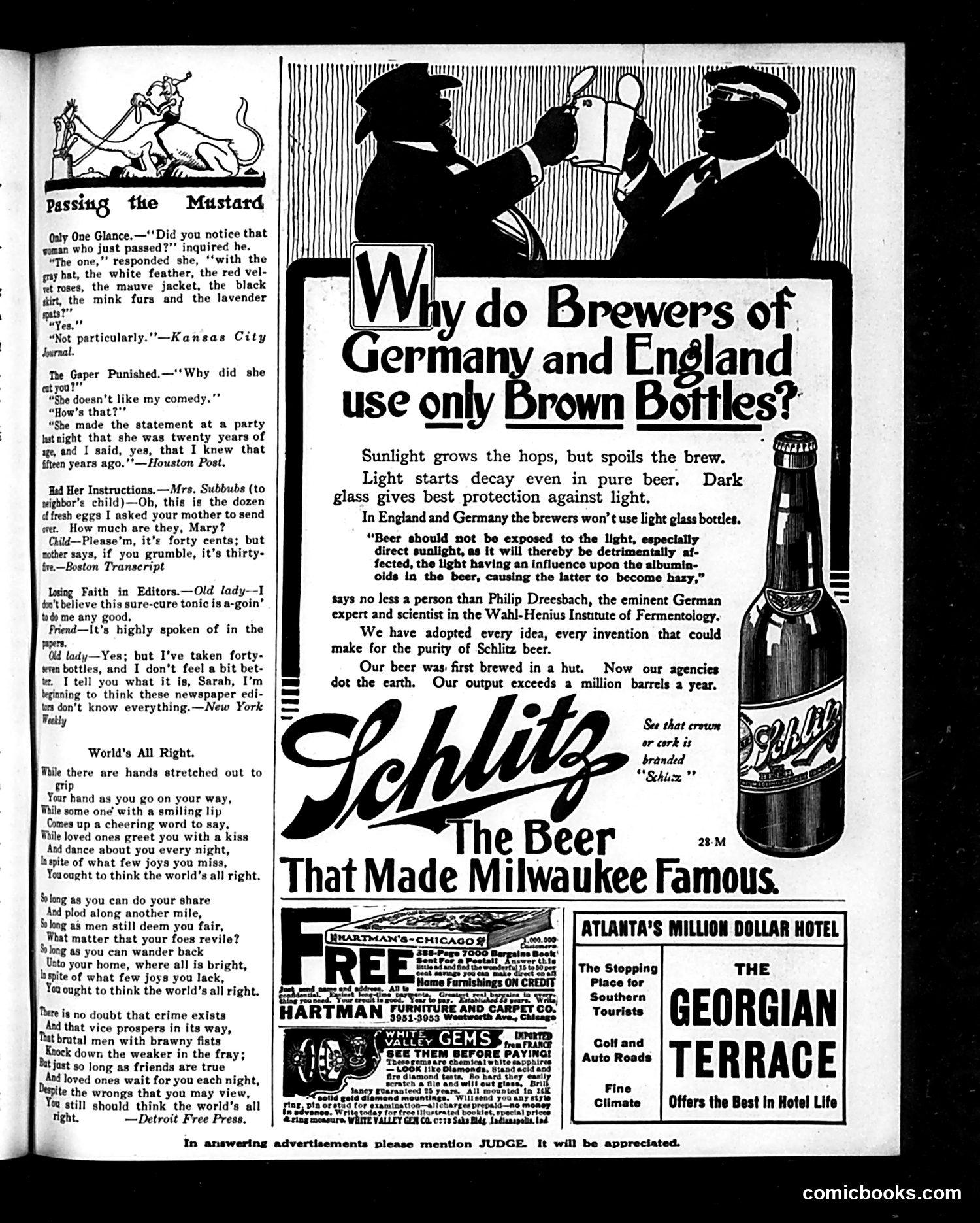
This page contains primarily **short humorous anecdotes** on the left side and a **Schlitz beer advertisement** dominating the right half. The anecdotes are brief jokes about social observation, comeuppance, and faith in institutions—typical of Judge's satirical humor. They mock vanity ("Only One Glance"), hecklers ("The Gaper Punished"), and gullibility toward patent medicines and newspaper endorsements. The **Schlitz advertisement** is the significant content. It argues that German and English brewers exclusively use brown bottles to protect beer from light damage, which causes deterioration. The ad invokes scientific authority (Philip Dreesbach from the Wahl-Henius Institute) to legitimize the claim and positions Schlitz as adopting "every idea, every invention" for purity. This addresses early 20th-century consumer concerns about product quality and scientific progress—selling beer through appeals to chemistry and international best practices rather than taste alone. The page reflects period anxieties about authenticity, expertise, and industrial modernity.
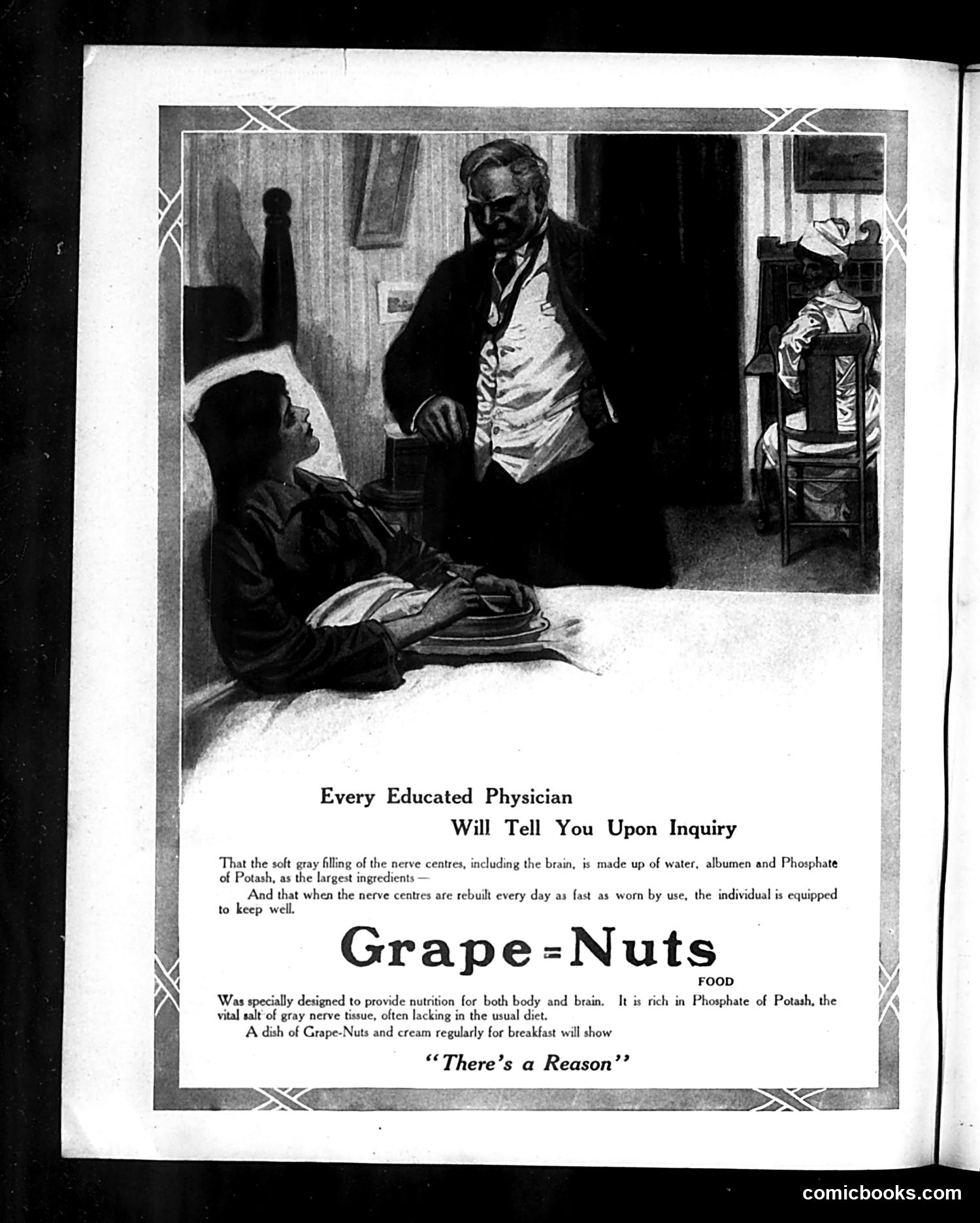
This is a **Grape-Nuts cereal advertisement**, not a satirical cartoon. The image depicts a physician visiting a bedridden patient—a common early 20th-century scene representing illness or weakness. The advertisement makes a pseudo-scientific health claim: that nerve tissue requires phosphate of potash, and Grape-Nuts cereal contains this ingredient, therefore improving brain function and overall wellness. The physician figure serves to lend medical authority to the product claim. The tagline **"There's a Reason"** was Grape-Nuts' actual historical marketing slogan, implying scientific backing for eating the cereal. By modern standards, this represents **false medical advertising**—claiming a breakfast food can rebuild nerve tissue and cure illness. Such direct health claims would violate modern FDA regulations. The appeal to physician authority without actual endorsement was typical of early 1900s marketing before advertising standards were established.