
Judge, 1913-03-22 · page 17 of 26
Judge — March 22, 1913 — page 17: what you’re looking at
What you’re looking at
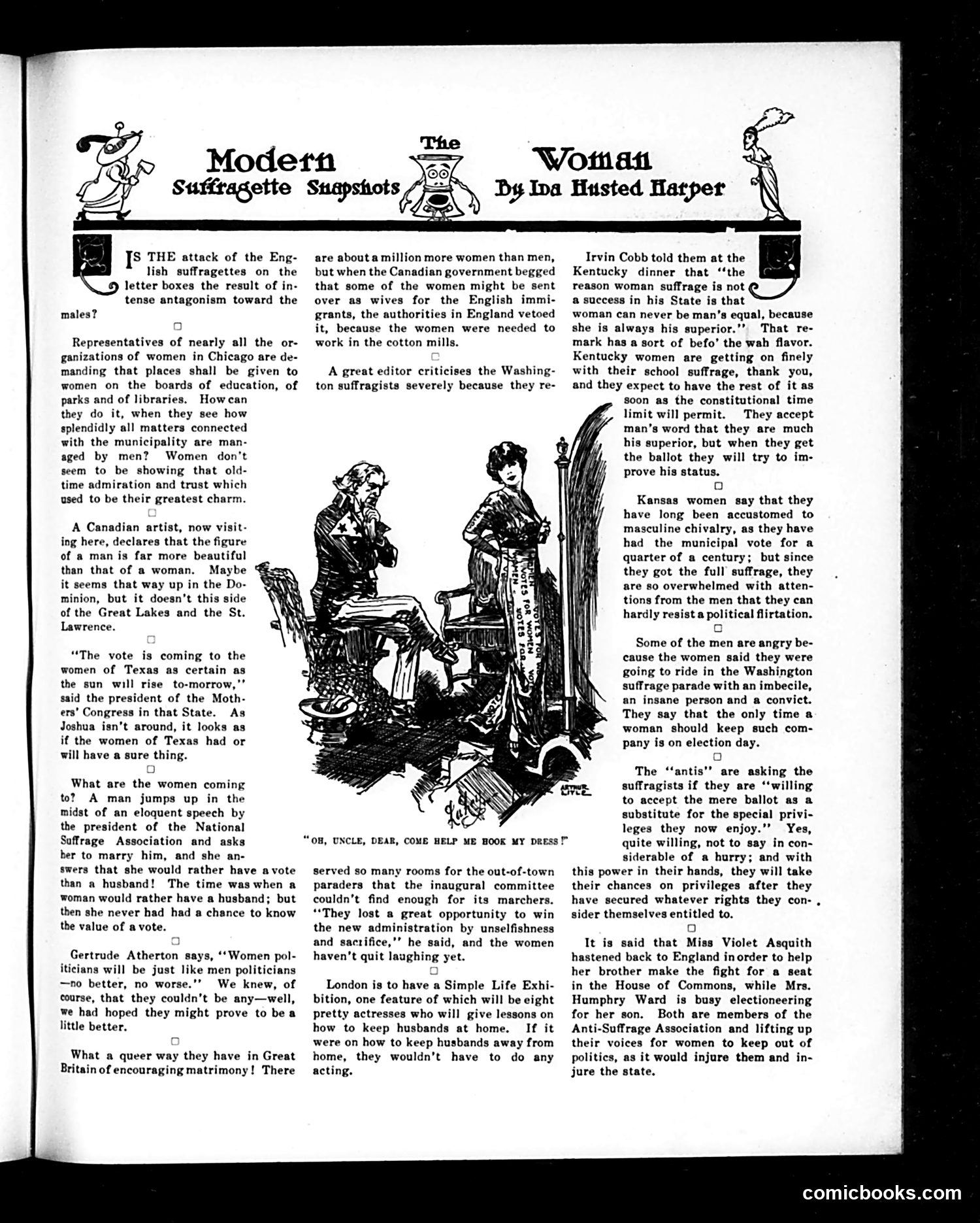
This page from *Judge* magazine satirizes anti-suffrage arguments through mock-serious commentary. The cartoon shows a man asking a woman to help him dress—a visual joke highlighting male dependence on women despite claims of superiority. The text collects anecdotes mocking opponents' positions: a Canadian artist claiming men are more beautiful than women; a man suggesting women prioritize marriage over voting rights; critics attacking suffragists for "unselfishness"; and Irvin Cobb's paternalistic claim that women can't equal men because they're "always superior." The satire's point: anti-suffragists contradict themselves—simultaneously claiming women are inferior yet need male protection, and denying them rights while depending on their labor. References to Texas, Kansas, and Kentucky women gaining voting rights suggest momentum toward suffrage. The piece uses absurdity to expose the illogic of opposition arguments.
📄 Transcribed text from this page (OCR, searchable)
Machine-transcribed from the original scan — historical spelling and the odd misread are preserved.
S THE attack of the Eng- lish suffragettes on the letter boxes the result of in- tense antagonism toward the males? Representatives of nearly all the or- ganizations of women in Chicago are de- manding that places shall be given to women on the boards of education, of parks and of libraries. Howcan they do it, when they see how splendidly all matters connected with the municipality are man- aged by men? Women don't seem to be showing that old- time admiration and trust which used to be their greatest charm. A Canadian artist, now visit- ing here, declares that the figure of a man is far more beautiful than that of a woman. Maybe it seems that way up in the Do- minion, but it doesn’t this side of the Great Lakes and the St. Lawrence. “The vote is coming to the women of Texas as certain as the sun will rise to-morrow,’’ said the president of the Moth- ers’ Congress in that State. As Joshua isn’t around, it looks as if the women of Texas had or will have a sure thing. ia} What are the women coming to? A man jumps up in the midst of an eloquent speech by the president of the National Soffrage Association and asks her to marry him, and she an- swers that she would rather have avote than a husband! The time was when a woman would rather have a husband; but then she never had had a chance to know the value of a vote. Gertrude Atherton says, ‘‘Women pol- iticians will be just like men politicians —no better, no worse.’’ We knew, of course, that they couldn’t be any—well, we had hoped they might prove to bea little better. What a queer way they have in Great Britain of encouraging matrimony! There Woman Dy Ina Husted Harper are about a million more women than men, but when the Canadian government begged that some of the women might be sent over as wives for the English immi- grants, the authorities in England vetoed it, because the women were needed to work in the cotton mills. A great editor criticises the Washing- ton suffragists severely because they re- “OH, UNCLE, DEAR, COME HELP ME BOOK MY DRess !” served so many rooms for the out-of-town paraders that the inaugural committee couldn't find enough for its marchers. “They lost a great opportunity to win the new administration by unselfishness and sacrifice,"” he said, and the women haven't quit laughing yet. London is to have a Simple Life Exhi- bition, one feature of which will be eight pretty actresses who will give lessons on how to keep husbands at home. If it were on how to keep husbands away from home, they wouldn't have to do any acting. Irvin Cobb told them at the Kentucky dinner that ‘‘the reason woman suffrage is not a success in his State is that woman can never be man’s equal, because she is always his superior.”” That re- mark has a sort of befo’ the wah flavor. Kentucky women are getting on finely with their school suffrage, thank you, and they expect to have the rest of it as soon as the constitutional time limit will permit. ‘They accept man’s word that they are much his superior, but when they get the ballot they will try to im- prove his status. a Kansas women say that they have long been accustomed to masculine chivalry, as they have had the municipal vote for a quarter of a century; but since they got the full suffrage, they are so overwhelmed with atten- tions from the men that they can hardly resist a political flirtation. a Some of the men are angry be- cause the women said they were going to ride in the Washington suffrage parade with an imbecile, an insane person and a convict. They say that the only time a woman should keep such com- pany is on election day. oO The ‘‘antis’’ are asking the suffragists if they are ‘‘willing to accept the mere ballot as a substitute for the special privi- leges they now enjoy.” Yes, quite willing, not to say in con- siderable of a hurry; and with this power in their hands, they will take their chances on privileges after they have secured whatever rights they con- sider themselves entitled to. 0 It is said that Miss Violet Asquith hastened back to England inorder to help her brother make the fight for a seat in the House of Commons, while Mrs. Humphry Ward is busy electioneering for her son. Both are members of the Anti-Suffrage Association and lifting up their voices for women to keep out of politics, as it would injure them and in- jure the state. comicbooks.com