
Judge, 1913-03-22 · page 18 of 26
Judge — March 22, 1913 — page 18: what you’re looking at
What you’re looking at
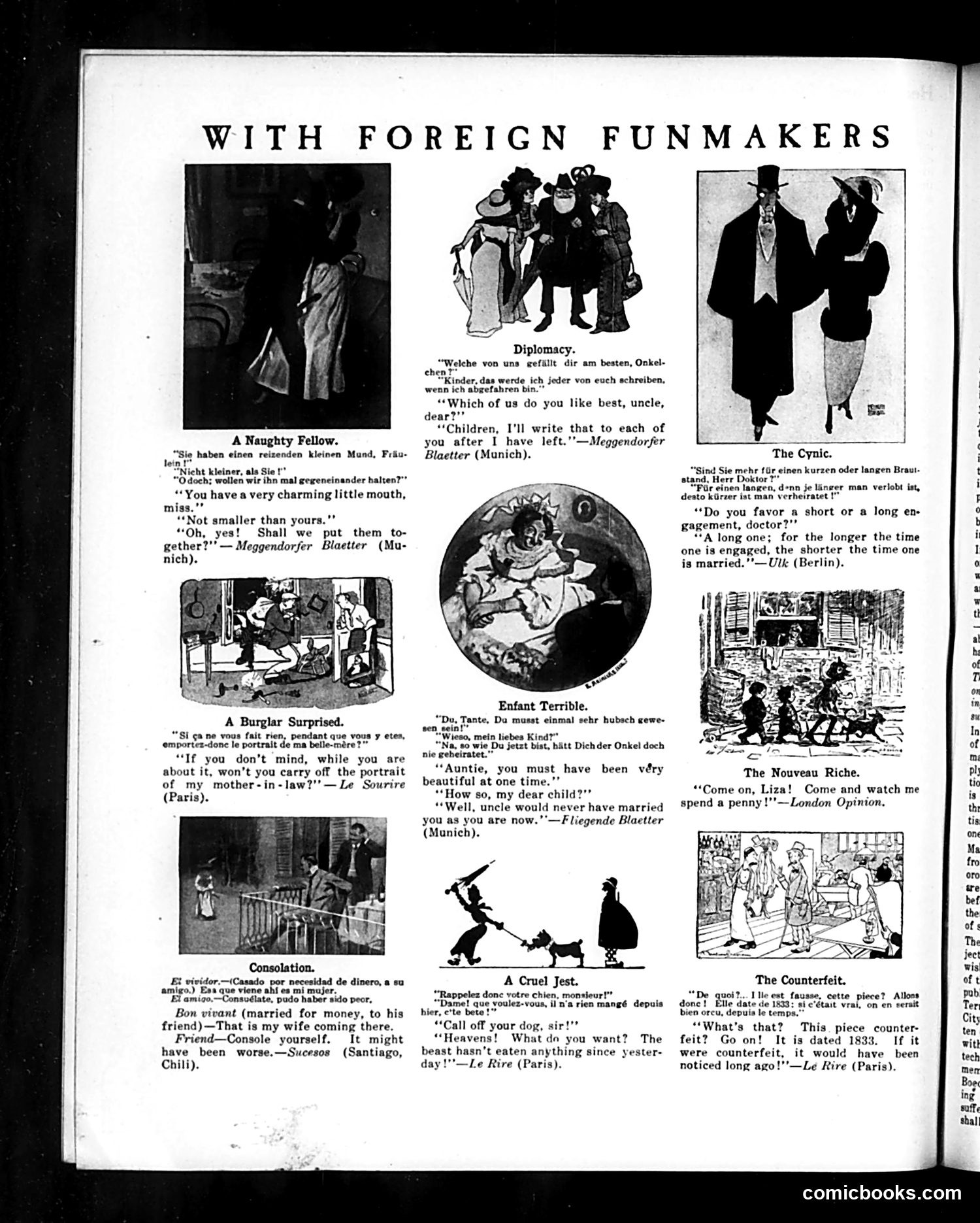
This page collects brief satirical jokes from European humor magazines, translated for American readers. The cartoons mock universal human follies: **"A Naughty Fellow"** and **"Diplomacy"** joke about flirtation and family favoritism—timeless social observations. **"A Burglar Surprised"** depicts dark humor about an unwanted mother-in-law (a stock comic target). **"Enfant Terrible"** shows a child's tactless honesty insulting an aunt's appearance. **"The Cynic"** cynically suggests engagements are longer than marriages. **"A Cruel Jest"** plays on a starving dog. **"The Nouveau Riche"** references newly wealthy people (implying ostentatious spending). **"The Counterfeit"** jokes that an obviously fake old coin shouldn't have gone undetected so long. These represent Judge's practice of publishing European humor to amuse educated American audiences with sophisticated, if occasionally mean-spirited, wit about universal human behavior rather than specific political events.
📄 Transcribed text from this page (OCR, searchable)
Machine-transcribed from the original scan — historical spelling and the odd misread are preserved.
A Naughty Fellow. 1ejSig haben einen reizenden kleinen Mund, Friu- “Nicht kleiner, als Sie!" “O doch; wollen wir ihn mal gegeneinander halten?”’ ef You have a very charming little mouth, miss." Not smaller than yours.'’ “Oh, yes! Shall we put them to- gether?"’— Meggendorfer Blaetter (Mu- nich). A Burglar Surprised. ga ne vous fait rien, pendant que v ‘emportez-done le portrait de ma belle-mare?” “If you don’t mind, while you are about it, won’t you carry off the portrait of my mother-in-law?’ —Le Sourire (Paris). —(Casado por necesidad de dinero, a su amigo.) Esa que viene ah{ es mi mujer. El amigo.—Consuélate, pudo haber sido peor, Bon vivant (married for money, to his friend)—That is my wife coming there. Friend—Console yourself. It might Cait been worse. ucesos (Santiago, hi Diplomacy. “Welche von uns gefiilit dir am besten, Onkel- chen T" “Kinder, das werde ich jeder von euch schreiben, wenn ich abgefahren bin. “Which of us do you like best, uncle, dear?” “Children, I'll write that to each of you after I have left."—Meggendorfer Blaetter (Munich). Enfant Terrible. “Da. Tante, Da musst einmal sehr hubsch gewe- #7. Wleso, mein liebes Kind?" “Na, s0 wie Du jetzt ine hite Dichder Onkel doch nie gebeiratet.” “Auntie, you must have been véry beautiful at one time. **How so, my dear child?”’ “Well, uncle would never have married you as you are now.’'"—F liegende Blaetter (Munich). A Cruel Jest. ‘“‘Rappelez donc votre chien, monsieur!" “Dame! que youlez-vous, ina rien mangé depuis hier, e’te bete ” “Call off your dog, sir! “Heavens! W de you want?) The beast hasn’t eate: thing since yester- day !""—Le Rire (Paris). The Cynic. “Sind Sie mehr fr einen kurzen oder langen Braut- stand, Herr Doktor ?" “Pur einen angen, denn je linger man verlobt ist, deato kirzer ist man’ verheiratet !" “Do you favor a short or a long en- gagement, doctor?” “A long one; for the longer the time one is engaged, the shorter the time one is married.’’—Ulk (Berlin). The Nouveau Riche. “Come on, Liza! Come and watch me "—London Opinion. The Counterfeit. est fauase, cette piece? Allons 1833: si c’était vrai, on en serait bien orcu, dep: “‘What’s that? This. piece counter- feit? Go on! It is dated 1833. If it were counterf it would have been noticed long ago!’’—Le Rire (Paris). comicbooks.com