
Judge, 1913-03-22 · page 5 of 26
Judge — March 22, 1913 — page 5: what you’re looking at
What you’re looking at
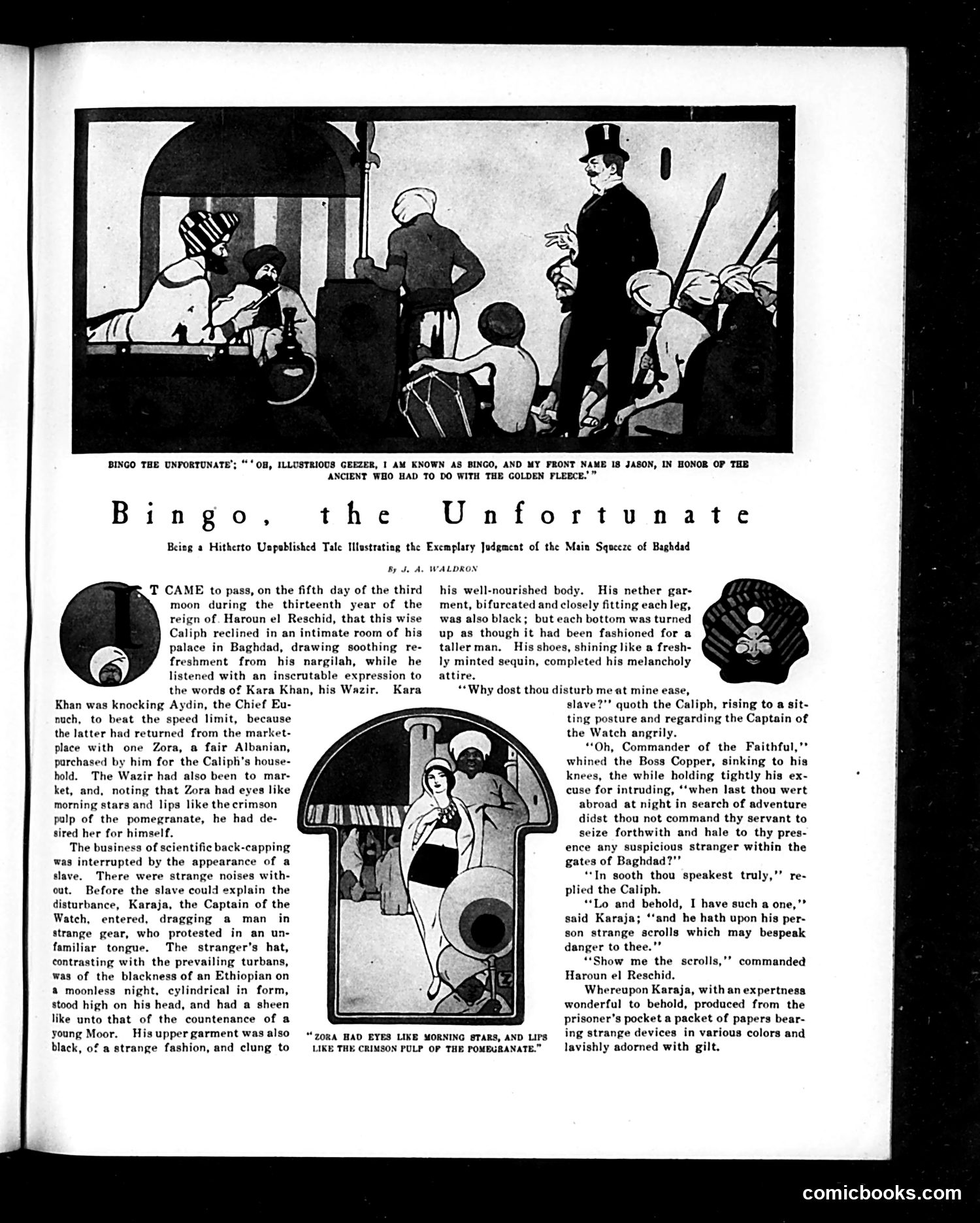
This page presents a fictional tale by J.A. Waldron set in Baghdad during Haroun al Raschid's reign. The story concerns a slave named Bingo who is discovered possessing mysterious scrolls bearing dangerous devices in various colors and gold. The narrative appears to be a fantastical adventure story rather than political satire. The illustrations show characters in period costume: the Caliph, his servants, and officials examining the suspicious documents. Without additional context about the publication date or contemporary events, the specific satirical target remains unclear. The "strange devices" and foreign scrolls might reference contemporary anxieties, but the text alone doesn't confirm a particular political or social reference point for modern readers.
📄 Transcribed text from this page (OCR, searchable)
Machine-transcribed from the original scan — historical spelling and the odd misread are preserved.
BINGO THE UNFORTUNATE’; “‘ OH, ILLUSTRIOUS GEEZER, I AM KNOWN AS BINGO, AND MY FRONT NAME 18 JASON, IN HONOR OP THE ANCIENT WHO HAD TO DO WITH THE GOLDEN FLEECE.’” Bingo, the Unfortunate Being a Hitherto Unpoblished Tale Ilustrating the Exemplary Judgment of the Main Squceze of Baghdad T CAME to pass, on the fifth day of the third By Je A. WALDRON his well-nourished body. His nether gar- moon during the thirteenth year of the reign of. Haroun el Reschid, that this wise Caliph reclined in an intimate room of his palace in Baghdad, drawing soothing re- freshment from his nargilah, while he listened with an inscrutable expression to the words of Kara Khan, his Wazir. Kara ment, bifurcated and closely fitting each leg, was also black; but each bottom was turned up as though it had been fashioned for a taller man. His shoes, shining like a fresh- ly minted sequin, completed his melancholy attire. “Why dost thou disturb me at mine ease, Khan was knocking Aydin, the Chief Eu- nuch, to beat the speed limit, because the latter had returned from the market- place with one Zora, a fair Albanian, parchased by him for the Caliph’s house- hold. The Wazir had also been to mar- ket, and, noting that Zora had eyes like morning stars and lips like the crimson palp of the pomegranate, he had de- sired her for himself. The business of scientific back-capping was interrupted by the appearance of a slave. There were strange noises with- out. Before the slave could explain the disturbance, Karaja, the Captain of the Watch, entered, dragging a man in strange gear, who protested in an un- familiar tongue. The stranger's hat, contrasting with the prevailing turbans, was of the blackness of an Ethiopian on & moonless night, cylindrical in form, stood high on his head, and had a sheen like unto that of the countenance of a young Moor. His upper garment was also black, of a strange fashion, and clung to “ZORA HAD EYES LIKE MORNING STARS, AND LIPS LIKE THE CRIMSON PULP OP THE POMEGRANATE.” slave?’ quoth the Caliph, rising to a sit- ting posture and regarding the Captain of the Watch angrily. “Oh, Commander of the Faithful,’’ whined the Boss Copper, sinking to his knees, the while holding tightly his ex- cuse for intruding, ‘‘when last thou wert abroad at night in search of adventure didst thou not command thy servant to seize forthwith and hale to thy pres- ence any suspicious stranger within the gates of Baghdad?” “In sooth thou speakest truly,’’ re- plied the Caliph. “Lo and behold, I have such a one,” said Karaja; ‘‘and he hath upon his per- son strange scrolls which may bespeak danger to thee."” “*Show me the scrolls, Haroun el Reschid. Whereupon Karaja, with an expertness wonderful to behold, produced from the prisoner's pocket a packet of papers bear- ing strange devices in various colors and lavishly adorned with gilt. commanded comicbooks.com