
Judge, 1913-03-22 · page 4 of 26
Judge — March 22, 1913 — page 4: what you’re looking at
What you’re looking at
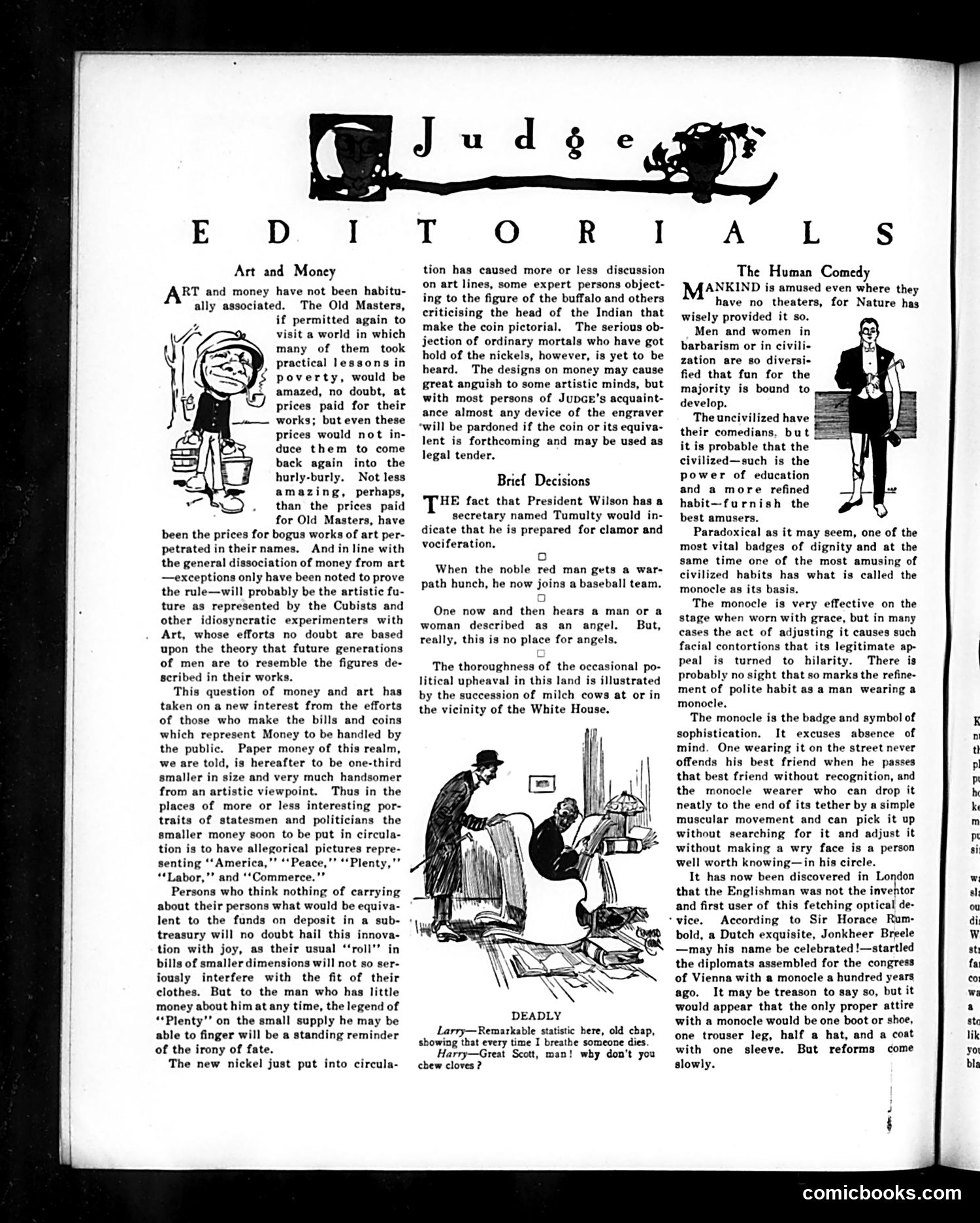
This page contains three editorial pieces. The main left column discusses the relationship between art and money, arguing that artistic prices shouldn't be dismissed simply because they're high—a defense of art market values against practical objections. The center column's "Brief Decisions" section includes short satirical comments. One mocks a secretary named Tumulty's preparedness for "clamor and vociferousness" (appears to reference a government official, likely from the Wilson administration era). The right column, "The Human Comedy," defends the monocle as a dignified fashion accessory, claiming it requires practiced sophistication. It mentions a London Englishman and Dutch explorer Jonkheer Breele as monocle users. The bottom illustration titled "DEADLY" depicts a dialogue about someone's bad breath, presented as dark humor. The satire targets pretension and social affectation broadly.
📄 Transcribed text from this page (OCR, searchable)
Machine-transcribed from the original scan — historical spelling and the odd misread are preserved.
D Art and Money ABT and money have not been habitu- ally associated. The Old Masters, if permitted again to visit a world in which many of them took practical lessons in poverty, would be amazed, no doubt, at prices paid for their works; but even these prices would not in- duce them to come back again into the hurly-burly. Not less E for Old Masters, have been the prices for bogus works of art per- petrated in their names. And in line with the general dissociation of money from art —exceptions only have been noted to prove the rule—will probably be the artistic fu- ture as represented by the Cubists and other idiosyncratic experimenters with Art, whose efforts no doubt are based upon the theory that future generations of men are to resemble the figures de- scribed in their works. This question of money and art has taken on a new interest from the efforts of those who make the bills and coins which represent Money to be handled by the public. Paper money of this realm, we are told, is hereafter to be one-third smaller in size and very much handsomer from an artistic viewpoint. Thus in the places of more or less interesting por- traits of statesmen and politicians the smaller money soon to be put in circula- tion is to have allegorical pictures repre- senting ‘‘America,”’ ‘‘Peace,”’ “Plenty,” “‘Labor,”’ and ‘Commerce. Persons who think nothing of carrying about their persons what would be equiva- lent to the funds on deposit in a sub- treasury will no doubt hail this innova- tion with joy, as their usual ‘‘roll’’ in bills of smaller dimensions will not so ser- fously interfere with the fit of their clothes. But to the man who has little money about him at any time, the legend of **Plenty’’ on the small supply he may be able to finger will be a standing reminder of the irony of fate. The new nickel just put into circula- T O R JI tion has caused more or less discussion on art lines, some expert persons object- ing to the figure of the buffalo and others criticising the head of the Indian that make the coin pictorial. The serious ob- jection of ordinary mortals who have got hold of the nickels, however, is yet to be heard. The designs on money may cause great anguish to some artistic minds, but with most persons of JupGE’s acquaint- ance almost any device of the engraver “will be pardoned if the coin or its equiva- lent is forthcoming and may be used as legal tender. Brief Decisions THE fact that President Wilson has a secretary named Tumulty would in- dicate that he is prepared for clamor and vociferation. a When the noble red man gets a ware path hunch, he now joins a baseball team. One now and then hears a man or a woman described as an angel. But, really, this is no place for angels. The thoroughness of the occasional po- litical upheaval in this land is illustrated by the succession of milch cows at or in the vicinity of the White House. DEADLY Larry—Remarkable statistic here, old chap, showing that every time I breathe someone dies. Harry—Great Scott, man! why don't you chew cloves ? * vice. AL The Human Comedy MANKIND is amused even where they have no theaters, for Nature has wisely provided it so. Men and women in barbarism or in civili- zation are so diversi- fied that fan for the majority is bound to develop. The uncivilized have their comedians. but it is probable that the civilized—such is the power of education and a more refined habit—furnish the best amusers. Paradoxical as it may seem, one of the most vital badges of dignity and at the same time one of the most amusing of civilized habits has what is called the monocle as its basis. The monocle is very effective on the stage when worn with grace, but in many cases the act of adjusting it causes such facial contortions that its legitimate ap- peal is turned to hilarity. There is probably no sight that so marks the refine- ment of polite habit as a man wearing a monocle. The monocle is the badge and symbol of sophistication. It excuses absence of mind. One wearing it on the street never offends his best friend when he passes that best friend without recognition, and the monocle wearer who can drop it neatly to the end of its tether by a simple muscular movement and can pick it up without searching for it and adjust it without making a wry face is a person well worth knowing—in his circle. It has now been discovered in London that the Englishman was not the invehtor and first user of this fetching optical de- According to Sir Horace Rum- bold, a Dutch exquisite, Jonkheer Breele —may his name be celebrated !—startled the diplomats assembled for the congress of Vienna with a monocle a hundred years ago. It may be treason to say so, but it would appear that the only proper attire with a monocle would be one boot or shoe, one trouser leg, half a hat, and a coat with one sleeve. But reforms come slowly. comicbooks.com