
Judge, 1913-03-22 · page 12 of 26
Judge — March 22, 1913 — page 12: what you’re looking at
What you’re looking at
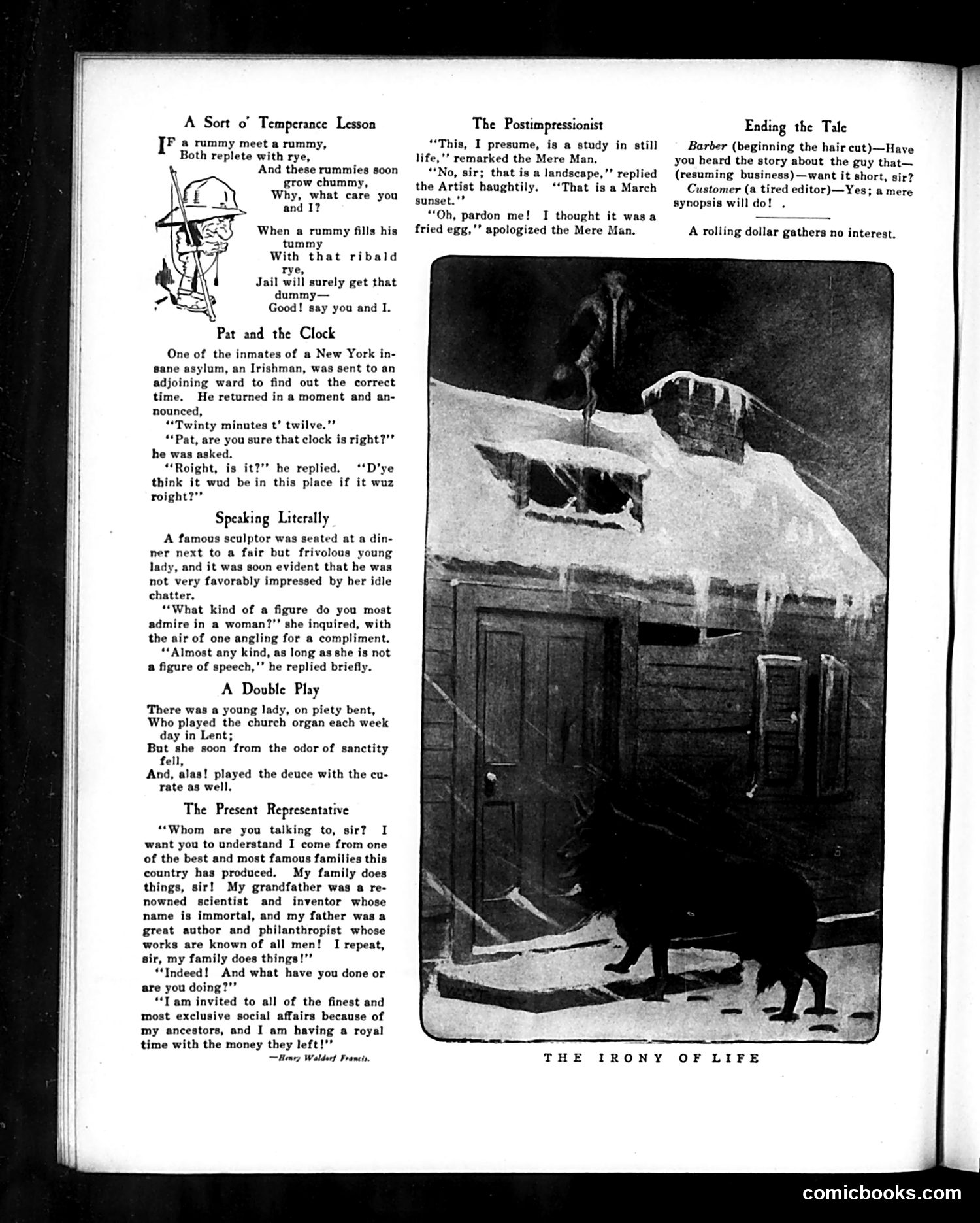
This page contains six humorous short pieces typical of early-20th-century American humor magazines: **"A Sort o' Temperance Lesson"** uses crude verse to mock drunks ("rummies") drinking whiskey ("rye"), suggesting jail awaits them—a prohibition-era temperance joke. **"Pat and the Clock"** is an Irish-stereotyped joke: an asylum inmate reports the time, and when questioned, replies the clock must be broken since it works correctly—implying insane asylums are illogical places. **"Speaking Literally"** features a sculptor dismissing shallow women; he prefers any figure except "a figure of speech"—wordplay mocking frivolous female socializing. **"A Double Play"** is a mild innuendo joke: a pious woman playing church organ during Lent "falls" from sanctity and "plays the deuce" with the curate (priest)—suggesting sexual impropriety. **"The Present Representative"** satirizes social climbers: a man boasts of famous ancestors while admitting he contributes nothing himself, merely attending parties with inherited wealth—mocking aristocratic pretension. **"The Irony of Life"** photograph's caption suggests idle wealth generates no returns—a financial joke.
📄 Transcribed text from this page (OCR, searchable)
Machine-transcribed from the original scan — historical spelling and the odd misread are preserved.
A Sort o° Temperance Lesson IF a rummy meet a rummy, Both replete with rye, And these rummies soon grow chummy, Why, what care you and I? When a rummy fills his tummy With that ribald rye, Jail will surely get that dummy— Good! say you and I. Pat and the Clock One of the inmates of a New York in- sane asylum, an Irishman, was sent to an adjoining ward to find out the correct time. He returned in a moment and an- nounced, “‘Twinty minutes t’ twilve.’”” “Pat, are you sure that clock is right?” he was asked. “Roight, is it?” he replied. ‘‘D’ye think it wud be in this place if it wuz roight?”’ Speaking Literally A famous sculptor was seated at a din- ner next to a fair but frivolous young lady, and it was soon evident that he was not very favorably impressed by her idle chatter. “‘What kind of a figure do you most admire in a woman?"’ she inquired, with the air of one angling for a compliment. “Almost any kind, as long as she is not a figure of speech,”’ he replied briefly. A Double Play There was a young lady, on piety bent, Who played the church organ each week day in Lent; But she soon from the odor of sanctity fell, And, alas! played the deuce with the cu- rate as well. The Present Representative “‘Whom are you talking to, sir? I want you to understand I come from one of the best and most famous families this country has produced. My family does things, sir! My grandfather was a re- nowned scientist and inventor whose name is immortal, and my father was a great author and philanthropist whose works are known of all men! I repeat, sir, my family does things!’’ “Indeed! And what have you done or are you doing?”’ “Tam invited to all of the finest and most exclusive social affairs because of my ancestors, and I am having a royal time with the money they left!"” Henry Walder Francis. The Postimpressionist “This, I presume, is a study in still life,’’ remarked the Mere Man. “No, sir; that is a landscape," replied the Artist haughtily. ‘‘That is a March sunset. "” “‘Oh, pardon me! I thought it wasa fried egg,’’ apologized the Mere Man, THE Ending the Tale Barber (beginning the hair cut)—Have you heard the story about the guy that— (resuming business)—want it short, sir? Customer (a tired editor)—Yes; a mere synopsis will do! . A rolling dollar gathers no interest. IRONY OF LIFE comicbooks.com