
Judge, 1913-03-22 · page 10 of 26
Judge — March 22, 1913 — page 10: what you’re looking at
What you’re looking at
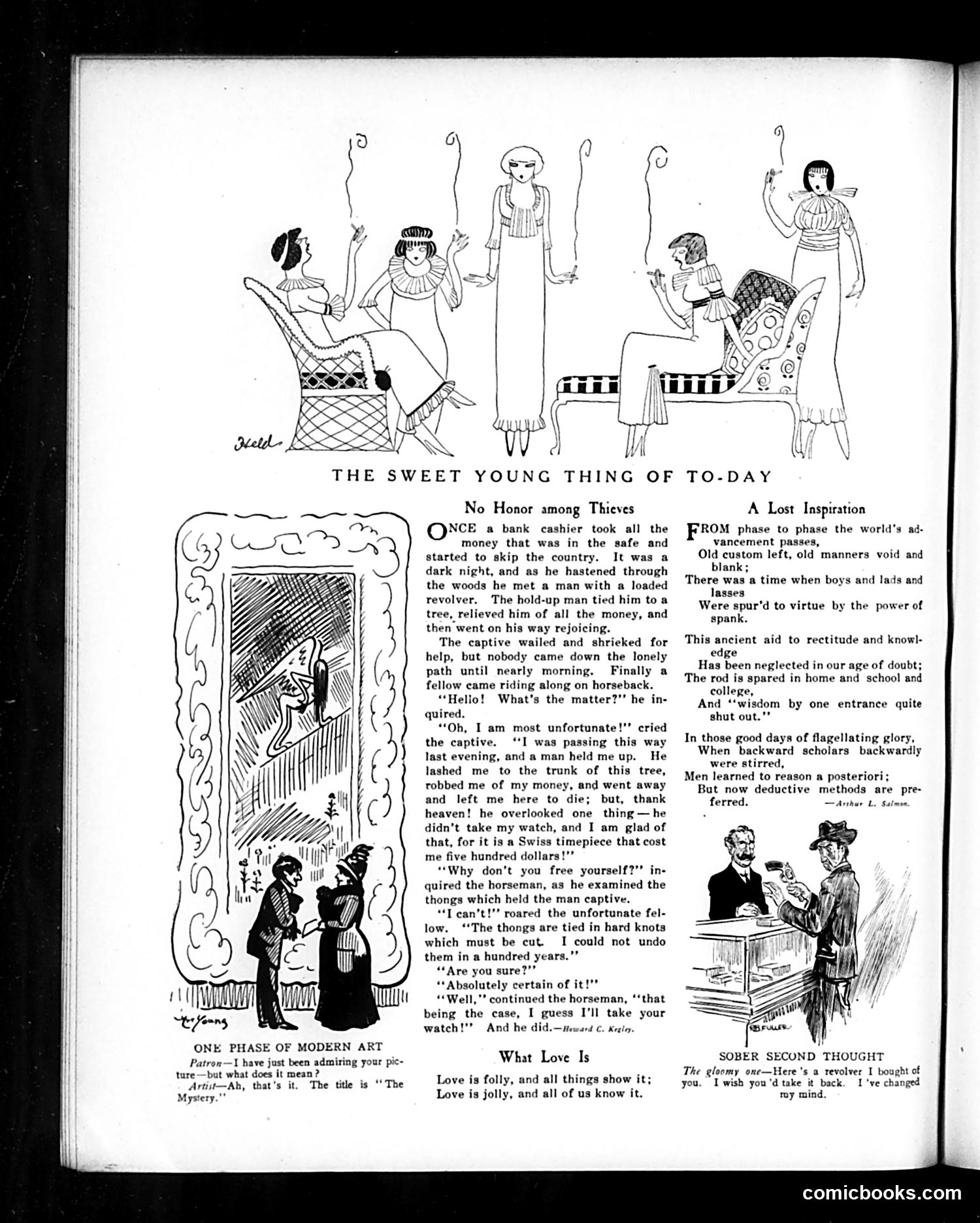
This page from the satirical magazine *Judge* contains several distinct pieces mocking early 20th-century society: **"The Sweet Young Thing of To-Day"** (top illustration): Depicts fashionable young women in flapper-style dress juggling or performing with curved objects, satirizing modern women's behavior and appearance as frivolous or absurd. **"One Phase of Modern Art"**: Mocks pretentious modern art by showing a patron confused about a painting titled "The Mystery"—the joke being that incomprehensibility itself has become the artistic point. **"No Honor among Thieves"**: A humor piece about ironic comeuppance: a robber steals from a bank cashier, then a highwayman steals from the robber. The cashier's concern that his expensive Swiss watch was overlooked (rather than his freedom) satirizes materialistic values. **"A Lost Inspiration"**: A poem lamenting the abandonment of corporal punishment in schools and homes, presenting spanking as essential to moral development—likely satirizing nostalgic attitudes about "the good old days." The page emphasizes social satire targeting modern manners, art pretension, and changing values.
📄 Transcribed text from this page (OCR, searchable)
Machine-transcribed from the original scan — historical spelling and the odd misread are preserved.
} VN THE SWEET YOUNG THING OF TO-DAY ONE PHASE OF MODERN ART Patron—I have just been admiring your pic- ture—but what does it mean? Artist—Ah, that's it, The title is Mystery.” “The No Honor among Thieves NCE a bank cashier took all the money that was in the safe and started to skip the country. It was a dark night, and as he hastened through the woods he met a man with a loaded revolver. The hold-up man tied him to a tree, relieved him of all the money, and then went on his way rejoicing. The captive wailed and shrieked for help, but nobody came down the lonely path until nearly morning. Finally a fellow came riding along on horseback. “Helio! What's the matter?’ he in- quired. “Oh, I am most unfortunate!’’ cried the captive. ‘I was passing this way last evening, and a man held me up. He lashed me to the trunk of this tree, robbed me of my money, and went away and left me here to die; but, thank heaven! he overlooked one thing —he didn’t take my watch, and I am glad of that, for it is a Swiss timepiece that cost me five hundred dollars!'" “Why don’t you free yourself?”’ in- quired the horseman, as he examined the thongs which held the man captive. “T can’t!’’ roared the unfortunate fel- low. ‘*The thongs are tied in hard knots which must be cut. I could not undo them in a hundred years.” “Are you sure?’’ “Absolutely certain of it!'" “*Well,”’ continued the horseman, ‘‘that being the case, I guess I'll take your watch!" And he did.—feward C. Keio. What Love Is Love is folly, and all things show it; Love is jolly, and all of us know it. A Lost Inspiration ROM phase to phase the world's ad- vancement passes, Old custom left, old manners void and blank; There was a time when boys and lads and lasses Were spur'd to virtue by the power of spank. This ancient aid to rectitude and knowl- edge Has been neglected in our age of doubt; The rod is spared in home and school and college, And ‘wisdom by one entrance quite shut out."” In those good days of flagellating glory, When backward scholars backwardly were stirred, Men learned to reason a posterior But now deductive methods are pre- ferred. ih SOBER SECOND THOUGHT The gloomy one—Here's a revolver I bought of you. I wish you'd take it back. I ‘ve changed ray mind. comicbooks.com