
A complete issue · 24 pages · 1912
Judge — January 20, 1912
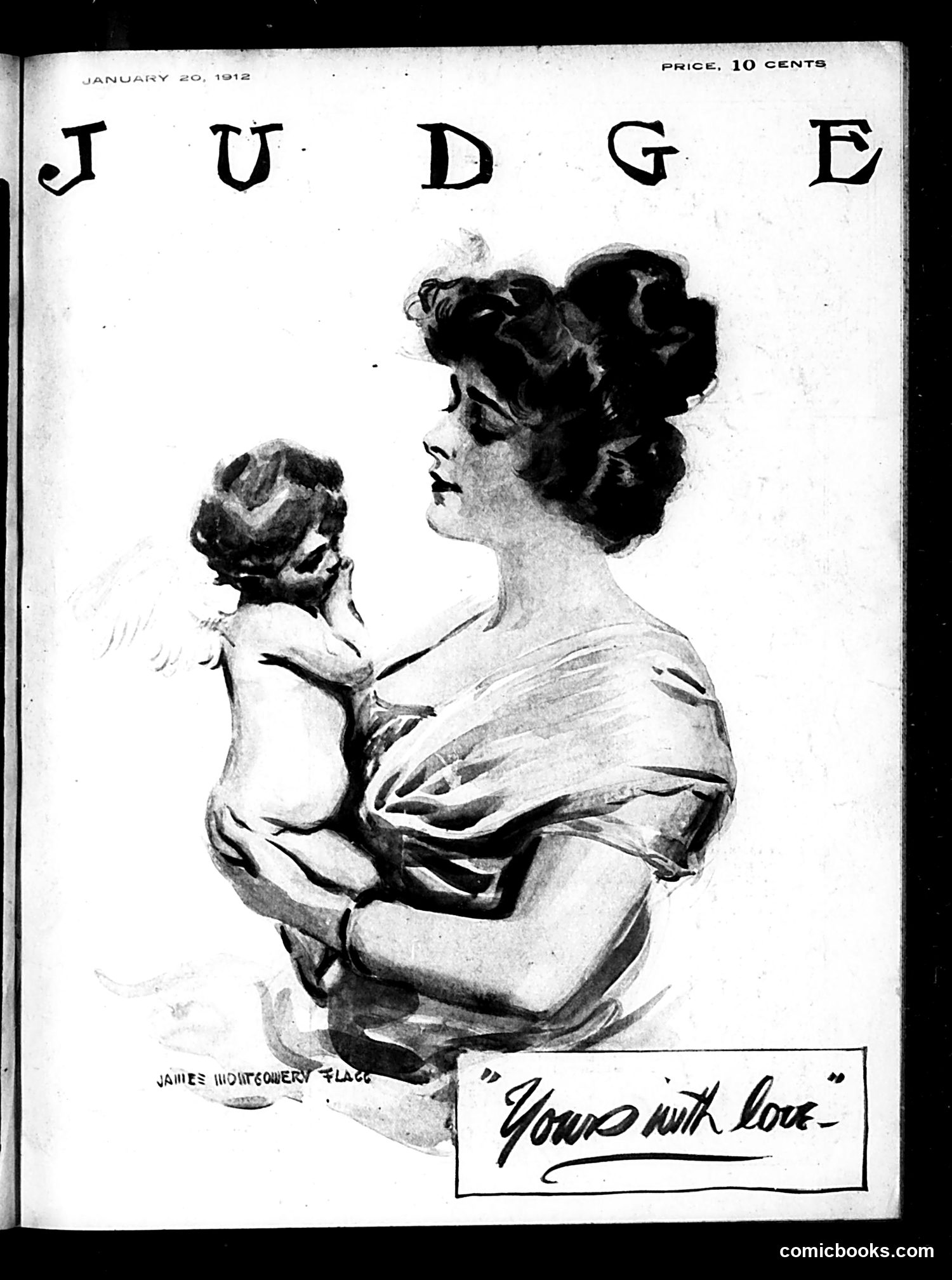
This is a sentimental cover illustration rather than political satire. It depicts a woman holding a small child, titled "Yours with Love." The artist credit reads "James Montgomery Flagg," a prominent illustrator of the era. The image represents idealized motherhood and domestic affection—common themes in early 20th-century popular magazines. The woman's fashionable hairstyle and clothing suggest middle-to-upper-class respectability. The tender pose and handwritten caption emphasize sentimentality. While *Judge* typically featured political and social satire, this particular cover functions as a straightforward sentimental image celebrating maternal love, likely intended to appeal to readers' emotions rather than critique contemporary politics or society.
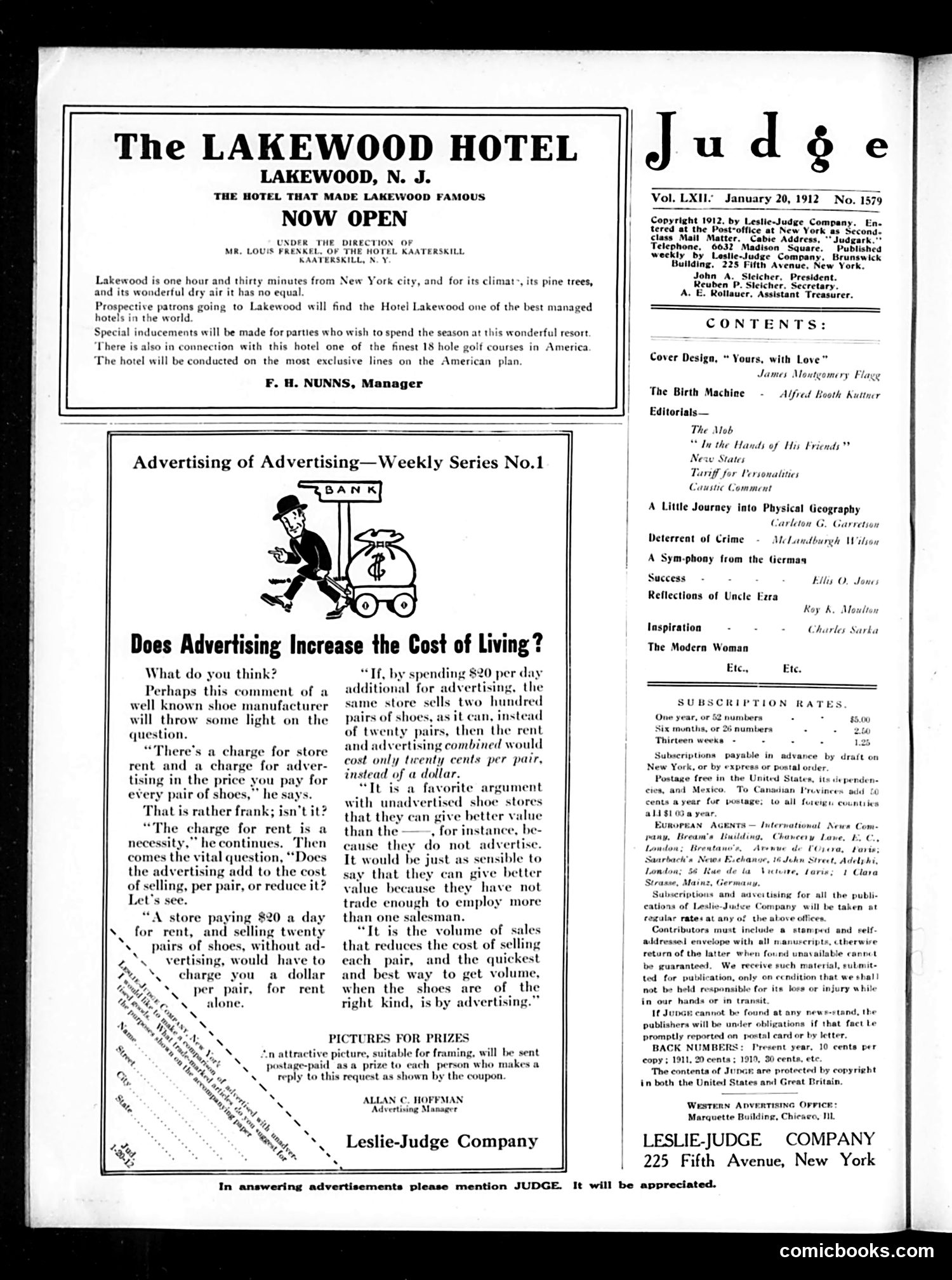
This cartoon satirizes the debate over whether advertising increases consumer prices. The illustration shows a man rushing toward a bank with a bag of money on a cart, captioned "Does Advertising Increase the Cost of Living?" The accompanying text presents both sides: a shoe manufacturer argues advertising costs are passed to consumers, while a counterargument claims advertised goods actually sell better in volume, reducing per-unit costs and allowing lower prices. The debate reflects early 20th-century concerns about rising living costs and business practices during the Progressive Era, when advertising was still a relatively new and controversial commercial practice. The page is primarily advertising for Leslie-Judge Company publications.
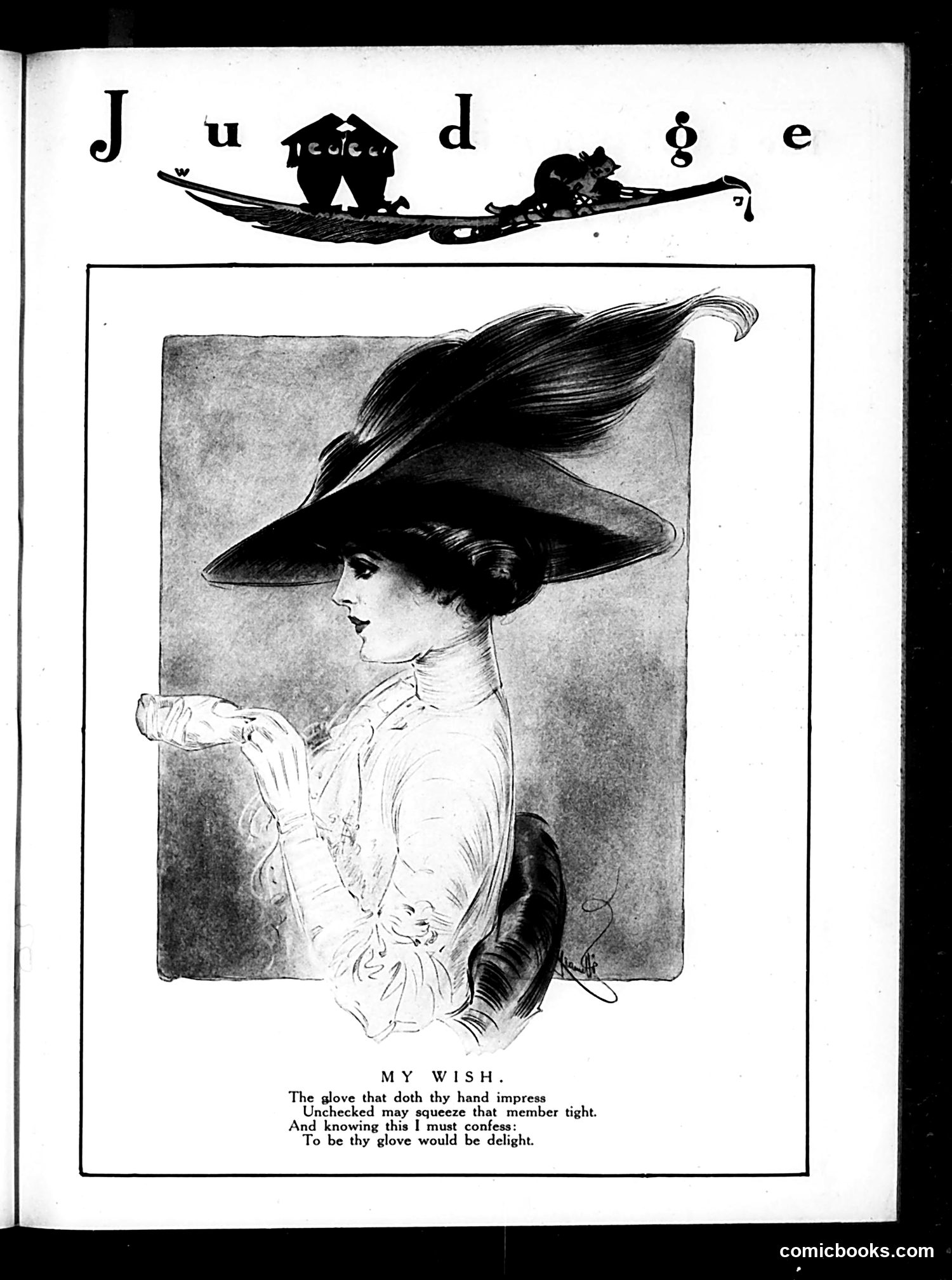
This page features an elegant illustration of a fashionable woman in Edwardian-era dress, wearing a distinctive wide-brimmed hat with a large feather plume. The accompanying verse expresses a romantic sentiment about gloves: "The glove that doth thy hand impress / Unchecked may squeeze that member tight. / And knowing this I must confess: / To be thy glove would be delight." The satire appears to be **romantic/flirtatious rather than political**. It's a genteel love poem with a cheeky premise—the speaker wishes he could be the glove touching the woman's hand. This exemplifies Judge's frequent use of sophisticated humor for its educated, upper-class readership. The detailed, admiring portrait of the fashionable woman suggests this may also subtly mock contemporary romantic idealization of feminine elegance.
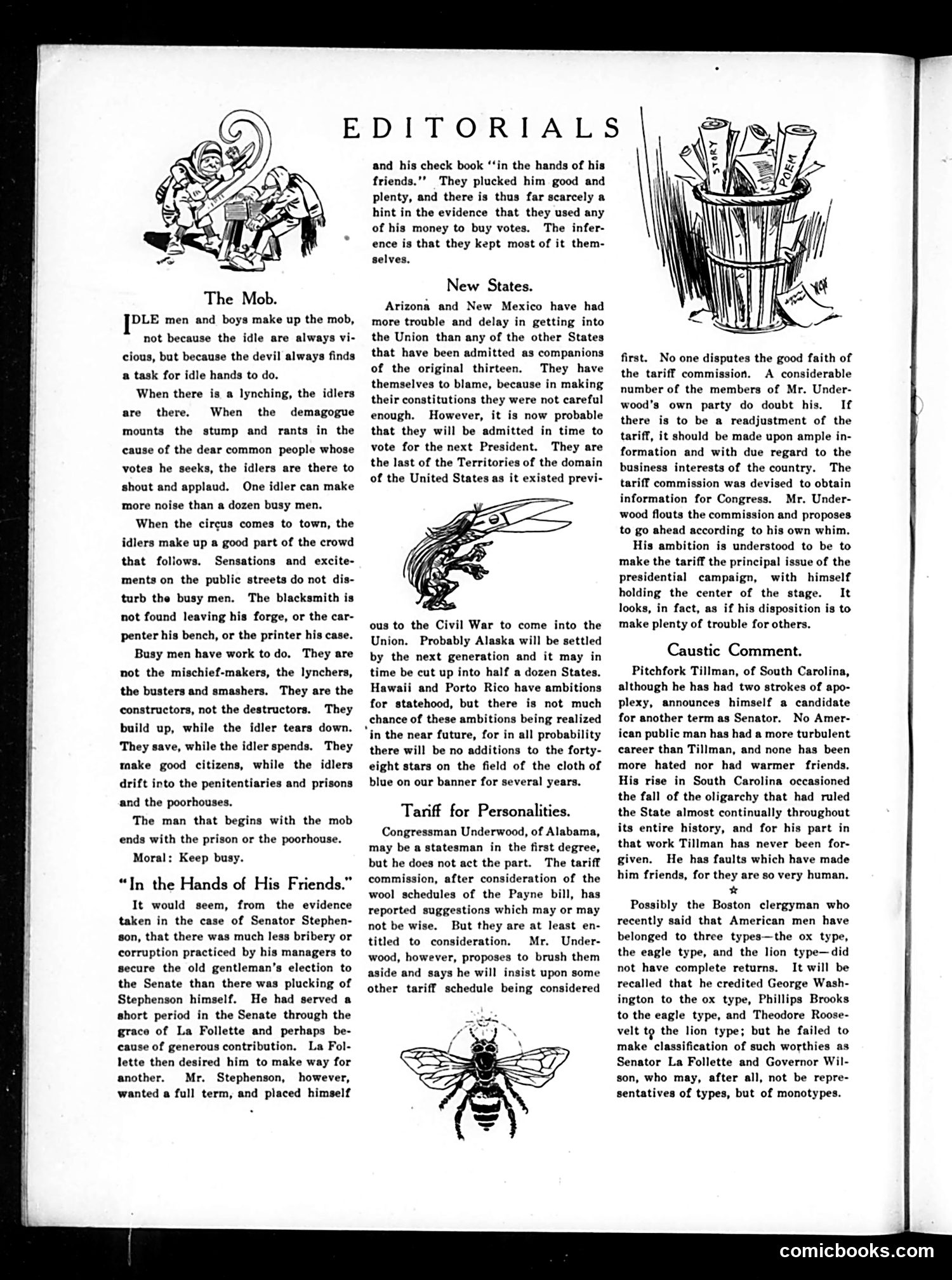
This page contains four editorials with accompanying illustrations criticizing various political and social issues: **"The Mob"** attacks idle men who participate in lynchings, arguing they're destructive rather than constructive citizens who belong in "penitentiaries and poorhouses." **"New States"** discusses Arizona and New Mexico's delayed admission to the Union, and criticizes Congressman Underwood's tariff commission proposal, suggesting his ambition might make tariff policy a "principal issue" in upcoming elections. **"In the Hands of His Friends"** (appears to reference Senator Stephen or another politician) alleges vote-buying corruption, with a La Follette figure orchestrating another candidate's removal to clear the field. **"Caustic Comment"** mocks Pitchfork Tillman's senatorial ambitions and sarcastically compares various politicians to animal "types" (eagle, ox, lion), suggesting they lack distinctive qualities.
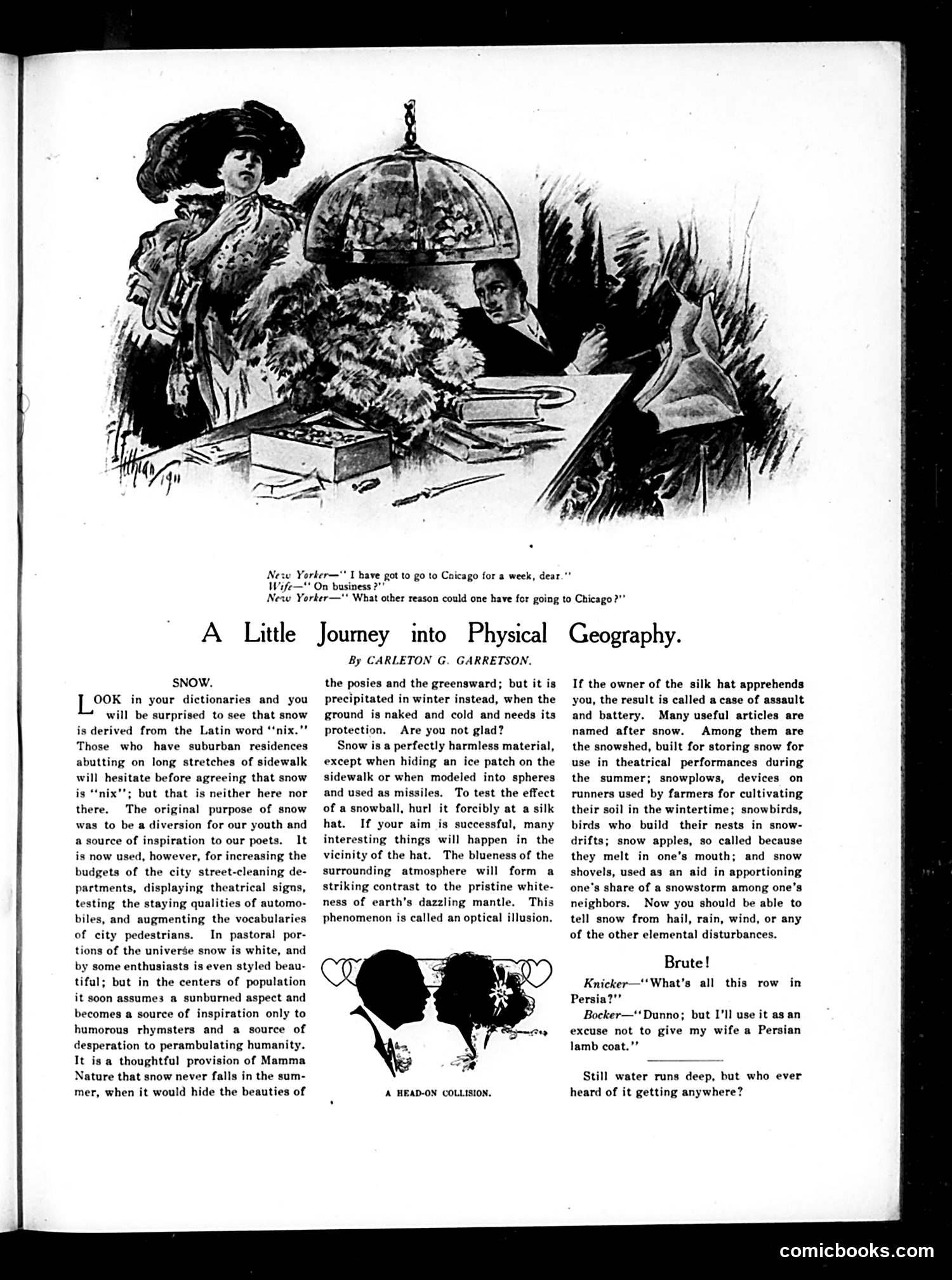
**Top Cartoon:** A well-dressed New Yorker tells a fashionable woman he must travel to Chicago on business. She questions why anyone would go there for any reason—a dig at Chicago's reputation as an unsophisticated, industrial city compared to New York. This reflects early 20th-century East Coast snobbery toward the Midwest. **Main Article:** "A Little Journey into Physical Geography" by Carleton G. Garretson is a pseudo-educational essay about snow, written in flowery, pretentious language. It's likely satirizing overly complicated scientific explanations of common phenomena. **Bottom Cartoon:** "A Head-On Collision" shows two figures in a minor accident, with one man joking he'll use it as an excuse to avoid buying his wife a Persian lamb coat—satirizing marital dynamics and male reluctance to spend money on wives' luxury items.
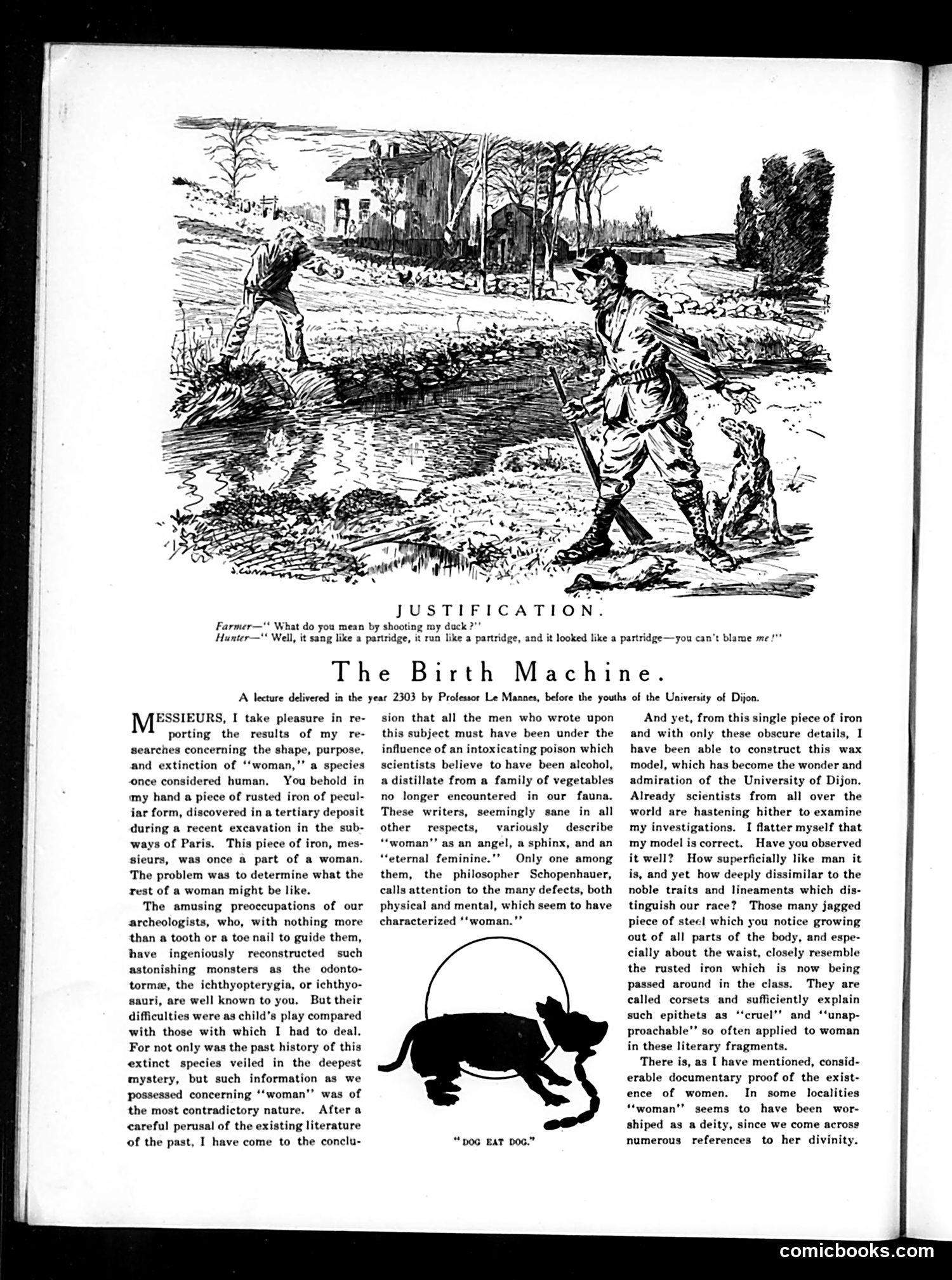
This page contains two satirical pieces from *Judge* magazine: **"Justification" (top cartoon):** A hunter shoots a farmer's duck, claiming it resembled a partridge in appearance, sound, and movement. The joke mocks flimsy excuses—the hunter blames the duck itself rather than his own poor judgment. **"The Birth Machine" (main article):** A futuristic satire set in 2303 where a professor presents women as an extinct species. Using a corroded corset as sole evidence, he reconstructs "woman" as a curiosity, noting historical texts contradict each other—describing women variously as angels or demons depending on the (allegedly drunk) author. The satire targets: - Victorian-era contradictory attitudes toward women - Pseudoscientific pretension (mocking contemporary archaeology) - The corset as a symbol of women's constraint and "cruelty" - Male philosophers' misogynistic writings The piece sardonically suggests future generations will view women-related debates as incomprehensibly absurd, implicitly critiquing contemporary sexism.
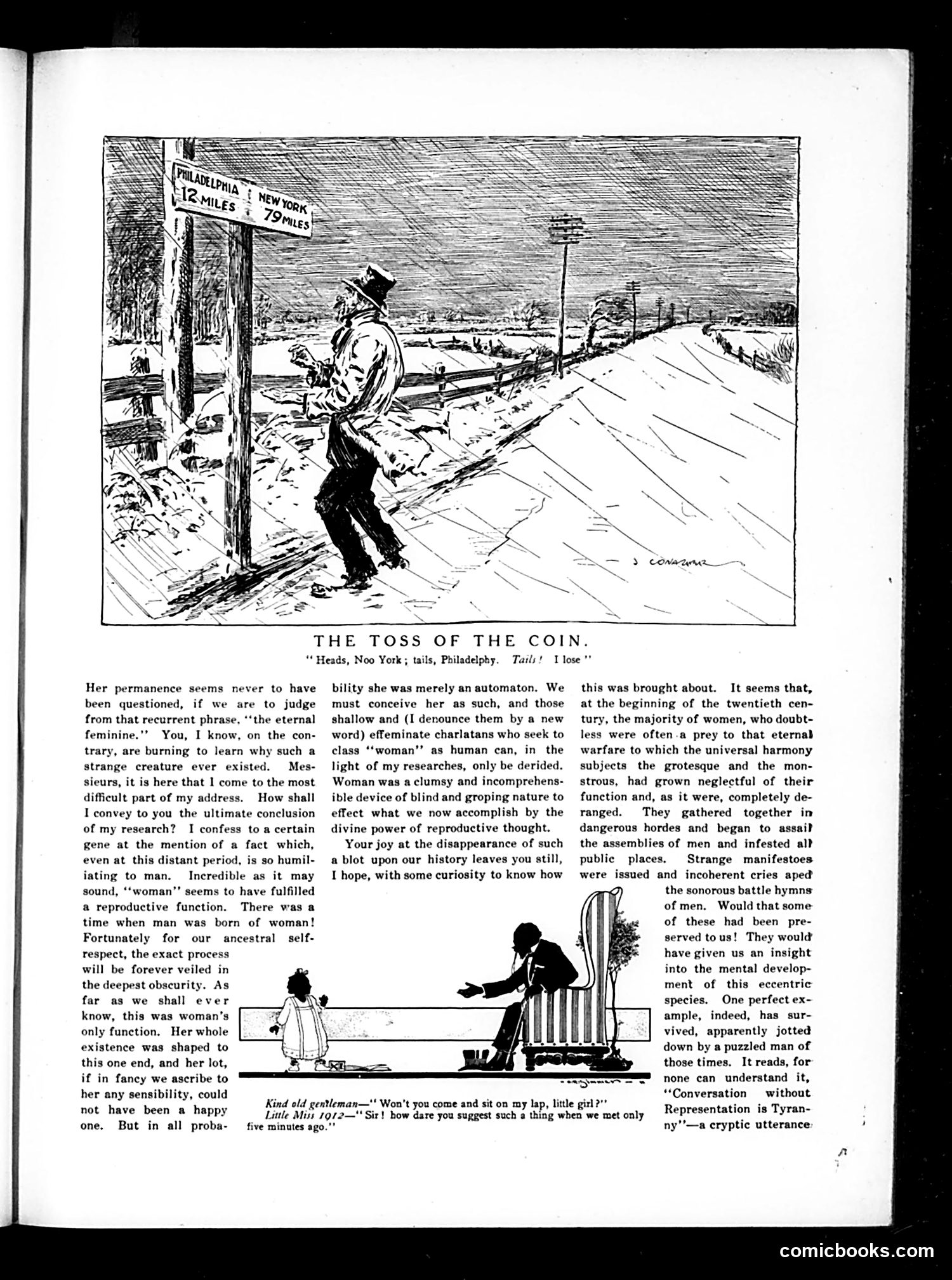
This page satirizes early 1900s anti-feminist ideology. The top cartoon shows a man flipping a coin between New York and Philadelphia—likely mocking how women's suffrage was treated as a trivial matter rather than serious political change. The lengthy text parodies pseudo-scientific misogyny popular at the time, presenting woman as merely a "reproductive function" and "automaton" rather than human. It frames early 20th-century feminism—women organizing and protesting—as chaotic disorder. The bottom comic depicts a 1912 young woman rejecting unwanted advances from an older man, illustrating changing female social autonomy that threatened traditional male authority. The page's closing quote—"Representation without Taxation is Tyranny"—echoes the American Revolution slogan but references women's suffrage demands, which the text treats dismissively as incomprehensible. The satire's target appears to be outdated male attitudes rather than feminism itself, though the mockery is heavy-handed.
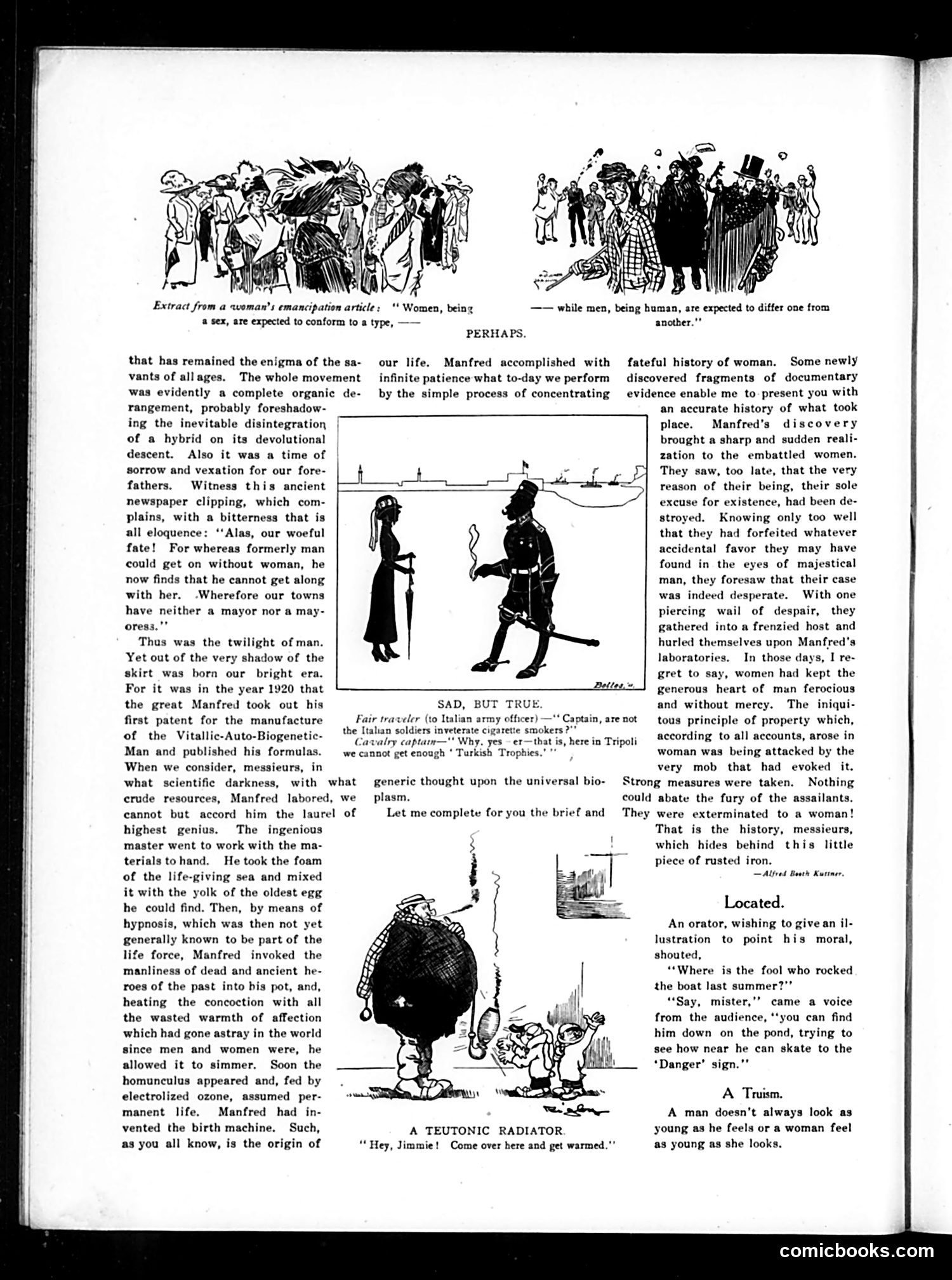
This page satirizes women's suffrage and emancipation movements through absurdist fiction. The central conceit: a scientist named Manfred invents an artificial man in 1920, rendering women obsolete. Women, realizing they've lost their "reason for being," attack his laboratories and are "exterminated to a woman." The satire targets pro-emancipation arguments by exaggerating them to ridiculous conclusions. By claiming women's sole purpose was serving men, the piece mocks both anti-feminist rhetoric and women's rights advocates simultaneously—suggesting both sides speak in absurdities. The cartoons show: a man and woman in period dress (labeled "Sad, But True"), and a figure labeled "A Teutonic Radiator" warming himself. These visual gags reinforce the anti-woman message through crude humor. The smaller jokes (Italian soldiers smoking, an orator's truism) are unrelated filler. Overall, this represents typical early-20th-century conservative pushback against women's political empowerment, disguised as satirical fantasy.
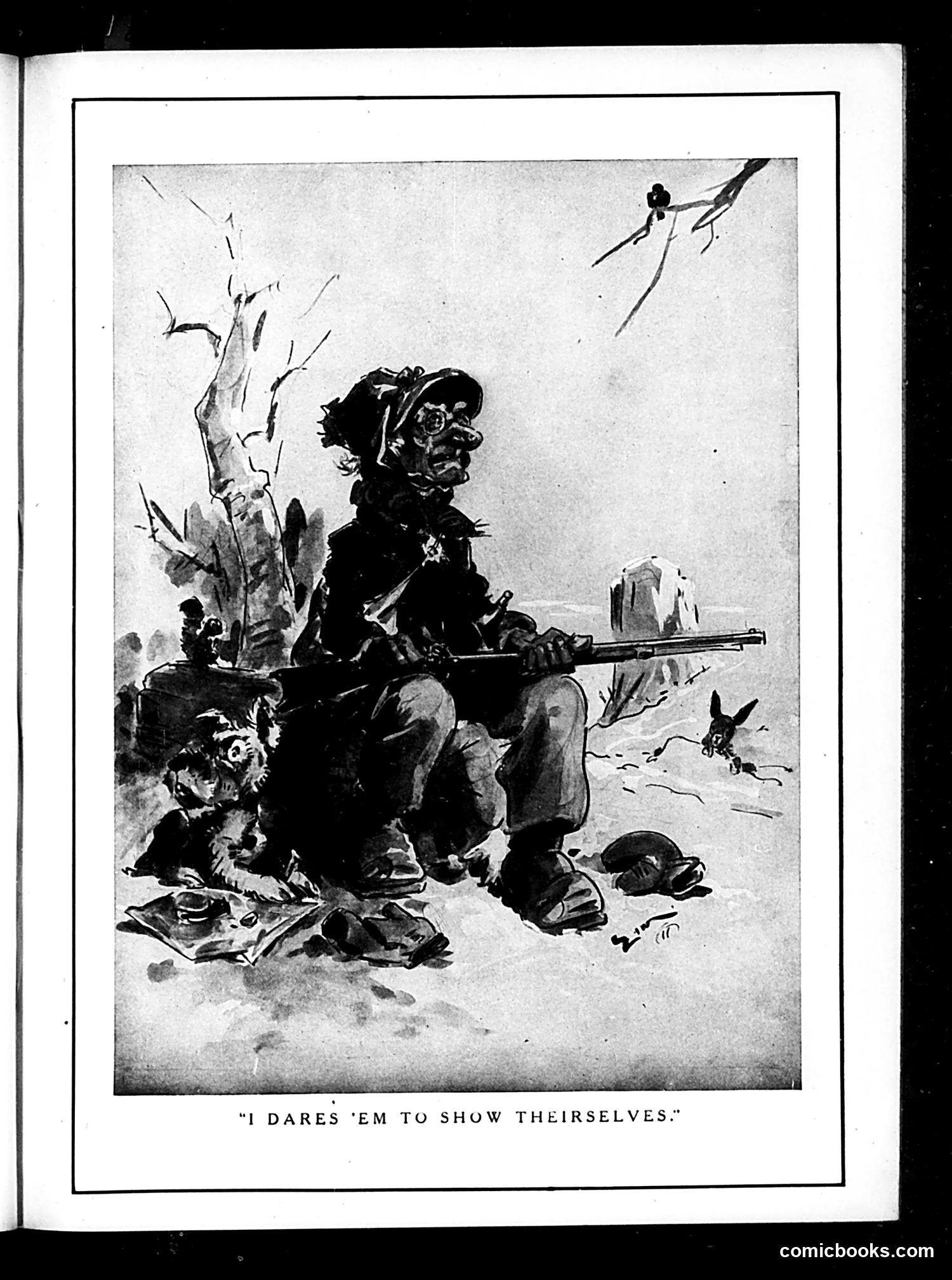
This cartoon depicts a caricatured military figure (appearing to be a general or political leader) seated in a commanding position, holding a rifle and surveying a desolate battlefield landscape. The caption reads "I DARES 'EM TO SHOW THEIRSELVES." The exaggerated facial features and crude drawing style are characteristic of period satirical caricature. The figure appears to be taunting or challenging an enemy to emerge from hiding, suggesting either overconfidence or bravado in military conflict. Without clearer OCR text or visible publication date, the specific historical conflict referenced is unclear—it could reference various late 19th or early 20th-century military situations Judge magazine covered. The satire likely critiques aggressive posturing or hollow military bravado, mocking the figure's blustering challenge to an unseen opponent.
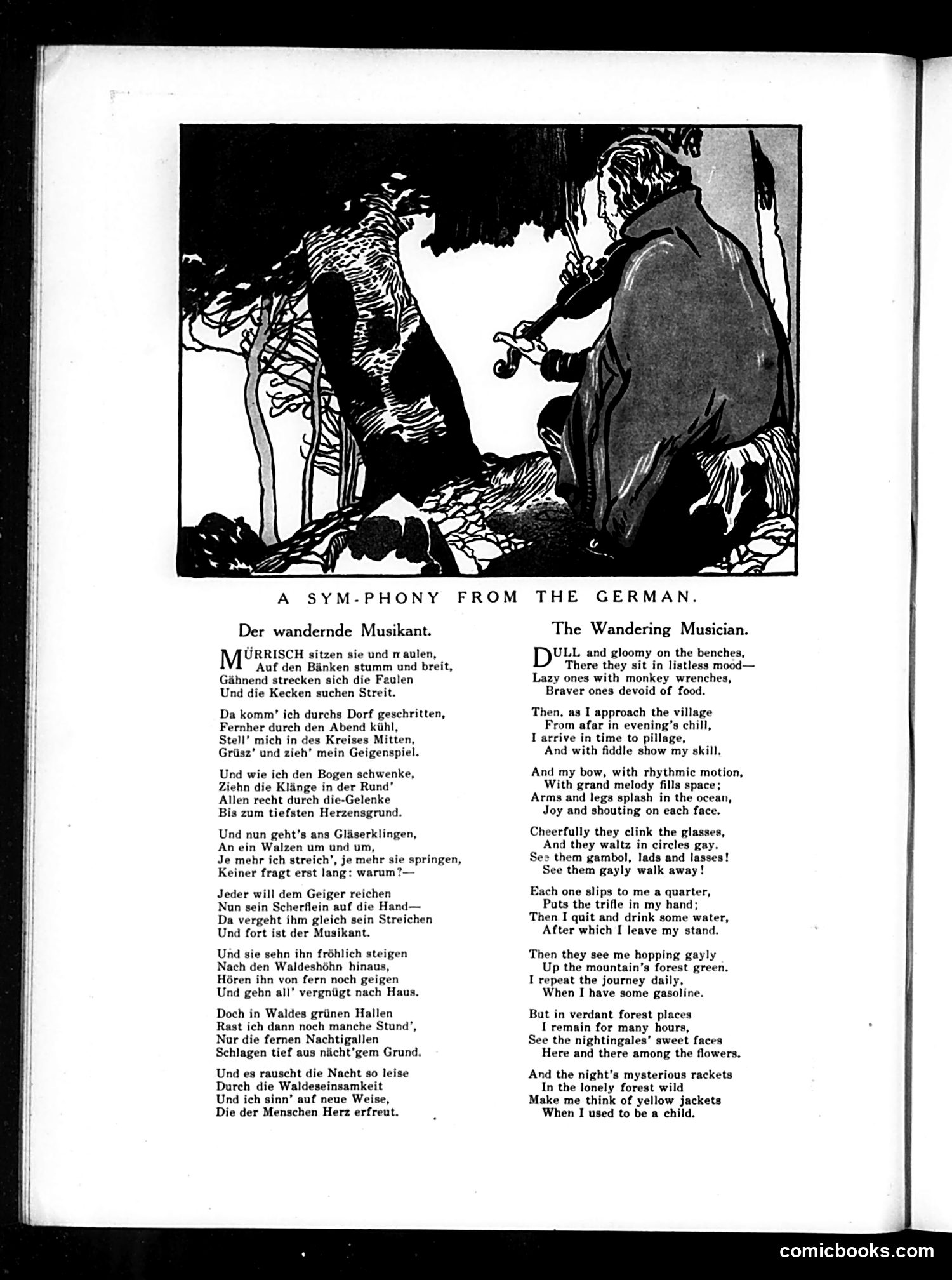
This page presents a German folk poem ("Der wandernde Musikant") with English translation, paired with a woodcut illustration of a wandering musician playing violin to villagers. The piece is **not political satire** but rather **cultural/ethnic humor**. The joke operates on stereotypes: a traveling musician arrives in a German village, captivates the (implied: gullible) villagers with fiddle-playing, collects their money, then departs—repeating this scheme regularly ("When I have some gasoline," the English translation adds, adding modern absurdity). The humor mocks both the itinerant musician's con-artist lifestyle and the villagers' susceptibility to entertainment and emotional manipulation. The illustration shows the musician performing while villagers listen, capturing the moment before the supposed "pillaging" of their wallets. For modern readers: this represents turn-of-century ethnic humor portraying Germans as sentimental, easily manipulated by music and emotion.
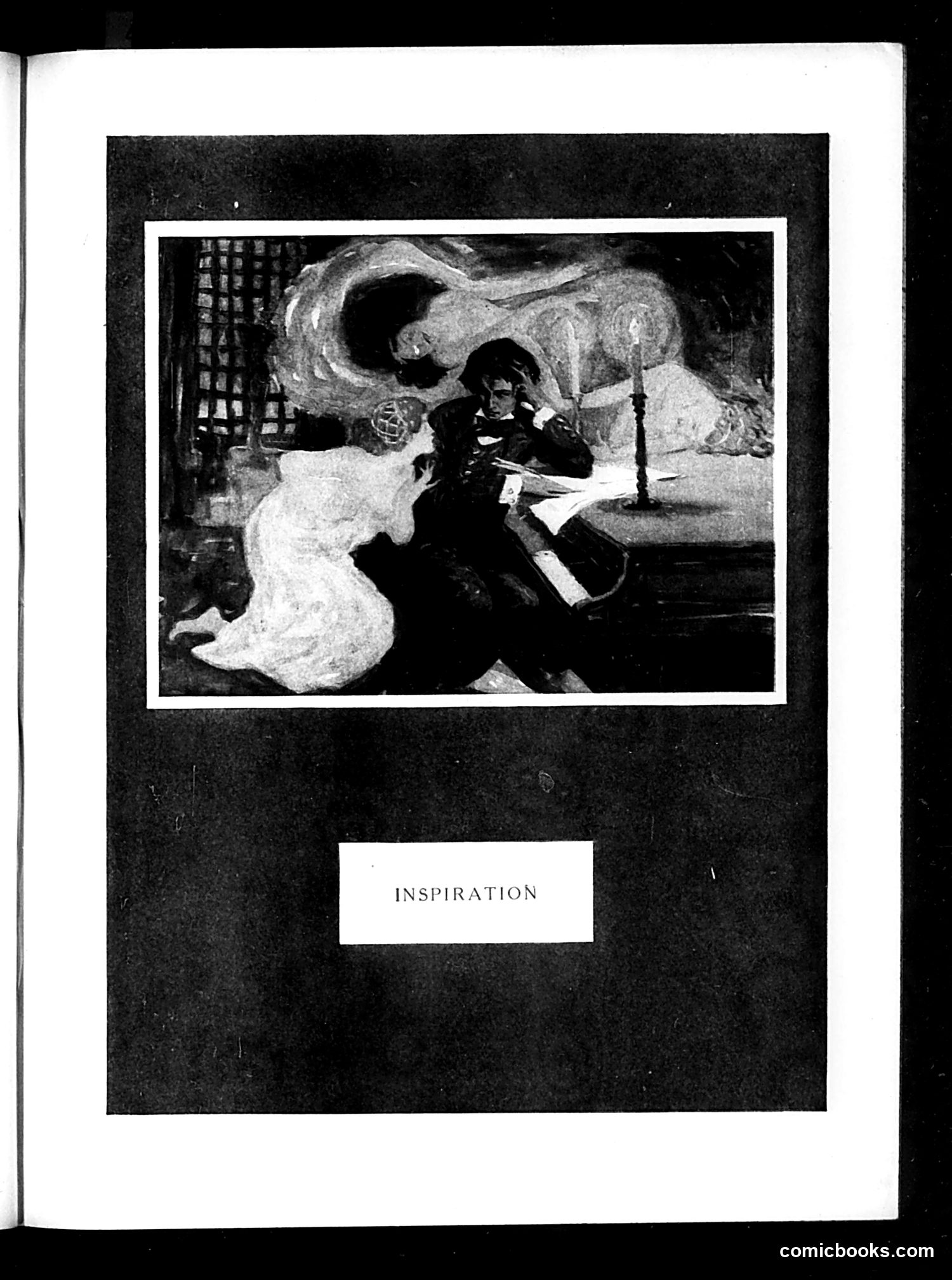
This page from *Judge* magazine shows a single illustration titled "Inspiration." The image depicts a figure in dark clothing seated at what appears to be a desk or writing surface, gesturing toward a large, ethereal white form or spirit-like shape looming above. The composition suggests a creative or artistic moment—the figure appears to be receiving inspiration from this supernatural or abstract presence. Without additional context about the publication date or accompanying article text, the specific political or social reference is unclear. However, the theatrical staging and supernatural imagery are typical of *Judge's* satirical approach. The piece likely comments on artistic pretension, creative processes, or contemporary cultural figures, though the exact target remains uncertain from the image alone.
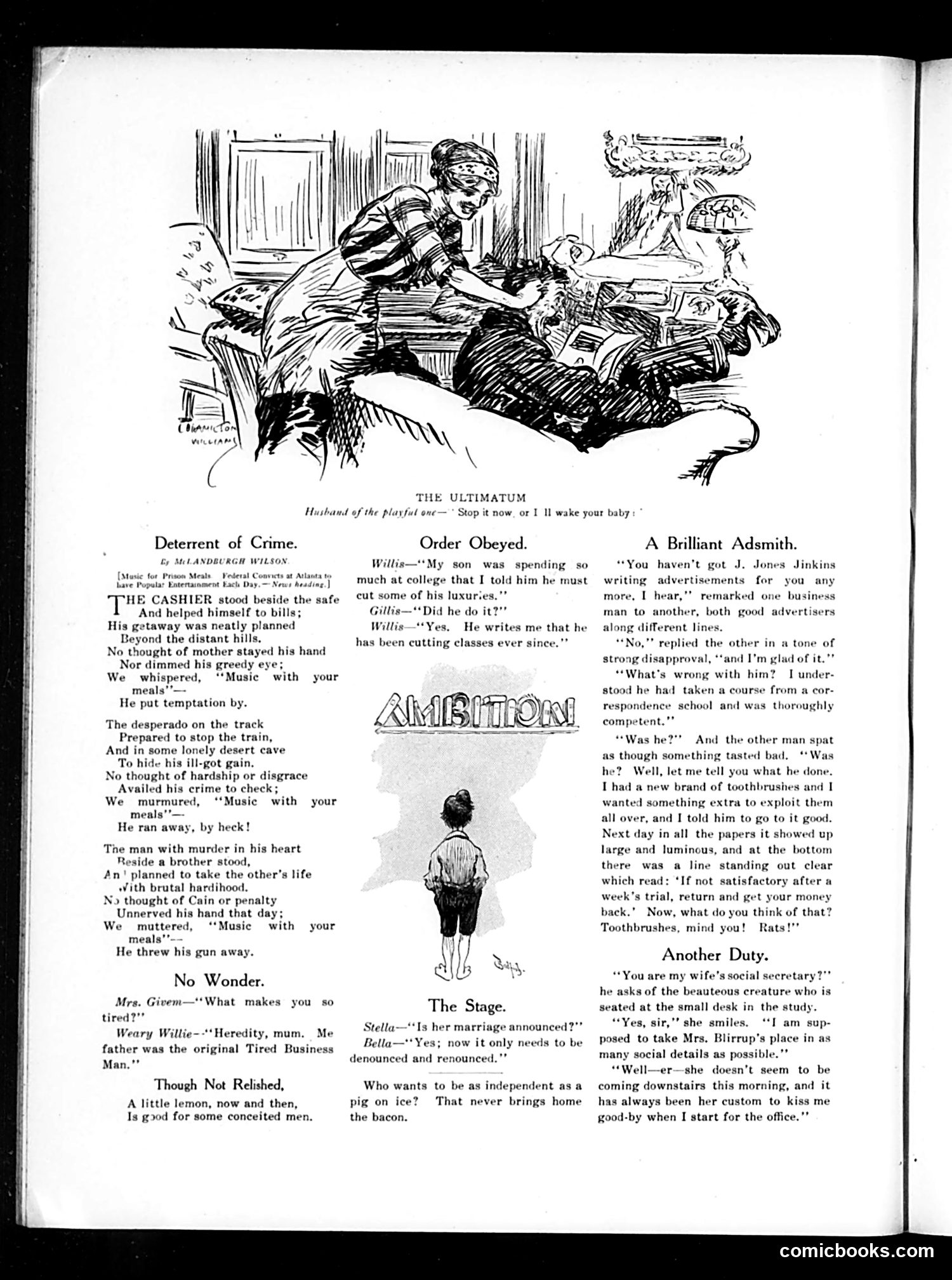
This page contains several short humorous pieces typical of early 20th-century satirical magazines: **Top cartoon**: "The Ultimatum" depicts a husband threatening his wife into compliance, captioned with his ultimatum to "stop it now or I'll wake your baby." It satirizes marital power dynamics. **"Deterrent of Crime"** by Mel Andburgh Wilson is a satirical poem mocking a prison reform idea (apparently providing musical entertainment with meals to inmates). The poem's repeated refrain "Music with your meals" absurdly suggests that offering music somehow deters criminals—a cashier, train robber, and would-be murderer all mysteriously reform after hearing about prison music programs. The satire targets naive rehabilitative policies. **Short jokes** below include wordplay about laziness as hereditary, marriage announcements, and advertising mishaps (a toothbrush ad's money-back guarantee appearing in large print defeats the purpose). The overall tone is cynical about crime prevention, marriage, and business competence—typical Judge fare mocking contemporary social trends and institutions.
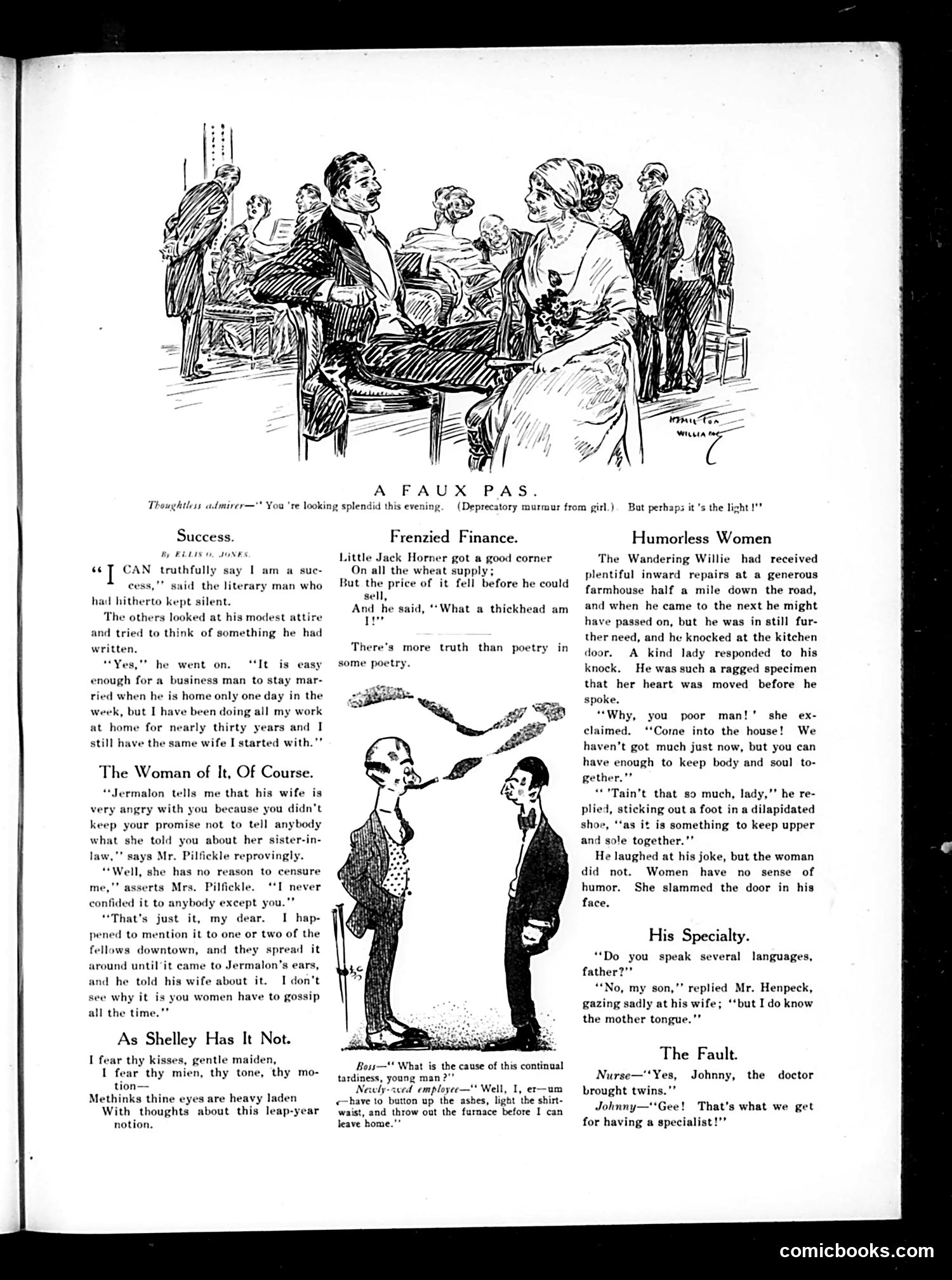
This page contains six separate humor pieces typical of early 20th-century American satirical magazines: **"A Faux Pas"** (top): A social scene mocking thoughtless conversation—the joke being someone compliments another's appearance while actually insulting them. **"Success"** and **"The Woman of It, Of Course"**: Domestic humor satirizing marriage and gender relations, specifically male hypocrisy about gossip (men spread secrets while blaming women) and marital tedium after 30 years. **"Frenzied Finance"**: References contemporary wheat market speculation ("cornering" supplies), mocking financial speculation when prices crash unexpectedly. **"As Shelley Has It Not"**: Parodies Romantic poetry (Shelley), suggesting modern women's concerns about leap-year marriage proposals have replaced poetic sentiment. **"Humorless Women"**: Satirizes women as lacking humor—a vagrant's shoe joke about "sole" goes unappreciated. **"His Specialty"** and **"The Fault"**: Joke about a doctor delivering twins, blaming medical "specialists" for complications—likely referencing contemporary medical obstetrics. The overall tone reflects era-typical gender stereotypes and market cynicism.
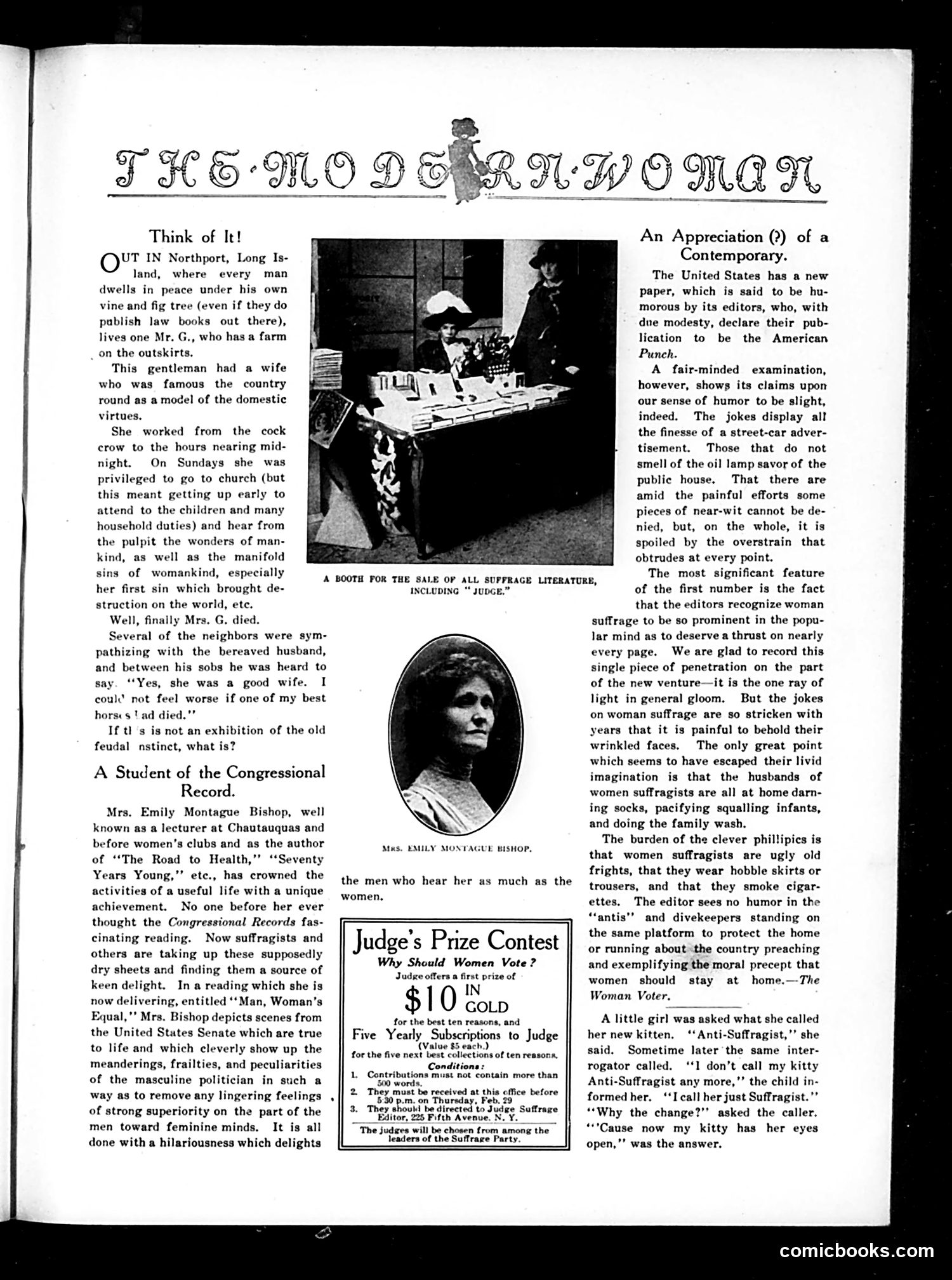
This Judge magazine page satirizes anti-suffrage attitudes through multiple pieces: **"Think of It!"** mocks the "feudal instinct" of a Long Island farmer who, upon his wife's death, expresses grief no deeper than if he'd lost a horse. The satire highlights how women were treated as property and domestic servants with no value beyond labor. **"A Student of the Congressional Record"** celebrates Mrs. Emily Montague Bishop, who entertainingly reads Congressional Records to expose male politicians' "meanderings, frailties, and peculiarities"—implying men are no more qualified to govern than women. **"Judge's Prize Contest"** asks "Why Should Women Vote?" offering prizes, likely sarcastically since Judge appears to mock suffragists elsewhere. **"An Appreciation(?)"** critiques a rival humorous paper for relying on tired anti-suffrage jokes, noting the editors recognize women's suffrage as culturally prominent enough to attack repeatedly—backhanded acknowledgment of the movement's growing importance during the early 20th-century suffrage campaign.
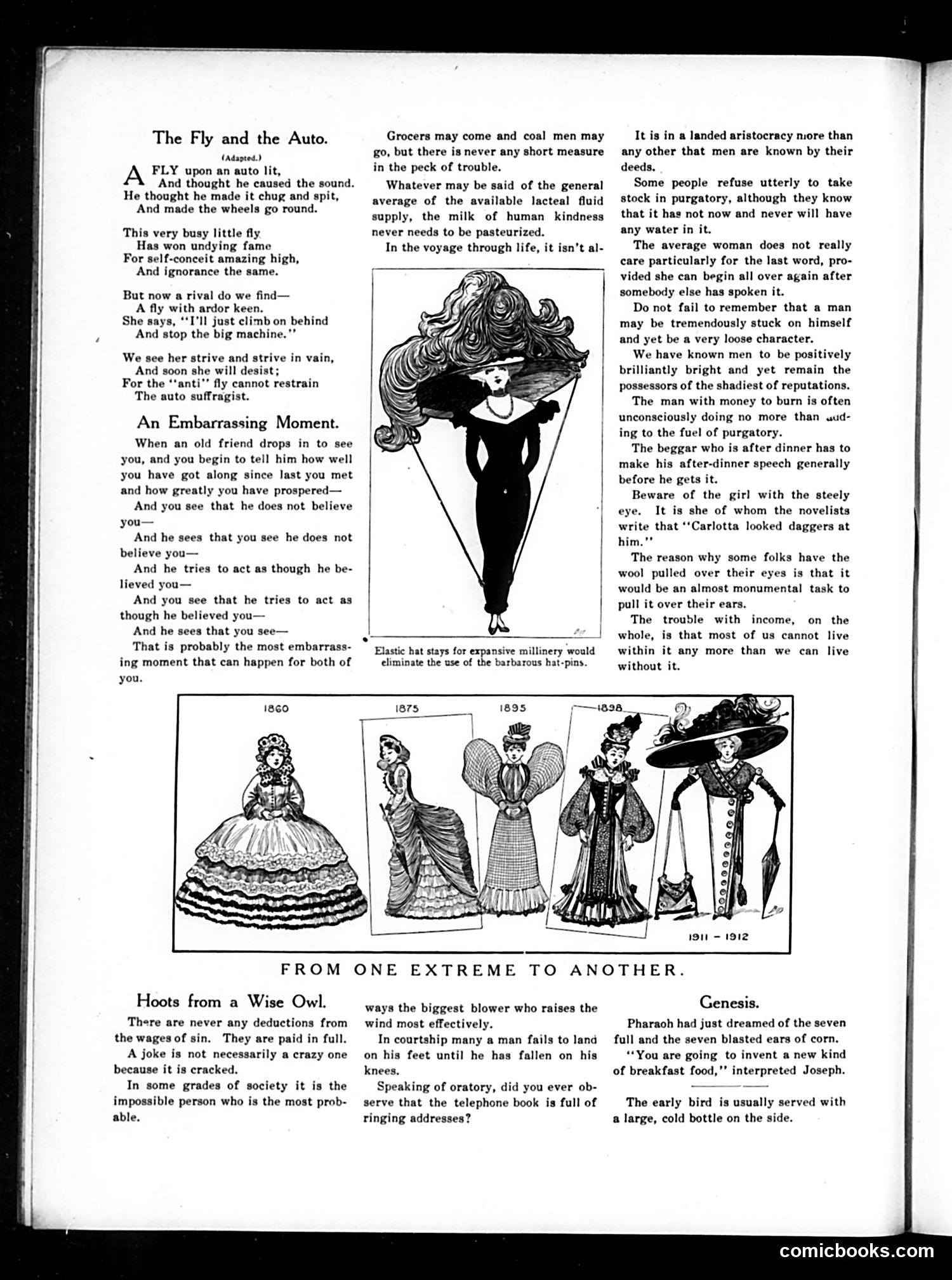
This page from Judge contains satirical commentary and fashion humor typical of early 1910s American humor magazines. **"The Fly and the Auto"** is a poem mocking two types of people: first, someone delusional about their importance (the fly believing it powers the automobile), then satirizing the "auto suffragist"—likely a reference to women suffragettes who were actively campaigning for voting rights around 1912. The joke suggests female activists are as futilely ineffectual as a fly trying to stop a moving car. **"An Embarrassing Moment"** humorously describes the social awkwardness when someone exaggerates their success and suspects the listener doesn't believe them. **The fashion timeline** ("From One Extreme to Another") shows women's hat sizes expanding dramatically from 1850-1912, with the 1911-1912 illustration depicting absurdly oversized hats. This satirizes women's fashion excess and the impracticality of contemporary millinery styles. The scattered aphorisms ("Hoots from a Wise Owl," "Genesis") offer general witticisms about sin, courtship, and success—typical filler content for satirical magazines of the era.
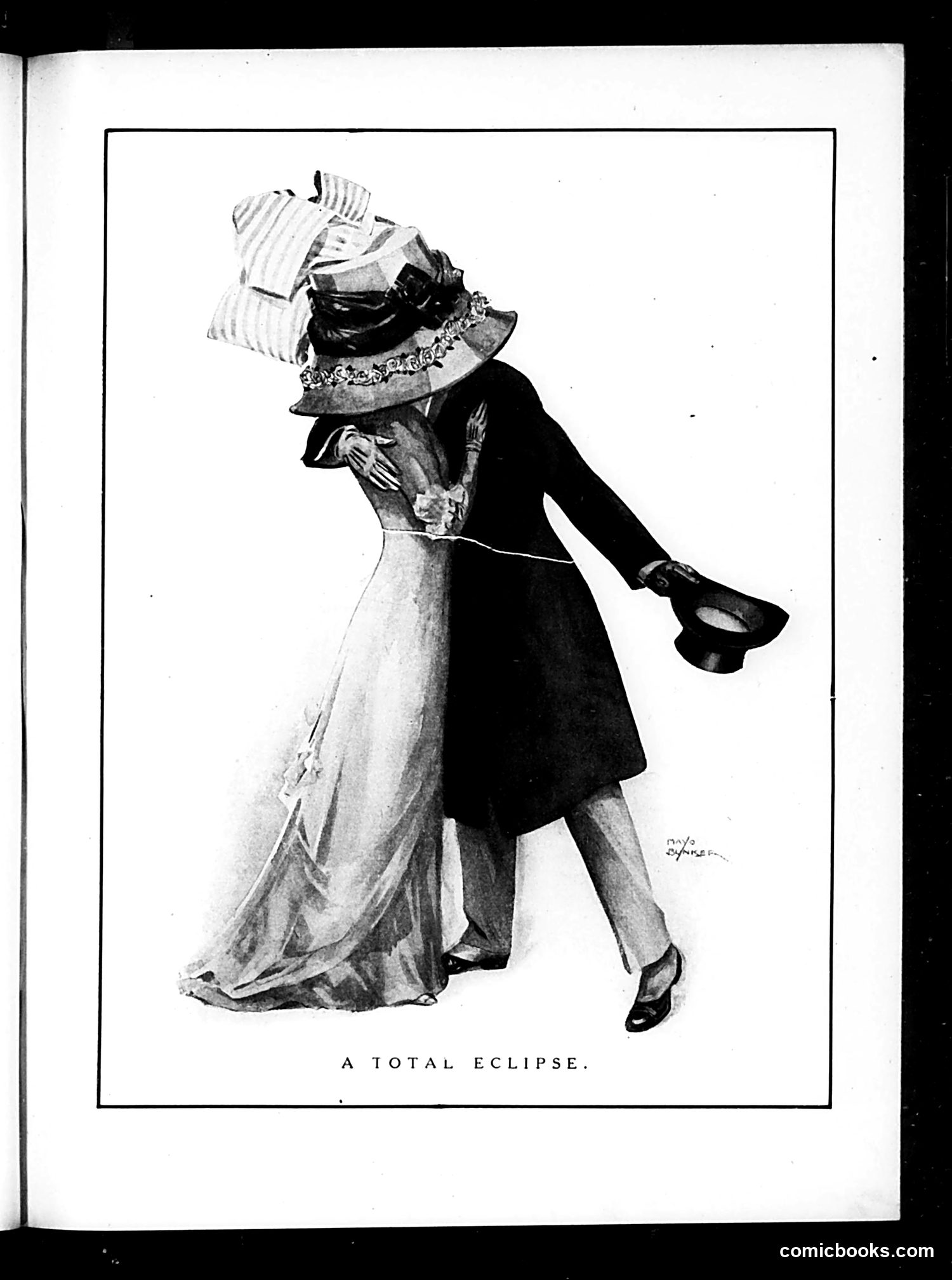
This vintage Judge illustration depicts a woman in an elegant black coat and fashionable hat holding a man's arm while walking. The caption "A Total Eclipse" is a visual pun: the woman's elaborate, oversized hat completely obscures the man's face and head from view—he is literally "eclipsed" by her headwear. The satire targets early 20th-century women's fashion, specifically the trend of extremely large, ornate hats that dominated the era. The joke mocks both the impracticality of these garments and the social dynamic where a woman's fashionable display could completely overshadow her male companion. It's a lighthearted commentary on vanity and the sometimes absurd extremes of contemporary fashion trends.
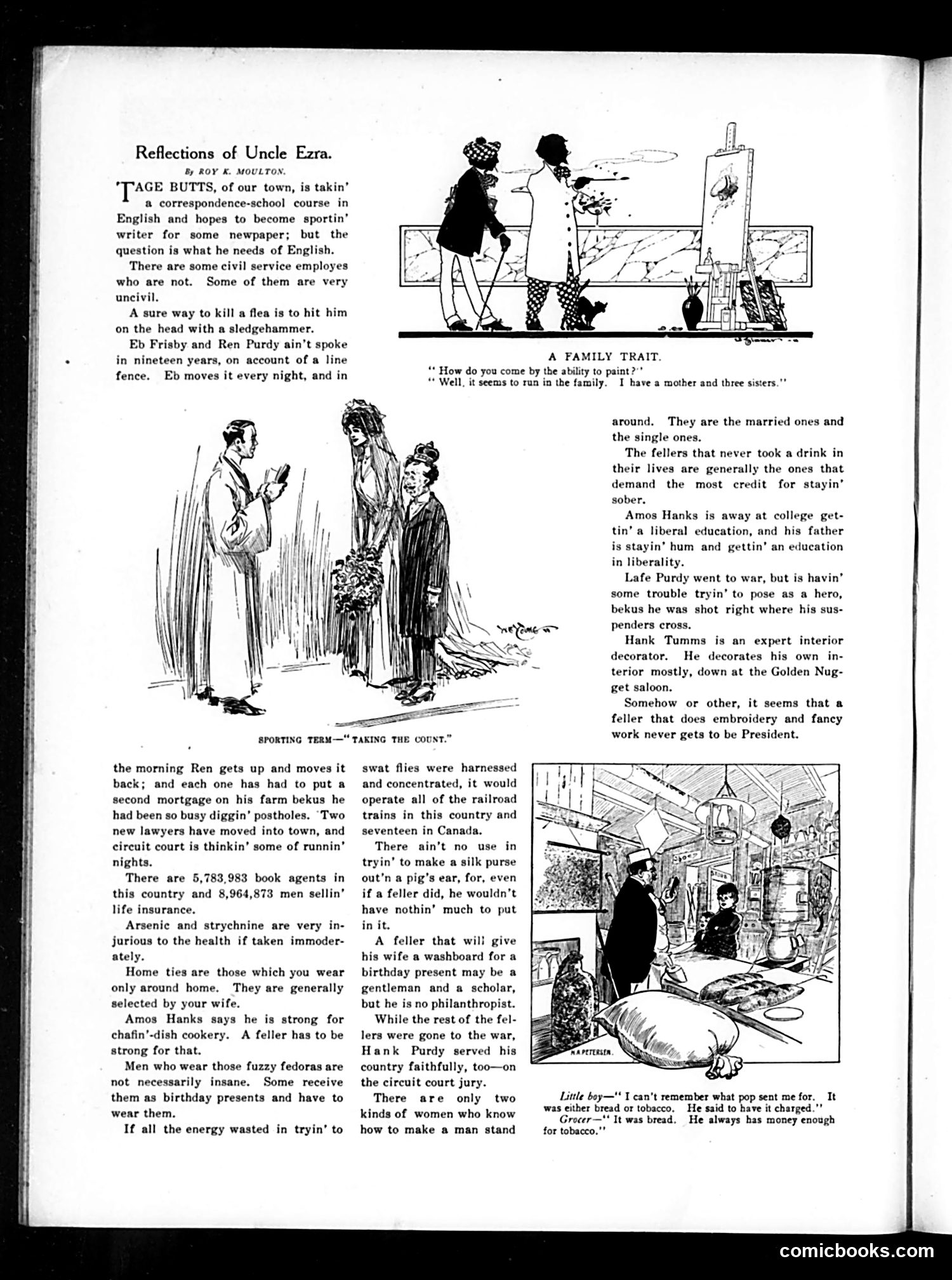
This page presents "Uncle Ezra" observations—homespun rural commentary by Roy K. Moulton mocking small-town life and human nature. The humor relies on exaggeration and ironic reversals. The three cartoons illustrate specific jokes: "Taking the Count" shows a boxing reference to a domestic dispute; "A Family Trait" satirizes inherited artistic ability (implying the women merely inherited laziness rather than talent); the final cartoon jokes about a boy confused between tobacco and bread purchases, with the grocer cynically noting fathers always have money for tobacco. The text collects witticisms about hypocrites (non-drinkers demanding sobriety credit), absurd situations (the endless fence-moving feud), and social commentary on insurance agents, book salesmen, and military service. The humor targets pretension, financial waste, and the gap between claims and reality—typical early-20th-century American rural satire.
This page is primarily **text and advertisements** with no distinct political cartoon, though it contains humorous anecdotal content. The "Steel Humor" section debates whether jokes about vice—like intemperance—are morally justified if they ridicule evil rather than celebrate it. The brief anecdotes illustrate "harmless" humor: a drunk man kicking a lamppost, mistaking a light for his wife being home; a commuter's threat to stop paying a railroad (the "P.D.Q.") after a dispute with a conductor. The "Coffee vs. College" section is a **Postum advertisement** disguised as a testimonial from a college student who quit coffee (which caused headaches and lethargy) and switched to Postum, recovering his health and mental clarity. The page reflects early 20th-century concerns about **stimulants' health effects** and advertising's use of pseudo-scientific testimonials. The advertisements promote White Rock water, the Navarre hotel, Cortez cigars, and a truss—typical Judge magazine revenue sources rather than satirical content.
This page contains **three humorous anecdotes** satirizing excessive literalism and rigid rule-enforcement: 1. **"Why He Drowned"**: A man drowns because Berlin police regulations strictly forbid swimming in the river—so he cannot save himself, illustrating absurd bureaucratic overreach. 2. **"The New Constable"**: A rural traffic officer enforces a 10 mph speed limit so rigidly that he arrests drivers going only 5 mph, mocking overzealous law enforcement that ignores practical context. 3. **"How the War Started"**: A woman naively suggests warring nations "arbitrate," not realizing they already attempted arbitration—which failed and *caused* the war. This satirizes advocates of universal arbitration (possibly referencing Theodore Roosevelt's arbitration efforts), suggesting the solution itself creates conflict. The page's point: **blind adherence to rules without judgment produces absurd, counterproductive results.** The humor relies on the gap between reasonable expectations and literal enforcement. Mixed with period advertisements, this represents typical Judge magazine satirical content.
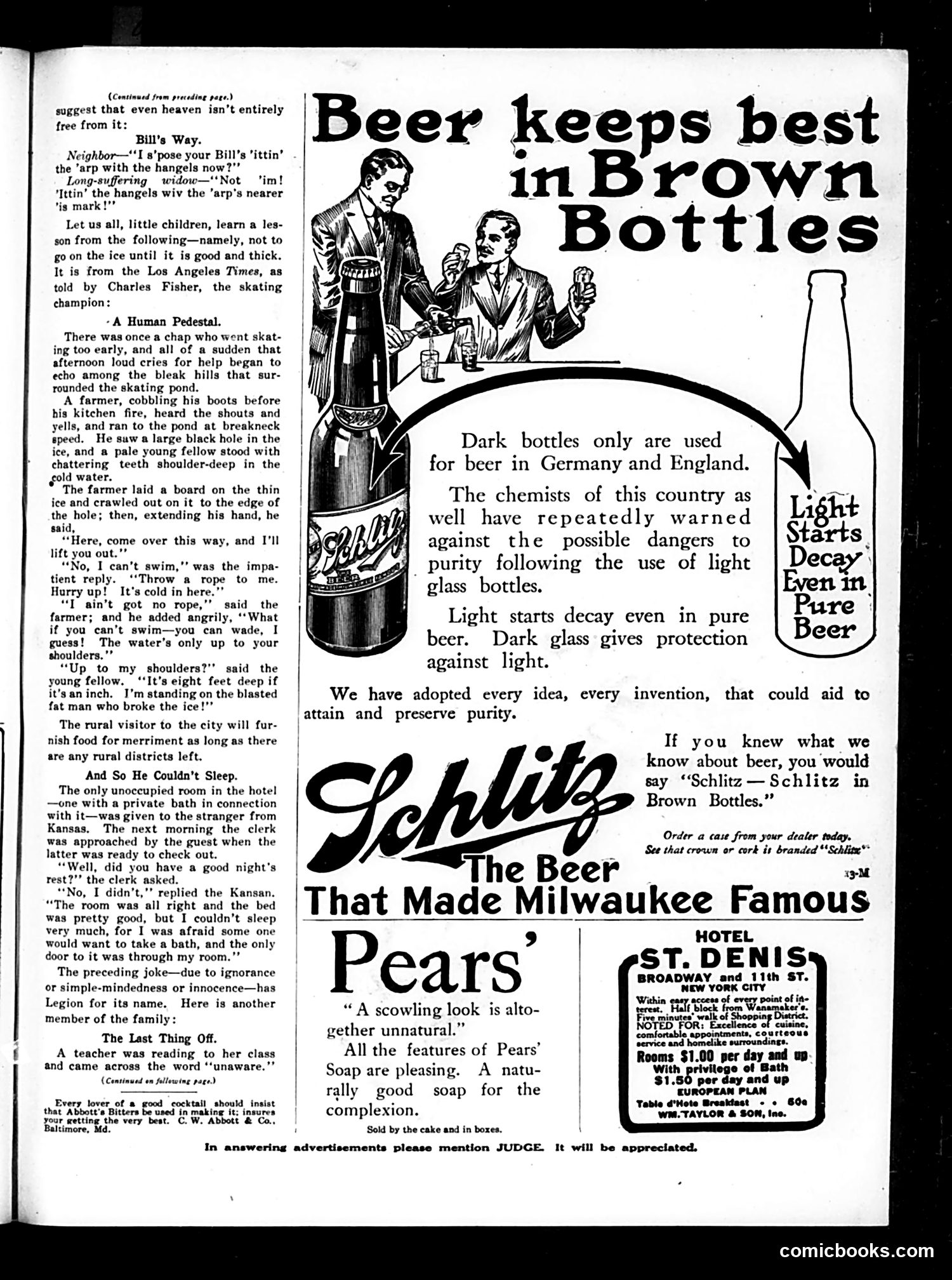
This Judge magazine page contains three separate humor pieces and advertisements typical of early 20th-century American magazines. **The cartoons/jokes** use working-class and rural stereotypes common to the era: a cockney widow ("'ittin' the 'arp"), a Kansas farmer unfamiliar with city hotels, and a skating accident victim. These rely on dialect humor and the "city versus country" theme popular in period comedy. **The advertisements** are the main content here. The Schlitz beer ad emphasizes brown bottles' scientific superiority—a marketing pitch referencing actual chemistry concerns about light degrading beer quality. The Hotel St. Denis and Pears' Soap ads are straightforward period advertising. **The satire level is minimal**—these are mostly light, gentle jokes rather than sharp political commentary. The humor derives from misunderstandings and character types rather than current events. The page demonstrates Judge's typical mix of humor content and commercial advertising from this era.
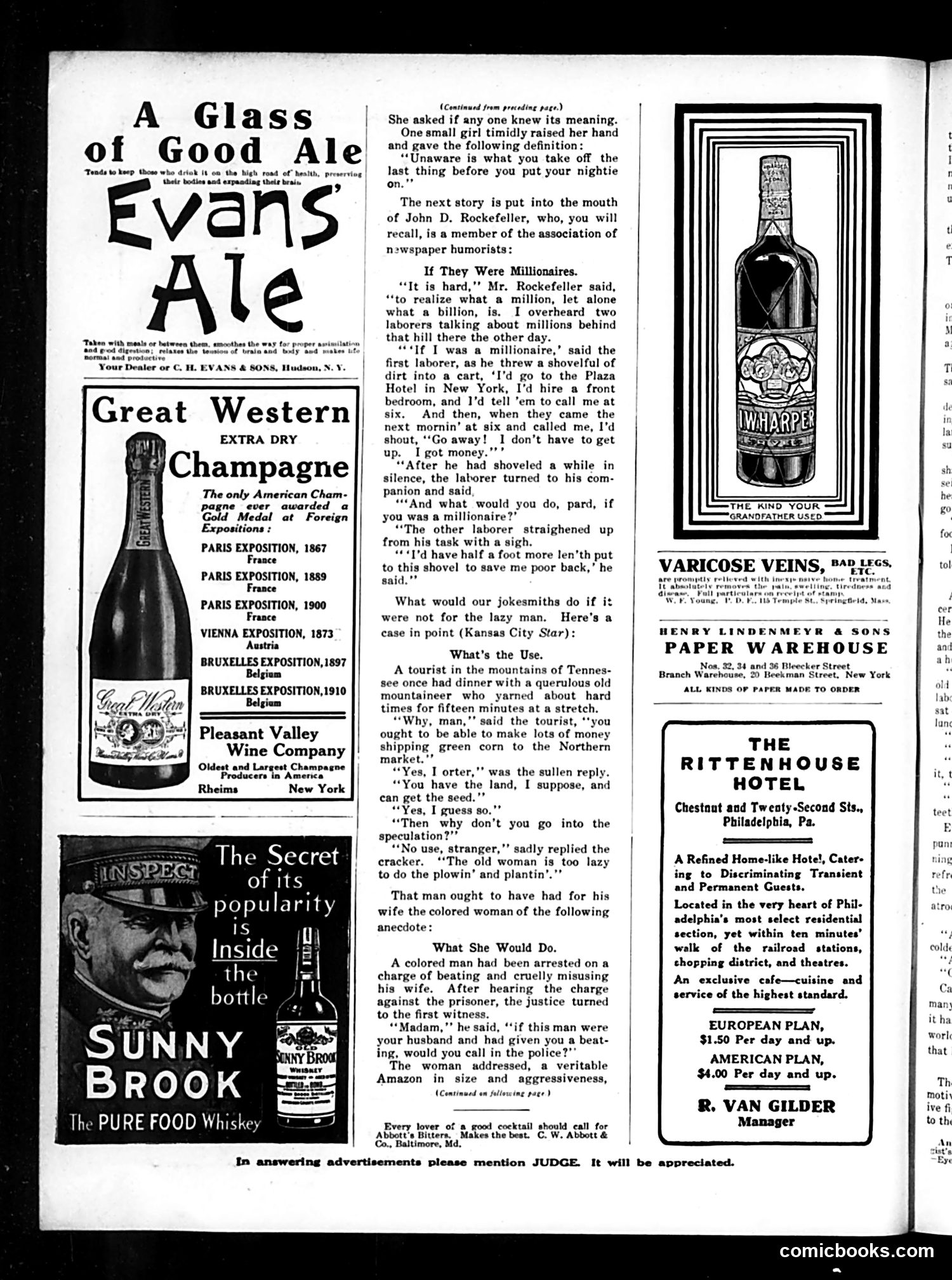
This page is primarily **advertisements and humor content**, not political satire. The main features are: **Humor Pieces:** Three short jokes occupy the center: 1. A child's innocent misdefinition of "unaware" 2. A story attributed to John D. Rockefeller about laborers imagining wealth—satirizing how the poor envision luxury (sleeping in rather than working) versus practical concerns (a longer shovel) 3. A joke about a lazy wife and a strong Black woman **The Satire:** The humor targets laziness and class differences. Rockefeller's anecdote contrasts the impractical fantasies of working-class men with their actual hardships. The final piece plays on racial stereotypes common to the era. **Advertisements:** The page is dominated by ads for Evans Ale, Great Western Champagne, Sunny Brook Whiskey, and Philadelphia hotels—typical Judge magazine content mixing entertainment with revenue. The page reflects early 20th-century attitudes toward labor, wealth, and race rather than specific political events.
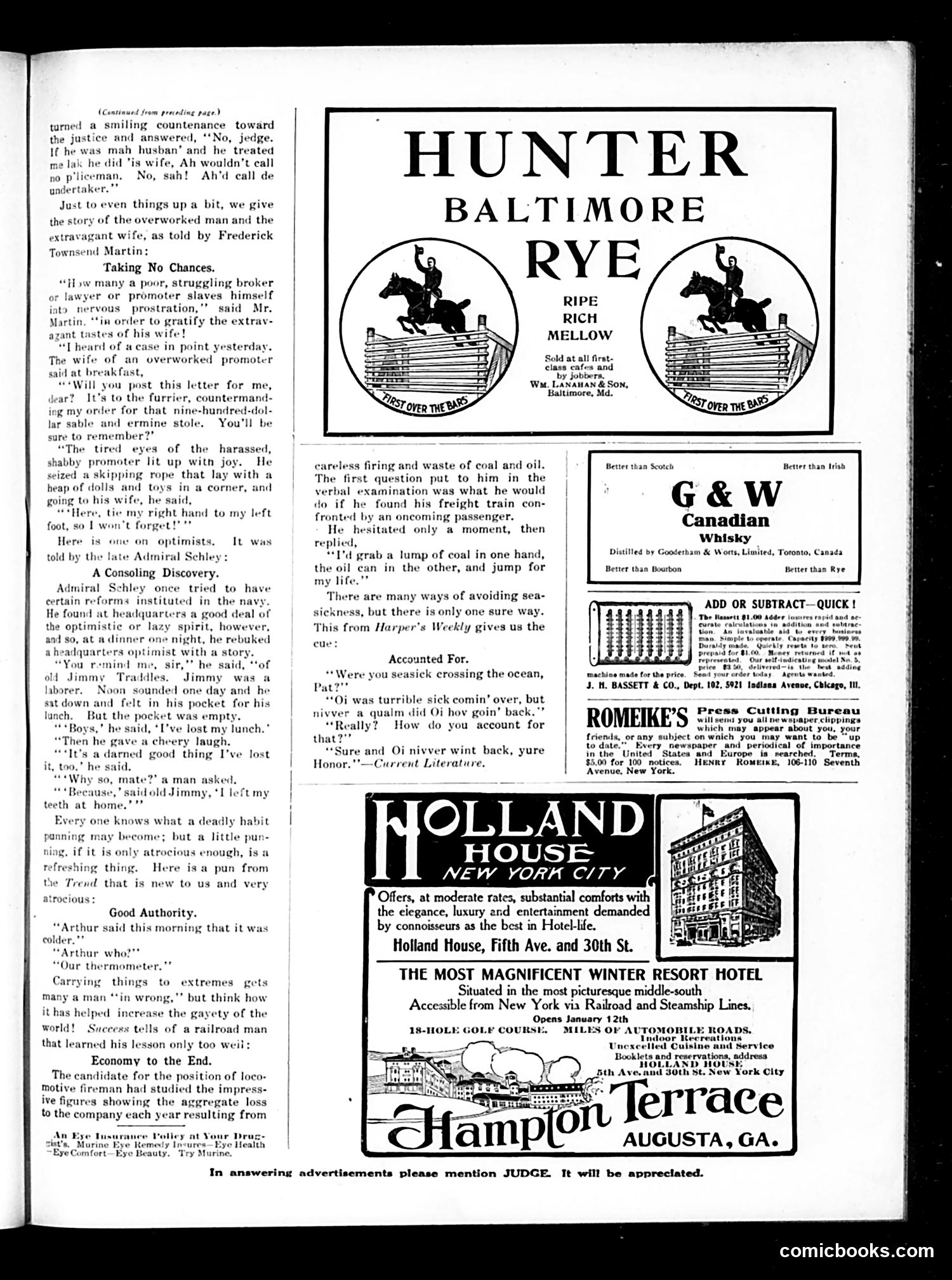
This page is primarily **advertisements and filler content** rather than political satire. The main items are: 1. **Text snippets** (top left): Humorous anecdotes about marriage, work, and optimism—including a story about Admiral Schley attempting naval reforms and various jokes about poverty and domesticity. These appear lifted from other publications. 2. **Advertisements**: The page is dominated by product ads—whiskey brands (Hunter Baltimore Rye, G&W Canadian), hotels (Holland House in NYC, Champion Terrace in Augusta), and business services (Romeike's Press Cutting Bureau, an adding machine). 3. **No clear political cartoons**: Unlike typical Judge content, this page lacks identifiable political figures or caricatures making satirical commentary on current events. The page reflects Judge's mixed format: part satirical magazine, part advertising vehicle. The humor is gentle domestic comedy rather than sharp political critique, suggesting this may be from a lighter issue or filler pages between main content.
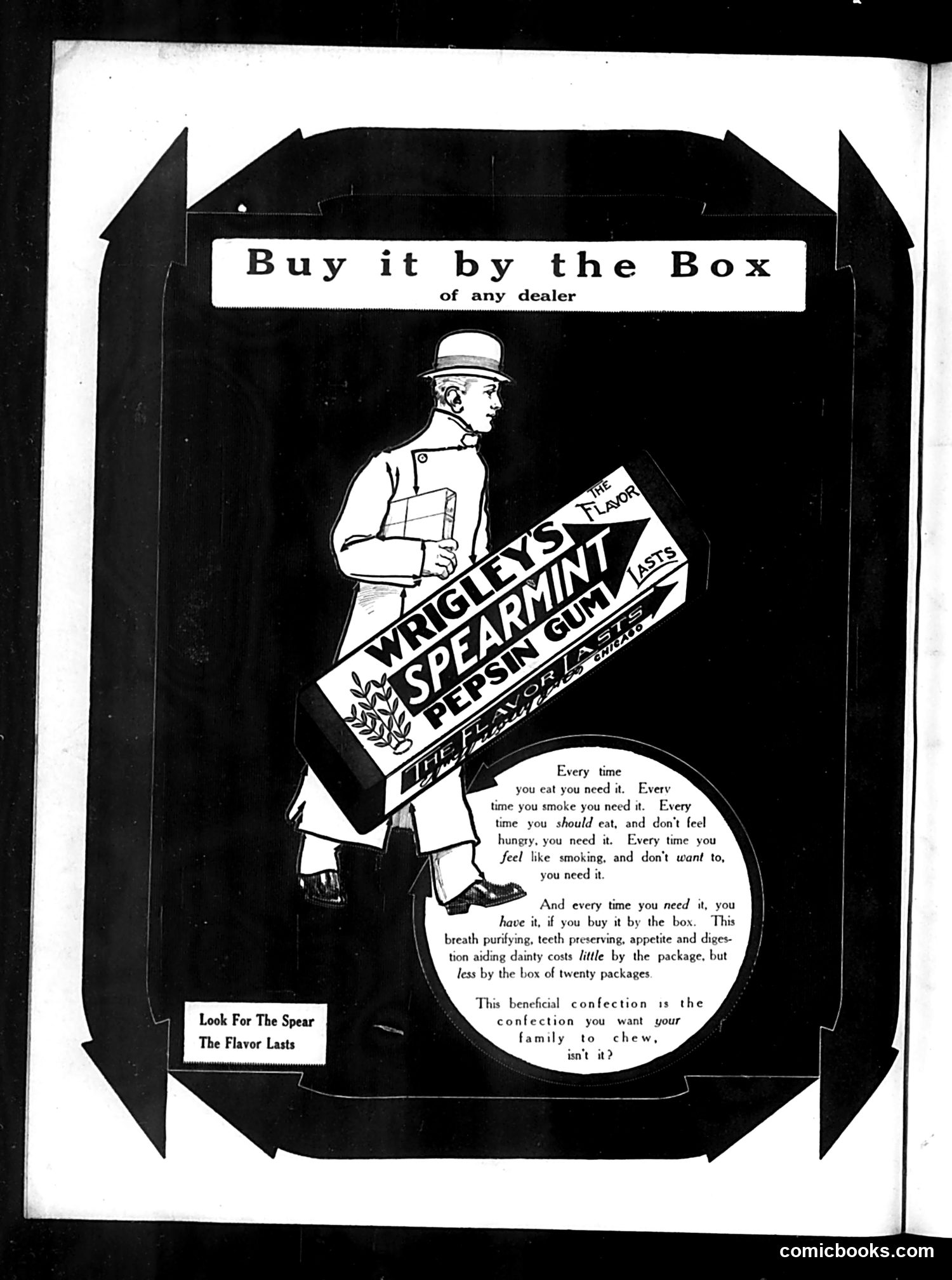
This is a **product advertisement**, not political satire. It promotes Wrigley's Spearmint gum, emphasizing bulk purchasing ("by the box") as economical. The ad employs comedic exaggeration typical of early 20th-century marketing: it claims gum is needed constantly—when eating, smoking, or wanting to smoke—and promises benefits like "breath purifying" and "teeth preserving." The circular text uses absurdist logic to convince consumers that buying twenty-package boxes is cheaper than individual packages. The illustration shows a well-dressed man carrying an enormous gum box, visually emphasizing the "buy by the box" message. The tagline "Look For The Spear / The Flavor Lasts" references Wrigley's iconic spear logo. This reflects early advertising's aggressive, humorous approach to creating consumer demand through repetition and dubious health claims—practices that would later face regulatory scrutiny.