
Judge, 1912-01-20 · page 6 of 24
Judge — January 20, 1912 — page 6: what you’re looking at
What you’re looking at
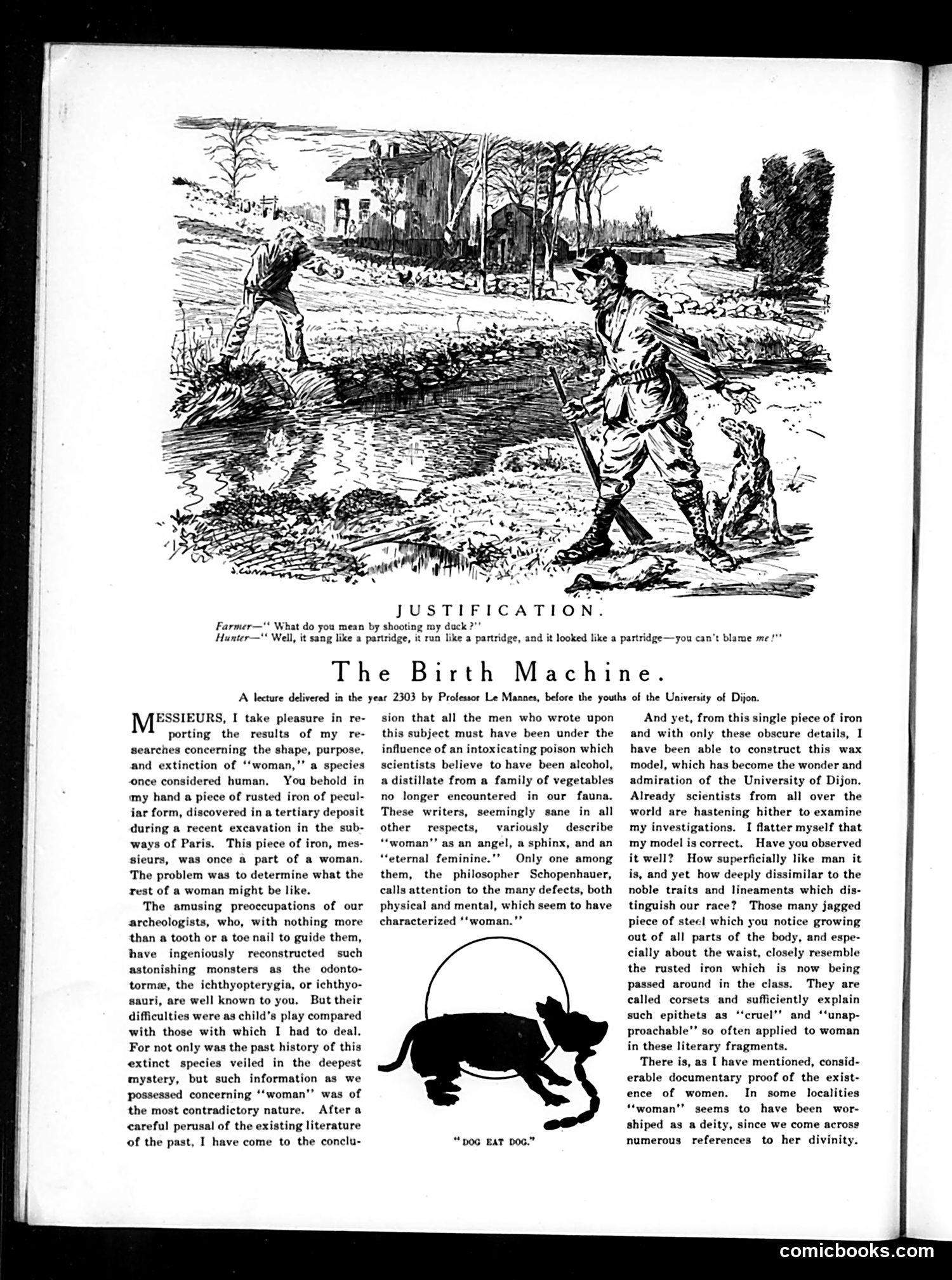
This page contains two satirical pieces from *Judge* magazine: **"Justification" (top cartoon):** A hunter shoots a farmer's duck, claiming it resembled a partridge in appearance, sound, and movement. The joke mocks flimsy excuses—the hunter blames the duck itself rather than his own poor judgment. **"The Birth Machine" (main article):** A futuristic satire set in 2303 where a professor presents women as an extinct species. Using a corroded corset as sole evidence, he reconstructs "woman" as a curiosity, noting historical texts contradict each other—describing women variously as angels or demons depending on the (allegedly drunk) author. The satire targets: - Victorian-era contradictory attitudes toward women - Pseudoscientific pretension (mocking contemporary archaeology) - The corset as a symbol of women's constraint and "cruelty" - Male philosophers' misogynistic writings The piece sardonically suggests future generations will view women-related debates as incomprehensibly absurd, implicitly critiquing contemporary sexism.
📄 Transcribed text from this page (OCR, searchable)
Machine-transcribed from the original scan — historical spelling and the odd misread are preserved.
JUSTIFICATION. Farmer—' What do you mean by shooting my duck ?"" Hunter—"' Well, it sang like a partridge, it run like a partridge, and it looked like a partridge—you can't blame me!" The Birth Machine. A lecture delivered in the year 2303 by Professor Le Mannes, before the youths of the University of Dijon. SSIEURS, I take pleasure in re- porting the results of my re- searches concerning the shape, purpose, and extinction of ‘‘woman,"’ a species ‘once considered human, You behold in my hand a piece of rusted iron of pecul- iar form, discovered in a tertiary deposit during a recent excavation in the sub- ways of Paris. This piece of iron, mes- sieurs, was once a part of a woman. The problem was to determine what the rest of a woman might be like. The amusing preoccupations of our archeologists, who, with nothing more than a tooth or a toe nail to guide them, have ingeniously reconstructed such astonishing monsters as the odonto- torme, the ichthyopterygia, or ichthyo- sauri, are well known to you. But their difficulties were as child’s play compared with those with which I had to deal. For not only was the past history of this extinct species veiled in the deepest mystery, but such information as we possessed concerning ‘‘woman'’ was of the most contradictory nature. Aftera careful perusal of the existing literature of the past, I have come to the conclu- sion that all the men who wrote upon this subject must have been under the influence of an intoxicating poison which scientists believe to have been alcohol, adistillate from a family of vegetables no longer encountered in our fauna. These writers, seemingly sane in all other respects, variously describe ‘*woman’’ as an angel, a sphinx, and an “eternal feminine."” Only one among them, the philosopher Schopenhauer, calls attention to the many defects, both physical and mental, which seem to have characterized ‘‘woman."’ “DOG EAT DOG.” And yet, from this single piece of iron and with only these obscure details, I have been able to construct this wax model, which has become the wonder and admiration of the University of Dijon. Already scientists from all over the world are hastening hither to examine my investigations. I flatter myself that my model is correct. Have you observed it well? How superficially like man it is, and yet how deeply dissimilar to the noble traits and lineaments which dis- tinguish our race? Those many jagged piece of steel which you notice growing out of all parts of the body, and espe- cially about the waist, closely resemble the rusted iron which is now being passed around in the class. They are called corsets and sufficiently explain such epithets as ‘‘cruel’? and ‘‘unap- proachable’’ so often applied to woman in these literary fragments. There is, as I have mentioned, consid- erable documentary proof of the exist- ence of women. In some localities “‘woman’’ seems to have been wor- shiped as a deity, since we come acrose numerous references to her divinity. comicbooks.com