
Judge, 1912-01-20 · page 15 of 24
Judge — January 20, 1912 — page 15: what you’re looking at
What you’re looking at
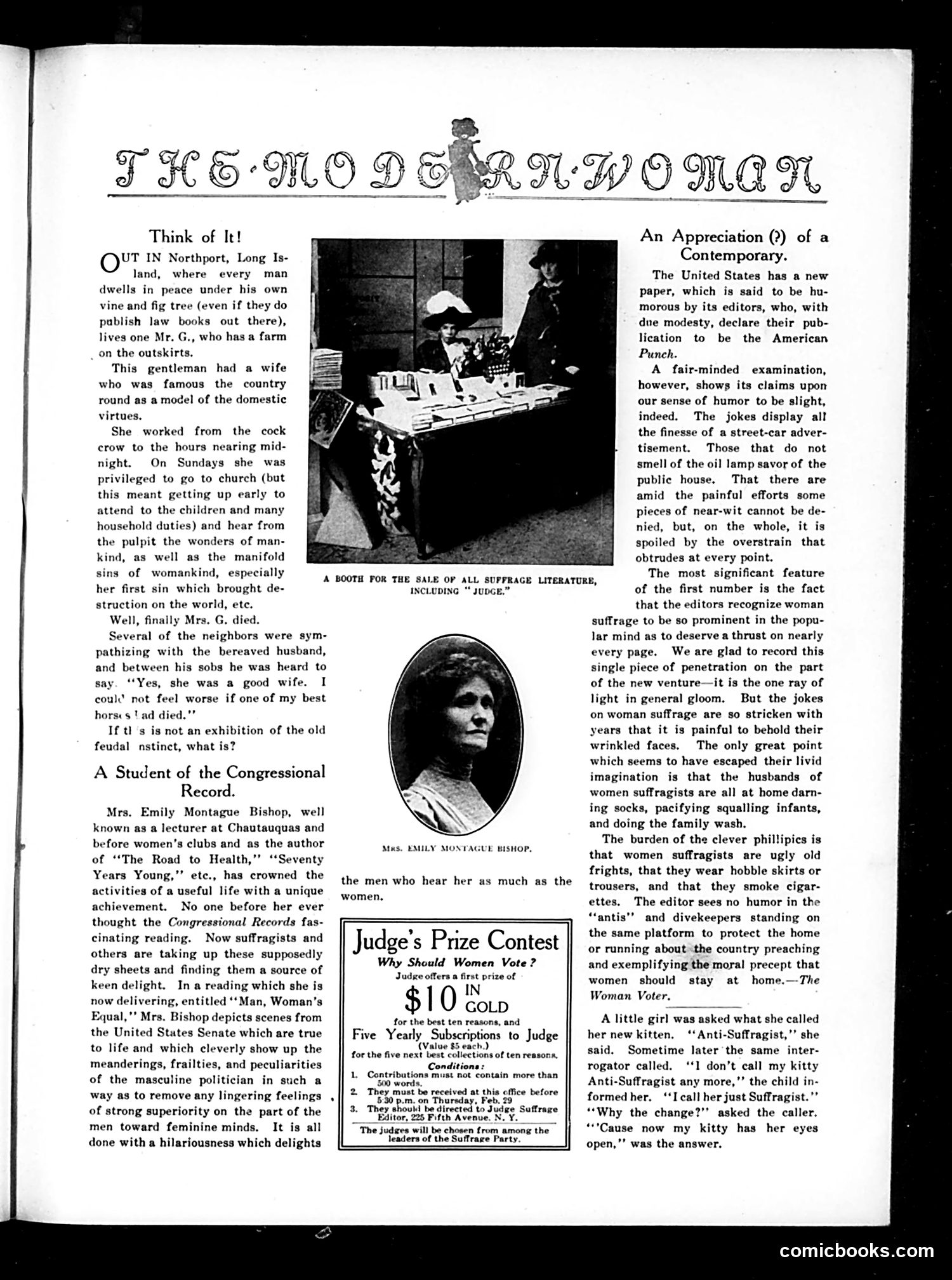
This Judge magazine page satirizes anti-suffrage attitudes through multiple pieces: **"Think of It!"** mocks the "feudal instinct" of a Long Island farmer who, upon his wife's death, expresses grief no deeper than if he'd lost a horse. The satire highlights how women were treated as property and domestic servants with no value beyond labor. **"A Student of the Congressional Record"** celebrates Mrs. Emily Montague Bishop, who entertainingly reads Congressional Records to expose male politicians' "meanderings, frailties, and peculiarities"—implying men are no more qualified to govern than women. **"Judge's Prize Contest"** asks "Why Should Women Vote?" offering prizes, likely sarcastically since Judge appears to mock suffragists elsewhere. **"An Appreciation(?)"** critiques a rival humorous paper for relying on tired anti-suffrage jokes, noting the editors recognize women's suffrage as culturally prominent enough to attack repeatedly—backhanded acknowledgment of the movement's growing importance during the early 20th-century suffrage campaign.
📄 Transcribed text from this page (OCR, searchable)
Machine-transcribed from the original scan — historical spelling and the odd misread are preserved.
Think of It! OUT IN Northport, Long Is- land, where every man dwells in peace under his own vine and fig tree (even if they do publish law books out there), lives one Mr. G., who has a farm on the outskirts. This gentleman had a wife who was famous the country round as a model of the domestic virtues, She worked the cock crow to the hours nearing mid- night. On Sundays she was privileged to go to church (but this meant getting up early to attend to the children and many household duties) and hear from the pulpit the wonders of man- kind, as well as the manifold sins of womankind, especially her first sin which brought de- struction on the world, ete, Well, finally Mrs. G. died. Several of the neighbors were sym- pathizing with the bereaved husband, and between his sobs he was heard to say. ‘Yes, she was a good wife. I coulk’ not feel worse if one of my best horses ' ad died.”” If tl s is not an exhibition of the old feudal nstinct, what is? A Student of the Congressional Record. Mrs. Emily Montague Bishop, well known as a lecturer at Chautauquas and before women’s clubs and as the author of ‘‘The Road to Health,’’ ‘Seventy Years Young,’’ ete., has crowned the activities of a useful life with a unique achievement. No one before her ever thought the Congressional Records fas- cinating reading. Now suffragists and others are taking up these supposedly dry sheets and finding them a source of keen delight. In a reading which she is now delivering, entitled ‘*Man, Woman’s Equal,”’ Mrs. Bishop depicts scenes from the United States Senate which are true to life and which cleverly show up the meanderings, frailties, and peculiarities of the masculine politician in such a way as to remove any lingering feelings , of strong superiority on the part of the men toward feminine minds, It is all done with a hilariousness which delights from J HG-MO D OF the A BOOTH FOR THE SALE OF ALL SUPPRAGE LITERATURE, INCLUDING “* JUDGE.” Mxs. EMILY MONTAGUE BISHOP, men who hear her as much as the women, eer Judge's Prize Contest Five Yearly Subscriptions to Judge for the Why Should Women Vote ? Judge offers a i prize of $10 cow for the best ten reasons, and (Value $5 each.) ext Lest eteees ten reasons, Contributions must not contain more than 500 words, They must be received at this office before 5:30 p.m. on Thursday, Feb. 29 ey should be directed to Judge Suffrage editor, 225 Fifth Avenue. N. Y. ~The judges will be chosen from among the | leaders of the Suffrage Party. An Appreciation (?) of a Contemporary. The United States has a new paper, which is said to be hu- morous by its editors, who, with due modesty, declare their pub- lication to be the American Punch. A fair-minded examination, however, shows its claims upon our sense of humor to be slight, indeed. The jokes display all the finesse of a street-car adver- tisement. Those that do not smell of the oil lamp savor of the public house. That there are amid the painful efforts some pieces of near-wit cannot be de- nied, but, on the whole, it is spoiled by the overstrain that obtrudes at every point. The most significant feature of the first number is the fact that the editors recognize woman suffrage to be so prominent in the popu- lar mind as to deserve a thrust on nearly every page. We are glad to record this single piece of penetration on the part of the new venture—it is the one ray of light in general gloom. But the jokes on woman suffrage are so stricken with years that it is painful to behold their wrinkled faces. The only great point which seems to have escaped their livid imagination is that the husbands of women suffragists are all at home darn- ing socks, pacifying squalling infants, and doing the family wash. The burden of the clever phillipics is that women suffragists are ugly old frights, that they wear hobble skirts or trousers, and that they smoke cigar- ettes. The editor sees no humor in the “antis” and divekeepers standing on the same platform to protect the home or running about the country preaching and exemplifying the moral precept that women should stay at home.—The Woman Voter. A little girl was asked what she called her new kitten. ‘‘Anti-Suffragist,’’ she said, Sometime later the same inter- rogator called. ‘‘I don’t call my kitty Anti-Suffragist any more,’’ the child in- formedher. ‘‘Icall her just Suffragist."’ “Why the change?’’ asked the caller. “Cause now my kitty has her eyes open,’’ was the answer. comicbooks.com