
Judge, 1912-01-20 · page 18 of 24
Judge — January 20, 1912 — page 18: what you’re looking at
What you’re looking at
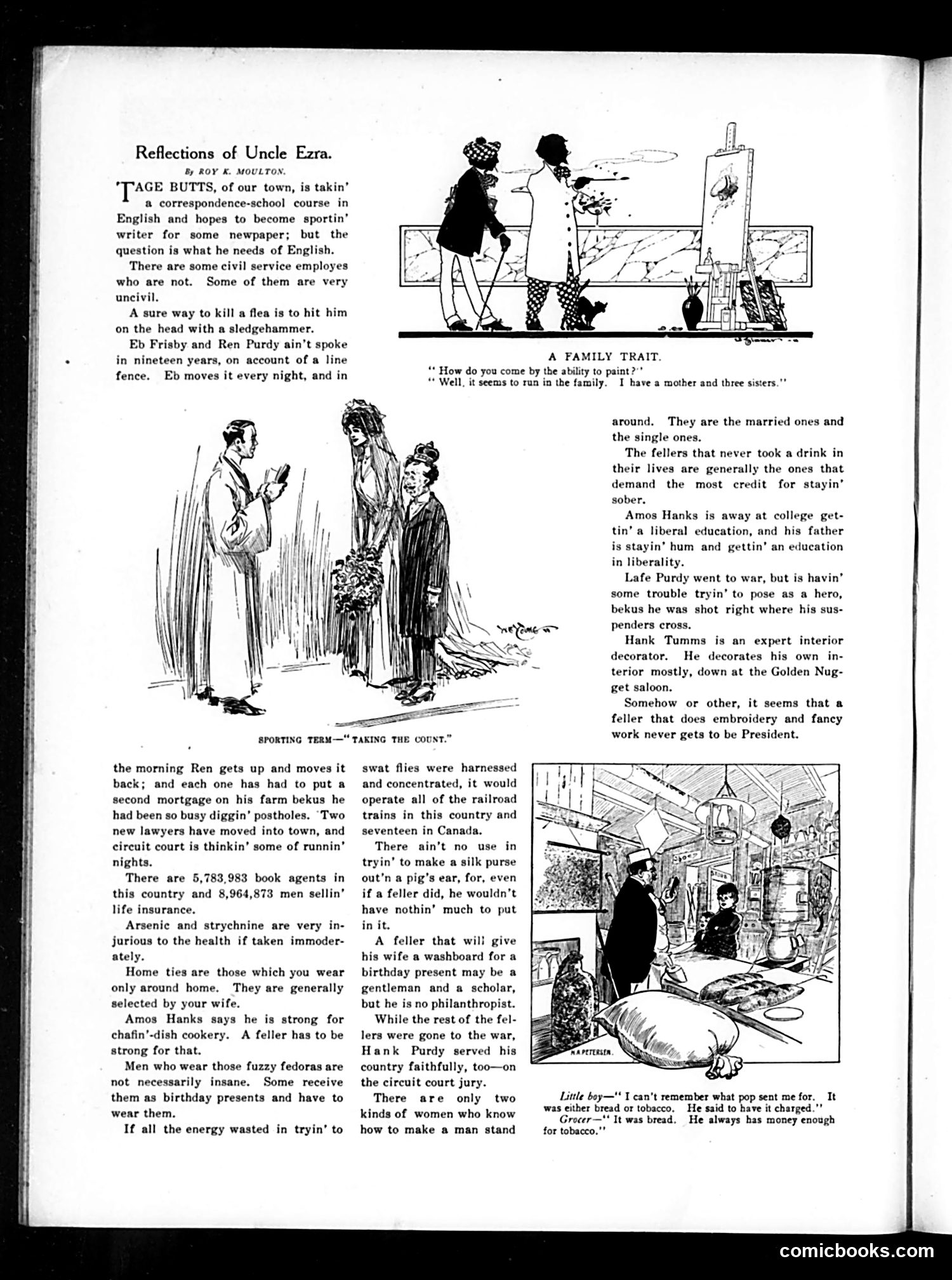
This page presents "Uncle Ezra" observations—homespun rural commentary by Roy K. Moulton mocking small-town life and human nature. The humor relies on exaggeration and ironic reversals. The three cartoons illustrate specific jokes: "Taking the Count" shows a boxing reference to a domestic dispute; "A Family Trait" satirizes inherited artistic ability (implying the women merely inherited laziness rather than talent); the final cartoon jokes about a boy confused between tobacco and bread purchases, with the grocer cynically noting fathers always have money for tobacco. The text collects witticisms about hypocrites (non-drinkers demanding sobriety credit), absurd situations (the endless fence-moving feud), and social commentary on insurance agents, book salesmen, and military service. The humor targets pretension, financial waste, and the gap between claims and reality—typical early-20th-century American rural satire.
📄 Transcribed text from this page (OCR, searchable)
Machine-transcribed from the original scan — historical spelling and the odd misread are preserved.
Reflections of Uncle Ezra. By ROY K. MOULTON. "TAGE BUTTS, of our town, is takin’ a correspondence-school course in English and hopes to become sportin’ writer for some newpaper; but the question is what he needs of English. There are some civil service employes who are not. Some of them are very uncivil. A sure way to kill a flea is to hit him on the head with a sledgehammer. Eb Frisby and Ren Purdy ain’t spoke in nineteen years, on account of a line fence. Eb moves it every night, and in SPORTING TERM—" TAKING THE COUNT.” the morning Ren gets up and moves it back; and each one has had to put a second mortgage on his farm bekus he had been so busy diggin’ postholes. ‘Two new lawyers have moved into town, and circuit court is thinkin’ some of runnin’ nights. There are 5,783,983 book agents in this country and 8,964,873 men sellin’ life insurance. Arsenic and strychnine are very in- jurious to the health if taken immoder- ately. Home ties are those which you wear only around home. They are generally selected by your wife. Amos Hanks says he is strong for chafin’-dish cookery. A feller has to be strong for that. Men who wear those fuzzy fedoras are not necessarily insane. Some receive them as birthday presents and have to wear them. If all the energy wasted in tryin’ to swat flies were harnessed and concentrated, it would operate all of the railroad trains in this country and seventeen in Canada. There ain’t no use in tryin’ to make a silk purse out'n a pig’s ear, for, even if a feller did, he wouldn't have nothin’ much to put in it. A feller that will give his wife a washboard for a birthday present may be a gentleman and a scholar, but he is no philanthropist. While the rest of the fel- lers were gone to the war, Hank Purdy served his country faithfully, too—on the circuit court jury. There are only two kinds of women who know how to make a man stand A FAMILY TRAIT. “* How do you come by the ability to paint?’ “ Well, it seems to run in the family. I have a mother and three sisters."* around. They are the married ones and the single ones. The fellers that never took a drink in their lives are generally the ones that demand the most credit for stayin’ sober. Amos Hanks is away at college get- tin’ a liberal education, and his father is stayin’ hum and gettin’ an education in liberality. Lafe Purdy went to war, but is havin’ some trouble tryin’ to pose as a hero, bekus he was shot right where his sus- penders cross. Hank Tumms is an expert interior decorator. He decorates his own in- terior mostly, down at the Golden Nug- get saloon. Somehow or other, it seems that a feller that does embroidery and fancy work never gets to be President. Little boy—"" I can't remember what pop sent me for. It was either bread or tobacco. He said to have it charged.’’ Grocer— It was bread, He always has money enough for tobacco."” comicbooks.com