
Judge, 1912-01-20 · page 4 of 24
Judge — January 20, 1912 — page 4: what you’re looking at
What you’re looking at
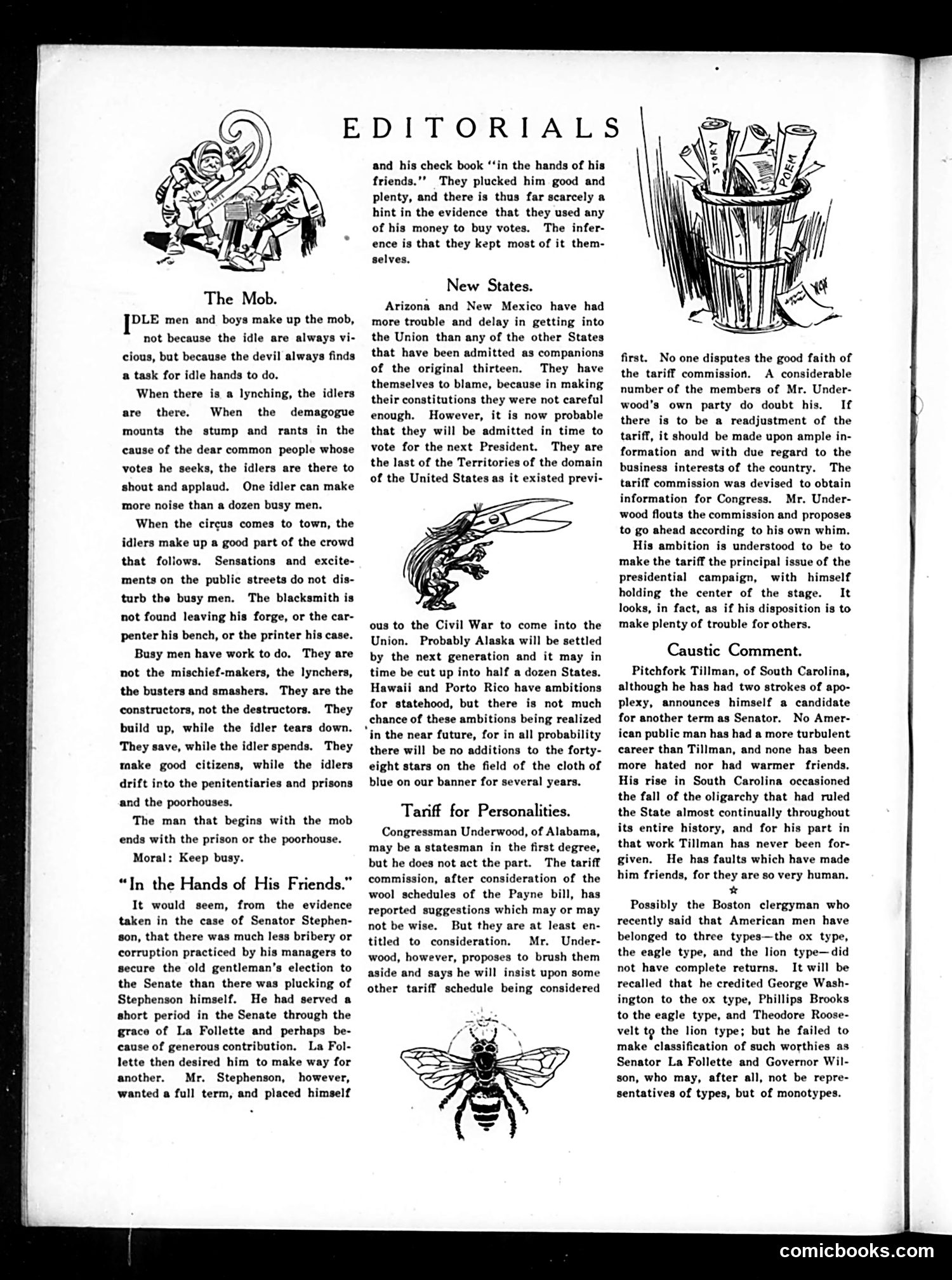
This page contains four editorials with accompanying illustrations criticizing various political and social issues: **"The Mob"** attacks idle men who participate in lynchings, arguing they're destructive rather than constructive citizens who belong in "penitentiaries and poorhouses." **"New States"** discusses Arizona and New Mexico's delayed admission to the Union, and criticizes Congressman Underwood's tariff commission proposal, suggesting his ambition might make tariff policy a "principal issue" in upcoming elections. **"In the Hands of His Friends"** (appears to reference Senator Stephen or another politician) alleges vote-buying corruption, with a La Follette figure orchestrating another candidate's removal to clear the field. **"Caustic Comment"** mocks Pitchfork Tillman's senatorial ambitions and sarcastically compares various politicians to animal "types" (eagle, ox, lion), suggesting they lack distinctive qualities.
📄 Transcribed text from this page (OCR, searchable)
Machine-transcribed from the original scan — historical spelling and the odd misread are preserved.
EDITORIALS [PLE men and boys make up the mob, not because the idle are always vi- cious, but because the devil always finds a task for idle hands to do. When there is a lynching, the idlers there. When the demagogue mounts the stump and rants in the cause of the dear common people whose votes he seeks, the idlers are there to shout and applaud. One idler can make more noise than a dozen busy men. When the circus comes to town, the idlers make up a good part of the crowd that follows. Sensations and excite- ments on the public streets do not dis- turb the busy men. The blacksmith is not found leaving his forge, or the car- penter his bench, or the printer his case. Busy men have work to do. They are not the mischief-makers, the lynchers, the busters and smashers. They are the constructors, not the destructors. They build up, while the idler tears down. They save, while the idler spends. They take good citizens, while the idlers drift into the penitentiaries and prisons and the poorhouses. The man that begins with the mob ends with the prison or the poorhouse. Moral: Keep busy. “In the Hands of His Friends.” It would seem, from the evidence taken in the case of Senator Stephen- son, that there was much less bribery or corruption practiced by his managers to secure the old gentleman's election to the Senate than there was plucking of Stephenson himself. He had served a short period in the Senate through the grace of La Follette and perhaps be- cause of generous contribution. La Fol- lette then desired him to make way for another. Mr. Stephenson, however, wanted a full term, and placed himself are and his check book ‘‘in the hands of his friends.’ They plucked him good and plenty, and there is thus far scarcely a hint in the evidence that they used any of his money to buy votes. The infer- ence is that they kept most of it them- selves. New States. Arizona and New Mexico have had more trouble and delay in getting into the Union than any of the other States that have been admitted as companions of the original thirteen. They have themselves to blame, because in making their constitutions they were not careful enough. However, it is now probable that they will be admitted in time to vote for the next President. They are the last of the Territories of the domain of the United States as it existed previ- ous to the Civil War to come into the Union. Probably Alaska will be settled by the next generation and it may in time be cut up into half a dozen States. Hawaii and Porto Rico have ambitions for statehood, but there is not much chance of these ambitions being realized “in the near future, for in all probability there will be no additions to the forty- eight stars on the field of the cloth of blue on our banner for several years. Tanff for Personalities. Congressman Underwood, of Alabama, may be a statesman in the first degree, but he does not act the part. The tariff commission, after consideration of the wool schedules of the Payne bill, has reported suggestions which may or may not be wise. But they are at least en- titled to consideration. Mr. Under- wood, however, proposes to brush them aside and says he will insist upon some other tariff schedule being considered first. No one disputes the good faith of the tariff commission. A considerable number of the members of Mr. Under- wood's own party do doubt his. If there is to be a readjustment of the tariff, it should be made upon ample in- formation and with due regard to the business interests of the country. The tariff commission was devised to obtain information for Congress. Mr. Under- wood flouts the commission and proposes to go ahead according to his own whim. His ambition is understood to be to make the tariff the principal issue of the presidential campaign, with himself holding the center of the stage. It looks, in fact, as if his disposition is to make plenty of trouble for others. Caustic Comment. Pitchfork Tillman, of South Carolina, although he has had two strokes of apo- plexy, announces himself a candidate for another term as Senator. No Amer- ican public man has had a more turbulent career than Tillman, and none has been more hated nor had warmer friends. His rise in South Carolina occasioned the fall of the oligarchy that had ruled the State almost continually throughout its entire history, and for his part in that work Tillman has never been for- given. He has faults which have made him friends, for they are so very human. * Possibly the Boston clergyman who recently said that American men have belonged to three types—the ox type, the eagle type, and the lion type—did not have complete returns. It will be recalled that he credited George Wash- ington to the ox type, Phillips Brooks to the eagle type, and Theodore Roose- velt tg the lion type; but he failed to make classification of such worthies as Senator La Follette and Governor Wil- son, who may, after all, not be repre- sentatives of types, but of monotypes. comicbooks.com