
Judge, 1912-01-20 · page 7 of 24
Judge — January 20, 1912 — page 7: what you’re looking at
What you’re looking at
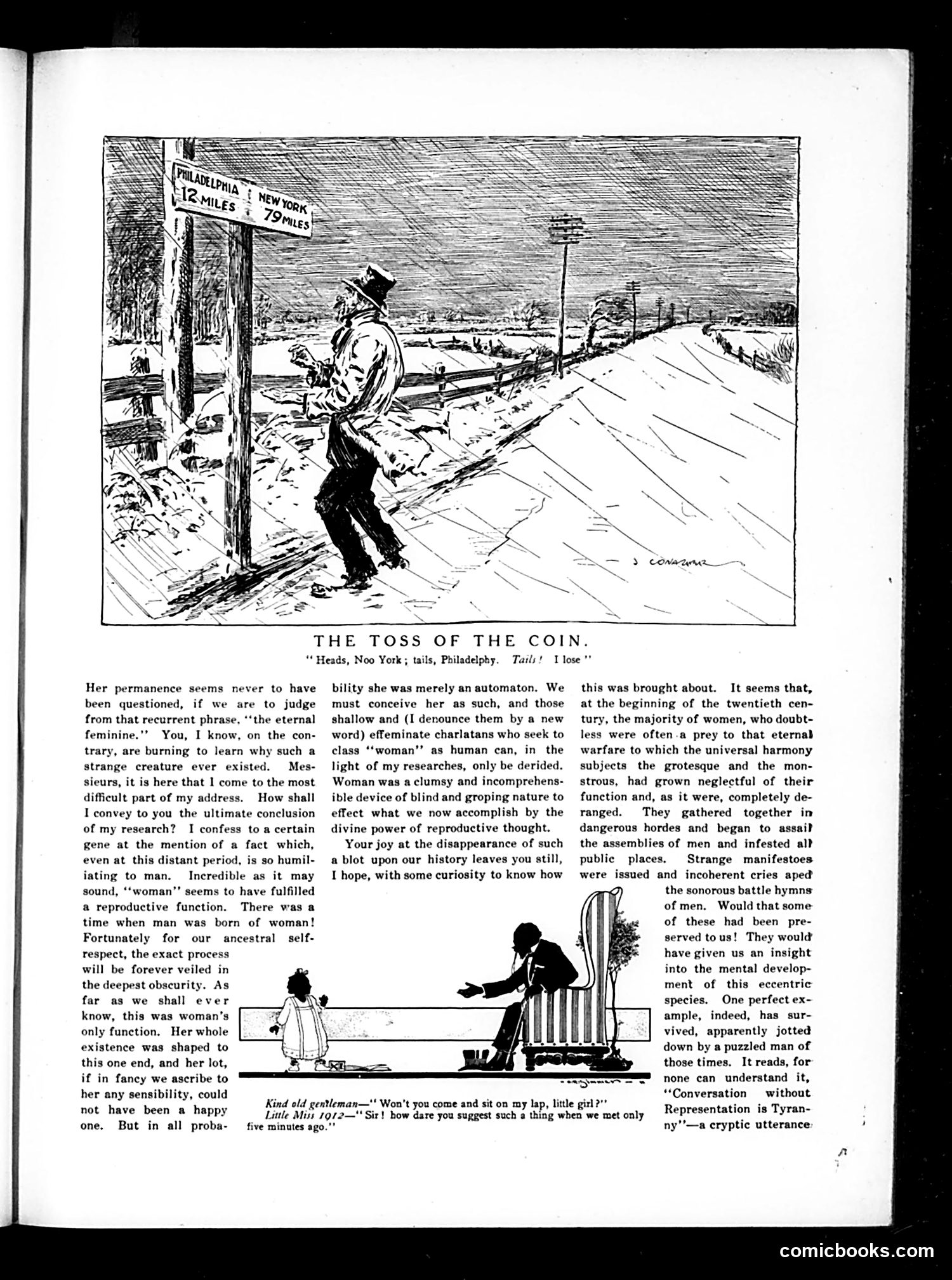
This page satirizes early 1900s anti-feminist ideology. The top cartoon shows a man flipping a coin between New York and Philadelphia—likely mocking how women's suffrage was treated as a trivial matter rather than serious political change. The lengthy text parodies pseudo-scientific misogyny popular at the time, presenting woman as merely a "reproductive function" and "automaton" rather than human. It frames early 20th-century feminism—women organizing and protesting—as chaotic disorder. The bottom comic depicts a 1912 young woman rejecting unwanted advances from an older man, illustrating changing female social autonomy that threatened traditional male authority. The page's closing quote—"Representation without Taxation is Tyranny"—echoes the American Revolution slogan but references women's suffrage demands, which the text treats dismissively as incomprehensible. The satire's target appears to be outdated male attitudes rather than feminism itself, though the mockery is heavy-handed.
📄 Transcribed text from this page (OCR, searchable)
Machine-transcribed from the original scan — historical spelling and the odd misread are preserved.
THE TOSS OF THE COIN. “Heads, Noo York ; tails, Philadelphy. Her permanence seems never to have been questioned, if we are to judge from that recurrent phrase, ‘‘the eternal feminine.’’ You, I know, on the con- trary, are burning to learn why such a strange creature ever existed. Mes- sieurs, it is here that 1 come to the most difficult part of my address. How shall I convey to you the ultimate conclusion of my research? I confess to a certain gene at the mention of a fact which, even at this distant period, is so humil- iating to man. Incredible as it may sound, ‘‘woman”’ seems to have fulfilled a reproductive function. There was a time when man was born of woman! Fortunately for our ancestral self- respect, the exact process will be forever veiled in the deepest obscurity. As far as we shall ever know, this was woman's only function. Her whole existence was shaped to this one end, and her lot, if in fancy we ascribe to her any sensibility, could not have been a happy one. But in all proba- Tails! bility she was merely an automaton, We must conceive her as such, and those shallow and (I denounce them by a new word) effeminate charlatans who seek to class ‘‘woman’’ as human can, in the light of my researches, only be derided. Woman was a clumsy and incomprehens- ible device of blind and groping nature to effect what we now accomplish by the divine power of reproductive thought. Your joy at the disappearance of such a blot upon our history leaves you still, I hope, with some curiosity to know how Kind old gentleman—"' Won't you come and sit on my lap, little girl?" Little Miss 1912—" Sit! how dare you suggest such a thing when we met only five minutes ago."" I lose "" this was brought about. It seems that, at the beginning of the twentieth cen- tury, the majority of women, who doubt- less were often.a prey to that eternab warfare to which the universal harmony subjects the grotesque and the mon- strous, had grown neglectful of their function and, as it were, completely de- ranged. They gathered together in dangerous hordes and began to assai? the assemblies of men and infested al? public places. Strange manifestoes were issued and incoherent cries aped the sonorous battle hymns of men. Would that some of these had been pre- served tous! They would have given us an insight into the mental develop- ment of this eccentric species. One perfect ex- ample, indeed, has sur- vived, apparently jotted down by a puzzled man of those times. It reads, for none can understand it, “Conversation without Representation is Tyran- ny’’—a cryptic utterance: comicbooks.com