
A complete issue · 48 pages · 1909
Judge — December 4, 1909
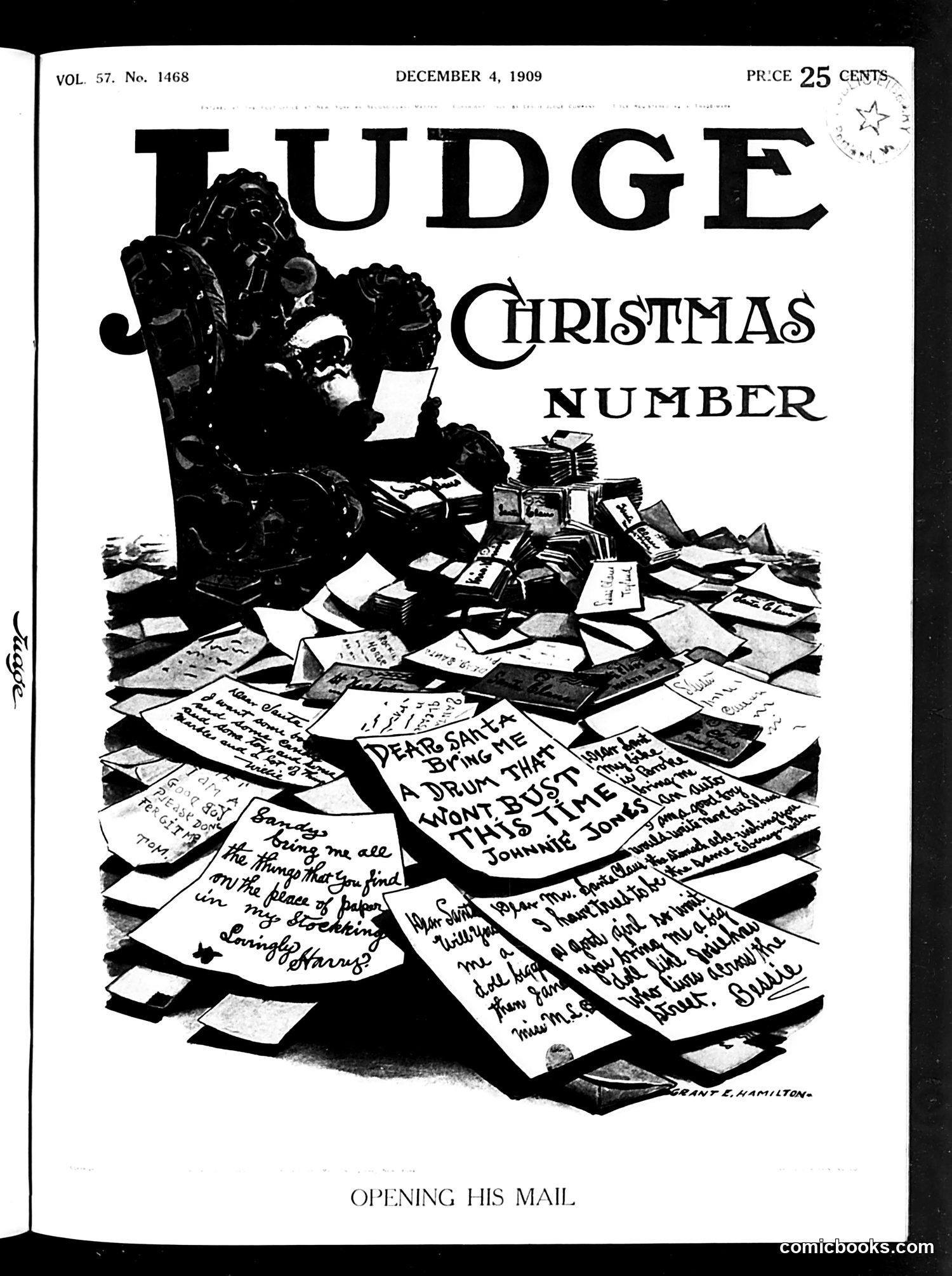
This satirical cover depicts Santa Claus overwhelmed by mail, sitting in a chair surrounded by scattered letters and gift requests. The caption reads "Opening His Mail." The joke satirizes the massive volume of Christmas wish letters Santa receives—a relatable holiday theme even for 1909 readers. Several visible letter fragments show typical Christmas requests: "Dear Santa, Bring me a drum," "Won't you bring that," "Johnnie Jones," and other children's handwriting requesting toys. The satire suggests the impossibility of fulfilling every child's demands, humorously presenting Santa's Christmas task as administrative burden rather than magical wonder. It's a commentary on commercialized Christmas expectations and consumer desire—themes that resonate across centuries.
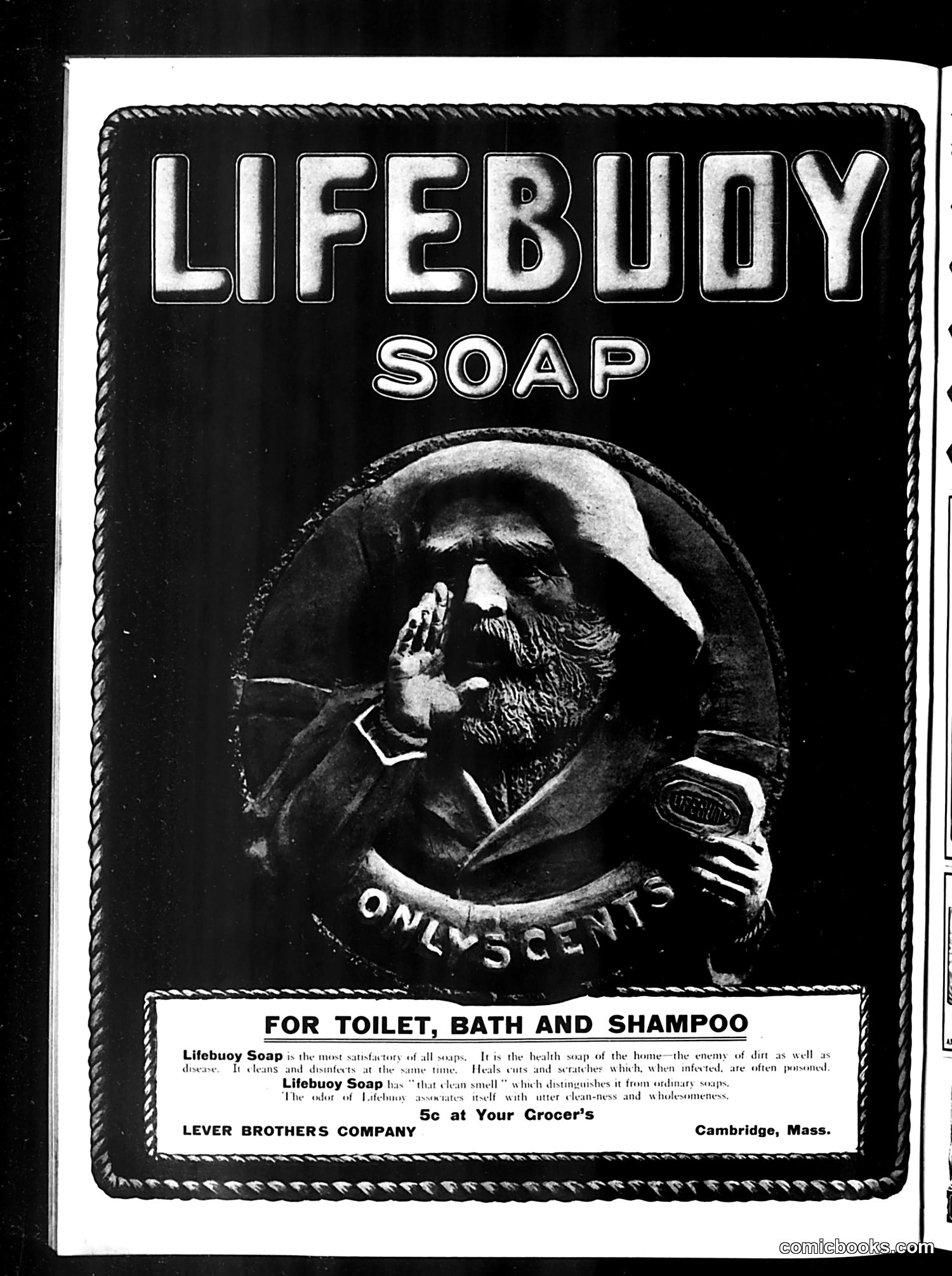
This is primarily a **commercial advertisement**, not political satire. It advertises Lifebuoy Soap, priced at 5 cents, sold by Lever Brothers Company in Cambridge, Massachusetts. The ad features a bearded man in period dress (appearing nautical or seafaring based on the hat and clothing), positioned within a life preserver ring—a visual pun on the product name "Lifebuoy." The accompanying text claims the soap "cleans and disinfects at the same time" and promises to heal "cuts and scratches" and kill disease-causing organisms. The historical context: This represents early 20th-century advertising that emphasized soap's antiseptic properties during an era when germ theory was gaining public attention. The maritime imagery reinforces the "life-saving" concept of sanitation.
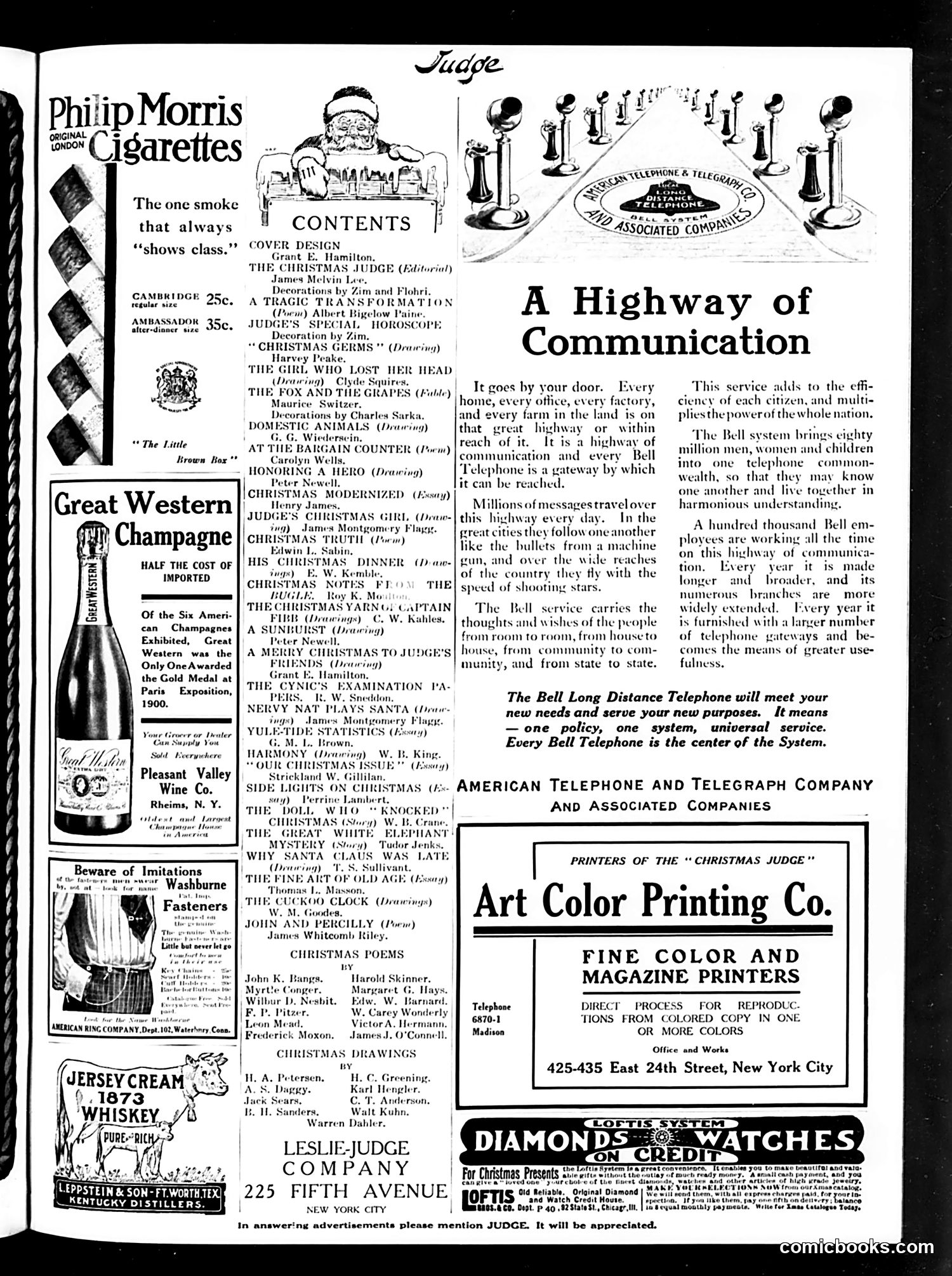
This page is primarily **advertising rather than satire or editorial content**. The main feature is a large advertisement for the Bell Telephone System titled "A Highway of Communication," using infrastructure metaphor to promote telephone service's reach and utility across America. The left side contains vintage product advertisements (Philip Morris Cigarettes, Great Western Champagne, Jersey Cream Whiskey) typical of early 20th-century publications. Below is a "Beware of Imitations" warning about counterfeit fasteners. At bottom, Art Color Printing Co. and Loftis System Watches advertise their services to Judge readers. The page's contents list references Christmas-themed stories and poetry, but the visible material is exclusively commercial, reflecting how advertising subsidized magazines of this era.
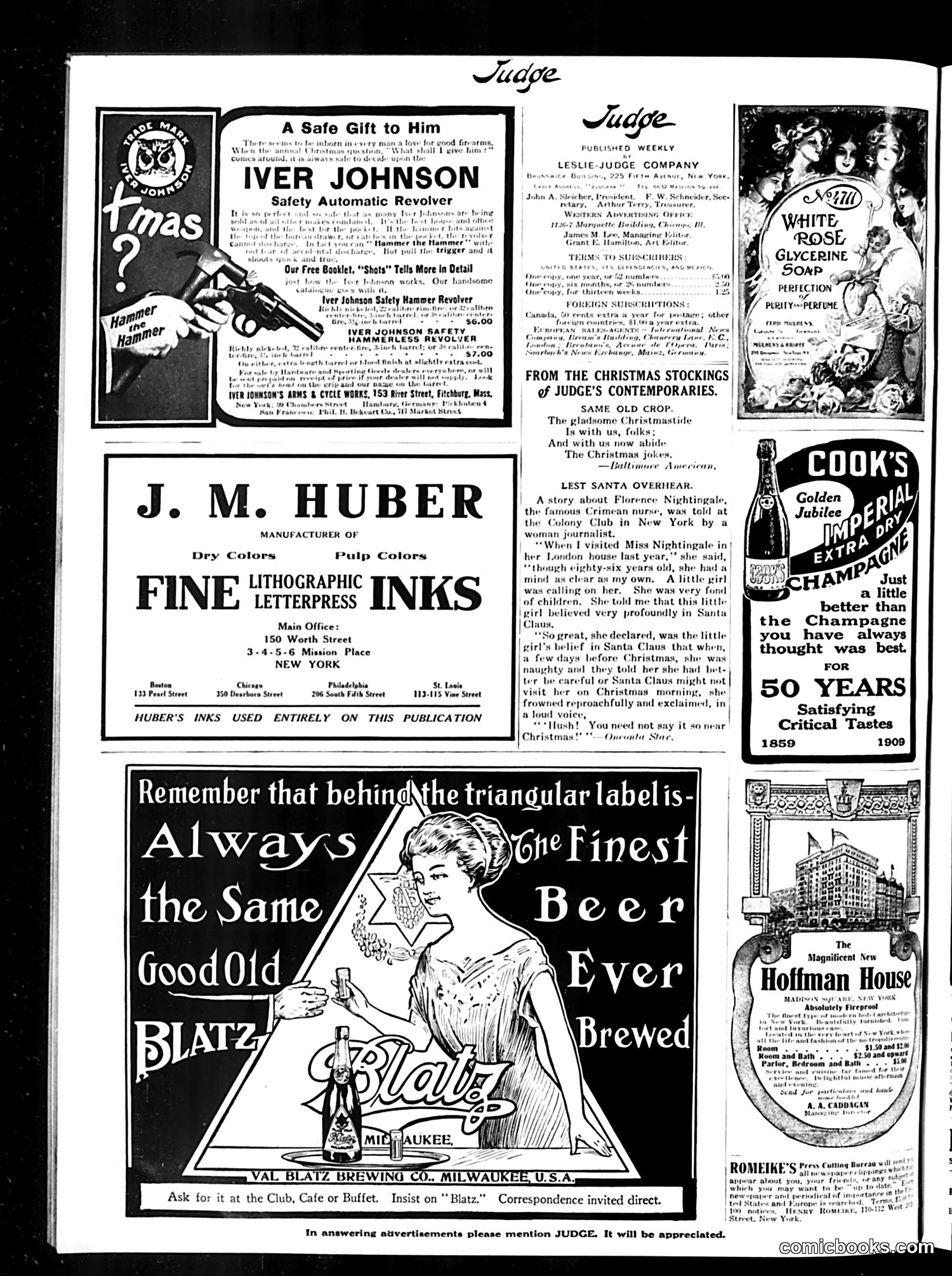
This page is predominantly **advertising** rather than political satire. The main content includes: 1. **Iver Johnson Safety Automatic Revolver** ad—promoting a firearm as a Christmas gift, emphasizing its safety features and reliability. 2. **J.M. Huber Fine Inks** ad—advertising printing supplies used by the publication itself. 3. **Blatz Beer** ad—featuring a woman with beer bottles, promoting "Good Old Blatz" from Milwaukee as "the Finest Beer Ever Brewed." 4. **Hoffmann House** and **Cook's Champagne** ads—promoting luxury beverages. 5. A brief **Christmas-themed literary excerpt** titled "From the Christmas Stockings of Judge's Contemporaries" featuring anecdotes about Santa Claus and Florence Nightingale. The page reflects early 1900s consumer culture, with firearms, alcohol, and perfume marketed as appropriate holiday gifts.
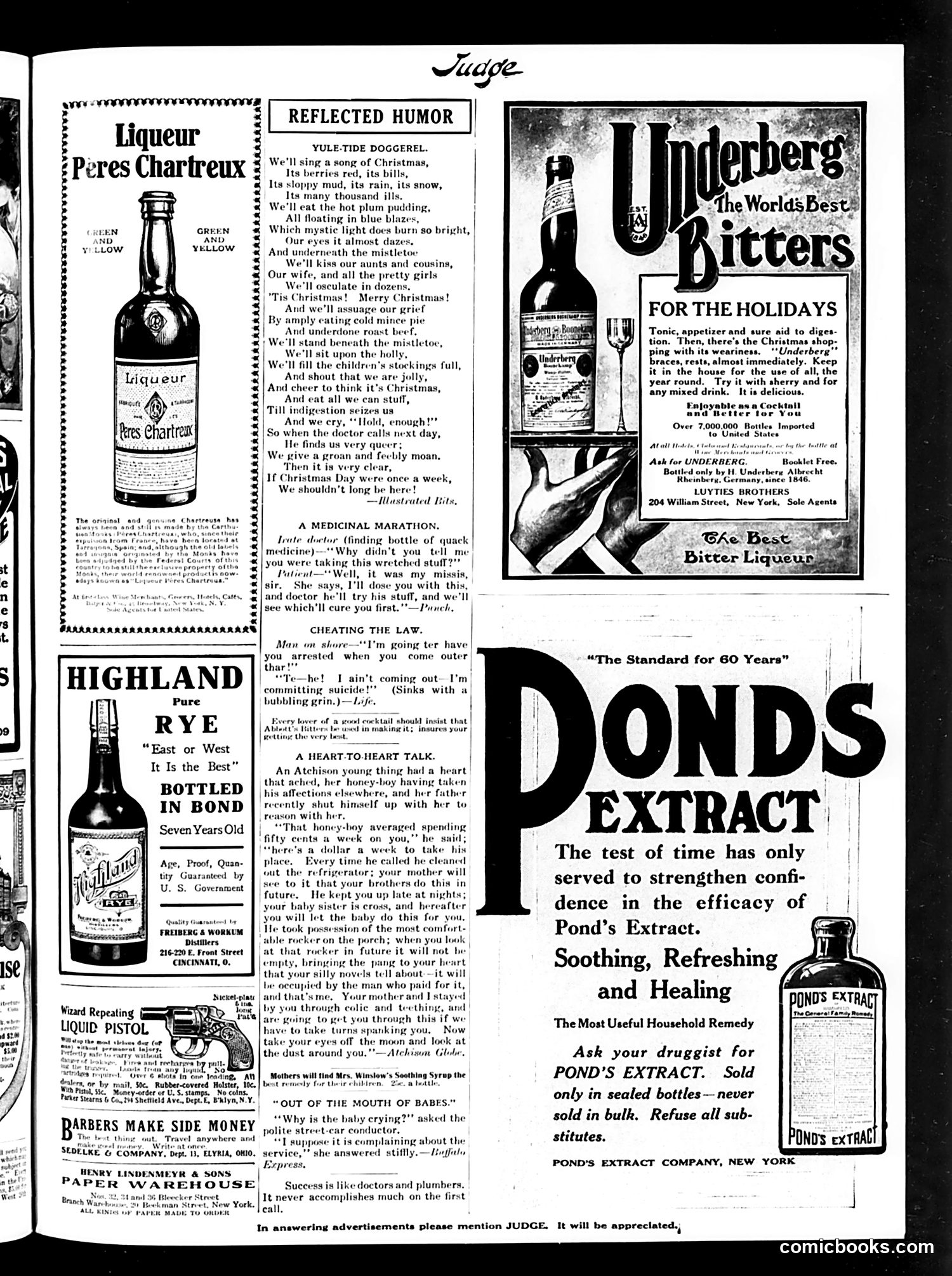
This page is primarily **advertising rather than editorial content**. It contains four liquor/alcohol ads (Liqueur Peres Chartreux, Highland Pure Rye, Underberg Bitters, and Pond's Extract) alongside a section titled "Reflected Humor" featuring brief humorous anecdotes and jokes. The "Reflected Humor" section includes satirical vignettes: a "Yule-tide Doggerel" about Christmas consumption, a "Medicinal Marathon" joke about doctors and quack medicine, "Cheating the Law," and "A Heart-to-Heart Talk" about financial hardship. These are general social satires targeting drinking culture, medical fraud, and domestic economics—typical Judge fare mocking middle-class life. The page reflects early 20th-century American attitudes toward alcohol as both commonplace consumer product and comedic subject matter.
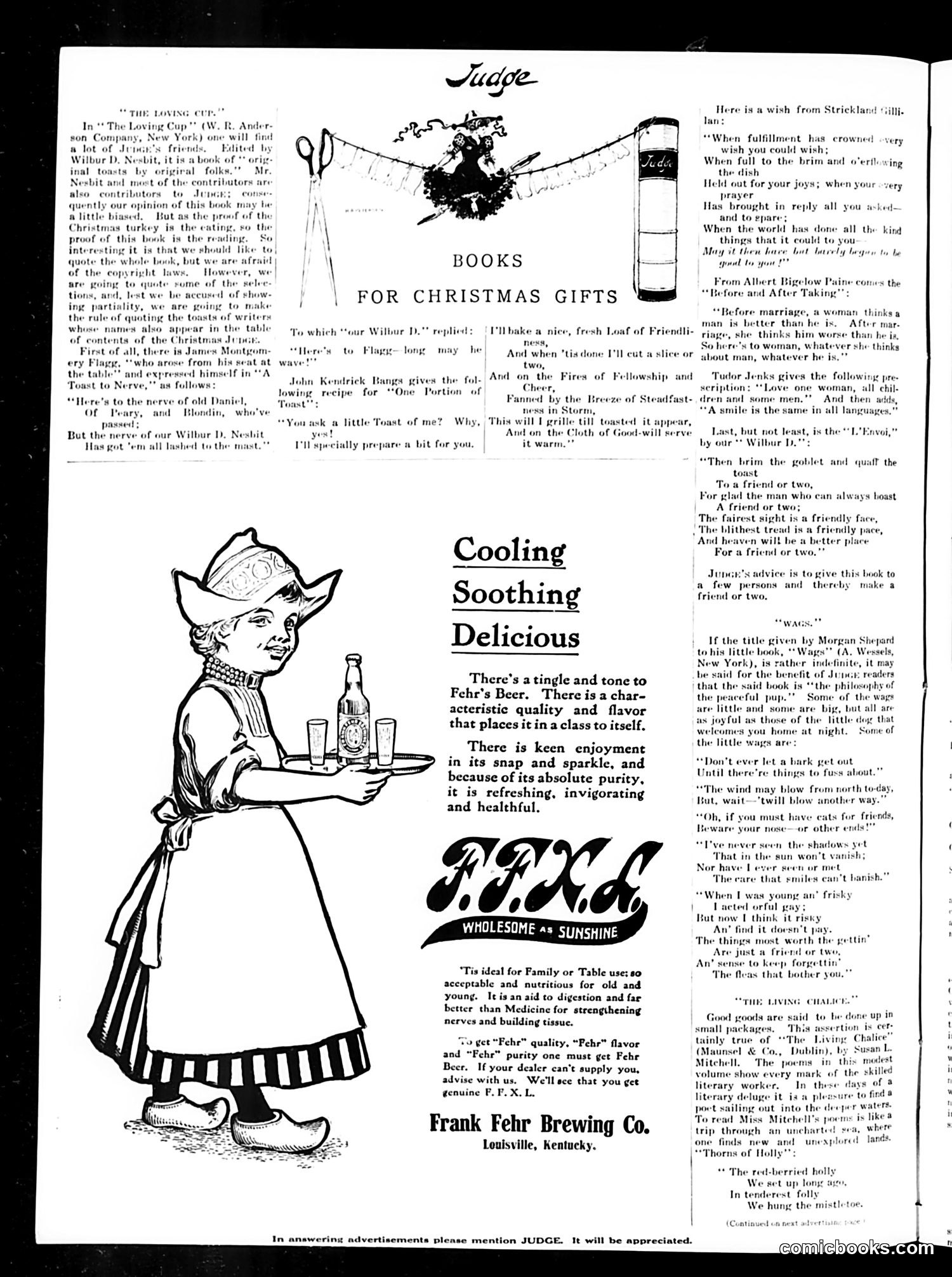
This page is primarily **advertising and gift recommendations** rather than political satire. The main content includes: **"Books for Christmas Gifts"**: A lighthearted section featuring toasts and witty verses from various contributors (Wilbur D. Nesbit, James Montgomery Flagg, John Kendrick Bangs, Tudor Jenks, and others) recommending books as holiday presents. The tone is humorous and convivial—typical of Judge's literary circle. **Fehr's Beer Advertisement**: The dominant commercial content, featuring a colonial-era woman serving beer. The ad emphasizes the drink's purity, digestive benefits, and suitability for family use—standard early-20th-century beer marketing before Prohibition. **Book Reviews**: Brief notices of titles like "The Living Chalice" and "Wages," typical of Judge's role as a cultural arbiter. **No clear political satire or caricature** is evident on this page. It represents Judge functioning as an entertainment and consumer guide rather than political commentary.
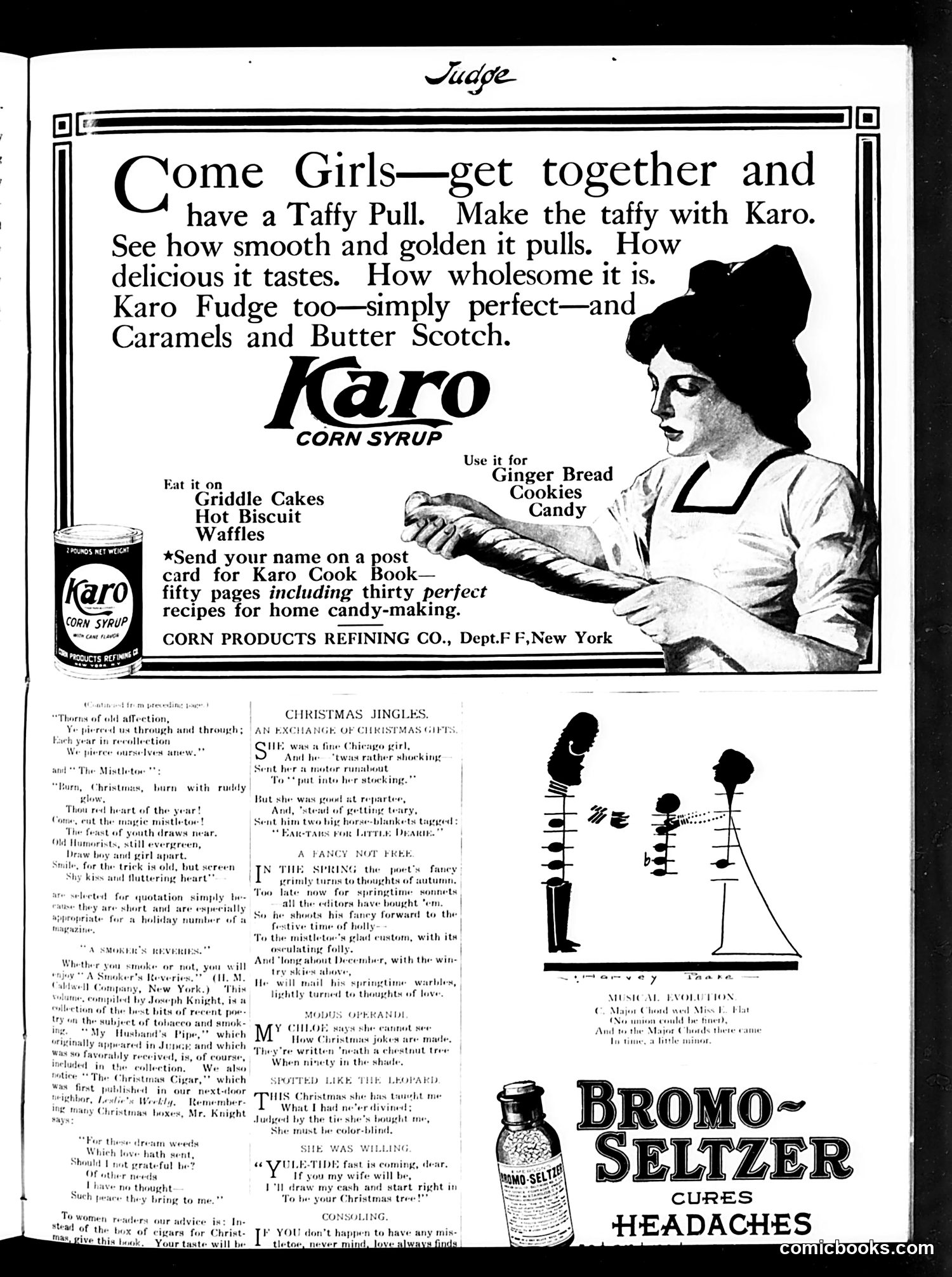
This page is primarily **advertising**, not political satire. The dominant content features a Karo Corn Syrup ad targeting women, encouraging "Taffy Pulls"—social candy-making gatherings—with an illustration of a woman in an apron. The ad emphasizes wholesome domestic activities and offers a free cookbook with thirty candy recipes. Below are lighter "Christmas Jingles" poems exchanging seasonal gifts and holiday humor (mostly illegible in the OCR), and a Bromo-Seltzer advertisement for headache relief. The Karo ad reflects early 20th-century marketing that romanticized women's domestic labor while promoting consumer products. There is no discernible political or social satire on this particular page—it represents Judge's reliance on commercial advertising revenue typical of the era.
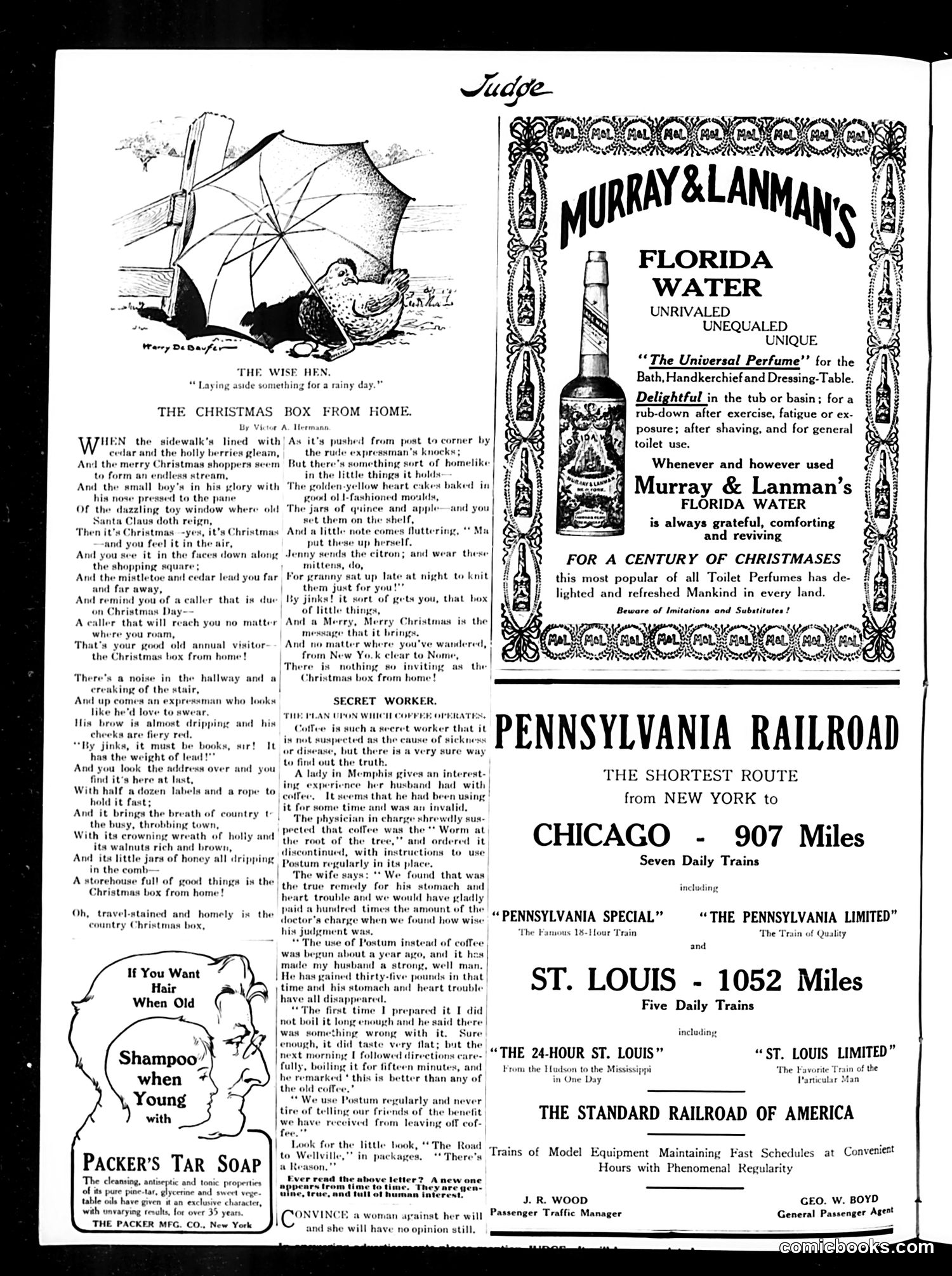
This page is primarily **advertising**, not political satire. It contains several period advertisements alongside two brief story/poem features. The main content includes: **"The Wise Hen"** — A short illustrated poem about prudent planning, using a hen seeking shelter in rain as metaphor for saving for difficult times. **"The Christmas Box From Home"** — A sentimental poem by Victor A. Hermann about receiving a care package from family, celebrating nostalgia and domestic bonds during the holidays. **"Secret Worker"** — A brief anecdote about a wife discovering her husband's stomach troubles were caused by coffee, solved when she switched beverages. **Advertisements** dominate the page: Murray & Lanman's Florida Water (perfume/toiletry), Pennsylvania Railroad (routes to Chicago and St. Louis), and Packer's Tar Soap. The cartoons are minor: "The Wise Hen" illustration and a small head sketch for the Packer's Tar Soap advertisement. This appears to be a standard Judge issue blending light entertainment with commercial promotion typical of early 20th-century American magazines.
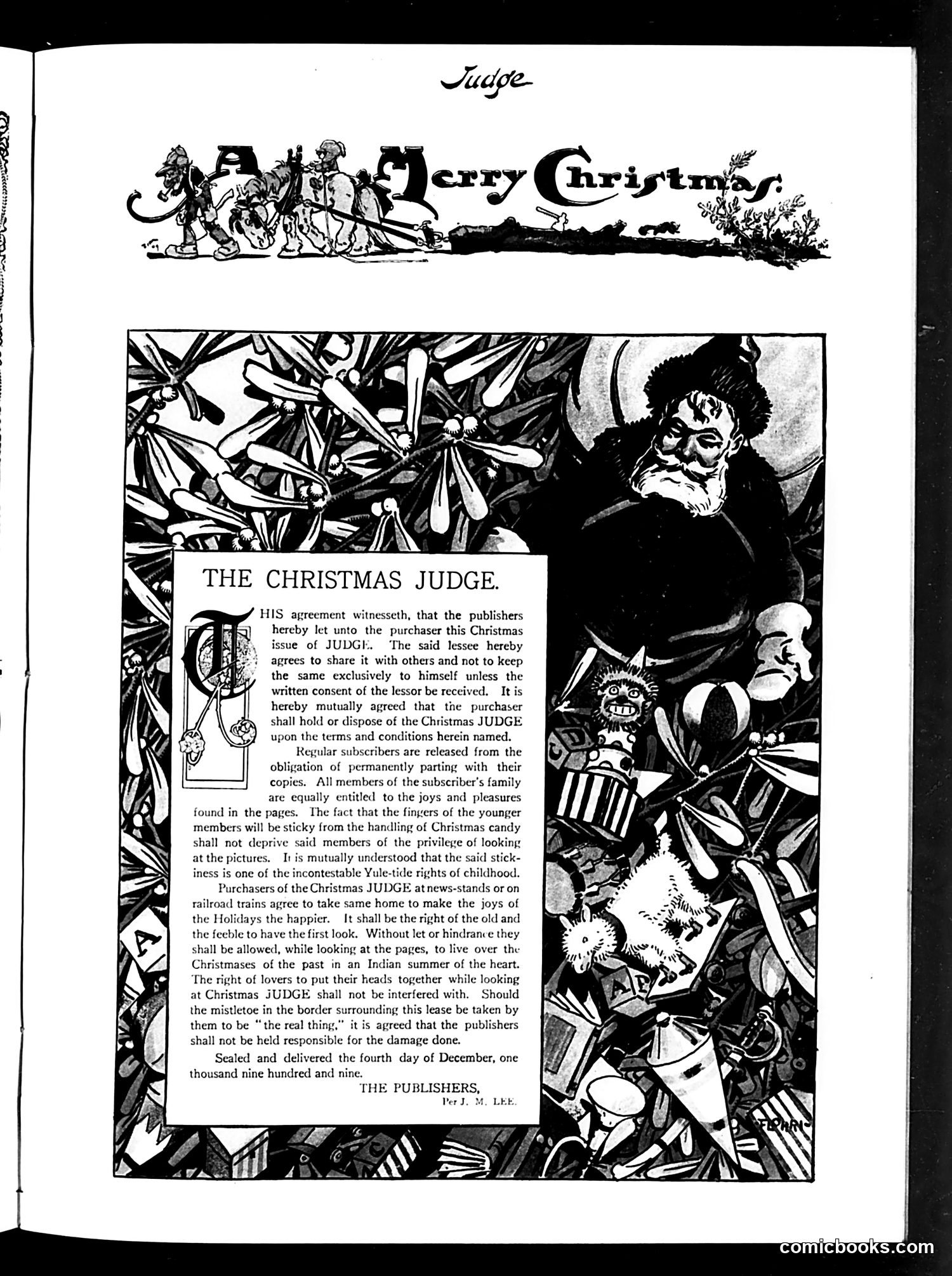
This is a humorous "lease agreement" parodying formal legal language—not a political cartoon. Judge magazine playfully presents its Christmas issue as a product being "leased" to purchasers rather than sold outright. The satire mocks both pompous legal contracts and the magazine's own commercialism. The text humorously stipulates sharing rights, family access, sticky-fingered children's privileges, elderly readers' viewing priority, and romantic couples' freedom to enjoy mistletoe decorations without legal liability. The ornate illustration of Santa and Christmas imagery frames this tongue-in-cheek contract. The joke plays on the gap between overwrought legal formality and the simple pleasure of sharing a holiday magazine. Published December 4, 1909, it's lighthearted seasonal humor rather than political satire—a winking acknowledgment that Judge wants readers to spread the magazine's joy widely.
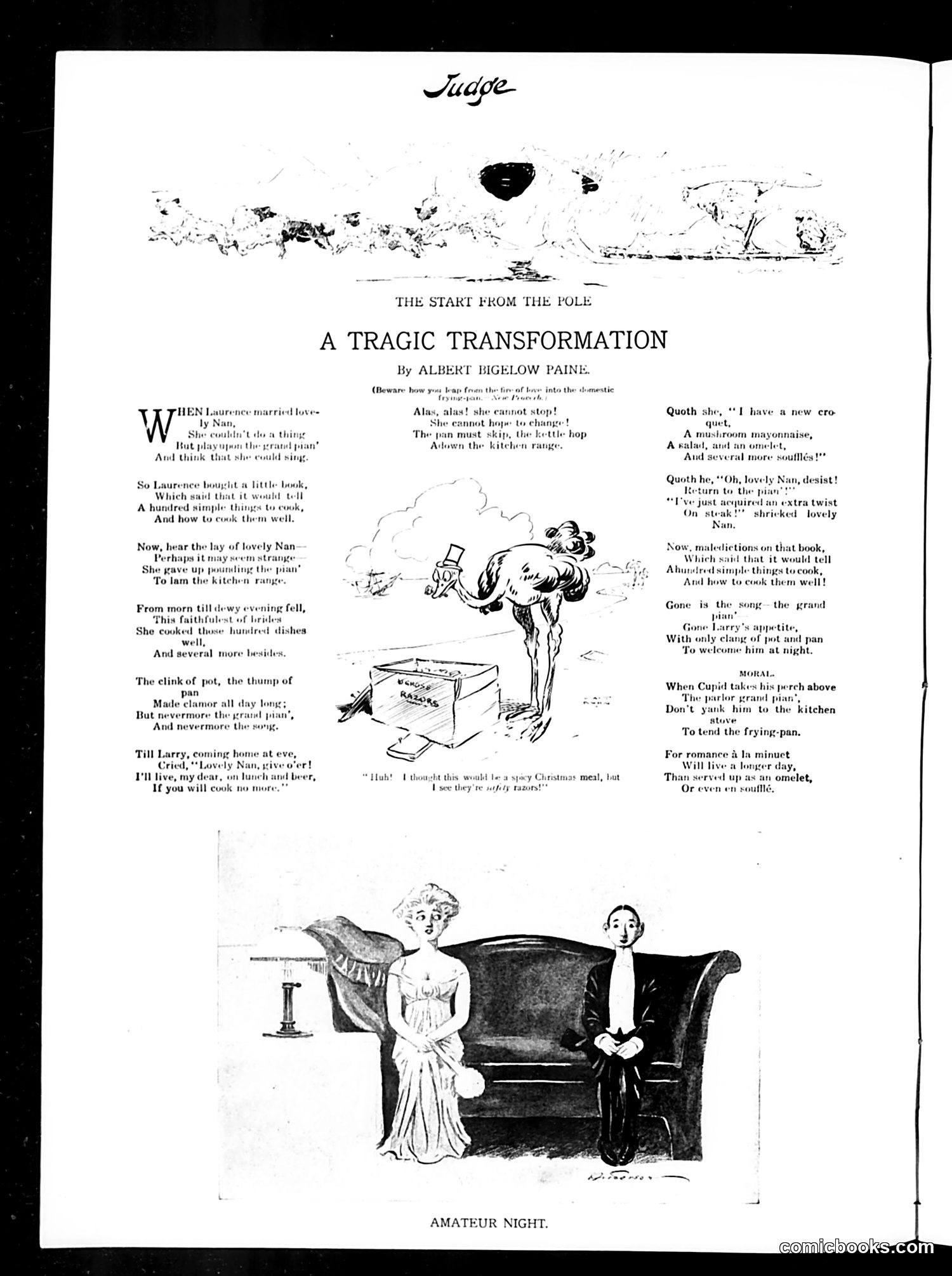
This satirical poem by Albert Bigelow Paine mocks the transformation of a bride from cultured woman to domestic drudge. **The narrative:** Laurence marries "lovely Nan," who initially pursues refined interests (playing piano). He buys her a cookbook to teach her "a hundred simple things to cook," expecting modest domestic contributions. **The irony:** Nan becomes *obsessed* with cooking, abandoning all other pursuits. She cooks constantly—"from morn till dewy evening fell"—reducing herself to kitchen labor alone. Her new aspirations are limited to cooking techniques ("soufflés," "mayonnaise"). **The satire's target:** The joke critiques both the limited expectations for married women and the consequences of male condescension. By giving his wife a cookbook as self-improvement, Laurence inadvertently traps her in domestic servitude rather than elevating her. **The moral:** Romance dies when women are confined to the "frying-pan"—a commentary on how marriage could diminish women's lives and potential in early 20th-century society. The illustration "Amateur Night" (showing an awkward couple on a couch) appears to depict marital discord resulting from this dynamic.
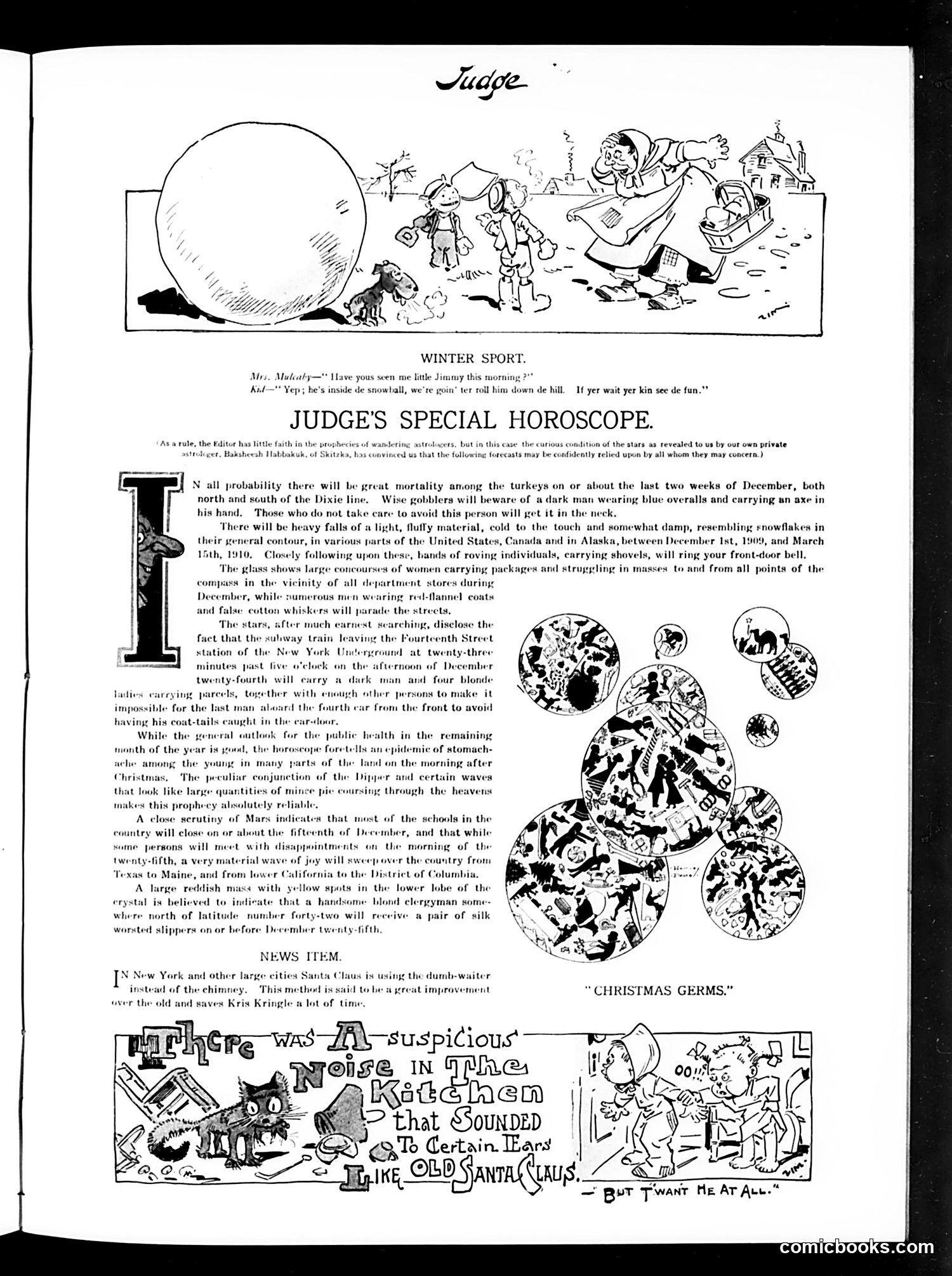
This page contains satirical holiday-season content from Judge magazine (circa 1909-1910, based on internal dates). **"Winter Sport"** (top): A crude Irish-dialect joke about working-class parents using a snowball to roll their child downhill for entertainment—satirizing both Irish immigrants and careless parenting as entertainment. **"Judge's Special Horoscope"**: Mock astrological predictions for December 1909-March 1910, satirizing both fortune-telling charlatans and seasonal phenomena. It humorously "predicts" turkey deaths (Christmas dinner), snowfall, Christmas shoppers ("roving individuals"), and stomach epidemics among children—essentially mocking superstition by stating obvious seasonal realities as mystical prophecies. **"Christmas Germs"** (illustration): Circular microscopic views labeled to show disease organisms associated with holiday season—satirizing contemporary germ-theory anxieties and holiday crowding. **Bottom cartoon**: A domestic scene where a mysterious kitchen noise disturbs a family, humorously resolved when it's revealed as Santa using a dumb-waiter (service elevator) instead of the chimney—poking fun at modern "improvements" replacing tradition.
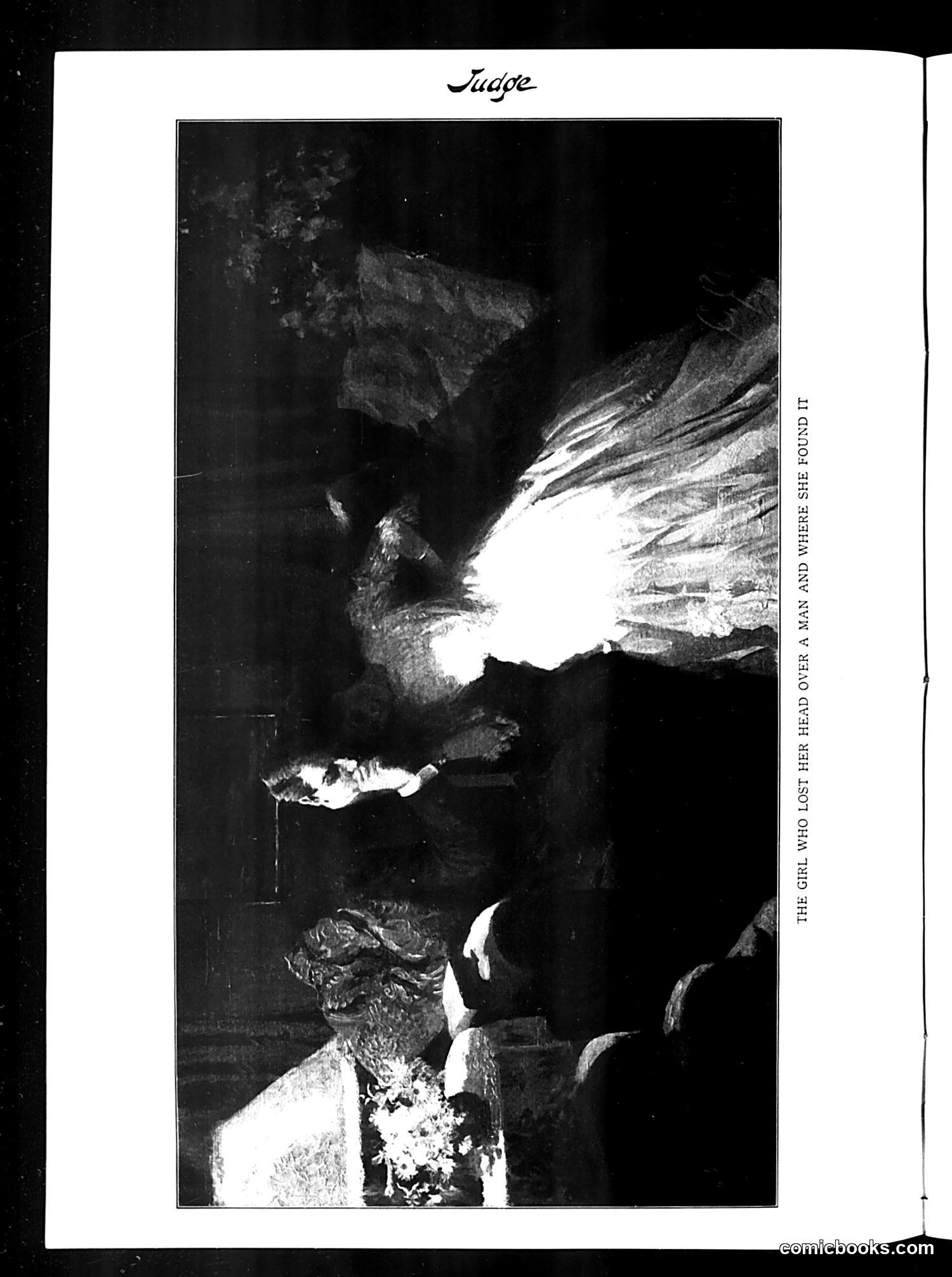
I cannot reliably read the OCR text provided, as it appears corrupted or in cipher. From the image alone, I can see this is a black and white illustration showing what appears to be a dramatic scene with a woman's head in profile (lower left, wearing what looks like formal dress with jewelry) looking upward, and above her a man's face also looking down. The caption on the right reads: "HE GIRL WHO LOST HER HEAD OVER A MAN AND WHERE SHE FOUND IT" This appears to be a romantic or cautionary illustration, likely satirizing women who become emotionally overwrought over relationships—a common theme in early 20th-century satirical magazines. However, without legible text or clearer context, I cannot specify which historical figures or events this references, or the precise satirical point intended.
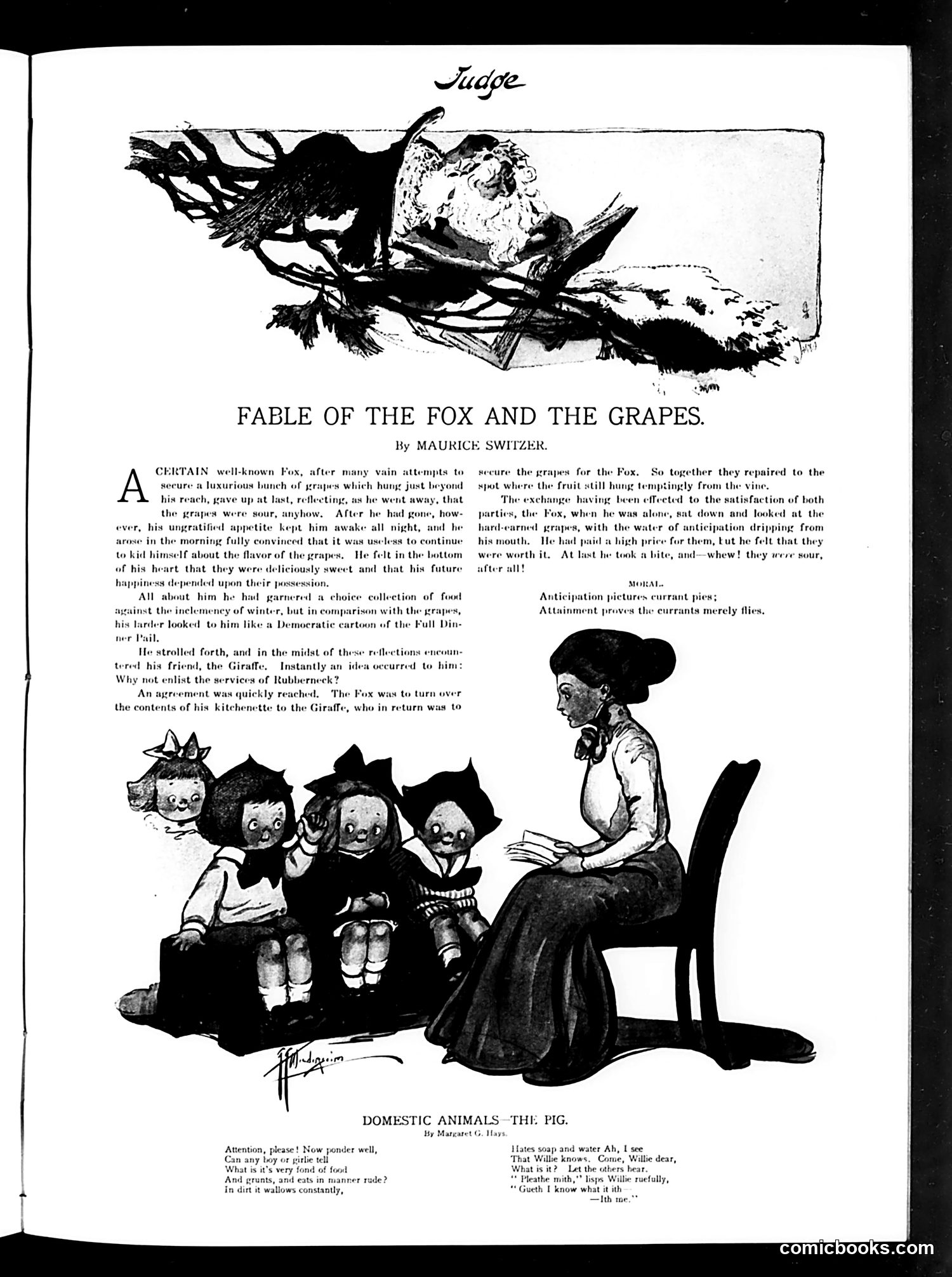
This page contains two distinct pieces: **"Fable of the Fox and the Grapes"** (top): A moral fable by Maurice Switzer illustrating the classic Aesop's tale. A fox unable to reach grapes convinces himself they're sour—a timeless story about rationalization and sour grapes psychology. The illustration shows the fox's disappointment after finally obtaining the grapes. **"Domestic Animals: The Pig"** (bottom): A children's riddle poem asking readers to identify an animal that loves dirt, wallows constantly, and eats messily. The illustration depicts an adult (likely a nanny or caregiver) reading to four children dressed in early-20th-century clothing with exaggerated features. These appear to be educational/entertainment content rather than political satire. The "Judge" magazine here functions as family reading material, offering moral lessons and children's puzzles alongside its typical satirical commentary on public issues.
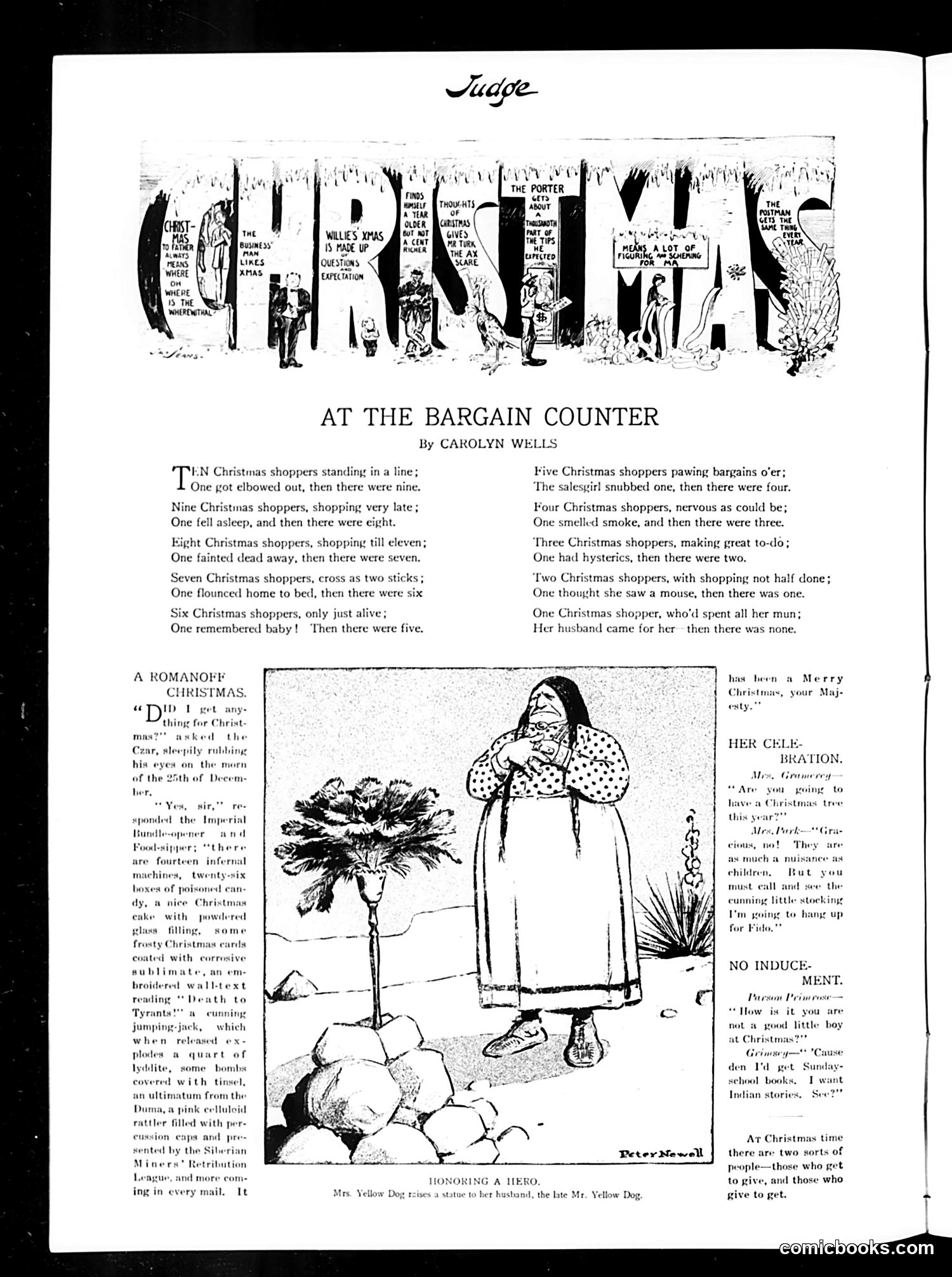
This page contains Christmas-themed humor from Judge magazine. The main content includes: **"At the Bargain Counter"** — A humorous countdown poem by Carolyn Wells depicting the chaotic experience of Christmas shopping. Women systematically disappear from a shopping line through various mishaps (elbowing, fainting, falling asleep, panic over perceived mice, hysterics), satirizing the stress and physical toll of holiday retail crowds and bargain-hunting on female shoppers. **"A Romanoff Christmas"** — Political satire mocking Russian Czar Nicholas II. The piece describes absurdly dangerous "gifts" (poisoned machines, bombs, explosives) allegedly presented to the Czar, referencing contemporary Russian political unrest, revolutionary threats, and the Duma's opposition. The joke darkly suggests the Russian imperial court lives in constant danger from internal dissent. **Other brief pieces** offer light holiday social commentary about gift-giving expectations and children's behavior. The illustrations support these themes with period-appropriate satirical drawings. The overall tone targets both the commercialization of Christmas and contemporary Russian political instability.
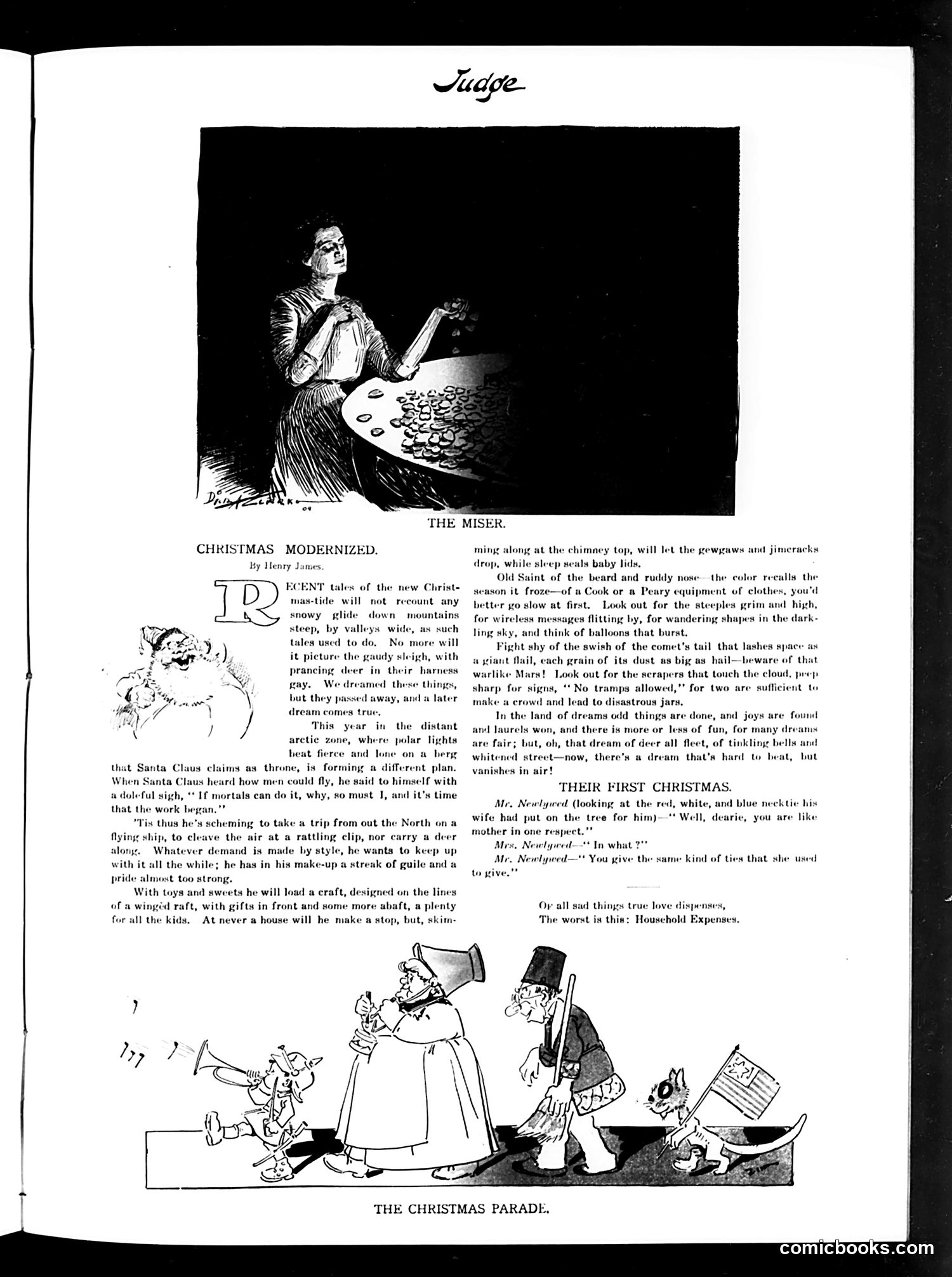
This Judge magazine page contains two satirical pieces about Christmas modernization: **"Christmas Modernized"** (by Henry James) mocks a wealthy miser who, learning that humans can now fly, abandons traditional sleigh-based gift-giving for a high-tech "flying ship." The satire criticizes how modern technology enables the rich to maintain selfish habits more efficiently—he'll drop gifts without stopping at houses, avoiding actual human contact. **"Their First Christmas"** depicts newlyweds where the wife gives her husband a cheap necktie (a disappointingly practical gift). His comment that she's "like mother in one respect" suggests wives, like mothers, give utilitarian rather than romantic gifts. The closing couplet—"Household Expenses" being love's worst burden—suggests marriage's financial realities undermine romance. Both pieces satirize how commercialism and practicality corrupt Christmas ideals. The era's anxiety about modernity replacing tradition and sentiment with efficiency and materialism runs throughout.
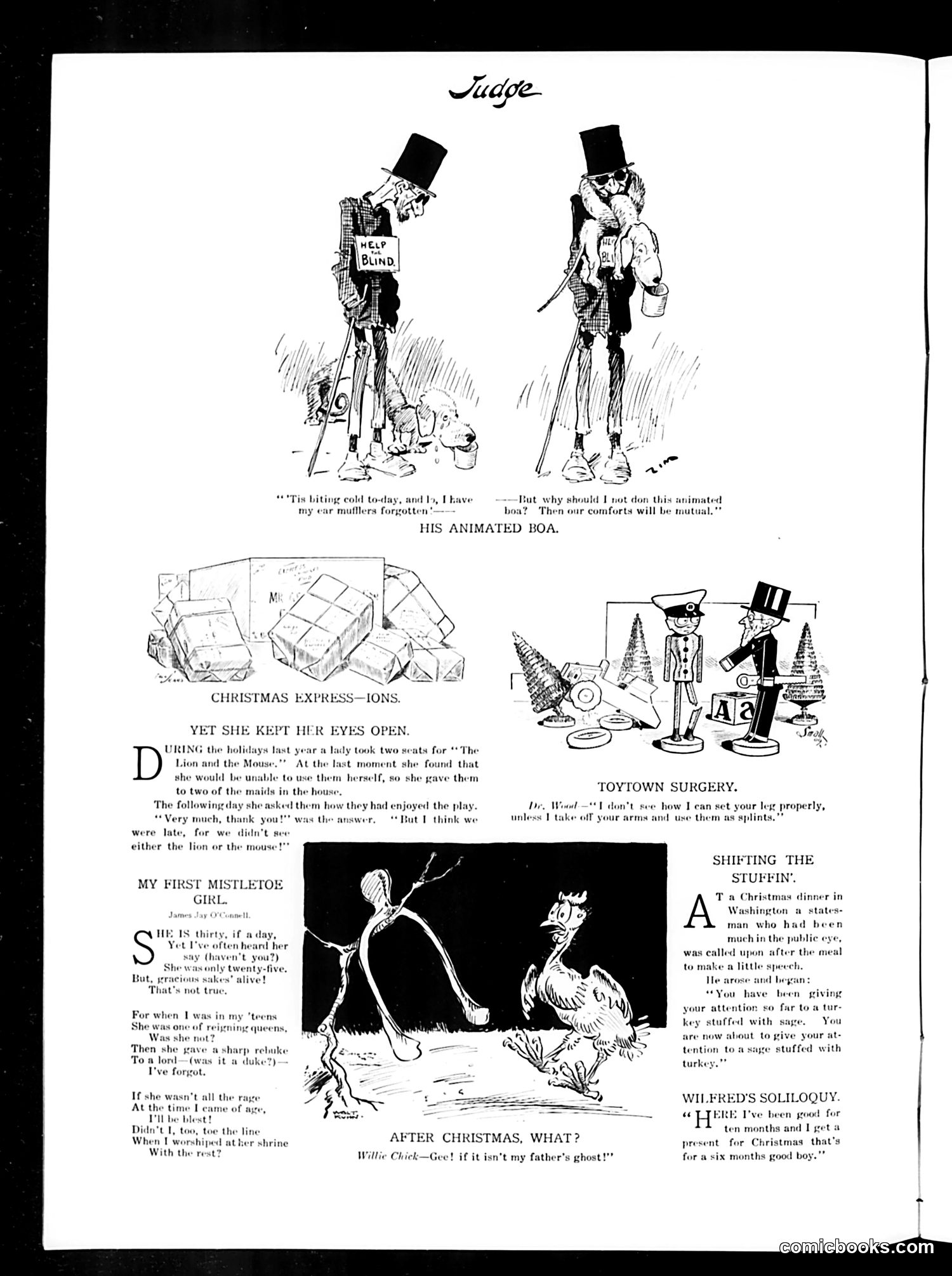
This page collects humorous illustrated vignettes typical of Judge's satirical humor, circa early 20th century: **"His Animated Boa"** mocks wealthy men's complaints about cold weather while dressed ostentatiously, carrying a beggar sign ("Help Blind"), the satirical point being their hypocrisy—complaining of discomfort while ignoring actual poverty. **"Christmas Express"** and related pieces appear to joke about holiday excess and gift-giving absurdities. **"My First Mistletoe Girl"** is a nostalgic poem about youthful romance, while **"Toytown Surgery"** and **"Shifting the Stuffin'"** offer domestic humor about Christmas dinner mishaps. **"After Christmas, What?"** depicts a child's post-holiday anxiety, with the ghost joke suggesting the father's exhaustion from holiday expenses. The overall tone reflects Judge's satirical commentary on American social pretension, domestic life, and holiday commercialism—poking fun at both wealthy affectation and middle-class seasonal chaos.
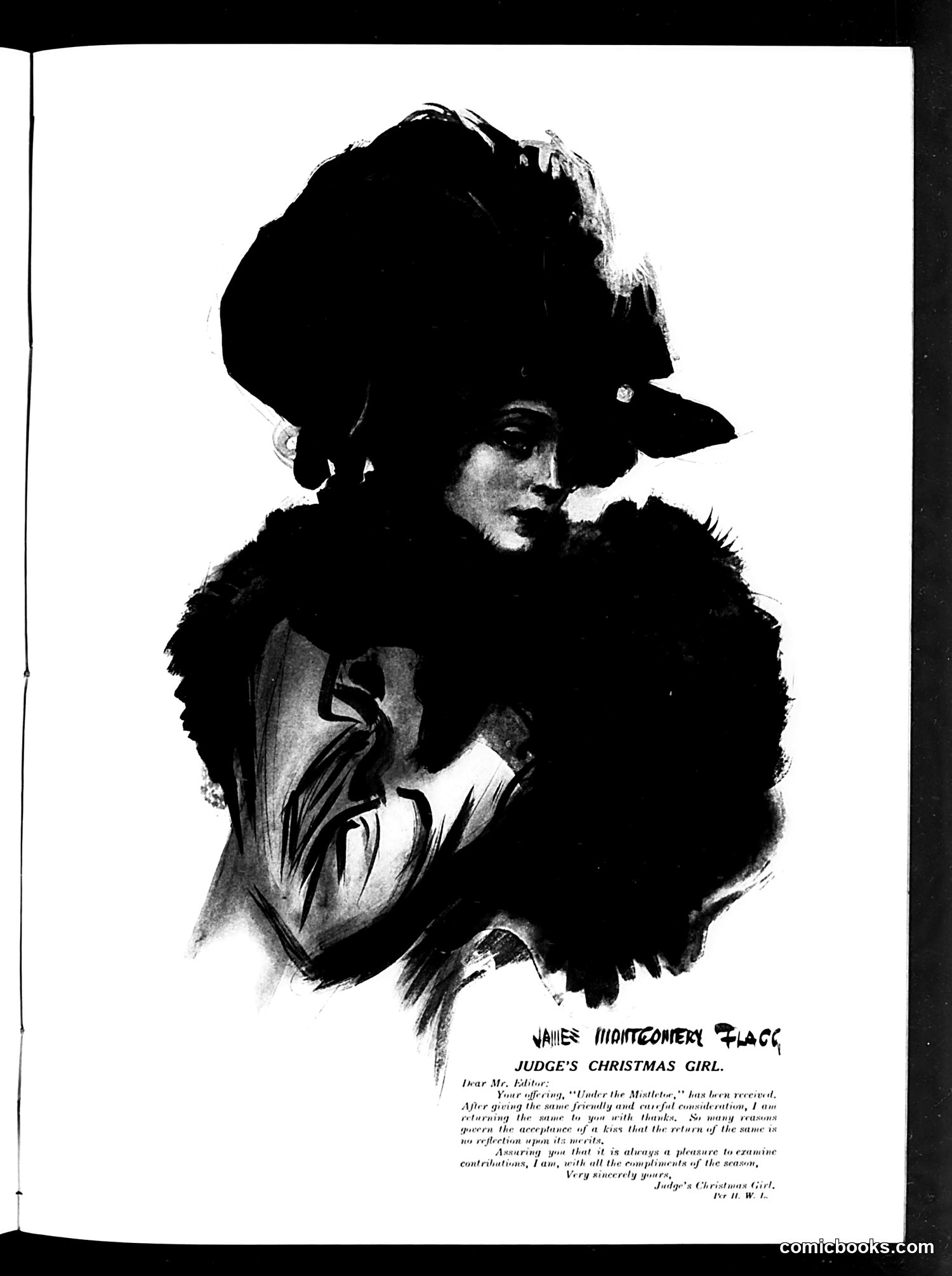
This is a portrait illustration by James Montgomery Flagg titled "Judge's Christmas Girl." The accompanying text is a humorous rejection letter, ostensibly from the magazine's "Christmas Girl," politely declining a kiss someone has offered her. The joke plays on magazine submission letters: instead of rejecting a manuscript, the "Christmas Girl" formally declines romantic advances using the bureaucratic language of editorial correspondence. She lists reasons for rejection ("many reasons govern the acceptance of a kiss") while maintaining professional courtesy and holiday cheer. This reflects Judge magazine's sophisticated humor style—combining literary satire with flirtation. Flagg's elegant portrait of the well-dressed woman in fashionable hat and fur represents the idealized "modern girl" of the era, making the contrast between her glamorous appearance and the deadpan rejection letter the source of the wit.
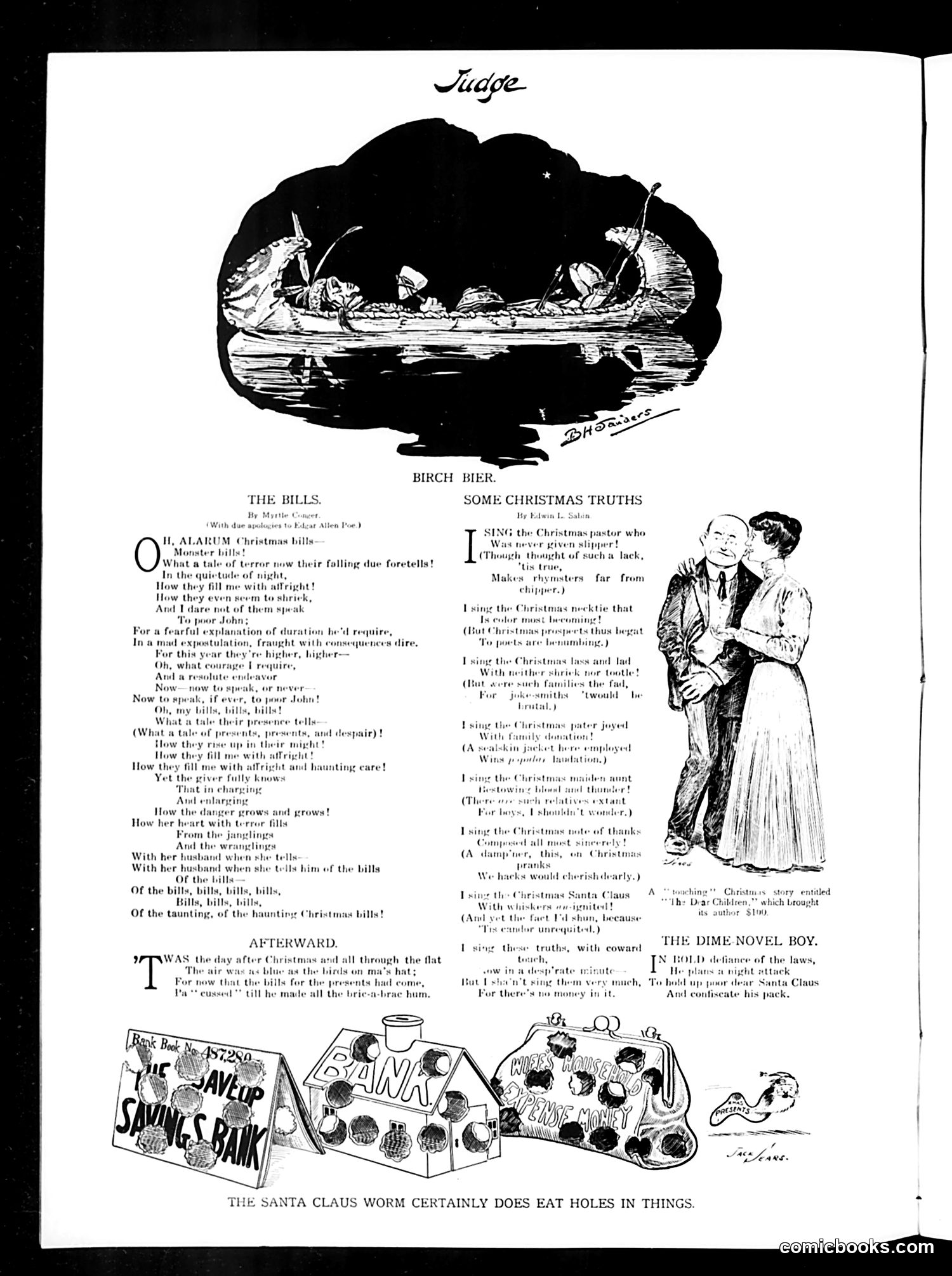
This page contains three interconnected satirical pieces about Christmas excess and its consequences: **"The Bills"** (top left) is a poem lamenting post-Christmas financial ruin. It parodies Edgar Allan Poe's melancholic style, with the speaker obsessing over mounting holiday debts—a relatable complaint about Christmas overspending. **"Some Christmas Truths"** (right) offers cynical observations about holiday traditions, suggesting Christmas carols are hollow, gift-giving is obligatory, and family gatherings are joyless—satirizing commercialized Christmas hypocrisy. **"Afterward"** and **"The Dime Novel Boy"** (bottom) appear to mock both post-holiday financial desperation and the escapism of cheap popular fiction. The final illustration shows money-saving devices riddled with holes—the "Santa Claus worm" eating away at savings—a visual metaphor for how Christmas spending devours finances. Overall, Judge satirizes 1890s-era consumer culture and middle-class anxiety about holiday expenses consuming their resources entirely.
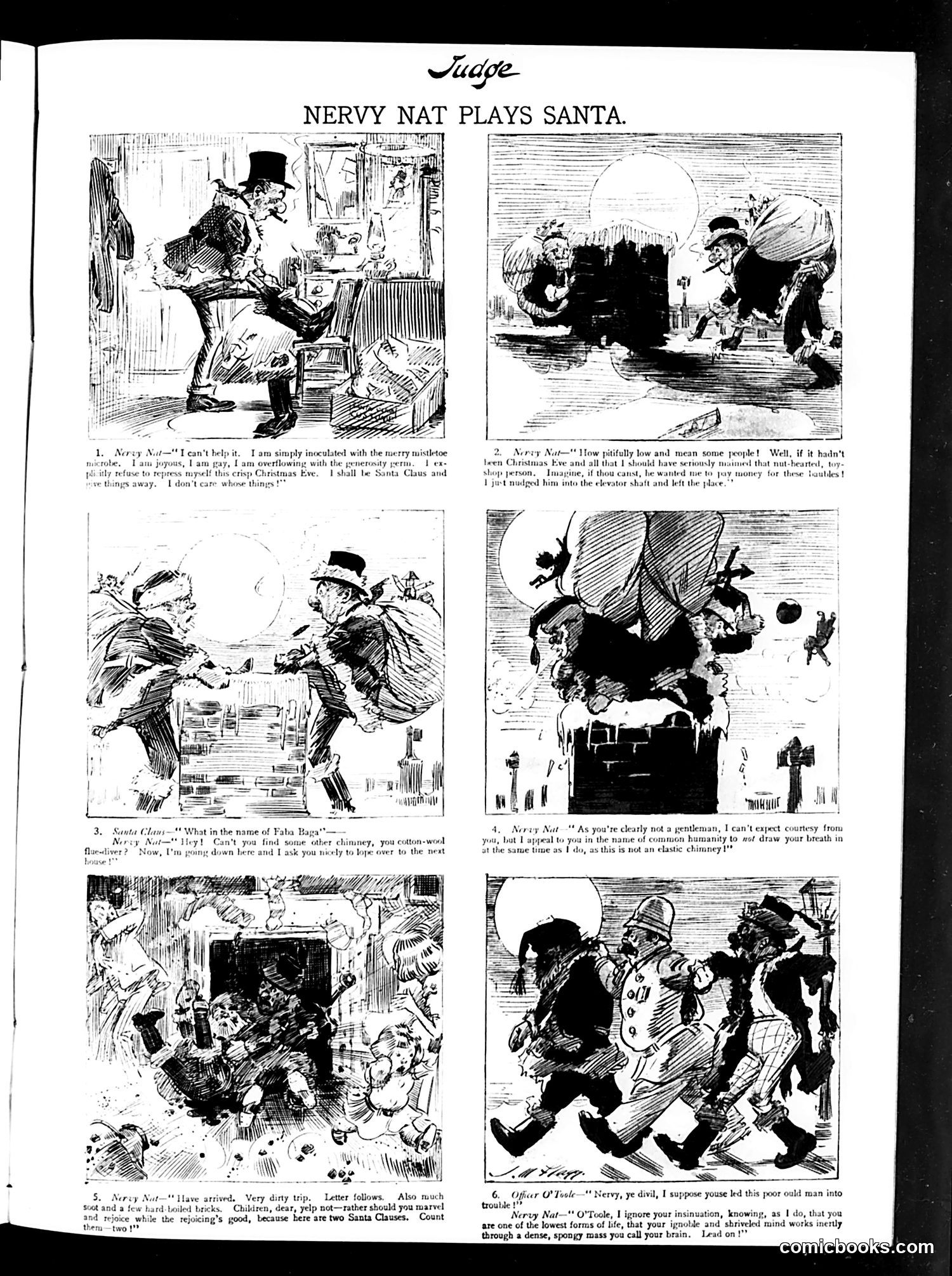
This six-panel comic strip from Judge satirizes a character called "Nervy Nat," who repeatedly uses crude insults and aggressive behavior while posing as Santa Claus. The joke centers on Nat's absurd contradiction: he claims to embody Christmas charity and goodwill, yet insults everyone around him—calling people "morose," accusing them of meanness, and eventually insulting an Irish police officer (Officer O'Toole, depicted with period Irish stereotype features) with lengthy, cruel verbal abuse. The satire mocks people who adopt false personas of respectability or charity while revealing their true nasty nature. Officer O'Toole's final line suggests Nat may have tricked or exploited "this poor ould man," implying Nervy Nat uses the Santa disguise as cover for dishonest schemes. The comic plays on the contrast between Christmas ideals and human selfishness—a timeless theme.
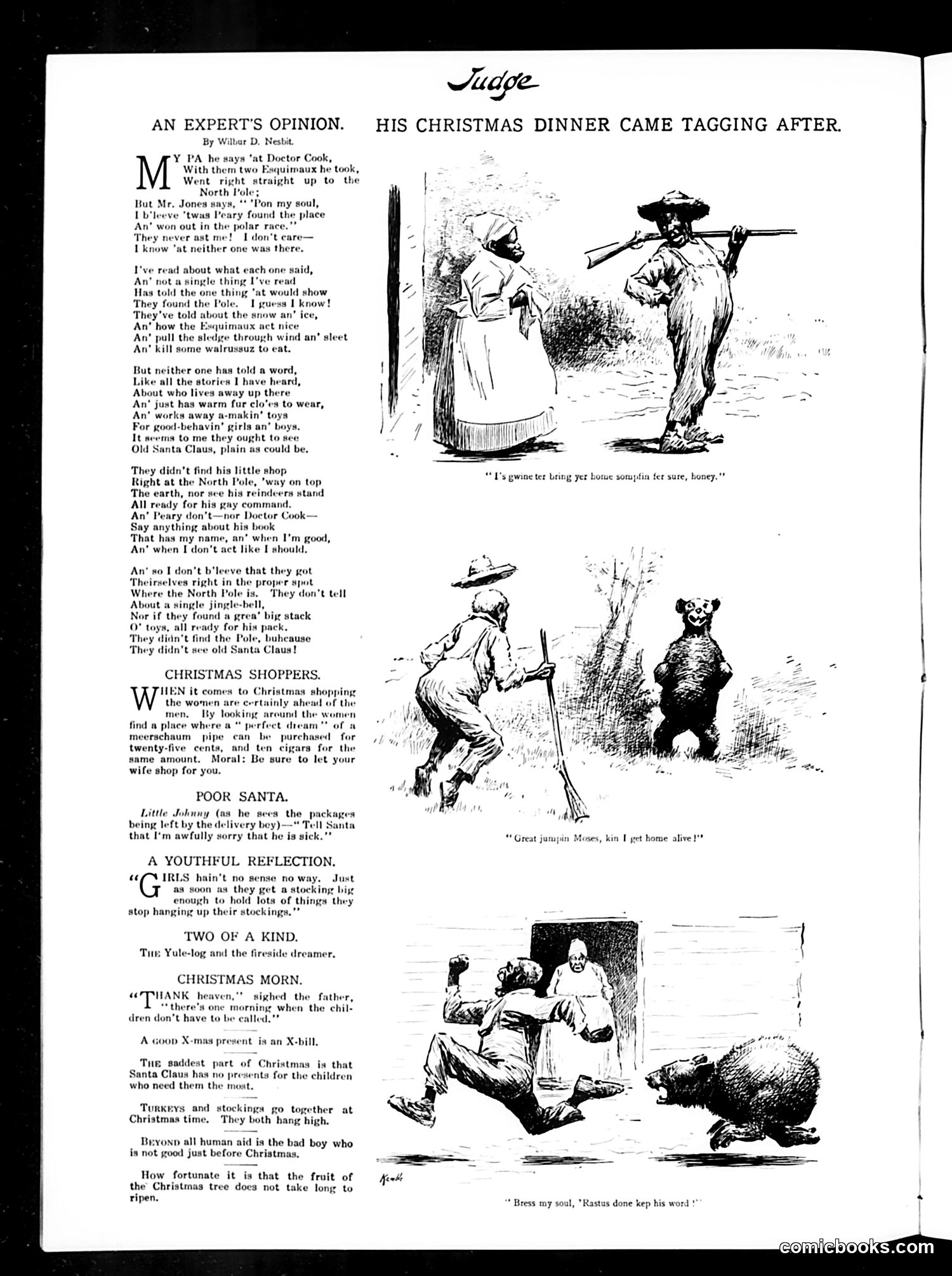
This page from the satirical magazine *Judge* contains multiple Christmas-themed pieces satirizing contemporary issues: **Main cartoon**: "An Expert's Opinion" mocks explorers (likely Frederick Cook and Robert Peary, who competed over North Pole discovery claims around 1908-1909). A child complains these famous explorers never mention finding Santa Claus at the North Pole, despite their detailed accounts—satirizing their self-aggrandizing expedition narratives that omitted children's actual interests. **Secondary sections** offer brief satirical commentary: - **Christmas Shoppers**: Women shop more shrewdly than men, knowing where bargains hide - **Poor Santa**: A child's pun about dying/going home ("kin I get home alive") - **A Youthful Reflection**: Girls recognize stockings are just receptacles, not magical - **Various quips**: About Christmas presents, bad boys, and family dynamics The humor targets adult pretense, gender shopping differences, and the gap between children's actual needs and adults' Christmas mythology—typical *Judge* social satire.
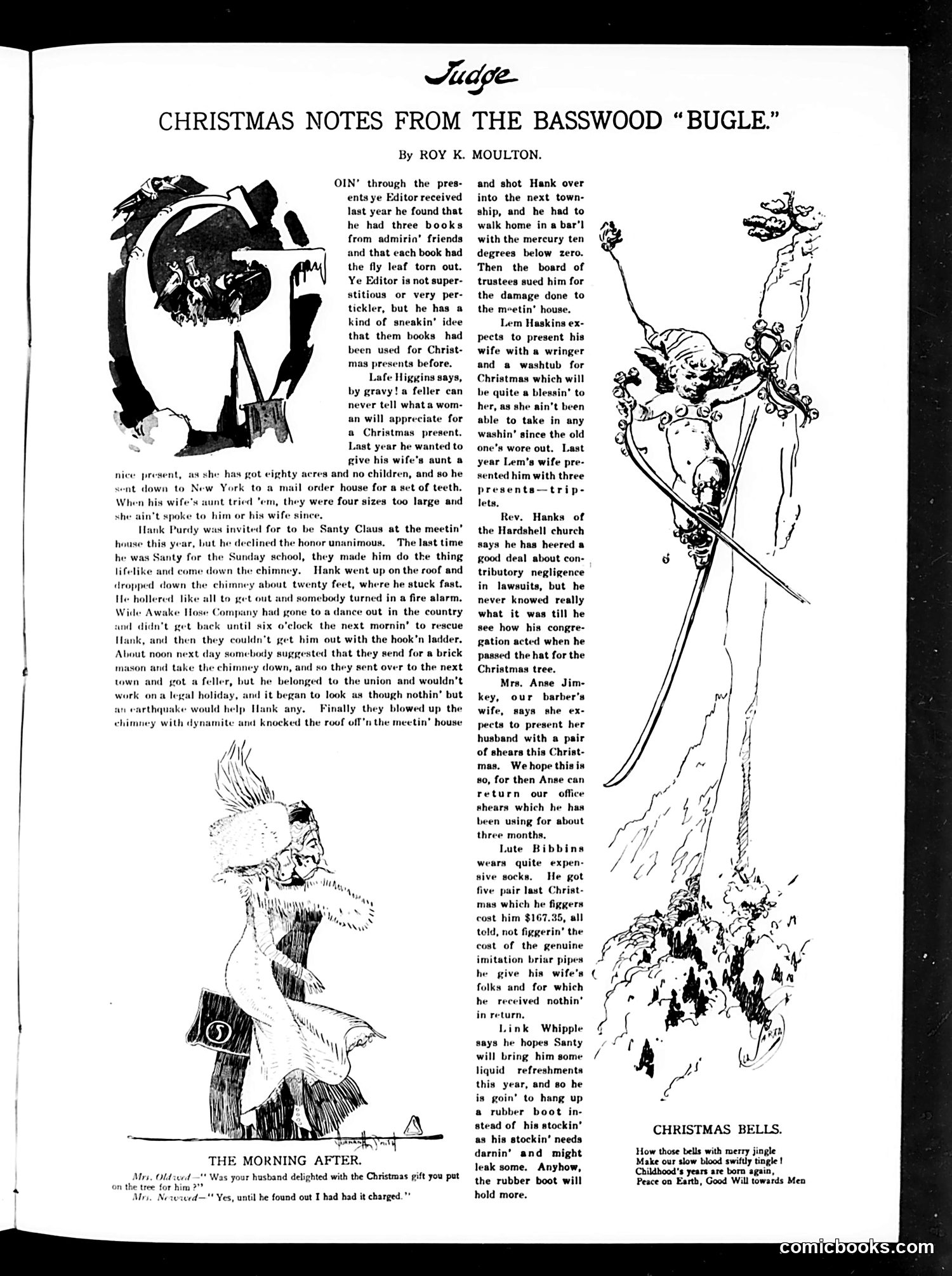
This is a humorous rural column by Roy K. Moulton featuring small-town Christmas mishaps. The satire targets rural American life and human nature through anecdotes from fictional "Basswood" characters. Key jokes include: recycled gift books with torn fly-leaves (implying regifting); a man buying dentures for his wealthy aunt (poor judgment); "Hank Purdy" getting stuck in a chimney while playing Santa, requiring dynamite to extract him—demolishing the meeting house (absurd consequences); a barber's wife gifting shears to replace office ones he'd borrowed; and "Link Whipple" planning to hang a rubber boot instead of a stocking because it won't leak. The bottom cartoon shows a wife admitting her Christmas gift was charged to her husband's account—the joke being he's delighted until learning of the debt. The satire gently mocks rural simplicity, poor planning, and the complications gift-giving creates in small communities.
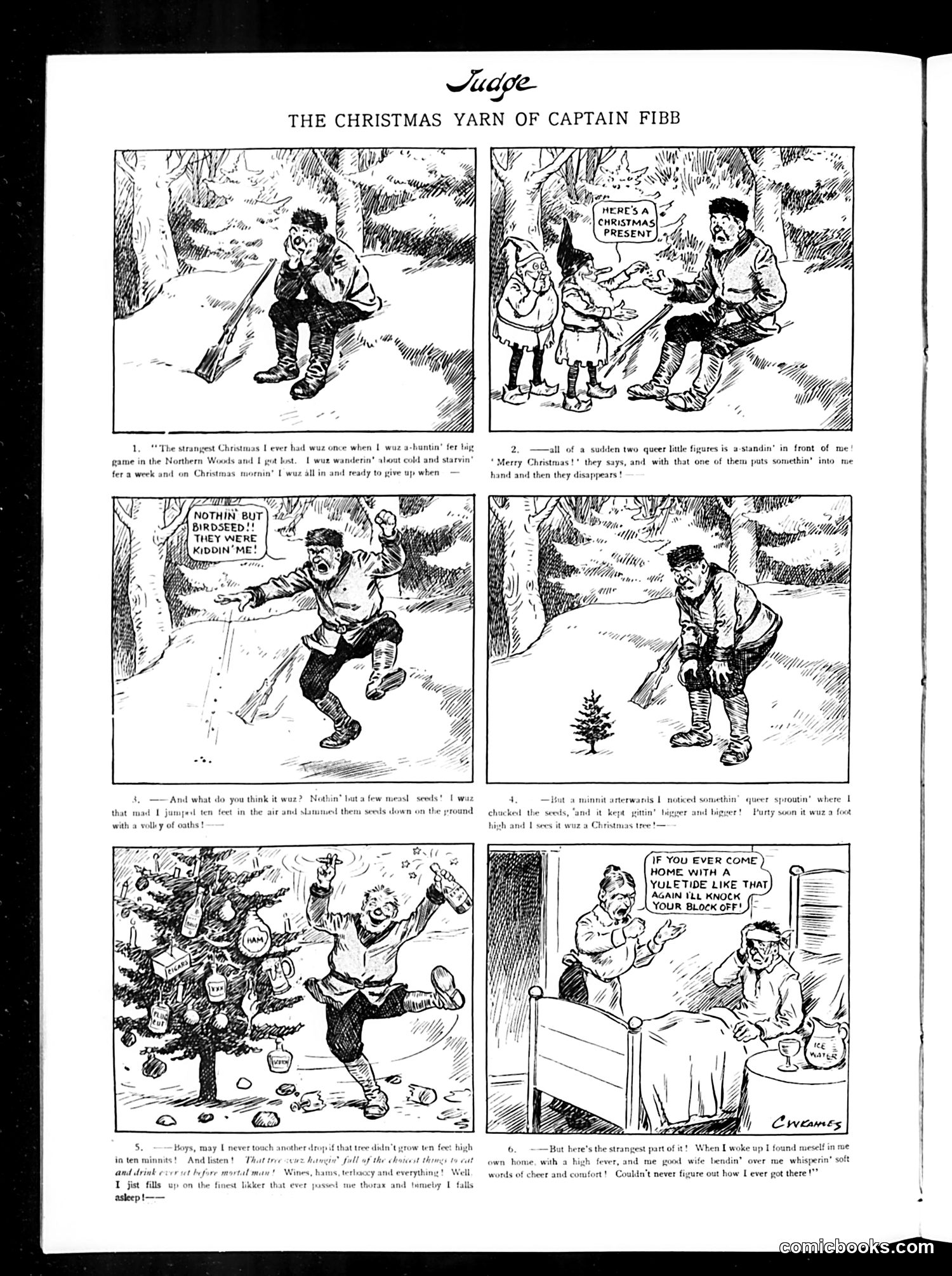
This is a humorous tall tale presented as a comic strip narrative. Captain Fibb recounts an absurd Christmas survival story: while starving during a winter hunt, two mysterious figures give him birdseed. He plants it, and a Christmas tree grows with bottles and provisions hanging from it—an obvious fantasy. The joke escalates absurdly: he eats too much and becomes so full he can barely move, eventually collapsing into a drunken sleep. The final panel shows his wife threatening violence if he ever comes home with such a ridiculous story again, punning on "Yuletide." This is pure slapstick humor with no political commentary—a tall tale in the style of frontier folklore or sailor's exaggerations, designed simply to amuse readers with its escalating implausibility and physical comedy. The satire targets no real figures or events, only human gullibility and storytelling itself.
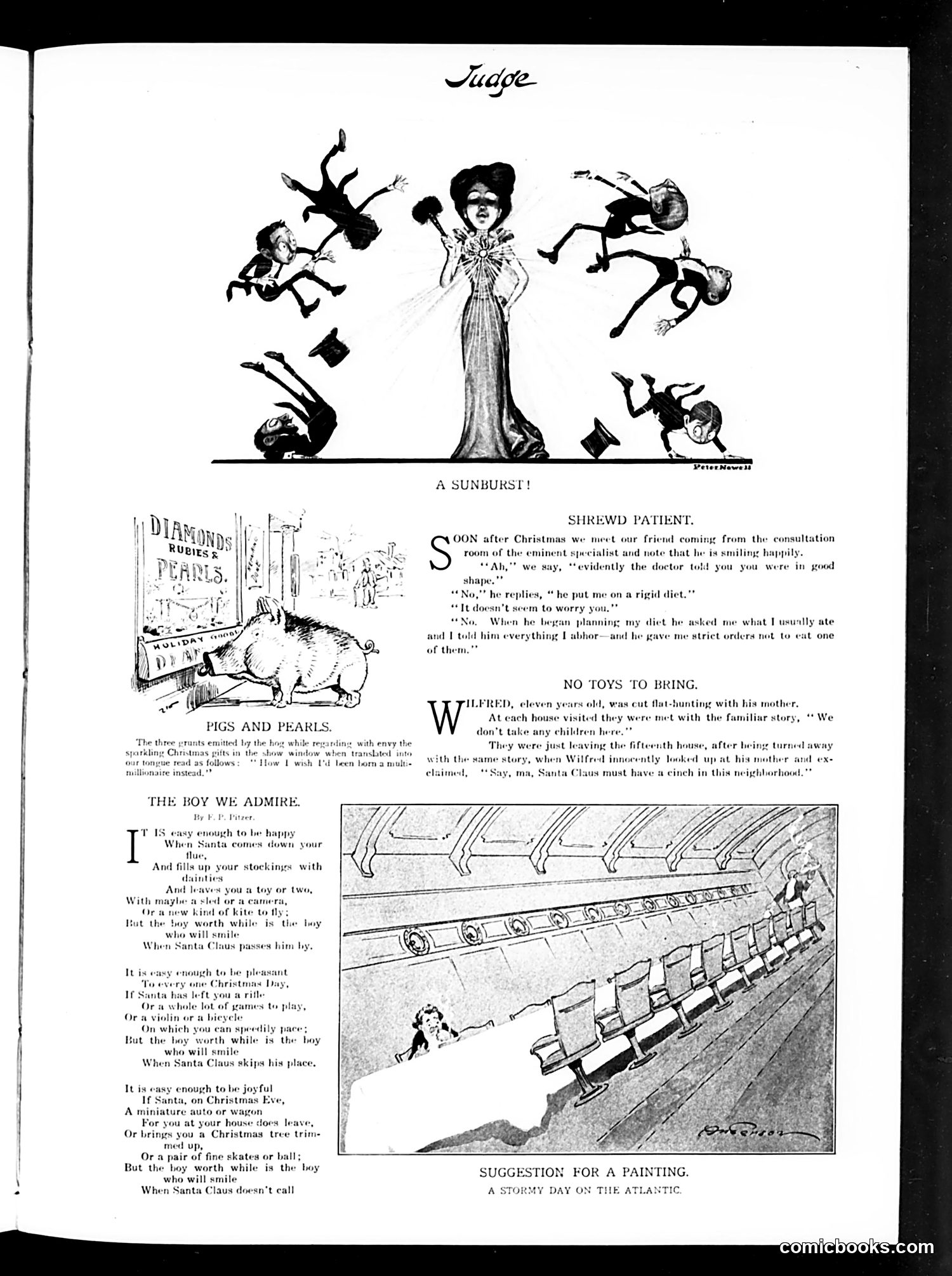
This page from the satirical magazine **Judge** contains several pieces with Christmas and social themes: **Top cartoon ("A Sunburst!")**: Shows a blindfolded female figure (representing Justice) surrounded by falling male figures and scattered objects. The title suggests chaos or disorder in the justice system—a critique of judicial unpredictability or corruption. **"Shrewd Patient"**: A brief comic dialogue about a doctor recommending a restrictive diet. **"Pigs and Pearls"**: A visual joke showing a pig at a jewelry store window—likely satirizing the saying "casting pearls before swine" (wasting refinement on the undeserving). **"The Boy We Admire"** (poem by F. P. Dunne): Celebrates the child who will smile when Santa Claus passes by—praising boys who find happiness in simple things rather than expensive toys. This reflects Progressive-era values emphasizing character over materialism. **"No Toys to Bring"**: A brief story about a boy named Wilfred encountering families who cannot afford Christmas gifts. The page overall emphasizes class disparities and moral virtue during the Christmas season.
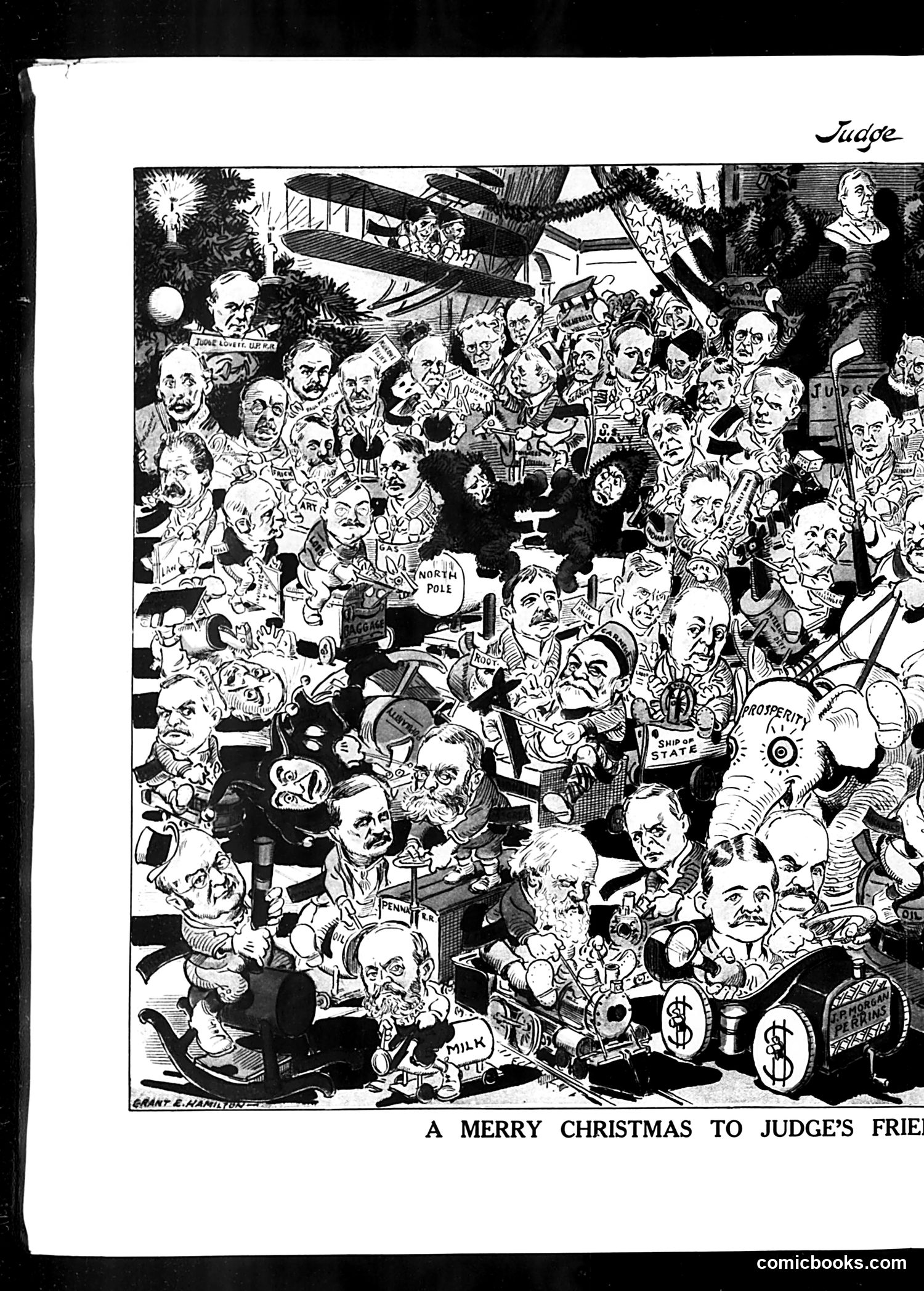
This is a densely-packed satirical cartoon featuring dozens of caricatured figures crowded together in what appears to be an industrial or commercial setting, with an airplane visible above. The cartoon is signed by Grant E. Hamilton. Visible labels include "NORTH POLE," "PROSPERITY," "MILK," "SHIP," and "$" symbols, suggesting the cartoon addresses economic and commercial themes. The exaggerated facial features and caricature style are typical of early 20th-century political cartooning. While the specific identities of most figures remain unclear without additional historical context, the crowded composition and reference to "Judge's friends" suggests this is a satirical commentary on prominent business, political, or cultural figures of the era, likely celebrating or mocking their roles in contemporary affairs. The exact date and specific targets are uncertain from the image alone.
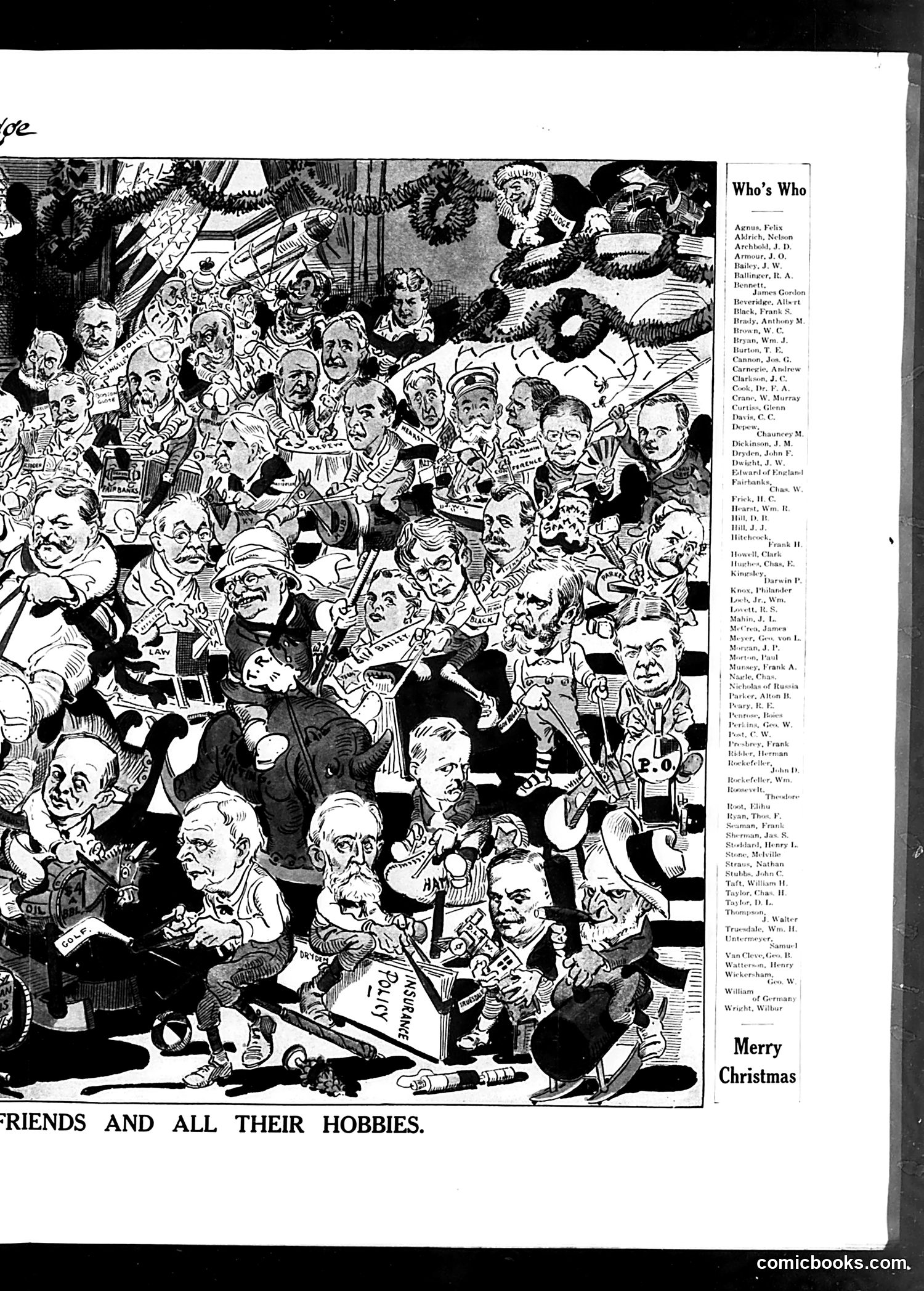
This is a satirical Christmas cartoon titled "Friends and All Their Hobbies," featuring caricatured figures in a crowded, chaotic scene. The accompanying "Who's Who" list on the right identifies numerous individuals by name, suggesting these are recognizable public figures of the era—likely politicians, celebrities, or prominent personalities. The cartoon appears to be a holiday-themed group caricature lampooning contemporary notable figures through exaggerated physical features and their depicted "hobbies" or characteristic behaviors. The densely packed composition with varied activities and expressions is typical of Judge magazine's satirical style, mocking society's elite and their quirks. Without specific dates or clearer identification of individuals in the artwork, the exact targets and particular jabs remain difficult to pinpoint for modern readers, though the intent is clearly comic ridicule of well-known contemporaries.
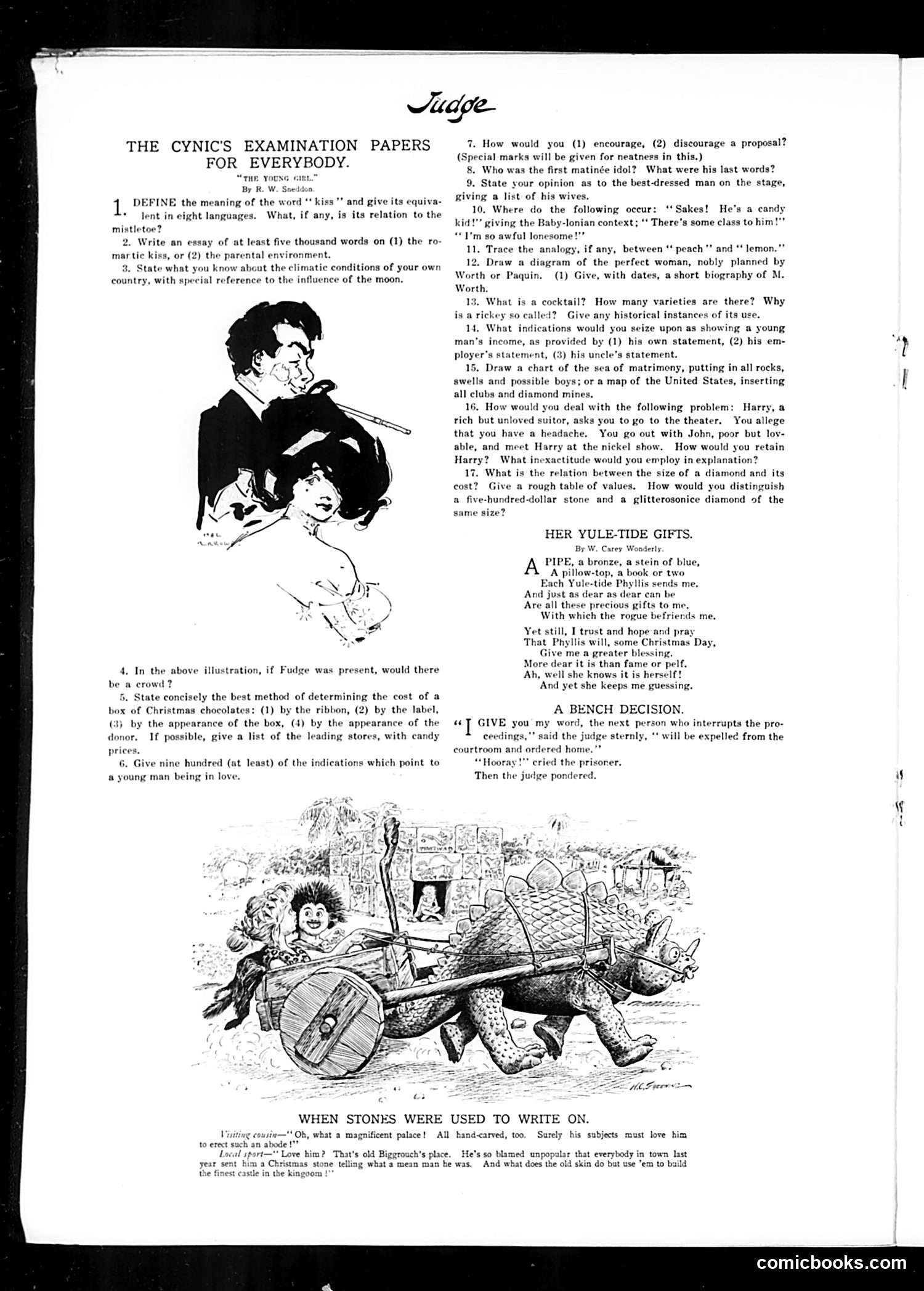
This page from *Judge* magazine contains examination questions parodying a cynic's perspective on romance, courtship, and social pretension in the early 20th century. **"The Cynic's Examination Papers"** mockingly treats romance as an academic subject, with absurdist questions about kissing, determining a suitor's wealth by his gifts, navigating love triangles, and evaluating women like commodities ("perfect woman, nobly planned"). References to specific fashion designers (Worth, Paquin) and venues (theaters, "nickel shows") ground the satire in period social life. The illustrations show a couple embracing and a whimsical scene of someone driving an animal-drawn cart, complementing the satirical tone. **"Her Yule-Tide Gifts"** is sentimental verse about gifts received, contrasting with the cynic's perspective above. **"A Bench Decision"** and **"When Stones Were Used to Write On"** are brief humorous anecdotes—one about courtroom interruption, one about a unpopular man receiving insulting stones as gifts. The overall satirical point: courtship and romance are transactional, materialistic, and governed by social calculation rather than genuine emotion.
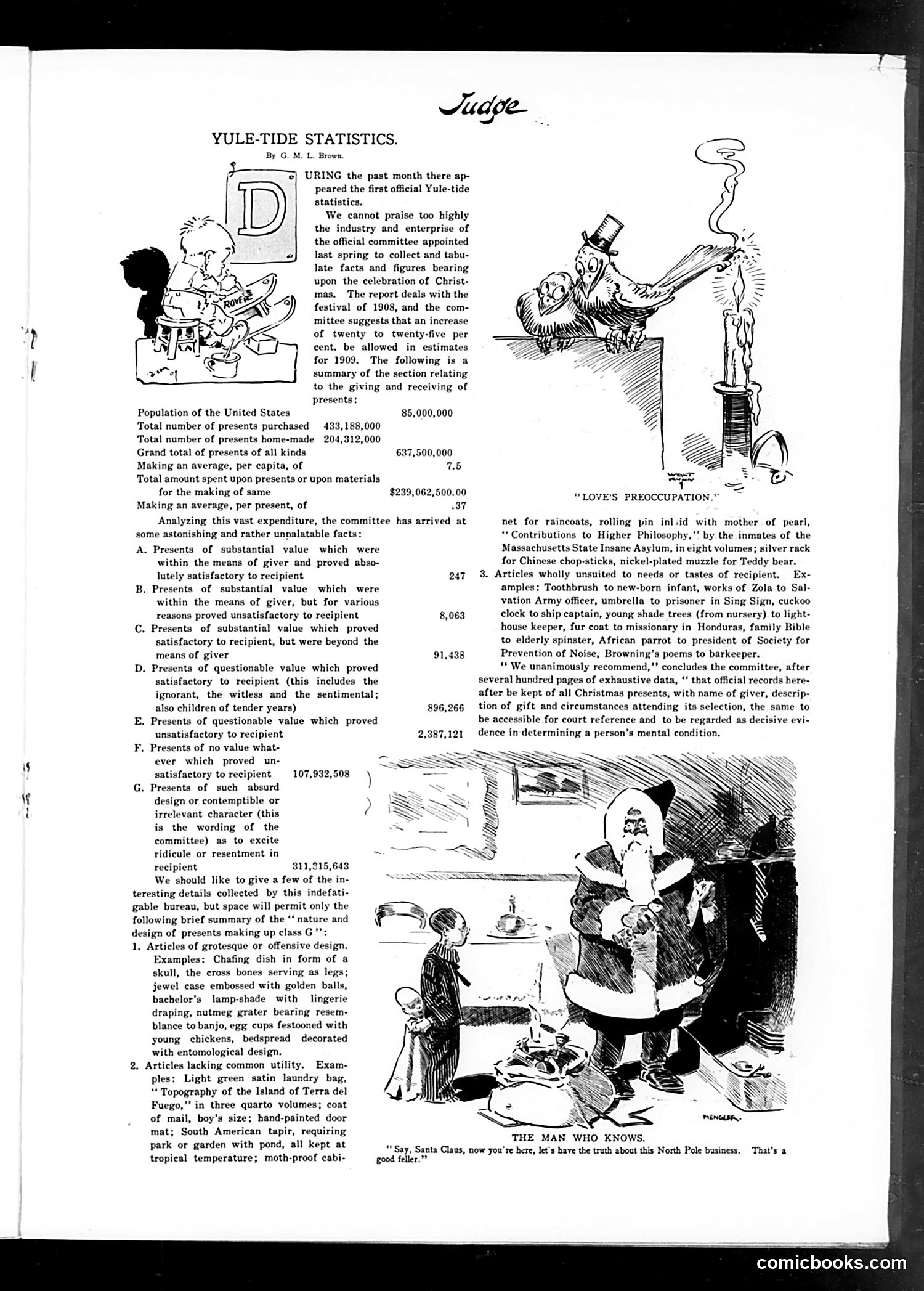
This 1908 article satirizes the absurdity of Christmas gift-giving through mock statistical analysis. Judge presents a fake "official committee" report quantifying Christmas presents given in America—637.5 million total, costing $239 million. The satire's punch comes in classifying gifts by recipient satisfaction. Of millions given, only 247 presents were "substantial value" and actually satisfactory. The vast majority fell into categories G (ridiculous or offensive designs) and F (worthless), totaling over 107 million presents. The examples are deliberately absurd: chafing dishes shaped like skulls, nutmeg graters resembling banjos, umbrellas for prisoners, toothbrushes for infants. The implication: Americans waste enormous sums on thoughtless, inappropriate gifts—buying out of obligation rather than genuine consideration. The accompanying cartoons reinforce themes of holiday excess and pretense masking hollow sentiment.

The image on this page is almost entirely black or severely underexposed, making it impossible to discern any cartoon figures, caricatures, or visual details. While the page header reads "Judge" and the right margin shows "HARMORY," the actual content—whether it's a political cartoon, advertisement, or illustration—is not legible in this reproduction. Without being able to see the visual elements, I cannot identify figures, references, or satirical intent. To provide accurate historical context as requested, a clearer or better-preserved version of this page would be necessary.
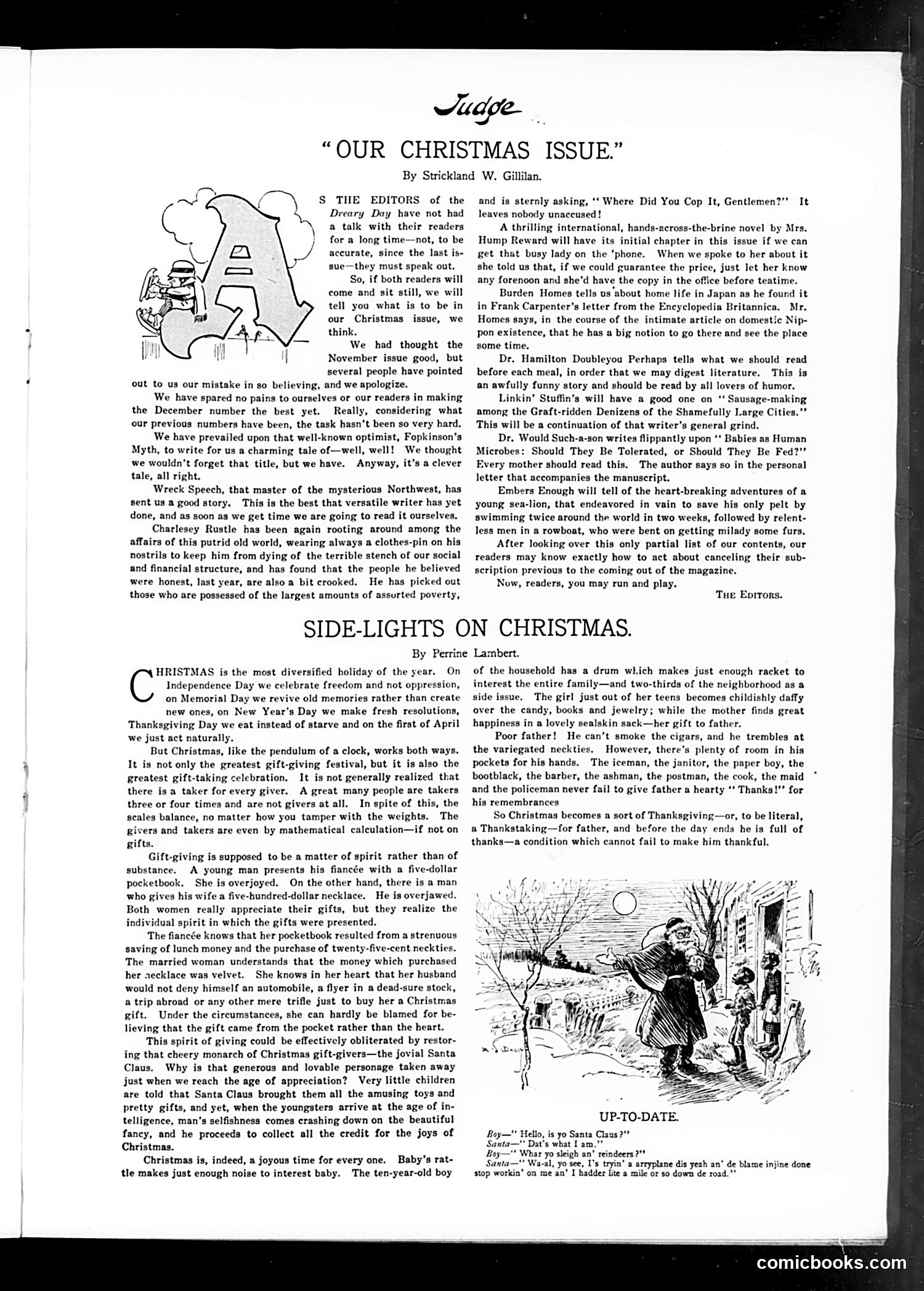
This is the editorial introduction to Judge magazine's Christmas issue, written with heavy satirical irony. The editors mock their own publication by listing upcoming stories with deliberately unflattering descriptions—admitting previous issues were poor, joking that they haven't bothered reading their own contributors' work, and sarcastically describing articles about poverty, corruption, and domestic life in Japan. The satire targets both the magazine itself and contemporary society. References to "Charlesey Rustle" rooting through "affairs of this putrid old world" and exposing poverty suggest criticism of social inequality. The article "Where Did You Cop It, Gentlemen?" appears to investigate wealth sources during an era of industrial corruption. The accompanying illustration shows a snow-covered winter scene with minimal context visible in this image. The second article, "Side-Lights on Christmas," shifts to social commentary about Christmas gift-giving expectations and class dynamics—how wealthy husbands give expensive gifts while wives receive pocket change, satirizing economic inequality within households. Overall, this reflects Judge's satirical mission critiquing Gilded Age American society.
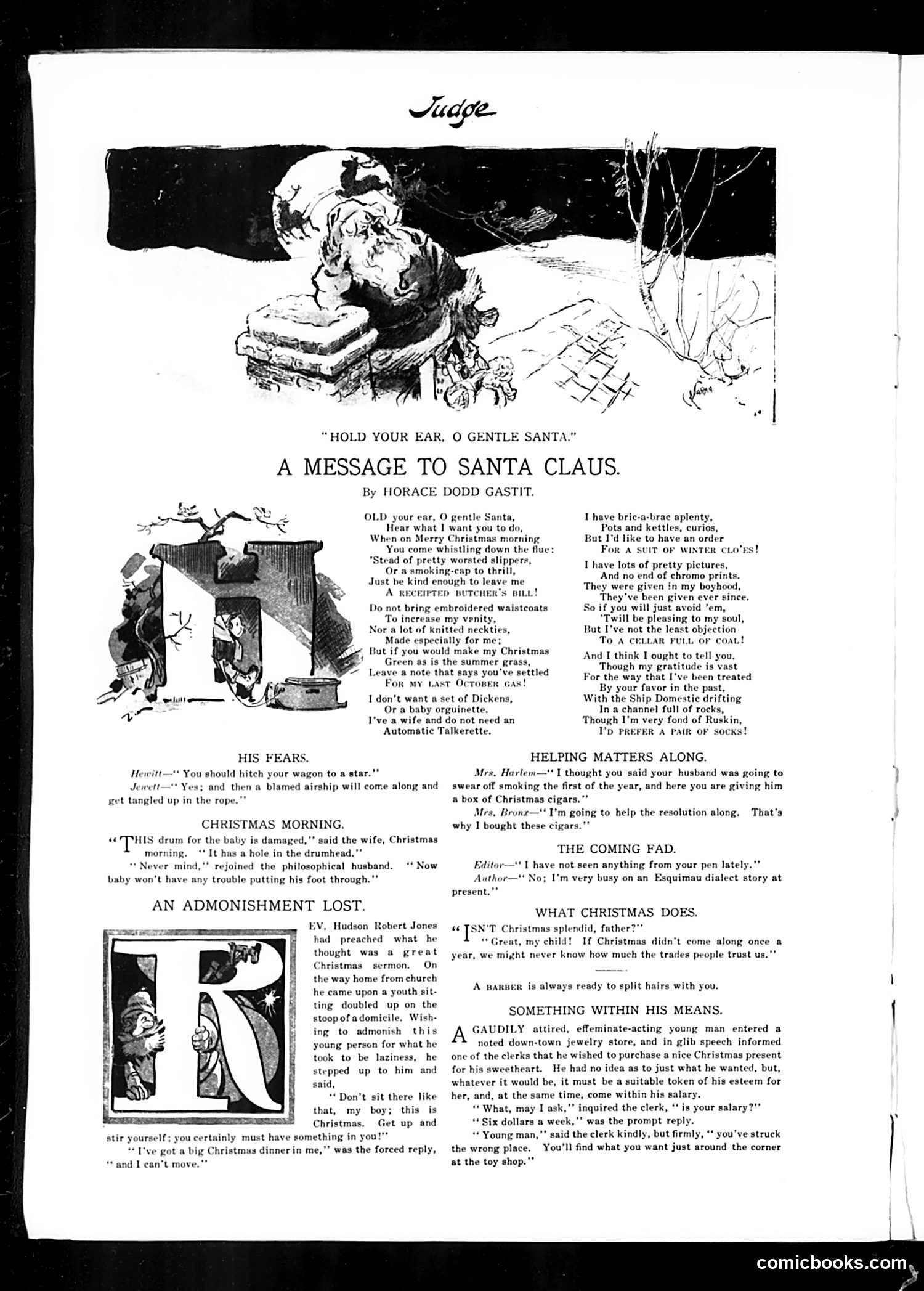
This is a Christmas-themed page from *Judge* magazine featuring satirical humor about holiday gift-giving and social manners. **Main Content:** The page's centerpiece is "A Message to Santa Claus" by Horace Dodd Gastit—a humorous poem where the narrator requests practical gifts (a paid butcher's bill, winter clothes, coal, socks) rather than frivolous items (decorative bric-a-brac, embroidered waistcoats, automatic talking devices). The satire targets both excessive consumerism and the gap between wants and financial reality. **Supporting Anecdotes:** - "Christmas Morning": A joke about a drum with a hole—the husband finds dark humor that the baby won't damage it further - "An Admonishment Lost": A reverend tries scolding a lazy youth on Christmas, only to learn he's literally too full from dinner to move - "Something Within His Means": A poorly-paid young man (six dollars weekly) seeks jewelry for his sweetheart but is redirected to the toy shop—mocking his delusion about his budget **The Satire:** These pieces poke fun at Christmas excess, social pretension, economic strain, and the disconnect between desire and means—themes recognizable today but expressed through period-specific consumer goods and language.
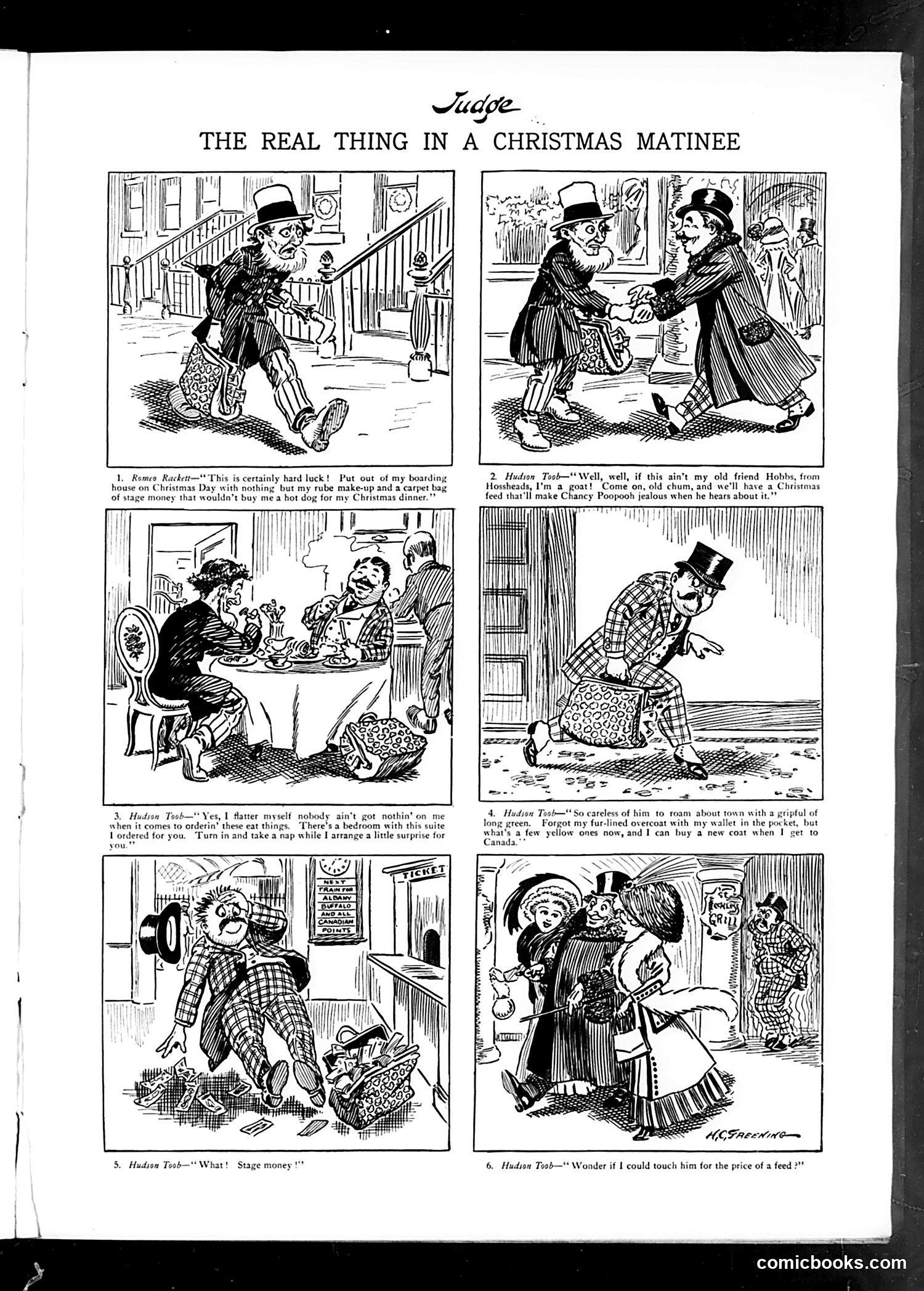
This six-panel comic strip satirizes theater culture and urban poverty during the Christmas season. The narrative follows "Hudson Tuck," a shabby vagrant or unemployed man, who encounters an acquaintance and is invited to Christmas dinner. The humor relies on exaggerated dialect ("Hossheads," "Chancy Poopooh") and the contrast between the characters' ragged appearance and their pretentious theatrical references. The satire targets both the **theatrical world** (through affected speech and references to "stage money" in panel 5) and the **economic desperation** of working-class Americans around Christmas. The final panel's punchline—"Wonder if I could touch him for the price of a feed"—reveals the strip's commentary on poverty: even small kindnesses at Christmas are transactional for those struggling to survive. The caricatured drawings emphasize the characters' lower-class status through exaggerated features and tattered clothing, typical of early 20th-century Judge magazine's social satire.
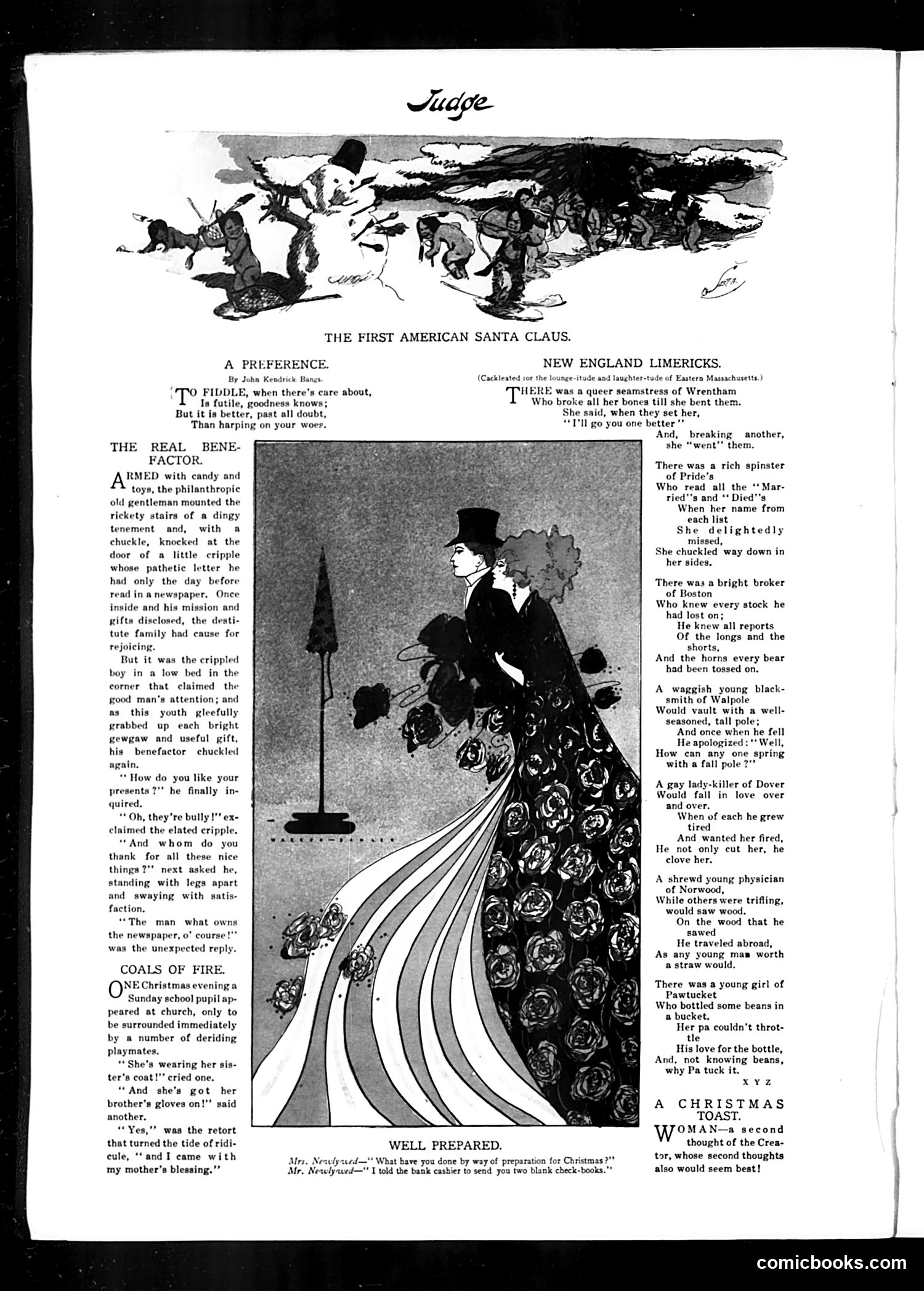
This page features satirical humor and social commentary typical of *Judge* magazine. The main cartoon, "The First American Santa Claus," depicts a well-dressed gentleman in top hat and coat—likely representing a wealthy philanthropist or businessman. The satire centers on **charitable giving and credit-seeking**: a rich man delivers gifts to a poor family, but the crippled boy credits "the man what owns the newspaper" rather than the actual donor. This mocks how newspapers publicized charitable acts for their own promotion and how donors sought public recognition. The surrounding text includes humorous verse ("New England Limericks") poking fun at regional stereotypes and human folly—broken bones, spinsters reading obituaries, stock brokers, blacksmiths, doctors, and domestic mishaps. The overall theme: **satire of Gilded Age philanthropy, vanity, and newspaper sensationalism**—showing how charity was often performed for publicity rather than genuine compassion.
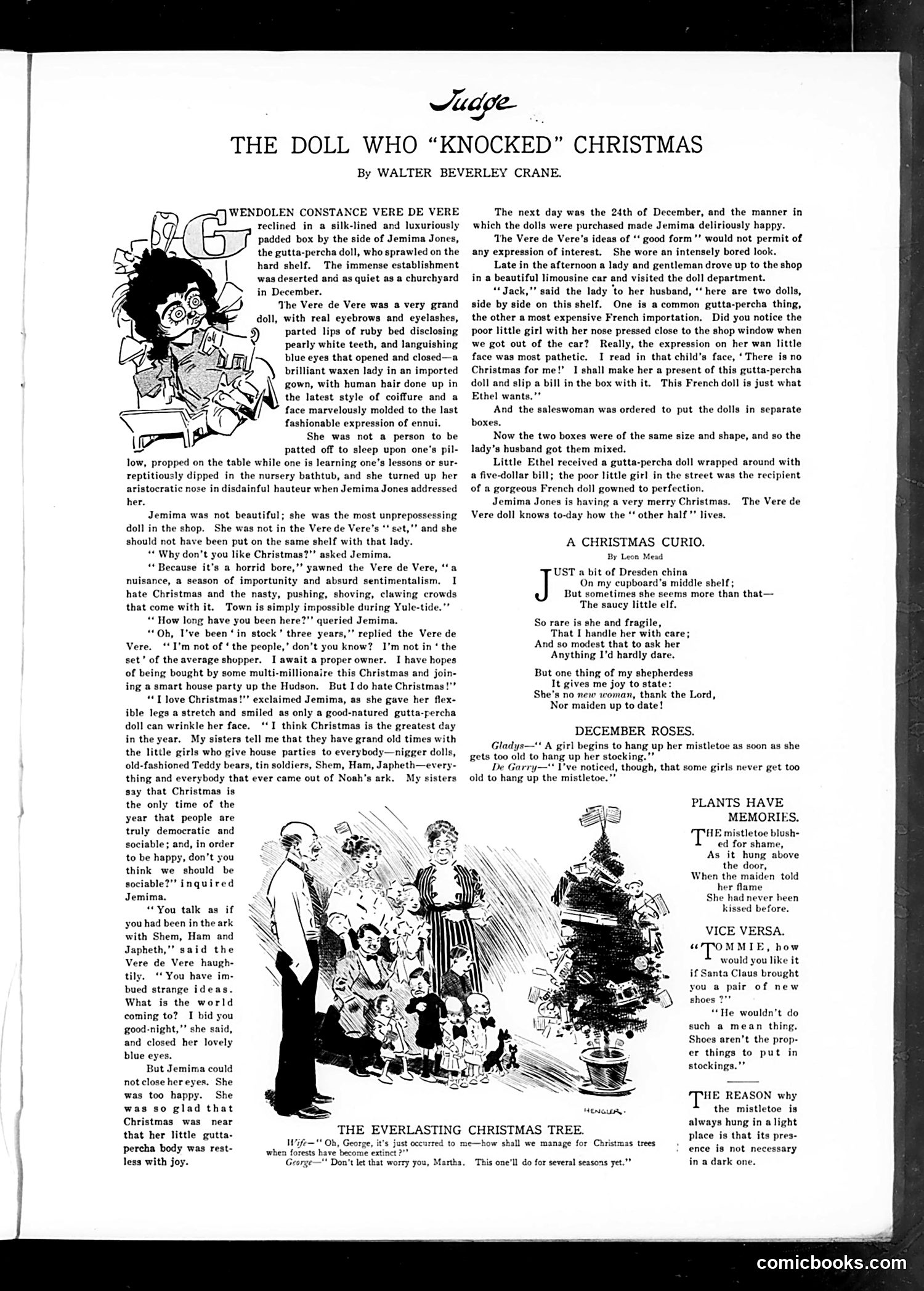
This is a satirical short story with accompanying illustration by Walter Beverley Crane, not a political cartoon. It mocks class snobbery through two contrasting dolls: **The Setup:** "Wendolen Constance Vere de Vere"—a luxury doll with realistic features, imported gown, and affected manners—represents upper-class pretension. "Jemima Jones," a plain gutta-percha doll, embodies working-class warmth and genuine Christmas spirit. **The Satire:** The Vere de Vere disdains Christmas as vulgar and crowded, despises "the people," and awaits purchase by a wealthy Hudson River estate owner. Jemima loves Christmas's democratic spirit and celebrates that common toys (teddy bears, tin soldiers) join in celebration together. **The Irony/Joke:** On Christmas Eve, a wealthy couple purchases *both* dolls—but Jemima's genuine joy contrasts sharply with the snob's forced indifference. The story satirizes how the wealthy pretend superiority while missing Christmas's actual meaning: human connection across class lines. The accompanying poem fragments reinforce themes of modest worth and nostalgic sentiment over material status.
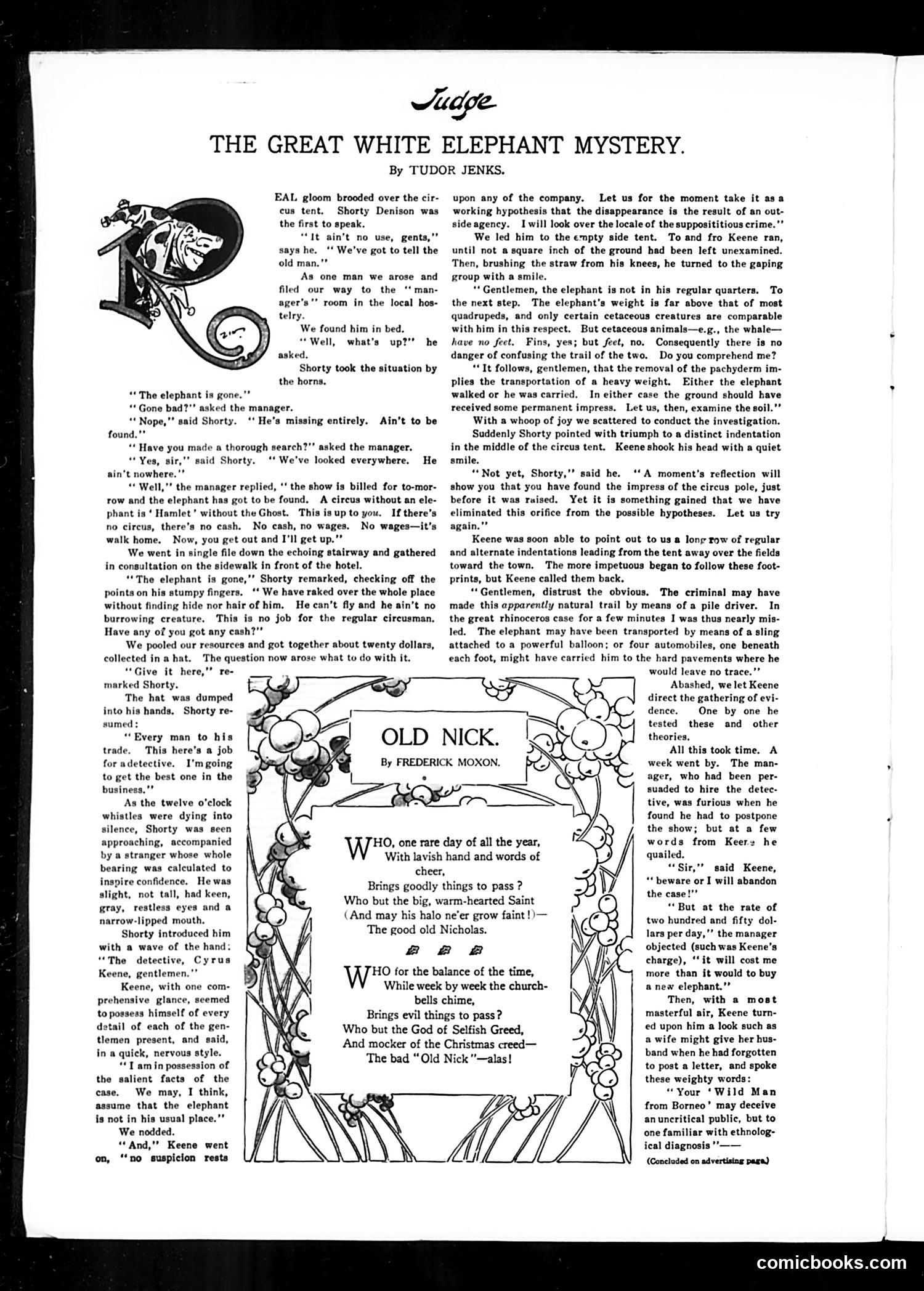
This is a serialized mystery story by Tudor Jenks, not political satire. It concerns a circus elephant's disappearance and the hiring of detective Cyrus Keene to solve it. The narrative parodies Sherlock Holmes-style detective fiction through exaggerated deductive reasoning. Keene lectures on pachyderm transportation logistics and ground impressions with overwrought scientific language ("cetaceous creatures," "pachyderm"). The humor lies in applying grandiose detective methods to a mundane circus problem—treating a missing elephant with the gravity of a major crime. The accompanying poem "Old Nick" by Frederick Moxon praises Saint Nicholas/gift-giving, appearing alongside the mystery story as typical Judge magazine content. The satire targets not politics but detective fiction conventions popular in the era.
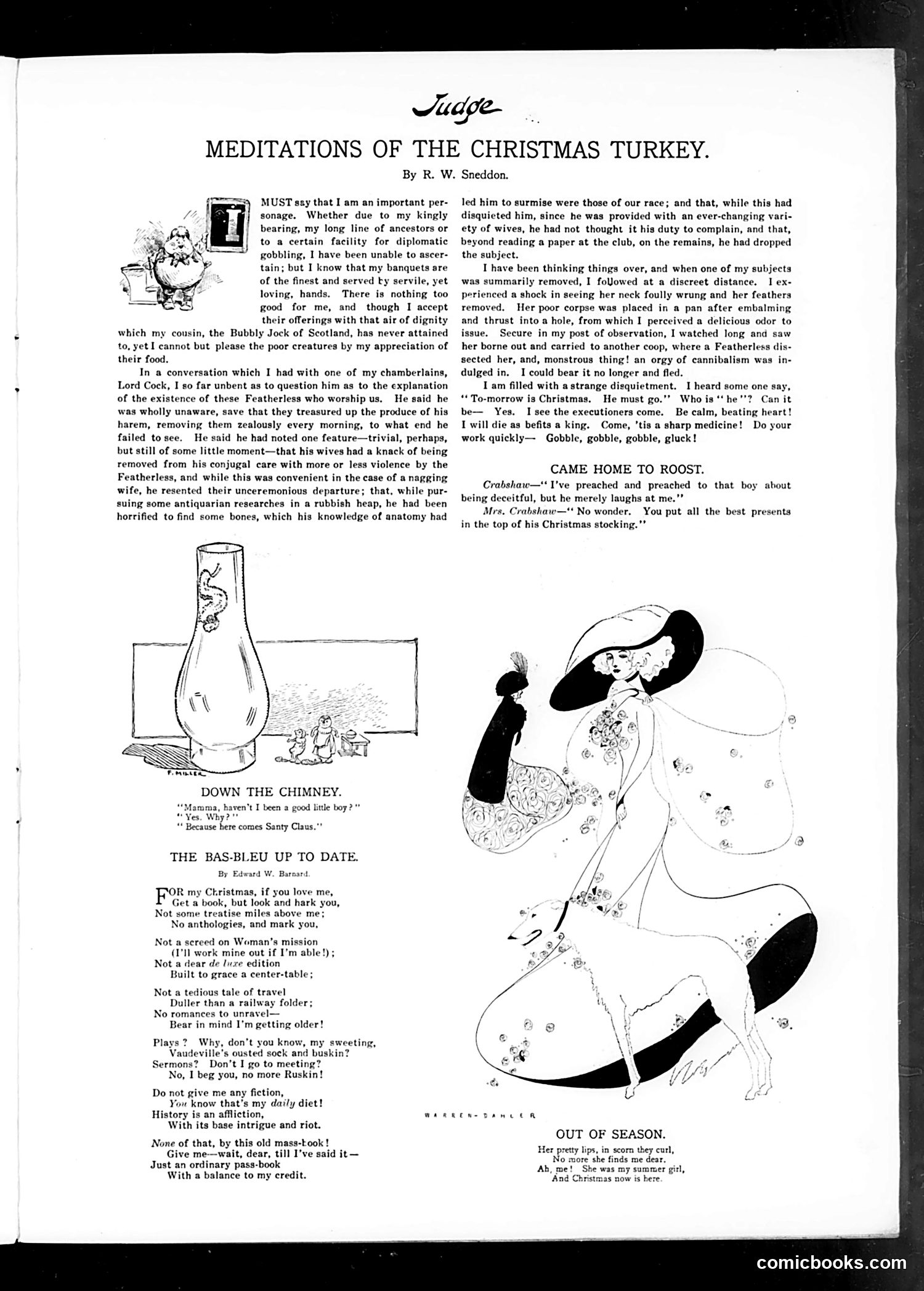
This *Judge* magazine page contains three satirical pieces: **"Meditations of the Christmas Turkey"** presents a turkey's first-person monologue discovering his fate—a dark comedy where the bird realizes he's being fattened for slaughter on Christmas. The satire mocks aristocratic pretension by having the turkey boast of his "kingly bearing" while remaining oblivious to his doom. **"Down the Chimney"** is a brief joke about a child asking Santa for presents, playing on traditional Christmas expectations. **"The Bas-Bleu Up to Date"** (by Edward W. Barnard) satirizes the "New Woman"—an educated, independent female figure of the era. The poem humorously lists what she *doesn't* want as Christmas gifts: improving books, travel narratives, plays, or sermons. Her actual desire? A bank passbook showing financial independence—mocking both women's education movements and their economic ambitions as ultimately mercenary. The cartoons and text together exemplify *Judge*'s style: satirizing social changes (women's roles, holiday excess) through exaggeration and dark humor.
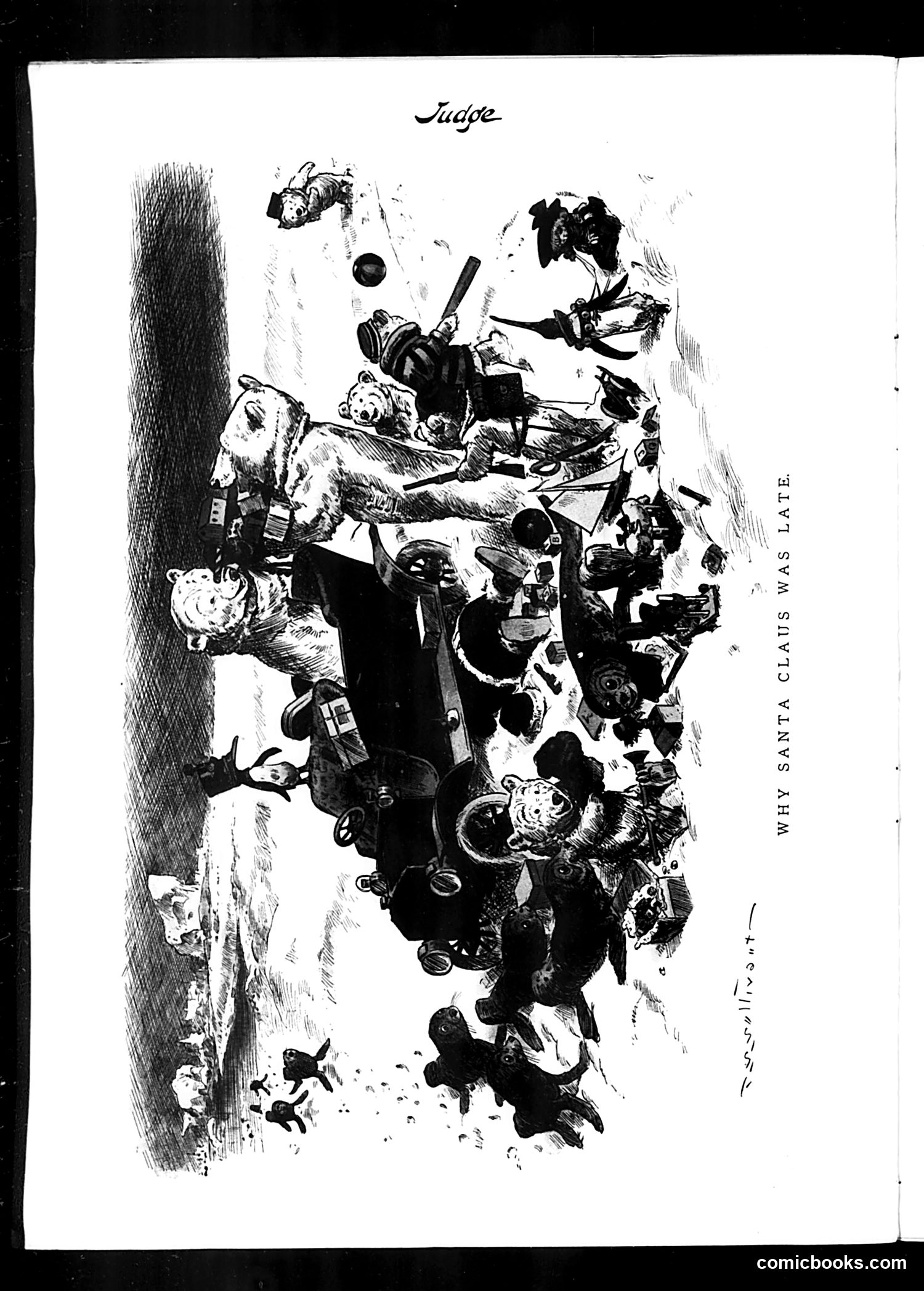
This Judge cartoon satirizes the commercialization of Christmas. The image depicts Santa Claus surrounded by coal, toys, and various goods in disarray—suggesting chaos in toy production or distribution. The Latin-like text at top appears decorative/satirical. The title "Why Santa Claus Was Slate" (likely "late") jokes that Santa couldn't deliver on time due to the overwhelming commercial demands of Christmas. The crowded, chaotic scene with Santa amid heaps of merchandise critiques how Christmas had become dominated by commercial excess and material gift-giving rather than spiritual meaning. This reflects Judge magazine's recurring theme of mocking American consumer culture and the growing industrialization of holiday traditions in the late 19th/early 20th century.
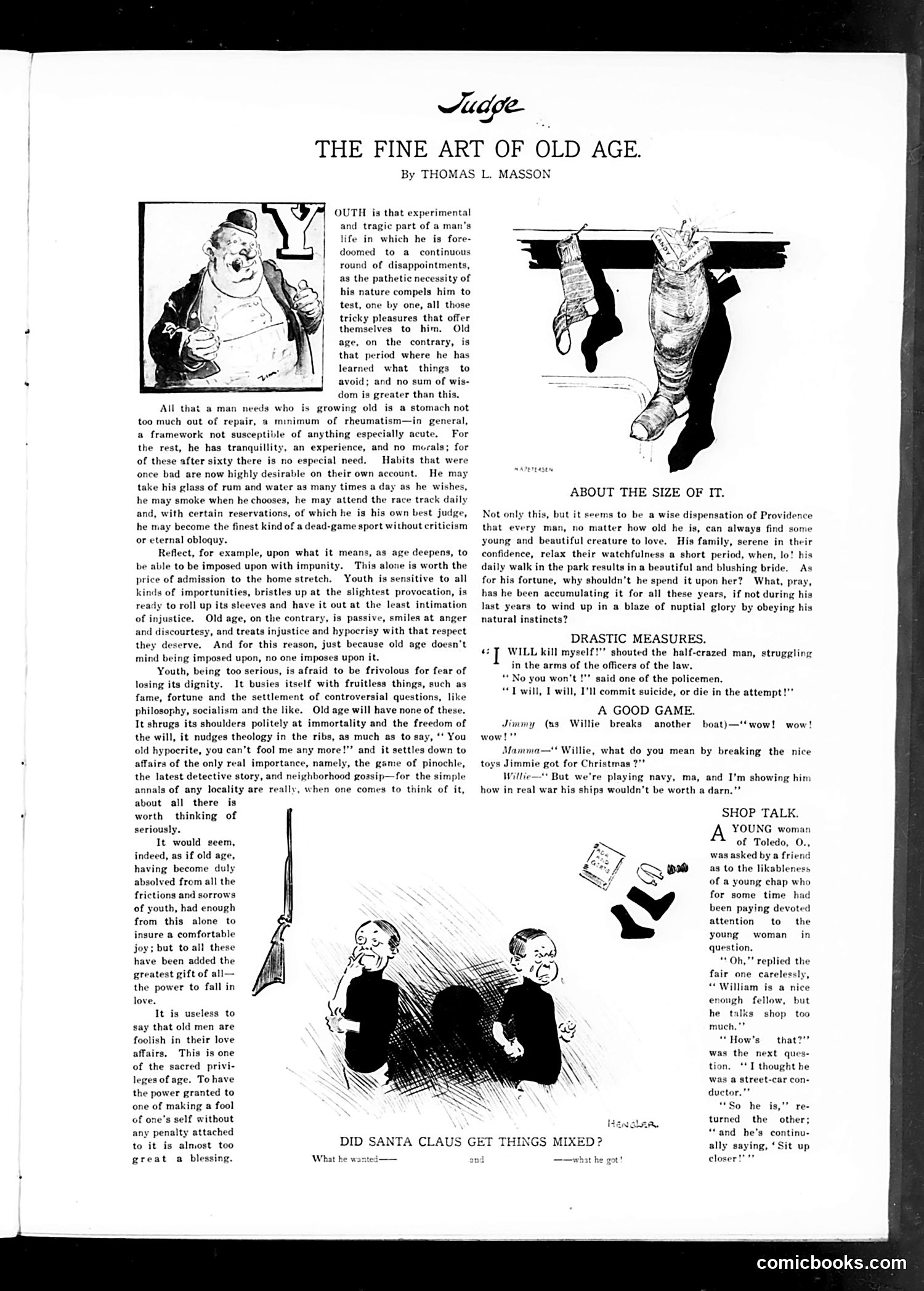
This essay by Thomas L. Masson celebrates aging as liberation from youth's constraints. The article argues old age grants freedom to indulge previously forbidden pleasures—drinking rum, smoking, gambling at racetracks, playing cards—without social judgment or "eternal obloquy." The satire targets Victorian morality's hypocrisy: youth must maintain dignity through restraint, while old age cynically dismisses concerns about "immortality," "socialism," and philosophy as pointless. Masson mockingly suggests aging men gain the "greatest gift"—romancing young women—implying wealthy older men routinely marry young brides, squandering accumulated fortunes. The accompanying cartoons illustrate this theme: one shows stockings hung to dry (domestic comfort); another depicts elderly men getting "things mixed" regarding Christmas gifts, likely satirizing confusion or foolishness. The piece uses biting irony to expose how age paradoxically brings both social permission to abandon respectability and the ability to pursue socially questionable behavior with impunity.
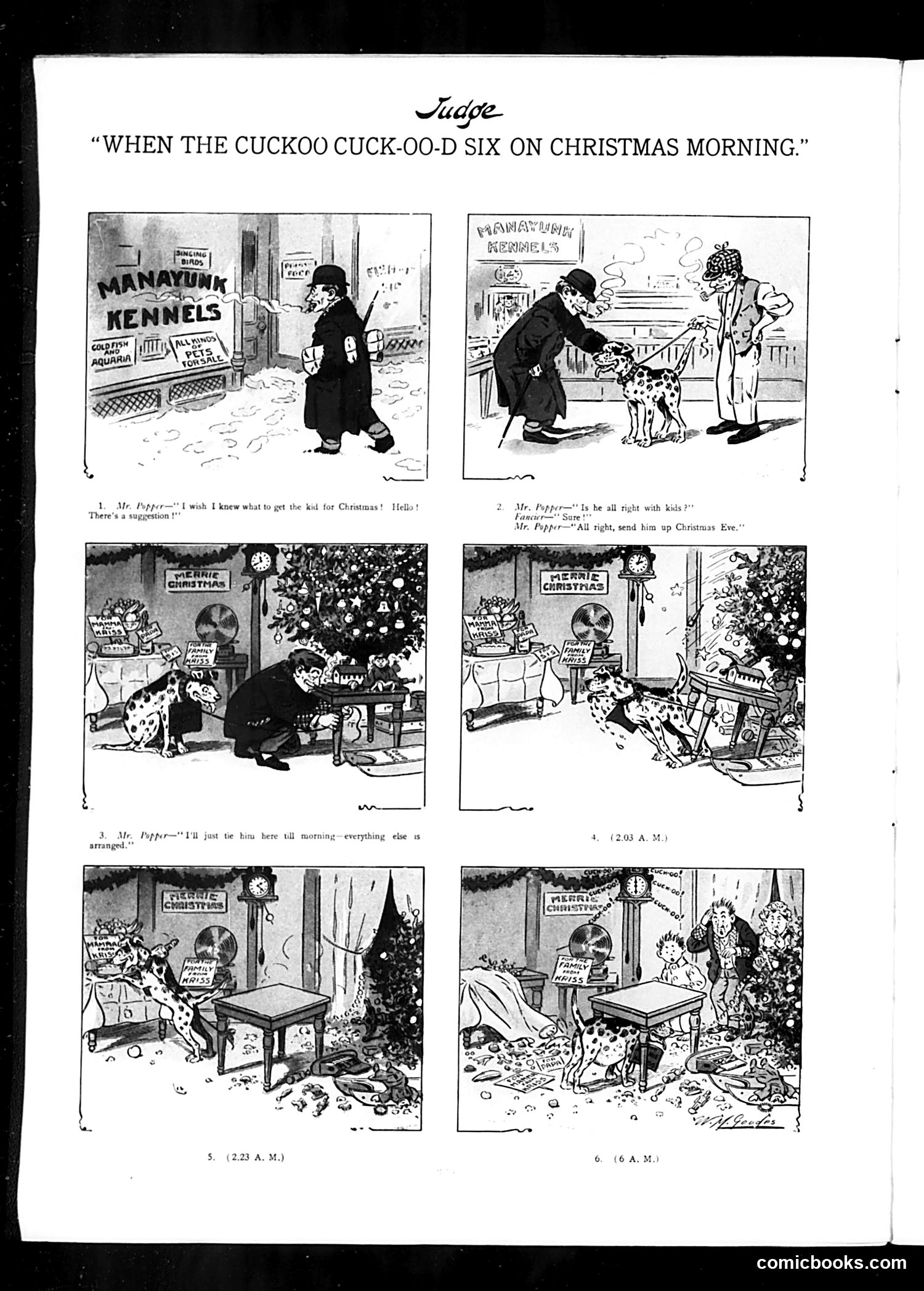
This six-panel comic depicts a man's Christmas morning disrupted by a cuckoo clock. The title plays on the nursery rhyme "cuckoo" sound with "cuck-oo-d," suggesting the clock's repeated chirping. **The narrative:** Panel 1: A man visits a pet shop (Manayunk Kennels), wishing to buy a dog for Christmas. Panel 2: The shopkeeper recommends a dalmatian puppy. Panels 3-6: The man brings the dog home and attempts to sleep, but the cuckoo clock repeatedly chimes through the early morning hours (midnight to 6 a.m.), with the dog's reactions growing increasingly chaotic and destructive. The humor lies in the escalating destruction and the dog's inability to adjust to the constant noise—a common domestic frustration for the magazine's readers.
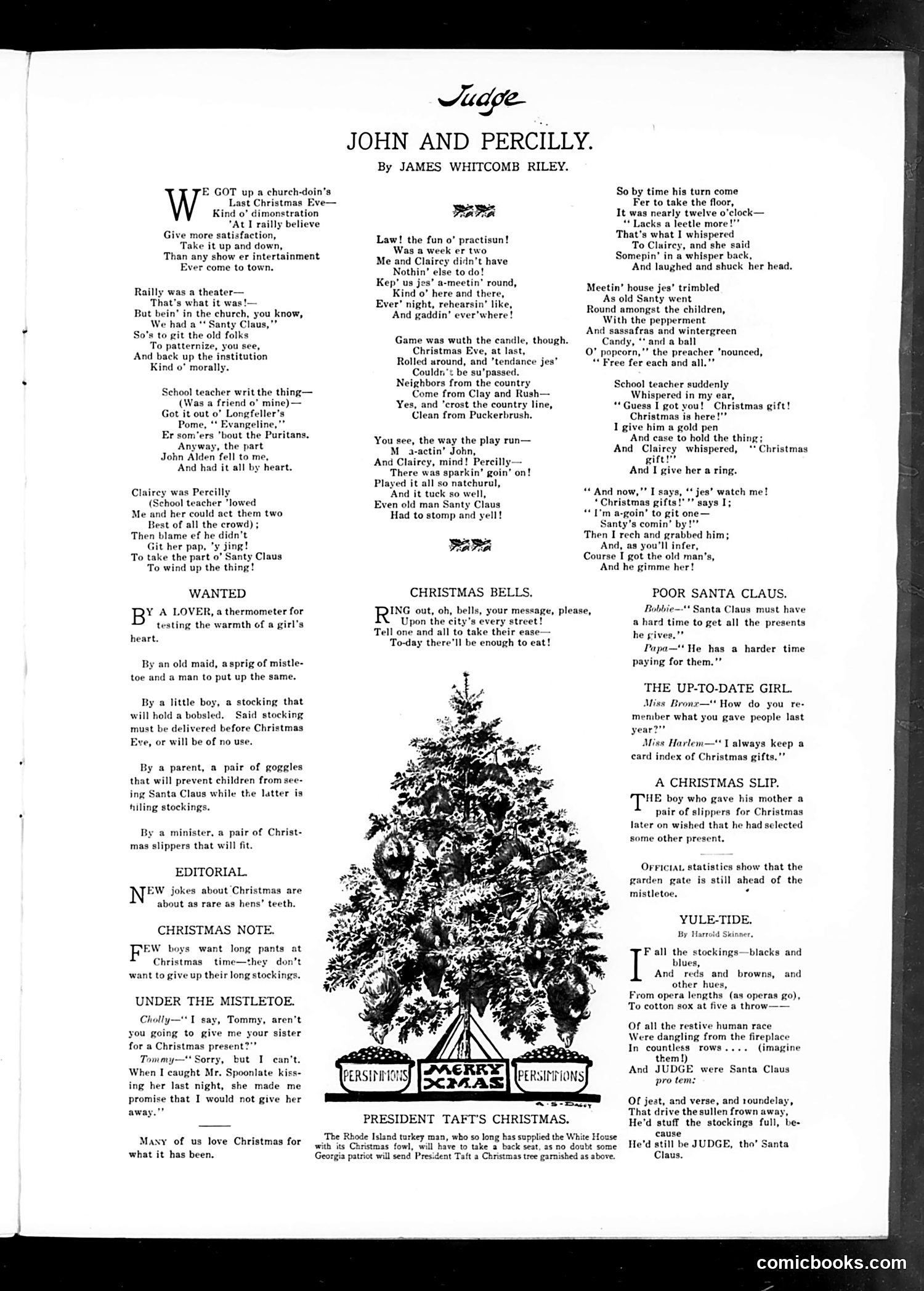
This page from *Judge* magazine contains a poem by James Whitcomb Riley titled "John and Percilly," a nostalgic rural Christmas narrative about a church pageant where the narrator and "Clairey" perform as characters John and Percilly. The poem humorously depicts their budding romance unfolding during rehearsals and the actual performance on Christmas Eve. The accompanying "Wanted" advertisements and brief jokes satirize Christmas expectations—a lover seeking to test a girl's affection, a parent wanting goggles to prevent children seeing Santa, and a minister needing properly-fitting slippers. At the bottom, a caption about "President Taft's Christmas" jokes that since Georgia patriotically sends the White House a turkey, a Georgia patriot should send President Taft a Christmas tree (likely with some added mockery, though the specific reference is unclear without historical context). The content reflects early 1900s small-town American Christmas customs and gentle romantic humor.
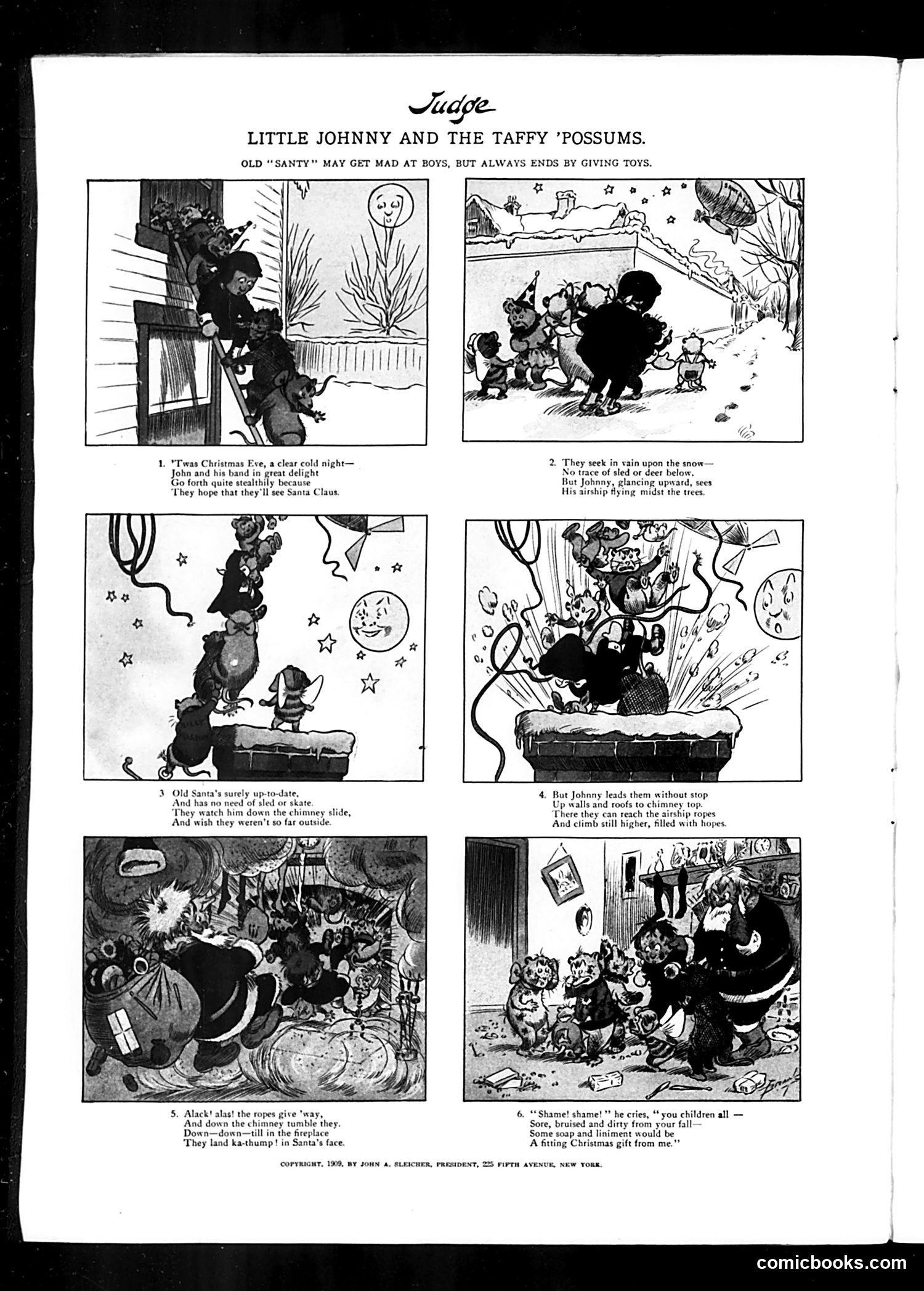
This is a whimsical children's comic strip, not political satire. It depicts Little Johnny and friends encountering Santa Claus on Christmas Eve—but with a modernized twist: Santa now travels by airship rather than sleigh and reindeer, reflecting early-1900s fascination with new aviation technology. The narrative follows the boys' mischievous Christmas Eve adventure seeking Santa. After failing to find traditional sleigh evidence in the snow, they spot his airship and pursue him across rooftops to the chimney. The story ends with Santa good-naturedly scolding them for their injuries while providing practical Christmas gifts (soap and liniment) rather than toys—a gentle moral lesson about obedience and self-care. The "taffy 'possums" reference in the title remains unclear from this page alone, possibly referring to character names or a subplot not fully visible.
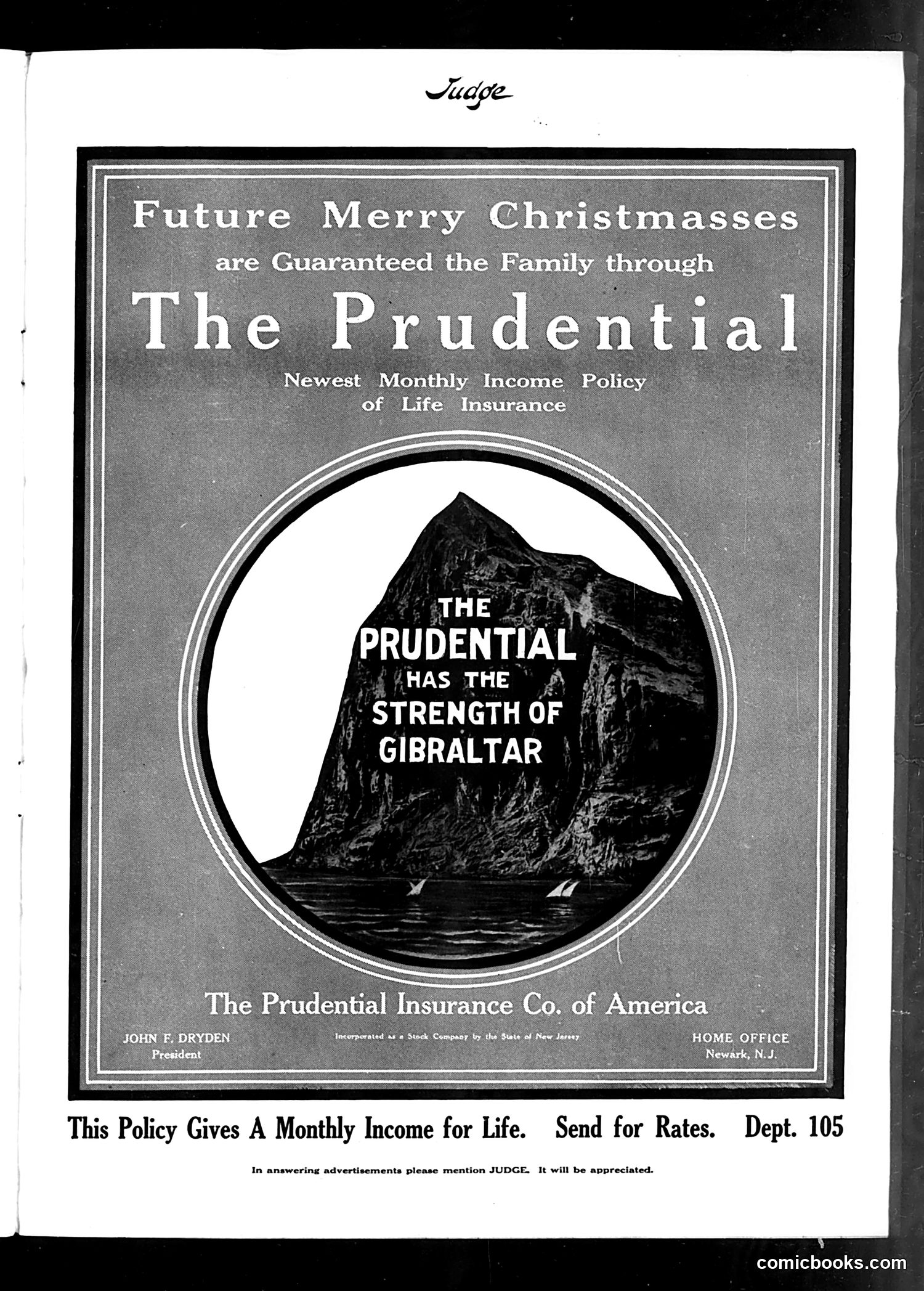
This page is primarily a **life insurance advertisement**, not political satire. It's a Prudential Insurance Company ad promoting their "Monthly Income Policy" with the slogan "The Prudential Has the Strength of Gibraltar." The only visual element is an image of the Rock of Gibraltar—a famous natural landmark known for its literal strength and stability. The metaphor equates Prudential's reliability with Gibraltar's permanence and fortitude, a common advertising strategy of the era. The headline promises "Future Merry Christmasses are Guaranteed the Family" through this insurance product, appealing to middle-class anxieties about providing financial security for dependents. There is no political cartoon or satire here—it's straightforward commercial advertising from Judge magazine's revenue stream.
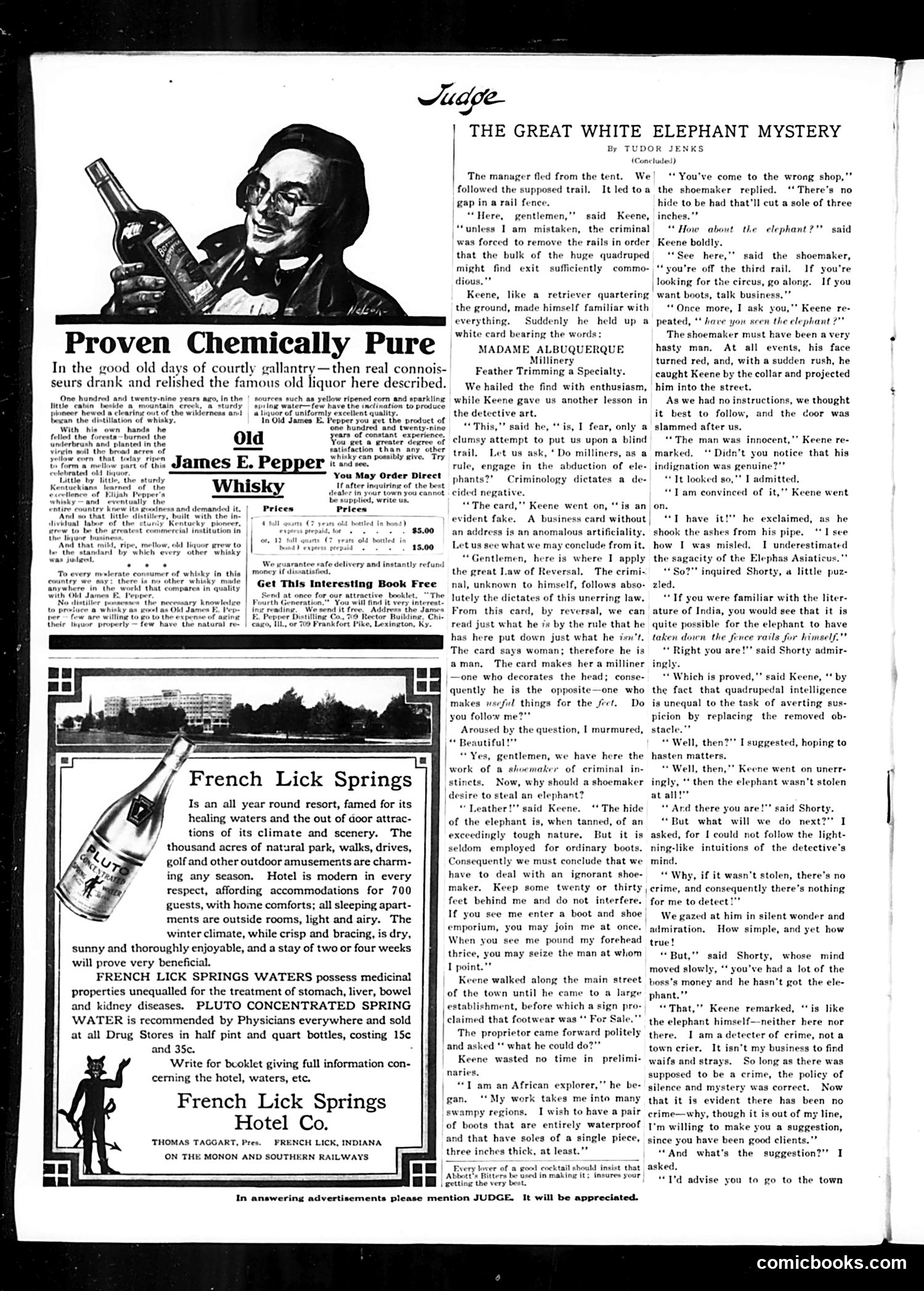
This page contains a detective fiction story by Tudor Jenks featuring a character named Keene solving a case involving a stolen elephant. The narrative demonstrates early 20th-century detective logic—Keene finds a business card and uses reverse reasoning to deduce the criminal is actually a male shoemaker (not a female milliner), since the card advertises the opposite of what the criminal does. The story is framed as humorous satire of detective fiction tropes, with Keene's overly elaborate deductive methods played for comic effect. The page also contains period advertisements for Old James E. Pepper Whisky (emphasizing 129 years of production), French Lick Springs resort in Indiana (promoting its healing waters), and other products—typical of Judge magazine's revenue model mixing editorial content with advertising.
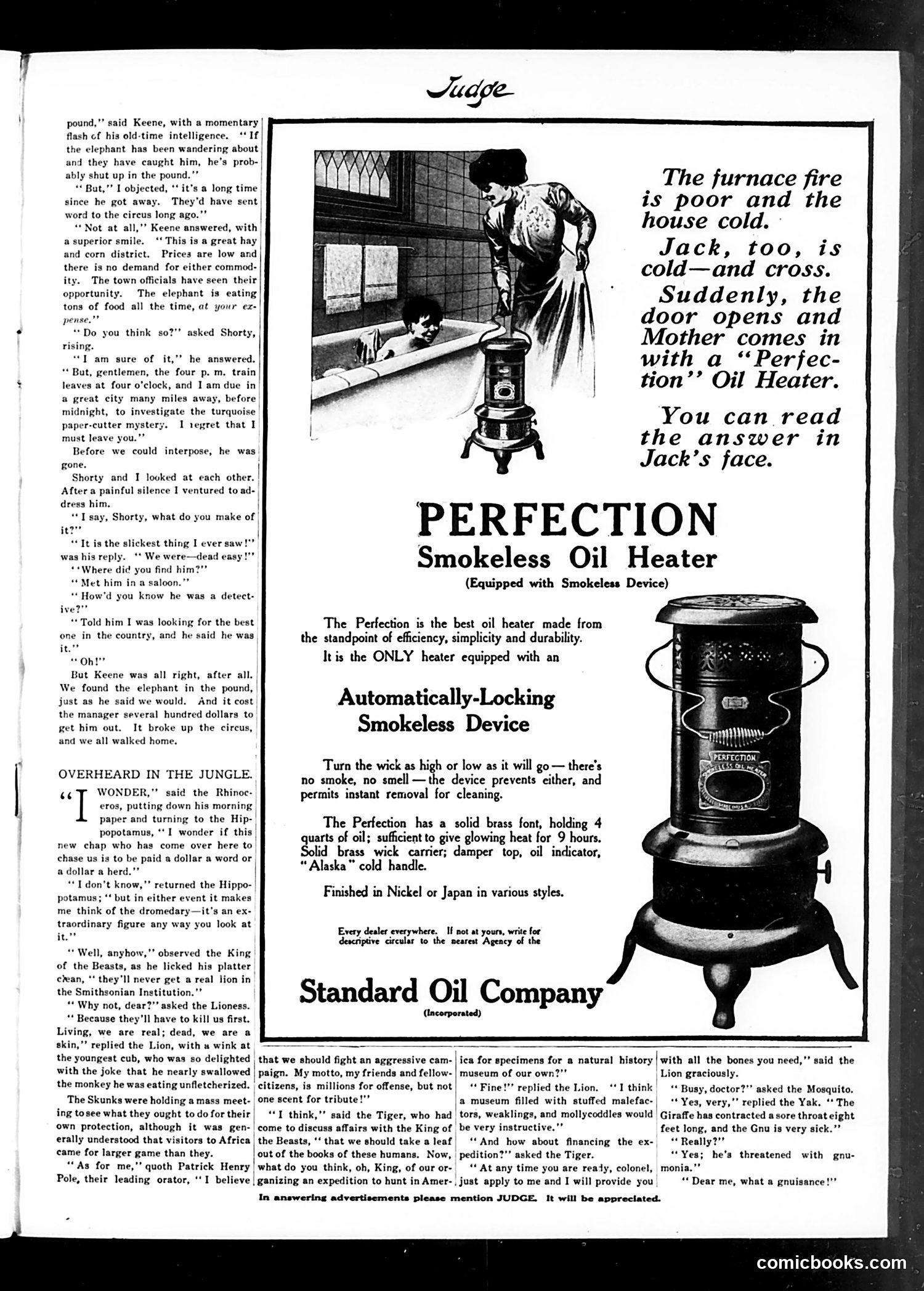
This page contains two distinct elements: **Left side**: A fictional narrative about detectives solving a circus elephant theft, concluding with a joke about a con artist detective who found the elephant in the town pound. **Right side**: A full-page advertisement for the "Perfection Smokeless Oil Heater" by Standard Oil Company, featuring an illustrated heating device and promotional text about its features (automatically-locking smokeless device, brass font, etc.). **Bottom section**: "Overheard in the Jungle"—a satirical dialogue between jungle animals (rhinoceros, hippopotamus, lion, lioness) discussing payment rates for a visiting human and joking about never getting a "real lion" in the Smithsonian Institution because "they'll have to kill us first." The jungle section appears to be gentle satire about colonialism and specimen collection, with animals anthropomorphically commenting on being hunted for museums. The page is primarily **advertising-driven**, with fiction serving as editorial content around the prominent product promotion.
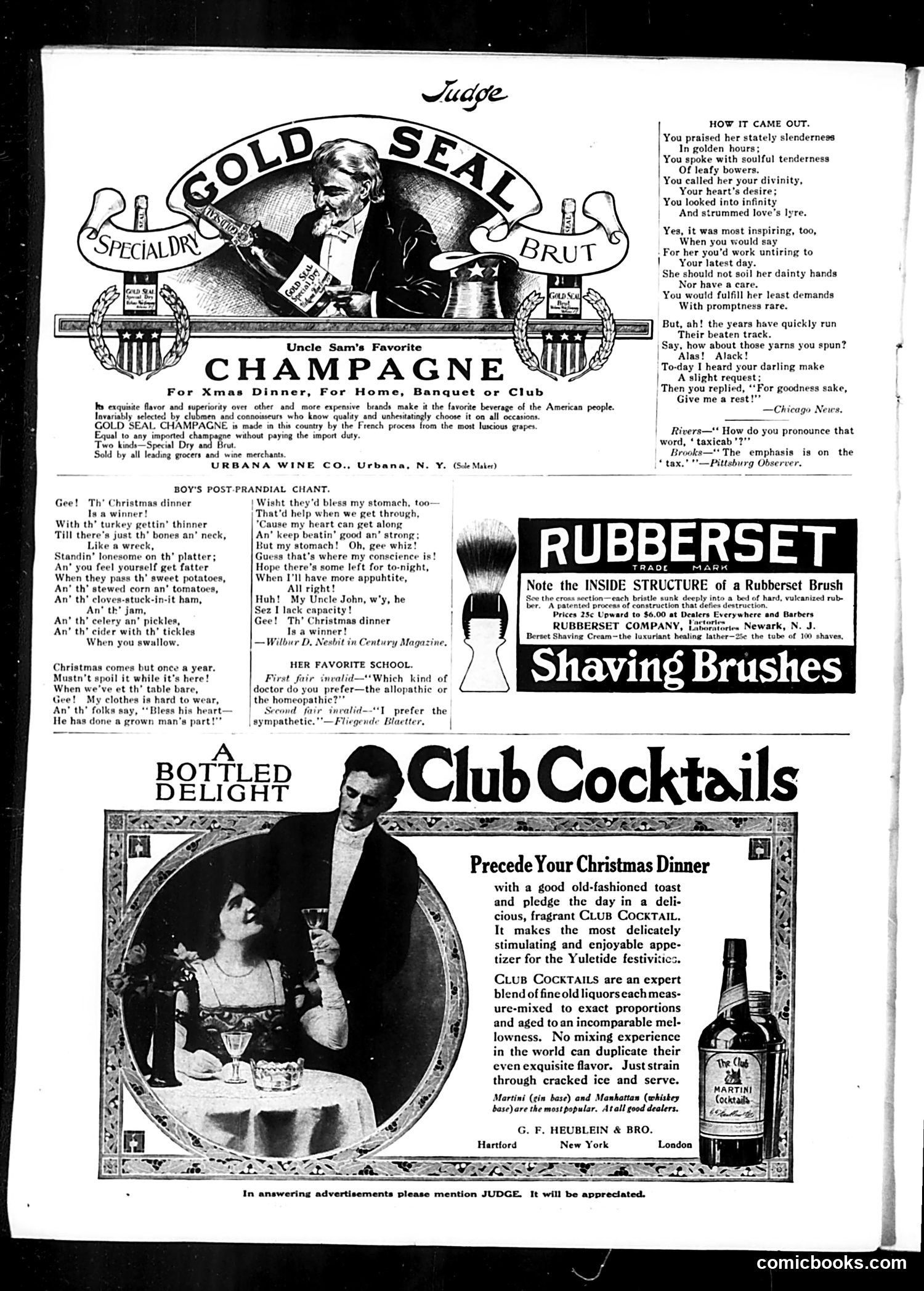
This is primarily an **advertising page** from Judge magazine, likely from the early 1900s (pre-Prohibition era, given the alcohol ads). The page contains several elements: **Poetry/Humor Content:** "How It Came Out" satirizes romantic courtship versus marriage reality—a husband who once praised his wife's "dainty hands" and swore he'd fulfill her every wish now dismisses her requests with "Give me a rest!" This reflects common domestic satire of the period. **Advertisements:** The dominant content includes champagne, shaving brushes, and cocktails—luxury goods marketed for Christmas and entertaining. These ads showcase period illustration styles and sales language ("exquisite flavor," "incomparable mellowness"). **Minor humor pieces:** A boy's post-Christmas dinner complaint about overeating, and a doctor joke about medical preferences. The page captures early 20th-century consumer culture and gender dynamics—courtship romance deflating into marital indifference—themes that would resonate with Judge's educated, urban readership.
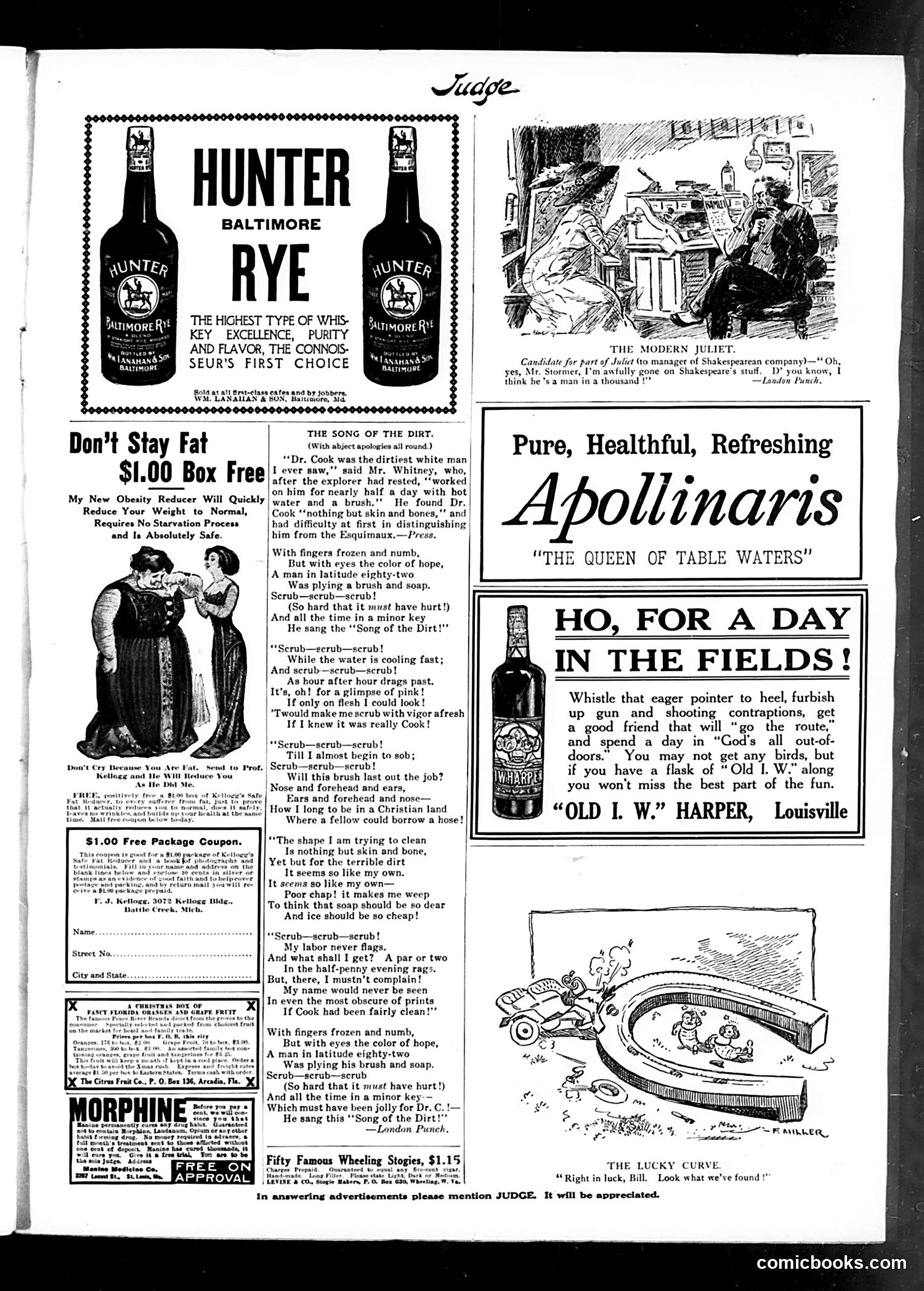
This page is primarily **advertising** with two satirical cartoons interspersed. The advertisements include whiskey (Hunter Rye), weight-loss products, and table water—typical early 20th-century Judge fare. The notable cartoons are: **"The Song of the Dirt"** references **Dr. Frederick Cook**, the Arctic explorer whose 1908 North Pole expedition claims were widely disputed and mocked. The poem satirizes Cook's supposed filthiness during his expedition, with a laborer scrubbing an extremely dirty man at high latitude, complaining the task is nearly impossible. The joke: Cook was so notoriously unclean that even achieving cleanliness seemed implausible. **"The Modern Juliet"** shows an actress auditioning for Shakespeare, declaring she's "awfully gone on Shakespeare's stuff"—satirizing theatrical pretension and actors' affected enthusiasm for classic literature. Both cartoons exemplify Judge's style: topical mockery of current events and social pretension, delivered through verse and visual comedy.
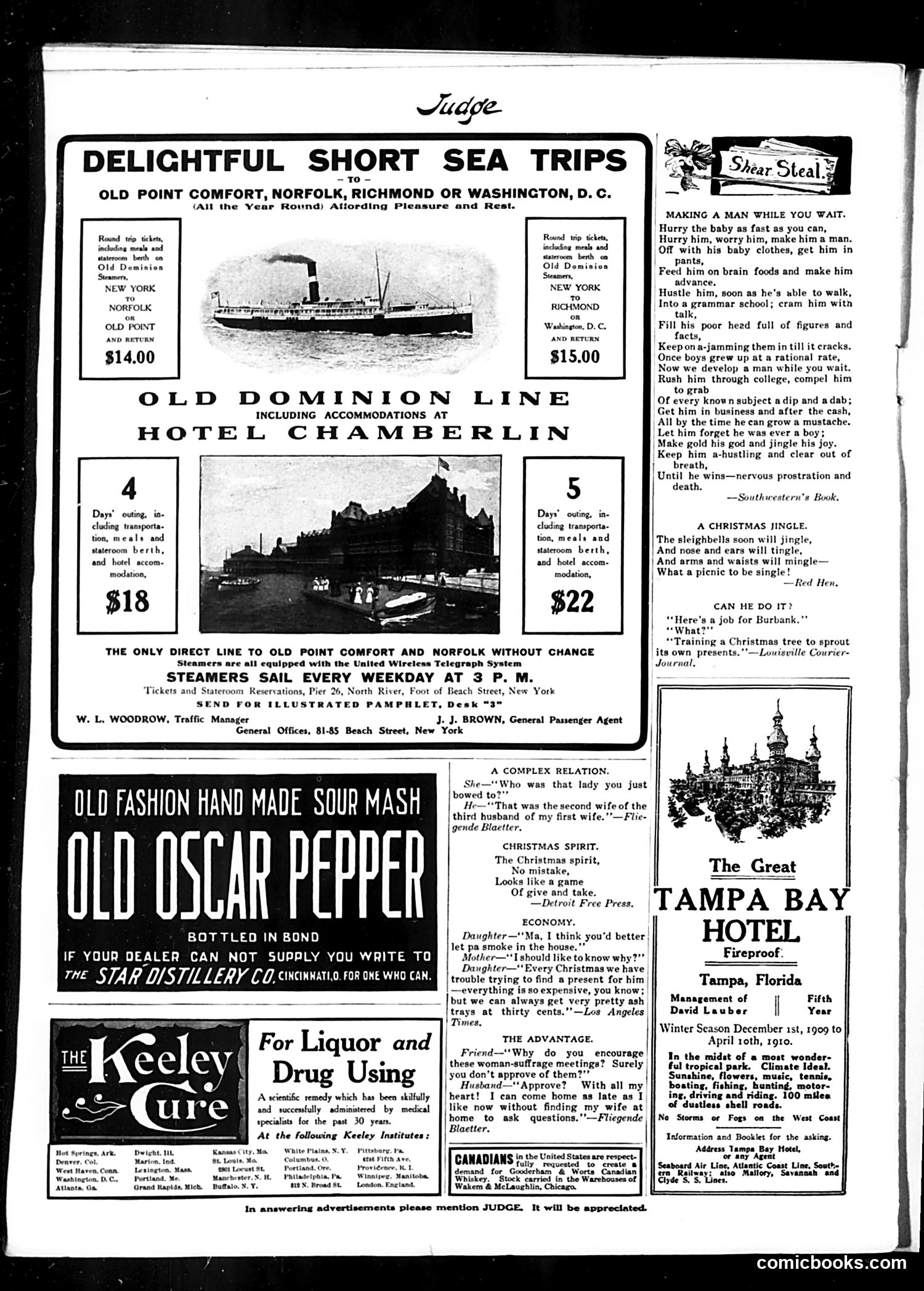
This page is primarily **advertising**, with satirical content interspersed. The main features are travel ads for the Old Dominion steamship line and various patent medicines/liquor products typical of early 1900s publications. The satirical pieces are brief humor columns: - **"Making a Man While You Wait"** critiques overscheduling of children—a Progressive Era concern about childhood being rushed away through constant education and work pressure, ultimately leading to "nervous prostration and death." - **"The Advantage"** is a joke about a husband approving women's suffrage because it keeps his wife occupied at meetings, so she won't nag him about smoking at home—satirizing both women's activism and marital dynamics of the era. - **"Can He Do It?"** references Luther Burbank, the famous plant breeder, joking about training Christmas trees to grow presents—light absurdist humor. The page reflects early 1900s social anxieties: childhood overscheduling, marital tension, and women's rights.
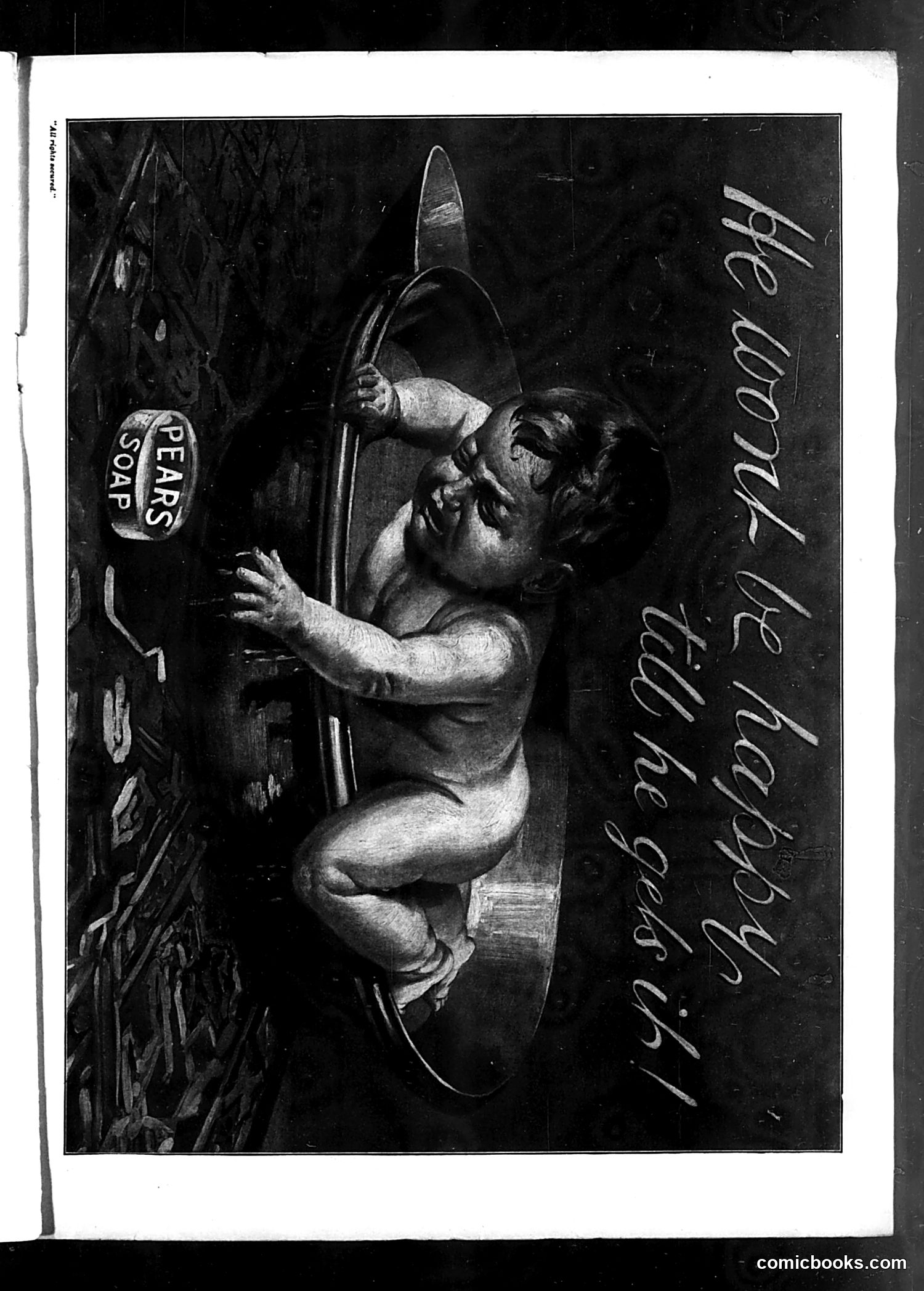
This appears to be an advertisement for **Pears' Soap**, a real historical brand. The image shows a cherubic child figure holding an axe, posed next to a barrel or container labeled "PEARS SOAP." The satirical point likely mocks the brand's advertising claims. During the late 19th/early 20th century, Pears' Soap marketed itself as a civilizing product. By pairing it with a childlike figure wielding an axe—traditionally a symbol of violence or primitive behavior—the cartoonist appears to satirize the gap between the soap's genteel marketing and reality, or perhaps mocks the exaggerated claims about soap's transformative powers. The handwritten text on the right remains unclear in the OCR, preventing full interpretation of the specific critique.
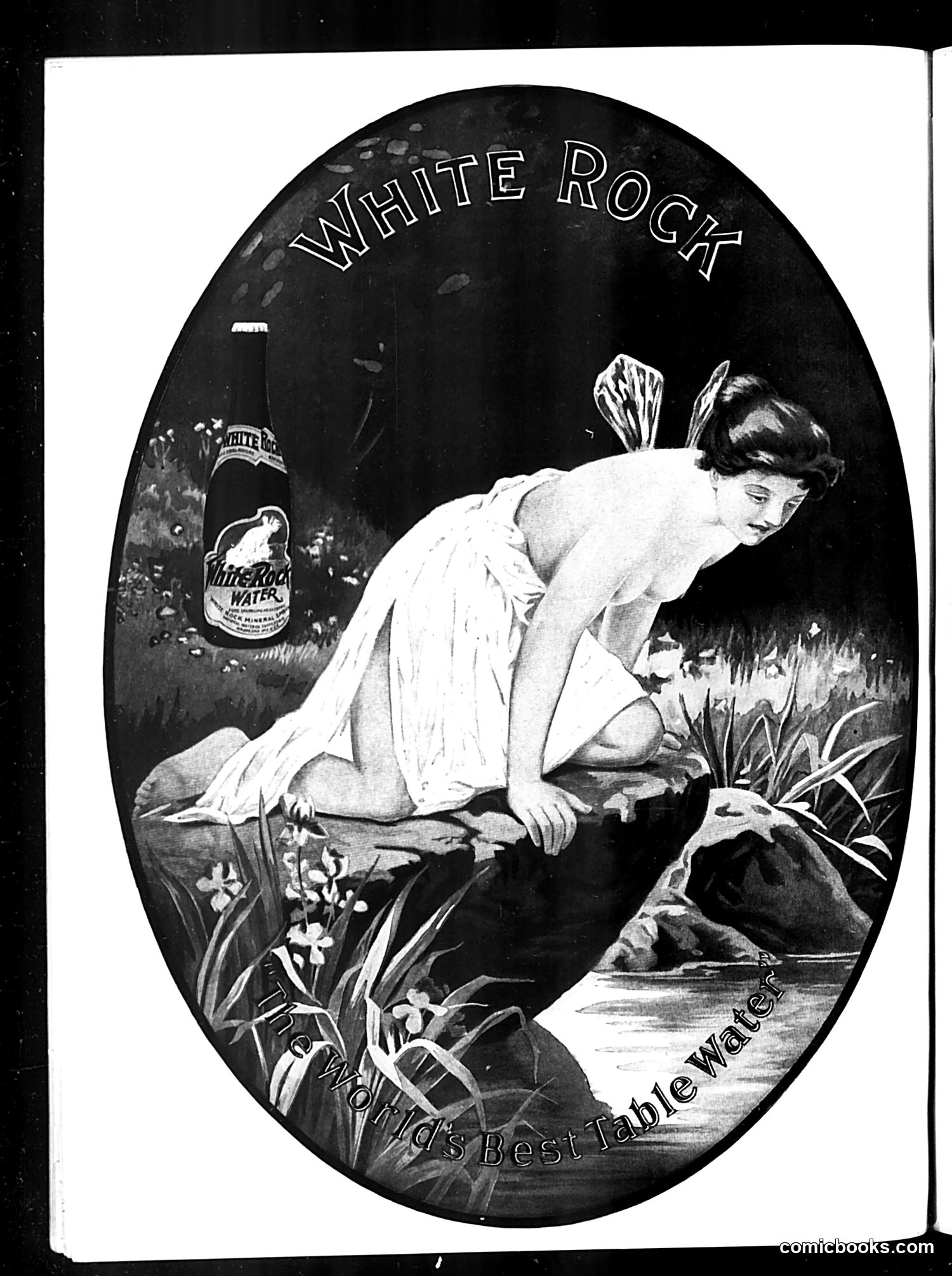
This is a commercial advertisement for White Rock brand mineral water, not political satire. The image shows a young woman in classical dress (appearing nymph-like) leaning toward a stream or spring, with a bottle of White Rock Water displayed prominently in the background. Flowers and natural foliage surround the scene, emphasizing purity and nature. The tagline reads "White Rock's Best Table Water," positioning the product as a refined, healthful beverage. The artistic style and idealized female figure were common in early 20th-century advertising, using classical imagery and beauty to market bottled water as a luxury item associated with natural springs and cleanliness—key selling points for beverages during an era increasingly concerned with water purity and health.