
Judge, 1909-12-04 · page 37 of 48
Judge — December 4, 1909 — page 37: what you’re looking at
What you’re looking at
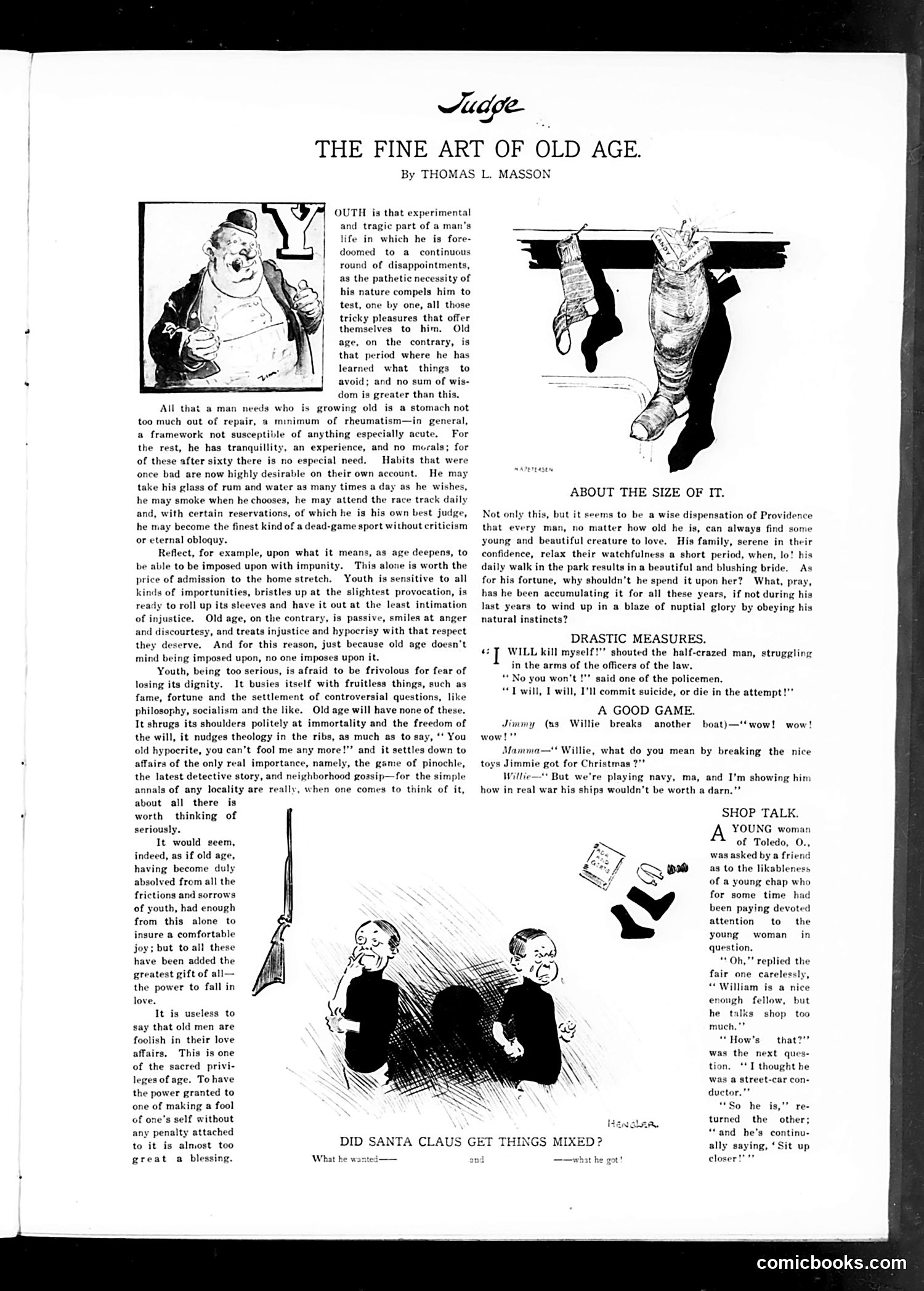
This essay by Thomas L. Masson celebrates aging as liberation from youth's constraints. The article argues old age grants freedom to indulge previously forbidden pleasures—drinking rum, smoking, gambling at racetracks, playing cards—without social judgment or "eternal obloquy." The satire targets Victorian morality's hypocrisy: youth must maintain dignity through restraint, while old age cynically dismisses concerns about "immortality," "socialism," and philosophy as pointless. Masson mockingly suggests aging men gain the "greatest gift"—romancing young women—implying wealthy older men routinely marry young brides, squandering accumulated fortunes. The accompanying cartoons illustrate this theme: one shows stockings hung to dry (domestic comfort); another depicts elderly men getting "things mixed" regarding Christmas gifts, likely satirizing confusion or foolishness. The piece uses biting irony to expose how age paradoxically brings both social permission to abandon respectability and the ability to pursue socially questionable behavior with impunity.
📄 Transcribed text from this page (OCR, searchable)
Machine-transcribed from the original scan — historical spelling and the odd misread are preserved.
uae THE FINE ART OF OLD AGE. By THOMAS L. MASSON OUTH is that experimental and tragic part of a ma life in which he is fore doomed to a continuous round of disappointments, as the pathetic necessity of his nature compels him to test, one by one, all those tricky pleasures that offer themselves to hi Old age, on the contrary, is that period where he has learned what things to avoid; and no sum of wis- dom is greater than this. All that a man needs who is growing old is a stomach not too much out of repair, a minimum of rheumatism—in general, a framework not susceptible of anything especially acute. For the rest, he has tranquillity, an experience, and no morals; for of these after sixty there is no especial need. Habits that w once bad are now highly desirable on their own account. He may take his glass of rum and water as many times a day as he wishes, he may smoke when he chooses, he may attend the race track daily and, with certain reservations, of which he is his own best judge, he may become the finest kind of a dead-game sport without criticism or eternal obloquy. Reflect, for example, upon what it means, as age deepens, to be able to be imposed upon with impunity. This alone is worth the price of admission to the home stretch. Youth itive to all kinds of importunities, bristles up at the slightest provocation, is ready to roll up its sleeves and have it out at the least intimation of injustice. Old age, on the contrary, is pas: smiles at anger and discourtesy, and treats injustice and hypocrisy with that respect they deserve, And for this reason, just because old age doesn’t mind being imposed upon, no one imposes upon it. Youth, being too serious, is afraid to be frivolous for fear of losing its dignity. It busies itself with fruitless things, such as fame, fortune and the settlement of controversial questions, li philosophy, socialism and the like. Old age have none of thes It shrugs its shoulders politely at immortality and the freedom of the will, it nudges theology in the ribs, as much as to say, ‘* You old hypocrite, you can’t fool me any more!’’ and it settles down to affairs of the only real importance, namely, the game of pinochle, the latest detective story, and neighborhood gossip—for the simple annals of any locality are really, when one comes to think of it, about all there is worth thinking of seriously. It would seem, indeed, as if old age, having become duly absolved from all the frictions and sorrows of youth, had enough from this alone to ingure a comfortable (a joy; but to all these ; have been added the greatest gift of all— the power to fall in love. It useless to say that old men are foolish in their love affairs, This is one of the sacred privi- leges of age. To have the power granted to one of making a fool of one’s self without any penalty attached to it is almost too great a blessing. sen: ive, ‘What he wa) DID SANTA CLAUS GET THINGS MIXED? ABOUT THE SIZE OF IT. Not only this, but it to be a wise dispensation of Provide that every man, no matter how old he is, can always find s young and beautiful creature to love. His family, serene in their confidence, relax their watchfulness a short period, when, lo! his daily walk in the park results ina beautiful and blushing bride. As for his fortune, why shouldn’t he spend it upon her? What, pray has he been accumulating it for all these years, if not during his last years to wind up in a blaze of nuptial glory by obeying his natural instincts? DRASTIC MEASURES. 42] WILL kill myself!” shouted the half-erazed man, struggling in the arms of the officers of the law. ** No you won't !"" said one of the policemen. “Twill, I will, I'll commit suicide, or die in the attempt!"" A GOOD GAME. Jimmy (as Willie breaks another boat)—‘ wow! wow! wow!"? Mamna—* Willie, what do you mean by breaking the nice toys Jimmie got for Christmas ?"" Willie—* But we're playing navy, ma, and I’m showing him how in real war his ships wouldn't be worth a darn."” SHOP TALK. YOUNG woman of Toledo, 0. was asked by a frien as to the likableness of a young chap who for some time had been paying devoted attention to the young woman in question. “Oh,” replied the fair one carelessly, “William is a nice enongh fellow, but he talks shop too much.”” “How's that?” was the next ques- tion. ‘I thought he was a street-car con- ductor.” “So he is," re- turned the other; “and he’s continu- ally saying, ‘Sit up got! closer!"’ comicbooks.com