
Judge, 1909-12-04 · page 34 of 48
Judge — December 4, 1909 — page 34: what you’re looking at
What you’re looking at
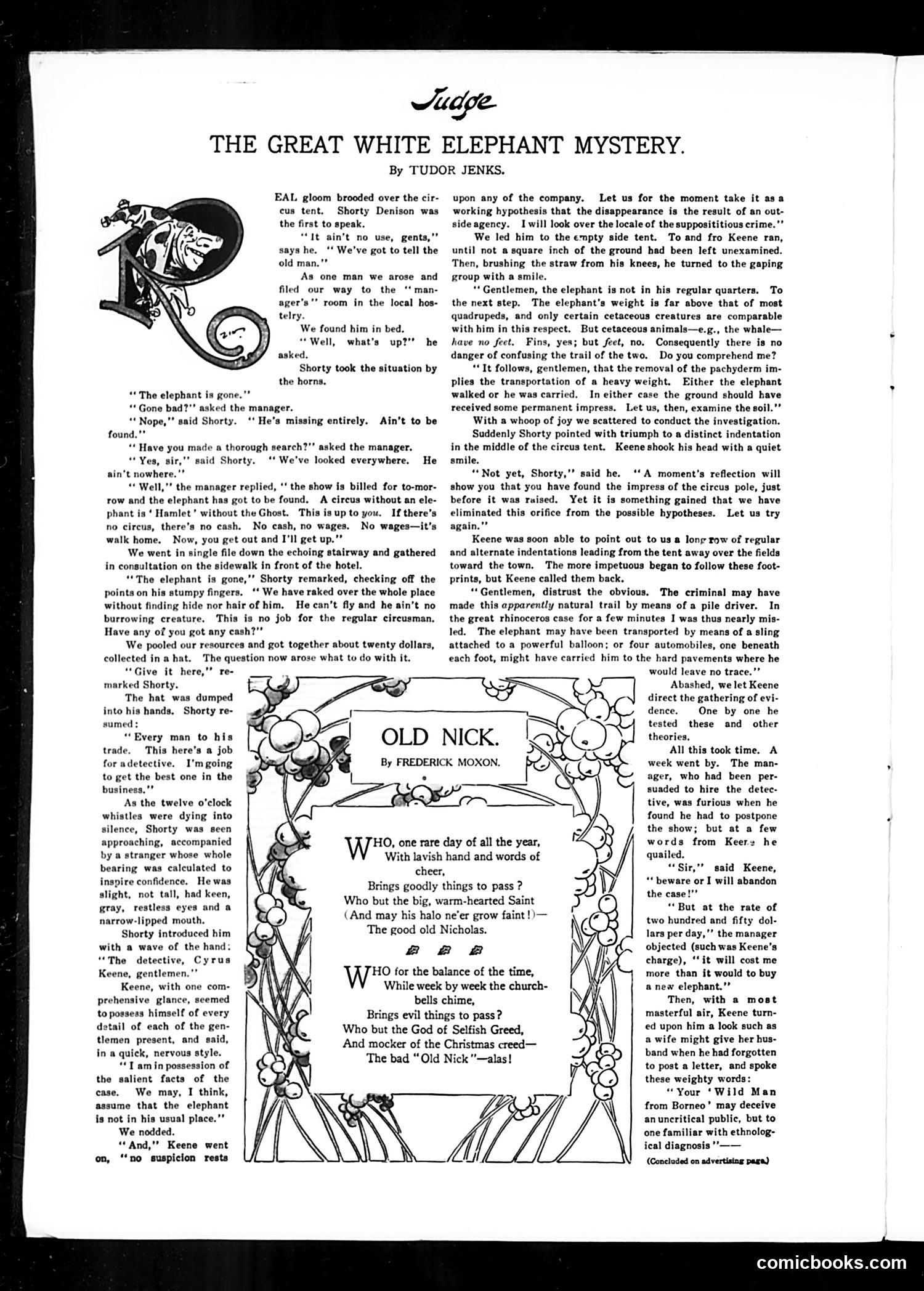
This is a serialized mystery story by Tudor Jenks, not political satire. It concerns a circus elephant's disappearance and the hiring of detective Cyrus Keene to solve it. The narrative parodies Sherlock Holmes-style detective fiction through exaggerated deductive reasoning. Keene lectures on pachyderm transportation logistics and ground impressions with overwrought scientific language ("cetaceous creatures," "pachyderm"). The humor lies in applying grandiose detective methods to a mundane circus problem—treating a missing elephant with the gravity of a major crime. The accompanying poem "Old Nick" by Frederick Moxon praises Saint Nicholas/gift-giving, appearing alongside the mystery story as typical Judge magazine content. The satire targets not politics but detective fiction conventions popular in the era.
📄 Transcribed text from this page (OCR, searchable)
Machine-transcribed from the original scan — historical spelling and the odd misread are preserved.
THE GREAT WHITE ELEPHANT MYSTERY. By TUDOR JENKS. EAL gloom brooded over the cir- cus tent. Shorty Denison was the first to speak, “It ain't no use, gents,”” says he. ‘ We've got to tell the old man."* As one man we arose and our way to the ‘‘man- filed ager’s'’ room in the local hos- telry. We found him in bed. “Well, what's up?’ he asked. Shorty took the situation by the horns. “The elephant is gone." “Gone bad sked the manager. ‘*Nope,"’ said Shorty. ‘‘ He's missing entirely. Ain't to be found.”* “* Have you made a thorough search?” asked the manager. “Yes, sir,’ said Shorty. ‘* We've looked everywhere. He ain't nowhere."’ “ Well,”” the manager replied, ‘‘ the show is billed for to-mor- row and the elephant has got to be found. A circus without an ele- phan ‘Hamlet’ without the Ghost. This isupto you. If there's no circus, there's no cash. No cash, no wages. No wages—it's walk home. Now, you get out and I'll get up. We went in single file down the echoing stairway and gathered in consultation on the sidewalk in front of the hotel. “The elephant is gone,’’ Shorty remarked, checking off the points on his stumpy fingers. ‘* We have raked over the whole place without finding hide nor hair of him. He can’t fly and he ain’t no burrowing creature. This is no job for the regular circusman, Have any of you got any cash?”” We pooled our resources and got together about twenty dollars, collected ina hat. The question now arose what to do with it. “Give it here,’’ re- marked Shorty. The hat was dumped into his hands, Shorty re- sumed: “Every man to his trade. This here's a job for adetective. I'mgoing to get the best one in the business."’ As the twelve o'clock whistles were dying into silence, Shorty was seen approaching, accompanied by a stranger whose whole bearing was calculated to inspire confidence. He was slight, not tall, had keen, gray, restless eyes and a narrow-lipped mouth. Shorty introduced him with a wave of the hand: ‘HO, one rare day of all the year, With lavish hand and words of cheer, Brings goodly things to pass ? Who but the big, warm-hearted Saint (And may his halo ne’er grow faint !)— The good old Nicholas. 2 Bf B upon any of the company. Let us for the moment take it asa working hypothesis that the disappearance is the result of an out- sideagency. I will look over the locale of the supposititious crime."’ We led him to the empty side tent. To and fro Keene ran, until not a square inch of the ground had been left unexamined. Then, brushing the straw from his knees, he turned to the gaping group with a smile. **Gentlemen, the elephant is not in his regular quarters. To the next step. The elephant's weight is far above that of most quadrupeds, and only certain cetaceous creatures are comparable with him in this respect. But cetaceous animals—e.g., the whale— have no feet. Fins, yes; but feet, no. Consequently there is no danger of confusing the trail of the two. Do you comprehend me? “*It follows, gentlemen, that the removal of the pachyderm im- plies the transportation of a heavy weight. Either the elephant walked or he was carried. In either case the ground should have received some permanent impress. Let us, then, examine the soil.” With a whoop of joy we scattered to conduct the investigation. Suddenly Shorty pointed with triumph to a distinct indentation in the middle of the circus tent. Keene shook his head with a quiet smile. “Not yet, Shorty,’’ said he. ‘‘A moment's reflection will show you that you have found the impress of the circus pole, just before it was raised. Yet it is something gained that we have eliminated this orifice from the possible hypotheses. Let us try again. Keene was soon able to point out to us a long row of regular and alternate indentations leading from the tent away over the fields toward the town. The more impetuous began to follow these foot- prints, but Keene called them back. “Gentlemen, distrust the obvious. The criminal may have made this apparently natural trail by means of a pile driver. In the great rhinoceros case for a few minutes I was thus nearly mis- led. The elephant may have been transported by means of a sling attached to a powerful balloon; or four automobiles, one beneath each foot, might have carried him to the hard pavements where he would leave no trace."” Abashed, we let Keene direct the gathering of evi- dence. One by one he tested these and other theories, All this took time. A week went by. The man- ager, who had been per- suaded to hire the detec- tive, was furious when he found he had to postpone the show; but at a few words from Keers he ed. Sir,” said Keene, “* beware or I will abandon the case!"’ “But at the rate of two hundred and fifty dol- lars per day,”’ the manager objected (such was Keene's “The detective, Cyrus charge), ‘‘it will cost me Keene, gentlemen." HO for the balance of the time, more than it would to buy Keene, with one com- While week by week the church- a new elephant.’” prehensive glance, seemed to posseas himself of every detail of each of the gen- tlemen present, and said, in a quick, nervous style. “Tam in possession of the salient facts of the case. We may, I think, assume that the elephant is not in his usual place.”” We nodded. “And,” Keene went “no suspicion rests on, bells chime, Brings evil things to pass? Who but the God of Selfish Greed, And mocker of the Christmas creed— The bad “Old Nick"—alas! Then, with a most masterful air, Keene turn- ed upon him a look such as a wife might give her hus- band when he had forgotten to post a letter, and spoke these weighty words: “Your ‘Wild Man from Borneo’ may deceive anuncritical public, but to one familiar with ethnolog- ical diagnosis ’—— (Concloded on advertising page) comicbooks.com