
Judge, 1909-12-04 · page 33 of 48
Judge — December 4, 1909 — page 33: what you’re looking at
What you’re looking at
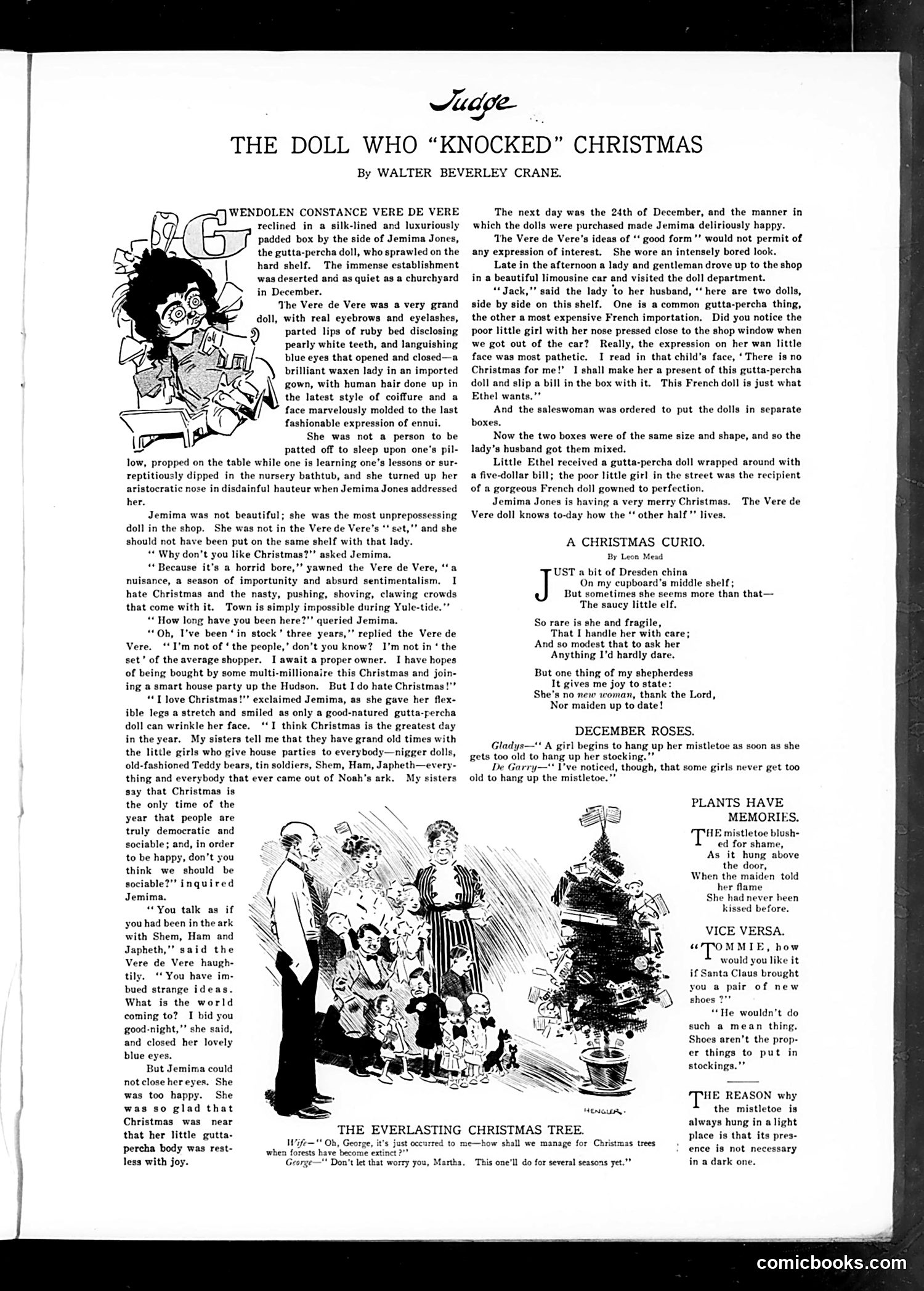
This is a satirical short story with accompanying illustration by Walter Beverley Crane, not a political cartoon. It mocks class snobbery through two contrasting dolls: **The Setup:** "Wendolen Constance Vere de Vere"—a luxury doll with realistic features, imported gown, and affected manners—represents upper-class pretension. "Jemima Jones," a plain gutta-percha doll, embodies working-class warmth and genuine Christmas spirit. **The Satire:** The Vere de Vere disdains Christmas as vulgar and crowded, despises "the people," and awaits purchase by a wealthy Hudson River estate owner. Jemima loves Christmas's democratic spirit and celebrates that common toys (teddy bears, tin soldiers) join in celebration together. **The Irony/Joke:** On Christmas Eve, a wealthy couple purchases *both* dolls—but Jemima's genuine joy contrasts sharply with the snob's forced indifference. The story satirizes how the wealthy pretend superiority while missing Christmas's actual meaning: human connection across class lines. The accompanying poem fragments reinforce themes of modest worth and nostalgic sentiment over material status.
📄 Transcribed text from this page (OCR, searchable)
Machine-transcribed from the original scan — historical spelling and the odd misread are preserved.
THE DOLL WHO “KNOCKED” CHRISTMAS By WALTER BEVERLEY CRANE. WENDOLEN CONSTANCE VERE DE VERE reclined in a silk-lined and luxuriously padded box by the side of Jemima Jones, the gutta-percha doll, who sprawled on the hard shelf. The immense establishment was deserted and as quiet as a churchyard in December. ‘The Vere de Vere was a very grand doll, with real eyebrows and eyelashes, parted lips of ruby bed disclosing pearly white teeth, and languishing blue eyes that opened and closed—a brilliant waxen lady in an imported gown, with human hair done up in the latest style of coiffure and a face marvelously molded to the last fashionable expression of ennui. She was not a person to be — patted off to sleep upon one’s pil- low, propped on the table while one is learning one’s lessons or sur- reptitiously dipped in the nursery bathtub, and she turned up her aristocratic nose in disdainful hauteur when Jemima Jones addressed her. Jemima was not beautiful; she was the most unprepossessing doll in the shop. She was not in the Vere de Vere’s ‘‘ set," and she should not have been put on the same shelf with that lady. “* Why don’t you like Christmas’ ked Jemima. “* Because it's a horrid bore,’’ yawned the Vere de Vere, “a nuisance, a season of importunity and absurd sentimentalism. I hate Christmas and the nasty, pushing, shoving, clawing crowds that come with it. Town is simply impossible during Yule-tide.”” ** How long have you been here?"’ queried Jemima. “Oh, I've been ‘in stock’ three years,’’ replied the Vere de Vere. ‘I'm not of ‘ the people,’ don’t you know? I’m not in ‘ the set’ of the average shopper. I await a proper owner. I have hopes of being bought by some multi-millionaire this Christmas and join- ing a smart house party up the Hudson. But I do hate Christmas!"” “*T love Christmas!"’ exclaimed Jemima, as she gave her flex- ible legs a stretch and smiled as only a good-natured gutta-percha doll can wrinkle her face. ‘‘1I think Christmas is the greatest day in the year. My sisters tell me that they have grand old times with the little girls who give house parties to everybody—nigger dolls, old-fashioned Teddy bears, tin soldiers, Shem, Ham, Japheth—every- thing and everybody that ever came out of Noah's ark. say that Christmas is the only time of the year that people are truly democratic and sociable; and, in order to be happy, don’t you think we should be sociable?” inquired Jemima. “You talk as if you had been in the ark with Shem, Ham and Japheth,"’ said the Vere de Vere haugh- tily. ‘You have im- bued strange ideas. What is the world coming to? I bid you good-night,”” she s: and closed her lovely blue eyes. But Jemima could not close her eyes. She was too happy. She was so glad that Christmas was near that her little gutta- wie one percha body was rest- when forests have become extinct ?” less with joy. George—"* Don’t let that worry you, Martha. THE EVERLASTING , it’s just occurred to me—how shall we manage for Christmas trees The next day was the 24th of December, and the manner in which the dolls were purchased made Jemima deliriously happy. The Vere de Vere’s ideas of ‘‘ good form’? would not permit of any expression of interest. She wore an intensely bored look. Late in the afternoon a lady and gentleman drove up to the shop in a beautiful limousine car and v: d the doll department. “Jack,” said the lady ‘to her husband, ‘‘ here are two dolls, side by side on this shelf. One is a common gutta-percha thing, the other a most expensive French importation. Did you notice the poor little girl with her nose pressed close to the shop window when we got out of the car? Really, the expression on her wan little face was most pathetic. I read in that child's face, ‘There is no Christmas for me!’ I shall make her a present of this gutta-percha doll and slip a bill in the box with it. This French doll is just what Ethel wants." And the saleswoman was ordered to put the dolls in separate boxes. Now the two boxes were of the same size and shape, and so the lady's husband got them mixed. Little Ethel received a gutta-percha doll wrapped around with a five-dollar bill; the poor little girl in the street was the recipient of a gorgeous French doll gowned to perfection. Jemima Jones is having a very merry Christmas. The Vere de Vere doll knows to-day how the ‘‘ other half ’’ lives. A CHRISTMAS CURIO. By Leon Mead UST a bit of Dresden china On my cupboard’s middle shelf; But sometimes she seems more than that— The saucy little elf. So rare is she and fragile, That I handle her with care; And so modest that to ask her Anything I'd hardly dare. But one thing of my shepherdess It gives me joy to state: She’s no new woman, thank the Lord, Nor maiden up to date! DECEMBER ROSES. Gladys—"* A girl begins to hang up her mistletoe as soon as she gets too old to hang up her stocking.’” De Garry—" I've noticed, though, that some girls never get too old to hang up the mistletoe.”” PLANTS HAVE MEMORIES. HE mistletoe blush- ed for shame, As it hung above the door, When the maiden told her flame She had never been kissed before. VICE VERSA. «“TOMMIE, how would you like it if Santa Claus brought you a pair of new shoes ?"° “He wouldn't do such a mean thing. Shoes aren't the prop- er things to put in stockings.”” HE REASON why Honor. the mistletoe is always hung in alight place is that its pres- ence is not necessary in a dark one. CHRISTMAS TREE. ‘This one'll do for several seasons yet." comicbooks.com