
Judge, 1909-12-04 · page 29 of 48
Judge — December 4, 1909 — page 29: what you’re looking at
What you’re looking at
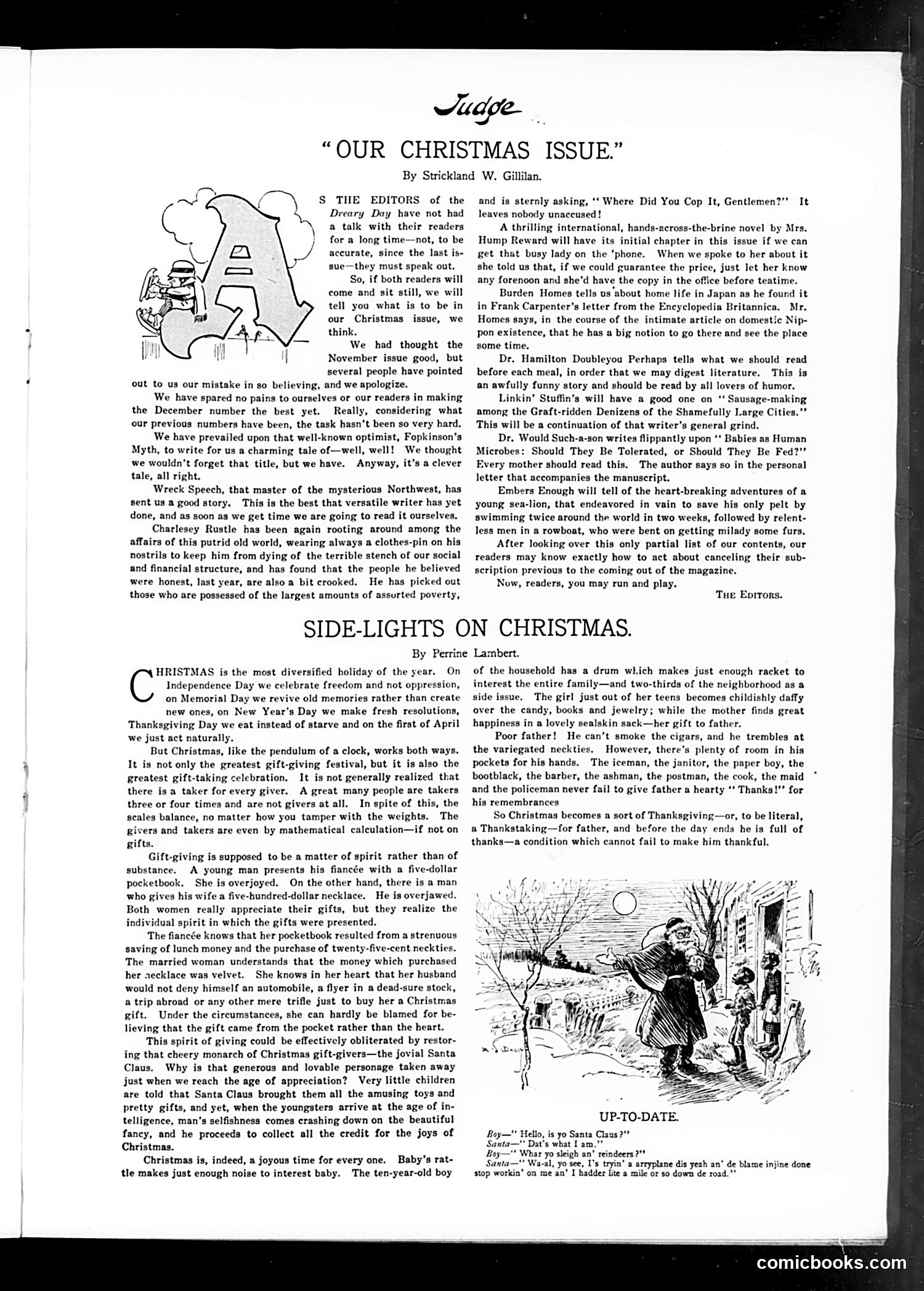
This is the editorial introduction to Judge magazine's Christmas issue, written with heavy satirical irony. The editors mock their own publication by listing upcoming stories with deliberately unflattering descriptions—admitting previous issues were poor, joking that they haven't bothered reading their own contributors' work, and sarcastically describing articles about poverty, corruption, and domestic life in Japan. The satire targets both the magazine itself and contemporary society. References to "Charlesey Rustle" rooting through "affairs of this putrid old world" and exposing poverty suggest criticism of social inequality. The article "Where Did You Cop It, Gentlemen?" appears to investigate wealth sources during an era of industrial corruption. The accompanying illustration shows a snow-covered winter scene with minimal context visible in this image. The second article, "Side-Lights on Christmas," shifts to social commentary about Christmas gift-giving expectations and class dynamics—how wealthy husbands give expensive gifts while wives receive pocket change, satirizing economic inequality within households. Overall, this reflects Judge's satirical mission critiquing Gilded Age American society.
📄 Transcribed text from this page (OCR, searchable)
Machine-transcribed from the original scan — historical spelling and the odd misread are preserved.
“OUR CHRISTMAS ISSUE.” By Strickland W. Gillilan. S THE EDITORS of the Dreary Day have not had a talk with their readers for a long time—not, to be accurate, since the last is- sue—they must speak out. So, if both readers will come and sit still, we will tell you what is to be in our Christmas issue, we think. We had thought the November issue good, but several people have pointed out to us our mistake in so believing, and we apologize. We have spared no pains to ourselves or our readers in making the December number the best yet. Really, considering what our previous numbers have been, the task hasn't been so very hard. We have prevailed upon that well-known optimist, Fopkinson’s Myth, to write for us a charming tale of—well, well! We thought we wouldn't forget that title, but we have. Anyway, it’s a clever tale, all right. Wreck Speech, that master of the mysterious Northwest, has sent us a good story. This is the best that versatile writer has yet done, and as soon as we get time we are going to read it ourselves. Charlesey Rustle has been again rooting around among the affairs of this putrid old world, wearing always a clothes-pin on his nostrils to keep him from dying of the terrible stench of our social and financial structure, and has found that the people he believed were honest, last year, are also a bit crooked. He has picked out those who are possessed of the largest amounts of assurted poverty, and is sternly asking, ‘‘ Where Did You Cop It, Gentlemen?” It leaves nobody unaccused! A thrilling international, hands-across-the-brine novel by Mrs. Hump Reward will have its initial chapter in this issue if we can get that busy lady on the phone. When we spoke to her about it she told us that, if we could guarantee the price, just let her know any forenoon and she'd have the copy in the office before teatime. Burden Homes tells us about home life in Japan as he found it in Frank Carpenter’s letter from the Encyclopedia Britannica. Mr. Homes says, in the course of the intimate article on domestic Nip- pon existence, that he has a big notion to go there and see the place some time. Dr. Hamilton Doubleyou Perhaps tells what we should read before each meal, in order that we may digest literature. This is an awfully funny story and should be read by all lovers of humor. Linkin’ Stuffin’s will have a good one on ‘ Sausage-making. among the Graft-ridden Denizens of the Shamefully Large Cities."” This will be a continuation of that writer’s general grind. Dr. Would Such-a-son writes flippantly upon ‘‘ Babies as Human Microbes: Should They Be Tolerated, or Should They Be Fed?’" Every mother should read this. The author says so in the personal letter that accompanies the manuscript. Embers Enough will tell of the heart-breaking adventures of a young sea-lion, that endeavored in vain to save his only pelt by swimming twice around the world in two weeks, followed by relent- less men in a rowboat, who were bent on getting milady some furs. After looking over this only partial list of our contents, our readers may know exactly how to act about canceling their sub- scription previous to the coming out of the magazine. Now, readers, you may run and play. Tue Epitors. SIDE-LIGHTS ON CHRISTMAS. By Perrine Lambert. HRISTMAS is the most diversified holiday of the year. On C Independence Day we celebrate freedom and not oppression, on Memorial Day we revive old memories rather than create new ones, on New Year's Day we make fresh resolutions, Thanksgiving Day we eat instead of starve and on the first of April we just act naturally. But Christmas, like the pendulum of a clock, works both ways. It is not only the greatest gift-giving festival, but it is also the greatest gift-taking celebration. It is not generally realized that there isa taker for every giver. A great many people are takers three or four times and are not givers at all. In spite of this, the scales balance, no matter how you tamper with the weights. The givers and takers are even by mathematical calculation—if not on gifts. Gift-giving is supposed to be a matter of spirit rather than of substance. A young man presents his fiancée with a five-dollar pocketbook. She is overjoyed. On the other hand, there is a man who gives his wife a five-hundred-dollar necklace. He is overjawed. Both women really appreciate their gifts, but they realize the individual spirit in which the gifts were presented. The fiancée knows that her pocketbook resulted from a strenuous saving of lunch money and the purchase of twenty-five-cent neckties. The married woman understands that the money which purchased her aecklace was velvet. She knows in her heart that her husband would not deny himself an automobile, a flyer in a dead-sure stock, a trip abroad or any other mere trifle just to buy her a Christmas gift. Under the circumstances, she can hardly be blamed for be- lieving that the gift came from the pocket rather than the heart. This spirit of giving could be effectively obliterated by restor- ing that cheery monarch of Christmas gift-givers—the jovial Santa Claus. Why is that generous and lovable personage taken away just when we reach the age of appreciation? Very little children are told that Santa Claus brought them all the amusing toys and pretty gifts, and yet, when the youngsters arrive at the age of in- telligence, man’s selfishness comes crashing down on the beautiful fancy, and he proceeds to collect all the credit for the joys of Christmas. Christmas is, indeed, a joyous time for every one. Baby’s rat- tle makes just enough noise to interest baby. The ten-year-old boy of the household has a drum which makes just enough racket to interest the entire family—and two-thirds of the neighborhood as a side issue. The girl just out of her teens becomes childishly daffy over the candy, books and jewelry; while the mother finds great happiness in a lovely sealskin sack—her gift to father. Poor father! He can’t smoke the cigars, and he trembles at the variegated neckties. However, there’s plenty of room in his pockets for his hands. The iceman, the janitor, the paper boy, the bootblack, the barber, the ashman, the postman, the cook, the maid and the policeman never fail to give father a hearty ‘‘ Thanks!’’ for his remembrances So Christmas becomes a sort of Thanksgiving—or, to be literal, a Thankstaking—for father, and before the day ends he is full of thanks—a condition which cannot fail to make him thankful. “* Dat's what I am."” Vhar yo sleigh an’ reindeers ?”* Santa—' Wa-al, yo see, I's tryin’ a arryplane dis yeah an‘ de blame injine done stop workin’ on me an’ I hadder lite a mile or so down de road.’ comicbooks.com